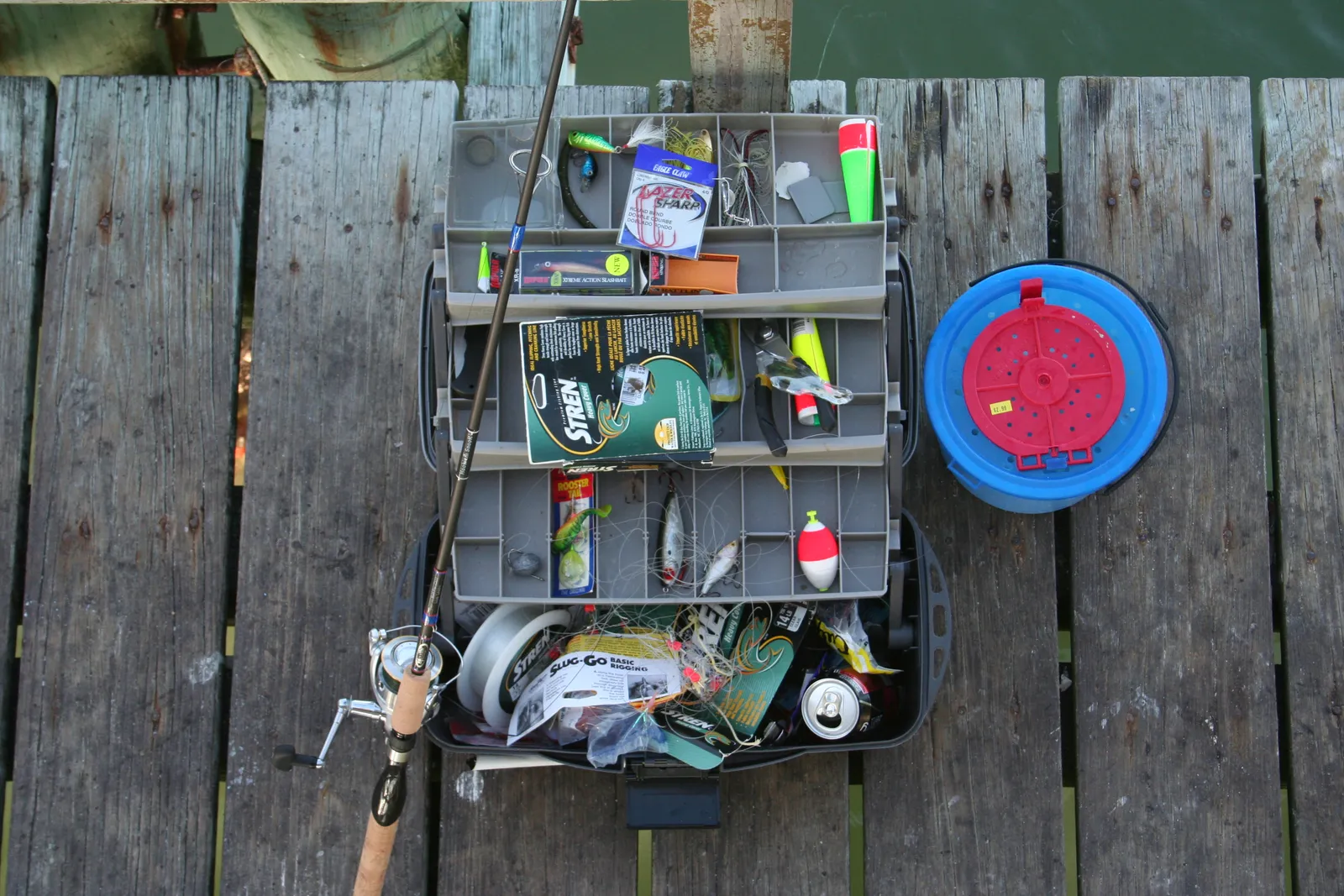
Fishing terms sort into thirteen groups: the tackle, the hooks and weights, the lures and rigs, the ways of fishing them, fly fishing, ice fishing, boats and electronics, the fish, the water, tournaments, the rules, and a thick layer of slang and acronyms on top. All 690 are defined below in plain words, alphabetical inside each group, with the number attached wherever a term has one. Ten of them carry a first day of fishing:
- Tackle: all the gear you fish with, from the rod to the hook.
- Cast: the throw that sends the bait or lure out with the rod.
- Pound test: the pull a line takes before it breaks; 8 lb test covers most first trips for panfish, trout and bass.
- Drag: the brake in the reel that lets a strong fish pull line out instead of snapping it.
- Bail: the wire arm on a spinning reel; open it to cast, close it to reel.
- Bobber: the float that holds a bait at one depth and goes under when a fish takes it.
- Sinker: the weight that takes a bait down and adds casting distance.
- Lure: an artificial bait made to look or move like food.
- Hookset: the sharp lift of the rod that drives the hook home when a fish bites.
- Bag limit: the number of fish of one species the law lets you keep in a day.
The world-record largemouth bass is a tie because of one line in the rule book. A fish under 25 lb has to beat the old record by 2 oz, and the 22 lb 4.97 oz bass Manabu Kurita caught in Japan in 2009 beat George Perry’s 22 lb 4 oz fish from 1932 by less than one.
The full story of both fish is in the world-record largemouth bass. New to all of it? Start with fishing for beginners, then come back for the words.
A to Z index
The terms anglers look up most, by first letter. Each one jumps to the group where it is defined.
- A: action, angler, aught
- B: backlash, bag limit, baitcaster, bobber, braid, bucketmouth
- C: Carolina rig, catch and release, chatterbait, chop, circle hook, co-angler, cover, crankbait, culling
- D: dink, drag, drop shot, dry fly
- E: eater, eddy
- F: finesse fishing, flasher, flipping, fluorocarbon, forward-facing sonar
- G: gator, gear ratio
- H: hatch, hawg, honey hole, hookset
- I: IGFA
- J: jerkbait, jig
- K: keeper, kicker
- L: leader, livewell, lunker
- M: match the hatch, monofilament
- N: Ned rig, noodling, nymph
- O: offshore
- P: panfish, PB, pitching, possession limit, power
- R: riffle
- S: side imaging, skunked, slab, slot limit, snell, spinnerbait, Spot-Lock, structure, swivel
- T: terminal tackle, Texas rig, thermocline, tight lines, tippet, tip-up, trolling
- U: ultralight
- W: wacky rig, walk the dog, walleye chop, weigh-in
- X, Y, Z: X (tippet size), YOY, yo-yoing
What anglers say and what they mean
| What you hear | What it means | Where you hear it |
|---|---|---|
| “Tight lines!” | Good luck; may your line stay tight with a fish on it | Everywhere, as a goodbye |
| “Fish on!” | A fish is hooked; clear the other lines | Boats and piers |
| “Got skunked.” | Caught nothing all day | Everywhere |
| “They’ve got lockjaw.” | The fish are there but will not bite | After a cold front |
| “The bite turned on.” | The fish started feeding | Dawn, dusk, a tide change |
| “It came unbuttoned.” | The fish threw the hook | Mid-fight |
| “Long-distance release.” | The fish got off far from the boat, said with a grin | Rivers and boats |
| “Just a dink.” | A fish too small to matter | Bass and walleye boats |
| “That’s a kicker.” | One big fish that lifts the whole limit | Tournaments |
| “He’s on them.” | He has found the fish and what they want | Weigh-ins |
| “Chunk and wind.” | Cast a moving lure and reel it straight back | Bass fishing |
| “They’re short-striking.” | Fish nip the tail and miss the hook | Topwater and spinnerbaits |
| “New PB!” | A personal best: the angler’s biggest of that species | Photos and social media |
| “Burned the spot.” | Told the world where the fish are | Online |
| “Going to wet a line.” | Going fishing, with no big plan | Everywhere |
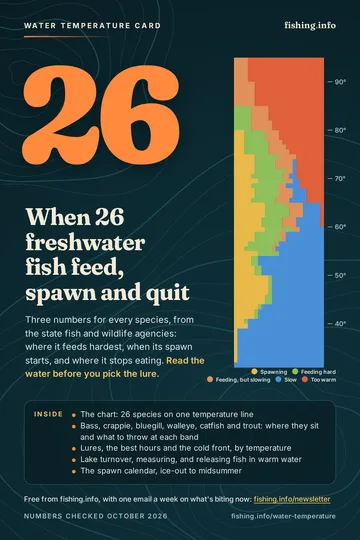
Free card: what 26 species do at your water temperature
Plus one email a week on what's biting now. No sales pitches. Privacy.
Rods, reels and line
A rod carries two ratings that beginners mix up: power is how hard it is to bend, action is where it bends.
- Abrasion resistance: How well a line stands up to rubbing on rock, shell, wood and teeth. Sources disagree whether fluorocarbon or mono is tougher; braid is the weakest of the three on sharp edges.
- Action: Where a rod bends under load. A fast action bends in the top third, a moderate action into the middle, and a slow action through the whole blank.
- Alberto knot: An improved Albright with seven wraps up the leader loop and seven back over them, for braid to a fluorocarbon leader.
- Albright knot: A join made by wrapping the lighter line 10–14 times around a doubled loop of the heavier one; used for mono to wire and fly line to backing.
- Anti-reverse: The mechanism that stops a reel handle from turning backward, so the hookset is solid.
- Arbor: The center of a reel spool. Line is tied to it with an arbor knot; a large arbor picks up more line per turn.
- Backbone: The stiff lower section of a rod that does the lifting once the tip has bent.
- Backing (spinning and baitcast reels): Cheap monofilament wound onto the spool under braid, so the slick braid cannot slip on the bare spool. 20–30 yd of 8–10 lb mono is typical on a 2500.
- Backlash (bird’s nest, professional overrun): The tangle on a baitcaster when the spool spins faster than line leaves it. Brakes, spool tension and a trained thumb prevent it.
- Bail: The wire arm on a spinning reel that guides the line onto the spool. Open it to cast, close it by hand or with a turn of the handle.
- Baitcaster (baitcasting reel): A reel with a revolving spool that sits on top of the rod. It is accurate and strong, and the standard for bass lures over about 1/4 oz.
- Ball bearings: The small steel bearings that make a reel turn smoothly, listed as 5+1 and the like. Quality matters more than the count.
- Barrel (of a knot): The neat coil of wraps a uni, clinch or blood knot tightens into; a barrel whose turns cross is a weak knot.
- Bend (knot): A knot that joins two lines end to end, such as the Albright, surgeon’s or blood knot (not to be confused with the bend of a hook).
- Bimini twist: A long twisted loop that doubles the end of the main line, so the leader knot is tied to two strands instead of one.
- Bite and run (baitfeeder): A reel lever that frees the spool with the bail closed so a fish can swim off with a live bait, then re-engages the drag when flipped back.
- Blank: The bare rod before guides, handle and reel seat are added.
- Blood knot: A line-to-line join in which each line is wrapped around the other and both tags are tucked back through the center; the slimmest join for two lines of similar diameter, standard on tapered fly leaders.
- Braid (braided line, superline): Line woven from synthetic fibers. It is thin for its strength and has almost no stretch; 30 lb braid is about as thick as 8 lb mono.
- Braid-ready spool: A reel spool with rubber strips or nubs on the arbor, so braid grips it without mono backing.
- Brakes: The centrifugal or magnetic system in a baitcaster that slows the spool during the cast to prevent a backlash.
- Butt: The handle end of a rod, and the thick lower section of a fly leader.
- Cane pole: A simple pole with a fixed length of line tied to the tip and no reel. Generations learned to fish for bluegill with one.
- Carrier (strand): One of the braided strands in a braided line; a 4-carrier braid is rougher and cheaper, an 8-carrier is rounder, quieter and casts farther, 12- and 16-carrier lines are the smoothest.
- Casting rod: A rod built for a baitcaster or spincast reel, with small guides on top and a trigger under the reel seat.
- Centerpin: A free-spinning reel with no drag, used with a long rod to drift a float at the exact speed of the current.
- Composite rod: A blank of graphite with fiberglass in it, for the glass bend on a crankbait or a chatterbait with graphite’s weight.
- Conventional reel: The saltwater name for a revolving-spool reel, used for trolling and bottom fishing with heavy line.
- Copolymer: A nylon line made from two or more polymers, with less stretch and memory than plain mono.
- DC brake (Digital Control): Shimano’s baitcaster brake, a microcomputer that reads spool speed about 1,000 times a second and brakes just enough to prevent a backlash.
- Double line: The doubled length of main line, made with a Bimini twist or a spider hitch, that IGFA record rules measure and limit above the leader.
- Double uni knot: Two uni knots, one in each line, pulled together; the easiest line-to-line join; bulkier in the guides than an FG, and how strong it tests depends on the wraps and the lines (5 wraps a side held 55.8% of 15 lb braid in Sport Fishing’s IGFA-machine test, 4 wraps 40.1%).
- Drag: The adjustable brake in a reel that lets a fish take line under pressure. A common setting is a quarter to a third of the line’s breaking strength.
- Duncan loop: Norman Duncan’s 1960s name for the uni knot tied as a sliding loop; what fly anglers still call it.
- Ferrule: The joint where the sections of a multi-piece rod fit together.
- FG knot: A braid-to-leader connection made of 12–15 pairs of leader wraps under and over a tensioned braid, locked with half hitches; slim enough to pass through rod guides, and among the strongest joins in published pull tests.
- Fiberglass: The heavier, slower, tougher rod material. Its soft bend keeps treble hooks pinned, so many crankbait rods are glass.
- Filler spool: The spool new line is sold on. When you put line on a spinning reel, lay it flat so the line comes off counterclockwise, the same way the bail lays it on.
- Fluorocarbon: Line that sinks, resists abrasion and is harder to see under water than mono. It is the usual leader material; how it differs from nylon is in fluorocarbon vs. monofilament.
- Foregrip: The short grip above the reel seat where the forefinger rests; left off on many split-grip rods.
- Free spool: A reel disengaged so line runs off with no resistance, as during a cast or while a fish runs with a bait.
- Fused line: A superline whose fibers are thermally fused rather than braided (Berkley FireLine): stiffer, a little wiry, cheaper, and it holds knots well.
- Gear ratio: Spool turns per turn of the handle, written 7.1:1. Around 5:1 is slow and strong, around 7:1 is all-round, and 8:1 and up is fast.
- Gimbal: A notched butt on offshore rods that seats in the socket of a fighting chair or fighting belt, so the rod cannot twist under a big fish.
- Graphite: The light, stiff, sensitive carbon material most modern rods are made of.
- Grinner knot: The British name for the uni knot.
- GT knot: A name used for more than one braid-to-leader knot: an FG variant from giant trevally fishing, and a different Bimini-based tie that scored 100% in Sport Fishing’s 50 lb braid class.
- Guides: The rings along a rod that carry the line. The one at the very end is the tip-top.
- Hagane: Shimano’s name for cold-forged parts: Hagane gears are pressed into shape rather than cut, and a Hagane body is a rigid metal reel frame that does not flex under load.
- Half hitch: A single turn of the tag end around the line (or around two lines) and back under itself; FG and other leader knots are finished with a chain of them.
- Hi-vis tip (glow tip): A rod tip in white, neon or clear glass, or glow-in-the-dark paint, so a bite shows in a headlamp or against dark water; standard on catfish rods because most catfishing is at night.
- Hollow-core braid: A braid woven as a tube so a leader can be spliced inside it with a needle; an offshore and surf line.
- IM7 (IM6, IM8): Old graphite grade names from a 1980s fiber maker, still used as a rough stiffness scale; a higher number is stiffer and lighter.
- Improved clinch knot (fisherman’s knot): Line passed through the eye, wrapped around itself five times, tucked through the small loop by the eye and then through the big loop; for mono and fluorocarbon, slips on braid.
- Inches per turn (IPT): The length of line a reel takes in with one turn of the handle, a more honest speed figure than gear ratio.
- IPX rating: The water-resistance class on a reel: IPX5 and IPX6 take a hose jet, IPX7 a short dunk, IPX8 longer immersion; what a saltwater reel’s seals are worth.
- Lead-core line: Trolling line with a lead center, colored in 10-yard sections. A rough rule is about 5 ft (1.5 m) of depth per color at 2 mph.
- Leader: A length of different line between the main line and the hook or lure, added for stealth, abrasion resistance or protection from teeth.
- Level wind: The guide on a baitcaster that travels back and forth to lay line evenly on the spool.
- Lever drag: A drag set with a lever on the side of a conventional reel, with preset strike and full positions; standard offshore.
- Line capacity: How much line of a given size a spool holds, printed on the reel as 12/120: 120 yards of 12 lb line.
- Line conditioner: A spray that softens fluorocarbon and mono on the spool so the coils relax and casts go farther.
- Line counter: A trolling reel with a meter that shows how much line is out, so a lure can be run back at the same depth.
- Line memory: A line’s habit of keeping the coils of the spool. Stiff, thick mono and fluorocarbon have the most.
- Line rating: The range of line, in pound test, a rod blank is built for; printed above the grip next to the lure rating. Line heavier than the rating makes the rod the weak link on a snag.
- Line roller: The small wheel on a spinning reel’s bail that the line runs over. A stuck roller twists line.
- Line twist: Twist built into the line by a spinning lure or by reeling against a slipping drag. It shows up as loops and tangles.
- Low-profile reel: A baitcasting reel with a flattened, palm-sized frame that sits low on a casting rod; the standard design for bass fishing.
- LT (Light & Tough): Daiwa’s lighter, more compact spinning-reel body, rotor and spool design, sold as lighter and tougher with more drag; most of its current spinning reels carry it in the name.
- Lure rating: The range of lure weights printed on a rod, such as 1/4–3/4 oz, that the blank is built to cast.
- Magsealed: Daiwa’s magnetic-oil seal on a reel’s shaft and bearings that keeps water and salt out without drag on the rotor.
- Main line: The line on the reel, as opposed to the leader tied to its end.
- Modulus (tonnage): The stiffness of a rod blank’s graphite, sold as 24-ton, 30-ton, 40-ton or a maker’s code; higher is lighter and more sensitive for the same power, and more brittle.
- Monocoque (MQ): Daiwa’s one-piece reel body that the engine plate screws into with no cover screws, leaving room for a larger drive gear and fewer seams for water.
- Monofilament (mono): Single-strand nylon line. It stretches, floats or sinks slowly, knots easily and costs the least.
- Non-slip loop knot (Kreh loop): A loop knot that leaves a lure free to swing; the knot for jerkbaits and plugs on a fluorocarbon leader.
- Noodle rod: A long, very soft rod, about 8½ to 10 ft and up, that lets a big fish such as a steelhead be landed on light line.
- Noose: A loop that closes when you pull the standing line, so it tightens around whatever it encircles. The arbor knot is a noose; a slip knot looks similar but pulls undone.
- One-way clutch (instant anti-reverse): The bearing in a reel that stops the handle turning backward at all, so the hookset starts the moment you reel.
- Overhand knot: The simplest knot, a single loop with the end passed through it. The arbor knot is two of them: one tied around the standing line and one in the tag as a stopper.
- Palomar knot: A hook knot tied by doubling the line through the eye, tying an overhand knot in the doubled line and passing the hook through the loop; strong on mono, fluorocarbon and braid.
- Parabolic: A rod that bends in a smooth curve down into the handle, the slow action that keeps a treble-hooked fish pinned.
- PE rating: The Japanese line-size scale for braid, PE 0.6 to PE 8 and up; it is a diameter, not a pound test, so a PE 1.5 from one maker may test at 16 lb and another at 25 lb.
- Perfection loop: A small fixed loop tied in the end of a leader or tippet that lines up with the line. It is the usual knot for loop-to-loop leader connections (Ashley’s Angler’s Loop, ABoK #1017).
- Pick-up pin: The small pin on a spincast reel’s spinnerhead that pinches the line on the retrieve and drops back when the button is pressed; braid can slip past it.
- Pound test (lb test): The pull, in pounds, at which a line is rated to break: 10 lb test. Many lines break above the label; IGFA-rated lines break at or below it.
- Power: The force it takes to bend a rod: ultralight, light, medium-light, medium, medium-heavy, heavy, extra-heavy. A medium-heavy bass rod typically handles 12–20 lb line.
- PR bobbin knot: A braid-to-leader knot whose wraps are laid on with a bobbin tool; it topped Sport Fishing’s 15 lb braid class at 84.3% on the IGFA’s tester.
- PVDF: Polyvinylidene fluoride, the plastic that fluorocarbon line is made of; dense, water-repellent and close to water’s refractive index.
- Rapala knot: A loop knot recommended by the Rapala brothers for their lures: an overhand knot, three wraps, and a final tuck through the loop. Its tag points up the line, so it catches more grass than the non-slip loop.
- Rear drag: A spinning-reel drag adjusted by a knob at the back of the reel body rather than on the spool, easier to reach during a fight but usually weaker and less smooth than a front drag.
- Reel seat: The fitting on the handle that clamps the reel foot to the rod.
- Refractive index: How much a material bends light; water is 1.33, fluorocarbon 1.42, nylon about 1.5 to 1.6 depending on the source, which is why fluorocarbon shows less in clear water and no line is invisible.
- Rod and reel combo: A rod sold with a matched reel, often already spooled with line.
- Rod bells: A pair of small bells clipped near the rod tip that ring when a fish pulls the tip down; the bank angler’s bite alarm for a rod left in a holder.
- Rod holder: A tube or cradle that holds a rod on a boat, bank or pier while the bait soaks.
- Rotor: The rotating arm on a spinning reel that carries the bail and lays line on the spool.
- San Diego jam knot: A multi-turn knot tied back down the standing line, strong on fluorocarbon and heavy mono; the West Coast tuna knot.
- Sand spike: A PVC or aluminum tube pushed into the beach to hold a surf rod upright, usually 22–50 in (56–127 cm) long.
- Sealed reel: A reel with gaskets or seals on the body, drag and bearings to keep salt and water out; the point of a saltwater reel.
- Shock leader: A heavy leader, several rod lengths long, that takes the strain of casting a heavy sinker in the surf.
- Specific gravity: Density against water (1.00): monofilament about 1.14 sinks slowly, fluorocarbon about 1.78 sinks fast, braid under 1.0 floats.
- Spider hitch: A quick way to double the end of the main line into a loop, faster to tie than a Bimini twist; captains use it to double braid before a leader knot.
- Spincast reel (closed-face reel, push-button reel): A reel with the spool under a cone and a thumb button to cast. It is the classic first reel for kids.
- Spinnerhead: The rotating cap in front of a spincast reel’s spool that carries the pick-up pins and winds the line.
- Spinning reel (open-face reel): A fixed-spool reel that hangs under the rod. It is the easiest reel for casting light lures.
- Spinning rod: A rod for a spinning reel, with the guides underneath and a large first guide to gather the coils of line.
- Split grip: A rod handle with bare blank showing between the reel seat and the butt grip; lighter, and a feel-the-blank fashion.
- Spool tension knob: The cap on the handle side of a baitcaster that sets how freely the spool turns. Set it so the lure falls slowly when the reel is in free spool.
- Spool: The part of the reel that holds the line. To spool a reel is to fill it with line.
- Standing line (standing part): The long end of the line that runs back to the reel, which a knot is tied around and which takes the load.
- Star drag: A star-shaped wheel beside the reel handle that tightens or loosens the drag.
- Stretch: How far a line gives under load before it breaks. Mono stretches 25–30%, fluorocarbon 10–15% and braid almost none. Stretch cushions treble hooks and softens a hookset.
- Stripper guide: The first and largest guide above the reel on a spinning rod, which funnels the coils coming off the spool.
- Surgeon’s knot: Two lines laid side by side and tied together in a double overhand knot (a triple with a third pass); a fast line-to-line join that takes lines of different sizes, bulkier than the blood knot.
- SV / TW (Daiwa casting reels): SV is a shallow spool whose magnetic brake responds to spool speed to stop overruns; TW is the T-Wing System, a wide line guide that flips down when you turn the handle.
- Tackle: All fishing gear together. The word first meant a ship’s rigging and has been used for fishing gear since the late 1300s.
- Tag end (tag): The short free end of the line you tie a knot with and trim afterward; the other end is the standing line.
- Telescopic rod: A rod whose sections slide into each other for travel.
- Thumb bar: The bar on a low-profile baitcaster that you press to put the reel in free spool.
- Tip-top: The guide at the very tip of the rod.
- Top shot: A length of monofilament or fluorocarbon tied on top of braid as the working line, longer than a leader (tens of yards), on trolling and surf reels.
- Travel rod (pack rod): A rod that breaks down into four or more pieces, or telescopes, to fit a suitcase or backpack.
- Trilene knot: Berkley’s “two turn clinch knot”: the line goes through the eye twice before the clinch wraps. It matched the improved clinch’s 96% on 10 lb mono in Field & Stream’s test and is easier to tie well.
- Ultralight: The lightest class of tackle: a soft rod, a small reel and 2–6 lb line for panfish, trout and small lures.
- Uni knot: Tag laid back along the line, formed into a loop and wrapped around both strands, five turns on mono and eight to ten on braid, then slid down to the eye.
- Winding check: The small trim ring where a rod’s grip meets the blank.
Hooks and terminal tackle
Terminal tackle is everything tied to the end of the line: hooks, sinkers, floats, snaps and swivels.
- Aberdeen hook: A long-shank, light-wire bait hook that bends free of a snag and slides out of a panfish; the crappie and bluegill hook.
- Aspirin head: A flat, disc-shaped jighead that offers little water resistance; walleye anglers use it for vertical jigging.
- Aught: The “/0” in hook sizes above size 1: 1/0 is said “one aught.” These hooks get bigger as the number rises, up to 20/0 for sharks.
- Bait clicker (bait alarm): The ratchet on a conventional or spincast reel that lets a fish pull line with a sound and no resistance; set it when a catfish rod sits in a holder.
- Bait-holder hook: A hook with small barbs on the back of the shank that keep a worm from sliding down.
- Baitholder hook: A single hook with small barbs cut into the shank that keep a worm or other soft bait from sliding down; #6 or #8 for a whole nightcrawler.
- Bank sinker: A teardrop-shaped weight with a molded eye, for bottom fishing in current.
- Barb: The small reverse point behind the hook point that keeps the hook from backing out.
- Barbless hook: A hook made without a barb, or with the barb pinched flat. Some trout and salmon waters require it.
- Barrel swivel: The basic swivel: two eyes on a barrel-shaped body that turns.
- Bead: A plastic or glass bead threaded between a sliding sinker and the knot to protect the knot, and to add a click.
- Bell sinker (dipsey sinker): A bell-shaped weight with a swiveling wire eye on top.
- Bend: The curved part of a hook between the shank and the point.
- Bobber (float, cork): A float that holds bait at a set depth and dips or runs when a fish takes. “Cork” is the Southern word.
- Bobber stop: A small knot or rubber stop on the line that sets how deep a slip bobber fishes.
- Bottom bouncer: An L-shaped wire with a weight on the long arm. It ticks along the bottom while a spinner rig trails from the short arm; a walleye staple.
- Bullet weight (worm weight): A cone-shaped sliding sinker, the weight of a Texas rig. Sizes run from 1/16 oz to more than 1 oz.
- Circle hook: A hook whose point turns back toward the shank, so it slides to the corner of the mouth and catches there. You do not jerk to set it; you reel tight. It is required with bait for striped bass on the Atlantic coast.
- Cricket hook: An Aberdeen with an extra-long shank, #6–#8, made to hold a cricket or grasshopper for panfish and stream trout.
- Crimp (sleeve): A small metal tube squeezed with pliers to fasten heavy mono or wire where a knot will not hold.
- Cutting point: A hook point ground with flat edges, like a knife, to slice into hard mouths; holds where a needle point skates.
- Dehooker: A tool with a hooked or pigtail end that backs a hook out of a fish without touching it, used for release.
- Double hook: Two points on one shank, used on the Super Rooster Tail and some frog lures because it snags less than a treble.
- Drop-shot hook: A small, light-wire, straight-eye hook sized 1 to 4 tied Palomar-style above a weight so it stands out from the line.
- Dropper loop: A loop tied in the middle of a line to carry a second hook or fly.
- Egg sinker: An egg-shaped weight with a hole through it that slides on the line, used on Carolina rigs and catfish rigs.
- EWG hook (extra wide gap): A worm hook with a deep, wide bend that leaves room for a thick soft plastic to collapse on the hookset.
- Eye: The loop at the top of a hook where the line is tied. How to tie it is in how to tie a hook.
- Fillet knife: A thin, flexible knife for cutting the meat off a fish’s bones; electric versions do the same job faster on a big catch of panfish or walleye.
- Forged hook: A hook hammered flat through the bend, which stiffens the wire without thickening it; makers list hooks as forged or unforged.
- Gap (gape): The distance between the hook point and the shank. It decides how much the hook can grab.
- Haywire twist: The hand-twisted loop that fastens single-strand wire to a hook, lure or swivel: 3.5 to 5 interlocking twists, then 5 to 7 tight barrel wraps; the only reliable connection for solid wire.
- Hook finish: The plating on a hook: bronze (cheap, rusts out of a lost fish), black nickel or black chrome (fresh water), tin or nickel (salt), red and gold (attractors); stainless does not rust and is banned in circle-hook rules for that reason.
- Hook keeper: The small wire loop above a rod’s grip to hang the hook on between casts.
- Hook size: The number on the packet. From size 1 down, hooks get smaller as the number rises (a 10 is small, a 32 is tiny); from 1/0 up they get bigger. The hook size chart shows every step.
- Inline circle hook (non-offset): A circle hook whose point and barb lie in the same plane as the shank; an offset circle has the point bent to one side, which sets faster but hooks deeper. Every law that requires circle hooks means the inline kind.
- Inline single hook: A single hook with a straight eye in line with the point, hung on a split ring in place of a treble on a crankbait or spoon.
- J-hook: The traditional hook shaped like the letter J, set with a firm sweep of the rod.
- Jig hook: A hook with the eye bent 60 or 90 degrees to the shank so a lead or tungsten head can be molded around it; the hook inside every jig, shaky head and crappie jig.
- Kahle hook: A wide-bend hook halfway between a J-hook and a circle hook, popular with live shiners and minnows.
- Kirbed point: A hook point bent sideways out of line with the shank, named for the London hookmaker Charles Kirby; sold today as an “offset point” on octopus and bait hooks.
- Light-wire hook: A hook of thinner wire that penetrates easily on fluorocarbon or monofilament but can bend open on heavy braid.
- Lip grip (lip gripper): A spring-loaded clamp that holds a fish by the lower jaw for unhooking and photos; hold the fish level with a hand under the belly, never hanging vertically by the jaw.
- Micro-barb: A very small barb, common on fly hooks; barbless rules still require it pinched flat.
- Multiple hook: The regulation word for a hook with more than one point, a double or a treble; rules that limit hook points or require single hooks count it as one hook with several points.
- Nail weight (insert weight): A thin lead or tungsten pin pushed into a soft plastic to make it sink faster or change how it falls; the weight of a Neko rig and of a weighted fluke.
- Needle point: A hook point that is round in cross-section and tapers to a fine tip; penetrates easiest and dulls fastest.
- No-roll sinker: A flat sliding sinker that stays put in river current; a catfish standard.
- O’Shaughnessy bend: A heavy-wire, slightly squared bend from the nineteenth century, still the bend on standard straight-shank worm hooks and saltwater bait hooks.
- Octopus hook: A short-shank hook with an eye bent back, used for live bait, drop shots and snelled rigs.
- Offset hook: A worm hook with a Z-bend below the eye that holds the nose of a soft plastic in place.
- Point: The sharp end of the hook.
- Polarized sunglasses: Sunglasses with a filter that blocks the glare reflected off the water, so you can see fish, weeds and rocks below the surface.
- Popping cork: A float with beads on a wire that clacks when you jerk the rod, calling redfish and speckled trout to the bait below it.
- Pyramid sinker: A pyramid-shaped weight that digs into sand, for surf fishing.
- Round bend: A treble or single hook whose bend is a half circle, for penetration; against it the wide-gap or extra-wide-gap bend that holds.
- Salmon-egg hook: A short-shank single hook, usually #10 to #14 for trout, made to be buried inside a cured salmon egg so no metal shows.
- Screw-lock keeper: A corkscrew of wire on a jighead or weighted hook that twists into the nose of a soft bait and holds it without glue; the shaky-head keeper.
- Shad-dart head: A jighead with a slanted, tapered nose that makes the jig hang and fall horizontally instead of nose-down; the head of the Trout Magnet.
- Shank: The straight part of a hook from the eye to the bend.
- Short shank: A hook with a shank shorter than the standard, used on trebles so the points sit close to the lure body and foul less.
- Short-shank jig: A jighead with a short hook shank, such as Northland’s Fire-Ball, made for tipping with a live or plastic minnow.
- Single-strand wire: Solid stainless leader wire, the thinnest for its strength and the hardest for teeth to cut, but stiff; a kink breaks it well below its rating.
- Sinker (weight): Any weight on the line. Lead is traditional; tungsten, steel and bismuth replace it where lead is restricted.
- Siwash hook: A long-shank single hook with an open eye, used to replace the treble on spoons and spinners.
- Skin-hook: To bury the hook point just under the skin of a soft bait so it is weedless but pulls free on the set.
- Sliding sinker: Another name for a slip sinker; on a trout dough rig it sits 12 to 24 in above the hook so the floating bait rises off the bottom.
- Slinky weight: A length of parachute cord filled with buckshot and melted shut at the ends, clipped to the line as a sinker that slides over rock and wood instead of wedging in it; the drift-fishing weight for catfish and steelhead.
- Slip bobber: A float that slides freely on the line until it meets a bobber stop, so you can fish 20 ft (6 m) deep and still cast.
- Slip sinker: Any sinker with a hole that lets the line slide through, so a fish can run with the bait without feeling the weight.
- Snap: A small wire clip for changing lures without retying.
- Snap swivel: A snap and a swivel in one piece. It is handy for spoons and spinners and too much hardware for most other lures.
- Snell (snelled hook): A hook tied on by wrapping the leader five to eight times around the shank instead of knotting it to the eye, so the pull runs straight down the hook. How to tie it is in snell knot.
- Snell: A knot that wraps the line around the hook shank instead of tying it to the eye. A snelled hook is one sold with a leader already attached.
- Split ring: A tiny double ring, like a key ring, that connects a hook or line tie to a lure.
- Split shot: A small round weight with a slit, pinched onto the line with pliers or fingers.
- Split-ring pliers: Pliers with a hooked tip that opens a split ring so a treble can be changed without bending the ring.
- Stand-up head: A jighead with a flat bottom that lands upright and holds the bait at an angle off the bottom; the shaky-head and Ned-rig shape.
- Stinger hook (trailer hook): An extra hook behind the main one for fish that strike short.
- Stranded wire (1x7, 7x7): Leader wire twisted from several strands, often nylon-coated; supple and easy to crimp, but thicker, and teeth can fray it one strand at a time.
- Stringer: A cord or chain clipped through a fish’s jaw or gill to hold it alive in the water; noodlers keep it on the bank, never tied to the body.
- Superline hook: A maker’s label (Gamakatsu and others) for a hook in heavier wire built for braided line, so it does not bend when a flipping rod drives it home.
- Swivel: A small fitting with two eyes that turn independently, to stop line twist and join main line to leader.
- Terminal tackle: The collective name for hooks, weights, floats, swivels, snaps and beads.
- Three-way swivel: A swivel with three eyes: one for the main line, one for a weight line and one for the hook line.
- Throat (of a hook): The depth from the point down to the bottom of the bend; a deep throat holds a fish, a shallow one hooks faster.
- Treble hook: Three points on one shank, standard on crankbaits, spoons and spinners.
- Tungsten: A metal denser than lead. A tungsten weight is smaller for the same weight and transmits the feel of the bottom better.
- Walking sinker: A boot-shaped slip sinker that slides over rock without wedging; the weight of a Lindy rig.
- Weed guard: A wire or fiber brush in front of a hook point that keeps it from snagging.
- Welded eye (closed eye): A hook eye whose end is sealed shut, so line cannot slip through a gap; needed for a snell.
- Wire leader: A short steel or titanium leader that pike, muskie, bluefish and mackerel cannot bite through.
- Worm hook: A hook built for rigging soft plastics, in offset, EWG and straight-shank shapes. The other families are in types of fishing hooks.
- X ratings (1X, 2X, 3X): How a hook differs from its maker’s standard: 2X strong is wire two sizes heavier, 2X long is a shank two sizes longer, 1X fine is lighter wire.
Lures, baits and rigs
A lure is artificial, bait is natural, and a rig is the way hook, weight and line are put together. The families are sorted in types of fishing lures.
- Alabama rig (umbrella rig, A-rig): A wire frame with several arms that swims a small school of swimbaits at once. It took over bass fishing after Paul Elias won an FLW Tour event on Lake Guntersville with it in October 2011.
- Arkie jig (casting jig): The all-purpose flipping and casting jig with a flat-sided, slightly pointed head that stands up on the bottom and comes through wood; the 3/8 oz black-and-blue in every bass box.
- Artificial: Any lure, as opposed to natural bait. “Artificials only” is also a legal rule on some waters.
- Bait: Natural food on a hook: worms, minnows, cut fish, shrimp, dough. Bass anglers also call any lure a bait.
- Bait bridle: A rubber band or floss loop passed through a live bait’s snout just ahead of the eyes, with the hook riding on the loop, so the point stays clear and the bait lives longer; the way to free-line a big live bunker for stripers.
- Bait keeper: The barb, wire or screw on a jig’s hook shank that holds the soft-plastic trailer in place.
- Balsa bait: A crankbait carved or molded around a balsa-wood body; far more buoyant than plastic, so it floats up fast out of cover but dents and breaks more easily.
- Beaver (trailer): A flat-bodied soft plastic with a broad, flapping tail, used as a jig or Texas-rig trailer; a compact, low-action choice for cool water.
- Blade bait: A thin metal lure with a weighted nose that vibrates hard when lifted; a cold-water lure.
- Blade: The spinning or flashing metal part of a spinner, spinnerbait or blade bait.
- Bucktail: Deer-tail hair tied on a jig or a treble hook. A bucktail jig is a saltwater standard; in muskie fishing a bucktail is a large inline spinner.
- Bunker spoon: A big, wide trolling spoon that wobbles like a menhaden (bunker), pulled on wire line for striped bass.
- Buzzbait: A wire topwater lure with a propeller blade that churns and squeaks across the surface.
- Carolina rig (C-rig): A sliding weight and bead ahead of a swivel, then a leader of 1 to 4 ft to the hook. The weight drags the bottom while the bait floats behind.
- Chatterbait (bladed jig): A jig with a six-sided blade fixed to its nose that knocks against the head and makes the whole lure shake. ChatterBait is Z-Man’s brand name; the generic term is bladed jig.
- Chunk trailer: A short, flat soft plastic with two thick flaps, fished on a jig in cool water, where it moves less than a craw.
- Circuit-board lip: A thin, stiff crankbait lip cut from printed-circuit-board material; thinner than molded plastic, so the bait starts wobbling at once and kicks off cover harder.
- Clacker: A buzzbait blade arm with a hinged metal flap that slaps the blade on every turn, for a louder lure in wind or stained water.
- Clevis: The small U-shaped fitting that hangs a spinner blade on the wire shaft so it can rotate; Mepps and Rooster Tail blades turn on one, a Panther Martin blade spins on the shaft itself.
- Colorado blade: A round spinner blade that thumps hard and lifts the lure; for muddy water and slow retrieves.
- Countdown: Counting seconds while a sinking lure falls, to fish the same depth on every cast.
- Counter-rotating blades: Two buzzbait or spinnerbait blades turning in opposite directions so the lure tracks straight instead of torquing to one side.
- Crankbait: A hard-bodied lure with a plastic lip that makes it dive and wobble when reeled. The length and angle of the lip set the depth.
- Crawler: A topwater plug with a wide cupped lip or metal wings that make it waddle and plop across the surface on a straight retrieve. The Arbogast Jitterbug is the classic.
- Crawler harness (spinner rig): A leader with two or three hooks, beads and a spinner blade, baited with a nightcrawler and trolled or drifted for walleye.
- Creature bait: A soft plastic with flaps, arms and claws that looks like nothing in particular and moves a lot of water.
- Cut bait: Chunks or strips of fish used as bait, the standard for big catfish.
- Damiki rig: A small straight-tail minnow on a jighead with a 90-degree line tie, held still under the boat over fish seen on sonar.
- Deep-diving crankbait: A crankbait with a long lip that reaches 12 to 25 ft (3.5 to 7.5 m) or more.
- Deflection: A crankbait bouncing off a stump, rock or dock post and darting sideways; the moment a bass most often strikes a squarebill.
- Diamond jig: A heavy four-sided chrome metal jig, 2 to 6 oz, dropped and cranked for striped bass, bluefish and cod.
- Dodger: A flat, bent metal blade trolled ahead of a lure on a short leader that swings side to side, flashing to draw fish and giving the lure behind it a darting action.
- Donkey rig (double-fluke rig): Two soft jerkbaits on one line, each on its own leader from a barrel swivel; one swivel slides on the main line and the other is tied to its end, so the baits run at different lengths and two hooked fish cannot pull against each other.
- Dough bait: Scented paste molded on a hook for stocked trout and catfish. PowerBait is the best known.
- Downline: A live-bait rig dropped straight down from a boat: an egg sinker above a swivel, then a short leader to a hook held at the depth the sonar shows the fish. The summer rig for reservoir stripers.
- Drift bobber (Lil’ Corky): A small buoyant bead-shaped float threaded on the leader just above the hook, so it lifts and colors a bait; Yakima Bait’s Lil’ Corky is the best known, and it floats PowerBait off the bottom when the dough alone will not.
- Drop shot: A hook tied 6 to 24 in above a weight at the end of the line, so the bait hovers off the bottom.
- Egg loop: A variant of the snell that holds a cluster of fish eggs or spawn bait against the hook.
- ElaZtech: Z-Man’s stretchy, buoyant soft-plastic material, made without PVC plastisol. It floats, so a Ned rig bait stands up off the bottom, and it outlasts ordinary plastics by dozens of fish; it must be stored apart from plastisol baits.
- Finesse football jig: A smaller football jig with a trimmed skirt, for tough bites, cold water and smallmouth or spotted bass.
- Finesse jig: A small skirted jig, about 1/4–7/16 oz, with a round or ball head, a lighter hook, a thin weedguard and a short-cut skirt. It is dragged over rock for cold-water, smallmouth and spotted bass.
- Fish-finder rig: A surf rig with the sinker on a sliding sleeve above a swivel, so a fish can take line without moving the weight.
- Flipping jig: A skirted bass jig with a heavier, stouter hook and a thicker weedguard, often 3/4–1 oz. It has a pointed head for grass or a rounder Arkie head for wood, and is flipped or pitched into heavy cover.
- Float-and-fly: A tiny hair jig hung 8 to 14 ft under a bobber on a long rod, for winter smallmouth in clear highland lakes.
- Floating minnow (minnow bait): A slim hard lure shaped like a baitfish that floats at rest and dives a few feet on the retrieve; the Rapala Original Floater is the first of the type.
- Florida rig: A Texas rig with a weight that screws into the nose of the soft plastic so it cannot slide.
- Fluke (soft jerkbait): A soft-plastic baitfish shape with a forked tail, twitched just under the surface. Named for the Zoom Fluke.
- Follower: A fish that swims behind a lure to the boat without eating it; the glide-bait and swimbait angler’s signal to change speed, size or color.
- Food lure: A small, slow lure such as a soft plastic on a light jighead, a micro jig or a nymph under a float, fished so a feeding fish eats it; the follow-up to a reaction lure.
- Football jig: A jig with a wide, football-shaped head that rocks over gravel and rock without tipping.
- Free rig: A soft plastic on a bare hook below a free-sliding ring weight. The weight falls first and the bait glides down after it.
- French blade: An oval spinner blade between a Colorado and a willow, a middle ground of flash and thump; the default on most trout spinners.
- Frog: A hollow, weedless topwater lure for mats, pads and scum.
- Glide bait: A big, single-jointed hard swimbait that swings wide left and right on each turn of the handle.
- Green pumpkin: The dark brown-green soft-plastic color, sold plain or with flake by nearly every maker; with watermelon, the most common bass-plastic color family.
- Grub: A short soft-plastic body with a curly tail, usually on a jighead.
- Hackle tail: A collar of rooster hackle feathers tied over the treble of an inline spinner; it pulses behind the blade and gives the Rooster Tail its name and its larger profile.
- Hair jig: A jig dressed with bucktail, marabou or rabbit instead of a rubber skirt.
- Hard bait: Any lure with a hard body: crankbaits, jerkbaits, topwater plugs.
- Hard knock (knocker): A crankbait with one large steel or tungsten ball instead of a bead rattle, which clacks once per wobble; a sound bass on pressured lakes have heard less.
- High-low rig (chicken rig): A saltwater bottom rig with two hooks on dropper loops above a sinker.
- Hollow-body swimbait: A soft swimbait with a hollow belly that collapses on the bite so the hook comes through; rigged on a weighted swimbait hook.
- Indiana blade: A teardrop-shaped blade between a Colorado and a willow in flash and thump.
- Inline spinner: A blade that spins around a straight wire shaft with a weighted body and a hook behind. The Rooster Tail and the Mepps Aglia are the classics.
- Jerkbait: A slim minnow-shaped hard lure worked with jerks of the rod and pauses.
- Jig: A hook with a weighted head molded onto it, dressed with a skirt, hair or a soft plastic. It may be the most widely fished lure there is.
- Jig and pig: A skirted bass jig with a pork-rind or soft-plastic chunk trailer.
- Jighead: The bare weighted hook of a jig, for rigging soft plastics. Common weights run from 1/32 oz to 1 oz.
- Jighead minnow: A small, slender soft-plastic minnow on a light jighead, fished for suspended bass that are watched on forward-facing sonar. The dominant Elite Series bait wherever live sonar is allowed.
- Jointed lure: A hard lure built in two or more hinged sections for a looser swimming action.
- Kentucky rig: A crappie rig with a bell sinker on the end of the line and two minnow hooks on short droppers about 18 in (46 cm) apart above it, tight-lined or slow-trolled over stumps and brush.
- Laminate: A soft plastic poured in two or three colors in one bait, usually a darker back over a lighter belly; Zoom’s triple-laminate worms are the best-known example.
- Lindy rig: A walking sinker, a swivel and a 3 to 6 ft leader to a small hook with a leech, minnow or nightcrawler. It is the classic live-bait rig for walleye.
- Line tie: The eye on a jig head or lure where the line is tied; a line tie in line with the hook shank keeps a swim jig from rolling.
- Line-through (line-thru) swimbait: A swimbait the line runs straight through, so the lure slides up the line when a fish is hooked and the fish cannot use its weight to throw the hook.
- Lip (bill): The plastic or metal plate on the nose of a crankbait or jerkbait that makes it dive.
- Lipless crankbait: A flat-sided, sinking, rattling crankbait with no lip and the line tie on its back. The Rat-L-Trap gave the type its nickname, “trap.”
- Live bait: Any living bait: worms, minnows, leeches, crickets, crayfish, shiners, shrimp.
- Living rubber: Jig-skirt strands of natural rubber, softer and more lifelike in the water than silicone but quicker to perish.
- Lure: Anything artificial with a hook that is made to draw a strike. A rundown by fish is in the best fishing lures.
- Micro jig: A jig of 1/16 oz or less, often 1/64 or 1/32 oz, fished on 2–4 lb line for trout, crappie and panfish; the Trout Magnet is the best-known one.
- Minnowbait: A slim, minnow-shaped hard lure, usually floating, that wobbles or darts on the retrieve; another name for a jerkbait or stickbait, and the lure catfish guides drift below dams on a Carolina rig.
- Mushroom head (mushroom jighead): A jighead with a flat, round, mushroom-shaped head that sits flush against the bait so the whole rig stands up on the bottom; the Ned rig head.
- Ned rig: A 2.5 to 3 in buoyant stick bait on a light mushroom jighead. Named for Kansas outdoor writer Ned Kehde, who made it known.
- Neko rig: A wacky-rigged worm with a nail weight pushed into one end, so it falls nose-first and stands on the bottom.
- Nightcrawler: A large earthworm, the most widely used live bait in fresh water.
- Nose-hook: To hook a soft bait once through the tip of its nose, so it hangs straight and swims free; the standard way to rig a drop-shot bait.
- One-knocker: A lipless crankbait with a single large rattle that thumps instead of buzzing, for fish that have heard too many multi-ball rattles.
- Paddle tail: A soft plastic whose tail ends in a flat boot that kicks side to side on a steady retrieve.
- Plug: The older word for a hard-bodied lure, still common in salt water and for topwaters.
- Popper (chugger): A topwater plug with a cupped face that spits and pops when twitched.
- Power-shot (power shotting): A drop shot scaled up for cover: a casting rod, 15–20 lb fluorocarbon, a 3/0 to 5/0 hook, a 1/2 oz or heavier tungsten weight and a big worm, pitched into grass and wood instead of fished finesse-light.
- Prop bait: A topwater plug with a propeller at one or both ends.
- Punch rig: A heavy tungsten weight of 1 oz or more, pegged above a compact soft plastic on a stout hook, built to break through matted grass.
- R-bend: The bend in a spinnerbait’s wire where the upper and lower arms meet; the line is tied to it.
- Rate of fall (ROF): Huddleston’s sink-rate code: ROF 5 falls about 5 ft in 10 seconds, ROF 12 about 12 ft; a slow fall for shallow fish, a fast one for deep.
- Rate of stall: How fast a swimming lure can be reeled while holding its depth; a craw trailer’s claws add lift, so a swim jig with a craw rides higher than the same jig with a paddle tail at the same reel speed.
- Rated depth (running depth): The maximum depth a maker prints for a crankbait, measured on a stated line and a full-length cast; thicker line, a short cast or a high rod tip run the bait shallower.
- Rattle: A chamber of beads inside a lure, or a glass tube pushed into a soft plastic, that adds sound.
- Reaction lure: A fast, flashy lure such as a spinner, spoon, crankbait or jerkbait that draws a strike from a fish that was not planning to eat; it covers water and finds fish.
- Reaction strike: A bite triggered by speed, flash or a sudden change rather than hunger; what a ripped lipless crankbait or a burned spinnerbait gets.
- Ribbon-tail worm: A plastic worm with a long, thin, curling tail; a summer standard on a Texas rig.
- Sabiki rig: A string of six or so tiny feathered hooks jigged to catch baitfish.
- Safety-pin spinnerbait: The common V-shaped spinnerbait, named for its open-safety-pin shape; the older twin-arm design (Shannon Twin Spinner, patented 1919) has almost disappeared.
- Salt-impregnated: A soft plastic with salt mixed into it, for taste and for weight, so a weightless bait casts farther and sinks.
- Santee Cooper rig: A catfish Carolina rig with a small float on the leader that lifts the bait off the bottom. It is named for the South Carolina lakes; more setups are in catfish rigs.
- Scent: A liquid, gel or built-in flavor meant to make a fish hold a lure longer.
- Senko (stick bait, stick worm): A thick, straight soft-plastic worm that shimmies as it sinks. Gary Yamamoto’s Senko named the type.
- Shaky head: A light jighead with a screw-lock or wire keeper that stands a finesse worm tail-up on the bottom.
- Shiner: A silvery minnow sold as bait. A wild golden shiner is the trophy largemouth bait in Florida.
- Skein: A whole cluster of salmon or trout eggs still held in its membrane, cut into chunks and fished as bait.
- Skipping jig: A skirted jig with a horizontal eye and a scoop-shaped, planing head, built to skip across the surface under docks and limbs.
- Skirt: The collar of silicone or rubber strands on a jig, spinnerbait or buzzbait.
- Slashbait: A jerkbait built to dart hard and wide from side to side on a sharp twitch; the Rapala X-Rap’s category.
- Sliding-sinker rig: An egg or slip sinker that slides on the main line above a bead and swivel, then a 12 to 24 in leader to the hook, so a fish can take line without feeling the weight; the standard rig for floating PowerBait for stocked trout.
- Soft plastic: Any lure molded from soft plastic: worms, craws, grubs, tubes, swimbaits.
- Spawn sac: A small bundle of fish eggs tied in mesh, fished on a hook for steelhead, salmon and trout.
- Spinner: A lure with a blade that turns around a wire shaft. Yes, it is a fishing term three times over: this lure, a spinning-reel angler, and a spent mayfly in fly fishing.
- Spinnerbait: A V-shaped wire lure with one or two blades on the upper arm and a skirted, weighted hook on the lower.
- Spitter: A popper with a shallow cupped face that throws a fine spray and a flicking sound instead of a deep chug; a Pop-R spits with the rod tip held high and chugs with it low.
- Split-tail grub: A small soft-plastic body whose tail is split into two thin legs that flutter on the drift; the body of the Trout Magnet.
- Spoon: A curved piece of metal that wobbles and flashes. Casting, trolling, jigging and weedless spoons are the four families.
- Spreader rig: A wire bottom rig with two arms that each hold a hook above a heavy sinker; the standard Lake Erie perch rig, fished with minnows.
- Spybait: A small sinking minnow with a propeller at each end, reeled slowly and steadily in clear water.
- Squarebill: A shallow crankbait with a square lip that kicks off wood and rock instead of hanging up.
- Stink bait (punch bait, dip bait): A strong-smelling paste for channel catfish, held on a treble hook, a sponge or a ribbed worm.
- Suspending: Said of a lure that neither rises nor sinks when you stop reeling.
- Swim jig: A jig with a pointed head and a light weed guard, reeled steadily through grass with a swimming trailer.
- Swimbait head: A jighead with a narrow, often fish-shaped head and the line tie angled forward to about 130 degrees, so a paddle-tail bait swims level when reeled; it usually carries the strongest keeper.
- Swimbait: A lure shaped like a baitfish that swims on a straight retrieve, soft or hard, from 3 in to more than 10 in.
- Tail spinner: A compact lead body with a small blade on the tail, for casting far and fishing deep.
- Tandem spinnerbait: A spinnerbait with two blades on the upper arm, usually a small Colorado in front of a larger willow.
- Teardrop: A small teardrop-shaped jig, mostly for panfish through the ice.
- Teaser (umbrella rig): A bait with no hook on one arm of an umbrella rig. It fills out the school where a state limits the hooks per line.
- Texas rig (T-rig): A soft plastic on a worm hook with the point buried in the body and a bullet weight ahead of it. It is weedless and the first rig a bass angler should learn.
- Three-way rig (Wolf River rig): A three-way swivel with a short dropper to a sinker and a longer leader to the hook, for holding bait in river current.
- Toad: A soft-plastic frog with paddle feet that buzz on a steady retrieve, fished on a wide-gap hook over grass or as the body of a buzzbait.
- Tokyo rig: A hook on a ring with a stiff wire dropper that carries the weights below the bait.
- Topwater: Any lure fished on the surface.
- Trailer: A soft plastic added to the hook of a jig, spinnerbait or bladed jig for bulk and action.
- Tube head: A long, narrow jighead pushed inside a tube bait with only the eye poking out; it gives the tube a tapered, goby-like shape for smallmouth.
- Tube: A hollow soft-plastic cylinder with a fringe of tentacles, a smallmouth classic.
- Twin-tail grub: A grub with two curly tails instead of one; on a jig in warm water it adds action behind the skirt.
- Underspin: A jighead with a small willow blade on a swivel under the head, dressed with a swimbait.
- Urchin-style bait (Coike): A round soft bait covered in soft spikes, the Hideup Coike and its copies, fished on a jighead or a drop shot for bass that follow a lure and refuse it; it won two Elite Series events in 2026.
- Wacky rig: A stick worm hooked through the middle so both ends flutter as it falls.
- Wake bait: A lure that swims just under the surface and pushes a V-shaped wake.
- Walking bait: A lipless topwater stickbait made to zigzag. The Heddon Zara Spook is the original, hence “spook.”
- Weedless: Rigged or built so the hook point does not catch weeds: buried in plastic or shielded by a weed guard.
- Weighted swimbait hook: A wide-gap hook with a lead or tungsten weight on the shank and a screw-lock keeper, for a soft swimbait rigged weedless.
- Whopper Plopper: River2Sea’s topwater plug with a rotating tail that plops loudly; “plopper” has become the name of the whole type.
- Willow blade: A long, narrow blade that flashes more than it thumps and runs well at speed.
- Wobble head: A jighead joined to its hook by a hinge, so the head sits on the bottom while current swings the soft plastic around.
Techniques
- Back-trolling: Running a tiller boat stern-first into the wind or waves to crawl a live-bait rig along a contour with fine control; a walleye method.
- Bank fishing (shore fishing): Fishing from land rather than a boat.
- Bed fishing: Casting to bass that are guarding a nest in the shallows in spring.
- Bottom bouncing: Trolling or drifting a bottom-bouncer weight so it taps the bottom while a spinner rig follows behind.
- Bottom fishing: Fishing bait on or just above the bottom with a weight, in fresh or salt water.
- Bowfishing: Shooting fish with a barbed arrow tied to a line. In most states it is legal only for nongame fish such as carp, gar and buffalo.
- Bug shake: Nudging a resting popper just enough to make its feathered rear treble quiver, the retrieve for an insect hatch on clear water.
- Bumping: Back-trolling into river current with the bait on the bottom behind the boat, lifting and dropping the rod so the sinker bumps downstream; a big-river catfish method that uses a heavy, fast-tipped rod.
- Burning: Reeling a lure as fast as the reel allows.
- Cast: To throw a bait or lure with the rod. Overhead, sidearm, roll, pitch, flip and skip are all casts.
- Catch and release (C&R): Letting fish go alive. Wet hands, a short fight and little time in the air are the three things that keep them that way.
- Chumming: Putting bait, ground fish or scent in the water to pull fish to you. Some states restrict it in fresh water.
- Countdown method: Letting a sinking lure fall for a fixed count before the retrieve, then changing the count until fish answer.
- Cradle: A long, shallow net sling held between two people or alongside the boat to keep a muskie or a big pike horizontal and in the water while it is unhooked.
- Cranking: Fishing a crankbait; also simply turning the reel handle.
- Dabbling (dapping, dipping): Lowering a bait straight down into a gap in cover with a long rod and a short line.
- Dead-sticking: Leaving a lure completely still, on the bottom or hanging in the water, for many seconds at a time.
- Deadstick (dead-sticking): Leaving a lure or bait completely still on the bottom or under a float, sometimes for a minute at a time; a cold-water retrieve for a Ned rig or a jerkbait, and a second rod left still while ice fishing.
- Dock shooting: Bending a short rod like a slingshot to fire a small jig far under a dock; a crappie method.
- Doodling: Shaking a small worm on a light Texas rig in deep, clear water; a Western finesse method.
- Dragging: Pulling a jig or Carolina rig along the bottom with slow sweeps of the rod instead of hops.
- Drifting: Letting wind or current move the boat, and the baits with it, over fish.
- Fan casting: Casting in a fan pattern, like the hours on a clock, to cover all the water in reach.
- Feathering (thumbing): Slowing the line with a finger or thumb during the cast, to drop a lure softly on target.
- Finesse fishing: Small lures, light line of 6–10 lb and slow, subtle presentations, for clear water and pressured fish.
- Flat-lining: Trolling a lure straight behind the boat with no weight, downrigger or board.
- Flipping: A short-range presentation with a fixed length of line: you swing the lure out like a pendulum while the other hand feeds line by pulling it away from the reel. It puts a jig quietly into cover 10 to 20 ft away.
- Fly fishing: Casting a nearly weightless fly with the weight of the line itself rather than the weight of the lure.
- Gigging: Taking fish or frogs with a multi-pronged spear, usually at night with a light. Flounder and suckers are typical targets where it is legal.
- Gut-hooked (deep-hooked): Hooked in the throat or esophagus rather than the mouth; cut the line instead of digging for the hook. Largemouth hooked this way survived 66% of the time against 98% when hooked in the mouth (Wilde & Pope 2008).
- Hand-lining: Fishing or landing a fish with the line held in the hand rather than on a rod.
- Helicoptering: Letting a spinnerbait fall on a tight line down a ledge or steep bank so the blade spins as it drops. In surf fishing the word means something else: a long leader and its bait spinning around the main line during the cast, which costs distance.
- Hogging: Arkansas’s word for hand fishing (noodling), as written in its fishing code.
- Hookset: Driving the hook into the fish’s mouth: a hard upward snap with a jig, a sideways sweep with a crankbait, and only steady reeling with a circle hook.
- Hopping: Lifting a jig or worm off the bottom with short snaps of the rod and letting it fall back.
- Hunting (a lure): A lure that swims off its line unpredictably, darting left or right on a steady retrieve; the chatterbait’s signature, and a crankbait trait that triggers strikes.
- Jigging: Working a lure up and down with the rod. Vertical jigging is done straight under the boat or through the ice.
- Jug fishing (jugging): Catfishing with baited lines hung from free-floating jugs. Texas, for one, caps a jug line at five hooks and requires a tag.
- Kayak fishing: Fishing from a kayak, usually a wide sit-on-top or pedal-drive model built for it.
- Kneel and reel: Cranking a deep diver while kneeling on the deck with the rod pushed under water up to the reel, so the lower line angle lets the bait run deeper; Paul Elias first used it to win the 1982 Bassmaster Classic.
- Limb line: A baited line tied to a tree limb over the water and left for catfish, checked on a schedule; legal in some states with a tag and a hook limit, illegal in others.
- Lipping: Landing a bass by gripping its lower jaw between thumb and forefinger. Do not do it to fish with teeth.
- Live-lining: Fishing a live baitfish with no float and little or no weight, so it swims freely.
- Long-lining: Trolling small jigs or crankbaits far behind the boat on several rods; a crappie method.
- Noodling (hand fishing, grabbling): Catching catfish by reaching into their nest holes and pulling them out by the jaw. It is legal only in some states.
- Parallel cast: Casting along a bank, riprap wall or dock rather than at it, so the lure stays in the strike zone for the whole retrieve.
- Pattern: The combination of depth, cover, lure and retrieve that is catching fish on a given day, repeatable around the lake.
- Pegging: Fixing a sliding sinker in place with a rubber stop or toothpick so it stays against the bait in thick cover.
- Pier fishing: Fishing from a public pier or jetty. Some states let you fish from a public or licensed pier without a license of your own.
- Pitching: An underhand cast for targets 15 to 40 ft away: the lure swings from the off hand and travels low, landing with little splash.
- Playing a fish (fighting): Tiring a hooked fish with rod pressure and drag before landing it.
- Plunking: Fishing a bait or lure held still on the bottom with a heavy weight, so migrating fish such as steelhead and salmon swim past it.
- Power fishing: Covering water fast with moving lures and heavy line, hunting for active fish.
- Presentation: Everything about how a lure or bait reaches the fish: the cast, depth, speed and action.
- Pulsing: Reeling a swim jig at a steady pace while twitching the rod tip an inch or two every few turns, so the skirt flares and the trailer kicks.
- Pumping: Lifting the rod to gain line and reeling as you lower it; the way to raise a heavy fish.
- Punching: Dropping a heavy punch rig straight through a mat of vegetation to bass underneath.
- Retrieve: The way a lure is brought back: steady, stop-and-go, twitching, burning.
- Ripping: A hard, sharp pull of the rod that tears a lure free of grass or makes a jerkbait dart.
- Run and gun: Hitting many spots quickly and leaving each after a few casts.
- Sight fishing: Casting to a fish you can see, from bedding bass to tailing redfish. Polarized glasses do most of the work.
- Sink and draw: Letting a lure sink, lifting it with the rod, and repeating.
- Skipping: A low sidearm cast that bounces a lure across the surface like a flat stone, to reach under docks and branches.
- Slow rolling: Reeling a spinnerbait or swimbait just fast enough to turn the blades or tail, close to the bottom.
- Snagging: Hooking a fish anywhere but the mouth by jerking a hook through the water. It is illegal for game fish in most states, and legal by season for paddlefish and some salmon runs.
- Snap jigging: Ripping a jig 1 to 3 ft off the bottom and letting it fall on a slack line; a walleye method.
- Spearfishing: Taking fish with a spear, pole spear or speargun, usually while diving.
- Spider rigging: Slow-trolling with many long rods fanned from the bow like spider legs, each with a minnow or jig; a crappie method.
- Spitting: Working a shallow-cupped popper with quick snaps on slack line so it throws a fine spray forward instead of a deep chug.
- Still fishing: Waiting with bait under a float or on the bottom.
- Stroking: Snapping a jig several feet off the bottom with a long upward sweep, then following it down; a ledge-fishing method.
- Strolling: Dragging a lure behind a boat moved slowly by the trolling motor.
- Surf fishing: Fishing from an ocean beach, usually with a 9 to 12 ft (2.7 to 3.7 m) rod.
- Suspended drifting: Drifting with the bait held a set distance off the bottom, by a float on the leader (Santee Cooper rig) or a short dropper, so it rides over snags and in front of suspended catfish.
- Swinging (boat flipping): Lifting a hooked fish out of the water and into the boat with the rod alone.
- Tight-lining: Fishing bait on the bottom with a taut line and no float, feeling for the bite through the rod.
- Trolling: Pulling lures or baits behind a moving boat. Typical speeds run from under 1 mph for walleye to 7 mph and more offshore.
- Trotline: A long main line stretched across the water with many baited hooks on short droppers. States limit the number of hooks and require tags.
- Tuning: Bending a crankbait’s or minnow’s line tie in tiny steps so the lure runs straight; a lure that runs right has its eye bent right.
- Twitching: Short, quick snaps of the rod tip that make a lure dart.
- Wade fishing: Fishing while standing in the water, in waders or wet.
- Waking: Reeling a lure just under the surface so it bulges the water without breaking through.
- Walk the dog: Twitching the rod on a slack line so a topwater stickbait swings left, right, left.
- Yo-yoing: Lifting a lipless crankbait or spoon off the bottom and letting it flutter back, again and again.
Fly fishing
In fly fishing the line is the weight that carries the cast, and the fly weighs almost nothing. The whole outfit is laid out in how to fly fish for trout.
- Attractor: A fly that imitates nothing exactly and draws strikes with color, flash or movement; the Royal Wulff is one.
- Backcast: The part of the cast that unrolls behind the caster.
- Backing: Thin braided line under the fly line that fills the spool and gives a running fish 100 yards or more of extra line.
- Balanced leech: A leech fly tied on a jig hook with a weighted pin so it hangs level under an indicator.
- Beadhead: A nymph or streamer with a metal bead behind the eye for weight and flash.
- Caddis: An aquatic insect whose adult holds its wings like a tent. The Elk Hair Caddis is the standard imitation.
- Chironomid: A non-biting midge whose larvae and pupae are the staple trout food in lakes, fished as a tiny pattern hung under an indicator.
- Clouser Minnow: A streamer with weighted dumbbell eyes that rides hook-up; it has caught most fish that eat minnows, in fresh and salt water.
- Dead drift: A fly traveling at exactly the speed of the current, like a loose insect.
- Double haul: A pull on the line with the free hand during both the backcast and the forward cast, for line speed and distance.
- Double taper (DT): A fly line tapered the same at both ends, so it can be turned around when one end wears.
- Drag (fly fishing): Unnatural movement of a fly caused by the current pulling on the line. Trout refuse a dragging dry fly.
- Drift (insect drift): The nymphs, larvae and other food that the current carries downstream, which stream trout feed on from a lane beside slower water. This is not the same as drifting a boat.
- Dry fly: A fly that floats and imitates an adult insect on the surface.
- Dry-dropper: A buoyant dry fly with a nymph tied 12 to 24 in below it; the dry is also the strike indicator.
- Dubbing: Fur or synthetic fiber twisted onto thread to form the body of a fly.
- Dun: A mayfly that has just hatched into a winged adult and rides the surface while its wings dry.
- Emerger: A fly that imitates an insect in the surface film as it hatches.
- Euro nymphing (tight-line nymphing): Fishing heavy nymphs on a long rod and a thin leader with no indicator, keeping direct contact and reading a colored section of line called a sighter.
- False cast: A cast kept in the air, forward and back, to lengthen line, change direction or dry a fly.
- Floatant: A gel, liquid or powder that keeps a dry fly floating.
- Fly: A hook dressed with feathers, fur, thread or synthetics to imitate food. The patterns by job are in trout flies.
- Fly line: The thick, coated, weighted line that carries the cast. It comes as floating, sinking or sink-tip.
- Fly tying: Making flies by binding materials to a hook held in a vise.
- Hackle: A feather, usually from a rooster’s neck or saddle, wound around the hook so its fibers hold a dry fly up.
- Hatch: The emergence of one kind of aquatic insect as winged adults, often many at once.
- Hemostat: A locking surgical clamp fly anglers carry to unhook fish; it can also tie a surgeon’s knot when fingers are too cold.
- Hopper: A grasshopper, and the big foam or hair dry fly that copies it in late summer.
- Indicator (strike indicator): A small float on the leader that shows the take when nymphing.
- Leader (fly fishing): The clear, tapered line between fly line and fly, most often 7.5 or 9 ft (2.3 or 2.7 m) long.
- Line weight: The number that matches line to rod, from 1 (lightest) to 14 and up. A 5-weight is the all-round trout outfit; an 8-weight is the bass and inshore standard.
- Loop: The U-shape the line makes as it unrolls in the air. A tight loop cuts wind; an open loop is kinder to heavy flies.
- Match the hatch: Choosing a fly by the size, shape and color of the insect the fish are eating. Bass anglers borrowed it for matching lures to baitfish.
- Mayfly: The upright-winged aquatic insect at the heart of dry-fly fishing. It passes through nymph, dun and spinner stages.
- Mend: Lifting and flipping the line upstream or downstream after the cast so the current does not drag the fly.
- Midge: A tiny two-winged insect that hatches all year; often the main trout food in winter and in tailwaters.
- Nail knot: A tube-tied join of several turns that fastens a leader or backing to the end of a fly line; Islamorada guide Jimmie Albright is credited with inventing it.
- Nymph: The underwater stage of an aquatic insect, and the fly that imitates it. Trout take most of their food below the surface.
- Parachute: A dry fly with the hackle wound flat around an upright post, so it sits low and is easy to see.
- Popping bug: A cork, foam or deer-hair surface fly for bass and bluegill.
- Reach cast: A cast finished by reaching the rod upstream, laying the line at an angle for a longer drag-free drift.
- Rise: A fish taking something at the surface, and the ring it leaves.
- Roll cast: A cast with no backcast: the line is drawn back on the water and rolled forward. It is the answer to trees behind you.
- Scud: A small freshwater crustacean, shrimp-like and usually olive or gray, that trout eat all year; the Hare’s Ear passes for one.
- Shooting head: A short, heavy fly line section, rated in grains, joined to thin running line so it can be cast very far.
- Shooting line: Letting loose line slide out through the guides at the end of a cast for distance.
- Sink tip: A floating fly line whose front 5 to 15 ft sinks, for swinging streamers and wet flies.
- Sink-tip: A fly line whose front section sinks while the rest floats, used to get a streamer down in lakes and fast water.
- Sowbug: A small, flat freshwater crustacean that crawls like a pill bug through the weed beds of spring creeks and tailwaters; trout eat it all year.
- Speed blood knot: A quicker variant of the blood knot in which both tags pass through the center in the same direction, so it is not a true blood knot.
- Spey casting: A family of long roll casts made with a two-handed rod of 12 to 15 ft, named for the River Spey in Scotland and used on big steelhead and salmon rivers.
- Spinner (mayfly): The final, clear-winged adult stage of a mayfly. After mating the insects fall dead on the water, an event called a spinner fall.
- Stonefly: A large, flat-bodied aquatic insect of fast, clean rivers. The salmonfly hatch in the West is a stonefly hatch.
- Streamer: A long fly that imitates a baitfish, leech or crayfish and is stripped back or swung.
- Strip set: Setting the hook by pulling the line hard with the line hand while the rod stays low; the hookset for streamers and salt water.
- Strip: To pull line in by hand to move the fly.
- Swing: Letting the current carry a wet fly or streamer in an arc across the river on a tight line.
- Tailing loop: A casting fault in which the top of the loop drops below the bottom and crosses it, tying knots in the leader.
- Tapered leader: A fly leader that runs from a thick butt at the fly line to a fine tippet, so the cast’s energy unrolls all the way to the fly; usually 7.5 to 12 ft.
- Tenkara: A Japanese method that uses a long telescoping rod, a fixed line and no reel.
- Terrestrial: A land insect that falls in the water: ants, beetles, grasshoppers, crickets.
- Tippet: The thin final section of the leader to which the fly is tied, typically 18 to 24 in long and replaced as it is used up.
- Trout set: Lifting the rod to set the hook, as on a trout stream. It is the habit that pulls the fly away from saltwater fish, which need a strip set.
- Vise: The clamp that holds the hook while a fly is tied.
- Waders: Waterproof overalls for standing in the river. Chest waders with separate wading boots are the norm.
- Weight forward (WF): A fly line with its weight in the first 30 ft or so; the easiest to cast and by far the most common.
- Wet fly: A fly fished under the surface, traditionally swung across the current.
- Wind knot: An overhand knot in the leader, made by a tailing loop and not by wind. It can cut the leader’s strength by half.
- Woolly Bugger: A marabou-tailed, hackled streamer that passes for a leech, a minnow or a crayfish; often the first fly a beginner ties on.
- X (tippet size): Tippet diameter. Subtract the X number from 11 for thousandths of an inch: 5X is 0.006 in, 3X is 0.008 in. A bigger X is a thinner tippet.
- Zinger: A retractable cord pinned to a vest that holds nippers or forceps.
Ice fishing
- Auger: The drill that cuts the hole. Hand, gas, propane and battery augers cut holes 6 to 10 in (15 to 25 cm) wide.
- Dead stick (ice fishing): A second rod set in a holder with a live minnow, left alone beside the hole you jig in.
- First ice (early ice): The first weeks of safe ice, known for fish that are still shallow and biting.
- Fish house (shanty, shack, ice house): Any shelter on the ice. What it is called depends on the state: fish house in Minnesota, shanty in Michigan, Wisconsin and New York, shack almost anywhere.
- Flag: The spring-loaded signal on a tip-up. “Flag!” is the shout when one pops.
- Flasher: A sonar unit with a circular dial that shows the bottom, your lure and any fish under the hole as colored bands in real time. Anglers often call any flasher a Vexilar, after the best-known brand.
- Flip-over: A sled-based shelter whose frame and fabric fold over the angler in seconds.
- Hard water: Ice, as opposed to open water or “soft water.”
- Hole hopping: Drilling many holes and fishing each for a few minutes until fish show up.
- Hub shelter: A pop-up ice shelter held open by a hub in each wall, light for its size.
- Ice cleats (creepers): Spiked soles strapped over boots for grip on bare ice.
- Ice picks: Two spiked handles on a cord worn around the neck, for pulling yourself out if you fall through.
- Ice rod: A short rod of 24 to 36 in (60 to 90 cm) for jigging over a hole.
- Ice scoop (skimmer): A slotted ladle for clearing slush and ice chips from the hole.
- Jigging Rap: Rapala’s weighted minnow with a nose hook, a tail hook and a plastic fin that makes it swim in circles when jigged. The name is used for the whole class of swimming jigs.
- Last ice (late ice): The final weeks of the season, when fish move toward spawning areas and the ice is least trustworthy.
- Mark: A fish showing on the flasher. “Marking fish” means they are under you, whether or not they bite.
- Rattle reel: A reel mounted on the wall of a fish house with a bell or rattle that sounds when a fish runs.
- Safe ice: Minnesota’s guideline for new, clear ice is at least 4 in (10 cm) to walk on, 5–7 in (13–18 cm) for a snowmobile and 9–12 in (23–30 cm) for a car. White ice is about half as strong.
- Spearing (darkhouse spearing): Waiting in a dark shelter over a large hole and spearing pike, or sturgeon in Wisconsin’s Lake Winnebago season, as they come to a decoy.
- Spring bobber: A fine wire or spring on the tip of an ice rod that shows bites too light to feel.
- Spud bar (ice chisel): A heavy steel chisel on a long handle, used to test the ice ahead of each step and to open old holes.
- Teardrop (teardrop jig): A tiny teardrop-shaped lead jig, size 10 to 14, tipped with a waxworm, spike or insect larva and jigged gently for bluegill and perch through the ice; the Wisconsin DNR’s standard panfish ice lure.
- Tip-down: A balanced rod holder that lets the rod tip dip toward the hole when a fish takes.
- Tip-up: A frame set over the hole with a spool of line under water and a flag that springs up when a fish takes the bait. States limit how many lines you may set.
- Waxworm (waxie): The larva of the wax moth, a top panfish bait. “Spikes” are fly maggots used the same way.
- Wheelhouse: A fish house built on a trailer frame that lowers flat onto the ice, often with bunks and a heater.
Boats and electronics
- 2D sonar: The traditional sonar view: a cone pointed straight down, with fish drawn as arches.
- 360 imaging: A sonar transducer that rotates to sweep a full circle around the boat.
- Aerator: The pump that brings fresh water or air into a livewell or bait bucket.
- Arch: The curved mark a fish makes on 2D sonar as it passes through the cone.
- Bass boat: A low, fast boat with casting decks at bow and stern, a trolling motor on the bow and a large outboard, usually 17 to 21 ft long.
- Bathymetric map: A depth map of a body of water, drawn as contour lines; castable sonars and GPS fish finders build one from the soundings they log.
- Bay boat: A center-console boat with low sides for shallow coastal water.
- Big motor: The main outboard, as opposed to the trolling motor.
- Bilge: The lowest inside part of the hull, where water collects until the bilge pump throws it out.
- Black box (sonar module): The separate processor box that older live-sonar systems such as Garmin’s LiveScope Plus (GLS 10) need between transducer and display; LiveScope 2 and MEGA Live 2 do without one.
- Bow: The front of the boat.
- Bump board: A measuring board with an upright end plate that the fish’s nose is pushed against.
- Castable sonar: A floating sonar ball tied to the line, cast out and reeled back, that streams depth, bottom and fish to a phone app over its own Wi-Fi; the bank angler’s fish finder (Deeper, Garmin Striker Cast).
- Center console: A boat with the wheel on a console in the middle, leaving room to fish all the way around it.
- Chartplotter: A GPS screen that shows the boat on a map, usually combined with sonar in one unit.
- CHIRP: Sonar that sweeps a range of frequencies in each pulse instead of one, for sharper separation between fish and bottom. It stands for compressed high-intensity radiated pulse.
- ClearVü / SideVü: Garmin’s names for down imaging and side imaging; cv in a Garmin model number means CHIRP plus ClearVü, sv adds SideVü.
- Contour lines: The lines on a lake map that join points of equal depth. Lines close together mean a steep drop.
- Control head only (CHO): A fish finder sold without a transducer; the “MSI+” or “CMSI+” versions of the same unit include one.
- Deep-V: A hull with a sharp V shape that cuts through waves; the walleye and big-water boat.
- Down imaging: High-frequency sonar that draws a picture-like view of what is straight under the boat.
- Downrigger: A winch with a cable and a heavy weight, the cannonball, that carries a trolled line to an exact depth. The line pops free of a release clip when a fish hits.
- Drift boat: A rowed river boat with a flat, upswept bottom, built for floating trout and steelhead rivers.
- Drift sock: An underwater parachute tied to the boat to slow a wind drift.
- Electronics: The collective word for a boat’s sonar, GPS and live-sonar screens.
- Fish finder (depth finder, graph): A sonar unit that shows depth, bottom and fish on a screen. What the screen is telling you is in how to read a fish finder.
- FishReveal: Lowrance’s overlay that draws the CHIRP fish targets on top of the DownScan picture, so fish show as arches on the image of the structure instead of specks in a blank column; on every current Lowrance except the Eagle 4x, which has no DownScan.
- Float tube (belly boat): An inflatable seat in which the angler sits half in the water and kicks with fins.
- Flush mount: A rod holder tube set into a hole cut through the gunwale, at a fixed 0°, 15° or 30° angle; the strongest boat holder.
- Forward-facing sonar (FFS, live sonar): Sonar that shows fish, and your lure, moving in real time ahead of the boat. Garmin’s LiveScope started it in 2018; Lowrance ActiveTarget and Humminbird MEGA Live followed.
- Gear track: The slotted rail on a fishing kayak or boat that rod holders, fish-finder mounts and other accessories slide onto and bolt to.
- GPS: Satellite positioning. On a boat it marks waypoints, draws trails and drives the anchor function of a trolling motor.
- Gunwale (gunnel): The top edge of the boat’s side.
- Hole shot: How quickly a boat climbs from a standstill onto plane.
- In-hull (shoot-through) transducer: A transducer fixed inside the hull that reads through the plastic or fiberglass; it suits 2D sonar and needs no hole.
- Jack plate: A bracket that raises and lowers the outboard on the transom for speed and for running shallow.
- Jon boat: A flat-bottomed aluminum boat with a square bow, usually 10 to 18 ft long; cheap, stable and at home on small water.
- Kicker motor: A small second outboard used for trolling.
- Kill switch: A lanyard or wireless fob that stops the engine if the driver leaves the seat. Federal law requires its use on most boats under 26 ft when on plane.
- LakeMaster: Humminbird’s lake-map cards and built-in charts with 1 ft contours; CoastMaster is the saltwater version. Included on XPLORE and APEX since 2025.
- LiFePO4 battery: A lithium iron phosphate battery, the light 12 V battery kayak anglers use to run a fish finder.
- Livewell: A tank in the boat with circulating water that keeps the catch alive. A baitwell does the same for bait.
- MEGA imaging: Humminbird’s side and down imaging at 1.2 MHz; fine detail to about 125 ft (38 m) a side, 200 ft (60 m) on MEGA+, then the unit drops back to 455 kHz.
- On plane: Riding on top of the water at speed instead of plowing through it.
- One-Boat Network: The Johnson Outdoors link between a Humminbird display, a Minn Kota trolling motor or anchor and a Cannon downrigger, so one screen controls them.
- Outboard: An engine that mounts on the transom, with motor, gearbox and propeller in one unit.
- Outrigger: A long pole that swings out from the side of an offshore boat to spread trolling lines.
- Pedal drive: A fishing-kayak drive worked with the feet, which leaves the hands free for the rod.
- Perspective mode (Landscape, Scout): A live-sonar view with the beam laid flat, giving an overhead picture of the water ahead for finding bait and schools; Garmin calls it Perspective, Humminbird Landscape, Lowrance Scout.
- Planer board: A small board that pulls a trolled line out to the side of the boat, so lures run wide of the wake.
- Port and starboard: The left and right sides of a boat when facing the bow.
- Push pole: A long pole for moving a skiff silently across shallow flats.
- Quickdraw Contours: Garmin’s feature that draws a 1 ft contour map of a lake from the boat’s own soundings as you drive over it; the only map a Striker Plus or Striker Cast GPS ever shows.
- Ramp (boat launch): The sloped slab where trailers back boats into the water.
- Rocket launcher: A frame of rod-holder tubes on a T-top, hardtop or transom that holds several rods upright for trolling or drifting a spread.
- Rod locker: A long compartment in the deck that stores rods flat.
- Scupper hole: A drain hole molded through a sit-on-top kayak’s hull; on many fishing kayaks one is sized to take a transducer mount.
- Shallow-water anchor: A powered pole on the transom that drops into the bottom and pins the boat in water up to about 8 or 10 ft. Power-Pole and Minn Kota Talon are the two names you hear.
- Side imaging: Sonar that scans thin slices out to both sides of the boat and draws the bottom like an aerial photo. Hard objects cast sonar shadows.
- Skiff: A light, shallow-draft open boat for flats and backwaters.
- Sonar: Sound pulses sent into the water and timed as they echo back; the principle behind every fish finder.
- Spot-Lock: Minn Kota’s name for a GPS anchor: the trolling motor holds the boat on one spot without a rope. Anglers use the word for any brand’s version.
- Stern: The back of the boat.
- Thru-hull transducer: A transducer mounted through a hole cut in the hull below the waterline; the mount for inboards, sailboats and stepped hulls, where a transom mount will not work.
- Tiller: A handle on the motor itself for steering, in place of a wheel.
- Transducer: The part of a sonar that sends and receives the sound, mounted on the transom, in the hull or on the trolling motor.
- Transom: The flat back wall of the boat, where the outboard hangs.
- Trim: The angle of the outboard, and so of the bow. Trimming up lifts the bow at speed.
- Trolling motor: A quiet electric motor, usually on the bow, for moving along a bank while casting. Thrust is rated in pounds and power in volts: 12, 24 or 36.
- Waypoint: A spot saved on the GPS.
The fish and their bodies
- Active, neutral and negative fish: Shorthand for mood. Active fish chase, neutral fish take an easy meal put in front of them, and negative fish ignore nearly everything.
- Adipose fin: The small fleshy fin without rays between the dorsal fin and the tail on trout, salmon, whitefish and catfish. Hatcheries clip it to mark stocked salmon and steelhead.
- Anadromous: Born in fresh water, grown at sea, back to fresh water to spawn: salmon, steelhead, shad and striped bass.
- Anal fin: The single fin on the underside between the vent and the tail.
- Backcross: A hybrid breeding back with one of its parent species, as hybrid striped bass do with stripers in the Savannah River.
- Baitfish: Small fish that bigger fish eat: shad, shiners, alewives, herring, minnows.
- Barbels: The whiskers of a catfish, carp or sturgeon: organs of taste and touch that cannot sting. The sharp parts of a catfish are the fin spines, as shown in how to hold a catfish.
- Bedding: Guarding a nest. Bass and sunfish fan a round bed on the bottom and the male stays to defend it.
- Black bass: The genus Micropterus: largemouth, smallmouth, spotted and their relatives. They are sunfish, not true bass.
- Blueback herring: A small herring stocked or spread into southern reservoirs such as Lake Hartwell; its spring spawn on points draws schooling spotted bass.
- Bream (brim): The Southern name for bluegill and other sunfish, said “brim.”
- Brood stock: Adult fish kept in a hatchery to produce eggs and milt.
- Buck: A male fish, most often said of bass, trout and salmon.
- Cardiform teeth: The pads of tiny, close-set teeth on a catfish’s jaws that rasp skin like sandpaper; the reason noodlers wear gloves.
- Catadromous: The reverse of anadromous: living in fresh water and spawning at sea, like the American eel.
- Caudal fin: The tail fin.
- Caudal peduncle: The narrow wrist of the body just in front of the tail; thin on an Atlantic salmon, thick on a brown trout.
- Cavity nester: A fish that spawns inside a hole (a hollow log, an undercut bank, a culvert) and guards it; all three big catfish do, which is what makes noodling possible.
- Char: The group of trout relatives with light spots on a dark body: brook trout, lake trout, bull trout, Dolly Varden and Arctic char.
- Coldwater, coolwater and warmwater fish: The three temperature groups managers use: trout and salmon; walleye, pike, perch and smallmouth; largemouth, sunfish and catfish.
- Dorsal fin: The fin on the back. Perch, walleye and bass have a spiny part and a soft part.
- Ear flap (opercular flap): The dark tab at the rear of a sunfish’s gill cover. Its edge tells the sunfish apart: black to the edge on a bluegill, red or orange on a pale border on a redear, a red-orange half-moon on a pumpkinseed, trimmed in white on a longear.
- Esox: The pike genus: northern pike, muskellunge and the pickerels. Their place in fishing is covered under pike.
- Fingerling: A young fish about as long as a finger, the size many hatcheries stock.
- Florida bass: Micropterus salmoides, the fast-growing southern bass once called the Florida-strain largemouth; since 2024 the IGFA treats it separately from largemouth (M. nigricans) for all-tackle records.
- Forage: Whatever a predator fish eats in a given water: shad, perch, crayfish, insects.
- Fry: Fish in the first weeks after hatching.
- Fry ball: The tight cloud of newly hatched bass that hovers over the nest for several days while the male guards it; a popper pulled over it draws him up.
- Game fish (gamefish): A species the state manages for sport, with seasons and limits. Texas law lists its game fish by name; most states do.
- Gill plate (operculum): The bony flap that covers the gills. On a walleye or snook its edge is sharp enough to cut a hand.
- Gill rakers: Comb-like projections on the gill arches that strain food. Counting them separates some look-alike species.
- Gills: The red, feathery organs that take oxygen from the water. Never put fingers in the gills of a fish you plan to release.
- Grilse: An Atlantic salmon that returns to its river after one winter at sea.
- Hen: A female trout, salmon or steelhead.
- Holdover: A stocked trout that has survived at least one season in the water and grown wilder. On the Atlantic coast, also a striped bass that stays in a northern river or bay through the winter instead of joining the striper migration south.
- Hybrid: A cross of two species, such as the tiger trout, the splake, the tiger muskie, the saugeye and the wiper.
- Iteroparous: Able to spawn more than once in a lifetime, like a steelhead, a brown trout or an Atlantic salmon; the opposite of the Pacific salmon, which spawn once and die.
- Jack: A male salmon that returns to spawn a year or more early and is much smaller than the adults.
- Kelt: A steelhead or Atlantic salmon that has spawned and is heading back to sea, thin and dark.
- Kokanee: A sockeye salmon that never goes to sea and lives its life in a lake or reservoir; like sea-run sockeye, it dies after spawning.
- Kype: The hooked lower jaw that male trout and salmon grow before spawning.
- Landlocked salmon: An Atlantic salmon that lives its whole life in fresh water and uses a lake as its ocean, as in more than 300 Maine lakes.
- Lateral line: The row of sensory pores along each side of a fish that feels vibration and pressure. It is how a bass finds a spinnerbait in muddy water.
- Maxillary: The upper jawbone. On a largemouth bass it reaches past the back of the eye; on a smallmouth it stops below the eye.
- Milt: The sperm of a male fish, released over the eggs.
- Mouthbrooder: A fish that carries its eggs, and sometimes its young, in its mouth until they hatch; in the sea catfish it is the male, and he does not eat while he broods.
- Native: Living where the species evolved, as opposed to stocked or introduced. A brook trout is native in Appalachia and introduced in the Rockies.
- Nongame fish: Species without game-fish status, such as suckers, carp and gar. Rules for taking them are usually looser.
- Omnivore: A fish that eats both plants and animals, alive or dead. The channel catfish is the textbook case, which is why liver, worms and stink bait all catch it.
- Otolith: The ear stone of a fish. Biologists count its rings, like those of a tree, to age the fish.
- Panfish: Small fish that fit in a frying pan: bluegill, crappie, perch and the other sunfish.
- Parr marks: Dark oval bars along the sides of young trout and salmon.
- Pectoral fins: The paired fins just behind the gill covers.
- Pelvic fins: The paired fins on the belly.
- Pin bones (intermuscular bones): The thin, free-floating bones that sit in the flesh between the muscle segments of fish such as carp, salmon, herring and pike; they are not attached to the backbone and are pulled or cut from a fillet. Bass, walleye and crappie have none to speak of.
- Piscivore: A fish that eats other fish. The flathead catfish becomes one at about 10 in, and from then on it eats almost nothing but live fish.
- Post-spawn: The weeks after spawning, when fish are thin and recovering and then feed hard.
- Pre-spawn: The weeks before spawning, when fish move toward the shallows and feed heavily. It is the season for the heaviest bass of the year.
- Redd: The nest of a trout or salmon: a patch of clean gravel dug by the female. Do not wade on them.
- Reflex impairment (RAMP): A quick field score of a fish’s reflexes (righting itself, reacting to a touch) that researchers use to tell whether a released fish has recovered; a trout that cannot stay upright has not.
- Relative weight (Wr): A fish’s weight as a percentage of the standard weight for its length. Under 80 is severely thin; a heavy pre-spawn bass can run 110 or more.
- Roe: Fish eggs. A cluster cured for bait is a spawn sack or egg sack.
- Rough fish: An old, loose label for fish not counted as game or food fish. Several states have dropped it for native species such as gar, bowfin and buffalo.
- Salmonid: A member of the salmon family: salmon, trout, char, whitefish and grayling.
- Saugeye: A cross of walleye and sauger, stocked in rivers and reservoirs.
- School: A group of fish swimming together. Schooling fish chase bait as a pack, often at the surface.
- Sculpin: A small, big-headed bottom fish of cold streams and a staple food of large trout; the Muddler Minnow imitates it.
- Slime coat: The mucus on a fish’s skin that keeps out infection. Wet hands and rubber nets leave it on.
- Smolt: A young salmon or steelhead that has turned silver and is ready to go to sea.
- Sow: A big female bass.
- Spawn: To reproduce, and the season when it happens. Largemouth start when the water reaches roughly 60°F (16°C), as described in the bass spawn.
- Spawning wave: One group of bass moving up to nest on the same warming trend; a lake spawns in several waves over four to six weeks, not all at once.
- Staging: Holding on the last deep water near a spawning area, waiting for the right temperature.
- Standard weight (Ws): What a healthy, fast-growing fish of a given length should weigh, from a species equation (for largemouth, Henson 1991).
- Stocker: A hatchery fish, usually a trout, released for anglers to catch.
- Strike zone: The distance a fish is willing to move to take a lure. It shrinks in cold or muddy water.
- Sunfish: The family Centrarchidae: bluegill, pumpkinseed, redear, crappie, rock bass and the black bass.
- Suspended fish: Fish holding in open water between the surface and the bottom, tied to nothing you can see.
- Swim bladder: The gas-filled organ a fish uses to hold its depth. It swells when a fish is pulled up fast from deep water.
- Temperate bass (true bass): The family Morone: striped bass, white bass, yellow bass and white perch.
- Tiger muskie: A cross of northern pike and muskellunge, usually sterile, with bold vertical bars.
- Tooth patch: A rough patch of tiny teeth on the tongue; spotted and Guadalupe bass have one, largemouth and smallmouth do not.
- Triploid: A fish with three sets of chromosomes, made sterile in the hatchery so stocked fish cannot breed with wild ones.
- Vent: The opening on the belly just ahead of the anal fin.
- Vermiculation: The pale, worm-like marks on the back of a brook trout and other chars; on a tiger trout they spread into a maze over the whole body.
- Wild: Born in the water it lives in, even if the species was introduced there long ago.
- Wiper (hybrid striped bass): A cross of striped bass and white bass, stocked in reservoirs.
- Y-bones: The forked pin bones along the back of a northern pike or muskie, from the head to the dorsal fin; a five-fillet cut takes them out.
- Year class: All the fish of one species born in the same year. A strong year class can carry a fishery for a decade.
- Zooplankton: The tiny animals that drift in open water, such as copepods and water fleas; the first food of newly hatched bass and most other fry.
Water, structure and weather
Structure is the shape of the bottom; cover is whatever sits on it. Bass anglers have kept the two words apart since Buck Perry’s writing in the 1950s and 1960s.
- Backwater: A side area off a river’s main channel with little or no current.
- Bait ball: A tight ball of baitfish, packed together by predators attacking from below.
- Bar: A long ridge of sand, gravel or rock that rises from deeper water.
- Blitz: Predators tearing into baitfish at the surface, usually with birds diving on top; a striper and bluefish word.
- Bluff: A steep rock bank that drops straight into deep water.
- Boil: A swirl on the surface made by a feeding fish or by current hitting something below.
- Brackish: Water that is a mix of fresh and salt, as in estuaries and coastal marshes.
- Breakline (break): A line where depth changes quickly, or where one bottom type, weed edge or water color meets another.
- Brush pile: A heap of sunken branches or trees, natural or planted by anglers, that holds crappie and bass.
- Channel swing: A spot where the channel bends in against the bank or a point.
- Channel: The old riverbed or creek bed running through a reservoir, deeper than the water beside it.
- Chop: Short, steep wind waves on the surface, between a ripple and whitecaps.
- Clarity: How far you can see into the water: clear (several feet or more), stained (a foot or two) or muddy (inches).
- Cold front: The leading edge of cooler, drier air. The bright, calm, high-pressure day behind it is the hardest to catch fish on, as covered in cold fronts and wind.
- Cove (pocket): A small bay off the main lake. A pocket is a short one.
- Cover: Objects fish hide in or beside: weeds, wood, docks, boulders.
- Creek arm: A flooded creek valley branching off a reservoir.
- Culvert: A pipe or concrete box that carries a creek under a road; the still water inside it is a catfish spawning hole.
- Current break: Anything that blocks the flow and leaves a patch of slower water behind it.
- Cut (surf): A gap in a sandbar where the water piled up in the trough drains back to sea; stripers wait at its edges for the food it carries.
- Drop-off: A fast change from shallow to deep.
- Duckweed (cheese): The tiny floating plants that carpet a still bay in summer; a frog is the lure that fishes over it.
- Eddy: A pocket of slow or backward-circling current behind an obstruction.
- Estuary: The stretch where a river meets the sea and fresh water mixes with salt.
- Fish crib: A log or brush structure sunk on purpose as fish habitat, common on Northern lakes and often marked on maps.
- Flat: A wide area of nearly even depth. In salt water, “the flats” are shallow expanses of sand, mud or grass.
- Flow (cfs): River discharge in cubic feet per second, read from a stream gauge before a trip.
- Freestone: A river fed by rain and snowmelt, which swings in flow and temperature through the year.
- Grass: The bass angler’s word for all underwater vegetation: hydrilla, milfoil, coontail, eelgrass. In the North the broad-leaved pondweeds are called cabbage.
- Hard bottom: Rock, gravel, shell or packed clay, as opposed to mud or silt.
- Hump: An underwater hill with deeper water all around it.
- Hydrilla: A fast-growing invasive submerged grass of Southern reservoirs that tops out near the surface in summer; the classic swim jig and frog cover.
- Ice-out: The day in spring when a lake loses its ice.
- Inshore, nearshore and offshore: Saltwater zones: bays and coast in sight of land; the first miles of open ocean; and deep blue water beyond.
- Jetty: A rock wall built out from shore to protect an inlet or harbor.
- Laydown (blowdown): A tree that has fallen from the bank into the water.
- Ledge: A sharp step in the bottom, most often the edge of the river channel in a reservoir.
- Lily pads (pads): Floating round leaves on long stems, shade and cover in shallow water.
- Main lake: The open body of a reservoir, as opposed to its creeks and coves.
- Mat: A floating roof of dense vegetation.
- Mudline: The edge between muddy and clearer water, made by waves on a bank or by a muddy creek flowing in.
- Nervous water: A patch of surface that shivers differently from the water around it because fish are moving just below.
- Oxbow: A curved lake left behind when a river cuts a new channel.
- Pelagic: Living in open water rather than near the bottom or shore: tuna, mahi, and in lakes ciscoes and open-water shad. Bottom-oriented fish are demersal.
- Pocket water: Fast, broken water full of boulders, with small calm pockets behind each one.
- Point: A finger of land that runs out into the water and continues under it. A secondary point is one inside a creek or cove.
- Pool: A deep, slow stretch of a stream.
- Reservoir (impoundment): A lake made by damming a river.
- Riffle: A shallow, fast, broken stretch over gravel or cobble.
- Riprap: Broken rock laid along a dam, bridge or bank to stop erosion.
- Root wad: The tangled root mass of a fallen tree, in the water or at the bank; cover for bass and a nest cavity for catfish.
- Run: Smooth, steady current of medium depth between a riffle and a pool.
- Runoff: The spring weeks when snowmelt makes Western rivers high, cold and muddy.
- Saddle: A low ridge that connects two humps or an island and a point.
- Seam: The line where fast current meets slow. Trout hold in the slow side and feed from the fast side.
- Shade line: The edge where sunlit water meets shade under a dock, a tree or a bluff; bass hold on the shaded side and face the light.
- Slack tide: The pause at the top or bottom of the tide when the water stops moving.
- Slick: A smooth patch on a rippled surface. Offshore it can be oil rising from feeding fish.
- Slough: A shallow, slow side channel or backwater, said “sloo.”
- Spring creek: A stream fed by groundwater, steady in flow and temperature and usually very clear.
- Stained water: Water with a tea or coffee tint that cuts visibility to 1 to 3 ft; between clear and muddy, and the water for dark colors and a bait that thumps.
- Standing timber: Trees left upright when a reservoir was filled.
- Structure: Features of the bottom itself: points, humps, ledges, drop-offs, channels.
- Tailout: The shallowing, speeding end of a pool, just above the next riffle.
- Tailwater (tailrace): The river directly below a dam. Water released from the bottom of a deep reservoir keeps many tailwaters cold enough for trout all summer.
- Thermocline: The layer in a summer lake where temperature falls fast with depth. Below it there is often too little oxygen for fish.
- Tide: The twice-daily rise and fall of the sea. The incoming tide is the flood and the outgoing is the ebb; moving water is when coastal fish feed.
- Transition: A place where one bottom type changes to another, such as rock to clay.
- Trough: The deeper lane of water between a sandbar and the beach, where surf stripers wait for food swept off the bar.
- Turnover: The mixing of a lake in fall, when the surface cools to the temperature of the deep water and sinks.
- Undercut bank: A bank the current has hollowed out underneath; prime trout cover.
- Walleye chop: A steady wind chop, with waves of roughly 1 to 2 ft. Walleye anglers welcome it because it breaks up the light and brings the fish shallow.
- Water willow: Emergent stalks growing from the bank out into shallow water; the bank grass the swim jig was first fished through on the Arkansas River.
- Weed line (grass line): The edge of a weed bed. The outside or deep weed line is where the plants stop for lack of light.
- Wing dam: A rock wall built partway into a river to push current toward the channel; a classic walleye and smallmouth spot on the Mississippi.
How much temperature decides is in water temperature. The rest of the weather is in barometric pressure, moon phase, rain and the best time of day to fish.
Tournaments
- Angler of the Year (AOY): The season-long points title on a tournament trail.
- Bag (sack): The total catch an angler brings to the scales in a day: “a 20-pound bag.”
- Bass Slam: A B.A.S.S. program launched in 2009 that rewards anglers for catching several black bass species; it spotlights Guadalupe bass rivers in central Texas.
- Bassmaster Classic: The world championship of B.A.S.S., held every year since 1971.
- Big bass: The prize for the heaviest single fish of the day or the event.
- Blast-off (takeoff): The start of a tournament day, when boats leave by number.
- Boater: The angler who owns and drives the boat and chooses the water.
- Bubble: The last place that still makes the cut or the check. An angler “on the bubble” is sitting right at that line.
- Catch, weigh, release: A format in which every legal fish is weighed in the boat by an official and let go at once, with no limit and no livewell. Major League Fishing’s Bass Pro Tour is run this way.
- Check: Prize money. To “cash a check” is to finish in the paid places.
- Co-angler: An amateur who fishes from the back deck of a boater’s boat and competes only against other co-anglers.
- Cull tags: Numbered or colored floats clipped to each fish so the smallest can be found fast.
- Culling: Replacing a smaller fish in the livewell with a bigger one once you have a limit. Legal in tournaments in most states, and banned or restricted for some species in others.
- Cut: The point at which the field is reduced, such as the top 50 after day two and the top 10 for the final day.
- Dead-fish penalty: Weight taken off for each dead fish brought to the scales: 4 oz per fish in the Bassmaster Elite Series.
- Derby: A casual word for any fishing contest, and the usual name for kids’ events and salmon contests.
- Elite Series: The top professional trail of B.A.S.S.
- Fizzing: Releasing gas from the swollen swim bladder of a bass caught deep, with a needle, so it can stay upright in the livewell and swim back down.
- Flight: A group of boats sharing a takeoff time and a check-in time.
- Kicker: One fish much bigger than the rest of the limit.
- Limit: The maximum number of fish that may be weighed. Five bass per day is the standard in professional events.
- Marshal (observer): A rider in a pro’s boat who watches for rule violations and reports catches, and does not fish.
- No-information rule: A rule that bars competitors from getting help about where and how to fish from locals or guides before an event.
- Off-limits: The period before a tournament when competitors may not be on the water.
- Opens: Events that anyone may enter for a fee, and the path by which anglers qualify for the top trails.
- Practice (pre-fishing): The official days before competition when anglers search for fish, often shaking them off without hooking them.
- Team tournament: An event in which two anglers in one boat weigh a single limit together.
- Weigh-in: The end of the day, when bags are carried to the stage and put on the scales.
- Zero (blank): A day with nothing to weigh.
Rules, records and conservation
Every state writes its own definitions, and the rule booklet for the water in front of you is the one that counts.
- All-tackle record: The IGFA world record for the heaviest fish of a species caught on any line up to 130 lb (60 kg) class, on rod and reel, by one angler under its rules.
- Angler: The proper word for anyone who fishes with a hook and line. It comes from the Old English angel, a fishhook, so an angler is literally a hook user.
- Angling: The legal word for fishing with a hook and line.
- Artificial fly: A legal term on fly-only waters. Alaska defines it as a fly made by common tying methods and free of bait.
- Artificials only: A rule that bans natural bait, and on some waters scented lures too.
- Bag limit (daily limit, creel limit): The number of fish of one species you may keep in a day. Texas, for example, allows five largemouth bass.
- Barotrauma: Injury from the expansion of gas when a fish is brought up from depths of roughly 30 ft (9 m) or more: a swollen belly, bulging eyes, the stomach pushed out of the mouth.
- Broodstock: The adult fish a hatchery keeps and spawns to raise young for stocking, chosen for the right strain or genetics.
- Bycatch: Fish caught unintentionally while fishing for something else.
- Catch card (harvest card, report card): A card on which each kept fish of certain species is recorded, such as salmon and steelhead in Washington and California.
- Catch-and-release water: A stretch where every fish, or every fish of one species, must be let go.
- Certified scale: A scale tested for accuracy by an official body. A record claim needs the fish weighed on one, on land.
- Clean, drain, dry: The routine that stops boats from carrying invasive species between waters: clean off plants and mud, drain all water, dry everything.
- Closed season: The dates when a species may not be kept, or may not be fished for at all, most often around spawning.
- Consumption advisory: Official advice on how many meals of fish from a given water are safe to eat, because of mercury, PCBs or PFAS.
- Creel: A basket for carrying the catch. A creel survey is a clerk counting and measuring what anglers caught.
- Deep-hooked: A fish that has swallowed the hook into the gullet or gills; cut the line close to the hook rather than pulling it out.
- Delayed harvest: A stocked-trout rule: catch and release with artificials from fall through spring, then regular limits from late spring.
- Descending device: A weighted clip or cage that takes a fish with barotrauma back down to depth and releases it. Federal rules require one on board when fishing for snapper and grouper in the South Atlantic.
- Dressed fish: A fish with the entrails removed, and often the head and scales too. Many states forbid filleting on the water so that length and species can still be checked.
- Endemic: Found naturally in one region and nowhere else; the Guadalupe bass is endemic to central Texas.
- Fish barrier: A waterfall, weir or built step in a stream that fish cannot jump, used to keep non-native trout from moving back up into restored native-trout water.
- Fishing license: The permit to fish, sold by each state by the day or year. Fresh water and salt water are often separate.
- Fork length: The length from the tip of the snout to the fork of the tail, used for fish with deeply forked tails such as mackerel and amberjack.
- Free fishing days: Days set by a state on which no license is needed. Most states hold at least one a year, often in early June.
- Gaff: A pole with a large hook for lifting a fish into the boat. It kills the fish, so it is banned for many species; the IGFA caps its length at 8 ft.
- Girth: The distance around a fish at its fattest point. With length it gives a fair weight estimate: length × girth × girth ÷ 800, in inches and pounds, or use the fish weight calculator.
- Injurious wildlife: An animal the U.S. Fish and Wildlife Service lists under the Lacey Act, which bans importing it alive, with its eggs and hybrids, without a permit; the walking catfish family since 1970 and the wels since 2016.
- Invasive species: A non-native plant or animal that harms the waters it spreads to: zebra mussels, Asian carp, snakeheads, hydrilla.
- Keeper: A fish that is legal to keep, or big enough to be worth keeping.
- Length record: An IGFA all-tackle length record: the fish is measured on an official device, photographed and released alive.
- Line class: An IGFA record category set by the breaking strength of the line, in eleven steps from 2 lb (1 kg) to 130 lb (60 kg).
- Line limit: The number of rods or lines one angler may fish at once, commonly one to three and more through the ice.
- Minimum length limit: Fish shorter than this must go back. A 15 in walleye minimum means a 14.75 in fish is released.
- Party fishing: Pooling limits among anglers in a group. Minnesota allows it for people fishing together; many states hold each angler to a personal limit.
- Possession limit: The most fish of a species you may have at any time, counting the cooler, the truck and the freezer at home. In Texas and Wisconsin it is twice the daily bag for most species.
- Put-and-take: Water stocked with catchable hatchery fish that are meant to be caught and kept soon after release.
- Rotenone (piscicide): A plant-derived fish poison that biologists use to clear non-native fish out of a stream or lake before native fish are restocked.
- ShareLunker: Texas Parks and Wildlife’s big-bass program, running since 1986. Bass of 8 lb or 24 in and up qualify; 13 lb fish loaned to the state from January through March go to its breeding program (Legacy Class).
- Selective harvest: Keeping some fish, usually the smaller and more plentiful ones, and releasing the rest, especially the big spawners; a middle road between keeping a limit and releasing everything.
- Similarity of appearance (ESA): A listing the Fish and Wildlife Service gives a legal species that looks so much like a protected one that the two cannot be told apart on the bank; the shovelnose sturgeon has carried it since 2010 wherever it shares water with the endangered pallid sturgeon.
- Slot limit: A length range with its own rule. A protected slot (say 12 to 16 in) must be released; a harvest slot is the only size you may keep, like the 18 to 27 in slot for redfish in Florida.
- Stamp: An extra permit added to a license for one kind of fishing, such as a trout stamp or a salmon stamp.
- State record: The heaviest fish of a species certified by a state, with its own rules for scales, witnesses and identification.
- Stocking: Releasing hatchery fish into a water.
- Tagged fish: A fish carrying a numbered tag from a research study. Report the number, place and date; some tags pay a reward.
- Take (ESA): The Endangered Species Act’s word for what is forbidden with a listed animal: to harass, harm, pursue, hunt, shoot, wound, kill, trap, capture or collect it (16 U.S.C. § 1532). Hooking one by accident while fishing legally is not take; keeping it is.
- Threatened / endangered (ESA): The two protection levels of the U.S. Endangered Species Act; an endangered species is at risk of extinction now, a threatened one is likely to become endangered, and either usually may not be kept.
- Tippet class: The IGFA fly-fishing record category, set by the breaking strength of the tippet, up to 20 lb (10 kg).
- Total length: The length from the tip of the closed mouth to the end of the tail with the tail squeezed together, the fish lying flat. Most state limits use it.
- TrophyCatch: Florida FWC’s program, running since 2012, that rewards the documented catch and release of bass of 8 lb or more. Its clubs are Lunker (8–9.99 lb), Trophy (10–12.99 lb) and Hall of Fame (13 lb and up).
- Venting: Releasing gas from a deep-caught fish with a hollow needle so it can swim down. Descending devices have largely replaced it.
- Wanton waste: The offense of killing a fish and leaving it to spoil.
Slang
No list of fishing slang is complete, because every dock has its own. These are the words heard across the United States, with the region noted where one stays home.
- Bank beater: An angler who fishes only the visible shoreline.
- Bendo: A rod bent hard under a fish; West Coast saltwater talk.
- Bite: A fish taking the bait, and also the mood of the fish in general: “the bite is on.”
- Blow-up: An explosive strike on a topwater lure.
- Bow: A rainbow trout.
- Bronzeback: A smallmouth bass, for its bronze-brown back; also brownie, brown fish and smallie.
- Brookie: A brook trout. In parts of the Northeast and Canada the same fish is a speck or speckled trout.
- Bucketmouth: A largemouth bass, for the mouth that opens wide enough to swallow a fist.
- Bull: A big male of several species. A bull bluegill is a thick male of 9 in or more; a bull red is a redfish grown past the slot, often over 27 in; a bull dolphin is a male mahi with a square forehead.
- Bump (tick, tap): A light touch felt through the line that may or may not be a bite.
- Catfish knuckles: The scraped, swollen knuckles of a catfish angler who lip-grips them with a bare thumb; a sandpaper-mouth badge.
- Chrome: A steelhead or salmon fresh from the ocean or the Great Lakes, still bright silver.
- Community hole: A well-known spot that everyone fishes.
- Cow: A big female striped bass, usually 30 lb or more.
- Cruiser: A bass moving along a spring bank without stopping, between beds or not yet committed to one, and far harder to catch than a locked-on fish.
- Dink: A small fish, especially a bass under the legal length.
- Ditch pickle: A largemouth bass, a Northern joke about a green fish that lives in weedy backwaters.
- Donkey: A very big fish; also tank, toad, pig, stud, slob and giant.
- Doormat: A summer flounder (fluke) big enough to cover one, near 10 lb.
- Eater: A fish of the best size for the table, kept while the big breeders go back: a 15 to 18 in walleye is the textbook eater.
- Eyes: Walleye; also marble-eyes and, in the Upper Midwest, walters.
- Farmed: Lost through the angler’s own mistake. “I farmed it” is river talk from the Pacific Northwest.
- Fish on: The call when a fish is hooked, so other anglers clear their lines.
- Fish story: A tale that grows with each telling, like the fish in it.
- Football: A short, fat fish, most often a smallmouth or a tuna.
- Gator: A big, toothy fish. In the North it is a large northern pike, for the shape of the head; on the Gulf and Atlantic coasts a gator trout is a speckled trout past about 25 in, and a gator blue is a big bluefish.
- Goggle-eye: A rock bass, or in parts of the South a warmouth.
- Green fish: A largemouth bass, as against a brown fish, a smallmouth.
- Grip and grin: The standard photo: fish held out, angler smiling.
- Hammer handle: A small, skinny northern pike; also snot rocket and snake.
- Hardhead: The hardhead catfish (Ariopsis felis), the small gray saltwater catfish that steals bait from Gulf and Atlantic piers; named for the bony plate on top of its head.
- Hawg: A big bass, from the Southern way of saying “hog.”
- Honey hole: A spot that reliably gives up fish, and that its finder keeps quiet about.
- Junk fishing: Having a dozen rods on deck and switching lures all day because no single pattern holds.
- Laker: A lake trout.
- Limit out: To catch the full legal limit.
- Linesider: A striped bass, for the dark stripes along its sides. In Florida the word means a snook.
- Lit up: Showing bright feeding colors, said of a marlin, sailfish or mahi behind the boat.
- Locked on: A bedding bass that will not leave its nest even when the boat drifts over it; the fish bed anglers target first.
- Lockjaw: The condition of fish that will not bite.
- Lunker: A very big fish, above all a bass. The word is American, in print since the early 1900s, and of unclear origin. Texas gives it a number: its ShareLunker program starts at 8 lb or 24 in.
- Meat: Live or dead bait. A meat fisherman fishes to fill the cooler.
- Mossback: An old, big bass.
- Mudcat: A bullhead or flathead catfish, depending on the state.
- Old salt: A veteran saltwater angler or sailor.
- One that got away: The big fish that broke off, always bigger than any that were landed.
- Papermouth: A crappie, for the thin membrane around its mouth that tears on a hard hookset.
- Rockfish: A striped bass in the Chesapeake Bay and the Carolinas. On the Pacific coast the word means the many species of the genus Sebastes.
- Sac-a-lait: Crappie in Louisiana; Cajun French, usually explained as “sack of milk.”
- Schoolie: A small striped bass that still travels in a school, under the keeper size.
- Short: A fish under the legal length; also a shaker or a throwback.
- Short strike: A hit on the tail of the lure that misses the hook.
- Silver king: A tarpon.
- Skunked: Caught nothing. It comes from 19th-century American slang for being shut out in a game without scoring. Also blanked or zeroed.
- Slab: A big crappie, thick and flat as a slab, usually said of fish over 12 in or about a pound.
- Slay: To catch a great many; also hammer, whack and wear them out.
- Smoker: A king mackerel of 30 lb or more, whose first run makes the reel smoke.
- Sore-mouthed: Said of fish that were hooked earlier and are now wary.
- Specks: Crappie in Florida, where they are also speckled perch; speckled trout (spotted seatrout) on the Gulf coast.
- Spot burning: Giving away the location of a good spot, usually in a photo or a post.
- Steelie: A steelhead. A fuller picture of the fish is in steelhead fishing.
- Stick: A very good angler: “he’s a real stick.”
- Tight lines: The angler’s goodbye and good-luck wish: may your line be tight with a fish on it. Many anglers treat a plain “good luck” as bad luck.
- Toothy critter: A pike, muskie, pickerel, gar or any other fish that cuts line with its teeth.
- Trash fish: An unwanted catch. Many of them, from drum to bowfin, fight hard and eat well.
- Unbuttoned: Came off the hook mid-fight. A long-distance release is the same thing, said kindly.
- Wall hanger: A fish big enough to mount.
- Water wolf: A northern pike.
- Wet a line: To go fishing.
- Yak: A fishing kayak.
Acronyms and abbreviations
| Short form | Stands for | Where you meet it |
|---|---|---|
| A-rig, C-rig, T-rig | Alabama rig, Carolina rig, Texas rig | Reports and forums |
| AIS | Aquatic invasive species | Signs at boat ramps |
| B.A.S.S. | Bass Anglers Sportsman Society | Bassmaster magazine and tournaments |
| BFS | Bait finesse system | Tiny baitcasters for lures under 1/4 oz |
| BH | Beadhead | Fly bins: BH Pheasant Tail |
| BPT | Bass Pro Tour | MLF’s top circuit |
| BWO | Blue-winged olive | A small mayfly and its flies |
| C&R | Catch and release | Rule booklets, forums |
| CDC | Cul de canard | Naturally buoyant duck feathers on dry flies |
| CPR | Catch, photo, release | Kayak tournaments scored by length |
| DH | Delayed harvest | Trout stream signs |
| DI / SI | Down imaging / side imaging | Fish-finder model names |
| DNR | Department of Natural Resources | The fishing agency in many states |
| DS | Drop shot | Rod labels, forum posts |
| FFS | Forward-facing sonar | Tournament rules and arguments |
| FL / TL | Fork length / total length | Size limits, record forms |
| GPH | Gallons per hour | Livewell and bilge pump ratings |
| IGFA | International Game Fish Association | World records |
| lb test | Pound test: a line’s rated breaking strength | Line spools, rod labels |
| LDR | Long-distance release | Fishing reports |
| LMB / SMB | Largemouth bass / smallmouth bass | Reports, stocking lists |
| M, MH, H | Medium, medium-heavy, heavy | Rod power, printed above the handle |
| MF / F / XF | Moderate-fast, fast, extra-fast | Rod action, next to the power |
| MLF | Major League Fishing | Pro bass tournaments |
| PB | Personal best | Photos: “new PB, 6 lb 2 oz” |
| PFD | Personal flotation device | Boating law: a life jacket |
| PMD | Pale morning dun | A Western mayfly and its flies |
| TD | Tournament director | Tournament rules |
| UL / ML | Ultralight / medium-light | Rod power on panfish and trout rods |
| WF5F | Weight forward, 5-weight, floating | Fly line boxes |
| WMA | Wildlife Management Area | State-owned land with ponds and ramps |
| YOY | Young of the year | Fisheries survey reports |
Quick answers about fishing words
What do fishermen say for good luck?
“Tight lines.” It wishes the other angler a line pulled tight by a fish. Many anglers avoid saying “good luck” before a trip, the way actors say “break a leg.”
What is a fisherman called?
An angler, if the fishing is done with a hook and line; the word covers men and women alike. “Fisherman” and “fisher” also cover people who fish with nets for a living. The old literary word is piscator, from the Latin for fish.
What is it called when a fish bites?
A bite, a strike, a hit or a take. A soft one is a bump, a tick or a tap, and a loud one on a surface lure is a blow-up. The angler’s answer is the hookset.
What is slang for a big fish?
Lunker, hawg, hog, pig, toad, tank, donkey, slob, giant, stud and wall hanger. Species have their own: a slab is a big crappie, a gator a big pike or speckled trout, a cow a big striped bass, a doormat a big flounder, a bull a big bluegill or redfish.
What is slang for a small fish?
A dink, a short, a shaker or a throwback. Small pike are hammer handles and small stripers are schoolies.
What does “skunked” mean in fishing?
It means the angler caught nothing at all. The word is older than sport fishing’s use of it: Americans in the 1800s said a team was skunked when it lost without scoring.
What does PB mean in fishing?
Personal best: the biggest fish of a species that an angler has ever landed, by weight or by length.
What is a honey hole?
A spot that produces fish trip after trip. It can be a brush pile, a bend in a creek or a single dock. The custom is not to ask where it is.
Is “spinner” a fishing term?
Yes, with three meanings: a lure with a revolving blade, the last adult stage of a mayfly, and, loosely, an angler who fishes with spinning tackle.
Is “brah” a fishing term?
No. “Brah” is Hawaiian Pidgin for brother, a way of greeting a friend. You will hear it on boats and beaches in Hawaii, as you hear it everywhere else there, but it names nothing in fishing.
What does “chop” mean in fishing?
Chop is the short, steep waves a steady wind raises on a lake or bay. A walleye chop is the kind walleye anglers hope for: waves of a foot or two that dim the light under water.
Where to go from the words
A glossary gets you through the conversation at the ramp; the fishing itself starts in fishing basics. The first skill to learn is a knot, and the knots pages begin with the improved clinch and the Palomar. After that, how to catch bass and trout fishing put most of these words to work.
Free download
The water temperature card
Read your water temperature and the card tells you who is spawning, who is feeding and what to throw. 26 species, 16 pages, for your phone and the tackle box.
Plus one email a week on what's biting now. No sales pitches. Privacy.
Related
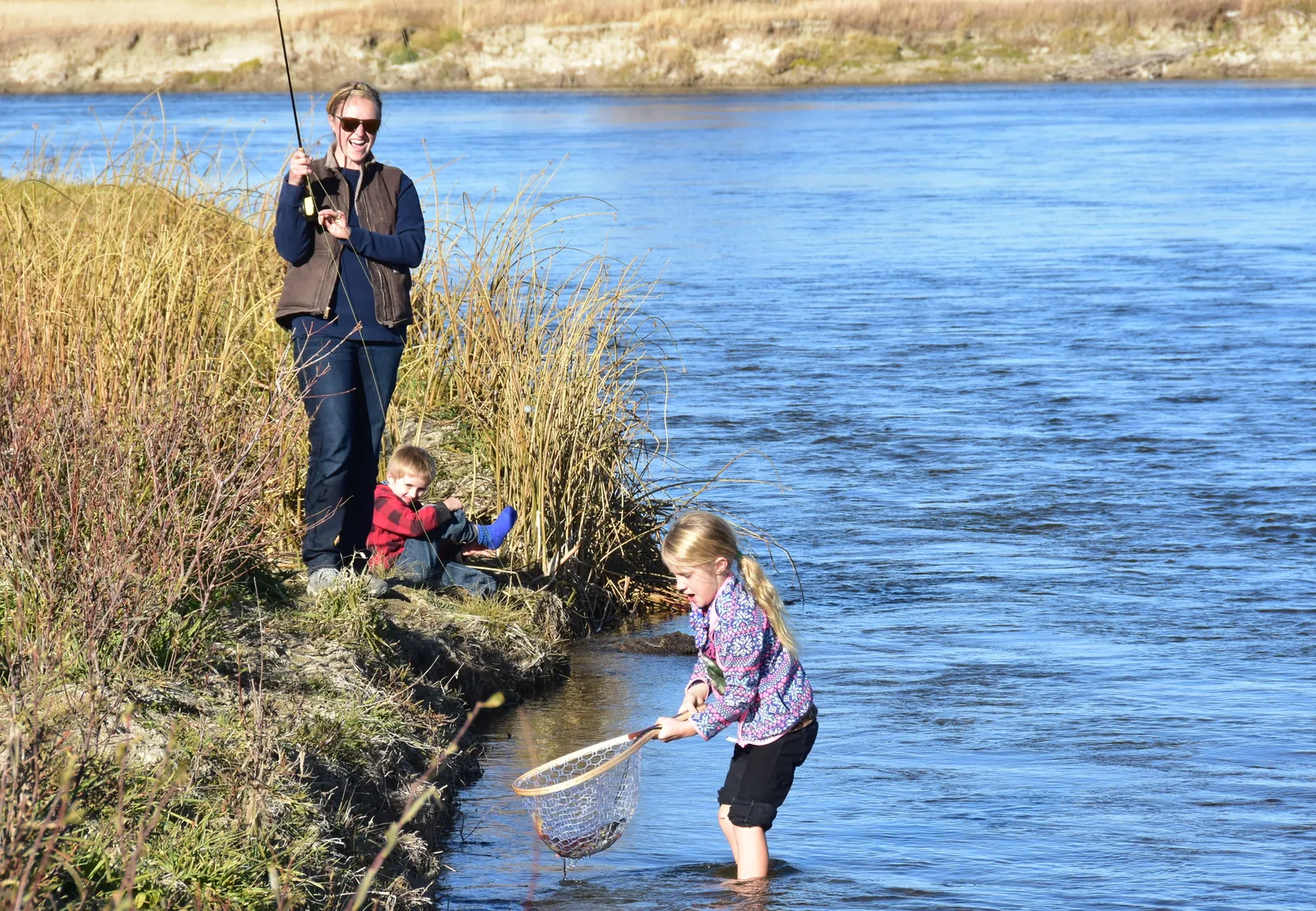
Section guide
Fishing Basics: Handling, Releasing and the First Day on the WaterThe fishing basics every angler needs before the first cast: handling fish, catch and release with the survival numbers, licenses, and the first-day kit.
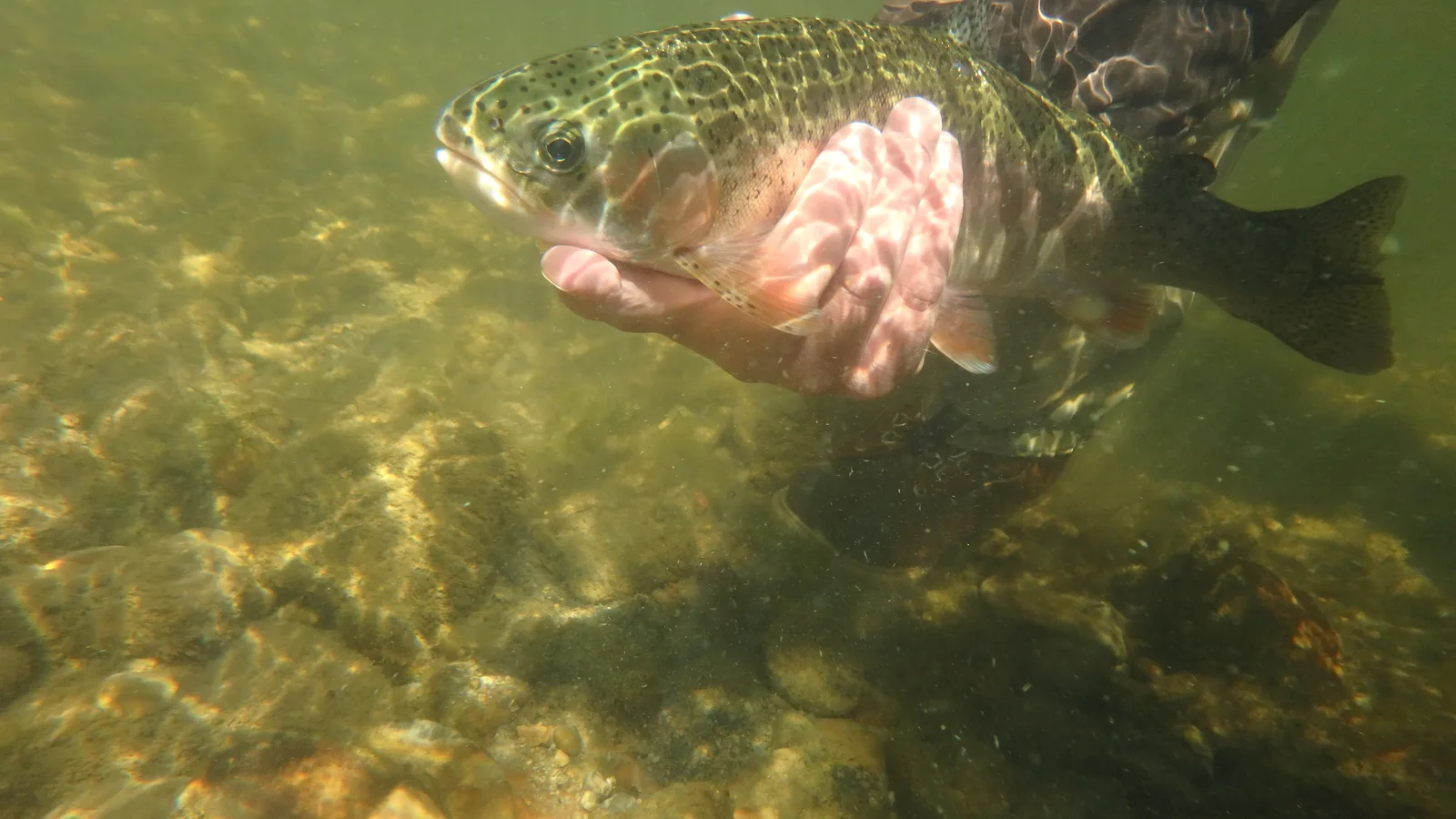 Catch and Release Fishing: How Many Fish Survive, and How to Do It
Catch and release fishing by the numbers: survival rates by species and hook location from the published studies, and the ten-step release that raises them.
 Fishing for Beginners: Your First Day, From License to First Fish
Fishing for beginners in one day: the kit, the license, where bluegill bite, the bobber rig, the first cast and fish, and a box on taking a child.
Sources
- IGFA, International angling rules (line classes, tippet classes, 2 oz rule, gaff length)
- Texas Administrative Code, 31 TAC 57.971, Definitions (artificial lure, jug line, trotline, possession limit, fish length)
- Texas Parks and Wildlife, Toyota ShareLunker program classes
- Florida Fish and Wildlife Conservation Commission, Fish measurement (total length, fork length)
- Minnesota DNR, Fishing regulations: general regulations and definitions (protected slot, possession, culling, party fishing)
- Minnesota DNR, Recommended minimum ice thickness
- Wisconsin DNR, Difference between possession and daily bag limit
- Alaska Department of Fish and Game, Statewide definitions for sport fishing
- NOAA Fisheries, Glossary (bycatch, pelagic, demersal)
- B.A.S.S., Rules are rules: the dead fish penalty
- Bassmaster, Bass fishing terms and expressions
- Major League Fishing, Bass Pro Tour rules (catch, weigh, immediate release)
- Take Me Fishing (RBFF), Fishing terms
- Orvis, Fly fishing glossary
- Orvis, Tippet chart (the X system)
- BassResource, Bass fishing glossary
- Bass Pro Shops 1Source, Fishing terminology, words and fishing slang defined
- FishTalk Magazine, Fishing terms: a glossary of fishing lingo
- Wired2Fish, IGFA approves Kurita's world record bass
- Online Etymology Dictionary, angle (v.)
- Wiktionary, skunked
- Collins Dictionary, lunker (American English)