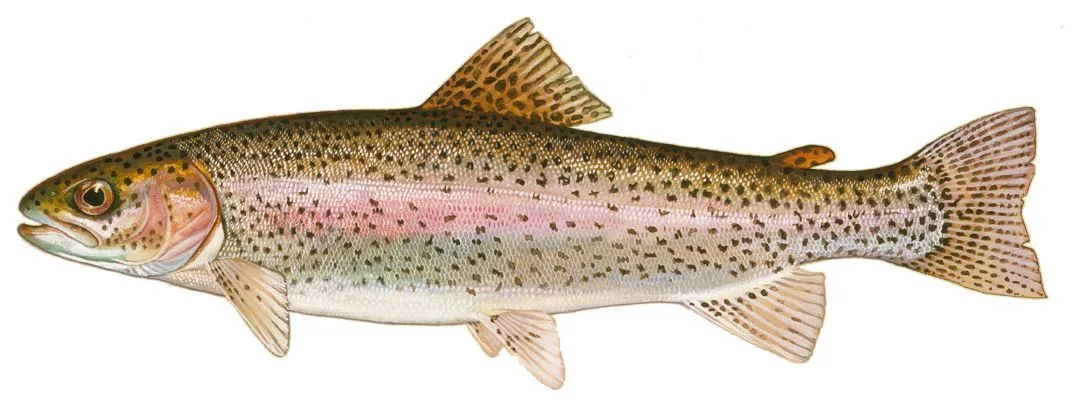
The rainbow trout is the trout most anglers catch first. It is native only to the Pacific slope of North America, yet it has been stocked into every state, and Pennsylvania alone puts about 2.3 million adult rainbows into its waters in a single season. You know one by the black spots across the whole tail and the pink band down its side. The steelhead is the same fish after a trip to sea.
The world record rainbow trout was a fish-farm escapee. In April 2000 wind and ice tore open pens on Lake Diefenbaker, a reported half-million sterile rainbows swam free, and nine years later one of them weighed 48 lb.
Rainbow, cutthroat or brown: how do you tell?
Color is the least reliable thing about a rainbow. The U.S. Geological Survey calls it “highly variable”: lake fish run silvery with an olive back, spawning fish turn “a rich crimson” on the sides, and stream fish sit somewhere in between.
Three marks hold up in every water. The first is black spots on the body and on the tail, dorsal and adipose fins. The spotting runs right across the tail, which is the fastest way to separate a rainbow from a brown trout, whose tail is nearly plain. The second is the pink to red band along the side that gives the fish its name. The third is what is missing: no red or orange spots, which a brown has, and no red slash under the lower jaw, which a cutthroat has.
| Fish | Spots | Side and belly | The mark that settles it |
|---|---|---|---|
| Rainbow trout | Small black spots, dense on back, fins and whole tail | Pink to red band; silver belly | Spotted tail, no red spots, no throat slash |
| Steelhead | As rainbow, fewer and fainter when fresh from the sea | Chrome silver; band faint until it darkens in the river | Same fish, bigger and brighter |
| Cutthroat trout | Black, sparse forward, crowded toward the tail | Often yellowish or coppery | Red-orange slash under each side of the jaw |
| Brown trout | Black and red spots, often with pale halos | Golden brown to yellow | Tail nearly unspotted; red spots |
| Golden rainbow (palomino) | None or very few | Solid yellow-gold, often a pink stripe | A rainbow without its dark pigment |
Where rainbows and cutthroat share a river in the West, they interbreed. A fish with a pink band and only a faint slash under the jaw is usually a hybrid, the “cutbow”. The yellow fish that shows up among stocked rainbows in the East is not a different species either. It is the palomino or golden rainbow, a color strain bred in West Virginia from a single fingerling in 1955.
Is a steelhead a rainbow trout?
Yes. Idaho Fish and Game calls the two “different life history forms of the same species.” A resident rainbow spends its whole life in fresh water. A steelhead is born in a river, runs to sea, feeds there for a year or more and comes back far larger. In Washington the average returning steelhead weighs 8–11 lb, while a river rainbow runs 11–18 in.
The two forms share rivers and interbreed, and in Idaho’s words “their offspring can adopt either life history.” A resident female can produce young that go to sea and come back as steelhead. What decides it, Idaho’s biologists write, is a mix of genes, growth and environment. In the Great Lakes, stocked rainbows use the lake as their ocean, and anglers call them steelhead too. The sea-run fish, its runs and its endangered populations have their own page: steelhead.
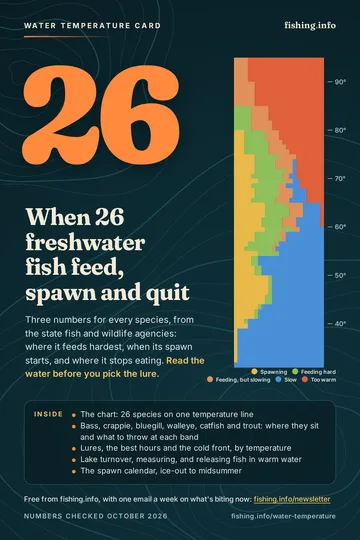
Free card: what 26 species do at your water temperature
Plus one email a week on what's biting now. No sales pitches. Privacy.
Where do rainbow trout live?
The native range is the Pacific slope, from the Kuskokwim River in Alaska to at least Baja California. There are also pockets in the upper Mackenzie drainage of Alberta and British Columbia and in the closed basins of southern Oregon. Everything east of that is stocked. The first transplant outside the range went to New York in 1874, followed by Arizona and Colorado in 1880. Today there are records from every state.
A rainbow wants cold, clean, oxygen-rich water: riffles and runs in streams, the cool layer in lakes. Native streams run around 54 °F (12 °C) in summer, and rainbows tolerate water up to about 75 °F (24 °C). That tolerance is why rainbows are the fish of stocked ponds and tailwaters where natives cannot hold.
How warm is too warm to fish for them?
The numbers anglers use, in one ladder:
| Water | What it means for rainbows |
|---|---|
| Upper 40s °F (8–9 °C) | Spawning fish start moving upstream in spring |
| About 54 °F (12 °C) | Summer temperature of native streams |
| 61 °F (16 °C) | Keep Fish Wet’s recommended ceiling for catch-and-release angling |
| 68 °F (20 °C) | The old rule of thumb, which Keep Fish Wet judges too high |
| About 75 °F (24 °C) | Upper tolerance; fish survive, they do not thrive |
The 61 °F line comes from Jamie Madden’s literature review for Keep Fish Wet. He concluded that “the angling threshold of 68°F/20°C is too high for all the species I researched.” He set 61 °F (16 °C) for rainbow, steelhead, cutthroat and brook trout instead.
So carry a stream thermometer in summer, fish the morning, and stop when the water passes that mark. The water temperature guide has the same logic for other species, and the catch-and-release page covers the handling.
Where do stocked rainbows come from?
Most rainbows caught east of the Rockies came out of a hatchery truck. Pennsylvania’s 2026 program is a fair yardstick: about 3.2 million adult trout for 684 streams and 130 lakes. Roughly 2.3 million of them are rainbows, averaging 11 in and 0.58 lb. On top of that come about 18,000 golden rainbows averaging 1.5 lb, and another 1.1 million fish from cooperative nurseries.
Stocking starts in mid-February for an early-April opener. That is why the first weeks of the season are the easiest trout fishing of the year.
Many stocked rainbows cannot breed. Idaho’s hatcheries pressure-shock almost every rainbow egg at the eyed stage to make the fish sterile, so stocked trout cannot spawn with wild ones. The same technique, which produces sterile triploid fish with three sets of chromosomes, is standard on trout farms. It is how the world record was grown.
Idaho is also where most farmed rainbow in the grocery store comes from. The University of Idaho puts the state at about 70 percent of domestic trout, around 41 million lb a year.
How do you catch rainbow trout?
Stocked rainbows were raised on pellets and hit almost anything in their first days: PowerBait, salmon eggs, a small inline spinner such as a Rooster Tail, a nightcrawler under a float. Washington’s list of rainbow baits reads like a bait shop inventory: corn, salmon eggs, dough, cheese, nightcrawlers and PowerBait, plus spinners, spoons, jigs, flies, wedding rings and plugs.
Washington also gives the one seasonal rule that matters. In cool months rainbows feed near the surface; in summer heat they go deep, “at or near the bottom.”
Wild river rainbows are pickier and feed on drifting insects. That is where a fly rod or a small inline spinner cast upstream earns its place. The full method, with tackle by water type, is in trout fishing. Baits and rigs are in trout bait, lures in trout lures, and the hook for each in the hook size for trout table.
How big is the world record rainbow?
The IGFA all-tackle record is 48 lb (21.8 kg). Sean Konrad caught it on Lake Diefenbaker in Saskatchewan in September 2009, at night, on a jointed Rapala X-Rap. The fish was 42 in long with a 32 in girth.
It replaced the 43 lb 10 oz fish his identical twin Adam caught in the same lake in June 2007. Adam cast a Mepps Syclops spoon from shore at night, on 6 lb line.
Both fish came from the same accident. In April 2000, high winds and ice damaged the holding pens of a fish farm on the lake, and about 490,000 sterile triploid rainbows were reported to have escaped. The farm operator, CanGro Processors, disputed the number. Sterile fish spend no energy on spawning, and in a reservoir full of food they kept growing. Anglers still argue about whether an escaped farm fish belongs in the record book; the IGFA accepted both.
The old benchmark, a 42 lb 3 oz steelhead from Bell Island near Ketchikan in June 1970, remains Alaska’s state record. It is the oldest on the state’s list.
Are rainbow trout good to eat?
Yes, and they are among the safest fish to eat often. The FDA lists “Trout, freshwater” among its Best Choices, the lowest-mercury group. The caveat is for fish you catch yourself. The FDA’s advice is to check the state advisory for that water, and if there is none, to eat one serving that week and no other fish.
The meat of a stream rainbow is mild and white to pale pink. Stocked rainbows are meant to be kept in most put-and-take waters. Wild rainbows in special-regulation rivers usually are not, and the state regulations for that water settle it.
When do rainbow trout spawn, and how fast do they grow?
Rainbows spawn in spring, the opposite season to brown and brook trout. In Idaho, the state’s biologists write, fish start upstream “as the days grow longer, and the water warms to the upper-40s F.” Across the native range the season runs from March to July by climate, and winter steelhead in California can start in January.
The female digs a nest, a redd, in clean gravel by fanning it with her tail, which can take her up to a week. A typical 2 lb female carries 2,000–3,000 eggs; the species range is 200 to 8,000. At upper-40s water the eggs take about seven weeks to hatch. The fry then stay in the gravel on their yolk sac for a few more weeks before they swim up.
Many Idaho rivers close to fishing through April and much of May for exactly those weeks. Wading across gravel bars in spring does real damage.
Growth depends on food more than age. Rainbows eat drifting insect larvae, crustaceans and other invertebrates, and fish as they grow. Stream fish stay small on a bug diet; lake and reservoir fish that switch to baitfish grow fast. Wild fish live six to eight years, possibly eleven, and mature anywhere from three to eleven years old.
The names, if you want them
The rainbow trout is Oncorhynchus mykiss, a Pacific trout and closer kin to the salmon than to the brook trout. The steelhead carries the same scientific name, and the California golden trout is a wild rainbow subspecies. The trout hub has the identification table for every trout and char.
Free download
The water temperature card
Read your water temperature and the card tells you who is spawning, who is feeding and what to throw. 26 species, 16 pages, for your phone and the tackle box.
Plus one email a week on what's biting now. No sales pitches. Privacy.
Related
Section guide
Trout: The Types of Trout and How to Tell Them ApartThe types of trout anglers catch, from rainbow and brown to brook and lake trout (two are chars): the marks that identify each, spawn seasons, records.
 How to Hold a Trout Without Hurting It: Grip, Photo, Release
How to hold a trout so it swims off healthy: the belly cradle and tail grip, no lipping, the 10-second photo, and what the release studies found.
 Splake: The Brook Trout and Lake Trout Hybrid
Splake are a hatchery cross of lake trout and brook trout. How to tell them apart, whether they can reproduce, the 20 lb record and how to catch them.
Sources
- Animal Diversity Web, Oncorhynchus mykiss
- USGS Nonindigenous Aquatic Species, rainbow trout fact sheet
- Washington Department of Fish and Wildlife, rainbow trout and steelhead
- Virginia DWR, rainbow trout
- Virginia DWR, brown trout
- Alaska Department of Fish and Game, steelhead and rainbow trout species profile
- Idaho Fish and Game, rainbow trout and steelhead: what's the difference?
- Idaho Fish and Game, rainbow trout are wrapping up their spawning season
- Pennsylvania Fish and Boat Commission, 2026 trout stocking schedules
- Wide Open Spaces, the world record rainbow trout was held by identical twins
- Outdoor Life, the biggest trout of all time
- Orvis News, are we wrong about safe temperatures for trout fishing? (Jamie Madden, Keep Fish Wet)
- U.S. Food and Drug Administration, advice about eating fish
- University of Idaho Extension, aquaculture in Twin Falls County