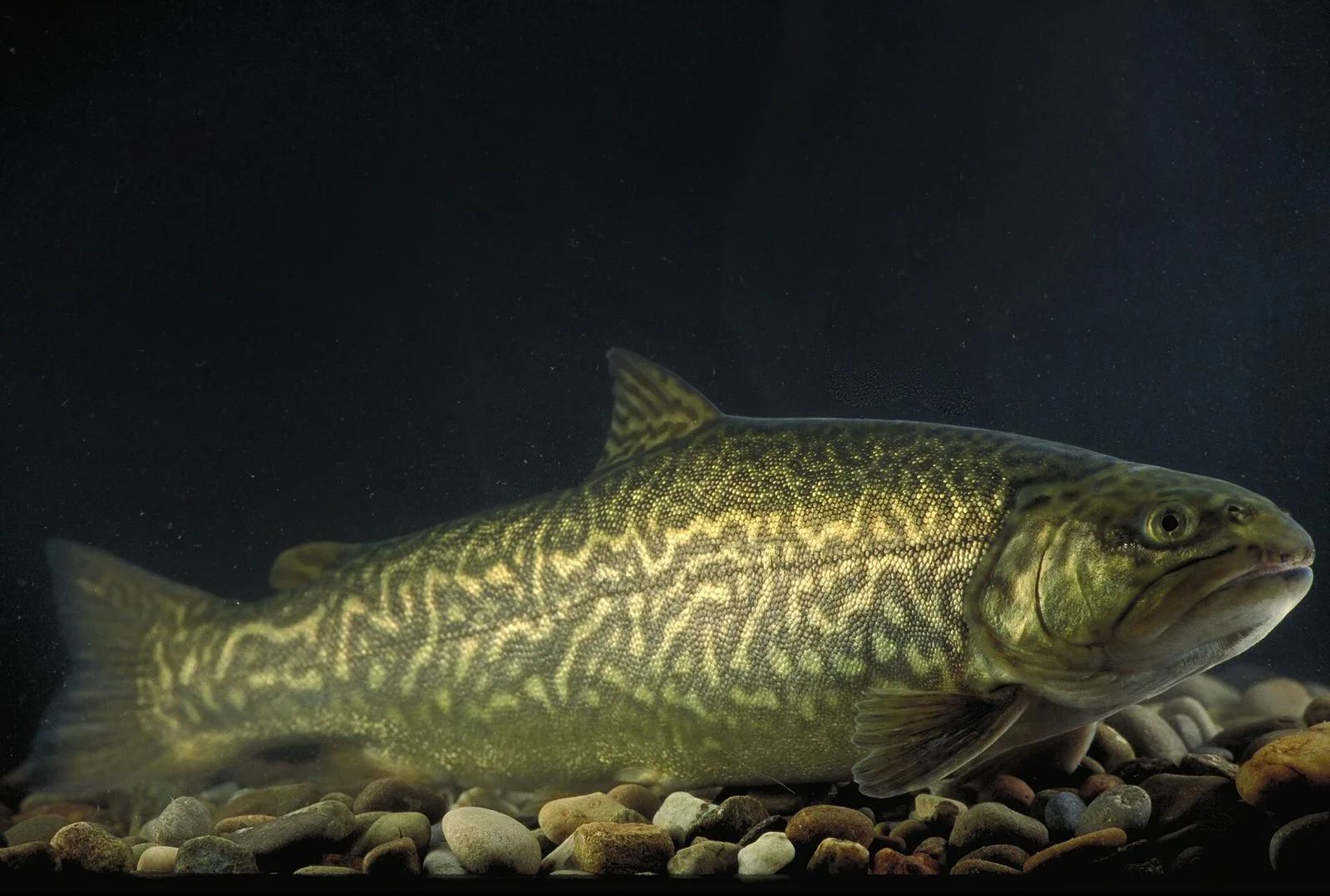
A tiger trout is a cross between a female brown trout and a male brook trout. It is sterile, it almost never happens in the wild, and nearly every one you will catch was made in a hatchery on purpose. States stock tigers because they turn to eating fish early, and because a fish that cannot breed can go into a water without changing it for good. Look for one in a stocked lake, and check the rule before you keep it: every Oregon tiger goes back.
The world record tiger trout, 27 lb 6 oz (12.42 kg), came off a family cabin dock on Loon Lake in 2022 on nightcrawlers. It beat the record the angler’s own son had set on the same lake the summer before.
How do you tell a tiger from its parents?
The name comes from the pattern. A brook trout has pale worm-like marks, called vermiculations, on its back. A tiger has the same marks blown up into bold, maze-like stripes over the whole body, and no real spots. The body is greenish yellow to brown and the belly yellowish orange. The pectoral, pelvic and anal fins are orange, and the tail is square or slightly forked.
| Mark | Tiger trout | Brown trout (mother) | Brook trout (father) |
|---|---|---|---|
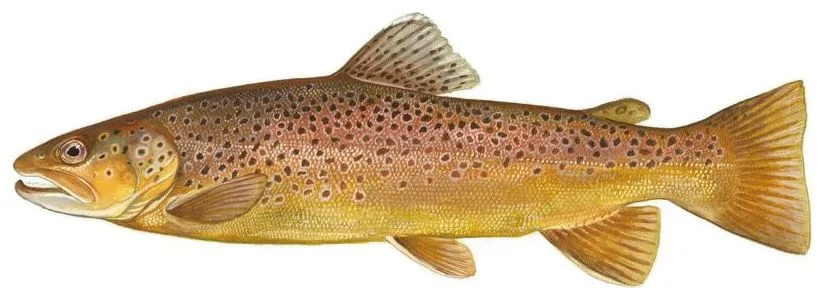
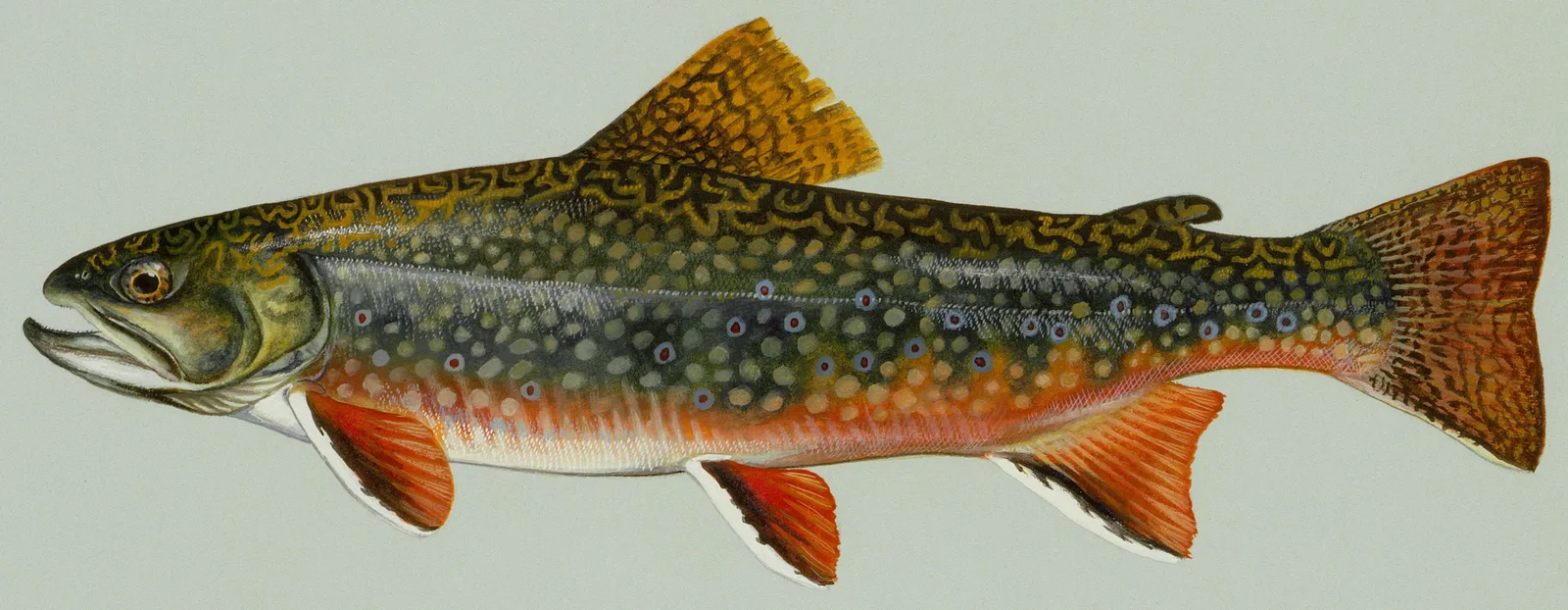
| Pattern | Bold maze-like stripes over the whole body | Black and red spots with pale halos | Pale worm-like marks on the back only |
| Spots | None to speak of | Many | Red spots with blue halos |
| Lower fins | Orange | Plain | White leading edge and black line |
| Tail | Square to slightly forked | Square, few spots | Square |
| Breeds | No, sterile | Yes, fall | Yes, fall |
The quick test at the net: spots mean a parent, a maze with no spots means a tiger. The parents have pages of their own, the brown trout and the brook trout.
Where will you catch one?
Almost always in a stocked lake. Brown trout are European and brook trout are native to eastern North America, so before the first brown trout eggs arrived in 1883 the two never met. Once both lived in the same streams, wild crosses became possible, and stream-born tigers have been recorded since at least 1944. They remain exceptionally rare, even where both parents live. Without a hatchery’s help, very few of these crosses survive.
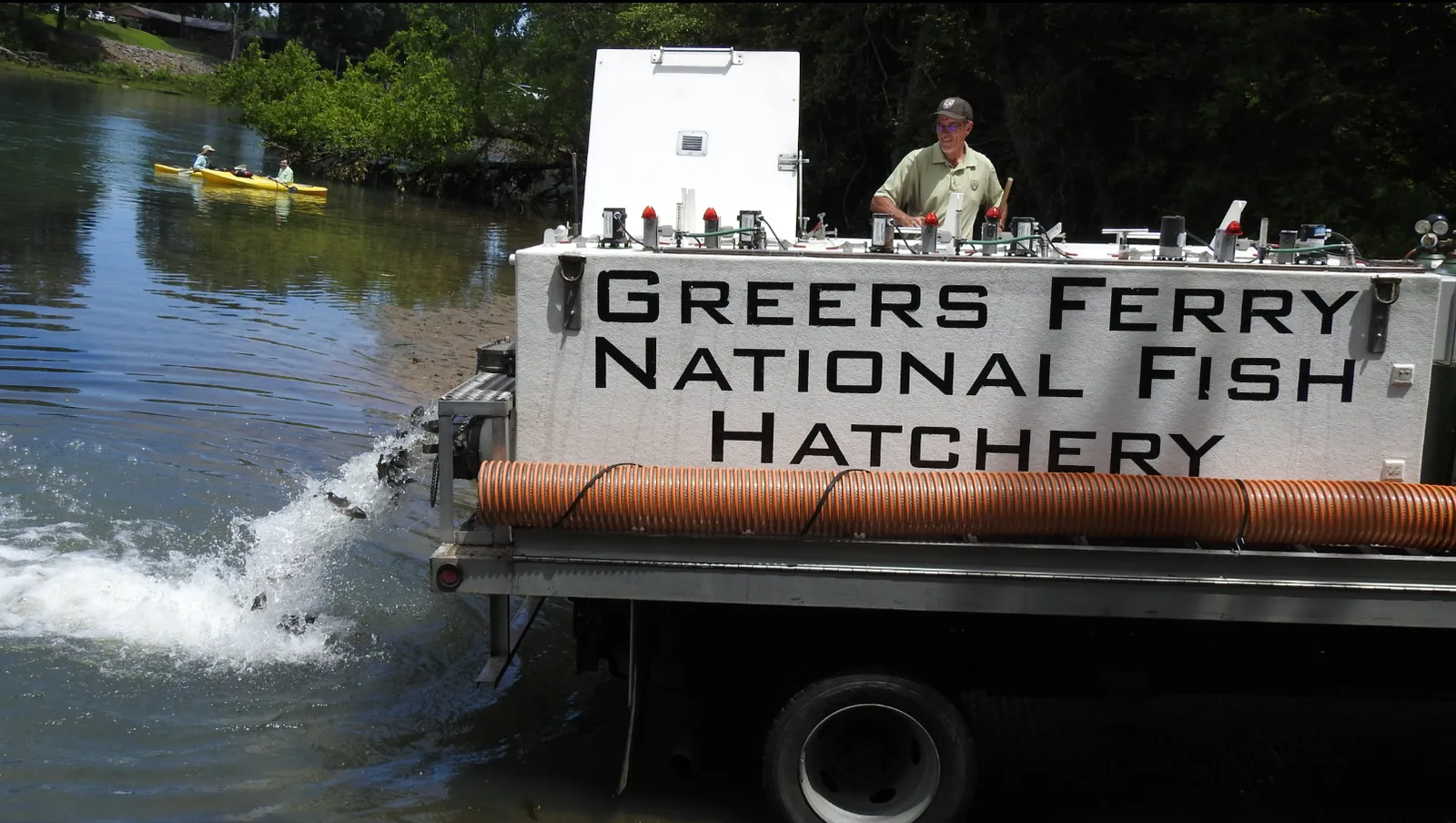
In a stocked lake the answer flips. West Virginia puts tigers in most of its waters stocked with catchable-size trout. Where a state stocks them, a tiger is a common, welcome catch.
So a tiger from a stocked lake came from a truck. One from a wild brook-and-brown stream with no stocking record is the fish of a lifetime, and worth a photo before it goes back.
A tiger trout cannot be endangered, for the same reason it cannot be common in the wild. It is not a species with a population of its own. Every tiger is a first-generation cross.
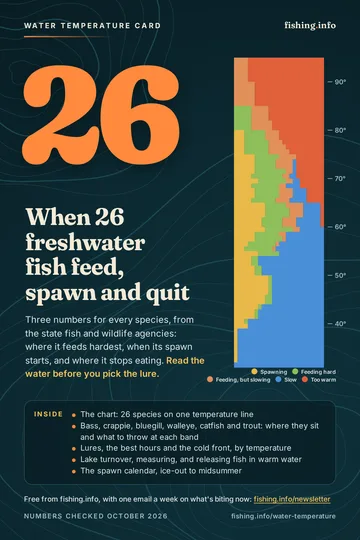
Free card: what 26 species do at your water temperature
Plus one email a week on what's biting now. No sales pitches. Privacy.
Why do states stock tiger trout?
Three reasons recur in the agency pages: tigers eat fish, they cannot breed, and they survive well in the hatchery. Utah shows the first one at work. Utah chub got into Scofield Reservoir by accident, and their numbers exploded. The state went from stocking only rainbows to stocking tigers and cutthroat trout alongside them as predators.
A 2017 study published by the USGS then counted the result. Chub made up as much as 80 percent of the tigers’ diet, depending on the season. The study estimated 238,000 tigers in the reservoir, eating about 1.1 million lb (508,000 kg) of chub a year. The cutthroat ate another 710,000 lb (322,000 kg). Together they ate more chub than the population produced each year.
| State | Where | Why tigers | Worth knowing |
|---|---|---|---|
| Utah | Scofield Reservoir | Eat introduced Utah chub (USGS, 2017) | About 238,000 tigers in the reservoir |
| Oregon | Diamond and Fish lakes | Combat invasive baitfish (ODFW) | Catch-and-release only |
| Wyoming | Sheridan Region reservoirs; Long and Ringbone lakes | Control stunted suckers, brook trout and grayling (WGFD) | Eggs from the Story Hatchery since 2011 |
| Colorado | Some coldwater lakes | Eat suckers and minnows (CPW) | Managed by stocking and harvest rules |
| West Virginia | Most catchable-trout waters | Part of the trout stockings (WVDNR) | Not in candy darter or Guyandotte crayfish waters |
| Virginia | Some trout waters stocked from Coursey Springs (experimental since 2021–22) | Disease resistance, hybrid vigor (VDWR) | Six trout a day, 7 in (18 cm) minimum |
| Washington | Loon Lake, 1,118.5 acres (453 ha) | No reason given by WDFW; big tigers eat kokanee | World record 27 lb 6 oz (12.42 kg, IGFA); state record 27.42 lb (WDFW) |
| Idaho | Montpelier Reservoir, since 2016 | No reason given in the record report | State record 9.13 lb (4.1 kg) |
Wyoming’s Sheridan Region list is specific: Willow Park, Cloud Peak, Weston and Muddy Guard #1 and #2 reservoirs, plus Long and Ringbone lakes in the Cloud Peak Wilderness. Colorado gives the plainest reason of all. Suckers and minnows offer little to anglers, compete with sport fish and can hurt water quality, but they make good prey for a fast-growing sterile predator.
The sterility matters as much as the appetite. A stocked brown or brook trout can breed with native fish or establish itself where it is not wanted. A tiger cannot. It does its job, gets caught or dies, and leaves nothing behind. That is why agencies can put tigers in waters where they would never release a fertile non-native trout. Pike managers use a striped hybrid of their own, the tiger muskie, a cross of muskellunge and northern pike.
How do you catch a tiger trout?
Start with the regulation for the water, not the lure box. In Oregon every tiger goes back. In Virginia it counts in the six-trout daily limit, with a 7 in minimum.
Then fish for a predator. Oregon’s biologists list flies, spoons, spinners and bait, and add that a minnow imitation can be effective because tigers eat other fish. That points to minnow-colored spoons, inline spinners and streamers on a fly rod. A minnow-colored spoon or spinner covers the rest of the box, and so do most trout lures.
Expect a hard hit. West Virginia says tigers “strike a bait or lure quickly and ferociously”. Wyoming’s hatchery superintendent called them very aggressive fish that fight hard.
Bait works too. Both Loon Lake records, the world record and the fish it beat, came on nightcrawlers.
Tigers live in the same stocked lakes and reservoirs as rainbows, and the same seasons apply: shallow in spring and fall; in summer, deeper and at dawn and dusk. The trout fishing page covers tackle and presentations for those lakes.
How big do tiger trout get?
As big as their food lets them. Most stream trout live largely on insects; what trout eat changes with the water. Tigers are strongly fish-eating, and the size of a tiger tracks the fish it can eat. Washington’s biologists put a typical tiger at 10 to 16 in (25–41 cm). In waters with quality populations they reach 20 in (51 cm) and 5 lb (2.3 kg).
The Scofield study puts a number on that appetite: about 5.9 lb (2.7 kg) of chub per tiger per year.
The two state records make the same point from the other end. Idaho’s record, from Montpelier Reservoir, weighed 9.13 lb and measured 27.25 in (69 cm). Washington’s record, from Loon Lake, weighed 27.42 lb on WDFW’s list, three times as much, and it is the world record too. Loon Lake holds kokanee of 11 to 13 in (28–33 cm), a steady supply of prey fish just the right size for a big trout.
The world record tiger trout
The heaviest tiger on any official list is Cathy Clegg’s fish from Loon Lake, Stevens County, caught Aug. 7, 2022. The IGFA lists it as the all-tackle world record at 12.42 kg (27 lb 6 oz); WDFW lists it as the Washington state record at 27.42 lb. It was 35.5 in (90 cm) long with a 28.125 in (71 cm) girth. She was fishing nightcrawlers off her family’s cabin dock. “It took off three or four times, screaming drag,” she told reporters.
The fish it replaced belonged to her son, Caylun Peterson. His tiger weighed 24.5 lb (11.1 kg) and measured 34.5 in (88 cm) with a 25 in (64 cm) girth. It came from Loon Lake on June 21, 2021, also on a nightcrawler.
Idaho’s record shows how fast these lists move. Austin Christensen’s 9.13 lb fish from Montpelier Reservoir, caught June 1, 2024, beat Tyson Lutz’s 8.3 lb record from May 17, two weeks earlier. The other trout records run far larger: the world record brown trout weighed 44 lb 5 oz (20.1 kg).
Are tiger trout good to eat?
Where the rules let you keep one, yes. It is a hatchery trout, and the FDA lists freshwater trout among its Best Choices for low mercury. No agency page describes the hybrid’s own flesh, but Arizona Game and Fish rates both parents well. The brown’s meat is “pink or yellow” and “tastes good”; the brook’s is flaky, “white to pinkish-orange,” with “a delicious flavor.” Check the rule first, since Oregon releases every tiger, and the state advisory for the water you fish.
How is a tiger trout made?
The two parents are further apart than most anglers think. A brown trout is a true trout, genus Salmo. A brook trout is a char, genus Salvelinus. The brown carries 80 chromosomes and the brook 84. A cross between them is an intergeneric hybrid, and most of the eggs die.
The cross is made one way round: eggs from a female brown, milt from a male brook. Wyoming’s Story Hatchery tried it the other way, with a female brook and a male brown, and got eggs of significantly lower quality.
Hatcheries fixed the survival problem with a shock. Warm water on the fertilized eggs gives each embryo an extra set of chromosomes, making it a triploid. That raises survival from about 5 percent to about 85 percent. A triploid fish is sterile. It will grow, feed and fight, but it will never spawn. Tigers have been part of US stocking programs since at least the 1960s.
Wyoming uses pressure instead of heat, and its recipe is exact. The Story Hatchery has made tiger eggs since fall 2011. Staff mix the eggs and milt, then wait. At exactly 40 minutes after fertilization the eggs go into a small chamber at 9,500 psi for five minutes. Pressure in that window leaves each egg with three chromosome sets instead of two.
The hatchery tested the payoff in 2013. Of the pressure-treated triploid eggs, 72 percent survived to first feeding, against 54 percent of untreated diploid tiger eggs. That is a different measure from the heat-shock figure above: one hatchery, shocked against unshocked tiger eggs.
Virginia shows how fragile the whole business is. The state had stopped producing tigers decades ago because of poor egg survival. Egg production restarted in fall 2020 at Paint Bank Fish Hatchery, and the fish are raised at Coursey Springs Fish Culture Station in Bath County.
The other hatchery hybrid is the splake, a lake trout crossed with a brook trout, and unlike the tiger it can breed. The trout hub has the rest of the family.
Free download
The water temperature card
Read your water temperature and the card tells you who is spawning, who is feeding and what to throw. 26 species, 16 pages, for your phone and the tackle box.
Plus one email a week on what's biting now. No sales pitches. Privacy.
Related
Section guide
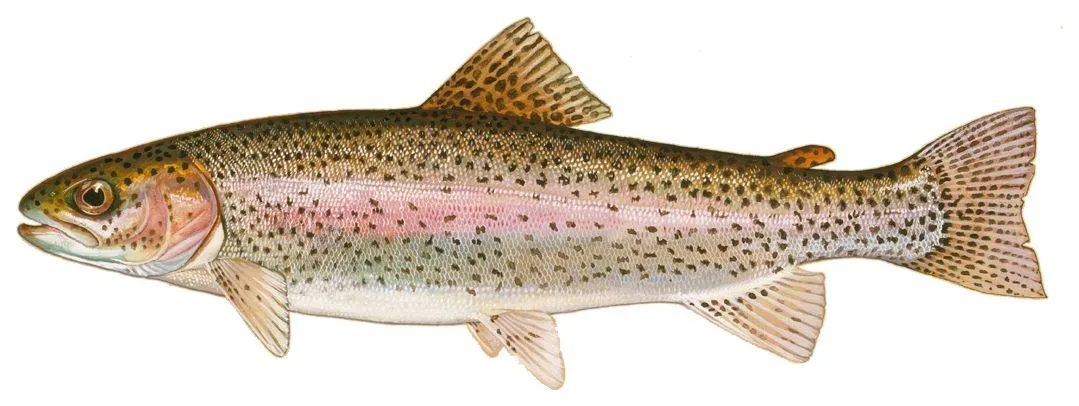
Trout: The Types of Trout and How to Tell Them ApartThe types of trout anglers catch, from rainbow and brown to brook and lake trout (two are chars): the marks that identify each, spawn seasons, records.
 Lake Trout: The Deep-Water Char That Lives 60 Years
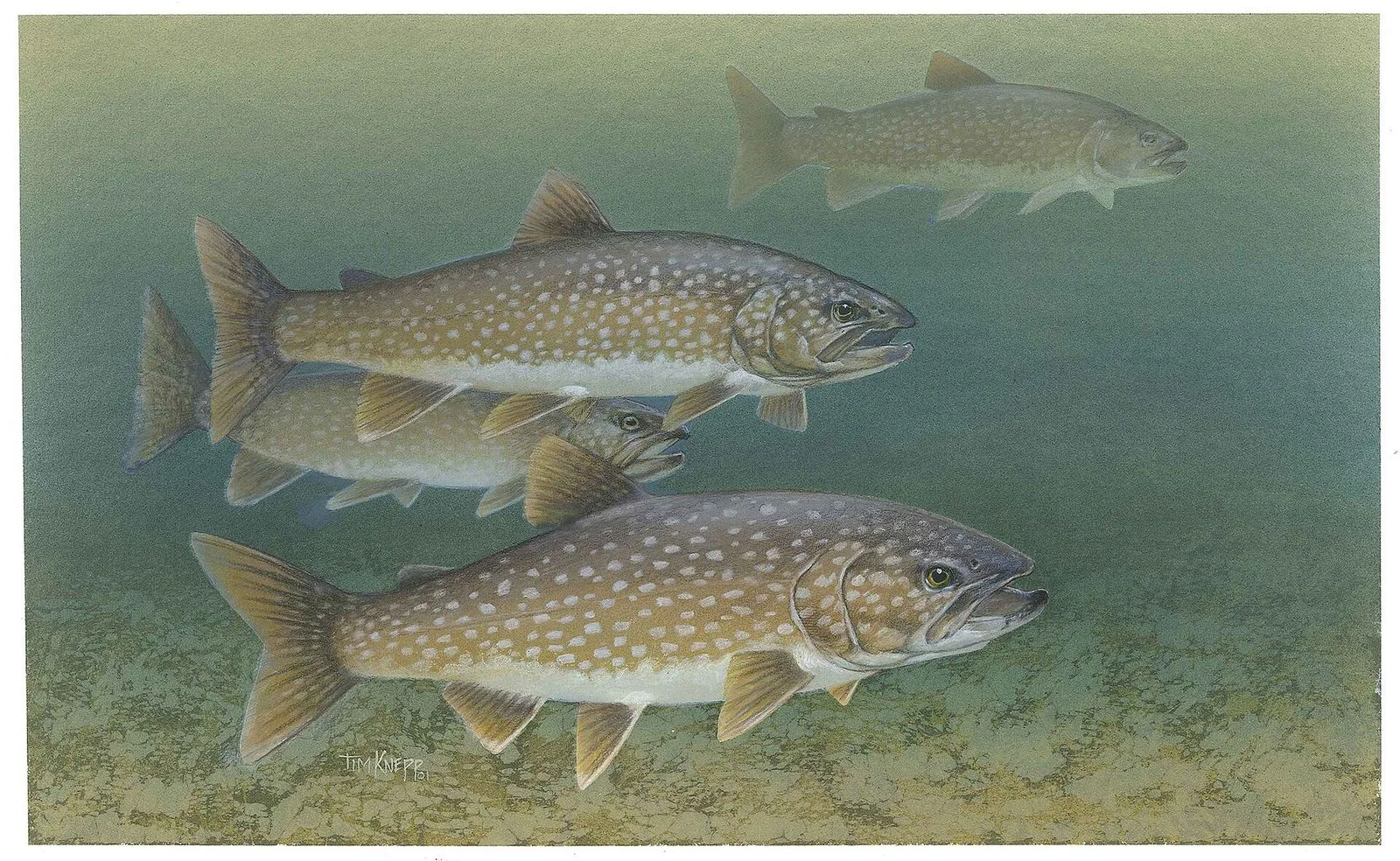
Lake trout are deep-water chars that live 60 years: how to tell one apart, where they hold by season, the 72 lb record and the Great Lakes comeback.
 Trout Fishing for Beginners: Where, When and What to Use
Trout fishing peaks at 55–65 °F, and most beginners catch stocked fish first. Where trout hold in streams and lakes, the one outfit to buy, and when to go.
 Brown Trout: Identification, History, Habits and Records
Brown trout from the agency data: how to tell one from a rainbow or brook, the 1883 import, night feeding, the fall spawn and the 44 lb record.
 Brook Trout: The Char That Marks America's Coldest Water
The brook trout is a char, not a trout: how to tell it apart, where it still lives, why it lost 28% of its range, and the 1915 record.
 Steelhead Trout: The Rainbow That Goes to Sea
Steelhead trout are rainbows that run to sea or a Great Lake and come back to spawn, often more than once. Runs, the ESA listings, Great Lakes fish, records.
- Rainbow Trout: Identification, Range, Spawning and Record
Rainbow trout from the agency data: how to tell one from a steelhead, cutthroat or brown, the temperatures that matter, spawning, and the 48 lb record.
Sources
- ODFW, How to fish for trout (brown trout introduced to the U.S. in 1883)
- Virginia DWR, tiger trout in Virginia
- Wikipedia, tiger trout (genetics, heat shock, wild records)
- Wyoming Game and Fish, making tiger trout at the Story Hatchery
- Oregon Department of Fish and Wildlife, tiger trout
- Colorado Parks and Wildlife, tiger trout
- West Virginia DNR, tiger trout
- USGS, Winters, Budy and Thiede 2017: tiger trout as biological controls in Scofield Reservoir
- Washington Department of Fish and Wildlife, tiger trout (typical size, state record)
- Washington Department of Fish and Wildlife, Loon Lake
- Sport Fishing, world record tiger trout caught by Washington woman
- Field & Stream, the biggest trout ever caught
- Outdoor Life, Idaho record tiger trout (Montpelier Reservoir, 2024)
- IGFA world record database, tiger trout (all-tackle)
- U.S. Food and Drug Administration, advice about eating fish
- Arizona Game and Fish Department, brown trout: table quality
- Arizona Game and Fish Department, brook trout: table quality