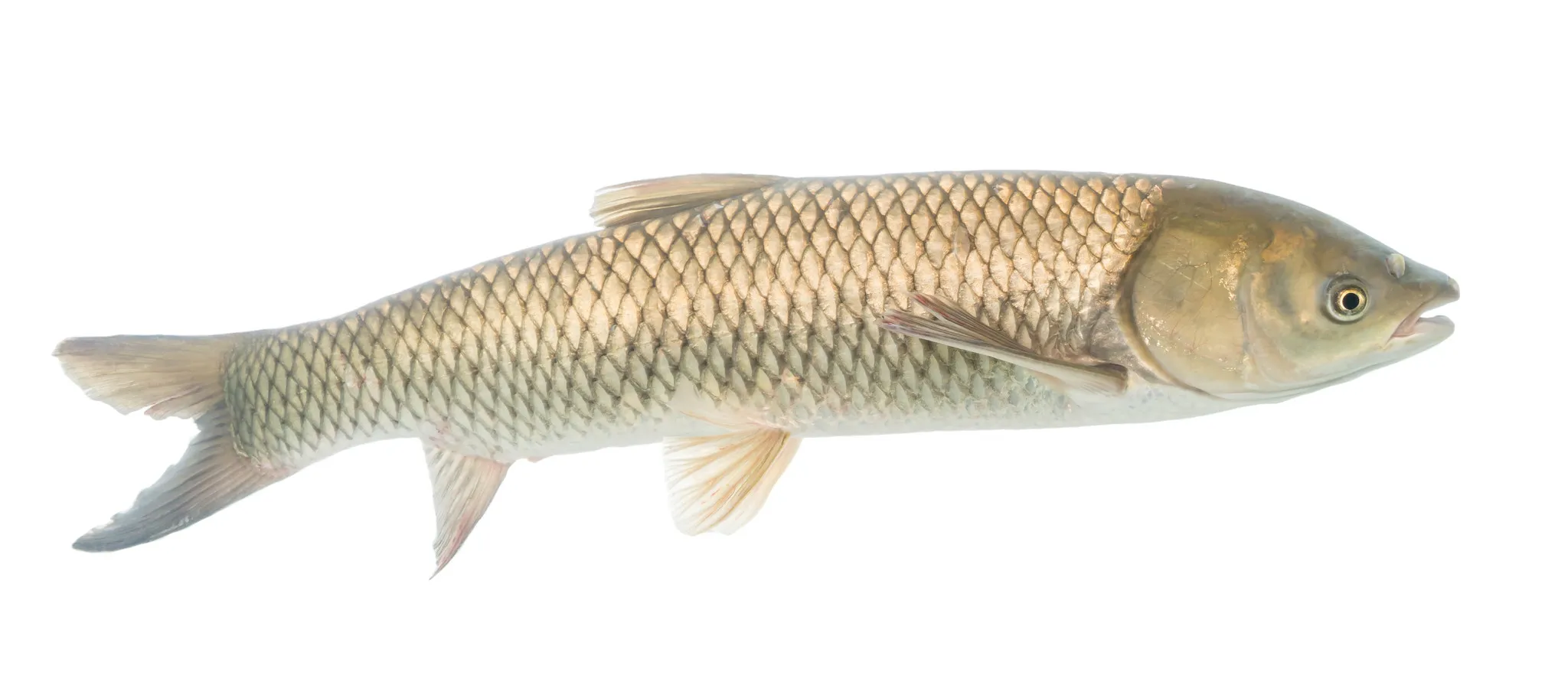
The grass carp is the big, plant-eating carp that pond owners buy to clear their weeds. Missouri’s field guide puts it at 12 to 24 inches (30–61 cm), with a maximum of 48 inches (122 cm) and 50 pounds or more. It came to the United States from eastern Asia in 1963, and many states now allow only sterile triploids, sold by permit. Anglers catch it by sight in the shallows on bread, berries and corn, and the IGFA world record stands at 87 lb 10 oz (39.75 kg).
A grass carp “can eat more than the equivalent of its body weight in a day,” says the Missouri Department of Conservation, and “about half of the food is passed through undigested.”
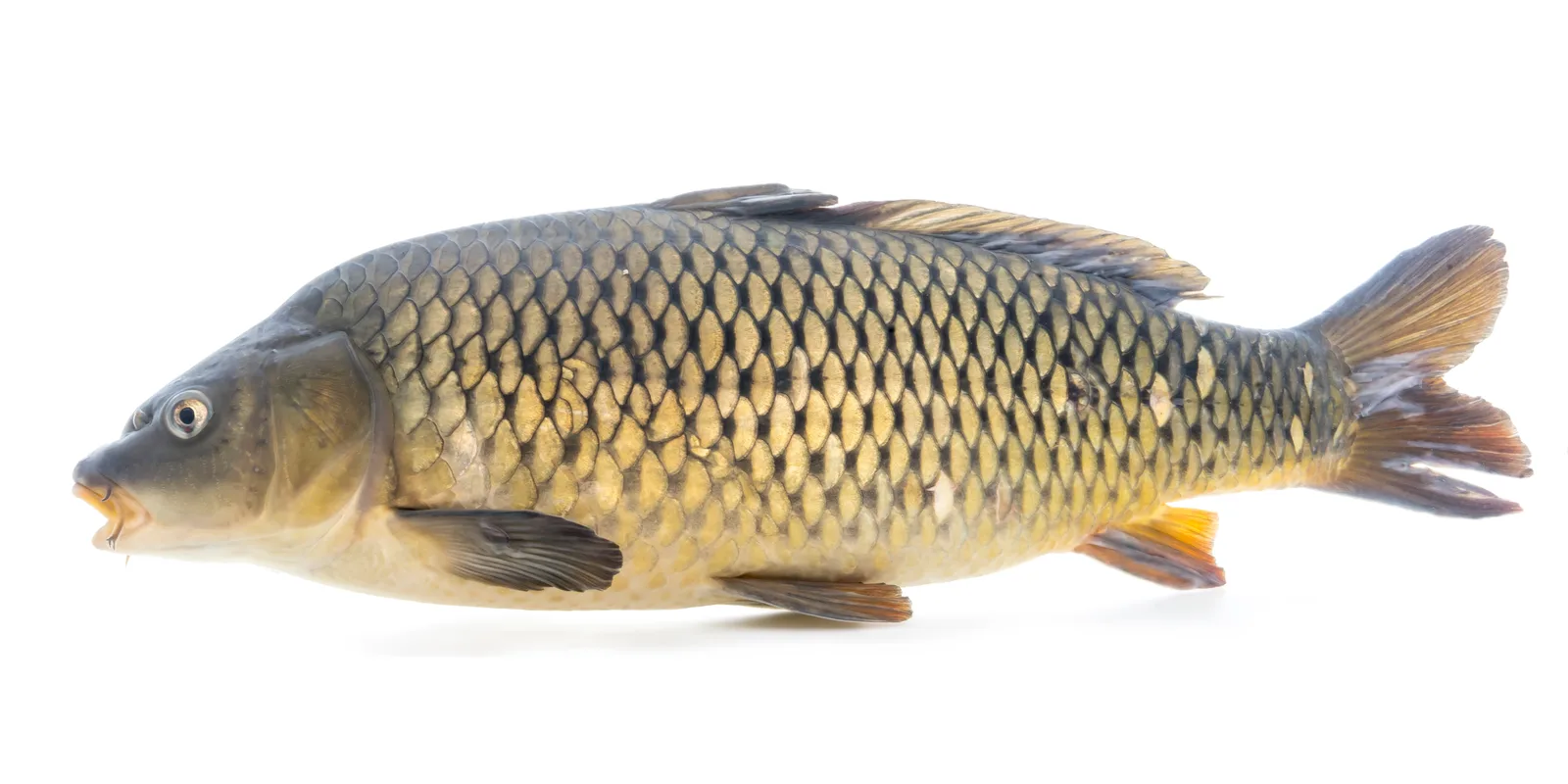
Grass carp (Ctenopharyngodon idella) at Gavins Point National Fish Hatchery, South Dakota. Photo: Sam Stukel, USFWS Mountain-Prairie (public domain).
Grass carp vs common carp: how do you tell them apart?
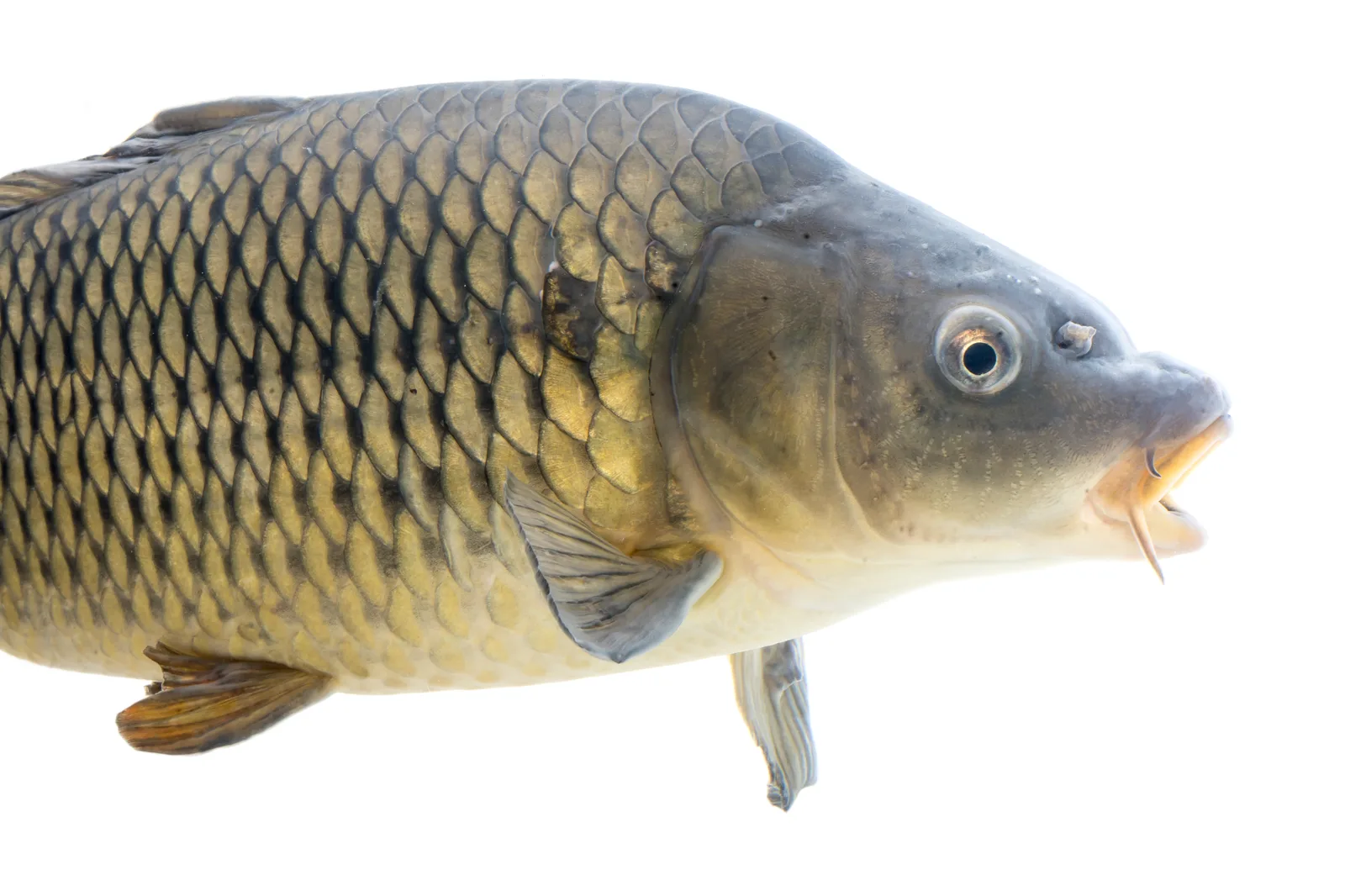
Look at the mouth first. A common carp has barbels, the fleshy whiskers at the corners of the mouth; a grass carp “lacks barbels,” in the words of the U.S. Geological Survey (USGS). Its mouth sits at the very front of a broad, blunt head rather than pointing down, and the back fin is short, 7 to 8 rays, with no saw-toothed spine at the front. The body is long and torpedo-shaped, in Minnesota DNR’s words, where a common carp is heavy-bodied, and the eye is small and set low.
Bighead and silver carp, two more of the invasive carp in the same rivers, have no barbels either. They give themselves away with an upturned mouth, an eye set below it, tiny scales and a sharp keel along the belly. The carp hub sorts every fish called carp in American water; this table puts the three that get confused most side by side.
| Mark | Grass carp | Common carp | Bighead and silver carp |
|---|---|---|---|
| Barbels | None (USGS) | Two on each side of the upper jaw (Missouri) | None (Minnesota DNR) |
| Mouth | At the front of a broad, blunt head (Missouri) | Points down (Minnesota DNR) | Large, upturned, toothless (Missouri, USGS) |
| Back fin | Short, 7–8 rays, no spine (USGS, Missouri) | Long, 17–21 rays, saw-toothed spine (Missouri) | Narrow (Minnesota DNR, silver carp) |
| Eye | Small and low; level with the mouth (USGS, Minnesota DNR) | Above the mouth (Minnesota DNR) | Below the mouth, far forward (Minnesota DNR, Missouri) |
| Scales | Large, dark-edged, crosshatched (USGS, Missouri) | Large, dark-edged, crosshatched (Missouri, Minnesota DNR) | Small; no scales on the head (Missouri, USGS) |
| Belly keel | None (Minnesota DNR) | — | Bighead: vent to the pelvic fins; silver: nearly to the throat (Missouri) |
| Food | Water plants (Missouri) | Mostly aquatic insects, from the bottom (Missouri) | Plankton strained through the gill rakers (Missouri) |
| Size | 12–24 in (30–61 cm); to 48 in (122 cm) and 50 lb (23 kg) or more (Missouri) | 12–25 in (30–64 cm), 1–8 lb (0.5–3.6 kg) (Missouri) | Both to 48 in (122 cm); bighead 80 lb (36 kg), silver 45 lb (20 kg) or more (Missouri) |
| IGFA all-tackle record | 87 lb 10 oz (39.75 kg) | 75 lb 11 oz (34.35 kg) | Bighead 97 lb (44 kg); silver 70 lb 8 oz (32 kg) |
| Status | Invasive carp; prohibited in Minnesota | Nonnative (USGS) | Invasive; illegal as live bait in Missouri |
Why are grass carp in American lakes?
They were brought in to eat weeds. USGS records that grass carp were “first imported to the United States in 1963” to fish-farm facilities in Auburn, Alabama, and Stuttgart, Arkansas, and that the first fish reached open water by escaping the station at Stuttgart. Federal and state agencies and private owners then stocked them widely for weed control. By the mid-1970s, says the federal Invasive Carp Regional Coordinating Committee, the species had been stocked in at least 45 states.
The name white amur comes from the Amur River, which forms the border between Russia and China, as Missouri’s field guide explains. The native range runs from the Amur south to the West River in southern China.
Today wild, breeding populations live in the Mississippi, Missouri and Ohio rivers and their tributaries. Grass carp have been detected in every Great Lake except Superior, and reproduction has been found in western Lake Erie tributaries. In ponds and lakes they favor shallow, weedy water and move deeper when the water cools, per USGS.
Free card: what 26 species do at your water temperature
Plus one email a week on what's biting now. No sales pitches. Privacy.
How do you catch grass carp?
Find them first. Connecticut’s Department of Energy and Environmental Protection (DEEP), which recruits volunteer anglers to thin the grass carp in Candlewood Lake and Squantz Pond, recommends sight fishing. Grass carp “regularly sit just below the surface,” and from a distance you can spot them when their fins or mouths breach. Toss out some of your bait as chum, watch for the fish to start feeding, then cast a hooked piece.
Bait is where grass carp differ from the common carp. DEEP’s list: “Good baits for grass carp include white bread, berries, corn (boiled maize), cherry tomatoes, and plant matter such as iceberg lettuce or grass clippings.” A floating piece of bread lets you see the take. In June and July, look for mulberry trees over the water: DEEP calls mulberries “a favorite food for both grass and common carp,” and fish wait under a tree that is dropping fruit. DEEP adds that common carp tactics work too: pre-bait a spot with corn, then fish on the bottom, as in how to catch carp. For the corn and dough-bait recipes, start with carp bait.
Keep the hook small. DEEP’s tackle advice for grass carp:
- Hook: size 4–6, small but stout, because grass carp have small mouths and reject baits that do not look or feel natural.
- Line: 10 lb braid to a long 8–10 lb monofilament leader, which also helps a bait float.
- Rod: a 7–9 ft medium rod with a 3000-size spinning reel, or a 9–10 weight fly rod with berry patterns.
Then be quiet. DEEP calls grass carp “renowned for being a wary fish,” easily spooked by motor noise or splashing.
How big do grass carp get?
Big, and fast. Missouri’s field guide puts the usual adult at 12 to 24 inches and the maximum at 48 inches and 50 pounds or more. Minnesota’s DNR says up to 70 pounds and around four feet. Growth is quick: “Grass carp can grow from 5 to 26 inches in a single year,” and by the third summer they can be 24 to 34 inches long and weigh 6 to 14 pounds, per Missouri.
They live long, too. Missouri gives “up to 20 years.” Florida’s largest triploid grass carp was 15 years old, 56 in (142 cm) long and 75 lb (34 kg), the Florida Fish and Wildlife Conservation Commission (FWC) reports.
The records:
- IGFA all-tackle: 87 lb 10 oz (39.75 kg), Stoian Iliev, Piasuchnik Dam, Bulgaria, July 22, 2009.
- Oklahoma state record: 68 lb 15.2 oz, 49 in, Jereme Budgick, Chelsea City Lake, April 5, 2008.
- Oklahoma, bow and arrow: 77 lb, 53 in, Brandon Taber, Arbuckle, July 30, 2002.
What is a triploid grass carp, and where is it legal?
A triploid grass carp has three sets of chromosomes instead of the normal two of a diploid fish, which makes it functionally sterile. Hatcheries make them by shocking fertilized eggs with heat, cold or pressure, and FWC says Florida tests every fish before it is permitted. A pond stocked with triploids cannot fill up with young grass carp.
The rules change at the state line, so check yours before you buy, stock or keep one:
- Minnesota: a prohibited invasive species. It is a misdemeanor to possess, transport or introduce one without a permit. “Report any occurrences of grass carp to the DNR immediately,” with a photo, and keep the carcass cool.
- Texas: “Only triploid (sterile) grass carp are legal for use and a permit is required to obtain them,” per Texas A&M AgriLife. An angler who catches one where no triploid permit is in effect “must immediately remove its intestines and discard the fish.”
- California: a restricted animal; triploids are stocked by permit in irrigation canals and golf course ponds. In the Sacramento River drainage of Siskiyou and Shasta counties, down to and including Lake Shasta, a grass carp you catch must be killed at once by removing the head, and the state told within 24 hours.
- Virginia: buy only from a certified triploid producer approved by the Department of Wildlife Resources (DWR), with a permit; up to 15 fish per acre.
- South Carolina: triploids since 1984, sold only by approved vendors, who issue the permit.
- Florida: a conditional species, stocked only as certified triploids under a permit.
- Connecticut: volunteers in the Candlewood Lake and Squantz Pond program must euthanize every grass carp they catch and report it.
For weed control, the coordinating committee notes, grass carp are “still legal for such use in states outside of the Great Lakes basin.”
Will grass carp clean up a pond?
They will eat the soft weeds, often too well. Virginia’s DWR lists hydrilla, elodea, coontail, milfoil, pondweeds and chara among the plants they readily eat; they leave cattails, lily pads and other hard-stemmed plants alone. Missouri warns that a grass carp “commonly removes too much vegetation,” and USGS notes that the half they cannot digest enriches the water and promotes algal blooms. They do not control algae reliably either: Virginia reports mixed results on filamentous algae and duckweed.
Plan on years, not weeks. Virginia’s DWR says stocked grass carp work best 2 to 5 years after stocking, and after 5 years a restocking at about half the original rate is often needed, because older, larger fish eat less. Pond owners who feed their fish should know that grass carp eat floating pelleted feed and prefer it to plants, per South Carolina’s DNR.
Stocking rates depend on the state and the weed load. Texas A&M recommends 7 to 15 fish per acre; Virginia uses 2, 5 or 10 per acre for light, moderate or heavy growth. Spillways need a barrier: Noble Research Institute says grass carp “can escape through an unprotected spillway with as little as 3 inches of water flow.”
Can you eat grass carp?
Yes, where you may legally keep one. In its native range “it is a highly valued food fish,” Missouri’s field guide notes, and commercial fishers harvest it from the Missouri and Mississippi rivers. Illinois sells grass carp, along with silver and bighead carp, under the name copi; its Choose Copi campaign says Monterey Bay Aquarium’s Seafood Watch recommends them for eating. Check your state’s fish consumption advisory before keeping a carp from urban water, as the carp hub explains for carp in general.
What grass carp eat, and how they spawn
Young grass carp eat zooplankton and small invertebrates, then switch to plants: at about two inches in Minnesota’s account, about 8 inches in Missouri’s. Adults eat mainly water plants, plus detritus, insects and other invertebrates when needed, per Florida’s FWC. Minnesota DNR lists no teeth in the mouth; instead, long, serrated throat teeth (pharyngeal teeth) chop and grind the plants, as California’s Department of Fish and Wildlife explains. In the wild they can eat 20 to 100 percent of their body weight a day, depending on size, plant type and water temperature, per the coordinating committee. USGS cites a sharp drop in feeding below 14 °C (57 °F), so expect slower feeding once the water temperature drops under about 57 °F.
Spawning needs a big river. Minnesota DNR says grass carp mature at four to six years and spawn at 62.5 to 79 °F (17–26 °C) in flowing water. The eggs drift and hatch in the current, so a stocked pond, even of fertile fish, does not produce young. That is why the wild populations sit in the large river systems, and why a pond’s spillway barrier matters.
Free download
The water temperature card
Read your water temperature and the card tells you who is spawning, who is feeding and what to throw. 26 species, 16 pages, for your phone and the tackle box.
Plus one email a week on what's biting now. No sales pitches. Privacy.
Related
Section guide
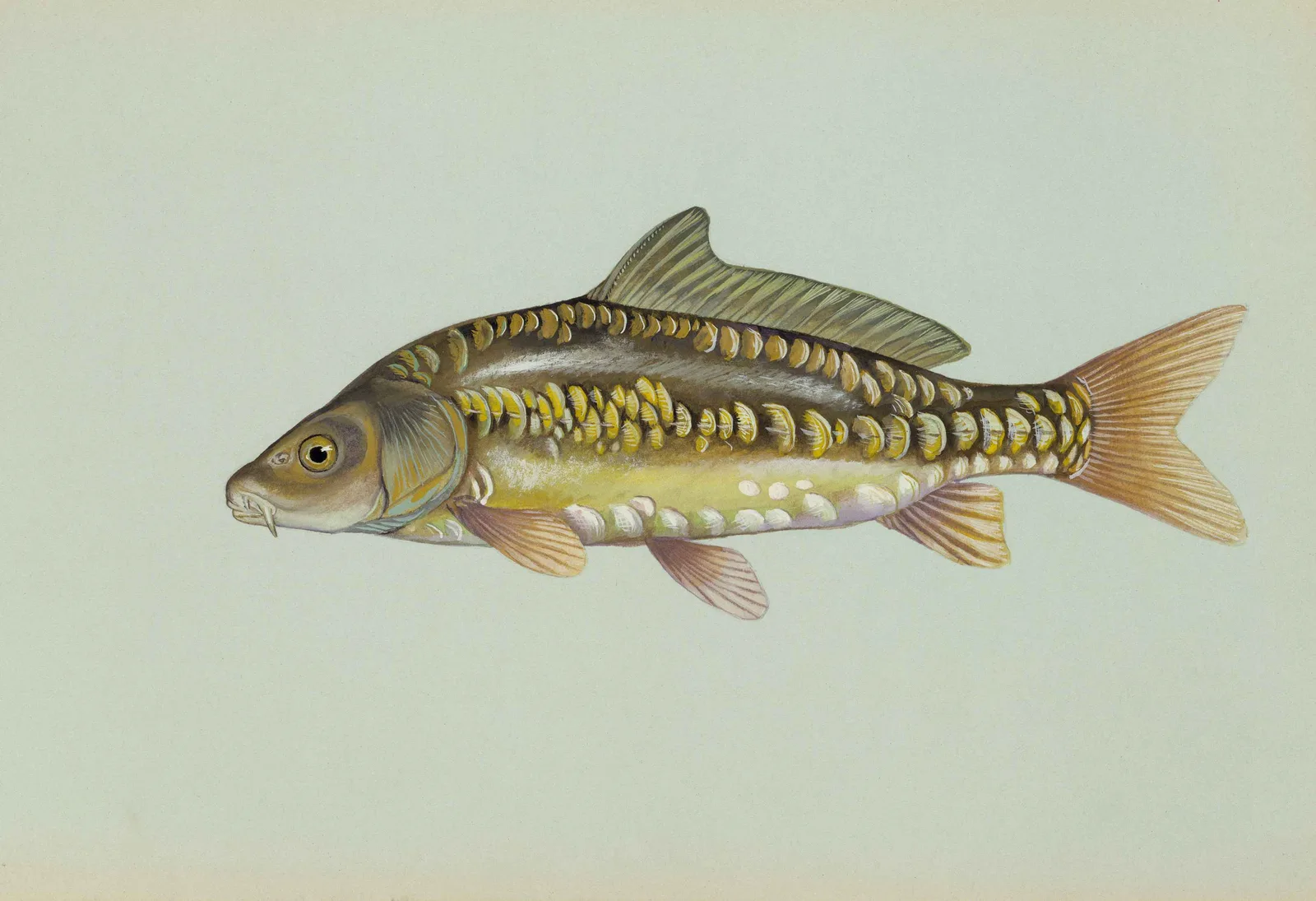
Carp: Common, Grass, Silver and Bighead Carp and the Fish Mistaken for ThemEvery carp in US waters told apart: common, mirror, grass, bighead, silver and black carp, goldfish and buffalo, with records and eating.
 Carp Bait: What Works, Homemade Recipes and How to Rig It
Carp bait: start with canned sweet corn or bread. Eight baits with their recipes and ratios (the 1-2-3 doughball, pack bait, field corn) and the chum laws.
 Carp Fishing: How to Catch Carp With a Simple Rig or a Hair Rig
Carp fishing for beginners: the setup, where carp feed by season, bread free-lined close in, and the hair rig with a baitrunner for big carp.
Sources
- Grass Carp (Ctenopharyngodon idella) - Species Profile (USGS Nonindigenous Aquatic Species)
- Grass Carp | Missouri Department of Conservation
- Grass carp (Ctenopharyngodon idella) | Minnesota DNR
- Have you seen an invasive carp? (Minnesota DNR flyer, 2024)
- Triploid Grass Carp Fishing Tactics and Tips (Connecticut DEEP, 2023)
- California's Invaders: Grass Carp (California Department of Fish and Wildlife)
- Grass Carp Frequently Asked Questions | Virginia DWR
- SCDNR - Using Triploid Grass Carp for aquatic plant control in SC
- Grass Carp | FWC
- Grass Carp | Outdoor Alabama
- Grass Carp - Aquaculture, Fisheries, & Pond Management (Texas A&M AgriLife Extension)
- Grass Carp | Invasive Carp Regional Coordinating Committee
- Controlling Aquatic Vegetation with Grass Carp (Noble Research Institute)
- IGFA world records, Carp, grass
- IGFA world records, Carp, common
- IGFA world records, Carp, bighead
- IGFA world records, Carp, silver
- State Records | Oklahoma Department of Wildlife Conservation
- Common Carp (Cyprinus carpio) - Species Profile (USGS Nonindigenous Aquatic Species)
- Common Carp | Missouri Department of Conservation
- Bighead Carp | Missouri Department of Conservation
- Silver Carp | Missouri Department of Conservation
- Bighead Carp (Hypophthalmichthys nobilis) - Species Profile (USGS Nonindigenous Aquatic Species)
- Silver Carp (Hypophthalmichthys molitrix) - Species Profile (USGS Nonindigenous Aquatic Species)
- Copi is a fresh and locally caught wild fish | Choose Copi