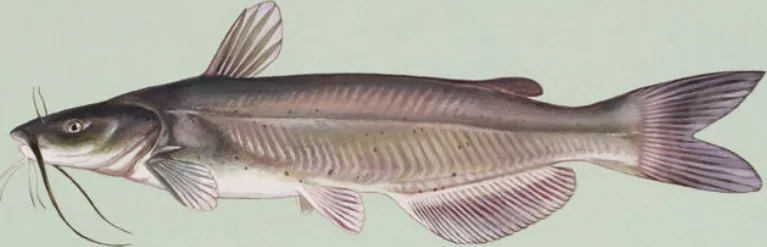
The channel catfish, Ictalurus punctatus, is the most fished catfish in the United States: about eight million anglers a year target it, it is the state fish of Missouri, Kansas, Nebraska and Tennessee, and it is the fish in the pond, the river and the farm-raised fillet. It is smaller than the blue catfish it is confused with, more of a scavenger than the flathead, and it feeds by taste and smell in water where sight is useless, which is why the bait argument matters more for channels than for any other fish. Below: the identification rule, the habitat, the spawning and growth numbers, the bait consensus and the record, each from the agency or publication it came from.
A channel catfish has taste buds over its whole body, including the tail. It can taste a bait it has not touched yet, which is why smell beats sight in every bait argument.
Identification
Two marks separate a channel catfish from a blue catfish, and color is not one of them. The first is the anal fin: a channel catfish has 24–29 rays and the fin’s outer edge is rounded, “curved across the bottom” in Oklahoma’s description; a blue catfish has 30–35 rays and a straight-edged fin, which Texas puts as “always has 30 or more”. The second is the spots: channel catfish carry scattered dark spots on the back and sides, but Missouri’s field guide notes they are often absent on the smallest young and on large adults, which is exactly where the confusion happens. Both have deeply forked tails; the flathead does not. Farmed hybrids (female channel crossed with male blue) turn up in stocked ponds and muddle the counts.
| Mark | Channel catfish | Blue catfish | Flathead catfish |
|---|---|---|---|
| Anal fin rays | 24–29 | 30–35 | 14–17 |
| Anal fin edge | Rounded | Straight | Short and rounded |
| Tail | Deeply forked | Deeply forked | Squared, slight notch |
| Jaw | Upper jaw longer | Upper jaw slightly longer | Lower jaw projects |
| Color | Olive-brown to slate blue, silvery belly, scattered spots on most fish | Pale bluish silver, no spots, steep straight back | Yellow-brown, heavily mottled |
| Common size | 12–32 in (30–81 cm), 1–15 lb (0.5–6.8 kg) | 20–44 in (51–112 cm), 3–40 lb (1.4–18 kg) | 15–45 in (38–114 cm), 1–45 lb (0.5–20 kg) |
Where they live
The range runs from southern Canada into northern Mexico through the central drainages, and stocking has carried the fish to almost every state. Missouri’s guide describes the water: “large, rather turbid streams with low or moderate gradients”, and Texas says the same, “most abundant in large streams with low or moderate current”. Adults hold near cover in the larger pools and deep holes by day, in drift piles, undercut banks and below logs, and “move onto riffles or into the shallows of pools to feed” at night; young fish tolerate faster current and shallower water. Channel catfish also thrive in ponds and reservoirs, tolerate brackish water up to about 11 parts per thousand salinity, and are the catfish most likely to be found in a farm pond or a city lake.
Season and behavior
Channel catfish are cavity nesters. The male picks a dark, secluded site, a crevice in a drift pile, a burrow in a bank, a space under rocks, an old bucket, and guards the eggs and then the fry, eating little while he does. The agency numbers agree on the trigger and vary on the rest.
| Source | Spawn trigger | Season | Eggs | Hatch |
|---|---|---|---|---|
| Texas Parks and Wildlife | Water reaches 75 °F (24 °C) | Late spring, early summer | – | About a week; fry stay in the nest another week |
| Missouri Department of Conservation | 75 °F (24 °C) | Last week of May to third week of July | – | About a week; fry in the nest 7–8 days |
| U.S. Fish & Wildlife Service | 72–73 °F (22–23 °C) | April through July by latitude | – | About 7 days; larvae 12–16 days |
| SRAC (aquaculture) | 75–85 °F (24–29 °C), optimum about 80 °F (27 °C) | – | 3,000–4,000 per lb of female | 8 days at 78 °F (26 °C), one day less per 2 °F warmer |
| Oklahoma Wildlife Department | 75 °F (24 °C) | Late May or early June | About 10,000 per female | 6–10 days |
Temperature runs the rest of the year too. The aquaculture literature puts optimum growth at 75–85 °F (24–29 °C), slow growth below 65 °F (18 °C) and feeding stopping below about 50 °F (10 °C); channel catfish survive from just above freezing to nearly 100 °F (38 °C). For the angler that means the bite builds through spring, peaks from pre-spawn through early summer, holds all summer at night, and fades in late fall. The pre-spawn weeks and the post-spawn feed are the easiest numbers of the year; during the spawn itself the guarding males are hard to catch on bait.
How to catch them
Channel catfish taste with their whole body: taste buds cover the skin and are densest on the barbels and gill arches, and the species can detect amino acids at about one part in 100 million. The bait consensus follows the biology. For numbers, the guides agree on prepared punch and dip baits, which break down in the water and lay a scent trail; chicken liver, nightcrawlers and shrimp are the grocery-store versions. For size, fresh cut bait, shad, perch or bluegill, beats prepared bait, and fresh beats frozen. The rig is a slip-sinker rig, an egg sinker sliding on the main line above a swivel and a 12–36 in leader to a 2/0–4/0 circle hook, fished still on the bottom; the catfish hub has the rig table and the hooks hub the sizes. Fish the deep holes by day and the shallow flats and riffles at night, and in rivers the outside bends and the head of the pool below a riffle. Channel catfish also hit lures, mostly by accident: small crankbaits and jigs on rock in summer take them regularly enough that the tournament magazines run articles on it.
Handling and eating
Channel catfish do not sting with their whiskers; the danger is the three spines, one in the dorsal fin and one in each pectoral fin, which lock upright when the fish is stressed and carry a mild venom that causes swelling. Small fish under about 16 in (40 cm) are the ones that hurt, because their spines are needle-sharp; big fish have dull spines. Hold a small channel cat with the hand behind the pectoral spines and the web of the thumb behind the dorsal spine, and a big one by the lower jaw or with a net. They are excellent eating, the basis of a $421 million farmed-catfish industry in 2021, and wild fish under about 5 lb (2.3 kg) are the best table fare; larger fish accumulate more mercury and some states publish advisories by waterbody, so check the state health department page for the water you fish.
Size, age and records
Most channel catfish weigh 1–15 lb (0.5–6.8 kg); fish over 30 lb (13.6 kg) are rare anywhere. In natural waters they do not reach a pound until two to four years old, and Missouri notes that few live beyond six or seven years, though individuals past ten are common and the aquaculture literature records fish of 20 and even 40 years. The all-tackle world record is 58 lb (26.3 kg), caught by W. B. Whaley at the Santee-Cooper reservoir in South Carolina on 7 July 1964, 47.25 in long with a 29 in girth, on a bucktail jig; it has stood for six decades, and Texas has produced channels over 36 lb (16.3 kg). Bag and length limits vary by state and often by lake; Texas, for example, allows 25 channel and blue catfish a day combined with no minimum length on most water but only 10 over 20 in, and tighter limits on a dozen trophy reservoirs. The state pages carry the current rules.
Related
The catfish hub covers all the species, the bait table and the rigs; the blue catfish and flathead catfish pages under it cover the two fish a channel catfish is confused with; the bass hub is the other freshwater pillar. For the gear, start with rods and hooks.
Sources
- Missouri Department of Conservation, channel catfish field guide
- Texas Parks and Wildlife, channel catfish
- U.S. Fish & Wildlife Service, channel catfish
- SRAC Publication 180, Channel catfish: life history and biology (The Fish Site copy)
- Oklahoma Department of Wildlife Conservation, channel catfish
- Outdoor Life, the biggest North American catfish of all time
- Catfish Edge, how to hold a catfish