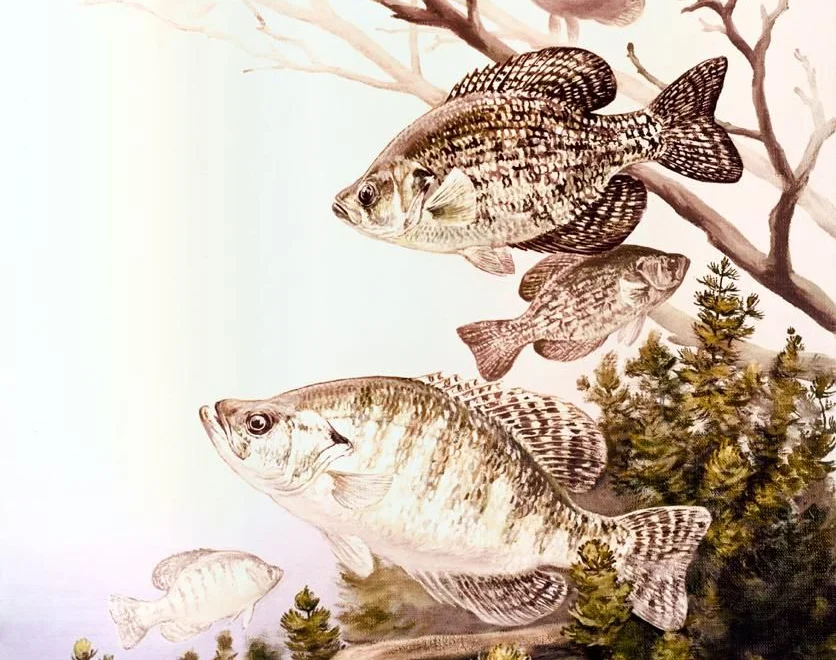
Crappie are the schooling panfish of brush piles, docks and standing timber, and two species answer to the name: the black crappie and the white crappie. Most run 9–10 in (23–25 cm) and well under a pound, and they bite small minnows and 1/16 oz jigs on light line. Spring is the easy season, when black crappie spawn at 58–68 °F (14–20 °C) and white crappie at 60–70 °F (16–21 °C) in shallow coves.
The heaviest crappie the IGFA has ever recorded, a 5 lb 7 oz black crappie from a private Tennessee pond in 2018, had to pass a DNA test before the state would call it a black crappie.
Start here
- Black crappie: the speckled, clear-water crappie, and how old a 13-incher is.
- White crappie: the barred crappie of muddy reservoirs, and the 1957 record nobody has beaten.
- Crappie fishing: how deep the fish sit each season and what to throw.
- Crappie jigs: which plastic body and which head weight for the depth.
- Crappie bait: which minnow and what size, and when a jig wins instead.
Black or white: which crappie is it?
Count the spines on the front of the back fin. Seven or eight is a black crappie, five or six a white crappie, and that count is the mark the state agencies lead with. Color is the trap: a spawning white crappie male darkens on the throat and head, and a white crappie from deep or stained water can hide its bars.
| Mark | Black crappie | White crappie |
|---|---|---|
| Dorsal spines | 7 or 8 | 5 or 6, usually 6 |
| Pattern | Speckles and blotches all over, no bars | 5–10 faint vertical bars |
| Dorsal-fin base | As long as the distance from the fin to the tip of the mouth | Clearly shorter than that distance |
| Head profile | Less concave | Concave, sloping like a ski jump from dorsal fin to jaw |
| Weight at length | Heavier at any length | Lighter, but grows longer faster |
| Water | Clear, weedy, still | Turbid, flowing, little vegetation |
| Spawn | First, a few degrees cooler | Second |
Jerald Horst, a retired Louisiana State University fisheries professor, prefers the dorsal-base rule because he found a few fish whose spine count belonged to the other species. Hybrids blur every mark, and in Mississippi the state stocks one on purpose, the sterile Magnolia crappie. The black crappie vs white crappie page has the checks in order.
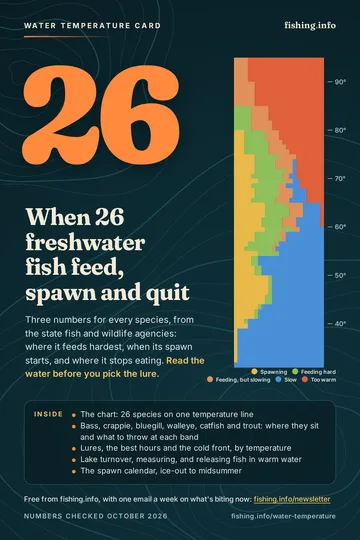
Free card: what 26 species do at your water temperature
Plus one email a week on what's biting now. No sales pitches. Privacy.
Where do crappie live, and which one is in your lake?
Both species live in lakes, reservoirs and the slow backwaters of rivers, almost always near cover: submerged timber, brush, weeds or docks. Which one dominates comes down to the plants. A 2026 study of 70 reservoirs that hold both found black crappie more abundant where submerged vegetation is dense and white crappie ahead where it is sparse or absent. The authors credit body shape suited to each habitat, not muddy water as such.
Clear, weedy natural lakes and blackwater swamps are black crappie water. Big muddy rivers, Horst notes for the Mississippi and the Atchafalaya, are almost always white crappie. Neither species suits a farm pond: Oklahoma’s wildlife department warns that both tend to overpopulate small water.
The short version: how crappie are caught
Spring starts on the first drop outside the spawning coves at 50–55 °F (10–13 °C). The fish then move onto brush and reeds to spawn, usually in 3–10 ft, shallowest in stained water and deepest in clear water; the spawn temperature page has the detail. Summer pushes them to deep brush and channel edges, and crappie fishing follows them through the year. A small jig on a 1/16 oz jig head or a minnow under a slip bobber covers most of the year, and crappie lures covers the spinners, crankbaits and kits beyond the plain jig. Light line matters: Pennsylvania’s agency lists 4–8 lb test for black crappie and 2–6 lb for white, with lures of 1/32–1/8 oz.
Two methods belong to crappie fishing above all. Spider rigging is slow trolling with many long rods fanned off the bow. Dock shooting bends a short rod like a slingshot to fire a jig far under the boards.
How big do crappie get?
A crappie of 12 in (30 cm) is a good fish and an old one in the North. Pennsylvania’s age table puts a 12-in black crappie at 8 years and a 12-in white at 6.5; a 9-incher is about four. In Tennessee and Kentucky, Steve McCadams writes in CrappieNOW, a white crappie reaches the 10-in limit in about three years. The world records are 5 lb 7 oz for a black crappie (2018) and 5 lb 3 oz for a white (1957).
How many can you keep, and are they good to eat?
Ten to 30 a day, depending on the state, and some lakes add a minimum length; check the booklet before you fill a cooler.
| State | Daily limit | Length limit |
|---|---|---|
| Minnesota | 10 | None |
| Texas | 25 | 10 in (25 cm) |
| Mississippi | 30; 10 on Grenada, Enid, Sardis and Arkabutla | 12 in (30 cm) on those four lakes |
| Missouri | 30 | None statewide |
| Arkansas | 30 | None statewide |
The Missouri Department of Conservation calls crappie “feisty, tasty, and a favorite of anglers”. Minnesota’s Department of Health puts crappie in its most generous statewide group, with bluegill and yellow perch. Adults not planning a pregnancy may eat up to four servings a week; children and anyone who is or may become pregnant, one.
The names, if you want them
Crappie are the two species of the genus Pomoxis, in the sunfish family with bluegill and the black bass, so a crappie is a sunfish and not a bass. The black crappie is P. nigromaculatus, “black-spotted”; the white is P. annularis, “ringed”, for its bars. Black crappie are specks or speckled perch in Florida and calico bass in the Northeast. In south Louisiana both species are sac-a-lait, in the north of the state white perch. Papermouth, for the thin skin around the mouth that tears on a hard hookset, fits both. The rest of the sunfish, from bluegill to rock bass, are on the panfish page.
Free download
The water temperature card
Read your water temperature and the card tells you who is spawning, who is feeding and what to throw. 26 species, 16 pages, for your phone and the tackle box.
Plus one email a week on what's biting now. No sales pitches. Privacy.
Sources
- Missouri Department of Conservation, black crappie
- Missouri Department of Conservation, white crappie
- Iowa DNR, white crappie (dorsal-fin base, turbid water, spawning)
- Iowa DNR, black crappie (clear water, spawning depth and temperature)
- Louisiana Sportsman, Jerald Horst, It's as clear as black and white
- Dannis et al. (2026), Morphological variation between black crappie and white crappie and its influence on species distribution, Environmental Biology of Fishes
- Pennsylvania Fish and Boat Commission, crappie management plan (Table 1, age and weight at length)
- CrappieNOW, Steve McCadams, How fast do crappie grow?
- IGFA world records, black crappie and white crappie
- Oklahoma Department of Wildlife Conservation, white crappie
- Texas Parks and Wildlife, white crappie (breeding color)
- Chicago Sun-Times (IGFA release), Lionel Ferguson's 5 lb 7 oz black crappie approved as world record
- Minnesota Rules 6262.0200, possession limits
- Texas Parks and Wildlife, freshwater bag and length limits
- Mississippi DWFP, new crappie regulations
- 40 Miss. Code R. 3-1.4, statewide creel limits
- Missouri Department of Conservation, crappie fishing regulations
- Arkansas Code R. 002.01.22-021, N1.01 daily limits
- Minnesota Department of Health, fish consumption guidelines (updated August 2026)