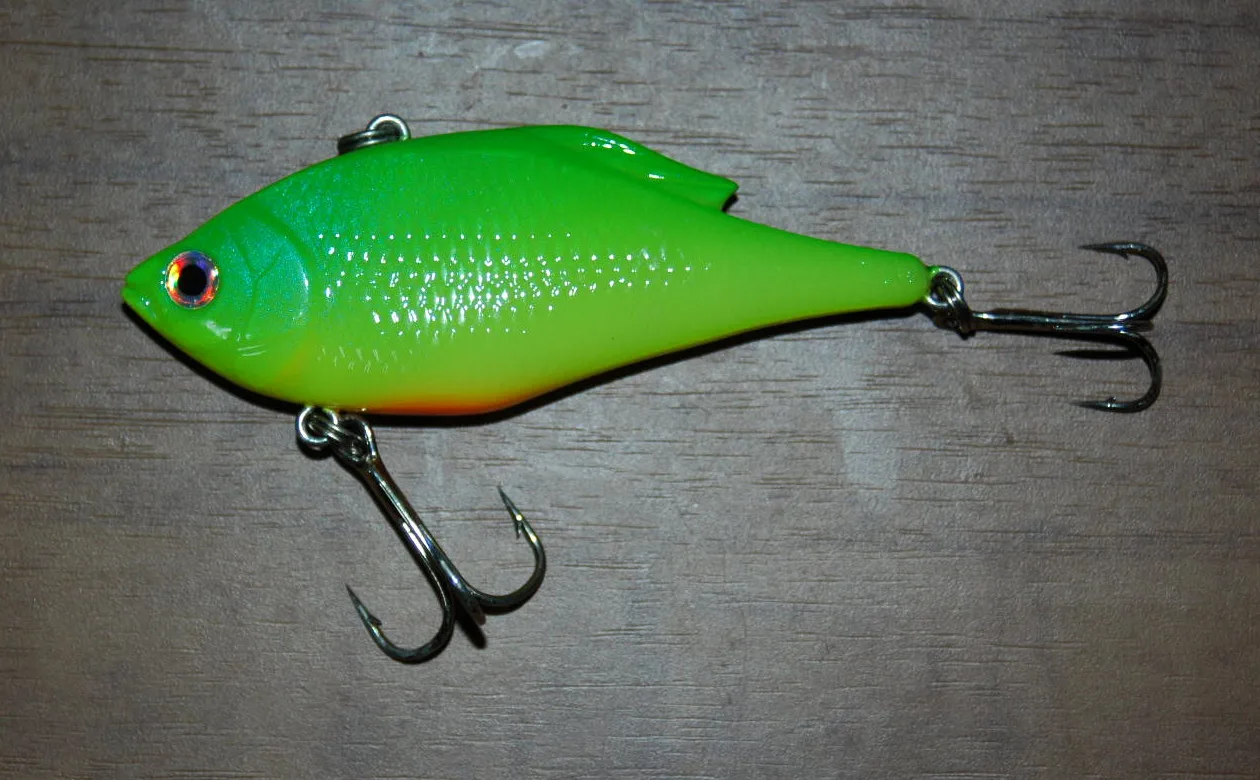
A lipless crankbait is a flat-sided, fish-shaped plug with no diving lip, a line tie on its back and a chamber of rattles inside. Without a lip it does not dive; it sinks, and you choose the depth by counting it down. On a straight retrieve the back tie keeps its nose down, and it swims with a tight, fast shimmy and a rattle that carries through stained water. Its season is the cold water before the spawn, ticked and ripped through short grass.
A lipless crankbait has no depth. It sinks until you start reeling, which means it fishes 2 ft of grass in March and 30 ft of ledge in January with the same knot.
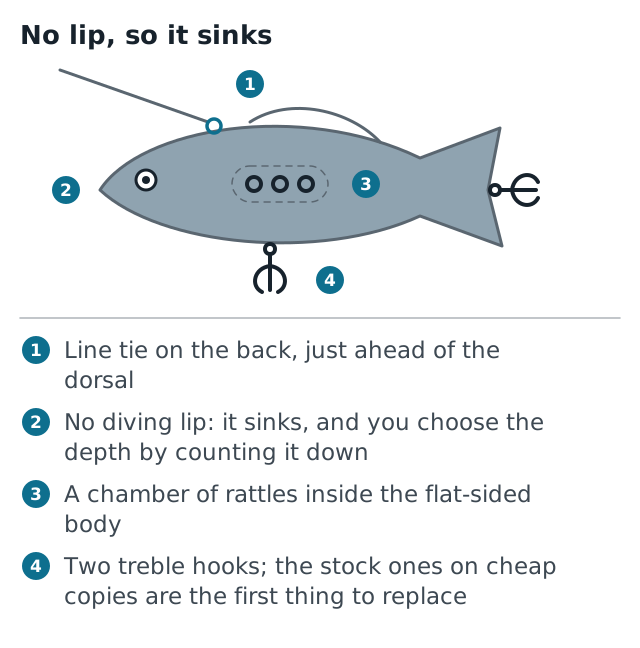
The parts of a lipless crankbait. Drawing: fishing.info.
What rod, reel and line?
The tackle is built around one problem. Two treble hooks hold a thrashing largemouth by small points, and the bait is moving fast when it is hit. A stiff rod tears those points out on the first jump, so every piece of the outfit gives a little and the hooks do not have to.
- Rod: 7 ft to 7 ft 6 in (2.1–2.3 m), medium or medium-heavy, moderate action, glass or composite. Tackle Warehouse’s gear guide starts every season with that rod, because its bend absorbs “head shakes and surges without tearing the hook points out of the fish’s mouth.” Randall Tharp fishes a 7 ft 4 in (2.2 m) medium-heavy cranking rod on Guntersville. Kevin VanDam uses a 7 ft (2.1 m) medium with a soft tip, because winter bass inhale the bait on the fall. The exception is thick grass, where a faster graphite rod pops the bait free.
- Reel: a baitcaster between 5.3:1 and 7.1:1. About 7:1 is the gear guide’s all-year pick; VanDam drops to 5.3:1 in winter so the bait crawls.
- Line: 12–17 lb fluorocarbon as the default, braid in grass, mono over shallow weeds. Fluorocarbon sinks and disappears, and the gear guide calls 12 lb the sweet spot. James Niggemeyer and VanDam go to 16–20 lb in cold water, because the thicker line slows the fall. Tharp ties 30 lb braid straight to the bait; it has no stretch, so it rips the bait out of hydrilla. Fred Roumbanis floats the bait higher over short spring grass on 20 lb mono: “the heavier the mono, the higher your bait will ride.” The fluorocarbon vs monofilament and braided line pages carry the detail.
- The bait: a 1/2 oz (14 g) in red craw and one in chrome with a blue back cover the first season; the model table adds the rest.
Which size?
| Size | Length | Weight | For |
|---|---|---|---|
| Tiny Trap | 1.5 in (3.8 cm) | 1/8 oz (3.5 g) | Panfish, trout, ultralight |
| Mini-Trap | 2.5 in (6.4 cm) | 1/4 oz (7 g) | Ponds, clear shallow water, small forage |
| Original | 3 in (7.6 cm) | 1/2 oz (14 g) | The standard for bass: grass flats, yo-yoing, count-down |
| Mag-Trap | 3.5 in (8.9 cm) | 3/4 oz (21 g) | Deep water, wind, big fish; the maker says its rattles can be felt at 40 ft |
| Super-Trap | 4 in (10 cm) | 1 oz (28 g) | Stripers, deep winter bass, schooling fish |
The sizes are the Rat-L-Trap’s; other makers run the same ladder, give or take an eighth. Two pros’ rules put them to work. Greg Hackney throws “the 1/2 ounce most of the time,” drops to a 1/4 oz after a cold front and goes up to 3/4 oz in stormy weather. Alton Jones picks by the grass: 1/2 oz where the tops reach 2–5 ft (0.6–1.5 m) and 3/4 oz where the grass is deeper. Where it is under 2 ft (0.6 m) and he wants to go slow, he throws a Cotton Cordell Super Spot, lighter for its body than most.
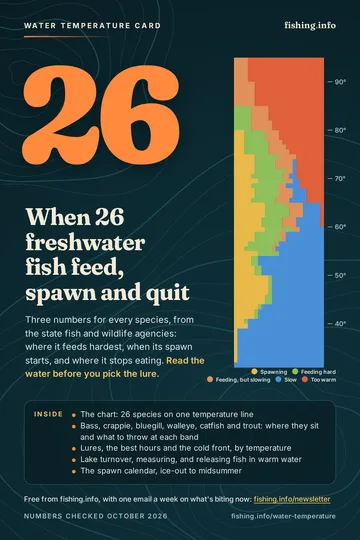
Free card: what 26 species do at your water temperature
Plus one email a week on what's biting now. No sales pitches. Privacy.
Which model, and which sound?
| Model | Length | Weight | Sound and hooks | Price |
|---|---|---|---|---|
| Bill Lewis Rat-L-Trap Original | 3 in (7.6 cm) | 1/2 oz (14 g) | Multi-ball rattle tuned to a “distressed baitfish” sound; Mustad trebles | $5–9 |
| Strike King Red Eye Shad | 2–3 in (5–7.6 cm) | 1/4, 3/8, 1/2, 3/4 oz (7–21 g) | Free-floating rattles; shimmies as it falls; VMC trebles | $7.59–8.59 |
| Rapala Rippin’ Rap | 2–2 3/4 in (5–7 cm) | 5/16, 1/2, 7/8 oz (9–25 g) | Loud BB rattle; VMC black-nickel trebles | $9.99 |
| Lucky Craft LV-500 | 3 in (7.6 cm) | 3/4 oz (21 g) | Brass and glass rattles, a lower, duller note; forward weight for casting | $15.99 |
| Booyah One Knocker | 2 1/4–3 in (5.7–7.6 cm) | 1/4, 1/2, 3/4 oz (7–21 g) | One oversized tungsten ball; a deep, slow thump | $8.99 |
| Yo-Zuri Rattl’n Vibe One Knock | 2 1/2 in (65 mm) | 5/8 oz (18 g) | Single knocker; sharp stock trebles | $9.99 |
| 6th Sense Snatch 70X | 2 3/4 in (70 mm) | 5/8 oz (18 g) | High-pitched rattle chamber; black-nickel trebles | $7.99 |
| Berkley Warpig | 2 3/8–3 in (6–7.6 cm) | 1/4, 1/2 oz (7, 14 g) | Rattle chamber; blunt nose that bumps off stumps; Fusion19 trebles | $9.99–10.99 |
Lengths, weights and prices are from the makers’ and Tackle Warehouse’s pages. There are three sounds, and the pros use them in order. A multi-ball rattle (Rat-L-Trap, Red Eye Shad, Rippin’ Rap) is the loud default for stained water and wind. A one-knocker, a single big rattle, thumps low and slow. Edwin Evers reaches for it in clearer water, and Jones throws it over everything else on Guntersville in early spring: “I’ve just found that I do better with a One Knocker early in the spring.” Silent baits are the third step, for fish that have heard the first two all week.
Most lipless baits fall straight down. Walker Smith notes that the Red Eye Shad shimmies on a slack line, which is why Tharp and VanDam yo-yo it.
How do you retrieve it?
| Retrieve | How | When | Where |
|---|---|---|---|
| Tick the grass (Jones’s “slow roll”) | Reel just fast enough to feel the tops; feel nothing, slow down; load up, speed up | Pre-spawn and fall over short grass; Tharp’s most-days retrieve | Grass flats in 2–6 ft (0.6–1.8 m), grass points |
| Rip through grass | Reel until a stalk loads the rod, snap the tip up, let the bait fall a count; it jumps like a chased crawfish | Cold pre-spawn, 45–55 °F (7–13 °C) | Hydrilla and milfoil flats in 3–8 ft (1–2.4 m), the ditches through them |
| Yo-yo | Let it reach bottom on a semi-tight line, lift the rod 1–3 ft (0.3–1 m), reel the slack, let it flutter down; most bites on the fall | Late November to the spawn (Niggemeyer); winter at 40–52 °F (4–11 °C) | Ledges, channel swings, deep grass in 10–30 ft (3–9 m) |
| Burn and pause | Crank as fast as the reel allows, stop dead about every 10 ft (3 m) so the bait drops for a second | Fall shad schools; fish that follow but will not commit | Open flats, creek mouths, over bait |
| Count-down and straight | Sink at about a foot a second to the depth of the bait or the fish, then reel steadily | Any season; suspended fish | Open water, creek channels, points |
| Vertical jig | Drop it under the boat and work it in 12–36 in (30–90 cm) strokes like a spoon | Winter, deep schools | Bluffs and channel ledges |
Evers’s rule ties the table together: never settle into cast-and-reel. Mix pulls and snaps of the rod tip with speed changes until the fish say which. Set the depth with the rod: tip high to run shallow, tip low and slower to run deep.
Jones explains the pause in the burn: “A fish will follow that fast-moving bait, but with no real intention of eating. When the bait pauses the fish literally runs into it.” Niggemeyer explains why the yo-yo lands more of what it hooks. On the fall a bass swallows the bait; on a burn many are hooked outside the mouth.
How to rip grass on a pre-spawn flat
Lake Guntersville in north Alabama is where the pattern is written every February and March. Randall Tharp built his career there: “If I only had one bait that time of year to use on a grass lake — which Guntersville is — it would be a lipless crankbait.” Alton Jones calls it “the best bait I know of for generating a reaction strike in cold water from a bass that otherwise has no intention of eating.” The steps are theirs.
- Start on the main-lake grass and work back into the creeks. Pre-spawn bass move toward the flats along points, grass beds and creek channels; Tharp fishes those pathways until he finds a concentration. Jones casts within sight of the spawning bay: fish that will spawn in 2 ft (0.6 m) stage in grass in 5 ft (1.5 m).
- Find grass that is crisp, not mushy. Last year’s hydrilla or this year’s first growth, a few inches off the bottom. Jones’s test: “The bait should be self-cleaning with a good rip of the rod.” Gerald Swindle’s shortcut: find the coots and you have found green grass.
- Look for a 3 ft (1 m) change. Tharp says a drop of about 3 ft alongside the flat is enough; Jones looks for the small ditch or drain that leads to the spawning bay.
- Pick the size by the top of the grass. A 1/2 oz where it tops out in 2–5 ft (0.6–1.5 m), a 3/4 oz deeper; red craw first, chrome and blue second.
- Cast long and reel until the bait ticks. Barely touching the tops is the trigger. No contact, speed up; bogging down, slow down.
- When a stalk loads the rod, snap, do not pull. A sharp upward stroke rips the bait free and makes it jump. Let it fall a count on a semi-slack line and reel again. The bite comes on the jump or the first turn of the handle after it.
- On a bitter day, drag it. Tharp once weighed 27 lb (12 kg) from 2 ft (0.6 m) of 36 °F (2 °C) water. He held the rod tip high, barely turned the handle and let the bait drag through grass stubble. Swindle’s version: pick a pocket with less current and cleaner water and fish it clean.
When does it work best?
Greg Hackney’s rule is the one to remember: “lipless will catch you really big fish when the water temperature is between 45 and 55 degrees.”
| Water | Where the bass are | Retrieve and size |
|---|---|---|
| Below 45 °F (7 °C) | Deep: ledges, channel swings and bluff ends near the spawning flats | Yo-yo or jig a 1/2–3/4 oz on a slow reel; 17–20 lb fluorocarbon to slow the fall (VanDam) |
| 45–55 °F (7–13 °C) | Staging on the first grass between deep water and the flats | Hackney’s big-fish window: tick short grass with a 1/2 oz and rip when it loads; red craw |
| 55–60 °F (13–16 °C) | On the flats, in the grass, the last days before the beds | Tick and rip in 2–6 ft (0.6–1.8 m); the bait’s best two weeks of the year |
| 60–70 °F (16–21 °C) | Spawning, then guarding and recovering | Mostly other baits; a 1/4 oz over scattered grass for cruising fish |
| Above 70 °F (21 °C) | Schooling on points and creek mouths at first light; deep grass edges | A 1/4 oz burned over schoolers, or counted down to the deep edge; start on wind-blown banks (Evers) |
| Cooling, 65 to 55 °F (18 to 13 °C) | Following shad into creek arms and pockets | Burn and pause a 1/4–1/2 oz in shad colors; Evers’s one bait for fall |
The water temperature page for bass sets these bands beside every other lure, and the bass spawn page turns 60 °F into a month for your state. The best bass lures page puts the lipless bait in its season next to the rest.
Which color?
- Red craw, 45–60 °F (7–16 °C). The gear guide says red craw “really gets fish fired up” before the spawn, and Jones’s number one is Rayburn Red. The Bill Lewis Hammer Trap, which Field & Stream says “took the spring fishing season by storm” in 2026, is red.
- Chrome with a blue back. Evers’s “just a good all-around color” when he is unsure; chrome with a black back in fall.
- Gold on sunny days. VanDam’s gold sexy shad for bright skies and fairly clear water.
- Chili craw and solid colors in dirty water. Chili craw is VanDam’s cloudy-day and muddy-runoff color. Evers goes to white or a solid color in stained water, a hint of chartreuse when it is really dirty, and ghost minnow when it is clear.
Should you change the hooks?
Two schools, and the water temperature decides between them. The gear guide and Hackney upgrade to short-shank, extra-wide-gap trebles in the largest size the bait carries without tangling. Hackney runs size 2 Gamakatsu EWGs on his Red Eye Shad for “a bigger bite without tangling.” Owner reviews of that bait report stock trebles bent by 3 lb (1.4 kg) fish.
Gerald Swindle says leave them alone in cold water. The bait was engineered around its stock hooks, and the lighter wire penetrates a lethargic bass more easily, where heavy hooks dull the action and tear free. Walker Smith sorts the stock hooks: the Super Spot’s bend under load; the Rat-L-Trap’s Mustad Triple Grips, the Rippin’ Rap’s VMCs and the Warpig’s Fusion19s fish from the pack.
Change the split rings with the hooks and check the line-tie ring; it takes every rip. In wood, take the back hook off. The gear guide notes that a one-treble lipless bait comes through stumps like a squarebill, and a swivel with a small willow blade on the empty hanger adds flash. The treble hook page covers the hooks, size by size.
How do you land a bass on trebles?
Do not swing. The bass hooks itself on the moving bait, so when the rod loads, keep reeling and sweep sideways. Then keep the rod bent and the pressure even. Set the drag a click lighter than for a jig and keep the fish’s head in the water at the boat; a lipless bait on a jumping bass is a lever that opens a treble.
Lipless, squarebill or blade bait?
| Lipless crankbait | Squarebill crankbait | Blade bait | |
|---|---|---|---|
| Depth | Any; it sinks | 0–5 ft (0–1.5 m); floats up at rest | Any; sinks fast |
| Cover | Grass; hangs in wood and rock | Wood, rock, riprap; deflects | Clean bottom, rock, deep edges |
| Sound | Rattles or one knocker | Wobble, usually silent | Hard vibration, no rattle |
| Season | Pre-spawn, fall, winter | Spring to fall, 55 °F (13 °C) and up | The coldest water, under 45 °F (7 °C) |
| Retrieve | Tick, rip, yo-yo, burn | Steady, bump and deflect | Lift and drop |
The squarebill crankbait takes over where the lipless hangs: stumps, laydowns, riprap, anything under 5 ft (1.5 m). The jerkbait wins on clear, calm, cold water, where a rattle spooks more fish than it calls. The deep diving crankbait holds a ledge the lipless can only yo-yo across. A blade bait is the lipless bait’s cold-water cousin without the chamber, for bass under 45 °F that want a lift and a drop and nothing else. Matted grass is frog water. The crankbaits hub lines the family up by depth, and the lures hub maps every family.
Mistakes to avoid
- Reeling through the grass. The bait comes back with a salad; the tick and the rip are the retrieve.
- A fast, stiff rod. It tears the trebles out on the jump; only thick hydrilla calls for one.
- Over-reeling. VanDam’s complaint: too many anglers fish it too fast. In cold water drop to 5.3:1 and keep it on the bottom.
- One sound all day. Rotate multi-ball, one-knocker and silent where everyone throws the same red bait.
- Swapping hooks in winter, or never swapping them. Heavy hooks cost action and penetration on lethargic fish; flimsy ones cost the biggest fish of spring.
- Fishing it only in spring. The winter yo-yo bite is the one most anglers never try, and Evers would pick a lipless bait over anything for fall.
Where did the Rat-L-Trap come from?
Bill Lewis, a former bomber pilot, built the first lipless crankbait, the Rat-L-Trap, in Louisiana around 1970. He sold it from the trunk of his car at the marinas on Toledo Bend. The built-in rattle chamber was the innovation that, by Bass Pro Shops’ account, spread to other kinds of lure, and the baits are still built by hand in Alexandria, Louisiana.
Free download
The water temperature card
Read your water temperature and the card tells you who is spawning, who is feeding and what to throw. 26 species, 16 pages, for your phone and the tackle box.
Plus one email a week on what's biting now. No sales pitches. Privacy.
Related
Section guide
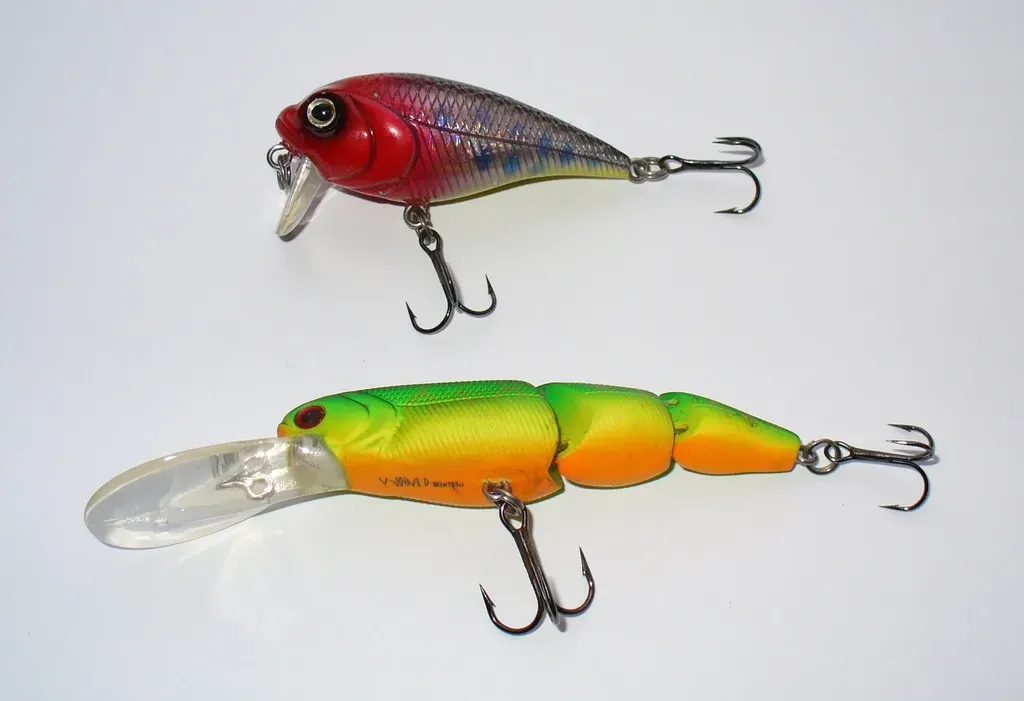
Crankbaits and Jerkbaits: Depth Classes, Lips and How to Fish ThemCrankbaits by running depth, squarebill to 25-foot diver, plus lipless baits and suspending jerkbaits: how the lip sets depth, the rod and line, the histories.
 Jerkbait: How to Fish It in Cold Water, the Cadence, and Which to Buy
A jerkbait is a slender minnow plug twitched and paused; suspending models hang in place at 38–55 °F where bass will not chase. The cadence by temperature.
Sources
- Bass Pro Shops, classic lures: the Bill Lewis Rat-L-Trap
- Bill Lewis Lures, Rat-L-Trap
- Bill Lewis Lures, Original Rat-L-Trap (specifications)
- Wired2Fish, Bill Lewis Rat-L-Trap review
- Wired2Fish (Walker Smith), best lipless crankbaits for bass
- Wired2Fish, Edwin Evers: 5 tips for better bass fishing with lipless crankbaits
- Wired2Fish, Gerald Swindle's 4 lipless crankbait tips for winter and prespawn
- Bassmaster (Louie Stout), Randall Tharp: 3 keys to lipless cranking on Guntersville
- BassResource, Alton Jones: lipless crankin' tips from a Classic champ
- Bassmaster (Greg Hackney), don't neglect lipless crankbaits or spinnerbaits this spring
- Bassmaster, Kevin VanDam: lipless crankbaits for winter bass
- Bassmaster, James Niggemeyer: when to yo-yo a lipless crankbait
- Bassmaster (Fred Roumbanis), 3 lines for lipless crankbaits
- Bassmaster, Edwin Evers: selecting the right lipless crankbait
- Tackle Warehouse, lipless crankbaits gear guide (rods, line, reels, modifications)
- Tackle Warehouse, Strike King Red Eye Shad (sizes, prices, owner reviews)
- Rapala, Rippin' Rap (sizes and weights)
- Tackle Warehouse, Lucky Craft LV 500
- Lurenet, Booyah One Knocker (specification table)
- Tackle Warehouse, Yo-Zuri Rattl'n Vibe One Knock
- 6th Sense Fishing, Snatch 70X
- Tackle Warehouse, Berkley Warpig
- In The Spread, winter bass fishing: Rat-L-Trap presentations
- Field & Stream (Shaye Baker), best crankbaits of 2026