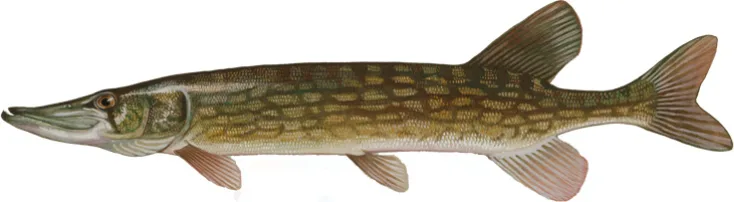
The chain pickerel (Esox niger) is the pike of the eastern pond: commonly 10 to 18 in (25–46 cm), marked with dark chain links on a yellow-green side, and with a world record of 9 lb 6 oz (4.25 kg) that has stood since 1961. It keeps biting under the ice when little else does. Below: how to tell it from a small pike and from the two little pickerels, how old a fish of each length is, where it lives through the year, and what the surveys and the specialists say about catching and eating it.
A chain pickerel needs more than five years to reach 18 in. The world record of 9 lb 6 oz beat a Massachusetts fish by a single ounce, and that fish’s captors lied about which lake it came from.
How to identify a chain pickerel
Three marks, all from Pennsylvania Fish and Boat Commission and Connecticut DEEP.
- The tear. A dark bar drops from the eye, straight down or tilted slightly. Pennsylvania calls it “a dark mark, like a clown’s painted tear.”
- The chain. Dark, interlocking lines on a yellow-green side, like links laid end to end.
- The scales on the head. Both the cheek and the gill cover are scaled all over.
The fins are pale and unmarked, with no red in them. The snout is long: the distance from the nose tip to the front of the eye is greater than from the back of the eye to the edge of the gill cover.
Chain pickerel vs pike
A small northern pike is the usual mix-up, and a young pike wears slanted light and dark bars that can pass for a pickerel’s pattern. Check four things.
- Gill cover. A pickerel’s is fully scaled. A pike has scales on the top half only.
- Pattern. A pike has rows of pale, bean-shaped spots on dark green. A pickerel has dark chains on a light side.
- Under the eye. The pickerel carries the dark tear. No agency lists one for northern pike.
- Fins. Pennsylvania describes pike fins with black blotches and yellow, orange or red color. A chain pickerel’s are plain.
Size settles the rest. In Pennsylvania’s survey data a pike averages about 14 in (36 cm) at age one and passes 30 in (76 cm) around age eight. A chain pickerel averages about 9 in (23 cm) at age one and levels off near 21 in (53 cm). All four big members of the family sit side by side on the pike family page.
The three pickerels compared
North America has three pickerels. The chain is the only one an angler targets. The redfin and the grass pickerel are two forms of one species, Esox americanus, and neither tops a foot very often.
| Mark | Chain | Redfin | Grass |
|---|---|---|---|
| Size | Often 10–18 in (25–46 cm); can pass 30 in | 12 in (30 cm) at most | Seldom over 10–12 in; 14 in (36 cm) maximum |
| Side | Dark chain links | Wavy pale marks, like irregular bars | Dusky, curved streaks; fainter |
| Bar under eye | Vertical, or nearly | Slants backward | Trails slightly backward |
| Fins | Pale, unmarked | Reddish, unspotted | Amber or dusky, no red |
| Snout | Long | Short and broad | Short |
| Home water | Atlantic and Gulf slopes | Atlantic coast, Massachusetts to Florida | Mississippi basin and Great Lakes |
All three have a fully scaled cheek and gill cover. That is what separates even a 6 in (15 cm) grass pickerel from a baby pike or muskie.
Redfin and grass look alike, and Pennsylvania’s advice is to use the map. In that state the redfin lives east of the Allegheny Mountains and the grass pickerel in the northwest.
Where chain pickerel live
USGS gives the native range as the Atlantic slope from southwest Maine to southern Florida, the Gulf Coast west to the Sabine and Red rivers in Texas, and the Mississippi basin north to Kentucky and Missouri. Stocking has moved the fish around inside and beyond that range in 27 states.
Within it, the fish is everywhere. Connecticut DEEP calls it the state’s largest native freshwater predator. Pennsylvania calls it the most abundant, most widespread and most often caught member of its pike family.
Look for quiet water with weeds. Connecticut places pickerel in the vegetated parts of anything from small shallow ponds to large lakes. Pennsylvania adds weed beds, sunken stumps and logs, and notes a tolerance most gamefish lack: the acidic, tea-stained water that drains bogs. Most fish hold in less than 10 ft (3 m), and the species puts up with brackish water.
How big chain pickerel get, and how old they are
Pennsylvania’s biologists aged the pickerel in their spring samples and published the whole table. These are selected rows.
| Length | Weight | Average age |
|---|---|---|
| 10 in (25 cm) | 0.2 lb (0.1 kg) | 2.3 years |
| 12 in (30 cm) | 0.3 lb (0.14 kg) | 2.9 years |
| 15 in (38 cm) | 0.7 lb (0.3 kg) | 4.1 years |
| 18 in (46 cm) | 1.3 lb (0.6 kg) | 5.6 years |
| 20 in (51 cm) | 1.8 lb (0.8 kg) | 6.9 years |
| 22 in (56 cm) | 2.4 lb (1.1 kg) | 8.6 years |
| 24 in (61 cm) | 3.2 lb (1.5 kg) | 11.4 years |
| 26 in (66 cm) | 4.1 lb (1.9 kg) | 17.7 years |
| 30 in (76 cm) | 6.6 lb (3.0 kg) | Older than the aged fish |
The agency’s own summary: “it requires over 5 years for a Chain Pickerel to attain the inland legal size of 18 inches.” The weight at 30 in comes from the fitted curve, not from a weighed and aged fish.
Other waters grow them faster. Maine’s fisheries agency says most pickerel caught there are three to five years old and 14 to 19 in (36–48 cm), with 2 to 3 lb fish in productive waters. Different lakes and aging methods, so the two do not join into one curve.
Life span is where the sources split. Missouri gives eight to nine years and the Chesapeake Bay Program up to ten, while Pennsylvania ages its 26 in fish at nearly 18. A fair reading: most pickerel die before ten, and a two-footer is an old fish wherever it swims.
Fishing pressure decides how many get there. Connecticut DEEP notes that large pickerel are most common in lightly fished waters. In reservoirs closed to fishing they pass 24 in and 4 lb, sizes the agency says are rarely reached in public water.
What they eat and when they spawn
Pickerel are ambush hunters of fish. A New York pond study of 234 pickerel found golden shiners in 47% of stomachs, crayfish in 42%, bullheads in 14% and sunfish in 13%. Frogs, snakes and small mammals are on the adult menu too.
Spawning comes early. The University of Michigan’s Animal Diversity Web puts the peak at 47 to 52 °F (8–11 °C), any time from December in the South to May in the North. There is no nest and no guarding. The female lays strings of sticky eggs over flooded vegetation, typically 6,000 to 7,000 and as many as 50,000, and they hatch in 6 to 12 days.
Pickerel fishing through the year
The standout number is a winter one. In Pennsylvania’s creel surveys, the best pickerel catch rate of the whole year comes in February on reservoirs of 50 to 500 acres: about 0.26 fish per angler hour, or one every four hours. Connecticut DEEP says the same in words: pickerel feed actively all winter and are popular with ice anglers.
| Season | Where the fish are | What the sources name |
|---|---|---|
| Winter | Under ice, 2–3 ft (0.6–0.9 m) over weeds; also deep milfoil, wood, rock | Live shiners of 4–5 in on tip-ups; jighead swimbaits, paused |
| Spring | Flats beside channels and coves, from the mid-40s °F (about 7 °C) | Subtle twitches while the water is cold |
| Early summer | Weeds reaching the surface, high 50s to low 60s °F (14–17 °C) | Buzzbaits, spinnerbaits, walking topwaters |
| Summer | Small fish shallow; 4 lb fish on weed edges at 12–15 ft (3.7–4.6 m) | Pads at dawn and dusk; drop-offs at midday |
| Fall | Big fish back up the same weedlines | ¼–½ oz spinnerbaits in October; twitched minnow baits in November |
The winter and summer depths and the fall pattern come from In-Fisherman’s piece with Massachusetts pickerel specialist Roger Aziz Jr. The spring and midday notes are Joe Cermele’s in Field & Stream. Pennsylvania’s agency list is shorter: live minnows, spinners, spoons and minnow-shaped lures. Pages on the buzzbait and on jerkbaits cover how those two are worked.
Tackle. Cermele’s outfit is a 7 ft (2.1 m) medium-light spinning rod with 6 lb mono or 10 lb braid.
Leader. A pickerel’s teeth cut light line, and both magazines say so. They differ on the cure. Cermele ties on 8 to 10 in of 10 or 15 lb tie-able wire for soft plastics and live shiners, and skips it for hard jerkbaits and spoons. In-Fisherman’s choice is a black 9 in steel leader or 30 to 40 lb monofilament. More on the options is in the fishing leader guide.
What to expect. In-Fisherman’s yardstick: the average fish is under 2 lb, good waters hold plenty of 3 to 4 lb fish, and a 6-pounder takes real effort. Cermele adds that a closed pond full of weeds and nothing else tends to fill with stunted pickerel; the big ones need deeper water nearby.
Release. In-Fisherman warns that big pickerel handle poorly. Unhook them at boatside and keep them in the water.
Are pickerel good to eat?
They are edible, and they are bony. No state agency rates the chain pickerel at the table. The nearest official verdict is Wisconsin DNR’s on its close relative, the northern pike: the flesh “is tasty, white and firm, but has lots of Y-shaped bones that are difficult to remove, especially if the fish is small.”
A pickerel is built on the same frame, and it is the small one. An 18 in keeper in Pennsylvania weighs 1.3 lb before cleaning. The boneless cut used for the pike family is shown step by step on the are northern pike good to eat page.
Limits, where the agency’s own page was read: Pennsylvania’s inland rule is 18 in (46 cm) and four fish. Connecticut’s is 15 in (38 cm) and six. Since January 1, 2026, three Connecticut lakes carry a 22 in (56 cm), one-fish limit to grow trophies: East Twin, West Twin and Wononskopomuc. Check the current rules for any other water.
The record, and the fish it beat by an ounce
Baxley McQuaig Jr. caught the world record at Homerville, Georgia, on February 17, 1961: 9 lb 6 oz (4.25 kg). Georgia DNR lists it as the state record, the IGFA all-tackle record and the Hall of Fame record. Connecticut DEEP gives its length as 31 in (79 cm).
The better story is the runner-up. In February 1954, Mrs. James E. Martin of Stockbridge, Massachusetts, pulled a 9 lb 5 oz pickerel through the ice on a tip-up. It was 29 in long and 17 in around. The Martins told the local paper it came from Pontoosuc Lake. It came from Laurel Lake, the Berkshire Eagle’s Gene Chague reported in 2020; they did not want anglers from all over crowding out the local ice fishermen. Field & Stream ruled that a tip-up catch did not qualify as a rod-and-reel record. It is still the Massachusetts record.
Other state marks: New York 8 lb 1 oz (1965), Connecticut 8.6 lb and 29.5 in, Maine 6 lb 13 oz (1992). New York’s DEC notes pickerel over 24 in are often caught on Oneida Lake.
Pickerel, the walleye, the weed and the frog
Pickerel is the diminutive of pike: a little pike. The word has traveled further than the fish.
- In Canada, pickerel usually means walleye. The Canadian Encyclopedia calls that use an error, and it is everywhere north of the border. A walleye is a perch, with two dorsal fins, the first one spiny. A true pickerel has one soft dorsal set far back by the tail.
- In the Upper Midwest, pickerel can mean a small pike. Wisconsin DNR lists “pickerel” and “snake pickerel” among the common names of the northern pike.
- Pickerelweed is a plant of the shallows, Pontederia cordata. Wisconsin DNR names it among the weeds muskies live in.
- The pickerel frog is a 2 to 3 in (5–8 cm) frog with two rows of squarish dark spots down its back, according to Maine’s wildlife agency.
Related
- Pike, muskie and pickerel: the whole family told apart, with the record for each.
- Northern pike: size by age, weight by length and the truth about its teeth.
- Muskie: the giant of the family.
- Tiger muskie: the pike and muskie hybrid.
- Walleye water temperatures: the fish Canadians call pickerel.
Sources
- Pennsylvania Fish and Boat Commission, Chain Pickerel (Esox niger) Management and Fishing in Pennsylvania (2018): length, weight and age table, catch rates by month, limits
- Pennsylvania Fish and Boat Commission, The 100-Year Chain: The Pike Family (2003): identification of chain, redfin and grass pickerel, habitat
- Connecticut DEEP, Chain Pickerel: identification, size, records, winter feeding
- Connecticut DEEP, Chain Pickerel Management: 22 in limit on three lakes from 2026
- USGS Nonindigenous Aquatic Species, chain pickerel fact sheet: native range, introductions
- Maine IFW, Chain Pickerel: size at age, state record
- Missouri Department of Conservation, Chain Pickerel
- Missouri Department of Conservation, Grass Pickerel
- Chesapeake Bay Program field guide, Chain Pickerel
- Animal Diversity Web, University of Michigan, Esox niger: spawning temperatures, eggs, diet study
- NCFishes.com, Esox niger: bar under the eye, snout, fin color
- Georgia DNR Wildlife Resources Division, state record freshwater fish (McQuaig, 9 lb 6 oz)
- Georgia DNR Coastal Resources Division, IGFA and Hall of Fame world records from Georgia (2012)
- Gene Chague, The secrecy and controversy around the world record pickerel, Berkshire Eagle (2020)
- In-Fisherman (2013), How To Catch Chain Pickerel
- Joe Cermele, Pickerel Fishing: How to Yank More Chains from Your Local Waters, Field & Stream
- New York DEC, New York State Freshwater Fishing Records
- New York DEC, Musky, Pike, Tiger Musky and Pickerel Fishing Opportunities
- The Canadian Encyclopedia, Pickerel
- Wisconsin DNR, Northern Pike (Esox lucius) fact sheet, PUBL-FM-707 (2008): common names, Y-bones
- Wisconsin DNR, Muskellunge (Esox masquinongy) fact sheet, PUBL FM-705 (2012): pickerel weed
- Maine IFW, Pickerel Frog