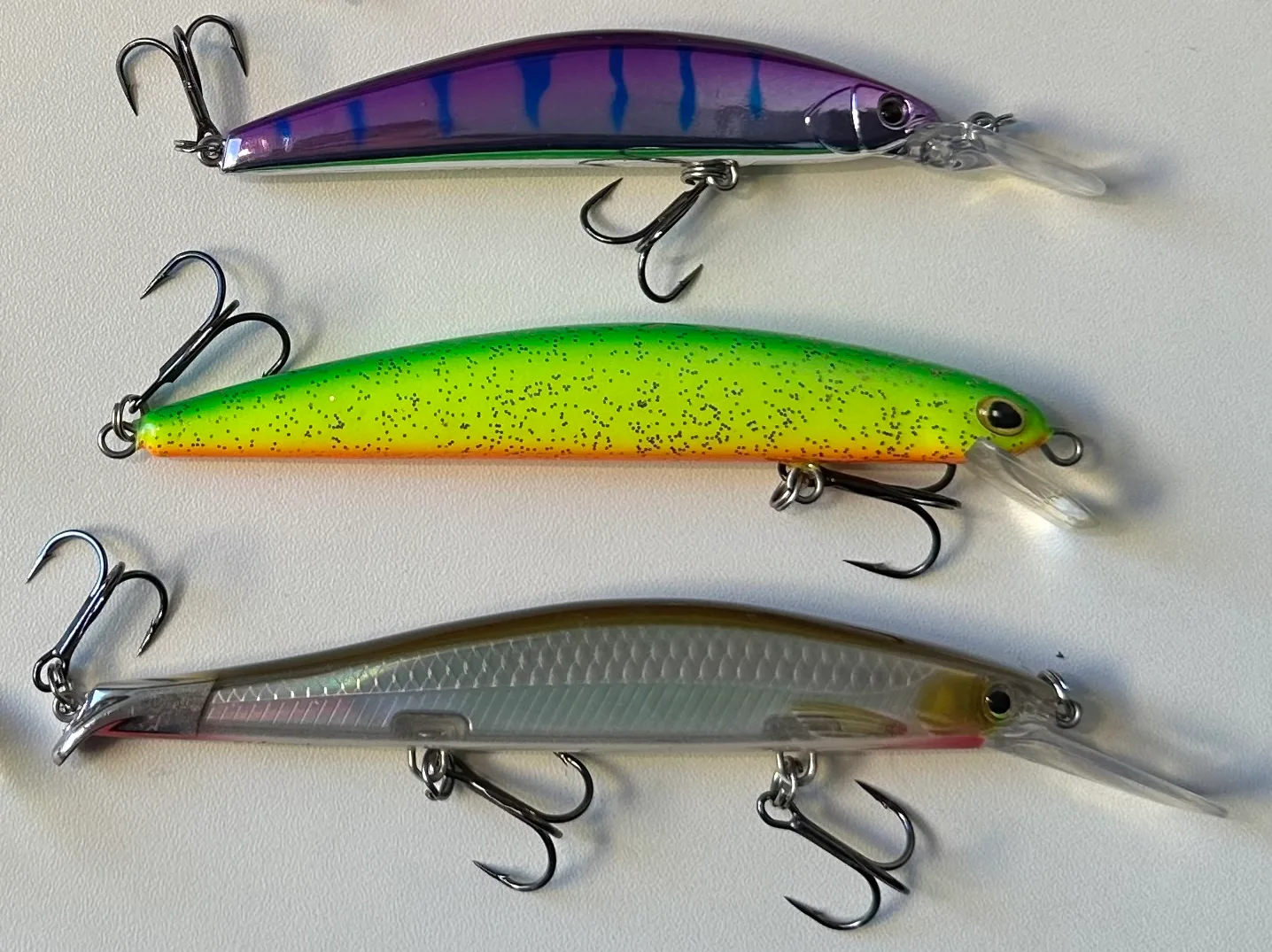
A jerkbait is a long, slender, minnow-shaped plug with a short lip and two or three treble hooks, fished not by reeling but by twitching the rod tip so the bait darts a foot to one side, then pausing so it hangs still. The pause is the point. Suspending jerkbaits are weighted to hang at the depth they were pulled to, neither rising nor sinking, and a bass that will not chase anything in 45 °F water will drift up and eat a minnow that hangs in front of its nose for ten seconds. That makes it the bait for the coldest water of the year, the cold-water guides putting its range at 38–55 °F (3–13 °C) with the sweet spot at 40–52, and Kevin VanDam’s six-season guide names the suspending jerkbait first for winter bass on vertical structure. Below: the tackle, the cadence by temperature, the three kinds of jerkbait, how to make one suspend that will not, where to fish it, six baits with their running depths, and jerkbait against crankbait.
The bite is on the pause. Twitch, twitch, wait, and keep waiting; in cold water a bass takes ten seconds to decide, and it decides yes.
What you need
- A suspending jerkbait, 4–5 in (10–13 cm): the Megabass Vision 110, the Rapala Husky Jerk, the Strike King KVD, the Smithwick Rogue, the Lucky Craft Pointer. Floating versions for warm water and shallow cover; deep-diving versions for 8–12 ft.
- A 6 ft 8 in to 7 ft (2–2.1 m) medium rod with a fast tip and a soft backbone; Elite Series pro Kelley Jaye fishes a 6 ft 9 in medium, and Mike McClelland wants a stiffer rod with a soft tip, because a rod that bends through the whole blank wears the arm out working the bait all day. Short enough to twitch without the tip hitting the water, soft enough to keep trebles in.
- A baitcaster in any ratio, or a 2500 spinning reel; Jaye fishes a 7.5:1, because the reel only takes up slack and the rod moves the bait.
- Fluorocarbon, 10–14 lb: Jaye runs 12 lb for smallmouth and 14 lb for largemouth and spotted bass, and warns that lighter line wraps around the hooks on the twitch. Fluoro sinks and helps the bait hold its depth; mono floats, and Menendez uses it only on a floating bait for a softer presentation. Which line does what is on the fluorocarbon vs. monofilament page.
- Sharp trebles, and a check of the bait’s suspension before the first cast (below).
The cadence by temperature
| Water temperature | Cadence | Pause | Where the fish are |
|---|---|---|---|
| 36–42 °F (2–6 °C) | One or two soft twitches, then wait | 10–20 seconds; McClelland goes to 30 | Deep vertical structure: bluffs, channel drops, standing timber; suspended |
| 42–48 °F (6–9 °C) | Jerk-jerk-pause | 5–15 seconds | Points and channel swings next to wintering areas |
| 48–55 °F (9–13 °C) | Jerk-jerk-pause, sharper | 2–5 seconds | Pre-spawn staging areas: the first drop off the flats |
| 55–65 °F (13–18 °C) | Jerk-jerk-jerk-pause, fast | 1–2 seconds | Flats, points, around bait; the spawn and post-spawn |
| Above 65 °F (18 °C) | Erratic and fast, or a floating model ripped and paused | Short | Schooling fish, clear water at dawn; a topwater or a swimbait usually beats it |
The FishUSA cold-water guide is written for walleye and the bass pros say the same: the colder the water, the longer the pause. McClelland pauses a suspending bait 12–15 seconds in early spring and sometimes 30; after the spawn, on fish in standing timber, he is down to 2–5. Make the twitches with the wrist, rod tip down, on a slack line, so the bait darts rather than pulls; reel up the slack on the pause without moving the bait. Count the pauses out loud, so that when a fish eats on “seven” the next pause is seven as well. Which band your lake is in on a given week is on the bass water temperature page.
Suspending, sinking or floating: three kinds of pause
Mike Iaconelli sorts his cold-water jerkbaits by what they do when he stops them, and the sort lines up with the water temperature.
| Type | On the pause | Water temperature | Example |
|---|---|---|---|
| Slow sink, nose down | Fades away slowly, nose barely pointed down, like a dying minnow | Low 40s down to freezing | Rapala Shadow Rap (slow sinking, head-down fade) |
| True suspending | Sits perfectly still, no vertical movement | 45–50 °F (7–10 °C) | Megabass Vision 110, Lucky Craft Pointer, Smithwick Suspending Rogue, Strike King KVD |
| Slow rise, nose up | Rises very slowly, nose barely toward the surface; a more aggressive look | 50 °F (10 °C) and warmer | Any suspending bait with a treble one size lighter, or a lightly weighted floater |
Above that comes the floater. Elite Series pro Mark Menendez says water temperature decides between a suspending bait and a floating one “every single time”: the suspending bait in cold, clear water, and from about 55 °F (13 °C) a floating model, worked harder and faster as a search bait, because by then the fish will chase. Rapala built the Shadow Rap for the top row: it kicks almost 180 degrees on each snap with little forward travel, so it can be worked nearly in place over a fish, and its fixed weight sends it fading head-down on the pause.
Make it suspend: the sink test and the SuspenDot
The word “suspending” on the box is a promise with no standard behind it. Field & Stream’s Joe Cermele points out that some baits sold as suspending sink slowly and others rise like a cork, and Menendez says two baits of the same brand and model can differ, which is why he tests every one: in his kitchen sink, in cold tap water, with the hooks already changed, since any hook swap goes on before the test. Iaconelli does the same in a tub at home rather than losing fishing time on the water.
Then the fix, in order:
- A bait that sinks: go lighter. Swap one treble a size smaller, or take the split ring off the middle hook. Menendez errs on the light side every time, because a bait that sinks slowly has lost the thing it was bought for.
- A bait that rises: add a Storm SuspenDot, a self-adhesive weight the size of a hole-punch dot (80 to a pack, $7.99), on the belly. Cermele’s method: one dot, test, add another, until the bait hovers after it dives. On a Smithwick Rogue Jr. one dot under the chin holds it in medium current to 3 ft; a second dot behind the front treble turns it into a slow sinker for 5 ft and deeper. SuspenStrips are the same thing in strips; lead golf tape, about $20 for 60 in (152 cm), is the cheap substitute Iaconelli keeps in the boat.
- Where the dot goes matters. Weight toward the lip makes the nose drop and the bait dive faster and deeper; weight toward the tail does the opposite and keeps a bait shallower over cover.
- Or change the hook. McClelland turns a floating Spro McStick 115 into a near-suspender by replacing its No. 5 trebles with 2X-strong No. 4s, the heavier wire doing what the dots would. For clear-water smallmouth, Jaye runs a smaller treble in the middle and larger ones at each end, a size down for the shy fish without changing the balance.
- Glue it. Menendez Super Glues the strips once the bait hangs right, so the fix survives the day.
What not to do is in Cermele’s own failed experiment: he drilled a belly and loaded it with BBs, and the bait dropped nose-first with no action left. Add weight in dots, not in a dose.
Six jerkbaits and how deep they run
The depth on the maker’s page is a range on the recommended line, and line changes it more than most anglers expect: Megabass rates the Oneten at nearly 7 ft on 6 lb test and about 4 ft on 15 lb.
| Model | Length | Weight | Runs | On the pause |
|---|---|---|---|---|
| Megabass Vision Oneten (110) | 4⅓ in (11 cm) | ½ oz (14 g) | ~6 ft (1.8 m) | Suspends |
| Rapala Shadow Rap | 4⅜ in (11 cm) | 7/16 oz (12 g) | 2–4 ft (0.6–1.2 m) | Slow sink, head down |
| Rapala Husky Jerk HJ12 | 4¾ in (12 cm) | 7/16 oz (12 g) | 4–8 ft (1.2–2.4 m) | Suspends |
| Strike King KVD Elite 300 | 4¾ in (12 cm) | ½ oz (14 g) | 4–7 ft (1.2–2.1 m) | Suspends |
| Smithwick Suspending Rattlin’ Rogue | 4½ in (11 cm) | ⅜ oz (11 g) | 0–6 ft (0–1.8 m) | Suspends, rattles |
| Lucky Craft Pointer 100 SP | 4 in (10 cm) | ⅝ oz (18 g) | to 5 ft (1.5 m) | Suspends |
For deeper fish the same families go down a class: the Strike King KVD Deep Elite 300 (4¾ in, ⅗ oz) is rated 10 ft and more, and McClelland works his suspending McStick 110 on outer breaks in the 5–7 ft range in pre-spawn. The Husky Jerk comes smaller too: the HJ08 is 3⅛ in and ¼ oz and runs 4–6 ft. For the Husky Jerk’s whole family, see the Rapala lures page.
The Megabass Vision 110, the “Oneten,” arrived from Japan in the 1990s with a weight-transfer system, tungsten balls that slide to the tail on the cast for distance and forward on the retrieve for balance; Wired2Fish’s review calls it the standard tournament jerkbait and Cermele arguably the best suspender out of the box. It costs $24.99, which is Cermele’s last warning: over cover you cannot see, throw the $8.99 Rogue. The Rapala Husky Jerk, neutrally buoyant, rattling and about a third of the Oneten’s price, is the bait most anglers learn on and many never leave; the KVD and the Pointer sit between them at $16.99.
Color by water clarity
| Water | Color | Why |
|---|---|---|
| Clear, bright sky | Translucent shad, ghost minnow, pro blue | The bass sees the bait from 10 ft; a loud color looks wrong |
| Clear, overcast | Table Rock Shad: purple back, chartreuse sides | McClelland’s bright-day standard that also carries a cloud |
| Stained | Gold with a black back and an orange belly | Jaye’s stained-water bait; flash and a dark outline |
| Any, fish following but not eating | Add an orange or chartreuse stripe on the belly | McClelland: a brighter belly under a subtle back turns lookers into biters |
Where to fish it
Clear water first. A jerkbait is a sight bait, and it works best where a bass can see it from ten feet away: clear reservoirs, rocky lakes, rivers in winter. Fish it over deep water with the bait at 4–8 ft, along bluff walls, over points and humps that top out at 8–15 ft, along channel swings, and over any bait school the sonar shows; the how to read a fish finder page shows the suspended arches a jerkbait is thrown at. On Bull Shoals and Table Rock, McClelland fishes it in winter on sunny days, when the baitfish rise in the water column and the bass come up under them. In pre-spawn, work the first drop off the spawning flats and the outer breaks at 5–7 ft; in early spring, the sunny bank in the afternoon; after the spawn, standing timber with the short pauses. It is not only a cold-water bait: Jaye made three Elite Series cuts on Toledo Bend with it on rock, piers and points, and threw it over grass on Toho while the field flipped. Wind helps in clear water and hurts in cold water, when the line bow moves the bait during the pause; fish the lee of a point.
Jerkbait, crankbait or lipless
| Jerkbait | Crankbait | Lipless crankbait | |
|---|---|---|---|
| Retrieve | Twitch and pause | Steady reel | Steady, rip, or yo-yo |
| Water temperature | 38–55 °F best | 48–80 °F | 45–75 °F |
| Water clarity | Clear | Any; stained | Stained |
| Depth | 3–8 ft, deep models 8–12 | Set by the lip, 0–25 ft | Any; it sinks |
| Fish | Suspended, inactive, cold | Active, on cover | Active, on grass or bait |
When the water passes 55 °F and the fish start chasing, the squarebill crankbait and the lipless crankbait take over, and for the fish that stay out on the ledges a deep-diving crankbait reaches what a deep jerkbait cannot; when it drops below 40 °F and even the jerkbait pause is too fast, a jig or a blade bait on the bottom is the last resort. The crankbaits hub sets the four beside each other by depth class.
Mistakes to avoid
- Pausing too short. The commonest cold-water mistake; make the next pause longer than feels right.
- Reeling instead of twitching. A reeled jerkbait is a poor crankbait.
- Trusting the box. “Suspending” has no standard; test every bait in the sink and tune it.
- Weighting it like a sinker. Dots, one at a time, on the belly; a dose of lead or BBs in the body kills the action, and too much on a floater ruins the roll it was bought for.
- A fast, stiff rod. Trebles tear out; a soft tip and fluorocarbon.
- Braid straight to the bait. It floats and lifts the bait’s nose on the pause; fluorocarbon, or a mono leader.
- Line too light. Lighter than 12 lb wraps around the hooks on the twitch.
Related
The best time to fish for bass page has the winter windows the jerkbait owns; the bass water temperature page says which band your lake is in; the lures hub maps the rest.
Related
Section guide
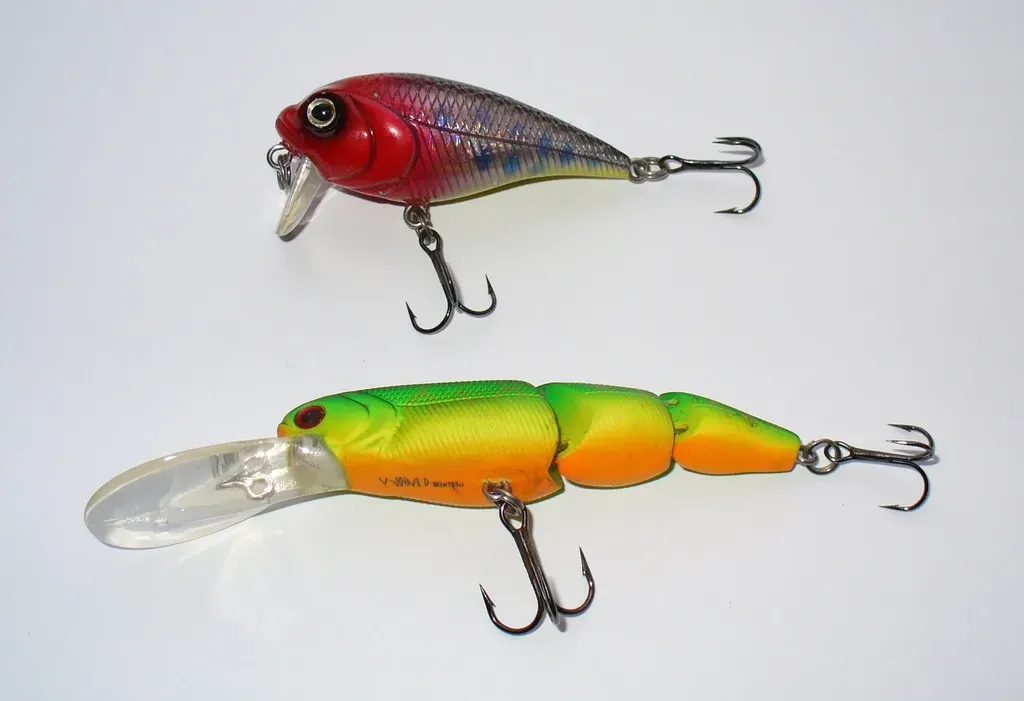
Crankbaits and Jerkbaits: Depth Classes, Lips and How to Fish ThemCrankbaits by running depth, squarebill to 25-foot diver, plus lipless baits and suspending jerkbaits: how the lip sets depth, the rod and line, the histories.
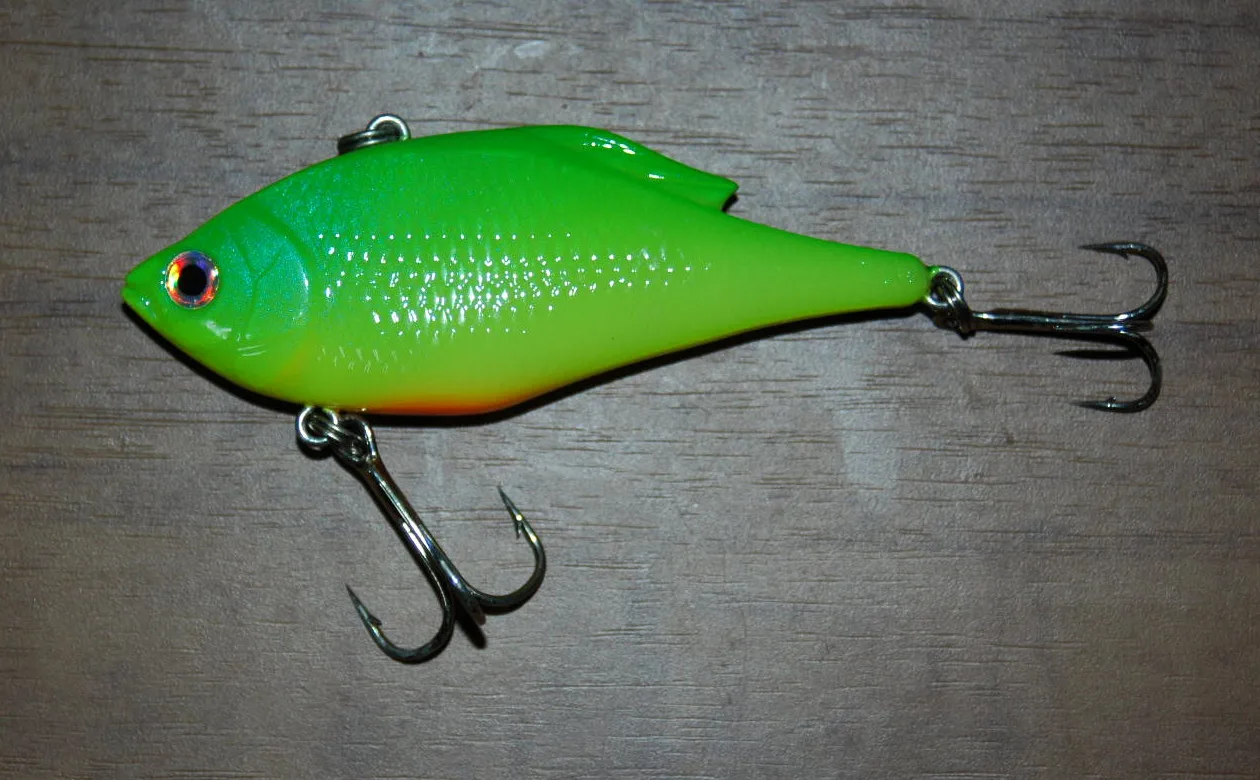 Lipless Crankbait: How to Fish It, Sizes, and the Rat-L-Trap Story
A lipless crankbait sinks, rattles and fishes any depth: eight models compared, six retrieves, the pre-spawn grass rip, and the rod that keeps trebles pinned.
Sources
- FishUSA, cold-water jerkbait cadence by temperature
- Bassmaster, Mike Iaconelli: fishing jerkbaits in cold water
- Bassmaster, Mark Menendez: suspending vs. floating
- Bassmaster, jerkbait techniques for every season (McClelland, Lane)
- Bassmaster, jerkbaits for every season (Kelley Jaye)
- Field & Stream, how to fish a suspending jerkbait for bass
- Tackle Warehouse, Storm SuspenDots
- Megabass, Vision Oneten
- Megabass, how the Vision Oneten was made
- Wired2Fish, Megabass Vision 110 review
- Rapala, Husky Jerk
- Rapala, Shadow Rap
- Lurenet, Smithwick Suspending Rattlin' Rogue
- Discount Tackle, Strike King KVD Elite 300 jerkbait
- Discount Tackle, Lucky Craft Pointer 100 SP
- Bassmaster, KVD's 6-season bass guide