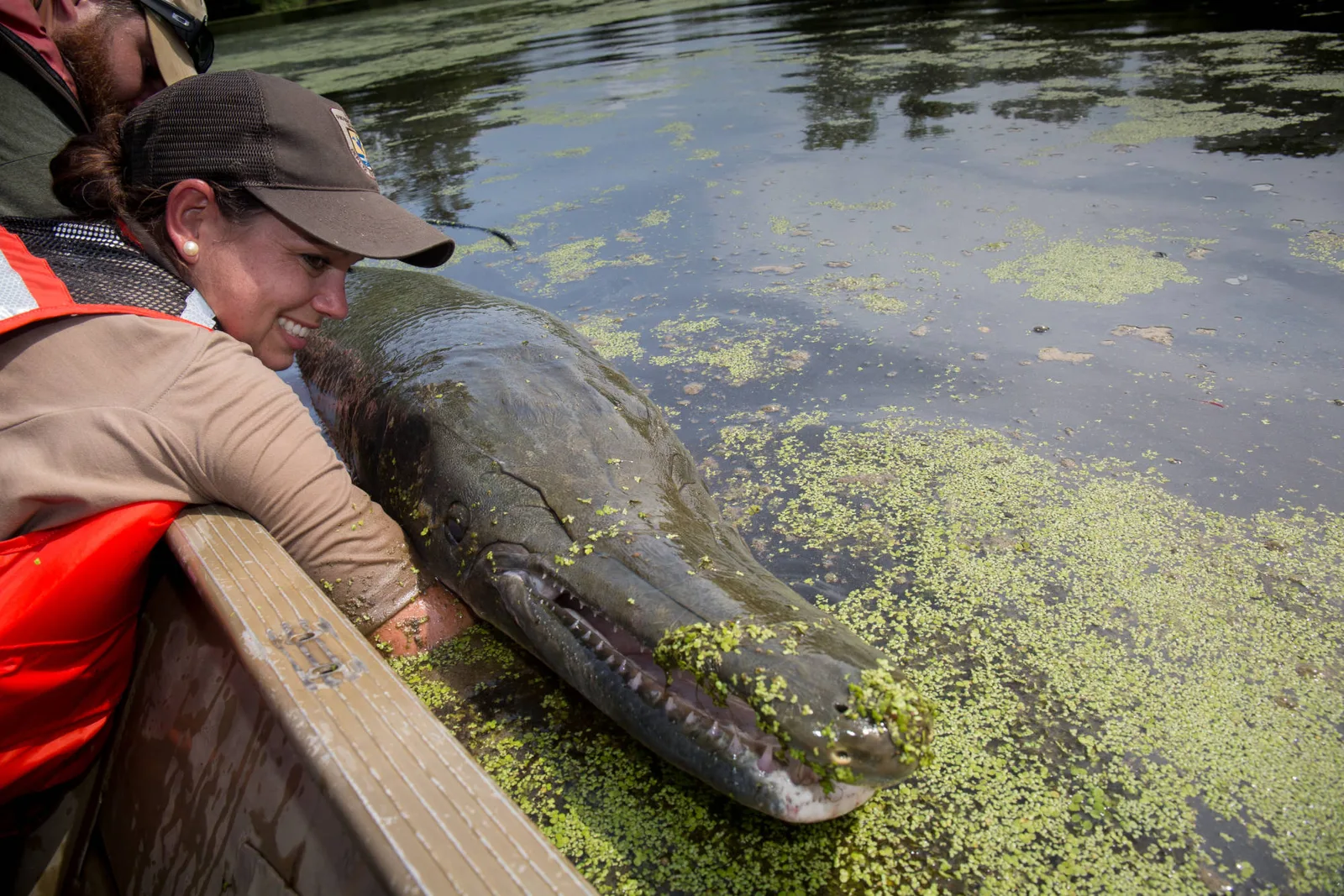
An alligator gar is a fish of up to 8 ft (2.4 m) and more than 300 lb (136 kg), with two rows of teeth in its upper jaw. Only the white sturgeon grows bigger in North American fresh water. It lives in the big, slow rivers, bayous and reservoirs of the Gulf coast and the lower Mississippi, and Texas populations are still strong. Catching one takes cut bait, heavy tackle, patience and a hookset that beats a mouth made of bone.
The 327 lb alligator gar netted in Mississippi in 2011 was first aged at 95 from its ear stone. A 2024 radiocarbon study supports about 100 years.
Alligator gar teeth and snout: how do you tell it from other gar fish?
Look in the mouth from a safe distance. The IGFA puts it plainly: the alligator gar “can be distinguished from all other gars by the two rows of teeth in the upper jaw, its broader snout, and its size when fully grown.” Every other gar has one row. The inner row is the longer one.
The snout is the second check. Seen from above it is short and wide, “alligator-like” in the words of the Texas Parks and Wildlife Department (TPWD), and for fish of the same length an alligator gar is much wider than a longnose. The body is armored in diamond-shaped ganoid scales, brown or olive above and lighter below, with the dorsal and anal fins set far back near a rounded tail. Gars are called living fossils: the U.S. Fish and Wildlife Service traces them back 100 million years in the fossil record.
Two mix-ups are common: a juvenile alligator gar looks like a spotted gar, and a big longnose gar fools people into thinking it is a gator gar. Texas genetic work has also found natural hybrids of alligator and longnose gar, so a fish with an in-between snout may be a cross.
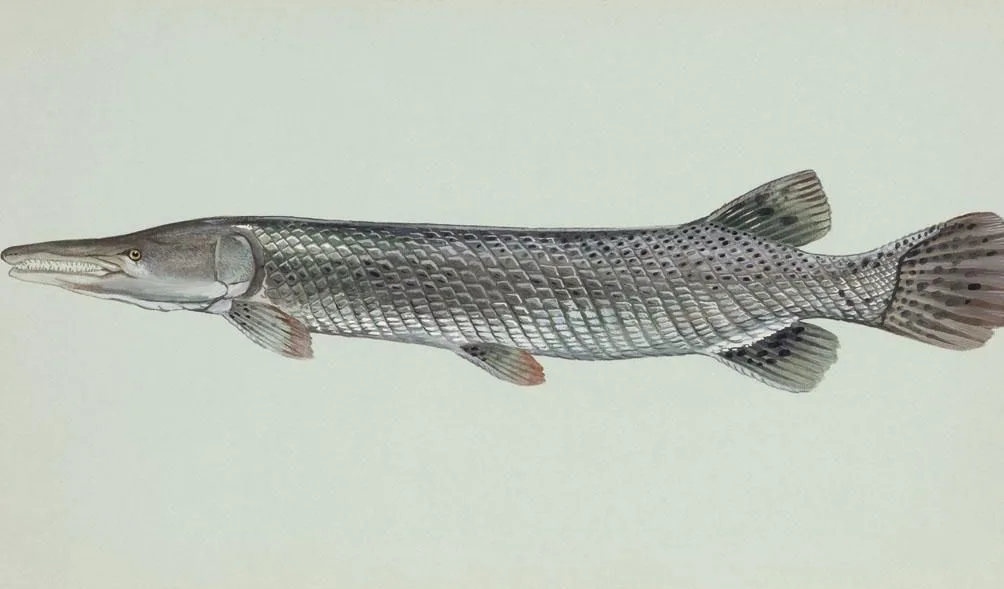
Illustration: Duane Raver, U.S. Fish and Wildlife Service (public domain)
| Gar | Snout and marks | Upper-jaw teeth | Size | US range |
|---|---|---|---|---|
| Alligator | Short and broad, alligator-like from above | Two rows | Up to 8 ft (2.4 m), 300+ lb (136 kg) | Gulf coast, Florida panhandle to Texas; lower Mississippi basin |
| Longnose | At least 10 times longer than wide; spots not on the head | One row | Over 6 ft (2 m); Texas record 50.31 lb (22.8 kg) | Florida to the St. Lawrence; Great Lakes, Mississippi and Gulf drainages |
| Shortnose | Short; no spots on top of the head or on the paired fins | One row | Seldom over 4 ft (1.2 m); Texas record 22 lb (10 kg) | Mississippi basin, Ohio to Montana, south to Louisiana |
| Spotted | Short; dark round spots on the fins and top of the head | One row | Seldom over 4 ft (1.2 m); Texas record 21.92 lb (9.9 kg) | Erie and Michigan drainages to the Gulf; Apalachicola to Nueces |
| Florida | Broad; round black spots on the head, body and fins | One row | Typically 13–34 in (33–86 cm), largest 52.4 in (133 cm) | Peninsular Florida; Ochlockonee to Savannah drainages |
Where do alligator gar live?
The native range runs along the Gulf coastal plain from the Econfina River in Florida west to Veracruz, Mexico, and up the Mississippi basin to the lower Ohio and Missouri rivers. Outside Texas the species is declining or gone in many areas of the Southeast. Florida’s fish live only in the coastal Panhandle rivers, and Kentucky has had no reported fish since 1977. Illinois, Kentucky and Missouri are restocking hatchery fish.
Within that range they want big rivers with floodplains, sluggish pools, backwaters, swamps, bayous and lakes. They are the most salt-tolerant of the gars and turn up in brackish bays. They also gulp air into a swim bladder that works much like a lung. In the lower Trinity River, acoustic-tagged fish held in main-channel water deeper than average at normal flows and moved into tributaries and flooded floodplains during big floods. Movements peaked during the May–June spawn and the July–October post-spawn. In winter they gather in groups at particular spots.
Free card: what 26 species do at your water temperature
Plus one email a week on what's biting now. No sales pitches. Privacy.
How do you catch an alligator gar?
“Alligator gar aren’t easy to catch,” TPWD says, and even guides see a high share of dropped baits, snags and failed hooksets. In Texas the fish is legal on rod and reel, on bowfishing tackle, and on passive gear such as juglines and trotlines, but an arrow kills: a shot fish cannot be released.
When. Tagged Trinity River fish moved most from May through October, and the IGFA record came on September 2. Check the spring closures first: Arkansas bars taking them from May 1 to July 1, Oklahoma bars fishing for them in May, and Texas can close an area when spawning conditions arrive.
The rig. The most common Texas setup is cut common carp on a 3/0 treble or J-hook, tied to a steel leader on strong braid and fished suspended or on the bottom. Use bronze (Aberdeen) hooks no larger than 3/0 and non-stainless leaders: stainless hooks persist in a fish for years, while bronze breaks down. Cut common carp is the same idea as cut bait for catfish on a bigger scale. Field & Stream’s Joe Cermele writes that “a rod and reel that handles muskies or big catfish” will do, and he fished 130 lb Dacron line; the catfish rods built for blues and flatheads are that class of stick.
The wait. A gar picks up the bait and swims a good distance before it stops to swallow. Its bony, toothy mouth resists hooks, so many Texas anglers let the fish swallow the bait, then cut the leader and release it with the hook in place. A hookset before the fish has swallowed works only about half the time; the best chance of a mouth hook may be a powerful set just after the pickup. A large slip float shows which way the fish is facing. Fishing the Trinity with Texas guide Dawson Hefner, Cermele put it this way: a solid hookset means giving the gar time to work the bait into the soft part of its throat.
The landing. Use a rope lasso, a large net or a cradle. Land the fish on shore rather than lifting it over the gunwale, and leave a hook that sits beyond the mouth where it is. Release the fish head first.
Are alligator gar dangerous?
Not to swimmers. In TPWD’s words, “While there are no confirmed attacks on people, alligator gar continue to be feared by many.” Tennessee’s wildlife agency says the same. The danger is at the boat: the teeth, the bony scales and a powerful tail. The rule at the boat is short: “Never stick your hands in the fish’s mouth and stay clear of the powerful tail.”
The one part that does hurt people is the roe. The eggs are toxic, and a 2020 case report describes an 18-year-old who fell ill about an hour after eating two or three spoonfuls of gar eggs.
How big do alligator gar get, and what is the record?
A Texas rule of thumb ties size to age: a 3 ft (0.9 m) fish is typically about 2.5 years old, a 4 ft (1.2 m) fish about 5, and a 7 ft (2.1 m) fish might be 40. “In general, for every additional foot the fish grows, its age doubles.” Most fish over 6 ft are females, because males rarely reach that length.
The record question has three honest answers:
- Rod and reel (IGFA all-tackle): 283 lb (128.4 kg), Arthur Weston, Sam Rayburn Lake, Texas, September 2, 2023, on 6 lb line with guide Kirk Kirkland. The fight took nearly three hours; the fish was weighed on a certified scale on shore and released. It beat Bill Valverde’s 279 lb Rio Grande fish of 1951. Weston also holds every men’s line-class record IGFA lists for the species.
- Any method: 327 lb (148 kg), 8 ft 5 in (2.6 m), caught in a commercial net on Lake Chotard, Mississippi, on February 14, 2011. It died soon after and went to the Mississippi Museum of Natural Science. TPWD lists it as the world record; it is not an IGFA rod-and-reel record.
- Texas, other methods: 302 lb (137 kg) and 7 ft 6 in (2.3 m), caught on a trotline in 1953, the overall Texas state record.
For the catfish that share these rivers, the heaviest on record are on the world record catfish page.
What are the rules for keeping one?
The rules are a patchwork, and they change, so read your state’s current booklet before you keep a fish.
- Texas: one a day statewide since 2009, and every harvested fish reported within 24 hours (Falcon Reservoir excepted). On the Trinity River from Dallas to the I-10 bridge, including Lake Livingston, only fish under 48 in (122 cm) may be kept; winners of a September drawing may keep one fish over 48 in. TPWD can close an area for up to 30 days during a spawn.
- Arkansas: one fish under 36 in (91 cm) a day; anything longer needs an Alligator Gar Tag; closed from noon May 1 to noon July 1.
- Oklahoma: one a day, report within 24 hours, no fishing for them May 1–31.
- Mississippi and Alabama: two a day.
- Florida, Missouri and Tennessee: no harvest. Tennessee forbids targeting them at all; a fish caught by accident must be released.
Can you eat alligator gar?
Yes. Texas biologists describe the flesh as “white and firm with a mild taste, comparable to the flesh of many sport fishes that anglers eat,” and add that it takes some work to clean and fillet a gar. Two warnings: never eat the eggs, and check the consumption advisories first. Texas has gar advisories on several waters, including the popular Lake Livingston and Trinity River fisheries, where no consumption is advised. In a 2018 Texas survey, only about 40% of respondents said they actually harvest gar to eat.
How old do alligator gar get, and why do they need protecting?
Biologists age gar by the rings in the otolith, the ear stone. Bomb-radiocarbon dating confirmed Texas fish of more than 60 years in 2019, and the 2024 study of the Mississippi giant put the species’ lifespan at “at least 75–95 years,” with support for 100 for that fish.
Spawning explains the rest. Five to 20 adults move onto shallow flooded grass when spring floods spill out of the river and the water passes 68 °F (20 °C), in April and May in Texas. The eggs hatch in about 48 hours, and the larvae cling to the plants for another two to four days. Then they grow fast: more than 5 in (13 cm) after one month, and up to 30 in (76 cm) by their first winter. In dry years they may not spawn at all: on the Trinity, TPWD biologist Dan Daugherty counted 17 years without reproduction in the 47 before 2015. A population of 5,000 to 10,000 adults can sustain a harvest of only about 5% a year, which is why the limits above are so tight.
Adults eat mostly rough fish such as carp, gizzard shad, buffalo, tilapia and freshwater drum. Texas biologists put it flatly: “There is no evidence that alligator gar have negative impacts on sport fish populations.” The other freshwater fish hub has the gar’s neighbors, from bowfin to sturgeon.
Free download
The water temperature card
Read your water temperature and the card tells you who is spawning, who is feeding and what to throw. 26 species, 16 pages, for your phone and the tackle box.
Plus one email a week on what's biting now. No sales pitches. Privacy.
Related
Section guide
Freshwater Fish Species Outside the Big Families: Sturgeon, Gar, Bowfin, BurbotThe freshwater fish species outside the bass, trout, catfish and pike families: sturgeon, gar, bowfin, burbot, drum, eel and paddlefish, with records.
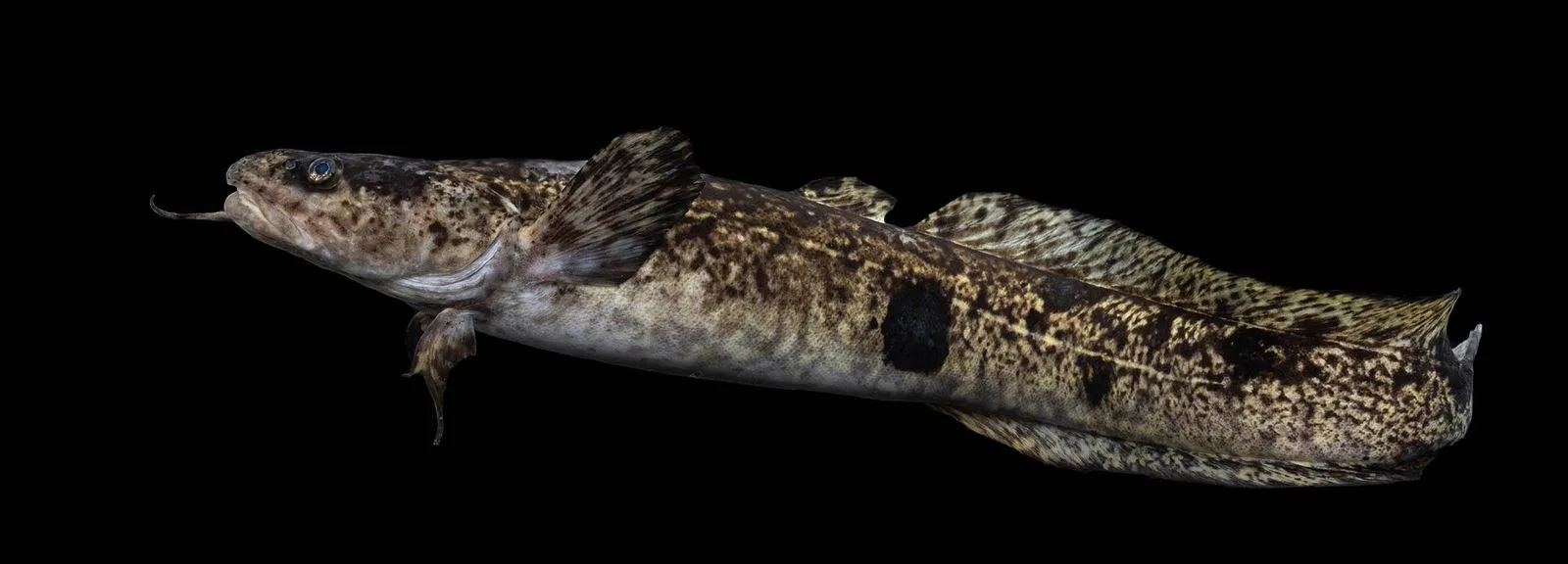 Burbot: The Freshwater Cod That Spawns Under the Ice
Burbot, the only freshwater cod: one chin barbel, 15–28 in, 1.5–5 lb. Where to find them, the glow jig and bait that work after dark, and the lobster test.
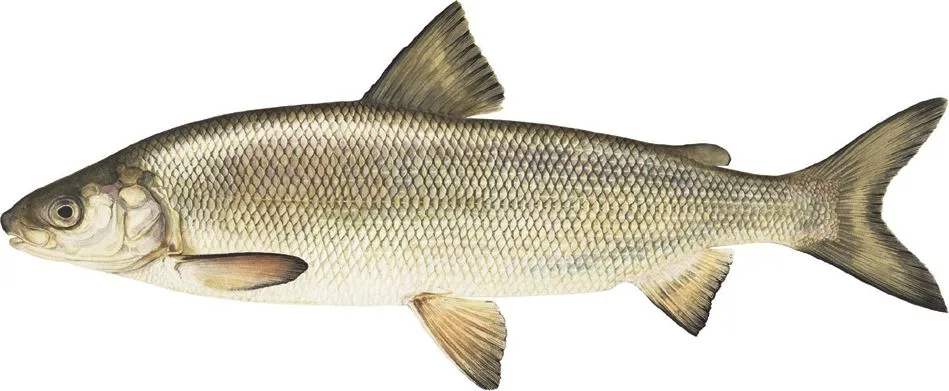 Whitefish: What It Is, When It Spawns, How Big It Gets and How to Catch One
Lake whitefish: how to tell it from cisco and menominee, how big it gets, when whitefish spawn, how to catch them through the ice, and the Great Lakes decline.
Sources
- Texas Parks and Wildlife Department, Alligator Gar (Atractosteus spatula)
- Texas Parks and Wildlife Department, Alligator Gar - Unique Management for a Unique Fish
- Texas Parks and Wildlife Department, Alligator Gar - Not A Threat to Humans
- Texas Parks and Wildlife Department, Alligator Gar Fishing Tips and Tactics
- Texas Parks and Wildlife Department, How to Identify Alligator Gar
- Texas Parks and Wildlife Department, Are Alligator Gar Safe to Eat?
- TPWD: News Roundup: Alligator Gar (fast facts: records, other gars, eggs)
- Texas Parks and Wildlife Department, Alligator Gar Special Restrictions and Reporting
- Texas Parks & Wildlife Magazine (March 2015), Alligator Gar Are The Misunderstood "Big Daddy" of Freshwater Fish
- U.S. Fish & Wildlife Service, Alligator Gar (Atractosteus spatula)
- U.S. Fish and Wildlife Service, Freshwater Fish of America: Alligator Gar (fact sheet, 2023)
- IGFA World Record Search: Gar, alligator (all-tackle, Arthur Weston, 283 lb 0 oz)
- International Game Fish Association, The Catch Heard 'Round the World
- Outdoor Life, Nearly 300-Pound Alligator Gar Should Break World Record
- Field & Stream, The Biggest Alligator Gar Ever Caught
- Field & Stream (2026), Alligator Gar Fishing: A Complete Guide
- Andrews et al. (2024), Alligator gar as a centenarian species: extending lifespan estimates using bomb radiocarbon and laser ablation–accelerator mass spectrometry, Marine and Freshwater Research
- Daugherty, Andrews and Smith (2019), Otolith-Based Age Estimates of Alligator Gar Assessed Using Bomb Radiocarbon Dating to Greater than 60 Years, North American Journal of Fisheries Management
- Buckmeier, Smith and Daugherty (2013), Alligator Gar Movement and Macrohabitat Use in the Lower Trinity River, Texas, Transactions of the American Fisheries Society
- Martin and Akpunonu (2020), Treating Ichthyotoxin Poisoning Induced by Gar Eggs Ingestion, International Journal of Medical Toxicology and Forensic Medicine
- Florida Museum of Natural History, Alligator Gar – Discover Fishes
- Florida Museum of Natural History, Longnose Gar – Discover Fishes
- Florida Museum of Natural History, Florida Gar – Discover Fishes
- Alligator Gar | FWC (Florida Fish and Wildlife Conservation Commission research page)
- Alligator Gar in Tennessee (TWRA)
- Alligator Gar | Missouri Department of Conservation
- Alligator Gar - Kentucky Department of Fish & Wildlife
- Alligator Gar • Arkansas Game & Fish Commission (limit and permits)
- Oklahoma Department of Wildlife Conservation, 2023_2024_Regulations, Page 16
- 40 Miss. Code. R. 3-1.4 - STATEWIDE CREEL LIMITS (LII)
- Ala. Admin. Code r. 220-2-.105 - Creel/Possession Limit On Alligator Gar (LII)
- Texas Parks and Wildlife Department, Who Fishes for Alligator Gar?
- Illinois DNR, Wild About Illinois Fishes: alligator gar
- U.S. Fish & Wildlife Service, Alligator Gar Restoration in Lower Mississippi Valley
- Bohn, Kreiser, Daugherty and Bodine (2017), Natural Hybridization of Lepisosteids: Implications for Managing the Alligator Gar, North American Journal of Fisheries Management
- USGS Nonindigenous Aquatic Species, Spotted Gar (Lepisosteus oculatus) - Species Profile
- USGS Nonindigenous Aquatic Species, Shortnose Gar (Lepisosteus platostomus) - Species Profile