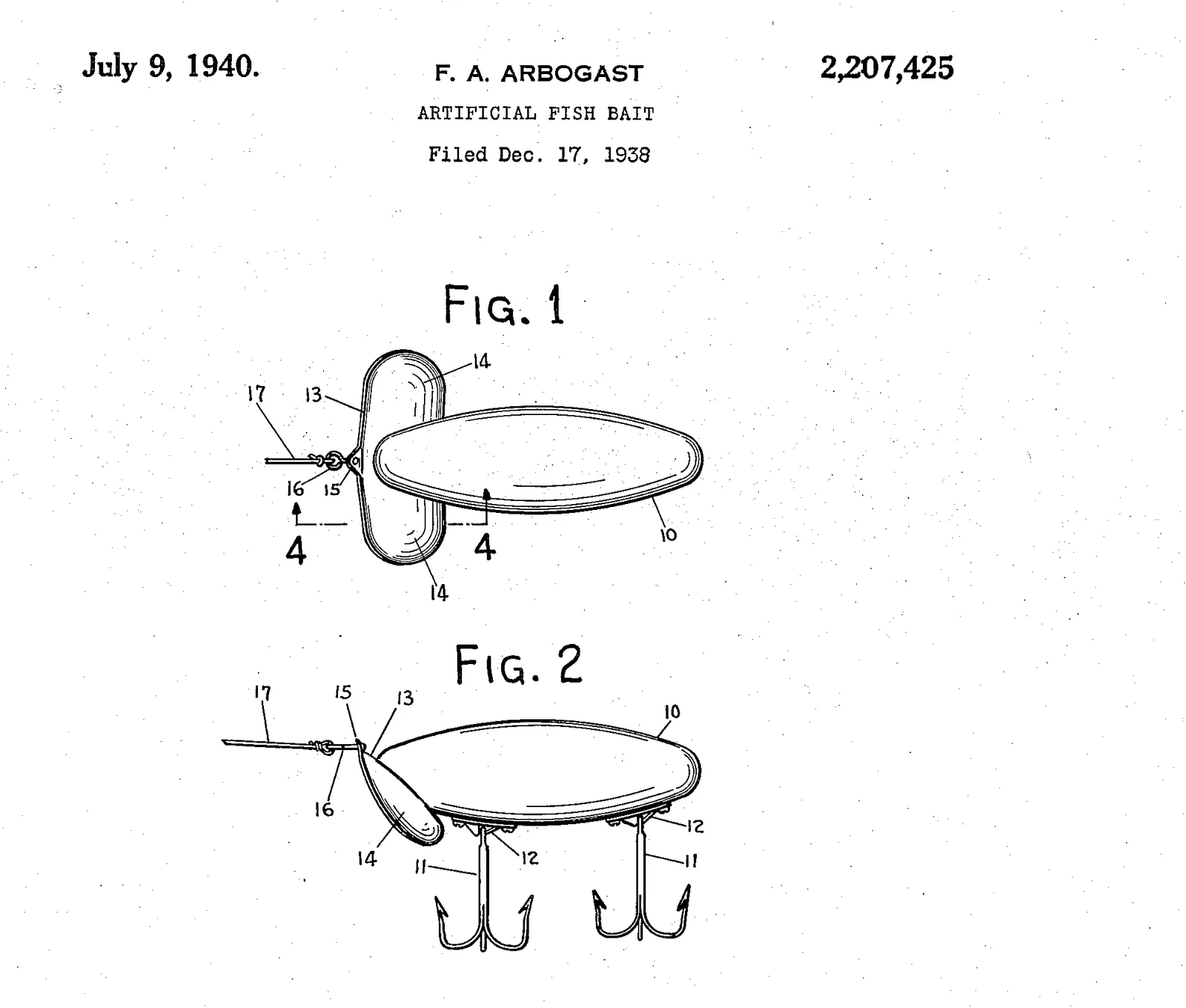
The Jitterbug lure is a wobbling surface plug that Fred Arbogast of Akron, Ohio, brought out in the late 1930s and patented in 1940. A wide, double-cupped metal lip makes it waddle side to side and plop on a slow, steady retrieve. You cast it, reel it, and listen. That simplicity is why it is still the classic topwater lure for bass after dark.
Fred Arbogast filed the Jitterbug patent on December 17, 1938. The claims describe what the cupped lip is for in two words that still sell the lure: “rhythmic gurgling.”
What does a Jitterbug do, and when should you throw it?
A Jitterbug is a crawler: a topwater that swims across the surface on a straight retrieve instead of being twitched. The lip catches water on each side in turn, so the body rocks left and right and each rock throws a small splash. The result is a steady plop, plop, plop. Lawrence Taylor of PRADCO, the company that makes Arbogast lures today, calls it “likely the only artificial lure that many anglers can identify by sound alone.”
That sound is the point. A bass under the surface at night cannot see much of the lure, but it can follow a steady noise. Gerald Almy’s history of the lure at Bass Pro names the classic windows: dusk, dawn and night on a calm lake. The calm matters: a wind chop covers the gurgle the fish is following.
In daylight, twitched erratically, it still draws bass out of lily pads and stumps, Almy writes, mostly in summer when bass feed on the surface early and late. The best time to fish for bass tables put that window in the summer rows. In water terms, Shaye Baker’s chart at Field & Stream says topwater lures “really start to perform well” at 65 to 70 °F (18–21 °C) and are “hard to beat” above 70 °F for bass that stay shallow.
Which Jitterbug size should you buy?
Arbogast makes the standard Jitterbug in four sizes and lists bass, muskie, northern pike and panfish as its targets. The three classic sizes carry two treble hooks, one under the belly and one at the tail; the 4 1/2 in XL carries three, one on each side and one at the tail. Lurenet’s list price in October 2026 is $7.99 for the classic sizes and $8.99 for the XL, often less on sale.
| Size (model) | Length | Weight | Hooks | Pick it for |
|---|---|---|---|---|
| G630 | 2 in (5.1 cm) | 1/4 oz (7 g) | #6 trebles | Streams, river smallmouth, panfish, light spinning gear |
| G600 | 2 1/2 in (6.4 cm) | 3/8 oz (11 g) | #5 trebles | The all-round bass size, day and night |
| G650 | 3 in (7.6 cm) | 5/8 oz (18 g) | #1 trebles | Big largemouth at night, long casts, pike |
| XL (G700) | 4 1/2 in (11.4 cm) | 1 oz (28 g) | Three 2/0 trebles (sides and tail) | Pike, musky and the biggest bass |
Almy recommends the biggest model for musky, pike and jumbo bass, and a 1/8 oz version for river smallmouth. That size is no longer in the catalog; the 2 in is today’s closest. The Lurenet night-fishing guide calls the 2 in “a gem for streams and light spinning tackle.” The musky size with three trebles that the Lurenet history remembers is still made: it is today’s XL, which some shops sell as the Magnum Jitterbug. Our best muskie lures page covers the bigger musky topwaters.
Jointed, Clicker or the 2.0?
The same lip comes on four variations. They change the action or the sound, not the way you fish it.
| Version | What changes | Sizes | Choose it when |
|---|---|---|---|
| Jointed Jitterbug | A hinged tail wags behind the lip | 2 1/2 in (3/8 oz), 3 1/2 in (5/8 oz) | You want more motion on a slow retrieve |
| Clicker Jitterbug | A clicker adds a click to the plop | 2 in (1/4 oz), 3 in (5/8 oz) | You want more noise; the maker’s claim, not a tested fact |
| Jointed Clicker | Both of the above | 2 1/2 in (3/8 oz), 3 1/2 in (5/8 oz) | The loudest, busiest version |
| Jointed Jitterbug 2.0 | Lower pull point, free-swinging black hooks, feathered rear treble | 2 1/2 in (3/8 oz) | You pause often; the feathers keep drifting after the lure stops |
For the jointed model, Arbogast says a slow retrieve gives the rhythmic plopping sound and a fast one “a more-frantic look.” If you buy one Jitterbug, buy the plain 2 1/2 in or 3 in in black. The versions are refinements of a lure that already works.
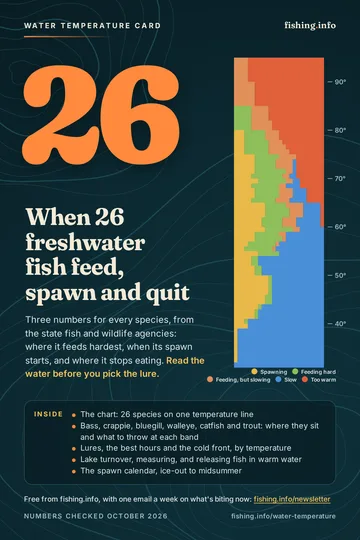
Free card: what 26 species do at your water temperature
Plus one email a week on what's biting now. No sales pitches. Privacy.
What rod, line and knot?
- Line: monofilament, 12–17 lb for bass casting. It floats, so it keeps the nose of the lure up, and its stretch keeps two sets of trebles from tearing out on a jumping fish. Fluorocarbon sinks, which is why monofilament line is the topwater choice.
- Rod: a medium-power casting rod with a moderate or moderate-fast action for the 3/8 and 5/8 oz sizes, a light spinning rod for the 2 in. Jim Ratley at BassResource suggests a light- or medium-action 6 to 6 1/2 ft casting outfit with 15 lb line. That is softer than the fast rod the mono page wants for twitched topwaters: the Jitterbug is reeled, not twitched, and like a crankbait its trebles want some give.
- Knot: a loop knot or a plain snap lets the lure rock freely; a snug knot on the line tie can dull the wobble.
- Hooks: check the points before every trip and replace a dull or bent treble hook with the same size, so the lure still sits right in the water.
How to fish a Jitterbug, step by step
- Cast past the target. Land the lure a few feet beyond the stump, dock post or weed edge, so it swims past the fish rather than landing on it. Keith Sutton’s first lesson, from his uncle, was to cast to the big tree on the pond.
- Let the rings settle, then start reeling. A second or two of rest is enough. A strike can come on the first turns of the handle.
- Find the plop. Reel slowly and steadily until you hear an even plop-plop-plop, then hold that speed. The Lurenet guide’s rule is “slow to moderate pace, all the way to the boat.”
- Keep it steady. Almy calls the slow-to-moderate, steady retrieve “the most consistent.” You do not need to twitch it; the lip makes the action.
- Pause beside lone cover. When the lure passes a visible stickup or a single piece of cover, stop for a moment. That brief pause can trigger a strike from a fish that has been following.
- Change only if ignored. If bass do not hit a steady retrieve, add an occasional pause or twitch, as Sutton advises for crawlers in general. Return to steady as soon as it works.
- Wait for the weight. When the water explodes, keep reeling. Lurenet’s guide puts it in capitals: “NEVER set the hook until you feel the fish.” Then “a short, sharp wrist snap” drives the hooks home. If the bass misses, keep reeling at the same steady pace; the guide says it often hits again.
What you should hear and feel
On a correct retrieve the rod tip pulses gently with each wobble and the sound stays even. At night you can fish by ear alone: Taylor’s advice is to start the retrieve and listen to make sure the bait is walking correctly. If the sound goes quiet or the lure skids, it has fouled on weed or the line has wrapped a hook; reel in and clear it.
A strike sounds like a slurp, a pop or a crash, and at night you hear it before you feel anything. That is why you keep reeling until the rod loads. Bass hit and miss a lot at night, the Lurenet guide says, so a set on the sound alone can find nothing and fling a set of trebles back toward your face. The guide suggests safety goggles after dark, and Mississippi Sportsman calls a headlamp essential for retying and unhooking.
Why black at night?
Black is the color most night anglers name first. Keith Sutton’s uncle told him “because it’s black, they can see it better in the dark.” Almy’s reason: black “shows up well against the light sky background.” The Lurenet guide adds the fish’s view: it looks up at a surface lure at night and sees its silhouette, and black makes the strongest one. Johnny Lewis told Mississippi Sportsman that “a black Jitterbug is as good as it gets,” and he favors black even under a bright moon.
In daylight, Almy prefers yellow and frog patterns. The maker sells perch, fire tiger, coach dog and white with a red head as well.
Where to throw it at night: shallow flats next to deeper water, where lake bass move up after dark, and a lighted marina, where the lights draw insects and baitfish. Start at the edge where the light fades into dark.
Mistakes to avoid
- Setting on the splash. The most common miss. Keep reeling until you feel weight, then snap the wrist.
- Fishing it in weeds. Two sets of trebles foul on every strand of coontail. Over mats and pads, throw a hollow-body frog instead.
- Fishing it in a chop. Wind drowns the sound the lure depends on. Save it for calm evenings and nights.
- Working it like a popper. The lip makes the action. Almy’s most consistent retrieve is steady, and twitches are the fallback, not the start.
- Line that sinks. Fluorocarbon sinks, so it pulls the nose down and dulls the wobble; use mono.
Where did the Jitterbug come from?
Fred Arbogast came from Akron, Ohio. He was a champion tournament caster: the Bass Fishing Hall of Fame counts at least eight national titles and a 293 ft (89 m) throw with a half-ounce weight in 1925. He started making lures at home and went to mass production in 1926.
The Jitterbug began as a failure. Almy writes that Arbogast set out to build a diving plug, could not make it work, and ended up with a surface wobbler named after the dance craze of the day. The year depends on whom you ask. Bass Pro says 1938, one of the maker’s own product pages says 1937, and its history blog says the wooden original appeared in 1939. The patent is firm: filed in December 1938, granted on July 9, 1940.
The first Jitterbugs were wood. A plastic body followed in 1941, and during World War II, with aluminum short, the lip was plastic too and the hook hangers tin. Black was the most popular color, with the frog pattern a close second.
Arbogast also gave the Hula Popper one of the first rubber skirts on a bait, an idea from his years at Goodyear and B.F. Goodrich. He died in 1947 at 53. In 2024 he entered the Bass Fishing Hall of Fame, with the most first-place votes of any of the 12 candidates on the ballot.
When something else wins
The Jitterbug is a calm-water, slow-retrieve lure. When the wind is up or you need to cover water fast, a buzzbait or a Whopper Plopper makes more noise at speed. Over thick mats a frog is the only topwater that comes through clean. When bass hold tight to one spot, a popper that can sit and spit in place wins. For everything else after dark on a flat summer lake, the lure your grandfather threw is still a good first choice.
Free download
The water temperature card
Read your water temperature and the card tells you who is spawning, who is feeding and what to throw. 26 species, 16 pages, for your phone and the tackle box.
Plus one email a week on what's biting now. No sales pitches. Privacy.
Related
Section guide
Topwater Lures: Types, When to Throw Them and How Each WorksTopwater lures explained: walking baits, poppers, prop baits, frogs and buzzbaits, the water temperature and light that make them work, and the lure histories.
 Whopper Plopper Lure: Sizes, How to Fish It, and Where It Began
The Whopper Plopper lure: all six sizes with the maker's weights and hooks, rod and line by size, the retrieves, colors by light and water, and the hookset.
 Frog Lure: How to Fish a Hollow-Body Frog Over Grass, and the Hookset
A frog lure is a hollow, weedless topwater walked over matted grass and pads where nothing else can be fished. The gear, the walk, and the two-second hookset.
Sources
- Lurenet (PRADCO), Arbogast Jitterbug: specifications
- Lurenet, Arbogast Jitterbug XL: specifications
- Lurenet, Arbogast Clicker Jitterbug: specifications
- Lurenet, Arbogast Jointed Jitterbug 2 1/2 in: specifications
- Lurenet, Arbogast Jointed Jitterbug 3 1/2 in: specifications
- Lurenet, Arbogast Jointed Clicker Jitterbug: specifications
- Lurenet, Arbogast Jointed Jitterbug 2.0: specifications
- Lurenet, Arbogast Jitterbug 4 1/2 in (introduced 1937, patented 1940)
- Google Patents, US 2,207,425: Artificial fish bait, Fred A. Arbogast (filed 1938, granted 1940)
- Lurenet blog, Joe Sills Sr.: These deadly topwater lures from the past still work today
- Lurenet blog: Topwater bassing in the dark
- Bass Pro Shops 1Source, Gerald Almy: Classic lures, the Jitterbug and Beetle Spin
- Arkansas Democrat-Gazette, Keith Sutton: By the moonlight (June 27, 2010)
- Mississippi Sportsman, David Hawkins: After the sun goes down, nighttime bass-fishing tips (2015)
- The Fisherman, Matt Broderick: New members in the Bass Fishing Hall of Fame (2024)
- Bass Fishing Hall of Fame: Fred Arbogast (inducted 2024)
- Tackle Warehouse, Arbogast Magnum Jitterbug Wakebait
- BassResource, Jim Ratley: Topwater Baits Explained (2003)
- Field & Stream, Shaye Baker: Bass fishing water temperature chart: use a thermometer to catch more lunkers (2026)
- Wired2Fish, Jason Sealock: best monofilament fishing lines