 By
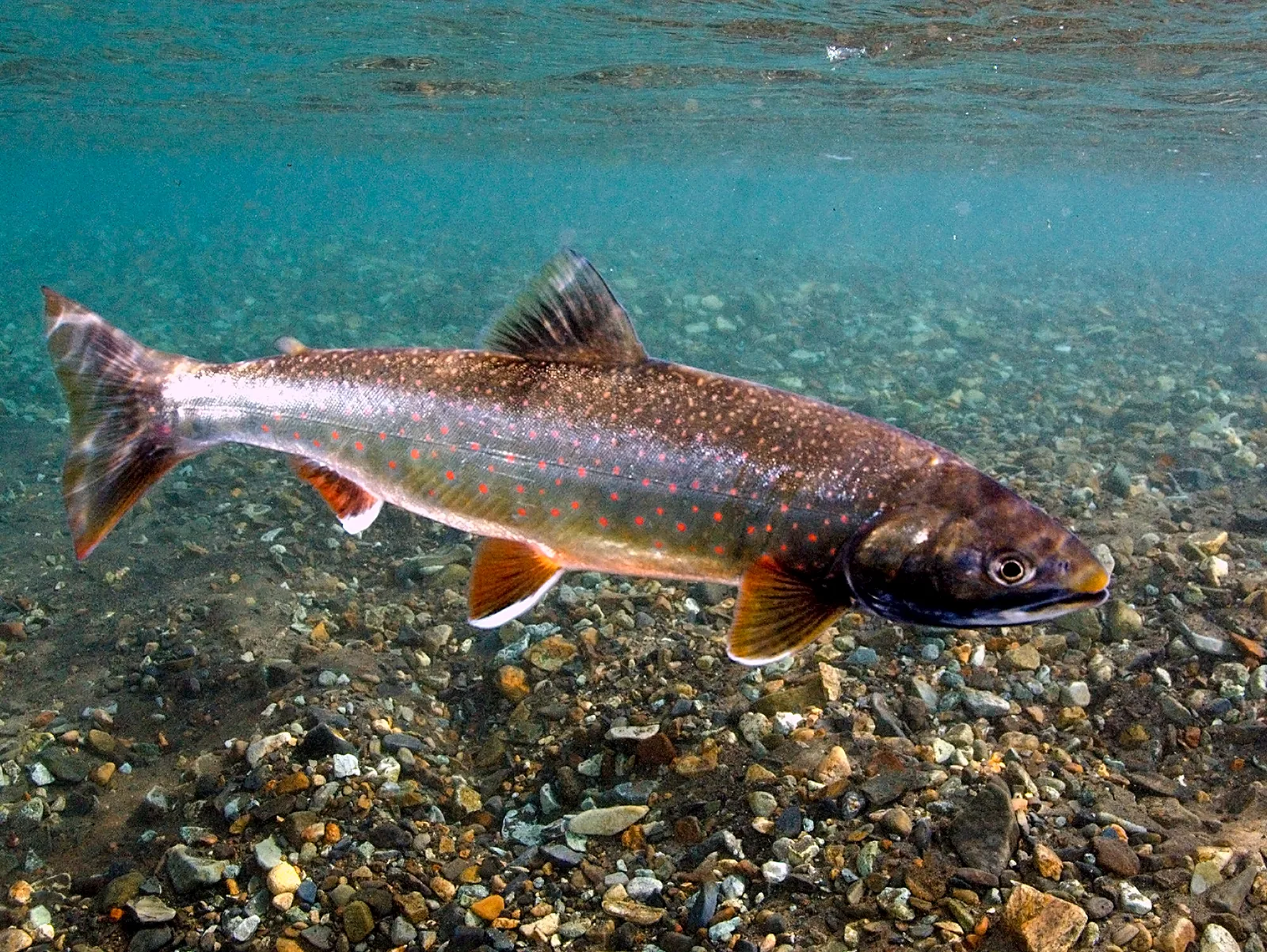
The Dolly Varden is a char of the North Pacific, one of the most widely distributed salmonids in Alaska, and its range runs down the coast to Washington. Most are sea-run fish: they feed in salt water all summer and come back to fresh water to spawn and spend the winter. That round trip tells you where to find them from spring to fall. In spring Alaska’s biologists point anglers to small spinners and flies that imitate salmon fry; in fall, to patterns that imitate salmon eggs and flesh.
From 1921 to 1941 there was a bounty on Dolly Varden tails in Alaska. When 20,000 tails turned in for payment in 1939 were checked, more than half came from coho salmon, and of the rest, more came from rainbow trout than from Dolly Varden.
Is a Dolly Varden a trout, a salmon or a char?
It is a char, Salvelinus malma, of the group of trout relatives with light spots on a dark body. The Alaska Department of Fish and Game (ADF&G) puts it plainly: “Though similar to, and often confused with, trout, Dolly Varden are actually a char.” Its genus, Salvelinus, also holds the brook trout, the lake trout, the bull trout and the Arctic char. So the name “Dolly Varden trout” is common, but the fish is a char like the brook trout, not a true trout like the rainbow trout. The types of trout page sorts the whole family by that one rule of the spots.
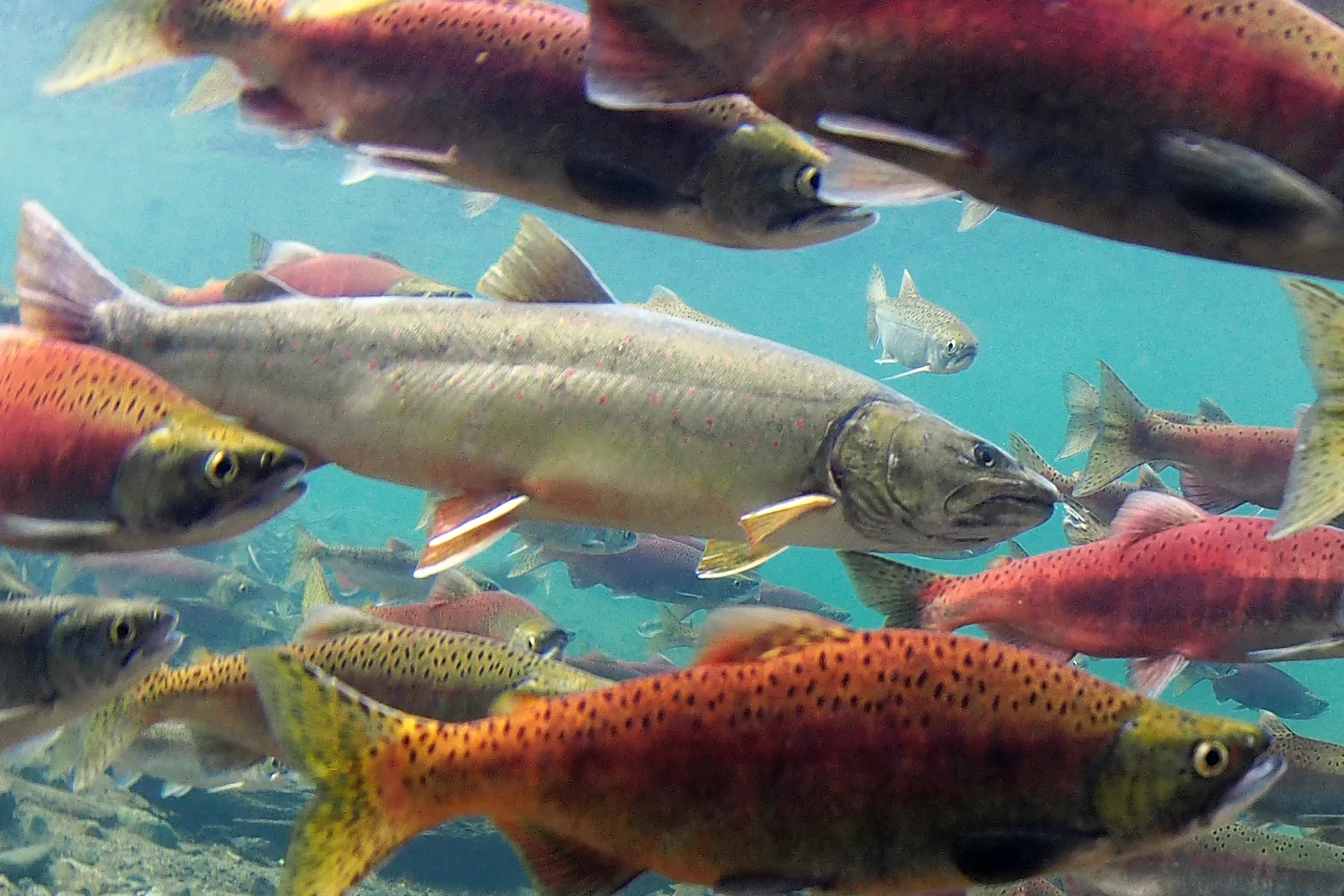
A Dolly Varden’s color changes with where it has been. ADF&G describes sea-run adults, at sea and for a short time after they enter fresh water, as “silvery with a faint green sheen overlain with light orange spots.” On the spawning beds the males turn into a different fish: red, black and white bellies, black gill covers, bright orange to red spots and a strongly hooked jaw, the kype. Females color up the same way, only less.
How to tell a Dolly Varden from an Arctic char or a bull trout
Three chars share the north and look alike: the Dolly Varden, the Arctic char and the bull trout. The International Game Fish Association (IGFA), which keeps the world records, calls the three “a closely related group and difficult to distinguish from external characteristics.” The spot is the best field mark. On a Dolly Varden the spots are smaller than the pupil of the eye; on an Arctic char they are larger.
| Fish | Body and spots | Other marks | Where you meet it |
|---|---|---|---|
| Dolly Varden | Greenish body; many small spots, smaller than the pupil | Spawning males grow a distinct kype; no wavy lines on the back | Coastal Alaska to Washington; Asia from Russia to Japan |
| Arctic char | Bronze-yellow body; fewer spots, larger than the pupil | Deeper tail fork, narrower wrist; kype absent or reduced in spawning males | Alaska, where it generally completes its whole life cycle in lakes |
| Bull trout | Green to gray-blue; pale yellow-orange spots | Larger, broader, flatter head; no black spots on the dorsal fin | The Northwest; shares water with Dollies in western Washington and BC |
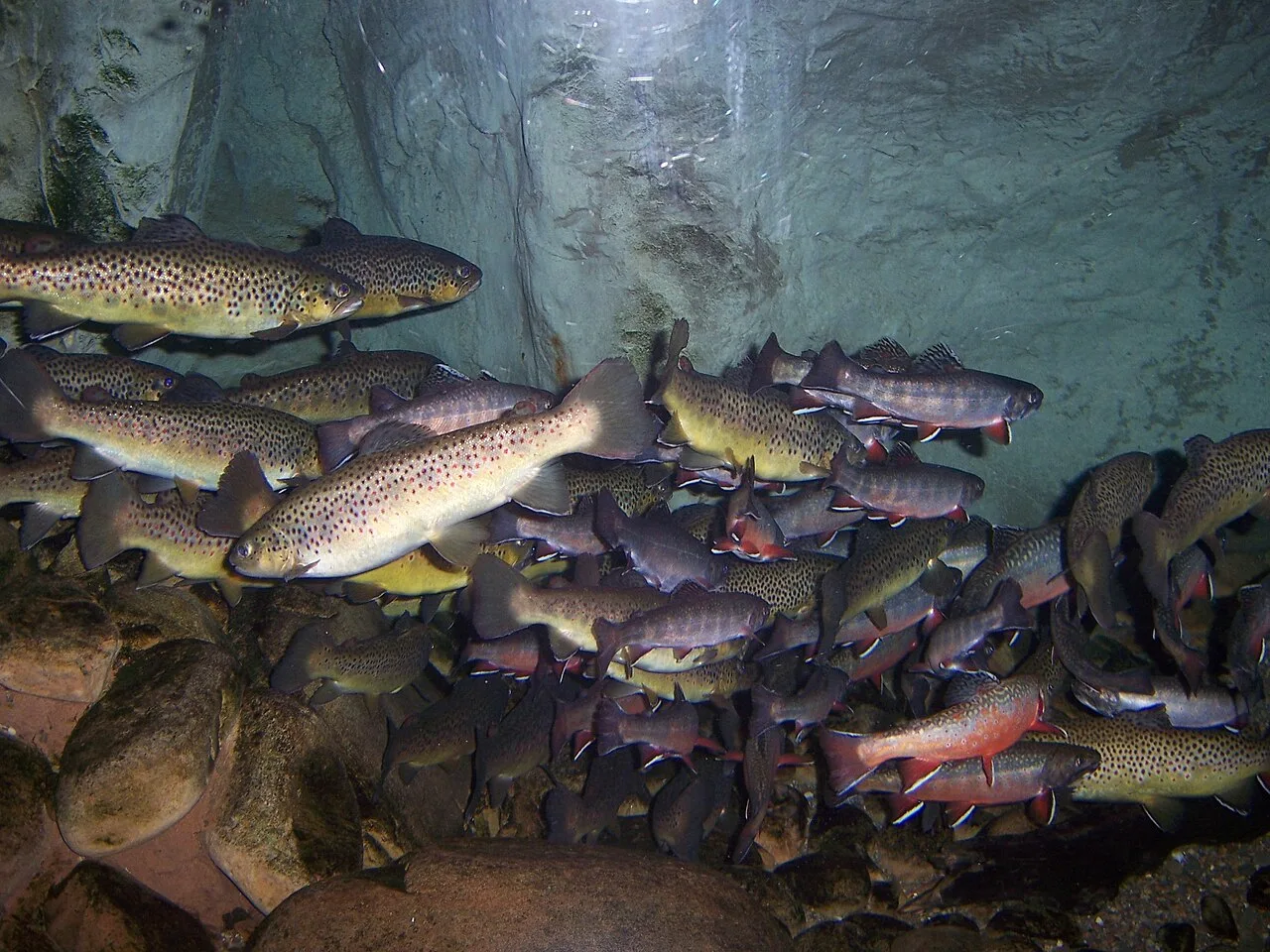
| Brook trout | Red spots in blue halos among pale spots | Worm-like (vermiculated) pattern on the back; white-tipped fins | Native to eastern North America |
| Rainbow trout | Dark spots (brown to black) on a light body | Not a char at all | Alaska too; ADF&G says Dollies are often confused with it |
The bull trout is the hard one, because for most of the 20th century biologists did not split the two. Dolly Varden and bull trout were counted as one species until Cavender (1978) described differences in the skull; a bull trout has “a larger, broader, and flatter head,” in the words of the British Columbia species account. Fisheries and Oceans Canada lists the Dolly Varden’s marks as “Small head,” an “Oval, snakelike body” and white leading edges on the lower fins. Where the two overlap, they also hybridize.
That matters at the water. The bull trout is federally threatened in the lower 48, and Washington’s Department of Fish and Wildlife (WDFW) says it is the angler’s responsibility “to be able to identify bull trout and release them immediately, unharmed.” In Washington the Dolly Varden lives mainly in the Olympic Peninsula and Puget Sound drainages, where it shares most rivers with bull trout; WDFW’s rule text names the pair as one group, “Dolly Varden/bull trout.” Where you cannot tell which one you have, the safe course is to release it as a bull trout.
Free PDF · Water temperature chart When do trout bite?
One water temperature reading, and the 16-page chart tells you who's spawning, who's feeding hard, where they sit and what to throw. 26 fish, every number sourced.
Enter your email, confirm it with one click, and the PDF is in your inbox. Plus one email a week on what's biting. Unsubscribe anytime. Privacy.
Where Dolly Varden live
The range covers the coast of Alaska from Southeast Alaska across the Gulf of Alaska and the Bering Sea and around to the Beaufort Sea, east to the Mackenzie River in Canada. Resident fish also live in headwater streams of the Interior and the Brooks Range. South of Alaska the range runs along the Pacific coast to Washington, and in Asia from Russia south to Japan and Korea.
Alaska has two forms. The northern form lives from the Mackenzie River to the north side of the Alaska Peninsula; the southern form from the south side of the Peninsula to the southern tip of Southeast Alaska, Kodiak and the Aleutians included. The difference shows in the fishing. Most southern fish winter in lakes, and those whose home stream has a lake usually return to that same lake each winter. Northern fish usually winter in rivers or springs, and they grow far bigger.
Populations are generally thought to be stable throughout Alaska, the Western Native Trout Initiative says, with some concerns about specific stocks, mainly around urban centers. Not every Dolly goes to sea. Freshwater residents are often dwarfed, maturing at 3–6 in (8–15 cm), and live in small headwater streams without easy access to the ocean or in landlocked lakes and ponds.
When and where to fish for sea-run Dollies
The sea-run Dolly Varden is an anadromous fish: it was born in fresh water and grows at sea. Young fish, now called smolts, first go to sea in May or June of their second to fourth year. After that, every year follows the same loop. They spend the summer feeding at sea, then return to fresh water to spawn and spend the winter. Marked Dollies have been recaptured at sea nearly 100 miles (160 km) from their home streams, ADF&G’s Sitka guide says, and an ADF&G study estimated that 35,000 of them spent one winter in Salmon Lake near Sitka.
Follow that loop and you know where to stand. The table puts ADF&G’s two regional guides, for Sitka in Southeast Alaska and for Southcentral Alaska, in the order of the year.
| When | Where the fish are | What to try | Region |
|---|---|---|---|
| Late March–May | The Sitka roadside fishery: salt water off stream mouths and points of land, after the fish leave the lakes and rivers | Small spinning lures; ADF&G says spring fish “strike readily at almost anything” | Sitka |
| April–May | Lake outlets, stream mouths and nearby beaches, as the fish head to sea | Small spinners or flies that imitate small fish, such as out-migrating pink salmon fry | Sitka, Southcentral |
| May–July | Salt water along the beaches; salmon trollers catch them as a bonus | Streamer flies that look like small fish, fished along saltwater beaches | Sitka |
| July–September | Creek mouths of larger streams on an incoming tide, then the streams themselves with the salmon runs | Fish near spawning salmon and in deep holes just above salt water | Sitka, Southcentral |
| Late August–October | Lakes, concentrated near inlet and outlet streams, as the fish reach their wintering grounds | Egg and flesh patterns that imitate salmon eggs and salmon flesh in the streams | Sitka, Southcentral |
Two lessons come out of that table. In spring a Dolly Varden near the shore is hunting young salmon, such as pink salmon fry on their way to sea, so a lure or fly the size of a fry makes sense. From midsummer on it lives off the salmon runs and their drifting eggs, which is why ADF&G points fall anglers to egg and flesh patterns. ADF&G’s Southcentral guide says most people fish for Dollies from July through October, when they are entering streams from the ocean to forage, spawn or find a place to winter.
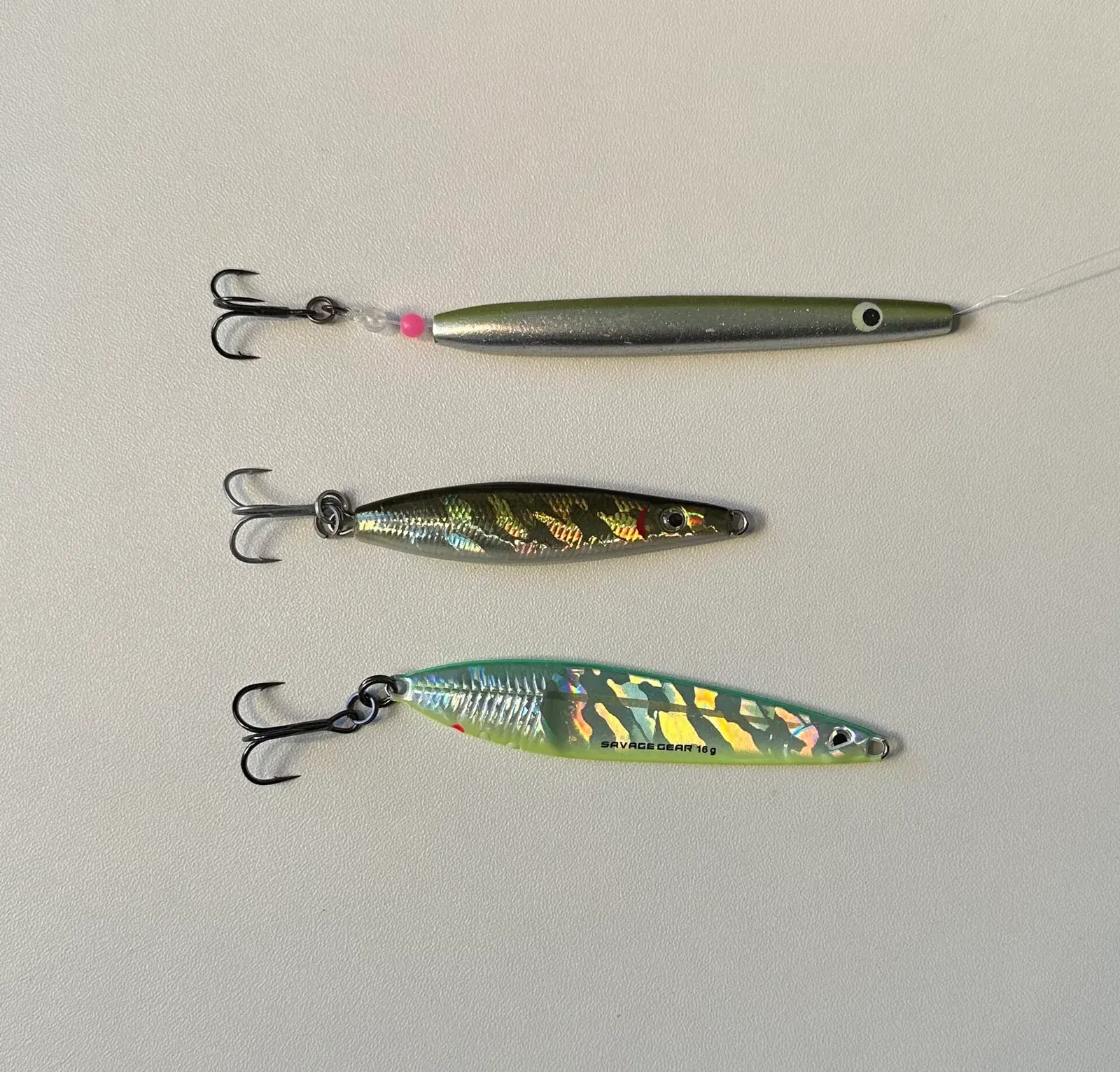
Tackle stays light. ADF&G’s Sitka guide says a sea-run Dolly Varden on light spinning tackle or a fly rod “will produce a fight not easily forgotten.” For the small spinners and spoons, see the trout lures page; many of the same rivers also hold sea-run rainbows, the steelhead.
How big do Dolly Varden get?
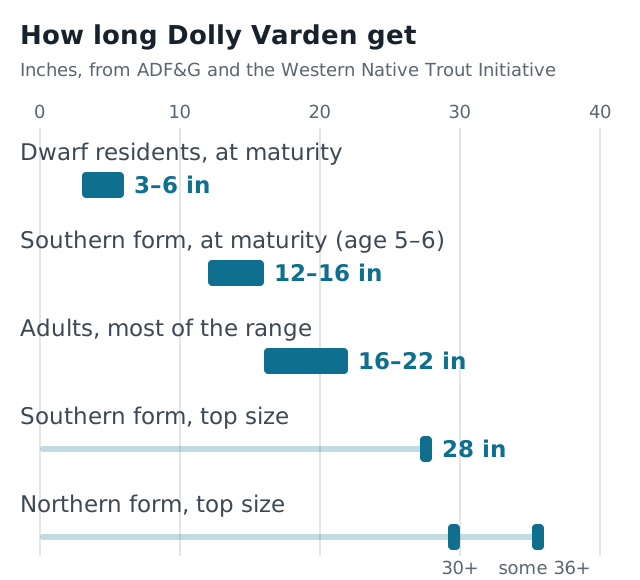
Across most of the range, adults average 16–22 in (41–56 cm), according to the Western Native Trout Initiative. Size depends on the form:
- Southern form. Most mature at 5 or 6 years old at 12–16 in (30–41 cm). ADF&G’s Sitka guide puts those fish at 1/2 to 1 lb. They rarely live past 8 years and reach up to 28 in (71 cm) and 10 lb (4.5 kg).
- Northern form. These live up to 16 years and reach over 30 in (76 cm) and 20 lb (9 kg) or more. ADF&G puts the top size at up to 27 lb, and the Western Native Trout Initiative says some northern populations produce fish over 36 in (91 cm) and 20 lb.
- Dwarf residents. Mature at 3–6 in (8–15 cm) in headwater streams and landlocked lakes.
The IGFA all-tackle world record is 20 lb 14 oz (9.46 kg), caught by Raz Reid in the Wulik River, Alaska, on July 7, 2001. Washington’s state record is 10.94 lb (4.96 kg) from the Whitechuck River in Snohomish County, caught on August 5, 1999.
The rules, and how to release one
ADF&G’s research is what lets the Alaska Board of Fisheries set the sport and subsistence rules, and limits differ from one water to the next. Check the current ADF&G regulation summary for the area you fish before you keep one. In Washington, check the WDFW pamphlet for the river, and keep any Dolly Varden or bull trout you release in the water: WDFW states that “It is unlawful to totally remove salmon, steelhead, or Dolly Varden/bull trout from the water.”
More anglers release their Dollies by choice, and ADF&G says a fish released correctly has a high chance of surviving. Its advice, in short:
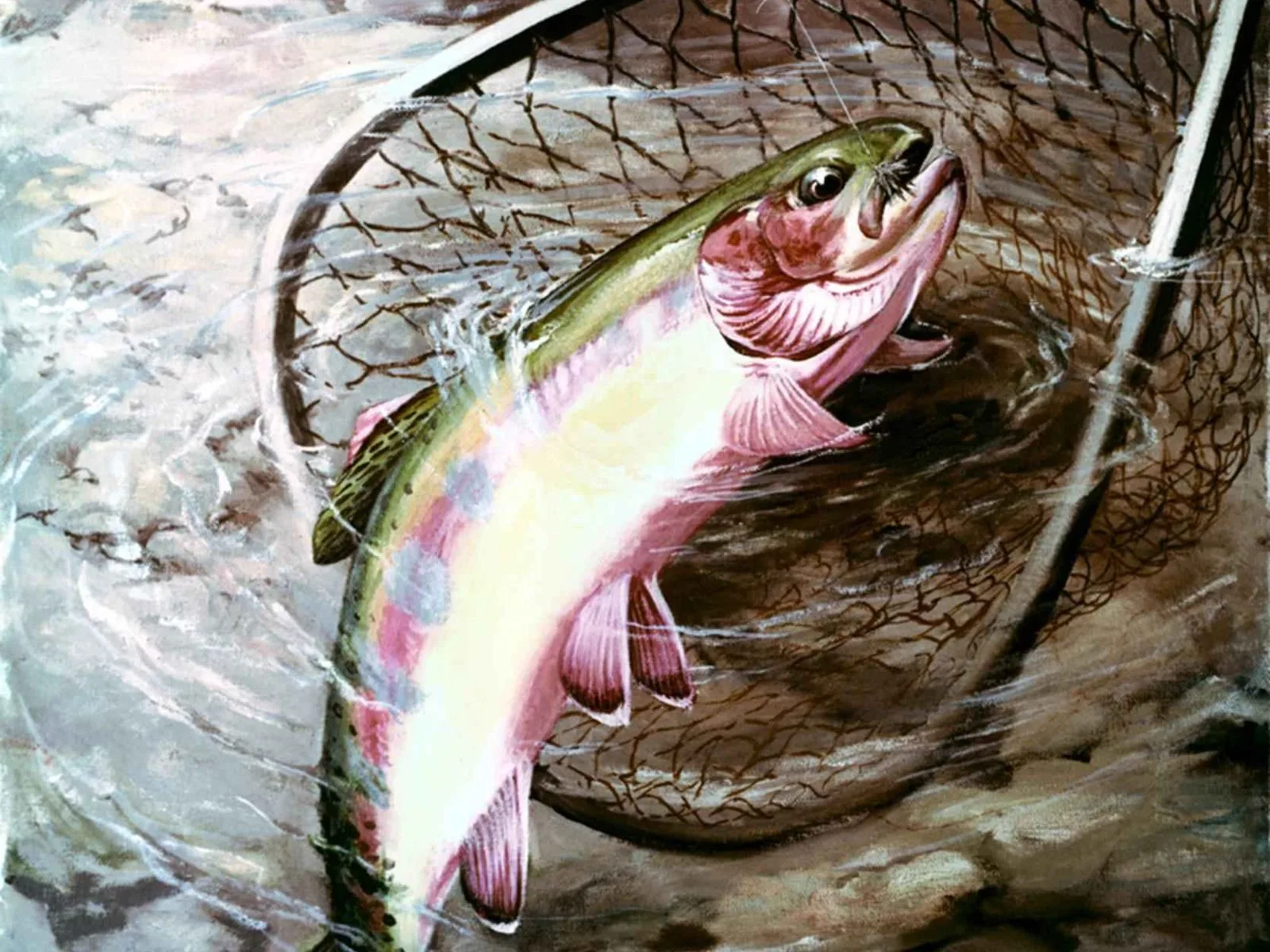
- Use flies or lures; hooking mortality is lower than with bait.
- Land the fish fast and keep it in the water while you handle it.
- If it is hooked deeply, cut the leader and leave the hook.
- Never let one hang from the line: a Dolly Varden has a “soft” mouth that tears easily.
- Wet your hands, never squeeze it, and hold it under the belly and near the tail (how to hold a trout shows the grip).
- In current, hold it belly down and head upstream until it swims off on its own.
Are Dolly Varden good to eat?
Yes. ADF&G says the flesh “is light pink and makes a delicious meal either pan fried or on the Bar-B-Q.” Its Sitka guide calls fish that have been at sea a while “unsurpassed in quality,” with flesh that is “pink, firm, and full of flavor,” and suggests smoking some of the catch. They are also food in the plainest sense: ADF&G notes that people in northwestern Alaska are heavily dependent on harvests of sea-run Dolly Varden. The Sitka guide adds that Dollies entering fresh water after their growing season in salt water are in prime condition.
Why is it called a Dolly Varden?
The name comes from Charles Dickens. In his novel Barnaby Rudge, Dolly Varden is a young girl in bright, boldly patterned dresses, and by the late 19th century a colorful dress fabric was sold under her name. ADF&G’s Southcentral guide credits a 15-year-old girl, Elda McCloud, with giving the name to a fish. Her uncle ran the Soda Springs resort in northern California, and looking at a catch from the upper McCloud River, she said the fish looked like a “regular Dolly Varden.” ADF&G adds that no one knows whether she had just read the novel or seen the dress.
There is a twist. Those McCloud River fish were what biologists now call bull trout. The two counted as one species, so the name traveled north to the Alaska char. When the inland fish were split off as their own species in 1978, they kept the name bull trout.
The life history of a Dolly Varden
Dolly Varden spawn in the fall, between September and November. In Southcentral Alaska a female lays 600 to 6,000 eggs, depending on her size, in a gravel nest called a redd. The year of a sea-run fish, from ADF&G’s Southcentral guide and species profile:
| Stage | When |
|---|---|
| Eggs laid in the redd | Late September or October in Southcentral Alaska |
| Alevins live off the yolk sac in the gravel | By March |
| Fry leave the gravel | April or May |
| Young fish rear in streams | Two to four years, some as long as six |
| Smolts turn silver and go to sea | May or June |
| Summer feeding at sea | Summer, every year after the first trip |
| Back to fresh water to spawn or winter | Late summer and fall |
Unlike Pacific salmon, Dollies can spawn more than once, but spawning is hard on them: an estimated 70% of the males and up to 60% of the females die after it, and few spawn more than three times.
The bounty in the pull quote came from their taste for salmon eggs. Research since the 1940s, summed up in ADF&G’s Southcentral guide, found the opposite of what the bounty assumed. Dollies mainly eat drifting eggs that would not have hatched anyway. By eating dead or fungus-infected eggs they keep the infection from spreading through the redd. In lakes they also eat freshwater snails that host a parasite which blinds young coho and sockeye salmon. The rest of the diet is opportunistic: winged insects and the larvae of mayflies and midges in fresh water, amphipods and small fish such as sand lance at sea.
The Inupiaq of northern Alaska had two names for the same fish, ADF&G notes: a bright fish entering a stream in summer was iqalukpik, and the same fish three months later in post-spawning colors was pyraulik. For the other chars and the trout that share their water, the trout hub is the place to go next.
Free PDF · 16 pages
Know what's biting before your first cast
The Water Temperature Fishing Chart. Take one water temperature reading, find it on the chart, and you know which of 26 freshwater fish are feeding today, where they are and what to throw. For your phone and the tackle box.
- Where they sit and what to throw at every band: bass, crappie, bluegill and walleye; catfish by species; trout: when to stop and where they hide
- The best hours at your reading, the cold front day by day, and the spawn calendar from ice-out to midsummer
- The three thermometer mistakes that make a reading lie (the first one is the surface)
- The 26-fish chart: who's spawning, feeding hard or shut down at your reading
Every number from state fish and wildlife agencies and fisheries research: 61 sources, all on the site.
Enter your email, confirm it with one click, and the PDF is in your inbox. Plus one email a week on what's biting. Unsubscribe anytime. Privacy.
Related
Section guide
Trout: The Fish, Where They Live, When They Bite and How to Catch ThemTrout are cold-water fish of the salmon family. The five you'll catch, the 68 °F line, when each spawns and how to catch them; every type on its own page.
 Bull Trout: How to ID the Threatened Char, and Where to Fish
Bull trout are a threatened char: how to tell one from a brook trout, lake trout or Dolly Varden, the few waters where you may fish, and the 32 lb record.
 Golden Trout: California's State Fish and Where to Catch One
The California golden trout: native to two Kern Plateau creeks, stocked in high lakes from Wyoming to Washington, and the 1948 record Wyoming now doubts.
 Trout Lures: Spinners, Spoons, Jigs and Minnows, and How to Fish Each
Trout lures come in five types: inline spinners, spoons, micro jigs, sinking minnows and jerkbaits, mostly 1/64–1/4 oz. Sizes by trout, colors by water.
 Types of Trout: Every US Trout and Char and How to Tell Them Apart
The types of trout in the US, rainbow and brown to bull trout and Arctic char: the group each belongs to, where it is native, and the one mark that IDs it.
 Cutthroat Trout: Subspecies, Identification and How to Fish
Cutthroat trout: how to tell one from a rainbow or cutbow, each subspecies with its range, size, spots and status, how to fish them, the 41 lb record.
 Lake Trout: The Deep-Water Char That Lives 60 Years
Lake trout are deep-water chars that live 60 years: how to tell one apart, where they hold by season, the 72 lb record and the Great Lakes comeback.
Sources
- Alaska Department of Fish and Game, Dolly Varden Species Profile
- Alaska Department of Fish and Game, Dolly Varden: Uses
- ADF&G Division of Sport Fish, Southcentral Region, Dolly Varden (Sport Fishing Series)
- ADF&G, Dolly Varden fishing in Sitka
- IGFA World Records, Dolly Varden (all-tackle, Raz Reid, Wulik River)
- Western Native Trout Initiative, Dolly Varden
- Washington Department of Fish and Wildlife, Dolly Varden (state record)
- Washington Department of Fish and Wildlife, Bull trout
- British Columbia Identified Wildlife Management Strategy, Bull Trout species account
- Fisheries and Oceans Canada, Identify your catch (BC sport fishing guide)
- West Virginia DNR, Brook Trout
- U.S. Fish and Wildlife Service, Bull trout
- Alaska Department of Fish and Game, Arctic Char Species Profile
- Wikipedia, Dolly Varden trout (origin of the common name; Moyle, Inland Fishes of California)