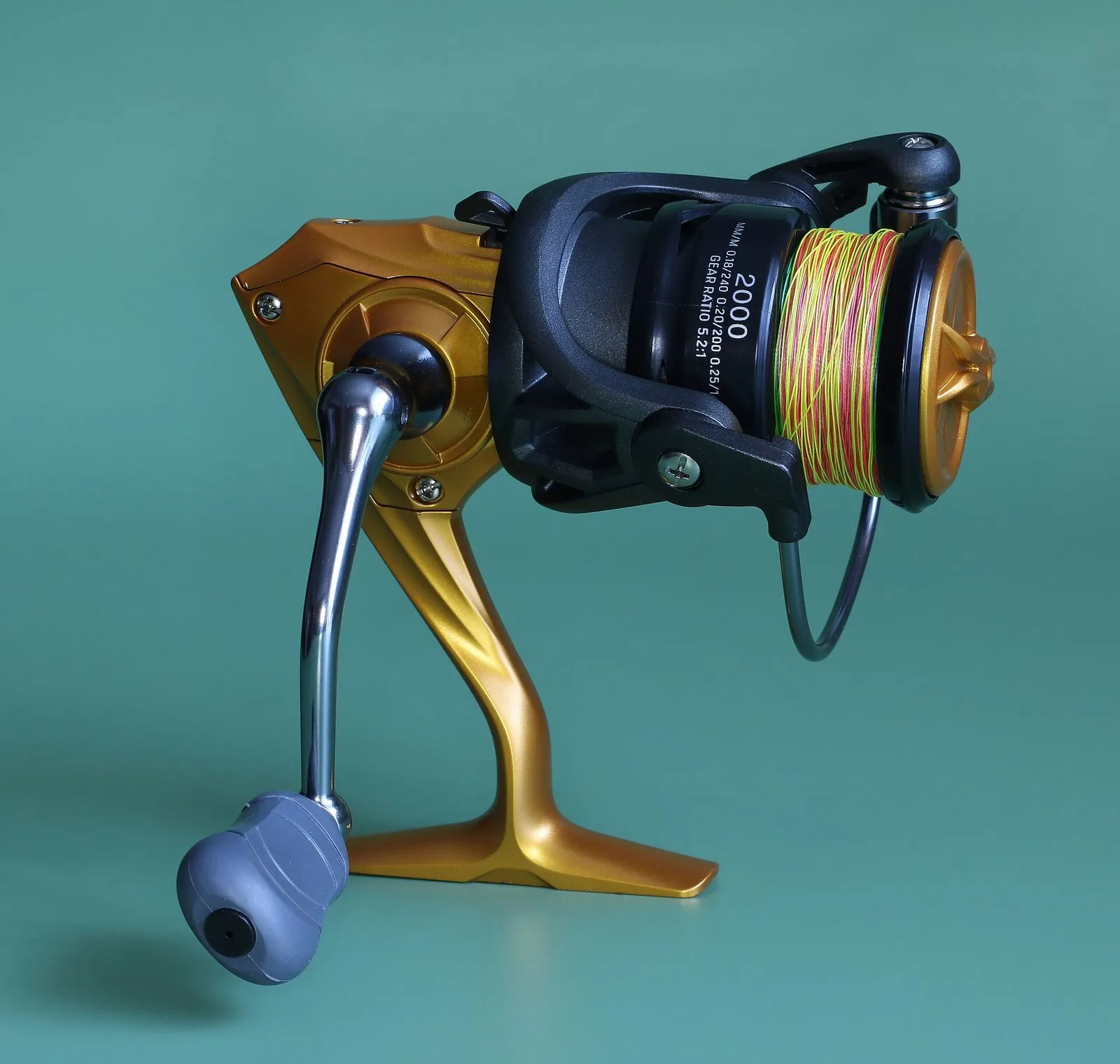
A spinning reel is the fixed-spool reel that hangs under the rod: the bail flips open, the line peels off the end of a spool that does not turn, and there is no backlash to learn. It is the reel most anglers start on and the one most keep for finesse fishing, trout, panfish, walleye, inshore saltwater and surf. The confusing part is the number on the box. A “2500” from one maker is not exactly a “3000” from another, and Penn counts in tens where Shimano and Daiwa count in thousands. Below: what the size number means, a size table that answers “which one do I need” for each kind of fishing, the gear ratio and drag figures decoded, and the 2500-versus-3000 question settled.
A “2500” from one maker is not a “3000” from another: Penn counts in tens where Shimano and Daiwa count in thousands, so the number on the box only means something inside one brand.
What you need
- A spinning rod: reel seat underneath, large guides near the handle shrinking toward the tip. The rods hub explains power and action.
- Line matched to the reel size: the table below gives the ranges. The line hub explains why braid needs a leader and mono backing on the spool.
- If you are choosing between spinning and baitcasting, read the baitcaster page first; the decision table there sends most anglers to the right reel in a minute.
What the size number means
The number describes the size of the spool and body, and with it the line capacity, the drag and the weight. The scale is a convention that grew out of Shimano’s and Daiwa’s numbering and is now used, loosely, by everyone: 1000 is the smallest common size, then 2000, 2500, 3000, 4000, 5000 and up to 10000 and beyond for offshore reels. Penn, Okuma and some others use 10, 20, 30, 40 and so on, or 2000 written as “20”; the mapping is close enough that a Penn 3000 and a Shimano 3000 hold similar line. Because sizes are not standardized, the one number to trust is the line capacity printed on the spool, and that is what the table is built from.
| Size | Mono line | Braid | Lure weight | Species and use |
|---|---|---|---|---|
| 1000 | 4–6 lb, about 100–120 yd (90–110 m) of 4 lb | 6–10 lb | 1/32–1/8 oz (1–4 g) | Panfish, trout, ultralight streams |
| 2000 | 6–8 lb | 10 lb | 1/16–1/4 oz (2–7 g) | Trout, crappie, light bass finesse |
| 2500 | 6–10 lb | 10–15 lb | 1/8–3/8 oz (4–11 g) | The all-purpose freshwater size: bass, walleye, crappie |
| 3000 | 8–12 lb | 15–20 lb | 1/4–3/4 oz (7–21 g) | Bass, walleye, pike, big trout; light inshore |
| 3500–4000 | 10–17 lb, about 200 yd (180 m) of 10–15 lb | 20–30 lb | 3/8–1.5 oz (11–43 g) | Pike, salmon, stripers, inshore redfish and snook |
| 5000–6000 | 17–20 lb | 30–50 lb | 1 oz (28 g) and up | Catfish, heavy inshore, light surf |
| 6000–8000+ | 20 lb and up | 50 lb and up | 2 oz (57 g) and up | Surf stripers and bluefish, offshore |
The table is the consensus of the retailer and review sizing guides; a given reel’s own capacity figures override it.
How to choose, step by step
- Start with the line the fish needs, not the reel. Trout and panfish want 4–6 lb; bass and walleye 8–12 lb mono or 10–20 lb braid; pike, salmon and inshore fish 12–20 lb; surf fish 20 lb and up. The line hub has the reasoning.
- Pick the size that holds 150–200 yards of that line from the table. That is enough for any freshwater run and most inshore fish.
- Match the rod. A 2500 balances a 6 ft 6 in to 7 ft light or medium-light rod, a 3000 a 7 ft medium, a 4000 a 7 ft medium-heavy, a 5000 and up an 8–12 ft surf or catfish rod. A reel that is too heavy for its rod tips the outfit forward and tires the wrist.
- Choose the gear ratio for the lures. About 5.2:1, roughly 26–30 in (66–76 cm) of line per handle turn on a 3000, is the all-rounder; 6.2:1 for jerkbaits, topwater and picking up slack on the drop shot; lower ratios for slow-rolling and big baits.
- Check the drag against the line. Set the drag at about a quarter to a third of the line’s breaking strain, so a 10 lb line runs 2.5–3.5 lb of drag; the reel’s maximum drag only needs to exceed that comfortably. A 2500 with 10–12 lb of maximum drag is plenty for bass; saltwater reels carry 20–30 lb.
- For salt water, buy sealing, not size. A sealed drag, corrosion-resistant bearings and an IPX rating (IPX5 or 6 for spray, IPX8 for submersion) separate a saltwater reel from a freshwater one of the same size; Outdoor Life’s saltwater picks run from the Okuma ITX 2500 at about $139 to the Penn Authority 5500 and Shimano Stella SW 5000 at $700–800, all sealed.
2500 or 3000?
Both catch bass. The difference is capacity and weight: a 3000 spool holds roughly 50 yards more line and a heavier test, and it balances a 7 ft medium rod, so it is the better single reel for an angler who throws everything from a drop shot to a small swimbait on one outfit. The 2500 is lighter, balances the 6 ft 10 in to 7 ft medium-light rods that finesse techniques want, and is the size the tournament anglers put their drop-shot and Ned-rig rods on. Can you put 30 lb braid on a 2500? You can, and it will hold less of it than you want; 10–15 lb braid is the 2500’s range, and a 3000 or 4000 is the honest answer for 30 lb. For a 4000, the usual worry is the opposite: it handles fish far bigger than a bass, pike to 20 lb and inshore redfish, but it is heavy for a day of casting light lures.
Brands and prices
The two Japanese makers own the middle of the market and their ladders are mirror images. Shimano’s runs Sienna ($35–38) and Sedona ($90–100) at entry, Sahara and Nasci ($105–145) in the middle, Stradic ($235–265) and Vanford ($285–295) as the workhorses, and Twin Power, Vanquish and Stella ($495–895) at the top; Daiwa’s runs Crossfire and Revros ($35–70), Legalis and Fuego ($100–125), BG ($150–250, the saltwater value reel every guide names), Tatula ($225), Certate ($650) and Saltiga ($1,100). The question “is Shimano or Daiwa better” has no answer at the same price; both reels at $150 are smooth, sealed enough for fresh water and will last for years. Penn, Okuma, Pflueger (the President is the combo pick in most round-ups) and KastKing fill the budget and saltwater ends. The reels hub keeps the ladders with prices.
Mistakes to avoid
- Buying the biggest reel “to be safe”. A 4000 on a bass rod is 3 oz heavier than it needs to be and casts light lures worse. Size to the line.
- Overfilling or underfilling. Fill to about 1/8 in (3 mm) below the spool lip; over that throws wind knots, under it costs casting distance.
- Braid straight onto the spool. Braid slips on a bare arbor; put on a few turns of mono backing or use a spool with a rubber band. The spooling page under the hub has the procedure.
- Reeling against the drag. Every turn of the handle while a fish takes line twists the line. Let the drag work, then reel when the fish stops.
- Leaving salt on it. Rinse a saltwater reel in fresh water after every trip and loosen the drag for storage.
When to use something else
A baitcaster is the right reel for lures over 3/8 oz, heavy cover and accuracy, and for most bass techniques that use 15 lb line and up; the baitcaster page has the decision table. A spincast reel is the child’s first reel. And for catfish on heavy bait, big musky lures and trolling, a round baitcaster or conventional reel carries the line a spinning reel cannot; the catfish hub covers that tackle.