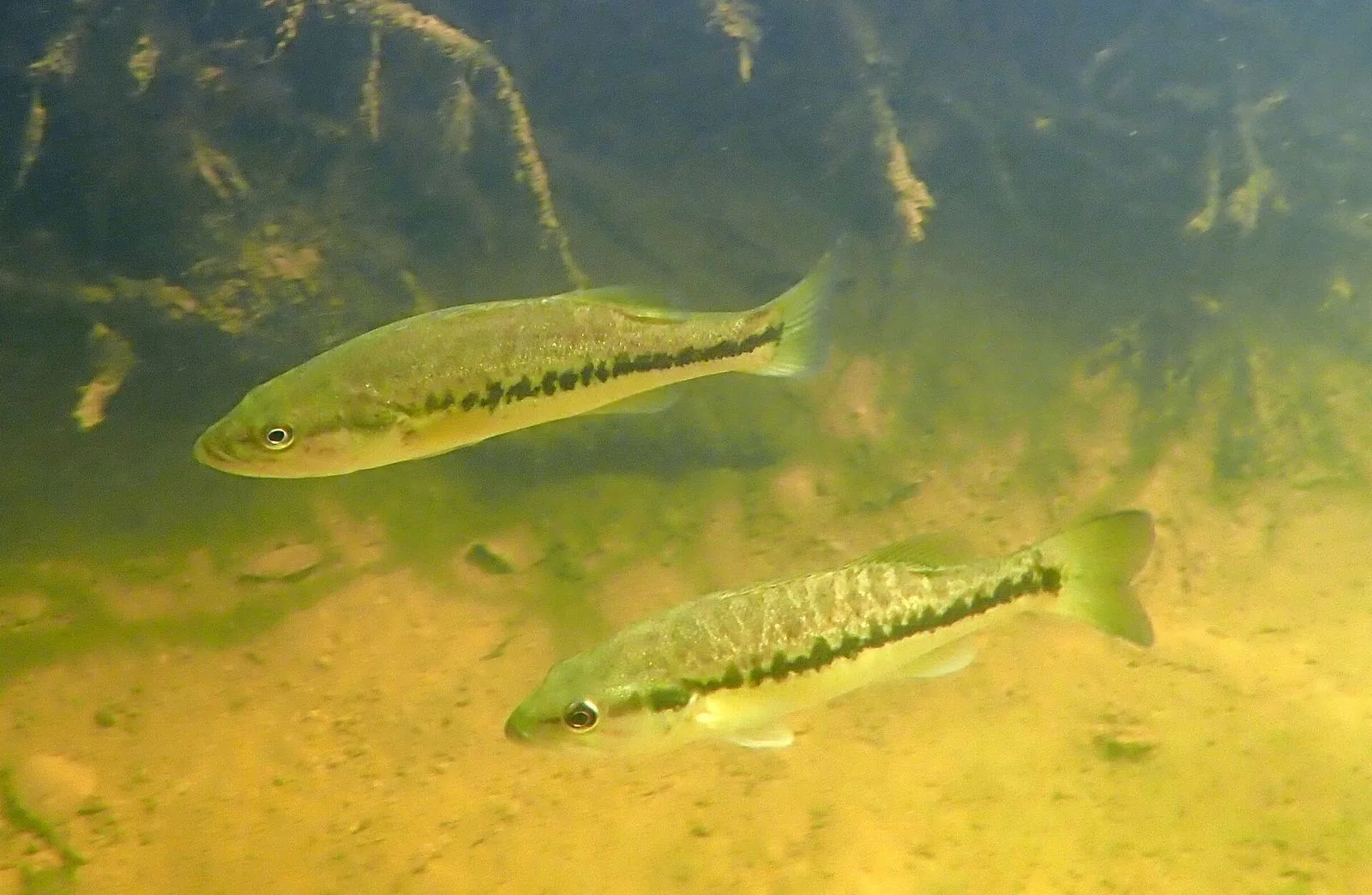
The spotted bass, Micropterus punctulatus, is the black bass that gets mistaken for both of the others: a largemouth that seems small-mouthed, a smallmouth that has a stripe. It is a river fish of the Ohio and Mississippi basins that took to reservoirs, a fish that matures in a year, fights harder than its size and rarely passes five pounds, and since 2008 it has had a near-identical twin, the Alabama bass, whose spread through the Southeast has rewritten the record books. Anglers in Kentucky call it the Kentucky bass, and it is that state’s official game fish. Below: the marks that separate it from largemouth, smallmouth and Alabama bass, the water it lives in, the spawning and growth numbers, the tackle, and the record story, each with its source.
The spotted bass all-tackle record was reset in 2025, because the biggest “spotted bass” on the books turned out to be Alabama bass, a species only recognized since 2008.
Identification
Three marks separate a spotted bass from a largemouth. The upper jaw does not extend past the rear edge of the eye; on a largemouth it reaches well beyond it. There is a rough tooth patch in the center of the tongue, which a largemouth never has. And below the dark lateral stripe the lower sides carry rows of small dark spots, which give the fish its name; the dorsal fin has ten spines to the largemouth’s nine and is only shallowly notched. Against a smallmouth the stripe settles it: smallmouth have vertical bars and no horizontal stripe.
| Mark | Spotted bass | Largemouth | Smallmouth | Alabama bass |
|---|---|---|---|---|
| Upper jaw | Stops at the rear margin of the eye | Well past the eye | Never past the eye | Does not extend well past the eye |
| Tongue | Tooth patch | None | None | Tooth patch, often smaller and fainter |
| Flank | Lateral stripe plus rows of spots below it | Blotchy stripe | Vertical bars | As spotted; more mottled spots above the stripe |
| Dorsal fin | 10 spines, shallow notch | 9 spines, nearly divided | Shallow notch | As spotted |
| Lateral-line scales | 55–71 | – | – | 68–84, usually above 71 |
| Typical size | To about 18 in (46 cm), 3–5 lb (1.4–2.3 kg); Texas maximum over 5.5 lb (2.5 kg) | To 22 lb (10 kg) | To 12 lb (5.4 kg) | Record 11 lb 4 oz (5.1 kg) |
| Lifespan | About 6 years | Up to 16–23 years | 10 years and more | 8–10 years |
Spotted bass and Alabama bass cannot be separated reliably by eye. The scale counts overlap at 68–71, the spot patterns differ only on average (Wired2Fish’s guide counts 7–10 mottled spots above the stripe on a spotted bass and 10–12 on an Alabama bass), and where both occur, or where the Alabama bass has been introduced, only a scale count or a genetic test settles it. Texas puts the size difference bluntly: a spotted bass’s “maximum size is less than one-third that of largemouth bass”.
Where they live
The native range is the Ohio and Mississippi basins into Oklahoma and Texas, and along the Gulf states; in Texas the fish is native from the Guadalupe River to the Red River, excluding the Edwards Plateau. It prefers more current than a largemouth and, in Texas’s words, water “too warm, turbid, and sluggish for smallmouth bass”: river pools with flow, rocky banks, and the deeper, clearer, more open water of reservoirs, where spotted and Alabama bass suspend over channels and follow schools of shad in a way largemouth rarely do. That open-water habit is why a school of spotted bass will chase a topwater across a hundred yards of deep water in summer and why they show up on forward-facing sonar where largemouth do not.
The Alabama bass, Micropterus henshalli, native to the Mobile River basin and recognized as a species in 2008, has been moved illegally by anglers into Georgia, the Carolinas and Virginia. North Carolina counts it in more than thirty waters, Lake Norman’s Alabama bass outnumbered largemouth within five years of their arrival, and the fish hybridizes “aggressively” with smallmouth and spotted bass: three quarters of the smallmouth sampled at Fontana Lake carried Alabama bass genes. North Carolina removed all size and creel limits on Alabama bass in 2020 and asks anglers to harvest every one; Virginia lists it as predatory and undesirable with no limit. Where you fish matters to what a “spotted bass” is.
Season and behavior
Spotted bass spawn in spring at 57–74 °F (14–23 °C), a little earlier and over a wider band than largemouth. The female lays 1,150 to 47,000 eggs, the nest holds 3,000 to 5,000, and the male guards the eggs and then the fry “for up to four weeks after they have hatched”. The eggs hatch in two to six days. Growth is fast and life is short: reservoir fish reach about 6 in (15 cm) in their first year and add about 5 in in the second, mature at 9½–10 in (24–25 cm) under two years old, and “a large proportion reach maturity within a year”, with the fish on the spawning grounds usually three or four years old; the average lifespan is about six years, eight to ten for Alabama bass.
| Stage | Spotted bass | Source |
|---|---|---|
| Spawn | 57–74 °F (14–23 °C); 1,150–47,000 eggs; hatch 2–6 days; male guards fry to 4 weeks | Texas Parks and Wildlife, Wired2Fish |
| Year 1 | About 6 in (15 cm) in reservoirs | Wired2Fish |
| Year 2 | About 11 in (28 cm); mature at 9½–10 in | Wired2Fish |
| Spawning age | Usually 3–4 years | Texas Parks and Wildlife |
| Lifespan | About 6 years (Alabama bass 8–10) | Wired2Fish |
| Diet | Zooplankton, then insects, then fish and crayfish; crayfish about half the diet at 6 in | Texas Parks and Wildlife, Wired2Fish |
Through the year they follow the same temperature bands as largemouth in the bass hub, with two differences: they hold on current and rock in rivers rather than in vegetation, and in reservoirs they suspend over deep water in summer and fall, schooling on shad.
How to catch them
Spotted bass eat what smallmouth eat and live where largemouth live, so the tackle is the finesse end of the bass box: shaky heads, drop shots, Ned rigs and small jigs with craw trailers on rock and current seams, from the jigs and rigs hub; small crankbaits and jerkbaits in spring; and in summer and fall, when schools push shad to the surface over deep water, walking topwaters and small swimbaits cast to the boils, from the topwater and soft plastics hubs. The rod is a 7 ft medium or medium-light spinning outfit with 10–15 lb braid to a 6–10 lb fluorocarbon leader for most of it; the rods hub explains the matrix. They fight above their weight: Wired2Fish calls them among the most aggressive of the black basses, and the search-box question about which bass is most aggressive usually gets this answer.
Are spotted bass good to eat?
Yes, and where the fish is native they are eaten more readily than largemouth, being smaller, firmer and more abundant; where the Alabama bass has invaded, the agencies would rather you ate every one. The same mercury advisories that apply to largemouth apply here by waterbody, so check the state health department page for the water you fish.
Records and regulations
The record history is a lesson in taxonomy. For decades the “spotted bass” all-tackle record was a series of huge fish from California’s reservoirs, culminating in an 11 lb 4 oz (5.1 kg) fish from New Bullards Bar; every one of them was, genetically, an Alabama bass, stocked in California from Alabama’s Mobile basin. In June 2024 the IGFA split the categories, moved those records to Alabama bass, and reopened the spotted bass record; on 13 February 2025 Art Weston set the new all-tackle spotted bass record at Toledo Bend at 2 lb 8 oz (1.1 kg), and the true species’ record will climb from there. State records for spotted bass run to about 6 lb where the native fish is managed separately, which Texas and Tennessee do. Limits follow the largemouth rules in most states, with the invaded states removing all limits on Alabama bass; the state pages carry the current rules.
Related
The bass hub covers all five black bass species; the largemouth bass and smallmouth bass pages are the two look-alikes; the jigs and rigs hub covers the finesse rigs that catch most spotted bass.
Sources
- Texas Parks and Wildlife, spotted bass species profile
- Wired2Fish, Spotted bass: a comprehensive species guide
- North Carolina Wildlife Resources Commission, Alabama bass
- Kim, Taylor & Near 2022, Phylogenomics and species delimitation of the black basses, Scientific Reports
- Sports Illustrated, Art Weston's IGFA spotted bass records (2025)
- Outdoor Life, IGFA adds seven bass record categories (June 2024)