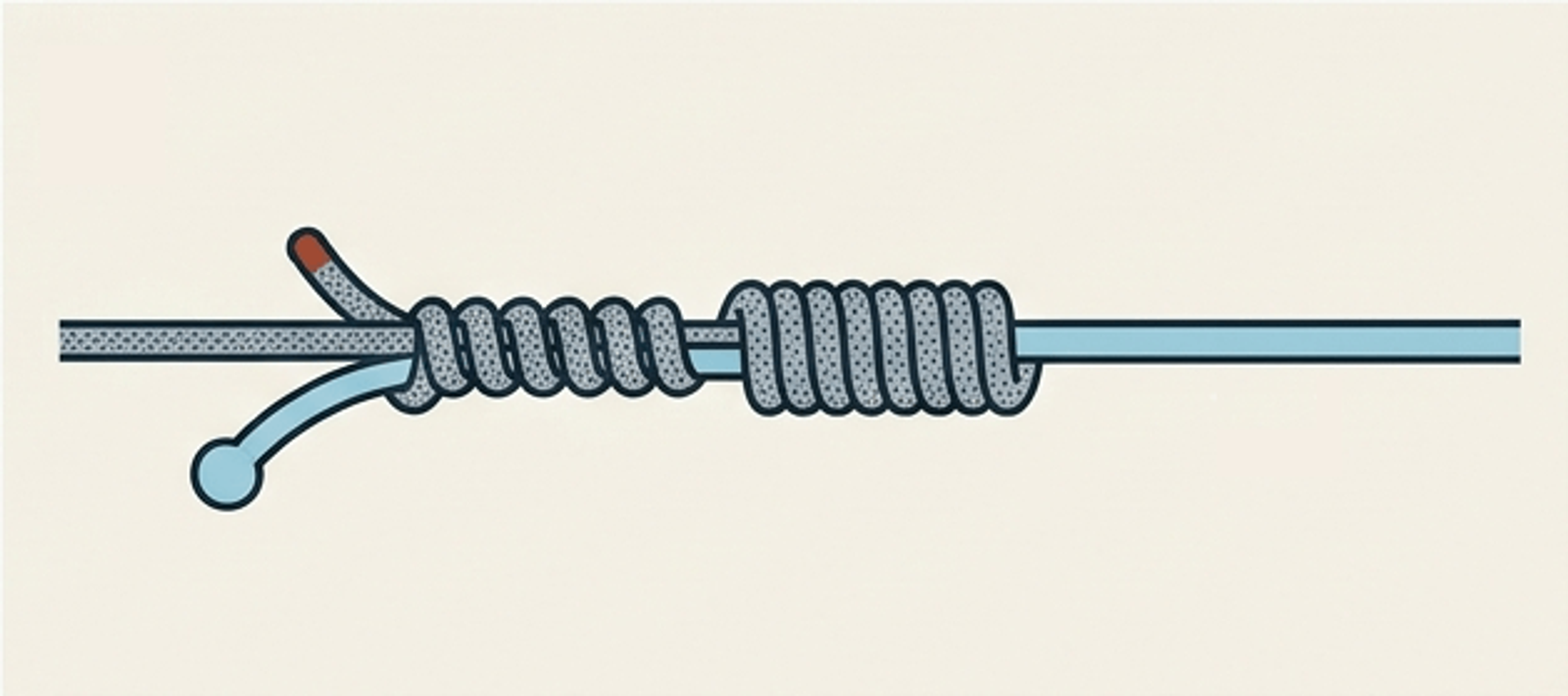
The FG knot joins braided main line to a fluorocarbon or mono leader, and in head-to-head pulls on 10 lb braid it beat the Alberto five times out of five. It is not really a knot. The leader wraps under and over a tight braid twelve to fifteen times each way, and the braid’s coils grip it like a Chinese finger trap. The harder you pull, the harder they grip.
On the IGFA’s tester, 15 lb braid broke at 34.4 lb. The FG tied in it held 73.4 percent of that, about 25 lb: stronger than the label, weaker than the line.
Why tie the FG instead of a quicker knot?
Because the load spreads along a sleeve of a dozen wraps instead of one sharp bend. And because the leader never folds back on itself, the join is slim enough to run through the guides on a cast.
It works for any braid to fluorocarbon or mono, as long as the braid is the weaker line. The price is time: the braid has to stay tight for a minute while you wrap, and the knot only holds if you set it properly.
What you need
- Braided main line. The FG is a braid knot; the braided line page covers why braid needs a leader at all.
- A fluorocarbon or mono leader that tests heavier than the braid. Every test on this page paired them that way: 10 lb braid to 30 lb leader, 15 to 30, 50 to 80. How long and how heavy the leader should be depends on the fishing.
- A way to keep the braid tight for a minute: your teeth, your little finger, or your foot.
- Clippers. A lighter is optional.
Free card: what 26 species do at your water temperature
Plus one email a week on what's biting now. No sales pitches. Privacy.
How to tie the FG knot, step by step
-
Put the braid under tension. Hold the braid’s tag in your teeth with the standing line running tight to the reel, or wrap it around your little finger. Jason Sealock of Wired2Fish pins the braid under his foot and holds the tag in his mouth. Outdoor Life’s Joe Cermele locks the rod in a holder, holds the braid in his teeth and backs away until the braid is tight. Whatever you choose, the braid stays tight for the whole knot.
-
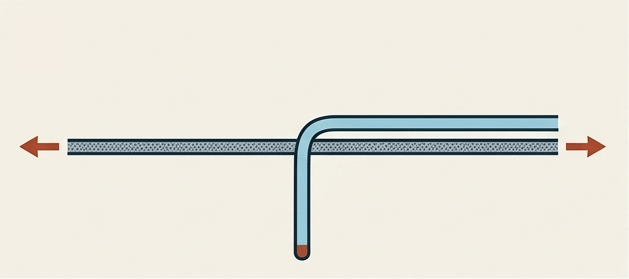
Lay the leader across the braid with a long tag, 12 in (30 cm) or more, on the side you will wrap with.
-
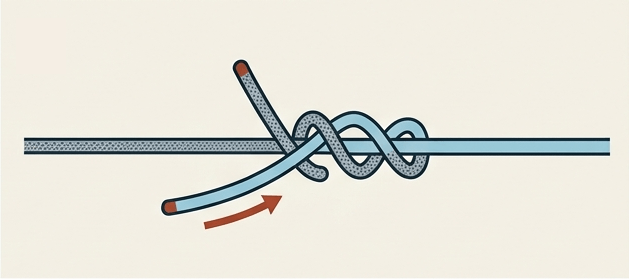
Wrap the leader under the braid, then over. Take the leader tag under the braid and back over the top, then under from the other side and back over. Each pair of passes is one “X” on the braid. A trick that helps: ease the braid slightly and pull the leader tight after each pair, so the braid’s coils slide up and lock.
-
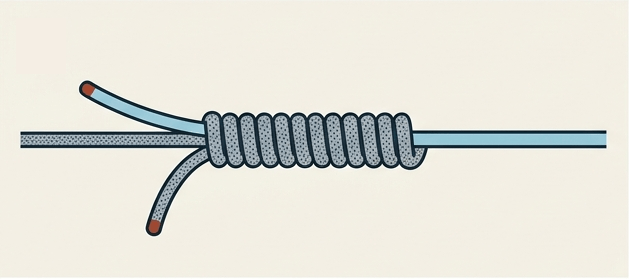
Repeat to 12–15 pairs of wraps, and compress the stack every five or six pairs by pushing the wraps together. Loose, gapped wraps are what lets the knot slip.
-
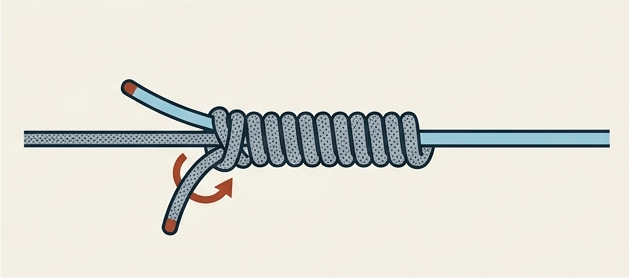
Lock it with two half hitches of the braid tag around both the braid and the leader, snug against the wraps.
-
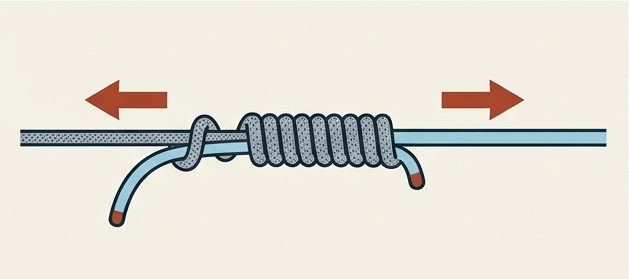
Set the finger trap. Wrap the braid around one hand, hold the leader in the other, and pull hard. The knot’s eventual strength depends on that final strong pull. The first coil matters most, and the coils should stay evenly spaced.
-
Finish the hitches, then trim the leader. Add more half hitches around both lines: four in all works, and a triple half hitch, a couple of double ones or a long chain all work. Only now cut the leader tag close, because the coils can slide before the knot is set. Then tie a few half hitches on the braid alone, so they taper over the cut end and ride through the guides. Glue is optional: Cermele says a drop of super glue can go on the half hitches, but never on the wraps.
-
Trim the braid tag. Burn it back with a lighter, fingers shielding the knot, so it will not fray.
Drawings: fishing.info (AI-generated).
How many wraps? The tutorials disagree
The wrap count is where the tutorials differ most, partly because some count each pass and some count pairs.
| Tutorial | Wraps | Finish |
|---|---|---|
| Animated Knots | 12–15 pairs, compressed every 5–6 pairs | Triple half hitch, double half hitches or a long chain |
| Salt Strong | 16 wraps in its how-to (once 20–22); 18–20 after its 2021 coil test | 2 half hitches, set, trim leader, 2 more |
| Wired2Fish | 20 wraps, ten to each side | 4 half hitches on both lines, a few on the braid alone |
| Salt Strong “hack” | Standard wraps | 4 half hitches, alternating sides, before trimming |
Read across, ten to fifteen pairs is the range the tutorials share. The only published count test, Salt Strong’s in 2021, found that 30 coils added some strength but were harder to lock in place, and its author settled on 18 to 20.
How strong is the FG?
Four published tests give FG figures with their lines and method. In the head-to-head pulls, two knots sit on one strand and are pulled until one breaks, so the figure is where the losing knot gave way. The Instron figures are machine pulls, three per knot.
| Test | Lines | FG result | Against |
|---|---|---|---|
| Salt Strong, 2015 | 10 lb PowerPro to 30 lb Ande fluoro | Won; 20–23 lb average | Improved Albright, slim beauty, double-double uni |
| Salt Strong, 2016 | 10 lb PowerPro to 30 lb Big Game mono | Won 11 of 12 bouts at 12.6–17.9 lb; lost one at 18.1 lb | Bimini twist plus improved Bristol, double uni, Yucatan or Albright |
| Salt Strong, 2020 | 10 lb PowerPro to 30 lb Ande fluoro | Won 5 of 5; Alberto broke at 8.7–14.6 lb | Alberto |
| Sport Fishing, IGFA Instron 5543 | 15 lb Spiderwire Stealth to 30 lb Berkley ProSpec fluoro | 73.4% of 34.4 lb, about 25 lb (11 kg) | Improved FG 80.9%, PR bobbin 84.3% |
Three things follow. First, braid is rated far below its true break. The “15 lb” Spiderwire broke at 34.4 lb on average, so a knot that beats the label can still waste a quarter of the line.
Second, the FG is not unbeaten. On the Instron, a PR bobbin knot and an improved FG ranked above it. And in the 2016 pulls, an FG tied to a doubled line behind a Bimini twist beat the single-line FG every time.
Third, who ties it matters as much as the knot. The same knots tied by different entrants tested far apart.
Does it hold the same on heavy braid?
The FG is the same knot on 10 lb bass braid and 50 lb offshore braid, but the numbers are not. In the Instron challenge the two best joins in 15 lb braid stayed in the low 80s, while three entries in 50 lb braid tested between 92 and 100 percent. The editors’ reading: knots near 100 percent may simply be harder to tie in light braid. The PR bobbin knot placed near the top in both classes, at 84.3 and 99.5 percent; the improved FG scored 80.9 and 82.1.
In the comments under Salt Strong’s 2015 test, Luke Simonds was asked whether the FG works for 50 lb braid to 80 lb fluorocarbon. Yes, he answered, for any braid to fluoro or mono as long as the braid is the weaker line. He reported that the PR knot beat the FG two times out of three, at a breaking strength very close to it. He still does not recommend it, because it takes significantly more time and effort to tie.
Mistakes that undo it
- Losing tension. If the braid goes slack while you wrap, the coils open and the trap never sets.
- Too few wraps. Stay inside ten to fifteen pairs, and compress the stack as you go.
- Skipping the hard pull. Step 6 is what makes the knot. Without it the half hitches are doing the holding.
- Trimming the leader too soon. Cut it after setting, or the coils can slide up off the end.
- A leader weaker than the braid. Salt Strong counts this among the FG’s three flaws, next to certain lines it does not work well with and a lure reported lost when the knot was cast through the guides. Asked about 6 lb fluorocarbon, Simonds called it too thin for the FG and suggested a blood knot with eight turns each side.
- Ignoring the braid tag. If the braid tag gets longer and longer as you cast, the knot is unraveling. Stop and retie it.
Where does the name come from?
Nobody agrees. The explanations on offer for “FG” are fine grip, fine grain, freaking good, and a possible originator named Fred Goldman. Its other name, the GT knot, comes from its value in catching giant trevally. A third name, the Sebile knot, credits the French lure designer Patrick Sébile, though his company’s website does not mention it.
The trail to Japan runs through anglers’ memories rather than records. Jason Pipe, a charter skipper in the Canary Islands, told Sport Fishing that a Japanese client showed him the FG in 2004, and he has used it ever since.
When should you tie something else?
Tie the double uni when you need a leader on fast in a rocking boat. Several of the charter captains in the Sport Fishing survey use nothing else. Venice, Louisiana, captain Damon McKnight: “I can tie it quickly, and it works every time.” And if you tie it wrong, it is obvious.
The Alberto is quicker to tie, though it lost all five pulls against the FG in 2020. The Albright still joins mono to wire and fly line to backing. For the last few percent, a PR bobbin knot needs a bobbin and time at home. The GT knot that scored 100 percent on 50 lb braid is a different tie built on a Bimini twist, despite the shared name.
Line to a hook is a Palomar job, not a leader knot. The knots hub matches every knot to its line and job.
Free download
The water temperature card
Read your water temperature and the card tells you who is spawning, who is feeding and what to throw. 26 species, 16 pages, for your phone and the tackle box.
Plus one email a week on what's biting now. No sales pitches. Privacy.
Related
Section guide
Fishing Knots: Which Knot for Which Line and JobFishing knots by job and line: the five to learn first (Palomar, uni, FG, surgeon's, loop), the knot for braid, and what three pull tests measured.
 Surgeon's Knot for Fishing: How to Tie It, and How Strong It Is
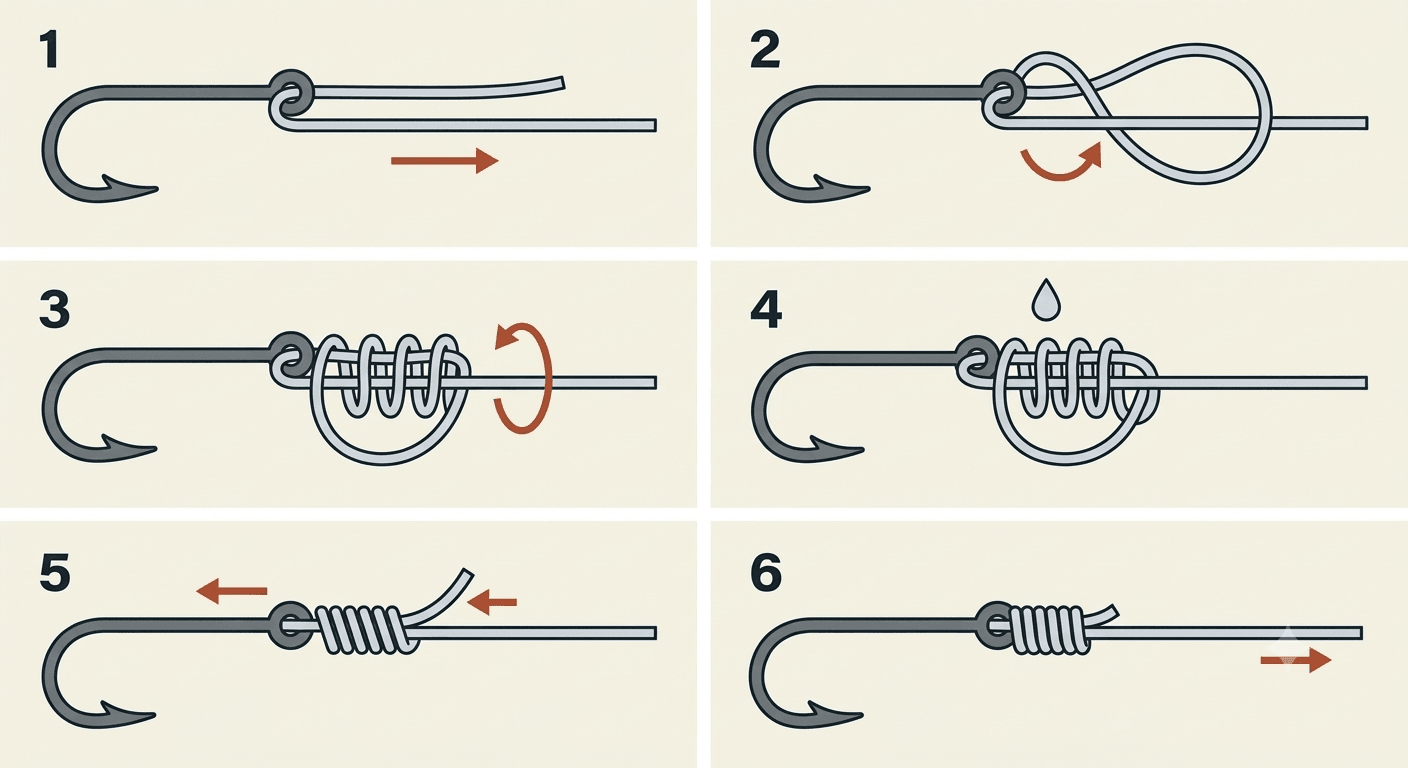
The fishing surgeon's knot in five steps, from 4–6 in of overlap to all four ends pulled, and what three pull tests measured: up to 64.6% of 50 lb braid.
 Uni Knot: One Knot for Hooks, Leaders, Snells and Loops
How to tie the uni knot in six steps, the turns for mono, fluorocarbon and braid, its six uses from hook to reel spool, and the pull tests.
 Palomar Knot: How to Tie It, How Strong It Is, When Not to Use It
How to tie the Palomar knot in six steps, its pull-test scores (89% on 10 lb mono, 82% on fluorocarbon), the double version for braid, and when to skip it.
Sources
- Luke Simonds, The Albright vs the Alberto vs the FG knot (strength contest), Salt Strong (2020)
- Salt Strong, Best fishing knot for braided line (braid-to-leader contest, 10 lb PowerPro to 30 lb Ande fluorocarbon, 2015)
- Salt Strong, FG knot vs the Bimini twist (strength test, 10 lb PowerPro to 30 lb Berkley Big Game, 2016)
- Salt Strong, FG knot: 3 critical times you should never use this fishing knot (2018)
- Salt Strong, FG knot: how to tie it (pinky and teeth tension, 16 wraps)
- Pat Ogletree, Hack to strengthen the FG knot, Salt Strong (2022)
- Doug Olander, Strongest fishing knots connecting braid to leader (53 knots on the IGFA's Instron 5543), Sport Fishing
- Animated Knots, FG knot (names, wraps, finish)
- Jason Sealock, How to tie the FG knot, Wired2Fish (2022)
- Bear Essentials Outdoors, How to tie the GT knot (how it differs from the FG)
- Luke Simonds, How many coils should an FG knot have? (coil experiment, 10 lb braid to 30 lb Ande mono), Salt Strong (2021)
- Joe Cermele, How to tie an FG knot (rod-holder tension, super glue on the half hitches only), Outdoor Life (2026)
- Luke Simonds, The best fishing knots of all time, ranked strongest to weakest (PR bobbin knot needs tools and time), Salt Strong (2018)
- Animated Knots, Albright knot (fly line to backing, braid to wire)
- The Fisherman, Albright knot (single-strand wire leader to mono)