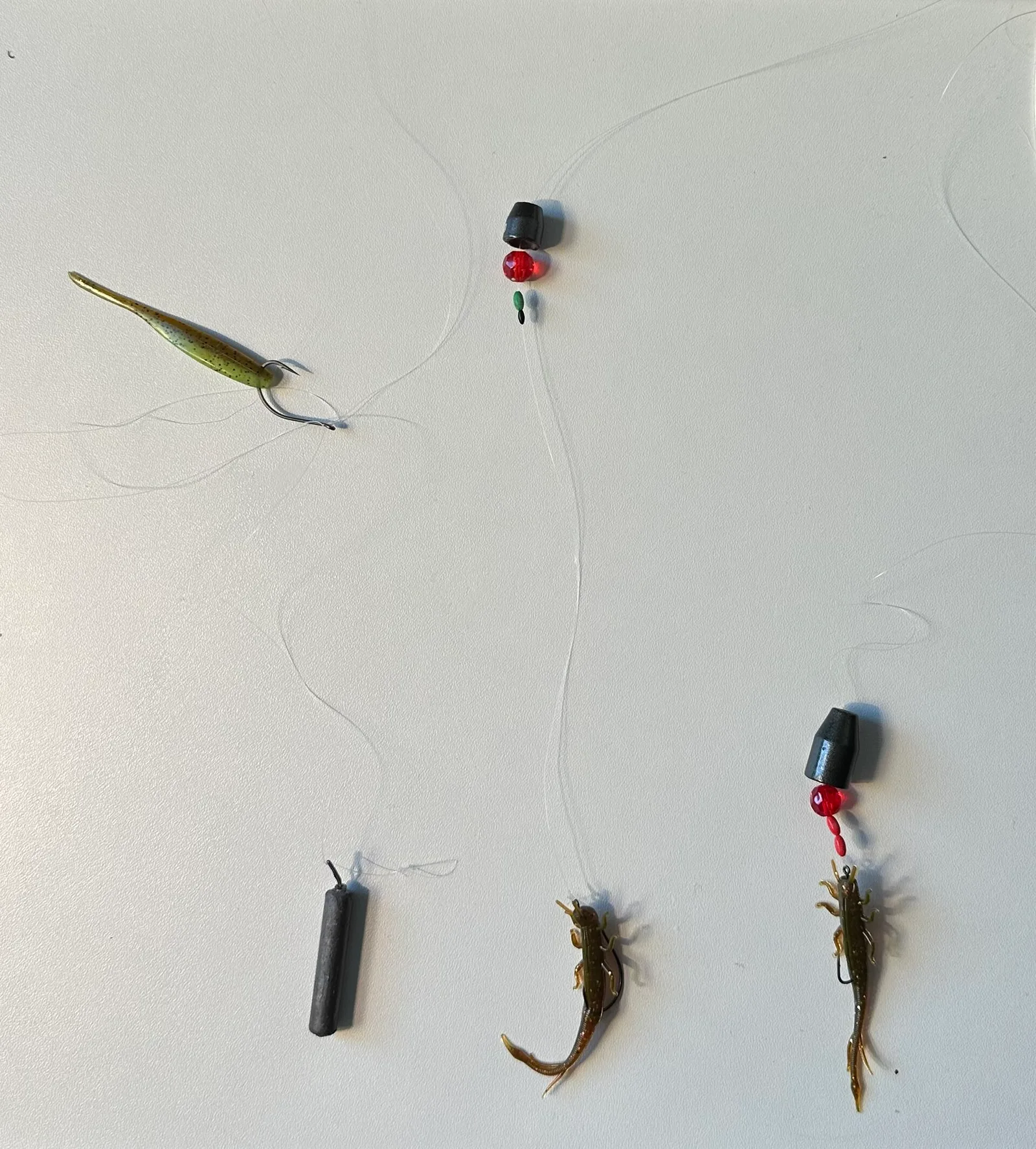
A fishing rig is a hook, a weight and a bait you put together on the end of your line, and where the weight sits decides what the bait does. Snug against the bait, it takes the bait through grass and wood. Behind it, the bait drifts over the bottom; below it, the bait hangs in front of a fish that will not look down. Five rigs cover almost all bass fishing, and the same ideas catch catfish, walleye and panfish.
Ned Kehde caught 109 largemouth in four hours on October 12, 2006, on a mushroom-head jig and half a plastic worm. The rig took his name four years later.
Start here
- Texas rig: the rig to learn first. The hook point is buried in the plastic, so it goes through any cover.
- Drop shot: for fish holding just off the bottom in clear or deep water.
- Ned rig: small and slow, for cold water and fish that have seen every lure on the lake.
- Catfish rigs: the bottom rigs for bait fishing, with sinker weights and hook sizes.
Which rig for which water?
| Rig | Build | Weight | Use it for |
|---|---|---|---|
| Texas | Bullet weight, worm hook, plastic rigged weedless | 1/8–1/2 oz (4–14 g); 1–2 oz (28–57 g) to punch grass | Grass, wood, docks: any cover |
| Carolina | Egg sinker, bead, swivel, 12–36 in (30–91 cm) leader, hook | 1/2–3/4 oz (14–21 g) | Dragging flats and points in spring and summer |
| Drop shot | Hook tied 12–18 in (30–46 cm) above the weight | 1/8–1/4 oz (4–7 g) | Fish just off the bottom; clear, deep water |
| Ned | Mushroom jig head, 2–4 in (5–10 cm) bait that floats tail-up | 1/16 oz (2 g) | Cold, clear or hard-fished water; smallmouth |
| Wacky | Stick worm hooked through the middle | None, or 1/16–1/8 oz (2–4 g) | Spawning bass in the shallows; docks |
The weights in the table are bass weights. The shaky head sits between the Ned and the Texas rig: a stand-up jig head with a finesse worm. It lives with the jigs because its weight is molded onto the hook.
Why does the weight’s position matter?
Because the weight decides where the bait hangs, and that is the whole difference between the rigs.
On a Texas rig the weight rides against the bait, so the two fall and crawl as one, and the bait goes wherever the weight goes: into the cover. On a Carolina rig the sinker drags the bottom and the long leader lets the bait float behind and above it. The drop shot turns that upside down. The weight sits on the bottom and the bait hangs above it, so you can shake a worm in one spot in front of a fish without moving it away. The Ned and wacky rigs carry almost no weight, and the slow fall is what draws the bite.
The catfish slip-sinker rig is the Carolina rig again, with a circle hook and a bigger sinker. Learn one and you have half of the other.
How heavy a weight?
Depth and cover decide it. Bassmaster’s weight guide is the list most bass anglers work from:
- Finesse baits: 1/32 to 1/8 oz.
- Five feet of water or less: 1/8 oz.
- Around twenty feet: 1/4, 5/16 or 3/8 oz.
- Deeper than that, or dragging big worms: 1/2 oz.
- Through matted grass: 1, 1½ or even 2 oz.
Wind adds weight at every depth, because line bowed by wind hides the bite. Tungsten is smaller than lead for the same weight and passes more of the bottom up the line. The hooks hub has the worm, drop-shot and wacky hook sizes the rig pages use.
Which rod and line?
The Texas and Carolina rigs are baitcaster rigs. Use a 7 ft to 7 ft 6 in medium-heavy, fast-action rod with 15–20 lb fluorocarbon, or 40 lb braid to a leader. The finesse rigs, Ned, drop shot and wacky, go on a 7 ft medium-light spinning rod with 10–15 lb braid to a 6–8 lb fluorocarbon leader. The rods hub explains power and action.
With the finesse rigs, the retrieve is restraint. Kehde’s own instruction is to keep the Ned rig “swimming slowly from six inches to one foot above bottom”. On a drop shot, shake the rod tip and leave the weight where it is.
Where did the rigs come from?
Nick Creme made the first soft-plastic worm in Akron, Ohio, in 1949. By the late 1950s anglers on Texas reservoirs were burying its hook point so the worm came through cover without snagging, and that is the Texas rig. The drop shot came from Japanese tournament anglers fishing pressured, clear water in the 1990s. The Ned rig is the youngest, from that Kansas afternoon in 2006, and In-Fisherman gave it its name in 2010. The bass hub says which season calls for which rig.
All articles
- Carolina Rig: How to Tie It, Leader Length and When to Use It
How to tie a Carolina rig, every part with its size, the leader by season and clarity, five baits, the drag-and-sweep retrieve, and when a Texas rig is better.
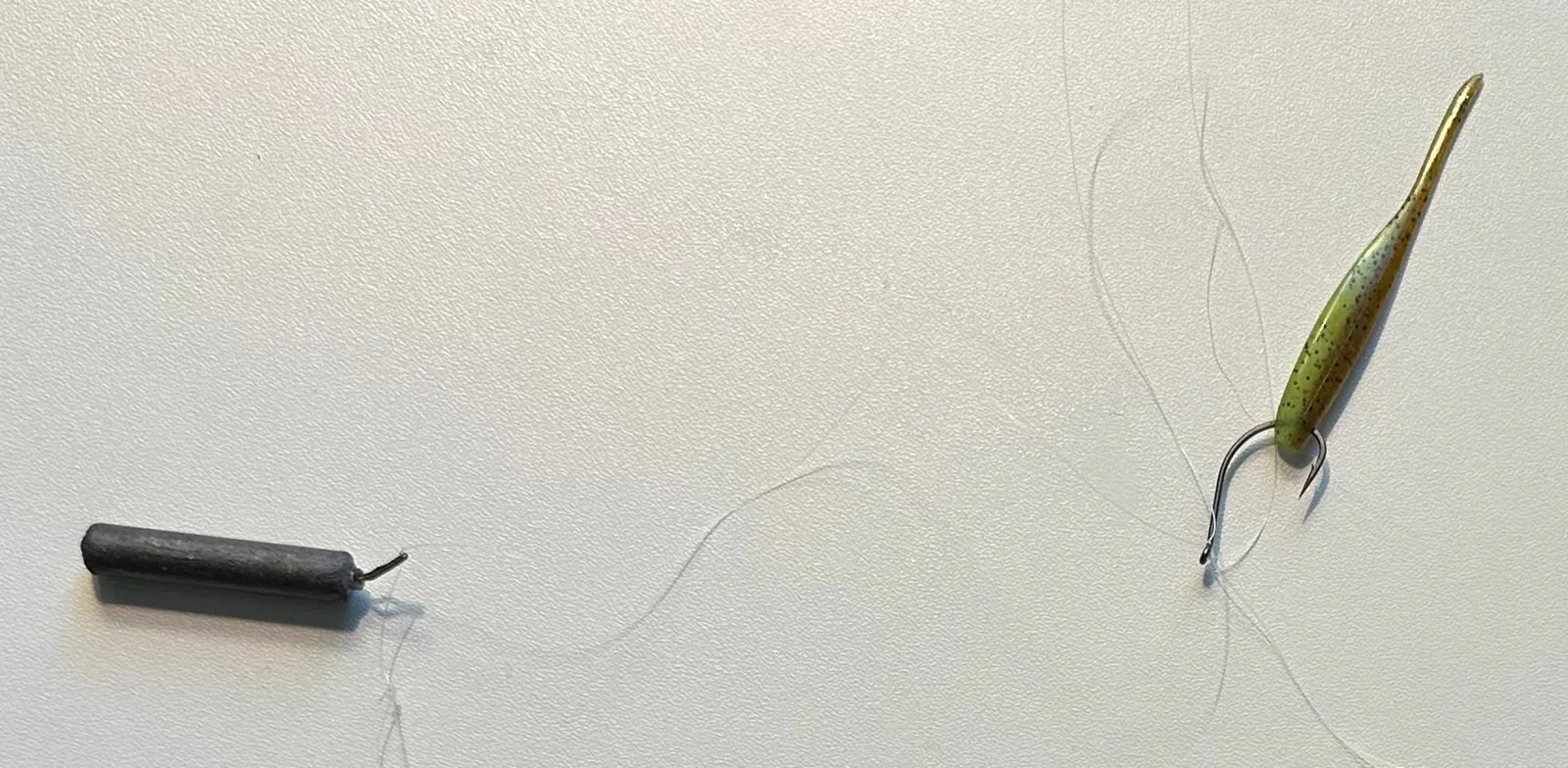 Drop Shot Rig: How to Tie It, Hook and Weight Sizes, How to Fish It
The drop shot rig step by step: a small hook tied 12–18 in above a 1/8–1/4 oz weight, the Palomar trick that stands the hook out, baits, tackle and retrieve.
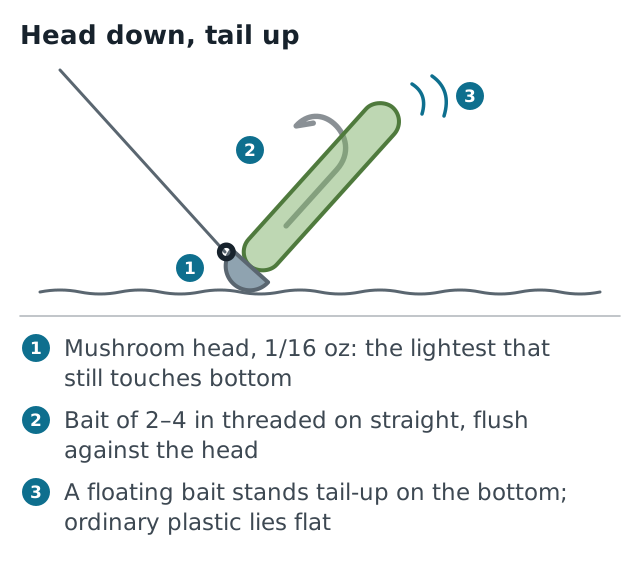 Ned Rig: How to Fish It, the Right Jig Head and Where It Came From
The Ned rig: a 2–4 in buoyant bait on a 1/20–1/5 oz mushroom head, the heads and baits in tables, six retrieves, the tackle, and the 2006 day it began.
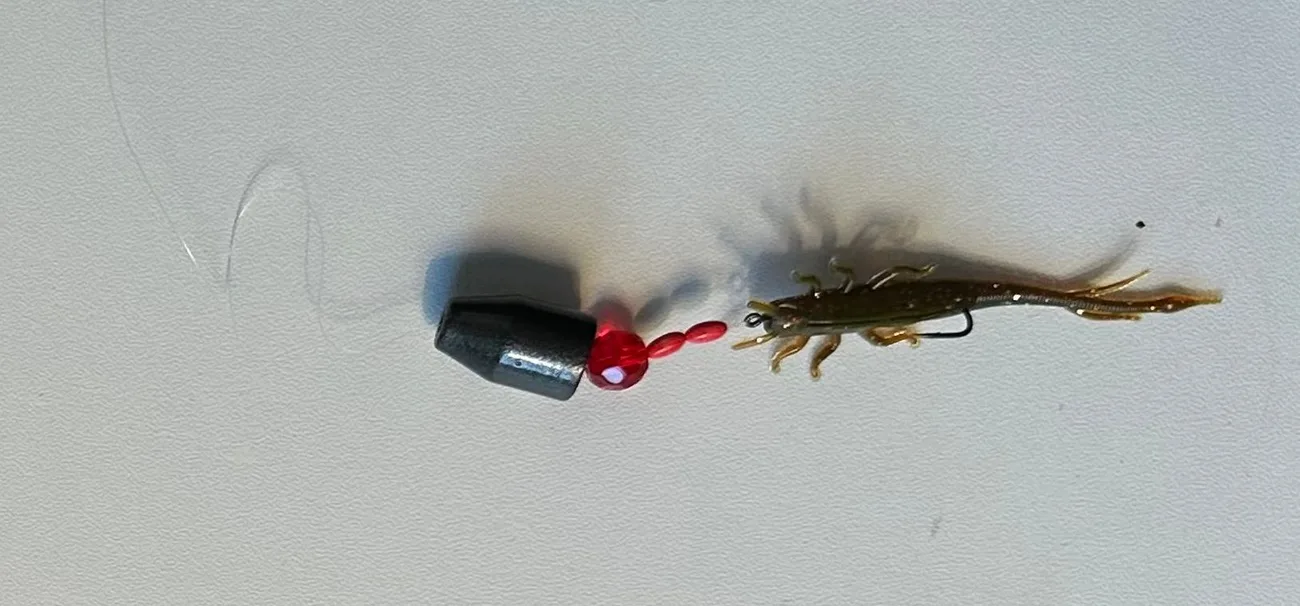 Texas Rig: How to Rig It, Which Weight and Hook, and How to Fish It
How to tie a Texas rig, which bullet weight and hook to use by depth and cover, how to fish it slowly on the bottom, and where the rig came from.
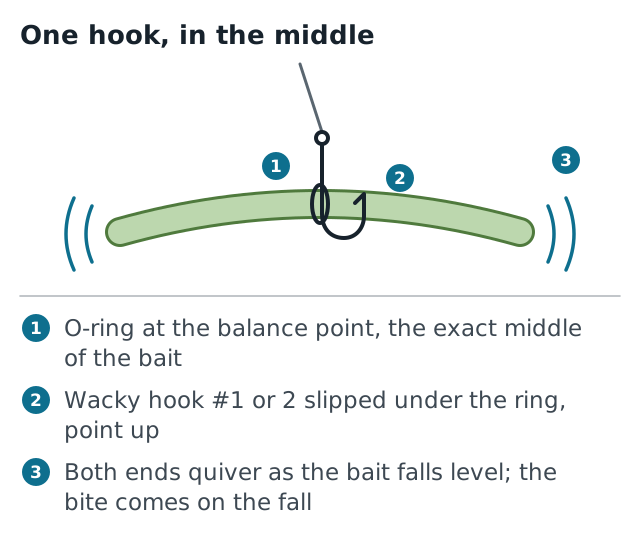 Wacky Rig: How to Rig It, and When It Beats a Texas Rig
The wacky rig hooks a stick bait through its middle so both ends quiver on the fall. The O-ring method, hook and line, weightless or weighted, when to use it.