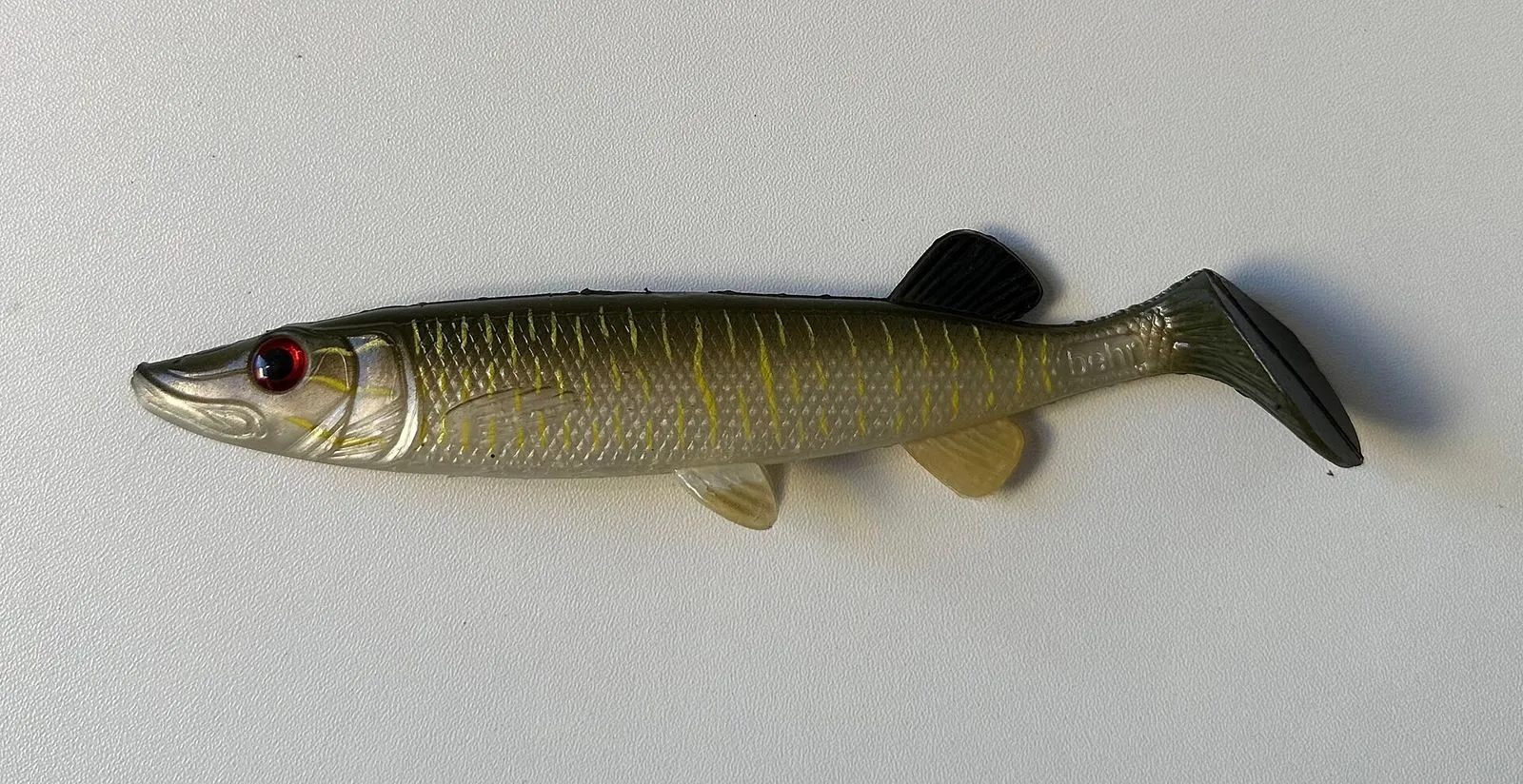
Swimbaits are lures built to look like one whole baitfish swimming. They come in three families: soft paddle tails you rig yourself on a jighead or a weighted hook, soft baits sold with the hook and weight molded in, and hard multi-jointed baits that swim with a tight wiggle. Bassmaster calls a bait of 5 in (13 cm) or more a “true” swimbait; smaller paddle tails are everyday lures on ordinary bass tackle, and the big ones are thrown for the biggest largemouth in the lake. Bass are not the only fish that eat them. In In-Fisherman, Jeff Gustafson casts a 5–6 in swimbait on a 1/2 oz jighead for pike. Oklahoma’s wildlife department lists 2–3 in paddle tails for white bass and 3–8 in swimbaits for striped and hybrid bass. The hard family’s single-joint cousin, the glide bait, has its own page.
A 14 lb 8 oz largemouth from New Melones Lake ate a 12 in swimbait that weighs 9.5 oz and costs $180. It was a Hawg Hunter Mag-X, the kind of trout imitation its angler throws when the stocked rainbows move shallow.
Which swimbait family for your water?
| Family | Size | How it is rigged | Where it fishes | When |
|---|---|---|---|---|
| Soft paddle tail, solid body | 2.8–7.8 in (7–20 cm) | Jighead, weighted swimbait hook, or as a trailer on a swim jig or chatterbait | Any depth; counted down to suspended fish | All year on ordinary bass tackle |
| Soft paddle tail, hollow belly | 4–7 in (10–18 cm) | Weighted EWG swimbait hook, point skin-hooked in the back; the Alabama rig | Through grass, timber tops and dock cover | Shad-chasing fish, spring and fall |
| Soft, pre-rigged | 5–10 in (13–25 cm) | Hook and weight molded in; tie it on | Bottom in 18–25 ft (5.5–7.5 m), deep docks, rip-rap | Water under 60 °F (16 °C), the 40s and 50s above all |
| Hard, multi-jointed | 4–8 in (10–20 cm) | Two trebles, ready to fish; slow sinker | Banks, flats, grass lines, ditches, under 15–20 ft (4.5–6 m) | Pre-spawn into summer, fall ditches, schooling fish |
| Hard, single joint (glide) | 3–12 in (7–30 cm) | Trebles, ready to fish; floating or slow sink | Shallower than 10 ft (3 m), clear water | Fall points, followers in clear water |
Wired2Fish splits the soft side by body: hollow bellies rig easier on a weighted EWG swimbait hook, solid bodies sit better on a jighead. The pre-rigged baits divide by tail. The Huddleston Deluxe has a wedge tail with a slow, lethargic kick, the Megabass Magdraft a paddle tail that thumps. The glide family wanders instead of swimming straight; the glide baits page carries its retrieves, sink rates and prices, and the swimmers are below.
Why are swimbaits so expensive? Most are not: a pack of Keitech Swing Impact FAT paddle tails costs about $8 to $11 at Tackle Warehouse, for two to eight baits by size. The money is in the big hard baits. The glides on our glide-bait table run from about $9 to $270 there, and the trout bait in the quote above costs $180.
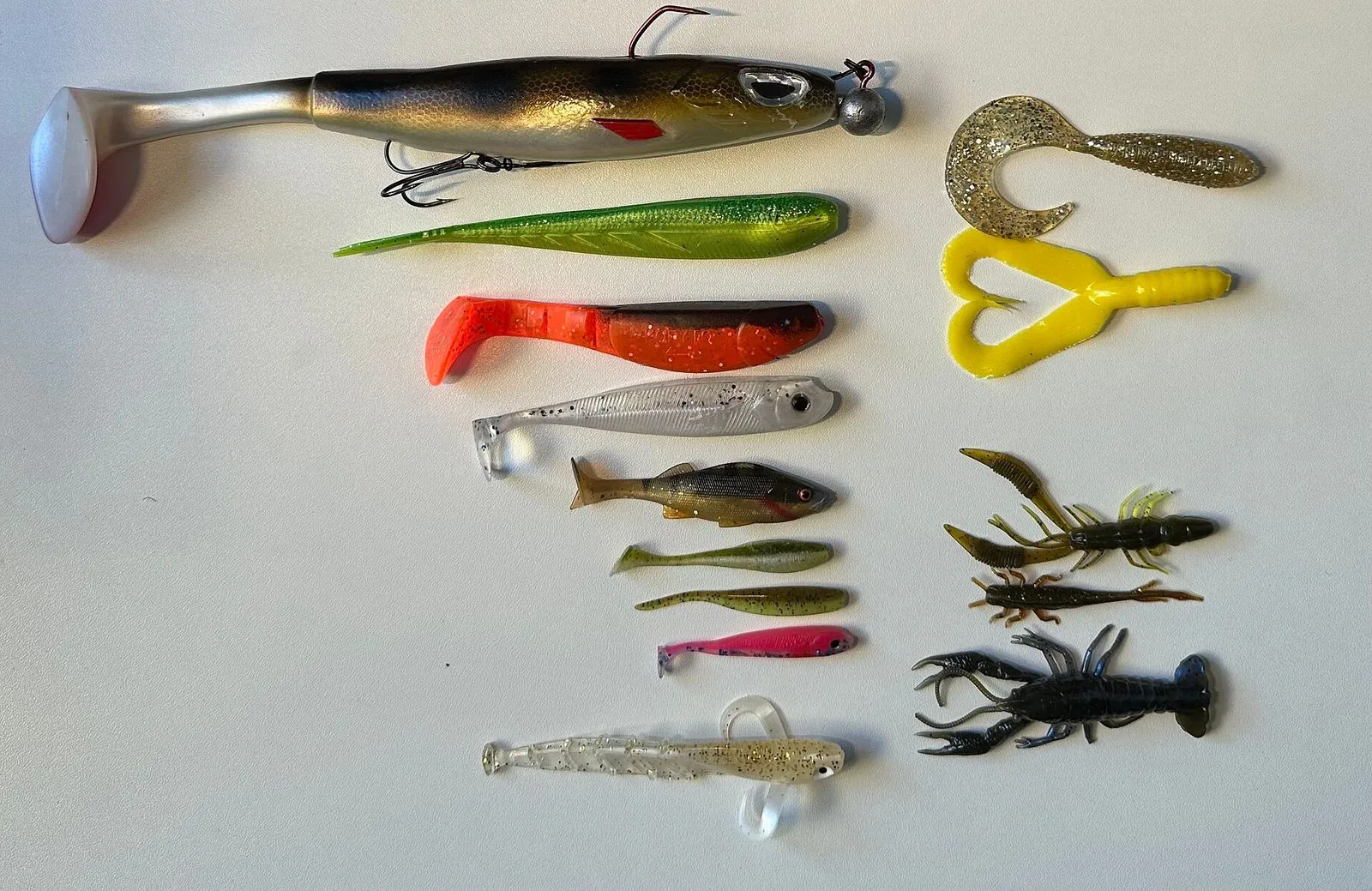
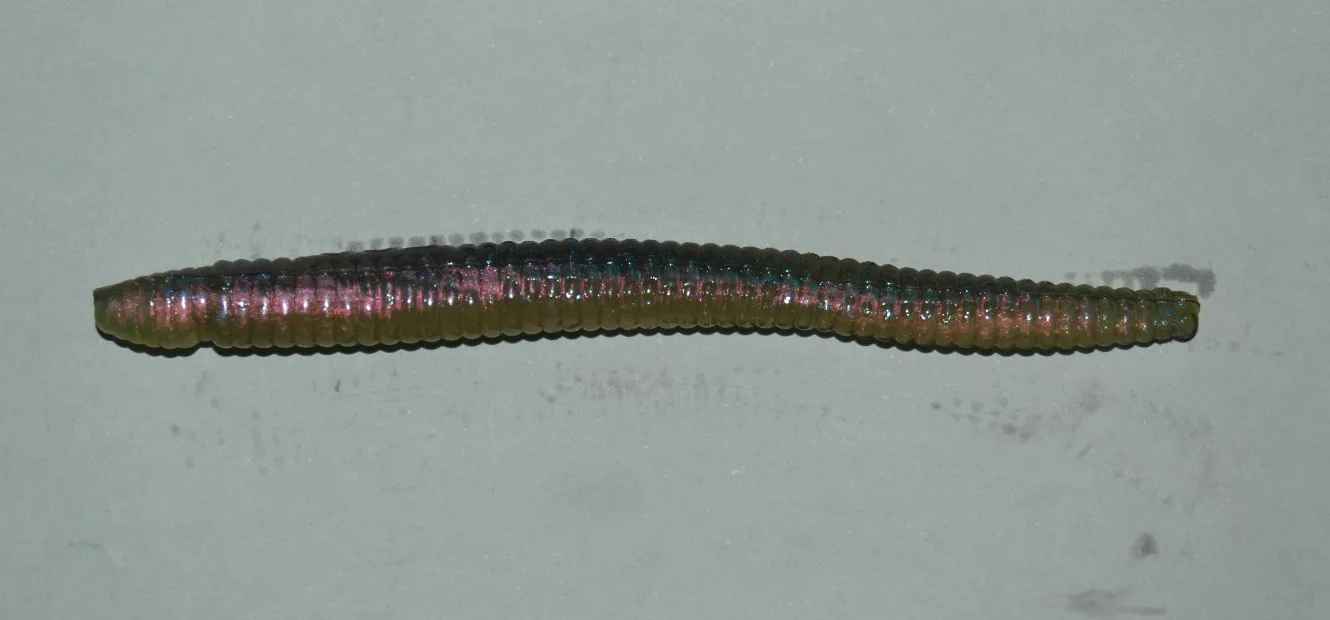
Under 5 in, the paddle tail is everyday tackle: a 2.8–3.8 in Keitech or Rage Swimmer on a light jighead, a swim jig or a chatterbait. The soft plastics hub covers the material and the other families.
Seven soft swimbaits: which one for what?
| Bait | Length | Body | Rig it on | Made for |
|---|---|---|---|---|
| Keitech Swing Impact FAT | 2.8–7.8 in (7–20 cm), eight sizes | Solid, two salted plastics injected together, squid scent | 1/16–1/4 oz jighead (small, per owner reviews), swim jig or chatterbait (middle), weighted weedless hook (large) | The do-it-all; smallmouth and spotted bass on the small sizes, ledges and grass on the large |
| Strike King Rage Swimmer | 2.75–5.75 in (7–15 cm), five sizes | Solid, soft ribs, thin tail ending in a flat disc | Drop shot and finesse underspin (2.75 in), swimbait jighead or hook (3.25–4.75 in), large jighead or weighted hook (5.75 in) | Vibration at any speed, the Alabama rig at 3.75–4.75 in |
| Zoom Swimmer | 4 and 5 in (10 and 13 cm) | Hollow, shad-shaped | Weighted swimbait hook or jighead; a chatterbait, swim jig or umbrella rig | Shad lakes; moves water at any speed |
| Yamamoto Zako | 3 and 4 in (8 and 10 cm) | Segmented body, forked tail, split belly, large-belly profile | A vibrating-jig trailer first; Texas-rigged weedless second | Brett Hite’s vibrating-jig trailer; a bluegill or shad profile |
| Berkley PowerBait Power Swimmer | 2–4.3 in (5–11 cm), five sizes | Solid, scented paddle tail | Weighted swimbait hook, jighead, A-rig, Texas or Carolina rig | Small forage; the 2 in for trout, crappie and panfish |
| Megabass Magdraft | 5–10 in (13–25 cm), 3/4–6 1/4 oz (21–177 g) | Solid, pre-rigged treble held to the belly by a magnet | Nothing to add; tie it on | Gizzard-shad lakes; skips well even in the big sizes |
| Basstrix Paddle Tail | 5–7 in (13–18 cm) | Hollow, smooth and narrow | Belly-weighted swimbait hook, 5/0 for the 5 in and 6/0 for the 6 in; an underspin | Tight cover: tree tops, creek mouths, over grass |
Two of these are not strictly paddle tails, and that is why they are here. The Zako was designed by Brett Hite as a chatterbait trailer, and its segmented body and forked tail swim behind the blade, while the split belly takes a weedless Texas rig. The Magdraft is a soft bait that fishes like a hard one, cast out and wound back slow and steady. A neodymium magnet holds its treble flat against the belly until a bite pulls it free. Omnia Fishing lists the 8 in Magdraft at just over 3 oz and calls it built for trophy bass hunting.
Free card: what 26 species do at your water temperature
Plus one email a week on what's biting now. No sales pitches. Privacy.
How do you rig a soft swimbait straight?
| Rig | Weight or hook | Depth | Best for |
|---|---|---|---|
| Open jighead | 1/8–1/4 oz (3.5–7 g) for 2.8–3.8 in baits; up to 1 oz (28 g) for 5–7 in | Mid-depth to the bottom, counted down | Solid bodies; smallmouth, spotted bass, suspended fish in open water |
| Weighted swimbait hook | 5/0 for a 5 in bait, 6/0 for a 6 in, belly weight on the shank | Shallow to mid-depth | Hollow bellies through grass, wood and dock cover |
| Underspin | Jighead or weighted hook with a small willow blade under the chin | Mid-depth | Flash around shad in clear water |
| Swim jig or chatterbait trailer | 3.5–4 in (9–10 cm) paddle tail or a Zako on the hook of the jig | Shallow grass | Spring and fall banks; the jig does the weight |
| Alabama rig | Three to five 3.5–4.5 in (9–11 cm) paddle tails on light heads | Mid-depth, suspended schools | Winter and early spring; check the hook limit in your state |
- Pick the head by the body. A solid Keitech or Rage Swimmer goes on a jighead. A hollow Basstrix or Zoom Swimmer goes on a belly-weighted EWG swimbait hook, where the cavity lets the bait collapse on the hookset.
- Thread it straight. Hold the hook along the bait and mark where the point should exit, dead center on the back. Push the hook in through the nose and out at the mark. A bait that exits off-center spins instead of swimming.
- Lock the nose. A screw-lock keeper or a drop of glue holds the nose to the head; a bait that slides down the shank quits swimming after one fish.
- Skin-hook the point on a weighted hook. Texas-rig the point just under the skin of the back so the bait slides through grass. The same bait trails a swim jig and rides the arms of an Alabama rig, whose legality varies by state.
- Match the weight to the depth, not the bait. A heavier jig head runs the same bait deeper at the same reeling speed, so pick the head for the depth of the fish.
How deep, how fast, and in which season?
The basic retrieve: cast, count the bait down to the depth you want, and reel it back slowly. A slow bait that does not flee is one a curious bass will eat. When fish follow without biting, vary it: rise and fall, stop and go, or burn it and let it sink, because most strikes come on the fall.
Bassmaster asked five pros, Gary Klein, Skeet Reese, Kelly Jordon, Dean Rojas and Fred Roumbanis, and their answers sort by depth.
| Depth | Bait | Retrieve | Season |
|---|---|---|---|
| 3–5 ft (1–1.5 m) | Surface or shallow runner | Steady, or burned across the top (Reese) | Spawn and post-spawn, fish shallow but not visible |
| 5–10 ft (1.5–3 m) | Slow sinker | Count it down and wind it back slowly; Roumbanis ran his about 5 ft deep through submerged timber | Suspended bass over grass or standing timber |
| 10 ft (3 m) and deeper | Fast sinker | Free-spool it through the bait school to the bottom, pause, reel slowly, burst five or six cranks, let it fall again; most bites come on the fall (Jordon) | Post-spawn through summer |
| Bottom, any depth | Fast sinker or a Huddleston | Crawl, hop and drag it; reel as slowly as the handle turns (Reese, Wired2Fish) | Water in the 40s to mid-50s (4–13 °C) |
The deep rows are the surprise. Klein caught two 4 1/2-pounders 34 ft (10 m) down at Grand Lake, and Reese has taken bass deeper than 40 ft (12 m). So a sinking swimbait is a deep-water lure when the bait schools show on the fish finder over structure.
Two retrieves work at every depth. One is uphill: cast deep and work the bait up a slope, so a follower has to eat or turn back. The other is slow and non-threatening, because bass are curious and a lure that does not flee is one they can catch. Klein rarely makes more than three or four casts to a spot; a swimbait pulls the fish that are there on the first pass.
By season, Wired2Fish’s rule is that water under 60 °F (16 °C) is soft-bait time, and the 40s and 50s belong to the Huddleston. Cast to the spot on the spot, let it hit bottom, then reel painfully slowly so it bumps everything in its path. From pre-spawn into summer the hard segmented baits run the banks, docks, flats and grass lines just under the surface. In fall they go to ditches and the creeks out of the backs of bays, or get bombed into schooling fish pushing shad to the top.
The bass water temperature page puts those bands on a thermometer. Alex Niapas of Boulder Creek, California, throws trout-imitating swimbaits whenever forage and bass are shallow. He adds the trigger: once the lakes turn over in fall and the water drops below 60 °F, the trout and shad move shallow and the biggest bass follow.
How fast does a rigged or hard swimbait sink?
| Bait | Length | Weight | Sinks | Notes |
|---|---|---|---|---|
| Huddleston Deluxe 8 in | 8 in (20 cm) | 4.8 oz (136 g) in ROF 12 | 12 ft per 10 seconds | Wedge tail; the cold-water bottom bait |
| Huddleston Deluxe 68 Special | 6 in (15 cm) body, 8 in tail | 2 oz (57 g) ROF 5; 2 1/3 oz (66 g) ROF 12 | 5 or 12 ft per 10 seconds | Top-molded hook; the 6 in body with the big tail’s kick |
| Savage Gear Line Thru Trout | 6, 8, 10 in (15, 20, 25 cm) | 1.5, 3.4, 6.2 oz (43, 96, 176 g) sinking; 1.4 and 3.3 oz floating | Sinking or floating by model; chin clip for added weight | Line-through: the hook slides free of the body on a fish |
| Megabass Magdraft | 5–10 in (13–25 cm) | 3/4, 1 1/4, 2 1/4, 3, 6 1/4 oz (21–177 g) | Slow | Magnet holds the treble to the belly |
| Bull Shad (original) | 6 in (15 cm) | 2 oz (57 g) slow sink; 2.35 oz (67 g) fast sink | Slow or fast sink by model; count it down | Hard, segmented, tight action; fish it like a spinnerbait |
| 22nd Century Triple Trout | 7 in (18 cm) | 2.25 oz (64 g) | Slow sinker | Hard, three sections, looser than the Bull Shad; made for speed |
Huddleston’s ROF number is the rate of fall in feet per ten seconds. A ROF 12 bait reaches a 12 ft (3.7 m) bottom in ten seconds, and a ROF 5 hangs in the top 5 ft (1.5 m) for the same count. Buy the number for the depth your fish sit at.
The line-through Savage Gear and the magnet-held Magdraft solve the same problem from two directions. A soft body on a fixed treble gives a big bass leverage to throw the hook. The Savage Gear lets the body slide up the line away from the fish; the Magdraft lets the hook break free of the body. The glides swing wide instead of swimming straight: the River2Sea S-Waver, the Deps Slide Swimmer, the Gan Craft Jointed Claw and the 6th Sense Flow Glider. Their lengths, weights and sink rates are tabled on the glide baits page.
What rod, reel and line for each bait weight?
Over 5 in, Bassmaster’s pros step up to a 7 ft 6 in medium-heavy or heavy flipping stick or a swimbait rod up to 7 ft 11 in.
| Bait | Rod | Reel | Line |
|---|---|---|---|
| 2.8–4 in paddle tail on a 1/8–1/4 oz head | 7 ft (2.1 m) medium or medium-heavy, spinning or casting | 2500 spinning or a 150 baitcaster | 10–15 lb fluorocarbon, or braid to a fluorocarbon leader |
| 4–6 in soft bait, 3/8–1 oz | 7 ft 3 in to 7 ft 6 in (2.2–2.3 m) medium-heavy or heavy, moderate-fast | 200 size, 7:1 | 15–17 lb fluorocarbon |
| 1–3 oz (28–85 g), trebled hard baits and 6–8 in soft baits | 7 ft 9 in (2.36 m) medium-heavy to heavy, rated 1–5 oz, such as the Dobyns Fury 795 | 300 size, 5.8:1 to 6.3:1 | 20 lb fluorocarbon, or 20 lb mono or copolymer |
| 3–7 oz (85–200 g) soft baits and big glides | 7 ft 9 in (2.36 m) extra-heavy, fast, rated 3–7 oz | 300 size, 6.3:1 | 20 lb fluorocarbon |
| 6–10 oz (170–280 g) magnums | 7 ft 11 in to 8 ft (2.41–2.44 m) extra-heavy, rated 2–10 oz | 400 size with the wide spool | 20 lb fluorocarbon to 25 lb or more, or 80 lb braid to a 25–30 lb mono leader |
Two numbers rule the table. Bassmaster’s pros use nothing under 20 lb line once the bait passes 5 in. Tackle Warehouse’s rule for the rod is that the bait’s weight sits in the middle of the rod’s rating. A 4 oz bait belongs on a rod rated 2–6 oz. The bottom two rows match the outfits on the glide baits page.
The lighter 7 ft 9 in rod suits trebled baits, where a softer tip keeps the hooks in a jumping fish. The stiffer extra-heavy rods drive a single molded hook through a Huddleston’s thick back. The rods hub covers the lure ratings and the baitcaster page the 300 and 400 sizes.
Wired2Fish starts newcomers on 20 lb copolymer or mono, forgiving on the cast and the hookset. It moves to fluorocarbon once the setup is dialed in, because fluorocarbon sinks the bait and swims it most naturally. It keeps beginners off braid, because a backlash with a $40 bait on the end snaps it off. The pros see it differently: Bassmaster notes that 50 lb braid is popular, and Tackle Warehouse runs braid to a long fluorocarbon leader on glide baits.
Why throw a bait that gets so few bites?
Klein says no other lure makes a following bass commit, strike or leave, the way a swimbait does. That is why Jordon and other pros throw one in tournament practice: to learn whether bass are in an area, what cover they hold on and how aggressive they are. The same drawing power produces the follower, a bass that tracks the bait to the boat and turns away. The glide baits page has the turn that converts some of them.
In a tournament, Reese says, swimbaits “can be your best friend or your worst enemy”; he aims for one or two quality fish per event with it. Rojas narrows the water to lakes that produce bass over 5 lb (2.3 kg) consistently; the bait sorts by size. Wired2Fish puts the trade in a sentence: step up from a 5 in bait to a 6–8 in and you get fewer bites and a much better chance at a true giant, a 10 pound bass.
What color swimbait?
A swimbait is a portrait of one fish, so the color question is which fish. Tackle Warehouse’s rule is “match the hatch”: a shad pattern where shad are the forage, a bluegill pattern where panfish crowd the shallows.
Where hatcheries stock rainbow trout, the trout pattern on an 8–12 in bait is the whole technique. Niapas says the stockers run about 10 in (25 cm) and a big bass ambushes trout up to 15 in (38 cm). Game & Fish credits Lake Skinner’s trout stockings, a richer diet than bluegill and crawfish, for Ryan Block’s 16 lb 2 oz largemouth. It was caught in March on a swimbait run parallel to the docks. The trout hub covers the fish those baits are painted after.
In more than 10 ft (3 m) of clarity, Tackle Warehouse stays natural; in stained water or low light, bone or a brighter color.
What goes wrong with swimbaits?
- Straight braid as a beginner. A braid backlash snaps off the bait; Wired2Fish’s starting line is 20 lb copolymer.
- The rod rated too light. The bait’s weight belongs mid-range on the rod’s rating (Tackle Warehouse).
- Fast in cold water. Under 60 °F the soft bait crawls; in the 40s a Huddleston is reeled as slowly as the handle turns, and the bite is a weight that was not there.
- The same retrieve all the way back. A following bass eats on the change: a burst of five or six cranks, a fall, a pause.
- Pitching into a bed. Rojas warns that a swimbait in a bed foul-hooks fish on the outside of the mouth, which is not a legal tournament catch unless the bass hit the lure.
When should you use something else?
On a numbers day a Texas rig or a Senko catches more; Rojas’s problem with the swimbait is time, since “what a pro needs most is a fast 2-pounder.” The best bass lures page sets that balance.
The twitched fluke beats a paddle tail when bass want an erratic bait rather than a steady one; a smallmouth on a 2.8 in paddle tail is where the two overlap. Every other lure family is on the lures hub.
And when the water is clear, shallower than 10 ft and the fish follow without eating, that is the glide bait’s day.
Free download
The water temperature card
Read your water temperature and the card tells you who is spawning, who is feeding and what to throw. 26 species, 16 pages, for your phone and the tackle box.
Plus one email a week on what's biting now. No sales pitches. Privacy.
Related
Section guide
Soft Plastic Lures: Types, Materials and How to Rig ThemSoft plastic lures explained: ten families from worms to swimbaits, the rig each was made for, what salt and plastisol do, and the color to start with.
 Glide Baits: How They Work, How to Fish Them, and Which to Buy
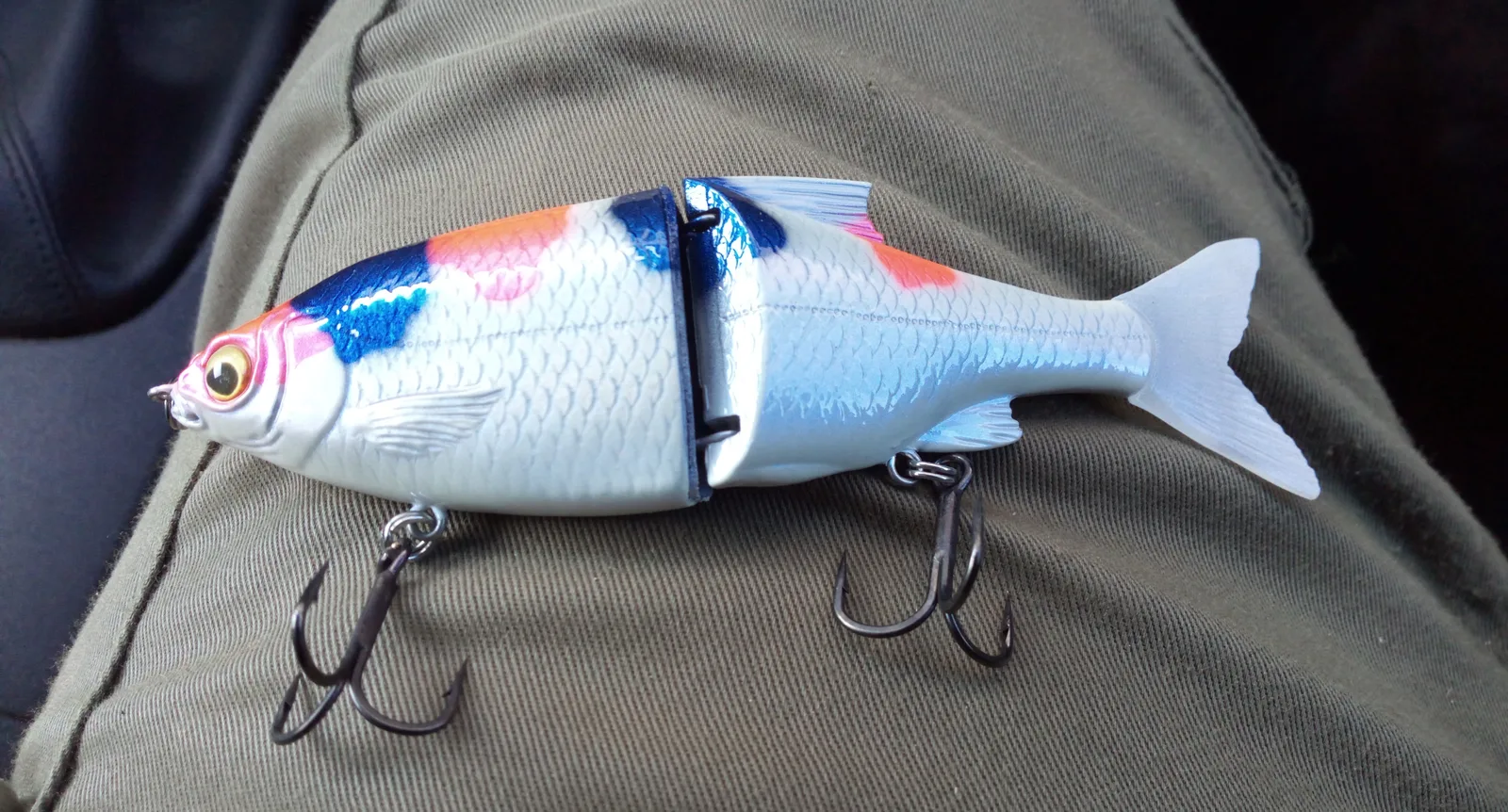
Glide baits are single-jointed swimbaits that swing in a wide S. Five retrieves, the 180 turn for followers, rods and line by bait weight, $9 to $270.
 Yamamoto Senko: Why It Works and the Six Ways to Rig It
The Yamamoto Senko explained: the salt-loaded stick bait designed to fall flat and quiver, the six rigs from wacky to drop shot, the tackle and the retrieve.
Sources
- Wired2Fish (Steven Slayton), best swimbaits for bass fishing
- Bassmaster (Steve Price), new ways to fish swimbaits: Klein, Reese, Jordon, Rojas, Roumbanis
- Tackle Warehouse, glide bait patterns and techniques
- Bassmaster, Best of 2025 Elite Series top lures
- Tackle Warehouse, Keitech Swing Impact FAT (sizes, pack counts, dual injection)
- Discount Tackle, Strike King Rage Swimmer (sizes and the rig for each)
- Wired2Fish, Zoom debuts a smaller Swimmer (4 in and 5 in hollow body)
- Wired2Fish (Jason Sealock), Yamamoto Zako swimbait review
- Berkley, PowerBait Power Swimmer (sizes and rigs)
- Megabass, Magdraft (sizes, weights, Maghold system)
- Tackle Warehouse, Huddleston Deluxe 68 Special (weights by rate of fall)
- Tackle Warehouse, Savage Gear Line Thru Trout (sizes, weights, sinking and floating)
- Tackle Warehouse, Triton Mike Bucca Bull Shad Slow Sinking Swimbait (sizes and weights)
- Tackle Warehouse, Triton Mike Bucca Bull Shad Fast Sinking Swimbait (sizes and weights)
- Tackle Warehouse, Yamamoto Zako Swimbait (sizes, trailer and Texas rig)
- Omnia Fishing, Megabass 8 in Magdraft (length and weight)
- In-Fisherman (Cory Schmidt), Pike Patterns Spring-To-Summer (2023)
- Oklahoma Department of Wildlife Conservation (Skylar St. Yves), White Bass Angler Guide: Top Tips & Area Highlights (2024)
- Oklahoma Department of Wildlife Conservation (Skylar St. Yves), Striped & Hybrid Striped Bass Angler Guide: Top Tips & Area Highlights (2024)
- Wired2Fish, 14 lb 8 oz New Melones largemouth on a 12 in swimbait (Dec 2022)
- Game & Fish, 16 lb 2 oz Lake Skinner largemouth on a swimbait, trout stocking and bass diet