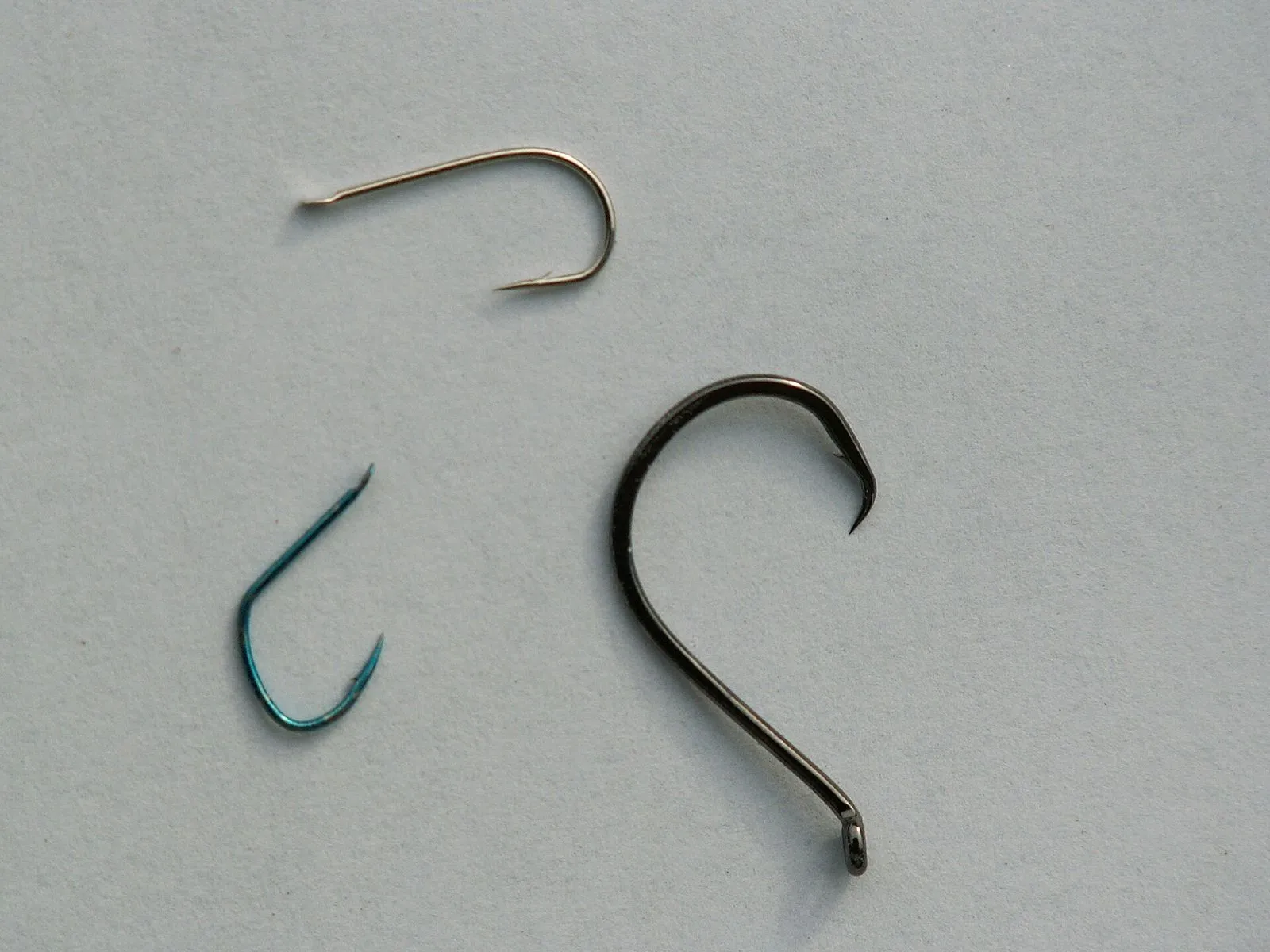
On a fishing hook size chart, a smaller number means a bigger hook from #32 up to #1. Then the scale flips to “aughts”, written 1/0, 2/0 and so on, and the numbers rise as the hooks grow, up to the 20/0 of a shark rig. Every beginner asks whether a #2 or a #4 is bigger, and the answer, the #2, is the one that feels wrong. The number describes the hook’s gap, not its length, and the bait you put on it decides the size before the fish does.
A #2 hook is bigger than a #4, and a 2/0 is bigger than a 1/0. The scale runs down to 1, then flips and runs up again, and nobody who learned it the hard way forgets.
What you need
- The hooks hub for the hook types and the parts of a hook; this page is about size only.
- A ruler. The gap of the hook, point to shank, is what the size describes, and the number to check against the chart.
How does the scale work?
Size 1 is the hinge: below it the numbers count down as the hooks grow, above it the aughts count up. The table gives the approximate gap of each range on a J hook, and what it is for.
| Size | Gap, approximately (J hook) | What it is for |
|---|---|---|
| #32 to #20 | Under 1/8 in (3 mm) | Midge and dry flies |
| #18 to #12 | 1/8–3/16 in (3–5 mm) | Trout flies, tiny bait hooks |
| #10 to #6 | 1/4–3/8 in (6–9 mm) | Bluegill, crappie, perch, trout on bait |
| #4 to #2 | 3/8–1/2 in (10–13 mm) | Walleye, small catfish baits, bass finesse |
| #1 and 1/0 | 1/2–9/16 in (13–15 mm) | Drop-shot and wacky hooks, walleye, small live bait |
| 2/0 to 3/0 | 5/8–3/4 in (16–18 mm) | Smallmouth, 4–5 in worms, channel catfish |
| 4/0 to 5/0 | 3/4–7/8 in (20–22 mm) | Largemouth on worms and creature baits, flukes, frogs |
| 6/0 to 8/0 | 15/16–1 1/8 in (24–28 mm) | Blue catfish on cut bait, big swimbaits, inshore |
| 9/0 to 12/0 | 1 1/4 in (31 mm) and up | Flathead live bait, grouper, tuna |
| 13/0 to 20/0 | 1 1/2 in (39 mm) and up, on circle hooks | Halibut, sharks, big-game bait |
Below the hinge, #10 is a panfish hook, #6 a trout-bait hook and #2 a walleye hook. Above it, 1/0 is said “one aught”, and each step adds a little more gap. Only even numbers are common below #1, so a tackle wall runs #10, #8, #6, #4, #2, #1, then 1/0 and up. Aught, gap, shank and snell are all defined under hooks and terminal tackle in the fishing terms.
Read the number as gap, not length. The size says how far the point sits from the shank, which sets how much bait the hook holds and how big a mouth it fits. A long-shank Aberdeen and a short-shank octopus of the same size are meant to share a gap and nothing else. Even the gap is approximate: in Mustad’s tables below, the #6 cricket hook gapes 0.28 in (7.1 mm) against the #6 octopus’s 0.35 in (8.8 mm). The sizes are not a standard either: each maker sets its own. So the ranges above, read from Mustad’s tables, are approximate for any other hook, and the maker’s own table is the one to trust.
What size hook for each fish?
From the small #8–#12 bluegill hook to the tuna’s 10/0 circle, with the line test to match each fish. The sizes are the retail and guide consensus, refined by the species pages where they exist. The line column is the pound test the same guides pair with each fish; the line hub explains when to go heavier.
| Species | Hook type | Size | Bait | Line |
|---|---|---|---|---|
| Bluegill, sunfish | Aberdeen or bait hook | #8–#12 | Worm piece, cricket | 2–6 lb |
| Crappie, perch | Aberdeen | #6–#10 | Minnow, small jig | 4–6 lb |
| Trout, stream | Single bait hook | #10–#14 | Worm, salmon egg | 4–6 lb |
| Walleye | Octopus or J | #4 to 1/0 | Minnow, leech, crawler | 6–10 lb |
| Smallmouth bass | Worm hook, drop-shot hook | 2/0–3/0; #1–1/0 drop shot | 4 in worms, tubes | 6–8 lb |
| Largemouth bass | Extra-wide-gap worm hook | 3/0–5/0 | 6–10 in worms, creature baits, flukes | 10–20 lb |
| Carp | Carp hook | #2–#10 | Corn, boilies, dough | 10–20 lb |
| Channel catfish | Circle | 2/0–4/0 (6/0 covers everything to mid-teens) | Cut bait; prepared bait on a #4–#6 treble | 10–20 lb |
| Blue catfish | Circle | 5/0–8/0 for chunks, 8/0–10/0 for heads | Cut shad, skipjack | 20 lb and up |
| Flathead catfish | Circle | 7/0–10/0, up to 12/0 for big live bait | Live bluegill, bullheads | 20 lb and up |
| Pike, musky | Treble or single | 2/0–5/0 | Lures, dead bait | 10–20 lb, wire leader |
| Striped bass | Circle | 5/0–8/0 | Bunker, eel, clam | 20–40 lb braid |
| Redfish | Circle | 1/0–3/0 | Shrimp, cut mullet | 20–30 lb braid |
| Snapper | Circle | 2/0–5/0 | Cut bait | 30–50 lb braid |
| Grouper | Circle | 8/0–12/0 | Live or cut bait | 50–80 lb braid |
| Tarpon | Circle | 3/0–7/0 | Live bait | 50–80 lb braid |
| Tuna | Circle | 7/0–10/0 | Live bait, chunks | 50–80 lb braid |
The line tests are starting points: Tackle Village’s tiers for fresh water and the Tackle Room’s braid classes for salt. A bluegill angler after the biggest fish in the school drops to 2 lb, and a catfish angler fishing a 10/0 for trophy blues goes well past 20. The hook size for trout page breaks the trout row down by bait, lure and fly.
One rule runs through the table. For bait fishing, match the hook to the bait rather than the fish, on a circle hook that sets itself in the corner of the mouth when the fish runs. The best catfish bait page sizes each bait, and the circle hook page has the rules on where circle hooks are required.
What size hook for each bait?
The bait sets the size before the fish does, because the hook has to hold the bait with the point clear.
| Bait | Hook size | Hook style | Fishing |
|---|---|---|---|
| Worm piece, 1–2 in (3–5 cm) | #10–#12 | Aberdeen or baitholder | Bluegill, sunfish |
| Cricket, grasshopper | #6–#8 | Long-shank cricket hook | Bluegill, crappie, stream trout |
| Whole nightcrawler | #6–#8 | Baitholder | Trout |
| Whole nightcrawler | #4 to 1/0 | Octopus or baitholder | Walleye, bass, bullhead |
| Single salmon egg | #10–#14 | Short-shank egg hook | Trout |
| Minnow, 1–2 in (3–5 cm) | #6–#8 | Aberdeen, octopus | Crappie, perch, trout |
| Minnow, 3–4 in (8–10 cm) | #2 to 1/0 | Octopus | Walleye, bass |
| Shiner or chub, 5 in (13 cm) and up | 2/0–3/0 | Octopus, Kahle | Pike, big bass |
| Finesse worm, 4–5 in (10–13 cm) | 1/0–2/0 | Light-wire straight-shank worm hook | Bass |
| Texas-rigged worm, 4–7 in (10–18 cm) | 3/0 | Offset worm hook | Bass |
| Worm, 8–12 in (20–30 cm); creature bait | 4/0–5/0 | Extra-wide-gap worm hook | Bass |
| Fluke, 6 in (15 cm) lizard or craw | 3/0 | Worm hook | Bass |
| Cut bait chunk, 1–2 in (3–5 cm) | 2/0–4/0 | Circle | Channel catfish |
| Cut shad chunk or head | 5/0–8/0, heads 8/0–10/0 | Circle | Blue catfish |
| Live bluegill, 4–6 in (10–15 cm) | 7/0–8/0 | Circle or Kahle | Flathead catfish |
| Punch bait | #4–#6 | Treble | Channel catfish |
The soft-plastic rows follow Mystery Tackle Box: 3/0 is the standard for a 4–7 in Texas-rigged worm, and finesse worms get a straight-shank hook because a wide gap gets in the way of the action. The jigs and rigs hub has the rigs that put these hooks to work. The catfish rows are the FishUSA consensus, given in full on the what size hook for catfish page, and the catfish hub has the rigs.
A spawn sack for steelhead is sized by the sack, not the fish. Pautzke ties them from dime to quarter size, four king salmon eggs to twenty, hooked through the netting opposite the knot. And Bass Pro’s live-bait primer gives the test for a hook that is too big: fish that nibble and drop the bait are telling you the offering is too large, hook included.
How to choose a size, step by step
- Start from the bait, not the fish. The hook has to hold the bait with the point clear: a nightcrawler on a #4, a 6 in worm on a 4/0, a bluegill through the back on an 8/0.
- Check the mouth. A bluegill cannot take a 1/0; a flathead swallows a 10/0 whole. The species table gives the range.
- Pick the type, which changes the gap at a given size: extra-wide-gap for plastics, circle for bait, Aberdeen for small mouths and snaggy timber.
- Match the wire to the line. Light wire on 4–8 lb mono, standard wire on 10–20 lb, 2X or 3X strong on braid and for fish that run into cover.
- Go one size smaller in clear water and for finicky fish, one size larger in cover and for big baits.
- Read the packet. The maker’s chart, drawn to scale, is the only exact one; hold a hook against it if in doubt.
How big is each size, measured?
Mustad publishes gap, length and wire diameter for every size it makes, so the scale can be put in numbers. This is its classic Octopus hook, pattern 92553, the walleye and salmon bait hook in every bait shop.
| Size | Gap | Length | Wire diameter |
|---|---|---|---|
| #6 | 0.35 in (8.8 mm) | 0.59 in (15 mm) | 0.031 in (0.80 mm) |
| #4 | 0.41 in (10.5 mm) | 0.71 in (18 mm) | 0.035 in (0.88 mm) |
| #2 | 0.49 in (12.5 mm) | 0.83 in (21 mm) | 0.039 in (0.98 mm) |
| #1 | 0.53 in (13.5 mm) | 0.89 in (22.5 mm) | 0.042 in (1.07 mm) |
| 1/0 | 0.57 in (14.5 mm) | 0.98 in (25 mm) | 0.045 in (1.15 mm) |
| 2/0 | 0.63 in (16 mm) | 1.10 in (28 mm) | 0.049 in (1.25 mm) |
| 3/0 | 0.71 in (18 mm) | 1.22 in (31 mm) | 0.052 in (1.32 mm) |
| 4/0 | 0.79 in (20 mm) | 1.34 in (34 mm) | 0.056 in (1.42 mm) |
| 5/0 | 0.87 in (22 mm) | 1.46 in (37 mm) | 0.064 in (1.62 mm) |
| 6/0 | 0.94 in (24 mm) | 1.61 in (41 mm) | 0.072 in (1.82 mm) |
| 7/0 | 1.02 in (26 mm) | 1.81 in (46 mm) | 0.080 in (2.04 mm) |
| 8/0 | 1.10 in (28 mm) | 2.05 in (52 mm) | 0.086 in (2.18 mm) |
| 9/0 | 1.22 in (31 mm) | 2.36 in (60 mm) | 0.092 in (2.33 mm) |
Three things stand out. Each aught step adds about 2 mm of gap, so a 2/0 and a 4/0 differ by 4 mm, just over 1/8 in on a ruler. That is the difference between a hook that disappears in a 4 in worm and one that holds a 7 in worm with the point clear. From #6 to 9/0 the gap grows three and a half times and the wire three times. That is why a big hook needs a hard hookset on heavy line, and a small one sets itself on 4 lb mono. And length grows faster than gap, because the maker lengthens the shank to carry a bigger bait.
Why is a 2/0 not always a 2/0?
Because the number is a label the maker gives a pattern, not a measurement. Two patterns from the same catalog can wear the same number on very different hooks, and Mustad’s own tables make the point better than any rule of thumb.
| Hook (Mustad) | Size | Gap | Length | Wire |
|---|---|---|---|---|
| Octopus 92553 | #6 | 0.35 in (8.8 mm) | 0.59 in (15 mm) | 0.031 in (0.80 mm) |
| Aberdeen cricket hook 3261D | #6 | 0.28 in (7.1 mm) | 1.44 in (36.5 mm) | 0.027 in (0.68 mm) |
| Octopus 92553 | 2/0 | 0.63 in (16 mm) | 1.10 in (28 mm) | 0.049 in (1.25 mm) |
| Demon Perfect circle 39950NP | 2/0 | 0.37 in (9.4 mm) | 0.84 in (21.4 mm) | 0.056 in (1.42 mm) |
The #6 cricket hook is 2.4 times as long as the #6 octopus, with a smaller gap: the long shank holds a cricket and gives a bluegill angler something to grip. The 2/0 circle hook gapes less than the #4 octopus, because a circle hook’s point curls back toward the shank and the usable gap is the throat. That is why the circle hook sizes for catfish and stripers look so big next to the J-hook sizes here. It is also why a circle hook one or two sizes larger than the J hook it replaces is normal. Between makers the differences are smaller, but real: when you switch brands, hold the new hook against the old one.
What do 2X strong and 2X long mean?
They say how far the hook departs from the maker’s standard hook of that size. A packet often carries one beside the size: 2X strong, 1X fine, 2X long or 2X short. The X system comes from fly hooks. A 2X long has a shank about two sizes longer, so a #10 2X long carries the shank of a #8 on the gap of a #10. A 2X strong (some makers say “heavy”) is made of heavier wire than the standard hook of that size, and a 1X fine of lighter. The steps are relative to each maker’s own standard, not to each other’s.
Mustad’s tables show the labels in metal. The Demon circle is sold as 3X strong and 2X short, and its 2/0 is drawn from 1.42 mm wire, the wire of the 4/0 octopus, on a shorter hook. The cricket hook is 4X long, and its #6 is as long as the 5/0 octopus. Which gauge to buy follows the line. Light wire penetrates on 4–8 lb mono and bends straight out of a snag, the point of an Aberdeen in crappie timber. Heavy wire holds a bass on 65 lb braid and needs a hard hookset. Finish and point are on the types of hooks page.
What sizes do treble hooks come in?
The same numbers with the same reversal, in a short range: #8 through #6, #4, #2, #1, 1/0, 2/0 and 3/0. Crankbaits ship with #4 and #6, topwaters with #2. A heavier replacement treble can sink a suspending jerkbait; the treble hook page has the table by lure and the crankbait hub explains the weight.
How do you measure a hook you have?
When the packet is gone, or when a rule depends on it, measure the gap. Lay the hook on a ruler and read from the tip of the point straight across to the inside of the shank, with the ruler at right angles to the shank. That is the number the chart describes and the one regulations use.
Idaho’s salmon rules make it “unlawful to use any hook larger than 5/8 inch measured from the point of the hook to the shank”. That 5/8 in (16 mm) is not a hook size. On Mustad’s octopus table a 1/0 passes at 0.57 in and a 2/0 fails at 0.63 in, while another maker’s 2/0 might pass. Where the law names a gap, measure the hook, not the label.
Mistakes to avoid
- Reading the scale the wrong way. A #6 is smaller than a #4; a 6/0 is bigger than a 4/0. The slash is the hinge.
- Choosing by the fish’s weight. A 20 lb catfish bites a 2/0 with a small bait on it; a 2 lb bass takes a 5/0 with a big worm. Bait first.
- Too small for the mouth. A #10 in a 4 in minnow hooks nothing but the minnow, and a small hook deep in a big bait gut-hooks the fish that swallows it, the deep hooking Take Me Fishing warns about.
- Too big for the bait. A 4/0 on a 4 in finesse worm kills the action; drop to a 2/0 or a #1 drop-shot hook. If the point cannot clear the plastic on the set, the hook is too big or the plastic too small.
- Judging size by length. The #6 cricket hook above is longer than a 2/0 octopus and still a bluegill hook. Length is the shank; size is the gap.
- Assuming brands and patterns match. Check the gap when you change makers, and expect a circle hook to run one or two sizes bigger than the J hook it replaces.
What else decides the hook?
Size is one of three hook decisions. The type is the second, and the hooks hub covers the ten styles. The third is the law: whether the water requires a circle hook for the fish you are after, or a barbless hook.
Related
Section guide
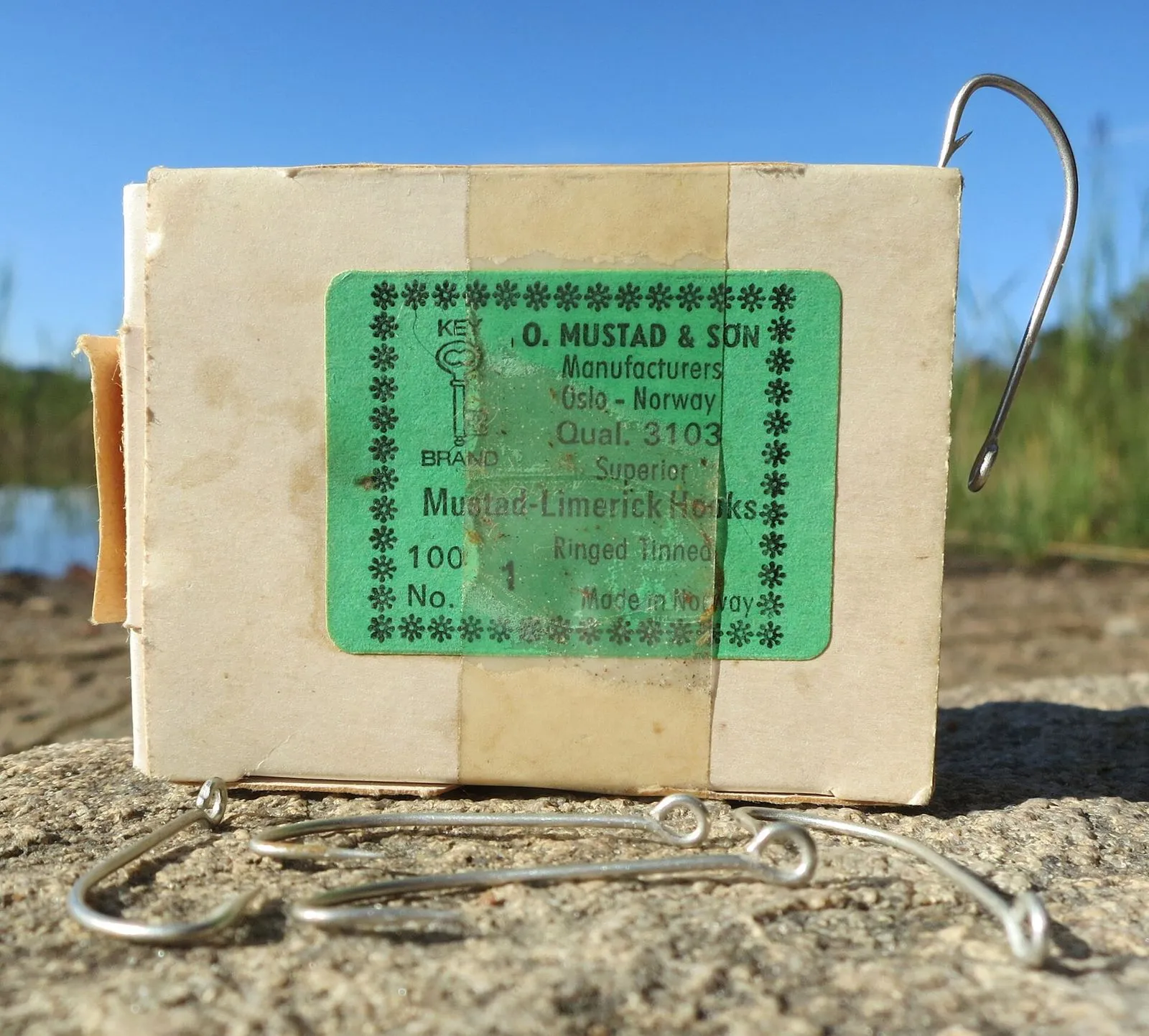
Fishing Hooks: Sizes, Types and Which Hook for Which FishHow fishing hook sizes work from 32 to 20/0, the parts of a hook, the ten hook types and what each is for, and a size-by-species chart from bluegill to tuna.
 Treble Hook: Sizes, When to Change Them, and the Single-Hook Waters
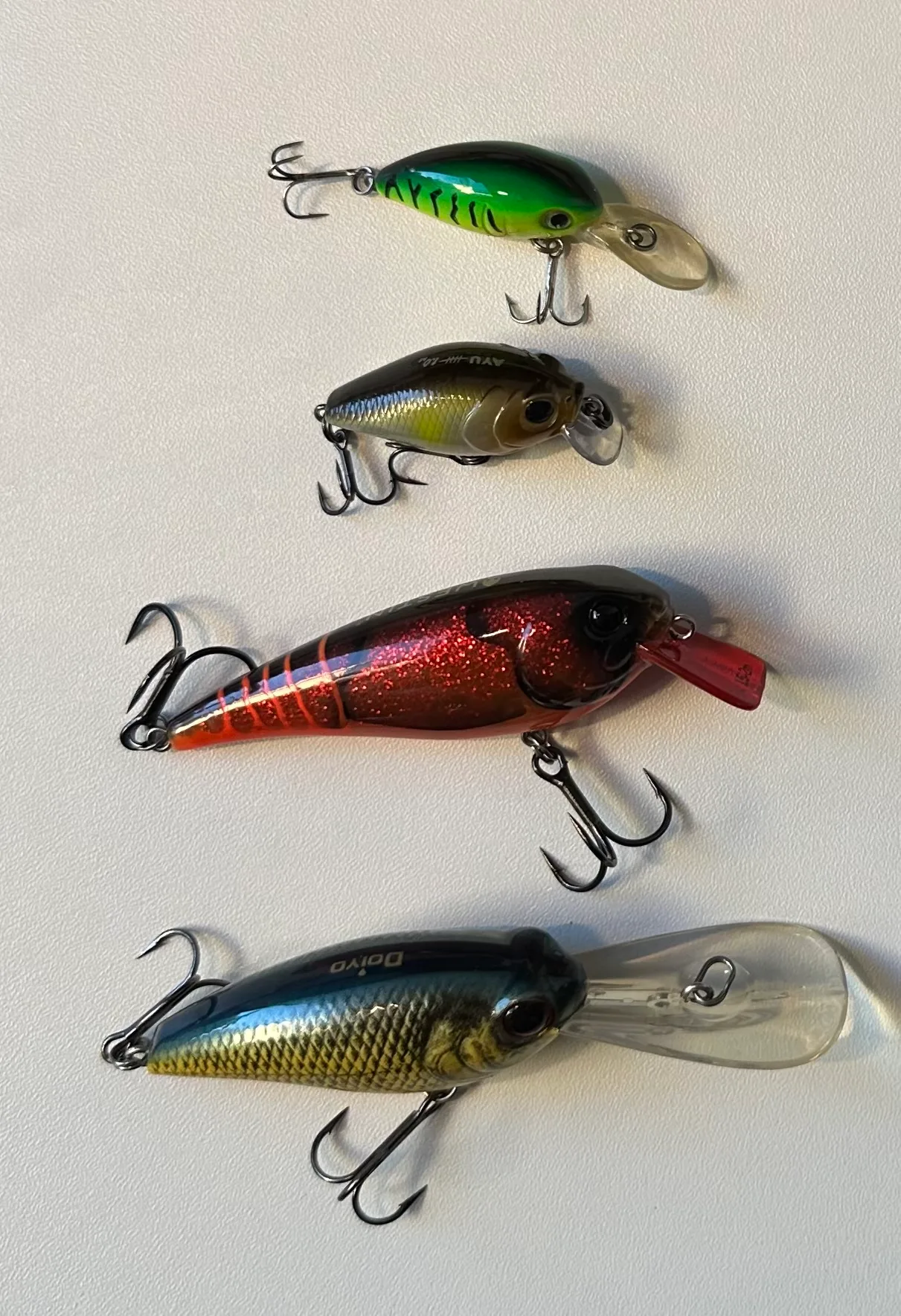
A treble hook has three points on one shank and comes on almost every crankbait and topwater. Sizes by lure, when to change them, and the single-hook waters.
 Circle Hooks: How They Work, How to Fish Them, and Where They Are Law
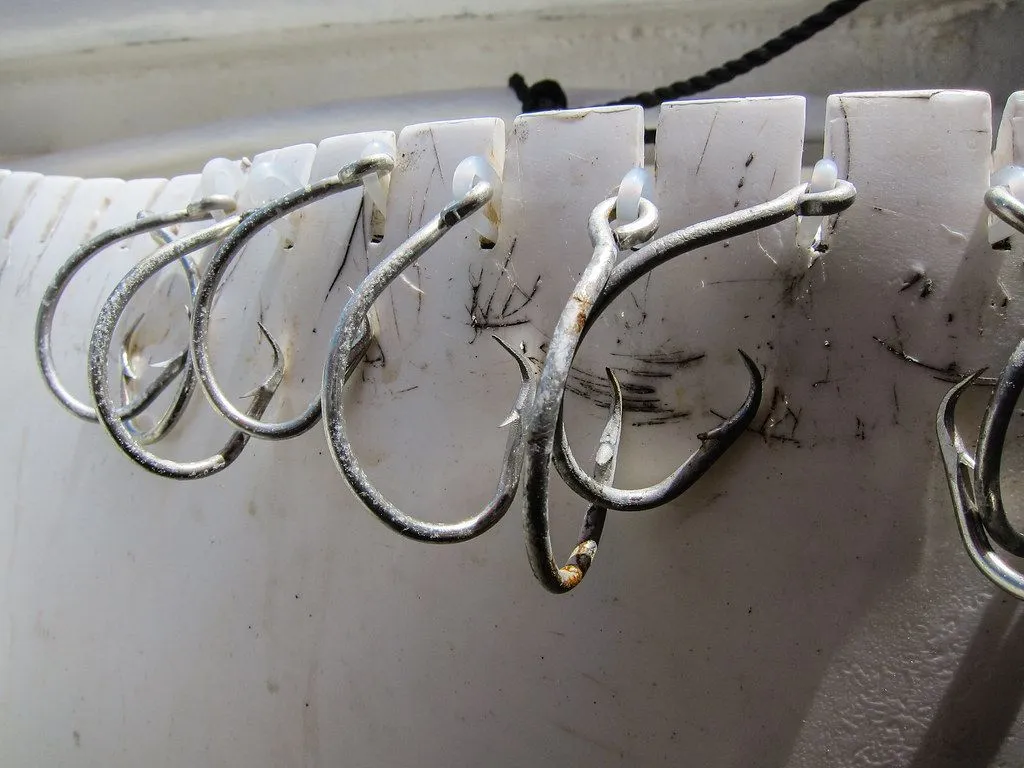
Circle hooks turn the point back toward the shank and set themselves in the corner of the mouth when you reel, not strike. How to fish them, and the rules.
Sources
- Take Me Fishing, Fishing hooks: sizes, types, anatomy
- Academy Sports, Fishing hook size chart by species
- Bass Pro Shops, A simple guide to the most popular fish hook styles
- Bass Pro Shops, Live bait and hook selection primer
- FishUSA, Best hooks for catfish (sizes by species)
- The Tackle Room, Treble hook sizes guide
- Mustad, Octopus Hook 92553: size chart with gap, length and wire diameter
- Mustad, Demon Perfect Inline Circle Hook 39950NP (3X strong, 2X short): size chart
- Mustad, Aberdeen Cricket Hook 3261D (4X long): size chart
- Orvis Fly Tying, Hook basics: the X factors
- Fly Fish SD, Fly tying hook reference guide (X system)
- Mystery Tackle Box, What size hook for soft plastics
- Cast and Spear, How to hook a minnow (hook size by minnow length)
- Maryland DNR, John Mullican: hook size for sunfish on worms
- Pautzke Bait, Spring spawn sack 101 (sack sizes and egg counts)
- Idaho Fish and Game, 2016 fall salmon rules (hook gap measured point to shank)
- Tackle Village, Fishing line strength chart by species
- The Tackle Room, Fishing line weight guide (saltwater species)