The Palomar knot is the first knot to learn and, for tying a line to a hook, lure or swivel, the strongest simple knot there is. It works by doubling the line before it goes through the eye, so that two strands share the load at the tight bend where knots fail; that one idea is why it wins the pull tests on monofilament and fluorocarbon and holds well on braid, and why it can be tied in the dark with cold hands. Below: the six steps, the numbers from the published tests, the lines it suits, and the situations where you want the uni knot or a loop knot instead.
The Palomar doubles the line before it goes through the eye, so two strands share the load at the bend where knots fail. That one idea wins the pull tests on nylon, holds on braid, and can be tied in the dark with cold hands.
What you need
- Line of any kind: monofilament, fluorocarbon or braid. The Palomar is one of the few knots that is good on all three.
- About 12 in (30 cm) of tag to work with; the doubled line uses twice as much as a clinch knot.
- A hook, lure or swivel with an eye the doubled line will pass through, and a body that will pass through the loop; that second condition is the knot’s only real limit.
- Water or saliva to wet the knot, and clippers to trim it.
Where it came from
Chester J. “Chet” Palomar, a Scout leader and public servant from Pomona, California, showed the knot at the Fred Hall fishing show in 1971. Representatives of DuPont, then the maker of Stren monofilament, were impressed enough to adopt it, and it spread through the tackle industry from there. Its virtues were clear from the start: almost nothing to remember, no turns to count, and a knot that is “nearly impossible to pull out” once seated, with the hook left free to rotate in the loop.
How to tie the Palomar knot, step by step
-
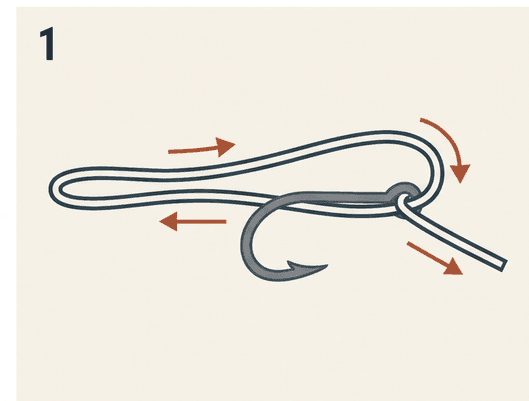
Double the line. Fold 8–12 in (20–30 cm) of line back on itself to make a loop, and pass the loop through the eye of the hook. With a small eye, pass the tag through, then back, to make the loop on the far side.
-
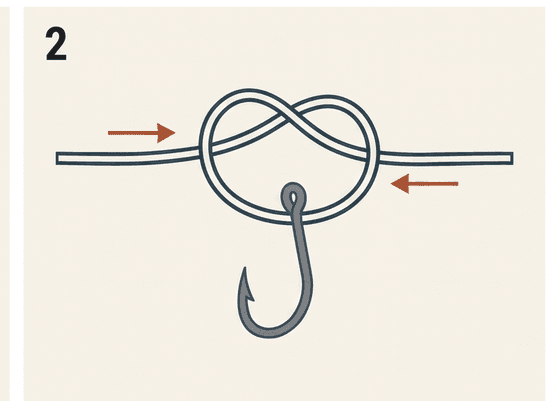
Tie an overhand knot in the doubled line. Use the loop and the two strands together, loosely, with the hook hanging from the middle of the knot. Do not tighten it yet.
-
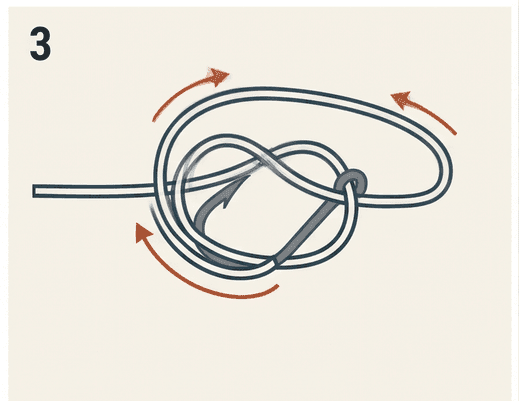
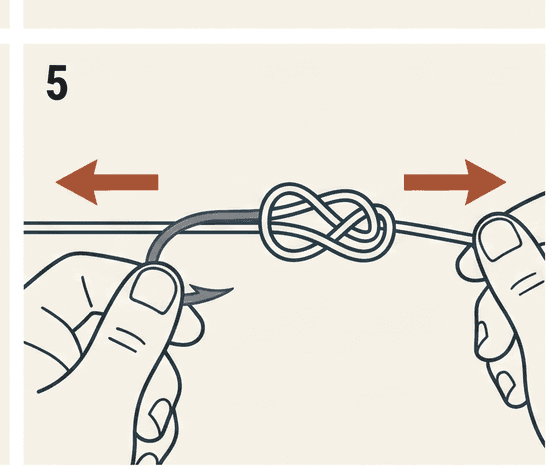
Pass the hook through the loop. Take the loop end of the doubled line and pass the whole hook or lure through it, then bring the loop up above the eye so it sits over the overhand knot.
-
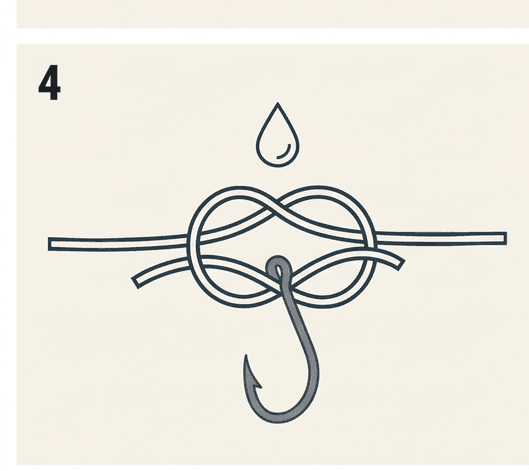
Wet the knot. Braid and fluorocarbon especially; a dry seat glazes fluorocarbon and scuffs braid.
-
Seat it. Hold the hook and pull the standing line and the tag together, steadily, so the overhand knot slides down and the loop closes over it against the eye. Both strands should lie neatly, not crossed.
-
Trim the tag to about 1/8 in (3 mm). Not flush: the knot settles a fraction under the first fish.
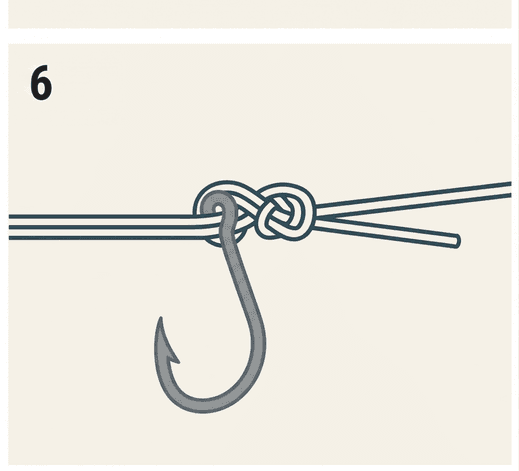
Drawings: fishing.info, generated with Gemini and checked step by step against the text.
How strong it is
| Line | Test | Result | Source |
|---|---|---|---|
| Monofilament (Ande) | Palomar vs Toit knot, hand tests, half dry and half wet | Palomar a slight advantage | Salt Strong |
| Fluorocarbon (Seaguar) | Palomar vs Toit knot | Palomar clearly stronger | Salt Strong |
| Mono and fluorocarbon, ranked | “Mono to hook, snug” ranking: Palomar first, Toit second, Trilene third | Top of the list | Salt Strong |
| Braid, 10 lb (0.15 mm) PowerPro | Machine pull to a swivel | Palomar 18.36 lb (8.3 kg); uni 20.21 lb (9.2 kg) average, “8 percent stronger” | Salt Strong |
| Any line | Wikipedia summary | “Retains almost all of the original line strength” | Wikipedia |
Two things to read from that table. On nylon lines the Palomar is the strongest knot a normal angler will tie. On braid it is good, and it beats an improved clinch by a wide margin, but the uni’s ten wraps grip the slick fiber better and won by about a pound and a half on 10 lb line. If every ounce matters on braid, tie the uni; if you want one knot for everything, the Palomar is it. These are single tests by one tester with one machine; a laboratory standard for fishing knots does not exist.
When not to use it
- The lure will not fit through the loop. A deep-diving crankbait, a jerkbait with three trebles or a swimbait is awkward to pass through a loop of light line, and the trebles catch it. Tie a uni or a non-slip loop knot instead.
- The item is already on a leader. A swivel on a pre-tied rig, or a hook on a dropper, cannot be passed through anything. Use the uni or the improved clinch on mono.
- Very small eyes with heavy line. The doubled line has to fit through the eye twice; a #10 hook and 20 lb mono will not. Step down the line or use a clinch.
- A free-swinging lure. The Palomar cinches tight to the eye; for a jerkbait or topwater that should swing, a loop knot fishes better even if it tests a little weaker.
Mistakes that cost strength
- Crossed strands. If the two strands twist over each other as the knot seats, it is a weaker knot. Keep them parallel through the overhand knot and let the loop close cleanly over it.
- Seating dry. The most common cause of a Palomar breaking below its number. Wet it, every time.
- Pulling only the tag. The knot seats from the standing line; pull both together, then check that the loop sits over the knot and not beside it.
- Trimming flush. Leave 1/8 in.
When to use something else
The uni knot for braid when strength is everything and for anything the Palomar loop will not pass over; the improved clinch knot on mono when you want a faster tie with a short tag; the FG knot when the job is braid to a leader rather than line to a hook. The knots hub has the full table of which knot goes with which line and job.