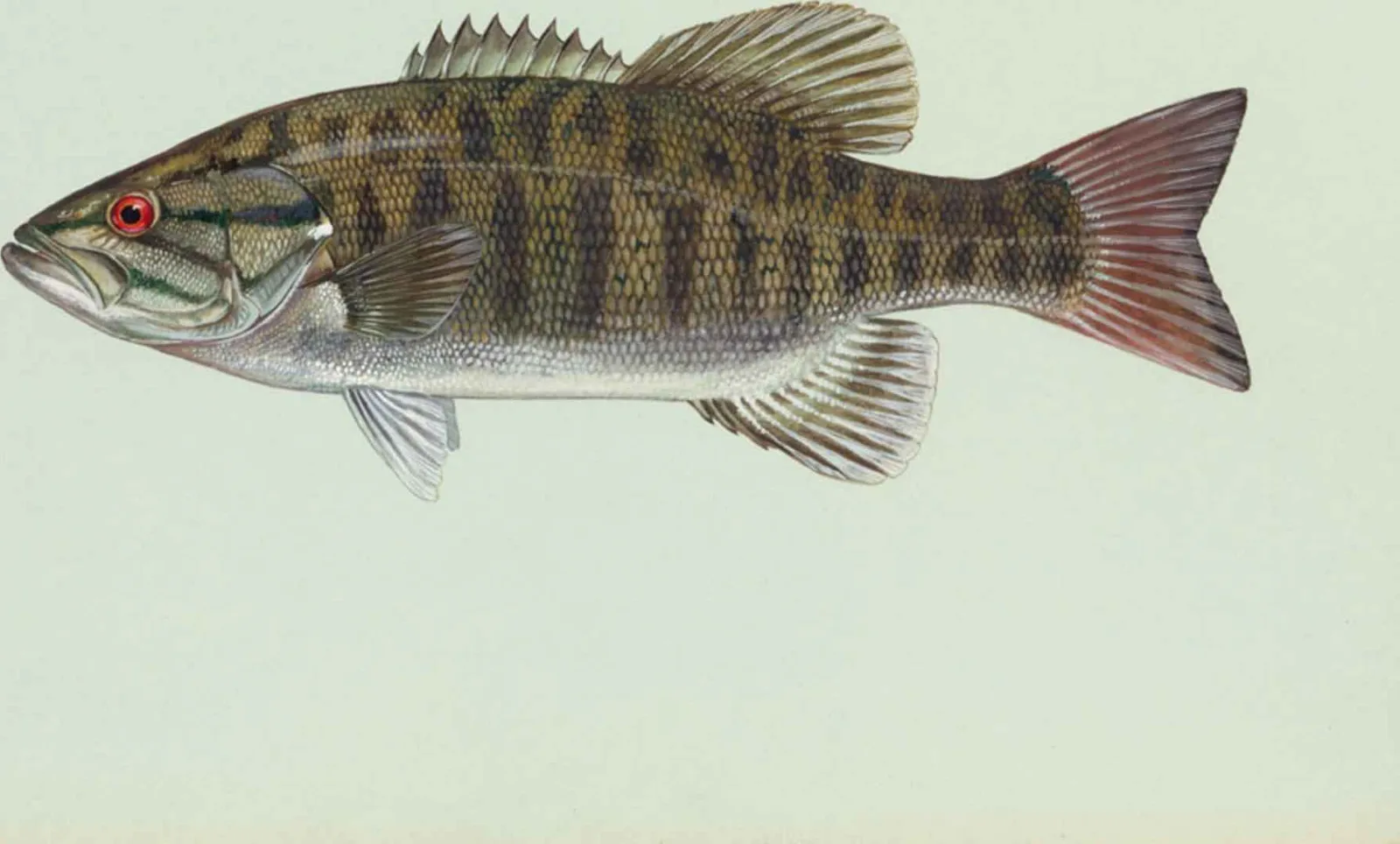
The smallmouth bass, Micropterus dolomieu, is the black bass of cool, clear, rocky water: the bronze fish of northern lakes, Ozark streams and the Great Lakes, and by common consent the hardest fighter of the family for its size. Wisconsin’s Department of Natural Resources calls it “pound for pound, the scrappiest fish of all in Wisconsin”. It is smaller than the largemouth, lives in different water, spawns a few degrees warmer and eats more crayfish, and those differences decide where and how it is caught. Below: the identification marks, the habitat numbers, the spawning data by source, the season pattern and the record, each from the agency or publication it came from.
“Pound for pound, the scrappiest fish of all in Wisconsin,” says the state’s Department of Natural Resources, and few anglers who have hooked one on light line disagree.
Identification
Color is the mark everyone uses and the least reliable: smallmouth run from bronze to olive to nearly black depending on the water, and a largemouth from tannic water can look just as brown. Three marks are reliable. The upper jaw never extends beyond the rear edge of the eye, where a largemouth’s reaches well past it. The flanks carry dark vertical bars, not a horizontal stripe. And the dorsal fin has only a shallow notch between the spiny and soft parts, with 13–15 soft rays, where the largemouth’s is nearly divided in two. Red or orange eyes are common but not universal.
| Mark | Smallmouth | Largemouth | Spotted |
|---|---|---|---|
| Upper jaw | Never past the rear edge of the eye | Well past the eye | Stops at the rear margin of the eye |
| Flank pattern | Dark vertical bars | Dark horizontal stripe of blotches | Stripe plus rows of spots below it |
| Dorsal fin | Shallow notch; 13–15 soft rays | Nearly divided; 12–13 soft rays | 10 spines |
| Tongue | No tooth patch | No tooth patch | Tooth patch |
| Typical adult | 12–18 in (30–46 cm), 1–4 lb (0.5–1.8 kg) | 12–20 in (30–51 cm), 1–6 lb (0.5–2.7 kg) | 3–5 lb (1.4–2.3 kg) at most in most water |
| Record | 11 lb 15 oz (5.4 kg) | 22 lb 4 oz (10.1 kg) | 2 lb 8 oz (1.1 kg) since the 2024 category split |
Where they live
The native range runs from Minnesota and southern Quebec south to the Tennessee River in Alabama and west to eastern Oklahoma and southwestern Arkansas; stocking has spread the fish to most states except Florida and Louisiana, and the Texas record now exceeds 7.5 lb (3.4 kg). What has not changed is the water they need. Texas Parks and Wildlife describes it as large clear lakes “greater than 100 acres, more than 30 feet deep” and cool clear streams with gravel bottoms. Wisconsin’s DNR, which manages the best stream fishery in the country, lists the requirements for a viable stream population: coarse rock and gravel, a mean width of 15–40 ft (5–12 m), pool depths of 3–4 ft (1–1.2 m), summer water temperatures above 72 °F (22 °C), and crayfish. Where those conditions meet, smallmouth hold on the current seams, the boulder edges and the drop-offs; in lakes they use rock points, reefs and gravel flats, and in summer they go deeper than largemouth ever do.
Season and behavior
Smallmouth follow the same temperature calendar as largemouth, shifted toward cooler water and rock. Kevin VanDam’s six-season bands, published by Bassmaster, apply with the caveats below; the agency spawning numbers are the fixed points.
| Source | Trigger and range | When | Nest | Eggs and hatch |
|---|---|---|---|---|
| Texas Parks and Wildlife | Begins as water approaches 60 °F (16 °C) | Spring | Near shore in lakes, downstream of boulders in streams | 2,000–15,000 eggs per female, average nest 2,500; hatch in about 10 days at mid-50s °F (13 °C), 2–3 days at mid-70s °F (24 °C); male guards up to a month |
| Wisconsin DNR | Usually 62–64 °F (17–18 °C); recorded at 53 °F (12 °C); season range 55–75 °F (13–24 °C) | Mid-May through June in southern Wisconsin | Rocky stream or lake habitat | – |
| Minnesota DNR | About 60 °F (16 °C) | Mostly May–June | Gravel bed beside a log or boulder in 3–10 ft (1–3 m) | – |
Pre-spawn smallmouth stage on the first rock structure outside the spawning flats as the water passes 48–55 °F (9–13 °C) and are the easiest big fish of the year on a jerkbait or a tube. After the spawn, in 70–75 °F (21–24 °C) water, they scatter and rise to topwater and swimbaits. In summer they hold deep, on humps, reefs and river-channel rock in 15–30 ft (5–9 m), and the drop shot and the Ned rig take over; in rivers they stay on current breaks all summer. In fall they follow baitfish onto the points and eat spinnerbaits and crankbaits until the water drops toward 50 °F (10 °C), when they gather on deep rock and slow down for winter.
How to catch them
Crayfish are the smallmouth’s favorite food in the Wisconsin data, with hellgrammites and dragonfly larvae behind them, and the lure list follows: brown and green-pumpkin tubes, craw-imitating jigs, Ned rigs, drop-shot worms and small swimbaits on the bottom; jerkbaits and spinnerbaits in the cold months; topwater walkers and poppers over rock in low light in summer. The jigs and rigs hub covers the finesse rigs that catch more smallmouth than anything else, and the crankbaits hub covers the jerkbait for pre-spawn. In rivers, a 1/16–1/8 oz inline spinner or a small crankbait cast upstream and across works from the bank. Tackle is lighter than for largemouth: a 7 ft medium-light spinning rod with 10–15 lb braid to a 6–8 lb fluorocarbon leader for the finesse rigs, and a 7 ft medium casting rod with 10–12 lb line for jerkbaits and topwater; the rods hub explains the matrix.
Are smallmouth harder to catch than largemouth?
Not harder, but different. Smallmouth roam more than largemouth, so finding them is the work, and they live in clearer water, so lighter line and smaller baits matter more. Once found they are usually more aggressive, which is why river smallmouth are the fish many anglers learn on. They are good to eat, mild and firm, and most are released; the same mercury advisories that apply to largemouth apply to them, by waterbody, so check the state health department page for the water you fish. On age: growth is slower than the largemouth’s in the North, and a 5-pound smallmouth from a northern lake is commonly ten years old or more, which is the reason big smallmouth waters are managed with slot limits and why the six-pound fish is a rarer catch than a ten-pound largemouth in most of the country.
Size, records and regulations
The all-tackle world record is 11 lb 15 oz (5.4 kg), 27 in long with a 21⅔ in girth, caught by David L. Hayes of Leitchfield, Kentucky, at Dale Hollow Lake on the Kentucky–Tennessee line on 9 July 1955. In 1996 a document surfaced claiming that a dock hand had “shoved 3 pounds of weights into the fish”, and the IGFA, the Fresh Water Fishing Hall of Fame and Kentucky struck the record; Tennessee kept it. An investigation found the affidavit fraudulent, a polygraph confirmed the accused man had not been there that day, and the fish’s measurements made a weight under 11 pounds physically impossible; the IGFA reinstated the record on 12 December 2005 and gave Hayes, then 80, a life membership and an apology. Dale Hollow still holds most of the biggest smallmouth ever weighed. Regulations vary by state and by water, with minimum lengths and protected slots common on the best lakes; the state pages carry the current limits.
Related
The bass fishing hub covers all five black bass species and the seasonal pattern; the largemouth bass page is the comparison most readers want; the spotted bass page separates the look-alike with the tooth patch. For the electronics that find deep summer smallmouth on rock, see fish finders.
Sources
- Texas Parks and Wildlife, smallmouth bass species profile
- Wisconsin DNR, smallmouth bass
- Minnesota DNR, smallmouth bass
- Bassmaster, the David L. Hayes world-record smallmouth returns to the record book
- Kim, Taylor & Near 2022, Phylogenomics and species delimitation of the black basses, Scientific Reports
- Bassmaster, KVD's 6-season bass guide