 By
An Alabama rig swims five small swimbaits at once: a shad-shaped head with five bendable wires behind it, each ending in a clip that holds a jig head and a bait. One cast puts a pod of baitfish in front of the bass. Paul Elias won the October 2011 FLW Tour event on Lake Guntersville with it, and three months later the top pro tour had banned it. Where you fish, the state’s hook count decides how many of the five baits may carry a hook.
Paul Elias weighed 102 lb 8 oz of Guntersville bass in four days and won by 17 lb 3 oz. On the final day most of the top ten had the rig tied on at one time or another.
What is an Alabama rig?
It is a castable umbrella rig. The original had five bendable wires joined at an angle inside a small shad-profile head, reaching 6–7 in (15–18 cm) behind it, with a small round jig head and a grub or swimbait on each. Weighed in October 2011, it came to about 3/8 oz before the baits, and over 4 oz with ordinary jig heads and soft plastics on it.
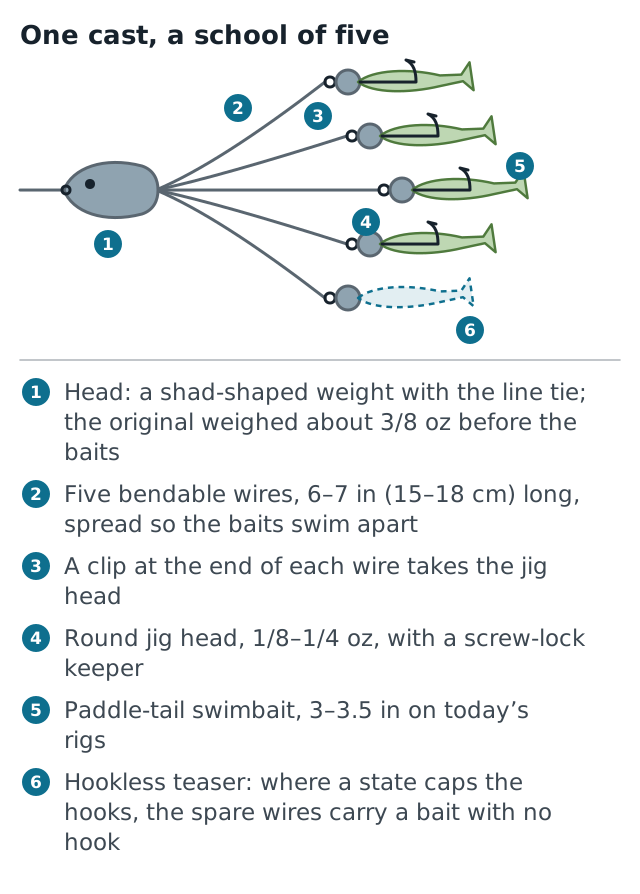
The name stuck to the whole category, the way every bladed jig gets called a ChatterBait. Today’s rigs carry fewer than five baits or more, with or without spinner blades on the arms, in wire or in clear material.
When and where does it work?
Fall through winter, wherever bass feed on shad. In fall the shad move into the creeks and the bass follow, and a rig that looks like a school stands out in all that bait. In winter it works on bass feeding on shad in deep water: the bottom of channel breaks, deep flats, and stumps and brush near the bait schools.
Elias held his boat in 25–40 ft (7.5–12 m) on ridges and points by the causeways, where current made the bass stage on shad. He caught them suspended at 20–30 ft (6–9 m). The fish finder guide shows what a bait ball with bass under it looks like.
Guntersville guide Alex Davis now fishes it like an oversized ChatterBait or spinnerbait: when the dam is pulling current, or with cloud and wind. Jason Sealock of Wired2Fish puts his rigs away in late winter and early spring. For the cold-water window it owns, see the best time to fish for bass.
Free PDF · Water temperature chart Which fish are biting at today's water temperature?
One water temperature reading, and the 16-page chart tells you who's spawning, who's feeding hard, where they sit and what to throw. 26 fish, every number sourced.
Enter your email, confirm it with one click, and the PDF is in your inbox. Plus one email a week on what's biting. Unsubscribe anytime. Privacy.
Is the Alabama rig legal where you fish?
States rarely regulate the rig by name. They limit hooks or lures per line, and that decides how many of the five baits may carry a hook. The spare wires carry hookless teasers. Six agencies have written down how their rule applies:
| State | The rule | A legal five-wire rig |
|---|---|---|
| Michigan | No more than six hooks on all your lines together | Five hooked baits, and one more hook on any other line |
| Missouri | No more than three lures with hooks per line; a lure’s own hooks count as one | Three hooked, two teasers |
| Tennessee | No more than three hooks per rod since March 1, 2013; a single, double or treble hook each counts as one | Three hooked, two teasers |
| Kansas | Two baited hooks or lures per line, but an umbrella rig may have up to five hooks | Five hooked baits, one hook each |
| North Dakota | No more than two lures per line | Two hooked, the rest without hooks |
| Minnesota | One artificial lure per line; an umbrella rig may carry hooks on one wire only (some border waters differ) | One hooked bait; hookless baits on the other wires |
Tennessee’s three-hook rule replaced an older, more tangled one. After the rig appeared, that rule “created much confusion among anglers and TWRA staff,” and the commission rewrote it. Under the new one a crankbait with two trebles counts as two hooks, so three such crankbaits on one line are illegal.
Bassmaster surveyed the states in January 2012. It found the full five-bait rig legal in Alabama, Arkansas, Connecticut, Florida, Idaho, Kentucky, Louisiana, Michigan, New Mexico, New York, North Carolina, Oklahoma and Texas. California, Colorado, Ohio, Pennsylvania, Rhode Island, Utah, Washington and Wisconsin allowed three hooks or fewer, and Arizona two lures with hooks. In New Hampshire, Iowa, Nebraska, Massachusetts, Nevada, Vermont and Maryland, a rig with three or more hooks was illegal. Mississippi barred it on Arkabutla, Grenada, Enid and Sardis, and New Jersey limited the Delaware River to three hooks.
That survey is a 2012 snapshot, and rules change. Check your state’s current regulations before the first cast.
How to rig an Alabama rig
- Count your legal hooks first. Where five are legal, rig five. Where three are, put hooks on three and swimbaits without hooks on the rest.
- Pick the jig heads for depth. Heavier heads and smaller baits run deeper and take a faster retrieve; lighter heads and bigger baits fish slower and shallower. Round ball jig heads with a screw-lock keeper hold the bait when bass nip the tail.
- Thread on the baits with the hook open, not rigged weedless. Sealock tried weedless swimbait hooks around grass and missed too many fish.
- Clip a jig head to each wire and spread the wires so the baits swim free of each other. The rig folds a little on the cast; set too tight, the baits tangle.
- Consider one odd bait. Five matching baits work, but a bigger or different-colored bait in the middle sometimes draws the bigger fish. Mark Zona swears by one odd-colored bait for smallmouth.
- Keep a second rig tied up with the other head weight, so a depth change is a rod swap, not a re-rig.
What tackle does it need?
A rig over 1 oz, cast all day, needs a rod built for it. Sealock fishes an 8 ft (2.4 m) heavy or extra-heavy rod rated for 1–3 oz, with a fast to moderate-fast action and a long handle for two-handed lobs. He calls a swimbait rod rated for at least 2 oz the minimum. Elias won Guntersville on a 7 ft 11 in (2.4 m) flipping rod. Davis now uses a 7 ft 8 in extra-heavy rod with more bend in it, which absorbs shock and casts easier. The rods hub covers the heavy rods.
For the reel, take a 200- or 300-size baitcaster. Davis uses a 7.1:1 gear ratio, slow enough for deep water and quick enough to burn the rig over grass.
The line is heavy braid: 65 lb for Sealock and Elias, 50 lb for Davis. There are two reasons. A rig that heavy snaps a thin line if it binds on the spool during the cast. And braid lets you pull hard enough to straighten a hook on a stump and get the rig back. That matters: in 2013 Sealock put the money tied up in one rig at $30 or more. In very clear, pressured water, switch to 20 lb fluorocarbon and a clear rig.
What is the best umbrella rig for bass fishing?
No rig is best everywhere: the right one has as many hooked arms as your state allows. Three current rigs show the range, specs from the makers’ store pages:
- YUMbrella Flash Mob: five heat-treated stainless steel wires, with four willow blades midway down the outer arms for flash and vibration.
- YUMbrella 3-Wire Rig: three stainless steel arms, sold for states that only allow three hooks per rig.
- Picasso Bait Ball Extreme: from 3 arms and 6 baits up to 7 arms and 16 baits, 9.5 in (24 cm) long (the 3-arm version 7.5 in, 19 cm); each snap takes a hooked bait or a hookless dummy head.
How do you set it up for depth?
| Where the bass are | Heads | Baits | Retrieve |
|---|---|---|---|
| Shallow, over grass or wood | Light, 1/8 oz (3.5 g) | Bigger bodies | Faster, to stay above the cover |
| About 10 ft (3 m) | 1/8–1/4 oz (3.5–7 g) | 3–3.5 in (8–9 cm) | Count to about eight, then a steady medium-slow wind |
| Suspended at 20–30 ft (6–9 m) | Heavier; Elias used 3/8 or 1/2 oz | His were 5 in and 6½ in (13 and 16.5 cm) | Count it down to the fish, wind slowly; a rig with willow blades slows down better |
| Clear, pressured water | Light | Small, 3 in (7.5 cm) | A clear rig on 20 lb fluorocarbon, fished slower |
The trend since 2011 runs one way: smaller. Davis started on 5- and 6-inch swimbaits; now anything bigger than 3.5 in “doesn’t get the same amount of bites.” The soft plastics hub has the smaller paddle tails.
How to fish it
The cast. Lob it; do not snap it. Sealock swings the rod back low and brings the tip around in a wide circle. As the upper hand drives toward the target, the lower hand pushes the butt away. A snap cast loads and unloads the weight too fast, which strains the wrist and shoulder and can crack graphite.
The count-down. Even on light heads the rig sinks fast. Sealock counts to about eight for 10 ft (3 m). Fishing deep, he lets it touch bottom and starts reeling the moment the line goes slack. A quick pop of the rod tip straightens the baits behind the head before the retrieve starts.
The retrieve. Steady, medium to slow, just fast enough to keep it off the bottom and the tails kicking. In cold water, faster than that costs bites. Two tricks trigger a follower. Stop, and pop the rod once or twice so the baits flare and dart. Or let the rig swing down a drop on a tight line like a pendulum. Davis watches fish track the rig on forward-facing sonar and gives the reel two quick turns to make the baits pulse. That is usually when they hit.
The hookset. Do not set hard. When the rod loads, lean into it and reel faster; the speed drives the hook home.
Where did it come from, and why did the pros ban it?
Umbrella rigs are old. Saltwater trollers pulled them for striped bass and bluefish off New England. Trollers on Georgia’s Lake Lanier pulled them for landlocked stripers. Andy Poss, an Alabama tournament angler, scaled the idea down to one you could cast on ordinary bass tackle.
Three months after Elias’s win, B.A.S.S. announced on January 19, 2012 that its Classic and Elite Series anglers would be limited to “a single lure during practice and competition”, effective February 1. That covered the Classic at Shreveport–Bossier City on February 24–26. The same rule ended double soft jerkbaits and drop shots weighted with a jig. The Elite pros on the rules committee asked for it unanimously, and one gave the reason: “It doesn’t matter how you work it. The fish can’t help themselves.”
The rule did not then apply to the Bassmaster Opens, the Federation Nation or College B.A.S.S. In April 2013 Patrick Bone won a Southern Open on Douglas Lake with the rig. In 2014 B.A.S.S. extended the ban to the Opens and every other event that leads to a Classic berth.
FLW followed for its 2014 season: “Alabama rigs and similar umbrella-type rigs are not permitted” on the FLW Tour. Its other circuits kept the rigs, capped at five wires, five lures and three hooks.
The rigs hub has the single-bait rigs, the lures hub every other family, and the bass hub the fish this one was built for.
Free PDF · 16 pages
Know what's biting before your first cast
The Water Temperature Fishing Chart. Take one water temperature reading, find it on the chart, and you know which of 26 freshwater fish are feeding today, where they are and what to throw. For your phone and the tackle box.
- The 26-fish chart: who's spawning, feeding hard or shut down at your reading
- Where they sit and what to throw at every band: bass, crappie, bluegill, walleye, catfish and trout
- The best hours at your reading, the cold front day by day, and the spawn calendar from ice-out to midsummer
- The three thermometer mistakes that make a reading lie (the first one is the surface)
Every number from state fish and wildlife agencies and fisheries research: 61 sources, all on the site.
Enter your email, confirm it with one click, and the PDF is in your inbox. Plus one email a week on what's biting. Unsubscribe anytime. Privacy.
Related
Section guide
Fishing Lures: The Six Types, What Each Catches and When to Throw ItFishing lures explained: the six families and what each imitates, which lure for which fish, water temperature and clarity, color, cost and a first box.
 Best Fishing Lures: The Ten to Buy First, by What Each One Does
The best fishing lures for a first box: ten that cover every season and depth, what the pros threw in 2025, a season table, a species table and colors.
 Fishing Advent Calendars 2026: What Is Behind the Doors, Priced Per Door
Fishing advent calendars for 2026, door by door: 12 or 24 doors, 80 cents to $5 a door for US calendars, what is inside, and when to order.
 Types of Fishing Lures: The Six Families, What Each Does and When
Types of fishing lures by family: crankbaits, topwater, spinnerbaits, jigs, soft plastics, spoons, swimbaits and flies, with depth, retrieve and season.
Sources
- Bassmaster (Steve Wright), Banned in the Opens (October 14, 2014)
- Bassmaster (Ken Duke), Alabama Rig: Hottest technique in years! (December 25, 2011)
- Wired2Fish (Jason Sealock), Alabama rig: how to fish and rig it
- Wired2Fish (Jason Sealock), 7 tips on how to fish for bass with umbrella rigs (2013)
- BassResource (Tyler Brinks), the evolution of the umbrella rig and how to fish it (2024)
- FLW release via BassResource, Elias wins FLW Tour event on Lake Guntersville (October 23, 2011)
- Wired2Fish, Alabama rig banned by B.A.S.S. for the Elite Series (January 17, 2012)
- Wired2Fish, FLW announces rule change banning the A-rig (2013)
- Bassmaster (Ken Duke), Alabama rig: what you'd better know (October 2011)
- Bassmaster (John Neporadny Jr.), Alabama rig: states differ (January 2012)
- Wired2Fish, Tennessee clarifies umbrella rig rule for Alabama rig (2011)
- Wired2Fish, New Alabama rig regulations in Tennessee (three hooks per rod from March 1, 2013)
- TWRA, fishing proposals for 2013 (August 2012)
- Bassmaster, B.A.S.S. imposes One-Lure Rule (January 19, 2012)
- Bassmaster, Georgia's Bone wins A-rig fest (Southern Open, Douglas Lake, April 2013)
- Minnesota DNR, Alabama (umbrella/Yumbrella) rig
- Minnesota DNR, 2026 Minnesota fishing regulations (tackle and lines, page 37)
- Missouri Department of Conservation, only three hooked lures allowed on Alabama rigs in Missouri (2012)
- Kansas Department of Wildlife and Parks, legal fishing equipment
- Kansas Administrative Regulations 115-1-1, definition of an artificial lure (five hooks for a device mimicking multiple prey)
- Kansas Administrative Regulations 115-7-1, fishing legal equipment (two lures per line)
- TWRA, Tennessee fishing guide 2026-27, statewide hook restriction (via eRegulations)
- North Dakota Game and Fish, is an umbrella rig legal in North Dakota waters?
- Michigan DNR, Alabama rigs are legal for anglers' use in Michigan (April 2012)
- Lurenet, YUMbrella Flash Mob Rig
- Lurenet, YUMbrella 3-Wire Rig
- Picasso Lures, Bait Ball Extreme