 By
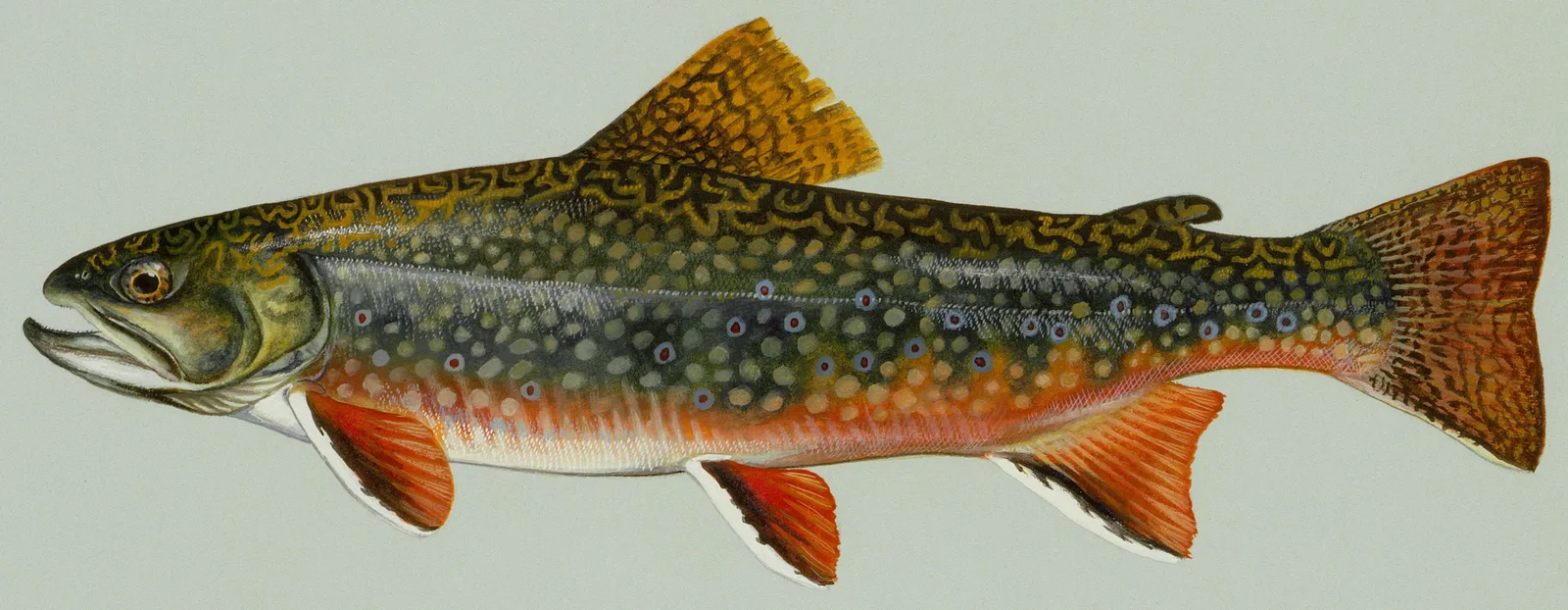
The brook trout is the only stream trout native to most of the eastern United States, and it is not a trout at all but a char. A typical stream brookie is 6–12 in (15–30 cm) long, lives about three years and wears the most elaborate paint job of any freshwater fish. It needs the coldest, cleanest water there is. That is why 28% of its eastern subwatersheds have already lost their wild brook trout.
The world-record brook trout, 14 lb 8 oz, came out of Ontario’s Nipigon River in 1915. Its captor first thought it was a lake trout, and the fish lay out of the water for days before it was weighed.
How do you tell a brook trout from a brown, a laker or a splake?
Three marks settle it. The back carries pale, worm-like marbling called vermiculation. The sides carry red spots, each ringed with blue. And the lower fins are orange with a crisp white leading edge and a black line behind it. The tail is square, which is where the old name “squaretail” comes from.
Behind those marks sits one rule for the whole char family. A trout has dark spots on a lighter body; a char has light spots on a darker body. Hold a brookie next to a brown trout and the rule is obvious in a second.
| Mark | Brook trout | Brown trout | Lake trout | Splake |
|---|---|---|---|---|
| Spots | Pale on dark, plus red spots with blue halos | Black and red on gold-brown, pale halos | Cream-white on gray-green, no red | Pale on dark, some red without blue halos |
| Back | Worm-like marbling | Spotted, no marbling | Pale spots, some worm-like marks | Some, less defined, more spot-like |
| Tail | Square or nearly so | Square, few or no spots | Deeply forked | Slightly forked |
| Lower fins | Orange, white edge, black line | Plain | White edge, no black line; can be orange | Tricolored |
| Typical size | 6–12 in (15–30 cm) | 9–14 in (23–36 cm) in streams, 13–21 in (33–53 cm) in lakes | 18–24 in (46–61 cm) | 10–18 in (25–46 cm) |
Males color up hard for the fall spawn. A male brookie in October is as bright as any freshwater fish on the continent.
Where do brook trout still live?
The native range runs from the Great Lakes east to the Atlantic, down the Appalachians to northern Georgia, and north through Canada to Hudson Bay. Within it the brook trout wants small spring-fed streams and ponds with sand or gravel bottoms.
It also wants them colder than rainbows or browns do. West Virginia’s biologists treat water above 65 °F (18 °C) for extended periods as a stress factor. In Shenandoah National Park the biologists put the adult limit near 77 °F (25 °C), and newly hatched fry die in numbers above 68 °F (20 °C). The trout water temperature chart sets the brookie against the other trout.

Free PDF · Water temperature chart When do brook trout bite?
One reading, and the 16-page chart shows which of 26 fish are spawning, feeding hard or slowing down; for bass, crappie, bluegill and walleye, where they sit and what to throw. Every number sourced.
No card, nothing to buy, and the PDF is yours to keep. Confirm with one click and it's on its way. Then a few short emails and one a week on what's biting. Unsubscribe anytime. Privacy.
Why is the brook trout disappearing?
That appetite for cold, clean water is the reason. The Eastern Brook Trout Joint Venture’s 2008 assessment classified almost 5,300 subwatersheds across the eastern United States:
- 28% had lost their self-sustaining brook trout entirely.
- 35% kept brook trout in less than half of their historical habitat.
- 31% still held brook trout in more than half.
- Of the intact subwatersheds, 94% were more than 68% forest.
Logging, farming, roads, acid rain and warm water did the damage. Naturalized brown and rainbow trout then push brookies out of the lower reaches. In Shenandoah National Park brook trout are still the most widespread fish, found in almost all streams, while browns are confined to the lower reaches of three. West Virginia has about 500 miles of native trout stream left, 2% of the state’s stream miles.
The story runs the other way in the West. Brook trout have been stocked across western North America since the mid-1800s, and there they are the invader. USGS research in western Montana (Peterson et al. 2008) treats nonnative brook trout as one of the main threats to native westslope cutthroat trout.
When do brook trout spawn, and what do they eat?
Brook trout spawn in the fall, when most anglers have put the fly rod away: September through November in West Virginia, early October to mid-November in Shenandoah. The female digs a redd in clean gravel where groundwater wells up through the bottom, or over spring seepage along a pond shore.
The eggs sit in the gravel all winter. Fry emerge from February to April and grow to 3–4 in (8–10 cm) by the end of their first summer. Most brook trout mature at two, some at one in small streams.
They eat whatever the stream delivers. Stoneflies, mayflies and caddisflies are the year-round menu; summer adds grasshoppers, beetles, salamanders and small fish. The big lake and Great Lakes forms, the coasters, turn to fish and grow past 2 ft (61 cm).
Where are brook trout in each season?
- Spring: fish spread through the stream and feed hard on the first hatches.
- Summer: they pack into the coldest water available, spring seeps, deep shaded pools and the headwaters. Fish dawn, and stop when the stream warms past 65 °F.
- Fall: the color peaks and the spawn starts. Stay off the gravel where fish are paired up; a redd trampled in October is next spring’s missing year class.
- Winter: slow and deep, in the slowest pools.
How do you catch brook trout?
Wild brook trout are rarely picky and always spooky. On a small mountain stream the fish sees the angler long before it sees the fly. Brett Boberly, a guide quoted by Game & Fish (Ingram 2024), puts it plainly: “How you approach, wade and work a stream is far more important than the fly you tie on.” Keep a low profile, use any cover, and wade slowly. In small pools the bigger trout lie at the top, so work the downstream fish first. Plunge pools and the pocket water behind rocks hold the most fish.
A light 3–5 weight fly rod with a high-floating dry fly covers almost every brook trout stream in the East. So does an ultralight spinning rod with a small inline spinner. Stocked brook trout in ponds take the same baits as stocked rainbows. For the full method, from tackle to reading the water, see trout fishing; for the patterns, trout flies.
Handle them as little as possible. A brook trout has the lowest stress threshold of the common trout. In a 2022 study, brookies held in the air for more than 30 seconds from water above 67 °F (19.5 °C) showed the most reflex impairment (Brownscombe et al. 2022). The fish that could not right itself was the one likely to die. Wet your hands, keep it in the water, and let it go fast; the catch-and-release guide has the numbers.
How big do brook trout get?
A 12 in (30 cm) wild brook trout is a good fish in most eastern streams, and the typical stream fish is 6–12 in. Vermont’s biologists write that many headwater mountain streams rarely produce brook trout larger than 6–7 in (15–18 cm). In productive lakes and ponds they can top 20 in (51 cm) and 5 lb (2.3 kg). Stream fish reach about 15 in (38 cm). Great Lakes fish grow past 2 ft (61 cm) and up to 15 lb (6.8 kg). West Virginia’s state record is 7.64 lb (3.5 kg) and 23.5 in (60 cm); Virginia’s is 5 lb 15 oz (2.7 kg), from Cub Run in 2019.
The world record belongs to Dr. J. W. Cook. He landed a 14 lb 8 oz (6.6 kg) brook trout on the Nipigon River, north of Lake Superior, in July 1915, on a week-long trip with his guide, Andrew Lexie. It measured 31.5 in (80 cm).
Cook first took it for a lake trout, and the fish was out of the water for days before anyone weighed it. It may have been heavier when caught. Ontario’s record registry dates it to 1916; the fish is the same. A century of anglers has not come close, and the stories of the other trout records are in world-record trout.
Are brook trout good to eat?
Yes, though in the East a wild brook trout is often a fish to release. Arizona Game and Fish credits the species with “a delicious flavor, with flaky meat ranging in color from white to pinkish-orange.” Shenandoah National Park makes every stream catch-and-release except a listed set of harvest streams, to “preserve and perpetuate native brook trout.” In the West, where the brookie is the invader, Idaho’s 2025–2027 rules set a brook trout limit of 25 in its Salmon and Clearwater regions, where the general trout limit is six (two in Clearwater rivers and streams). For mercury, Wisconsin puts inland trout in its least restricted group: unrestricted for most adults, four meals a month for children under 15 and anyone pregnant, nursing or planning a pregnancy (Wisconsin advice).
Which states have the brook trout as state fish?
No other fish is the state fish of as many states. The brook trout holds the title in nine:
- Pennsylvania (1970)
- West Virginia (1973)
- New York (1975)
- Vermont (1978)
- Michigan (1988)
- New Jersey (1991)
- New Hampshire (1994)
- North Carolina (2005, the Southern Appalachian brook trout)
- Virginia (2011)
Georgia made the Southern Appalachian brook trout its official state cold water game fish in 2006; its state fish is the largemouth bass.
Limits and seasons change by stream, and many wild brook trout waters are catch-and-release or artificial-lures-only. Check the state regulations for the water before keeping one.
Why is a brook trout a char?
“Trout” is a common name that covers fish from three genera. Rainbows and cutthroats are Pacific trout (Oncorhynchus), and browns are Atlantic trout (Salmo). The brook trout, Salvelinus fontinalis, is a char, like the lake trout and the Arctic char.
That kinship is why brook trout cross so readily with other chars. Both famous hatchery hybrids have a brookie parent: the splake (brook × lake trout) and the tiger trout (brook × brown). The old names tell the same story: speckled trout, squaretail, brook char, and in Lake Superior “coaster” for the big lake-run fish. The trout hub covers every trout and char in North America.

Free PDF · 16 pages
Stop guessing. Know what's biting before your first cast
A whole Saturday on the water with nothing to show for it. One reading tells you who's feeding.
The Water Temperature Fishing Chart. Take one water temperature reading, find it on the chart, and see which of 26 freshwater fish are spawning, feeding hard or slowing down.
- Where bass, crappie, bluegill and walleye sit, and what to throw. Trout: the reading where you stop.
- Why a 3 ft drop beats a cold front, and what to throw each day of the front
- The three thermometer mistakes that make a reading lie
The chart's numbers come from state fish and wildlife agencies and fisheries research: 61 sources, each listed on the site.
No card, nothing to buy. Confirm with one click and the PDF is on its way, one version for your phone and one to print, yours to keep. Then a few short emails and one a week on what's biting, with an unsubscribe link in every one. Privacy.
Related
Section guide
Trout: The Fish, Where They Live, When They Bite and How to Catch ThemTrout are cold-water fish of the salmon family. The five you'll catch, the 68 °F line, when each spawns and how to catch them; every type on its own page.
 Palomino Trout: The Golden Rainbow, Where It Came From
Palomino trout are golden rainbows from one West Virginia fingerling found in 1955: the name, where they are stocked and how to catch one.
 Arctic Char: How to Identify, Where to Catch and Is It Good to Eat
Arctic char, the most northerly freshwater fish: how to tell it from a Dolly Varden, where US anglers catch it, the record, and how it eats.
 Trout Magnet: How to Rig and Fish the 1/64 oz Jig and Float
Trout Magnet rigging step by step: the 1/64 oz jig under the E-Z float, how deep to set it, the twitch, 2 lb line, colors, and what a rigged lure costs.
 Dolly Varden: Alaska's Sea-Run Char and How to Catch One
The Dolly Varden is a char, not a trout: how to tell it from Arctic char and bull trout, where it runs, when to fish for it and the 20 lb record.
 Bull Trout: How to ID the Threatened Char, and Where to Fish
Bull trout are a threatened char: how to tell one from a brook trout, lake trout or Dolly Varden, the few waters where you may fish, and the 32 lb record.
 Golden Trout: California's State Fish and Where to Catch One
The California golden trout: native to two Kern Plateau creeks, stocked in high lakes from Wyoming to Washington, and the 1948 record Wyoming now doubts.
Sources (27)
- Virginia DWR, two state records in spring 2019 (5 lb 15 oz brook trout, Cub Run)
- U.S. Fish & Wildlife Service, brook trout (Salvelinus fontinalis)
- West Virginia DNR, brook trout
- West Virginia DNR, brown trout
- National Park Service, brook trout in Shenandoah National Park
Show all 27 sourcesShow fewer sources
- Hudy et al. (2008), Distribution, status, and land use characteristics of subwatersheds within the native range of brook trout in the eastern United States, North American Journal of Fisheries Management
- Maine IFW, lake trout (togue): forked tail against the brook trout's square tail
- Ontario government, splake identification
- Peterson, Rieman, Dunham, Fausch and Young (2008), Analysis of trade-offs between threats of invasion by nonnative brook trout (Salvelinus fontinalis) and intentional isolation for native westslope cutthroat trout (Oncorhynchus clarkii lewisi), Canadian Journal of Fisheries and Aquatic Sciences 65: 557–573 (USGS)
- Field & Stream, the biggest trout ever caught (Cook's 1915 Nipigon brook trout)
- Ontario Record Fish Registry (Not Just Fishing)
- List of U.S. state fish (adoption years)
- Brook trout: names, forms and introduced range
- Arizona Game and Fish Department, brook trout: table quality
- National Park Service, fishing in Shenandoah National Park (catch-and-release and harvest streams)
- Idaho Fish and Game, fishing planner: Boundary Creek, Salmon Region general rules 2025–2027 (brook trout limit 25)
- Idaho Fish and Game, fishing planner: Clearwater Region bag limits 2025–2027 (brook trout limit 25)
- Wisconsin DNR, Eating your catch: statewide safe-eating guidelines for most inland waters
- IGFA, all-tackle world record brook trout (Dr. J.W. Cook, Nipigon River, Ontario, 21 July 1915, 6.57 kg / 14 lb 8 oz)
- Brownscombe, Ward, Nowell, Lennox, Chapman, Danylchuk and Cooke (2022), Identifying thresholds in air exposure, water temperature and fish size that determine reflex impairment in brook trout exposed to catch-and-release angling, Conservation Physiology 10(1): coac070
- Ontario government, lake trout identification (white leading edge on lower fins, no black line)
- Michigan DNR, lake trout (lower fins often orange to orange-red with a white leading edge)
- Maine IFW blog, The Great (Splake) Debate: splake vs brook trout vermiculation
- Vermont Fish & Wildlife, brown trout (growth in streams and lakes)
- Vermont Fish & Wildlife, brook trout (size in headwater streams and in lakes and ponds)
- Bruce Ingram (2024), Catching Native Brookies Comes Down to How You Stalk Them, Game & Fish
- State Symbols USA, Georgia: official state cold water game fish (Southern Appalachian brook trout, 2006)