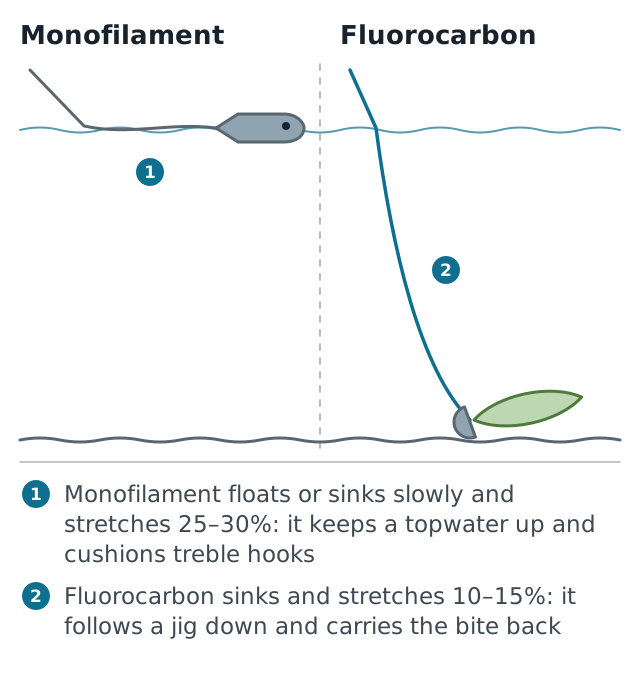
Fluorocarbon wins for baits fished on or near the bottom and in clear water; monofilament wins on the surface and on treble hooks. That is Mike Iaconelli’s rule, and the argument over the two lines never ends because each is right about different techniques. Monofilament is nylon: it stretches, floats, costs little and forgives. Fluorocarbon is polyvinylidene fluoride, a denser polymer that Kureha first spun into fishing line in 1971; it stretches less, sinks, shrugs off rock and is close to invisible in water.
Monofilament stretches 25 to 30 percent, fluorocarbon 10 to 15. That gap is why one is tied to a topwater and the other to a jig.
What you need
- The line hub for the three-way comparison that includes braid, and the braided line page for why braid usually needs a leader of one of these two.
- The monofilament and fluorocarbon pages, the full case for each line with its diameter table.
- A rod whose action suits the line: fast for fluorocarbon and single hooks, moderate for mono and trebles; the rods hub explains.
- The technique you are rigging for. That is the whole decision.
Which line for each bass technique?
The table turns Iaconelli’s rule into a line and a pound test for each technique. The pound tests are the tournament norms from Tactical Bassin and the guides.
| Technique | Winner | Line | Why |
|---|---|---|---|
| Jigs, Texas rigs, football jigs | Fluorocarbon | 15–20 lb | Sinks with the bait, transmits the tap, drives a single hook |
| Drop shot, Neko, wacky, shaky head | Fluorocarbon (or a fluoro leader on braid) | 6–10 lb | Invisibility on a slow bait in clear water; sink rate keeps it vertical |
| Deep and lipless crankbaits | Fluorocarbon | 12–15 lb | Sinking line lets the bait reach its rated depth |
| Squarebill and medium crankbaits | Monofilament | 10–14 lb | Stretch keeps trebles pinned; floating line keeps the bait shallower |
| Wake baits | Monofilament | 15–20 lb | A thick floating line holds the bait on the surface |
| Topwater: walkers, poppers, buzzbaits, frogs | Monofilament (or braid) | 15–20 lb mono, 50–65 lb braid for frogs | Fluoro sinks the nose; mono’s stretch delays the hookset “just enough for the fish to fully eat the bait” (Iaconelli) |
| Spinnerbaits, chatterbaits, swim jigs | Either; fluoro 15–17 lb in clear or deep, mono in shallow stained | 15–17 lb | Vibration baits; visibility matters less |
| Jerkbaits | Fluorocarbon 10–12 lb, or mono 10 lb to keep it higher | 10–12 lb | Fluoro helps a suspending bait hang deeper and still |
| Flukes and floating worms | Monofilament, or braid to a mono leader | 12–17 lb | Keeps the bait up in the column |
| Flipping and bed fishing | Fluorocarbon | 15–20 lb | Impact hooksets and a line the fish cannot see at close range |
| Leader on braid, finesse | Fluorocarbon | 6–10 lb | Invisible last yard; abrasion at the lure |
| Leader on braid, flipping | Monofilament or fluorocarbon | 12–17 lb | Iaconelli and Tactical Bassin’s Matt Allen both run either; fluoro for rock, mono for a softer hookset |
Two rows deserve a number. Shaye Baker at Wired2Fish puts the crankbait case plainly: 12 lb fluorocarbon on a deep diver, against 12 lb mono, “adds multiple feet to the bait’s depth range”. The line sinks instead of bowing up to the surface. The same sink rate is why a jerkbait suspends deeper and stiller on fluorocarbon. The opposite trick works too: 20 lb mono on a squarebill takes away some of its dive, so it cranks through a foot of water where 15 lb fluorocarbon would bury it.
Current is the third case. Iaconelli’s example is a weightless wacky rig thrown upstream. On fluorocarbon it drifts with the flow; on mono the floating line “can act almost like a parachute” and drags the bait.
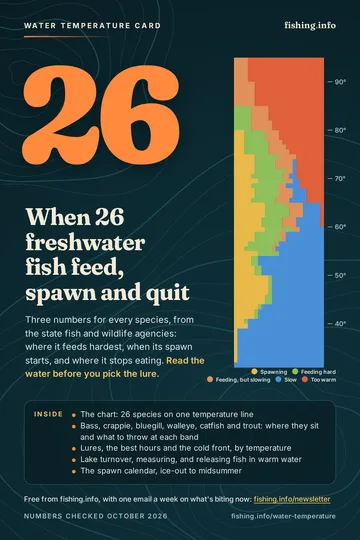
Free card: what 26 species do at your water temperature
Plus one email a week on what's biting now. No sales pitches. Privacy.
Which line for trout, catfish, surf and trolling?
| Fishing | Line | Test | Why |
|---|---|---|---|
| Trout, nymphs on the fly rod | Fluorocarbon tippet | 4X–6X | It sinks and gets the fly down; it survives the rocks of a tight-line drift |
| Trout, dry flies and emergers | Nylon tippet | 4X–6X | Near-neutral and supple, it floats a long leader to a rising fish; fluoro finer than 5X floats too, held by surface tension, until a nymph pulls it under |
| Trout, spinning in clear streams | Fluorocarbon, or a copolymer with a fluorocarbon coat | 4–6 lb | Low visibility to a fish that has seen every spinner; a limp line to cast a 1/16 oz lure |
| Catfish, cut and live bait on circle hooks | Monofilament | 15–30 lb main, heavier leader | A circle hook needs the fish to pull against a soft line; stretch absorbs a blue cat’s weight |
| Surf casting | Monofilament, with a mono shock leader | Matched to the sinker | Cheap by the hundreds of yards, forgiving on a long cast; a shock leader takes the strain of the cast |
| Inshore saltwater, redfish, snook, stripers | Braid to a fluorocarbon leader; mono leader on a surface bait | 20–40 lb leader | Fluoro survives oysters and dock pilings; a floating mono leader keeps a topwater plug up |
| Trolling for stripers, walleye, salmon | Monofilament | 12–20 lb | Stretch absorbs the strike at speed and the surge against a moving boat |
On the fly rod, fluorocarbon’s density only helps once there is weight enough to break the surface. A 6X fluorocarbon tippet under a dry fly sits in the film like nylon; under a bead-head nymph the same tippet sinks and keeps the fly down. The fly fishing for trout page has the tippet chart. The catfish rigs page builds the circle-hook rig that mono’s stretch makes work.
How to choose, step by step
- Name the lure’s zone. Bottom or mid-column: start from fluorocarbon. Surface: start from monofilament. No exceptions for topwater.
- Count the hooks. Trebles want stretch, so mono, or fluorocarbon on a moderate-action rod; single hooks want fluoro’s direct hookset.
- Look at the water. Clear and pressured: fluorocarbon, lighter test. Stained: mono is fine and cheaper. Current: fluorocarbon.
- Check the cover. Rock, shell, docks: fluorocarbon. Grass: either.
- Pick the test from the table, one size heavier around cover and one lighter in clear water.
- Decide where it goes. A whole spool on a baitcaster for bottom baits; a leader on braid for spinning gear; mono backing under either.
- Tie it right. Palomar or improved clinch, wetted, seated slowly; with fluorocarbon, feel the knot slide smooth before the final pull, then test it.
How do the two lines differ?
| Property | Monofilament (nylon) | Fluorocarbon (PVDF) | What it means on the water |
|---|---|---|---|
| Stretch | 25–30% | 10–15% | Mono cushions a hookset on trebles and a surging fish; fluoro transmits a bite and drives a single hook |
| Refractive index (water is 1.33) | 1.62 | 1.42 | Fluorocarbon bends light almost like water and is far harder to see |
| Specific gravity (water is 1.00) | About 1.14; floats or hangs | About 1.76–1.78; sinks | Mono keeps a topwater up; fluoro gets a bait down and keeps line off the surface in wind |
| Sink rate | Seaguar’s demonstration: 12 in (30 cm) in 40 s | 12 in (30 cm) in 15 s | Nearly three times as fast to the bottom |
| Abrasion resistance | Moderate | High; a harder surface | Fluoro around rock, shell and docks |
| Memory | High, worse from 10 lb up | Moderate to high; stiffer | Both coil on a spool; a limp mono or a leader on braid for spinning reels |
| Water absorption | Absorbs; weakens wet | “Absorbs very little water” | Fluoro keeps its strength and stiffness all day |
| UV and aging | Poor; 3–6 months of use | Excellent; 1–2 years | Change mono more often |
| Diameter at 20 lb test | 0.016–0.018 in (0.41–0.46 mm) | 0.015–0.016 in (0.38–0.41 mm) | Nearly the same; braid is the thin one |
| Knot strength, Palomar (TackleTour) | 98% of rated (Trilene XL) | 72–101% of rated, by brand | A dry, rushed fluoro knot is the usual break |
| Price per yard | $0.02–0.03 | $0.05–0.15 | Mono for the whole spool, fluoro as a leader or on a few reels |
By Varivas’ figures, nylon has a specific gravity of about 1.14, fluorocarbon about 1.76 and braid 0.97. A 20 lb mono and a 20 lb fluorocarbon are almost the same thickness. But one is about a seventh heavier than water and the other three quarters heavier, and that is the drawing at the top of the page.
Is fluorocarbon really invisible?
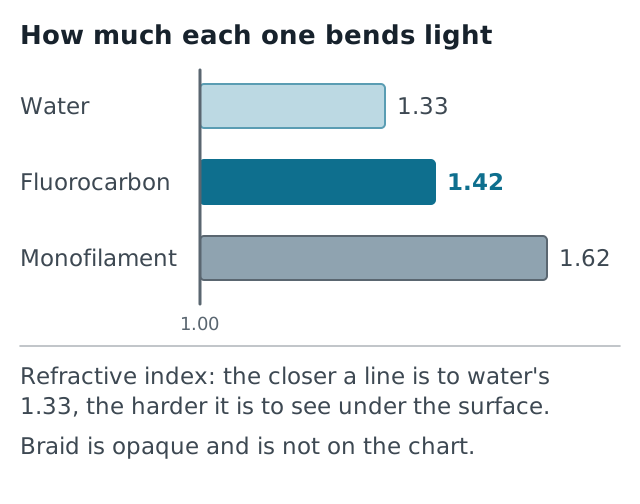
Refractive index of water and the two clear lines. Drawing: fishing.info.
Less visible, not invisible, and Seaguar’s own FAQ says so: “Is 100% fluorocarbon completely invisible under water? No. It is as close as any form of line.” The refractive index is how much a material bends light. The closer a line’s number sits to water’s 1.33, the less light reflects off the boundary between the two. Fluorocarbon at 1.42 is close; nylon at 1.62 is not, which is why Field & Stream describes mono as able to “absorb sunlight and glow underwater”.
That is all the number does. It does not shrink the line’s diameter, and it does not hide the line where it meets air at the surface. It changes nothing in stained water either, where, as Iaconelli puts it, “fish rely less on sight and more on vibration and movement”. Seaguar adds two facts. The refractive index of 100 percent fluorocarbon is a constant, so no brand is less visible than another. And a tinted spool is as hard to see under water as a clear one.
Why do fluorocarbon knots break?
The knot is the one honest complaint about fluorocarbon, and TackleTour measured it. It tied a Palomar in fourteen fluorocarbons, and in 12 lb Berkley Trilene XL as the mono baseline, and pulled each to failure. The mono knot broke at 11.8 lb, 98 percent of its rating. The fluorocarbons ranged from 72 percent of the label (Berkley Vanish Transition, 8.6 lb on 12 lb) to 101 percent (Seaguar InvizX, 10.1 lb on 10 lb). Only five of the fourteen reached 90.
Measured against each line’s actual tested break rather than its label, every line but InvizX fell under 90 percent, the mono included. The Palomar costs a tenth in either material; fluorocarbon simply loses it more often and with less warning.
The rule follows. In mono, the Palomar knot, the improved clinch and the uni knot all hold when simply pulled down. In fluorocarbon, tie the same knots but wet the line and draw the wraps down slowly until the knot slides tight. Then test it with a steady pull, because the harder surface heats and glazes under a fast, dry pull. To join either line to braid, tie the double uni for a quick join or the FG knot for the slimmest; the braid to mono knot page compares them.
Why not braid with a leader of either?
Most anglers who fish finesse rigs on spinning gear no longer choose between a spool of mono and a spool of fluorocarbon. They spool braid and tie on a leader: the thin, no-stretch, long-lasting line on the reel, the line that matters at the lure. A fluorocarbon leader buys invisibility and abrasion resistance in the last 6–10 ft (1.8–3 m). A mono leader buys a softer hookset on trebles and a bait that stays up, at a third of the price. That is why Matt Allen’s stained-water finesse rig is 10 lb braid to a 6–10 lb mono leader. The fishing leader page covers lengths, materials and knots.
Baker’s spooling trick saves the same money on a baitcaster. Fill the spool halfway with mono, join it to the fluorocarbon with a double uni, and finish with fluoro. The reel never casts its bottom half, so a 200 yd spool of fluorocarbon fills two reels.
Which line coils worse on a spinning reel?
The two lines coil for different reasons, and the sources disagree about which is worse. Field & Stream calls fluorocarbon stiffer but less prone to memory, and puts mono’s memory problem at 10 lb and up and in bargain brands. Flylords says fluorocarbon’s hardness makes it the more memory-prone line. Seaguar’s FAQ says fluorocarbon absorbs so little water that it stays “soft and supple” in the cold.
Every source agrees on what to do. On a spinning reel, a full spool of fluorocarbon over about 8 lb jumps off in loops. So finesse anglers run braid to a fluorocarbon leader, or keep straight fluoro to 6–8 lb on a limp line made for spinning gear. On a baitcaster, straight fluorocarbon from 12 to 20 lb is the norm for bottom baits. Spool it wet and under tension, stretch the first few yards by hand before the first cast, and condition both lines in winter. Line memory and the other line words are in the glossary.
What are copolymer and coated lines?
Between the two sit the copolymers and the coated lines, and their labels are worth reading. A copolymer is nylon blended with a second polymer for less stretch and memory than plain mono. It is still nylon: it still floats or hangs, and it still ages in the sun. A “fluorocarbon-coated” line is a copolymer core with a thin fluorocarbon skin. P-Line’s Floroclear is the type, built to cast like mono and reflect less light than nylon. TackleTour found it as limp and accurate on 4 lb trout gear as a pure mono, at an MSRP of $7.29–9.99 for 300 yd.
A coated line has neither fluorocarbon’s density nor its abrasion resistance. Only a line labeled 100 percent fluorocarbon carries fluorocarbon’s refractive index all the way through. Buy a coated copolymer for a clear-water spinning reel where handling matters more than sink rate; buy the real thing for a jig.
What it costs per season
The shelf price exaggerates the gap, because fluorocarbon lasts three or four times as long on the spool. By The Tackle Room’s schedule, hard-fished mono lasts three to six months and fluorocarbon one to two years. That turns current prices into a yearly cost per reel.
| Line | Spool | Price | Per yard | Per reel, per year |
|---|---|---|---|---|
| Berkley Trilene XL (mono) | 330 yd | $6–12 | 2–3 cents | $12–36 at two or three fills |
| Seaguar Basix (budget fluorocarbon) | 200 yd | $10.99 | 5.5 cents | $11, one fill |
| Berkley Trilene 100% Fluorocarbon | 200 yd | From $12.99 (smallest spool) | 6.5 cents | $13, one fill |
| Seaguar InvizX (premium fluorocarbon) | 200 yd | $29.99 | 15 cents | $15–30, one fill a year or every two |
Prices are retailer listings from October 2026 and move with sales; the per-yard column is the one to compare. Mono backing under fluorocarbon, or braid with a fluorocarbon leader, halves the fluorocarbon figure again. Respool mono at the end of a season, and sooner on a boat in the sun. Respool fluorocarbon when the first 20 ft (6 m) feel rough or the knot starts breaking, and both lines after a fish that ran them over rock.
Mistakes to avoid
- Fluorocarbon on a topwater. In Matt Allen’s words, it “will drive you insane”: the line sinks and drags the nose under. A fluorocarbon leader under a popper does the same in miniature.
- Dry knots in fluorocarbon. The heat of a fast pull weakens it; wet it and go slow. TackleTour’s worst line broke at 72 percent of its label at the knot.
- Old monofilament. Nylon weakens in sunlight and absorbs water; a spool that sat in the truck all summer is not 12 lb test any more.
- Heavy fluorocarbon on a spinning reel. Over 8 lb it stiffens and coils; drop to a lighter test or run braid to a short fluoro leader.
- Buying “fluorocarbon-coated” mono as fluorocarbon. It is nylon with a coating and has nylon’s buoyancy and abrasion resistance.
- Expecting invisibility in dirty water. Stained-water fish find the lure by vibration; put the money into the lure, not the line.
When does braid beat both?
Braid wins for frogs, punching, flipping heavy cover and every finesse rig on spinning gear, where its zero stretch and thin diameter beat both. It is the third column of the line hub table, and the braided line page explains the leader that brings mono or fluorocarbon back into the rig.
The rigs hub sets out which rig wants which line, and the best fishing line for bass page turns all three lines into one setup per technique.
Free download
The water temperature card
Read your water temperature and the card tells you who is spawning, who is feeding and what to throw. 26 species, 16 pages, for your phone and the tackle box.
Plus one email a week on what's biting now. No sales pitches. Privacy.
Related
Section guide
Fishing Line: Monofilament, Fluorocarbon and Braid ComparedThe three kinds of fishing line compared on stretch, visibility, diameter, sink rate and life, which line each technique wants, and why braid needs a leader.
 Monofilament Fishing Line: What It Is Good For, and Where It Loses
Monofilament fishing line stretches, floats, ties easily and costs a cent a yard. Where that wins, topwater, trolling, bait and beginners, and where it loses.
- Fluorocarbon Fishing Line: What It Does, and When Not to Use It
Fluorocarbon fishing line sinks, stretches less than mono and is nearly invisible under water. Where it wins, where it loses, and how to tie it so it holds.
 Best Braided Fishing Line: The Reviewers' Picks Compared
The best braided fishing line: eight braids compared on carriers, diameter and price per yard, with picks for flipping, finesse, inshore, surf, catfish and ice.
 Braided Fishing Line: Strength, Diameter, Pros and Cons Explained
Braided fishing line explained: what it is made of, the pound-test and diameter table against mono, why it needs a leader and backing, and when not to use it.
Sources
- Seaguar, Understanding fluorocarbon (FAQ: refractive indices, stretch, water absorption, UV, 1971)
- The Tackle Room, Mono vs fluorocarbon vs braid (stretch, abrasion, spool life, price per yard)
- Mike Iaconelli, Fluorocarbon vs monofilament: when each fishing line wins
- Tactical Bassin (Matt Allen), Best fishing line: braid, mono or fluorocarbon
- Tackle Village, Fishing line diameter chart (measured diameters by pound test)
- Wired2Fish (Shaye Baker), Fluorocarbon vs monofilament fishing lines (crankbait depth, backing, spinning gear)
- Field & Stream (Joe Cermele), Monofilament vs fluorocarbon fishing line (history, memory, price)
- TackleTour, Fluorocarbon showdown: knot strength against rated and tested strength, Palomar, 14 lines
- Varivas, How to select fishing line (specific gravity of nylon, fluorocarbon and PE; refractive index)
- Flylords (Matteo Moretti), Monofilament vs fluorocarbon tippet and leader (nymphs, dry flies, surface tension)
- TackleTour, P-Line Floroclear review (copolymer core, fluorocarbon coating, MSRP)
- Omnia Fishing, Seaguar Basix 200 yd (price)
- Omnia Fishing, Seaguar InvizX 200 yd (price)
- Berkley, Trilene line range (Trilene XL and Trilene 100% Fluorocarbon price ranges)