 By
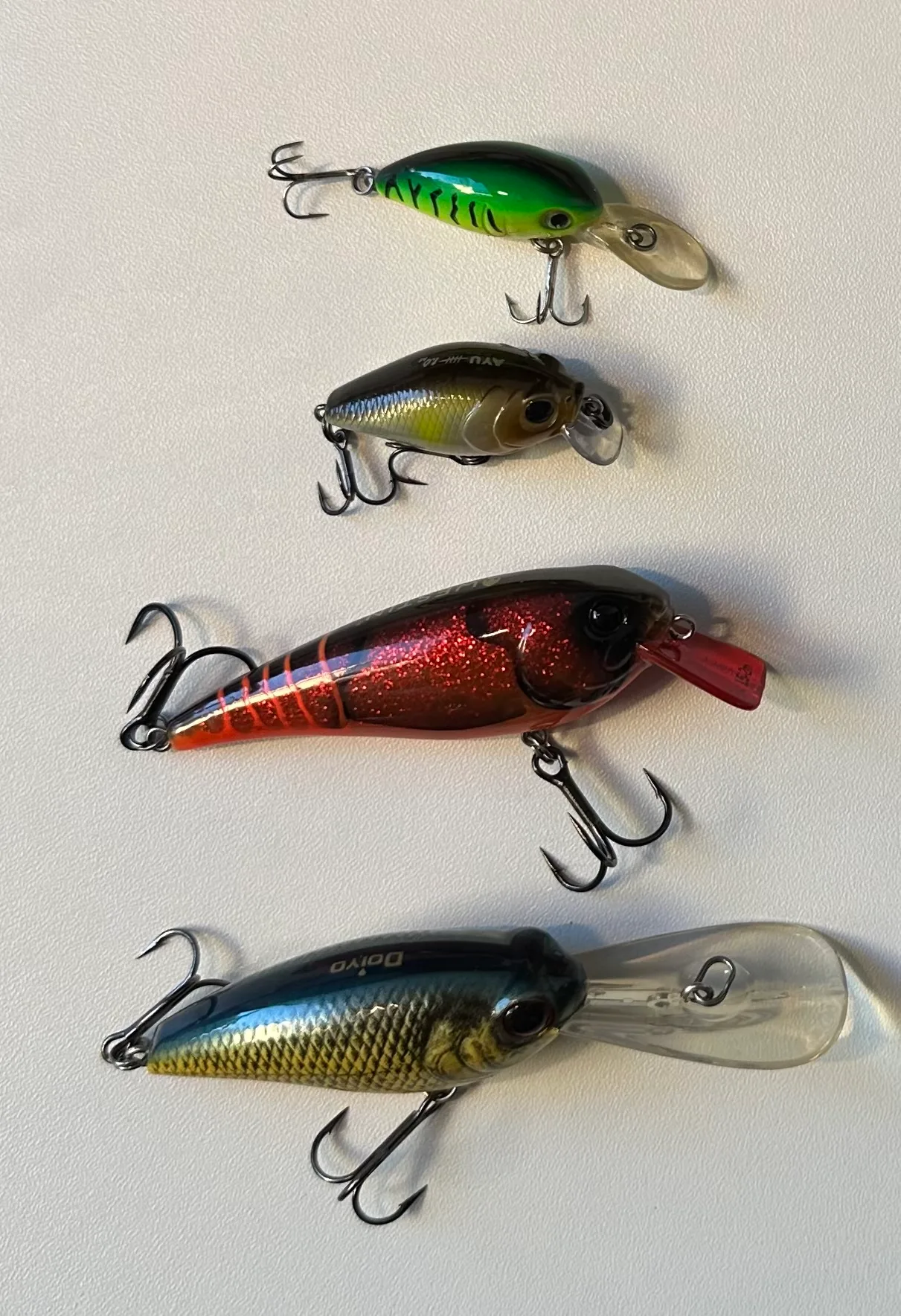
A treble hook is three hook points on one shank, joined at the eye, and it hangs from almost every hard lure sold: crankbaits, jerkbaits, lipless baits, topwater walkers and poppers, spoons and inline spinners. Some anglers say triple hook; the makers’ packets say treble. Fish strike lures without swallowing them, and three points facing three ways catch a fish that only slaps at the bait. The cost: a treble tears out more easily than one hook buried in the jaw, and it hooks the net, the angler and the fish’s eye. On some trout and salmon waters it is illegal.
Rapala hangs #8 trebles on a 2 in (5 cm) Shad Rap and 5/0 trebles on a 7 in (18 cm) X-Rap Magnum. Same scale, same maker, twelve sizes apart.
Treble hook size chart
Mustad makes its classic treble from #20 to 20/0, but the charts for lure fishing run from #14 to 5/0. Trebles use the same scale as single hooks: numbered sizes get bigger as the number falls, then the aught sizes climb from 1/0. The gap is the distance between the shank and the point.
| Size | Gap | Length | Ships on or used for |
|---|---|---|---|
| #14 | 0.15 in (3.8 mm) | 0.45 in (11.4 mm) | bluegill, crappie |
| #12 | 0.15 in (3.8 mm) | 0.5 in (12.7 mm) | crappie, perch, trout |
| #10 | 0.2 in (5.1 mm) | 0.55 in (14 mm) | 2.5 in Husky Jerk |
| #8 | 0.2 in (5.1 mm) | 0.59 in (15 mm) | 2 in Shad Rap, small spoons |
| #6 | 0.27 in (6.8 mm) | 0.79 in (20 mm) | 4 in Husky Jerk, trout lures |
| #4 | 0.31 in (8 mm) | 0.94 in (24 mm) | 5 in Super Spook, bass crankbaits |
| #2 | 0.37 in (9.5 mm) | 1.10 in (28 mm) | 4.4 in X-Rap Magnum, larger crankbaits |
| #1 | 0.41 in (10.3 mm) | 1.18 in (30 mm) | spoons, mid-size plugs |
| 1/0 | 0.45 in (11.5 mm) | 1.30 in (33 mm) | saltwater plugs, diamond jigs |
| 2/0 | 0.50 in (12.7 mm) | 1.42 in (36 mm) | trolling lures, large spoons |
| 3/0 | 0.55 in (14 mm) | 1.54 in (39 mm) | 5.5 in Super Shad Rap, kingfish rigs |
| 4/0 | 0.59 in (15 mm) | 1.69 in (43 mm) | heavy trolling, tuna poppers |
| 5/0 | 0.64 in (16.3 mm) | 1.85 in (47 mm) | 7 in X-Rap Magnum, giant plugs |
From #6 up, the gap and length are Mustad’s own figures for its classic 3551 treble. Mustad publishes none below #6, so the small sizes come from Tackle Village’s measured chart. The lures are the makers’ spec sheets; the uses are The Tackle Room’s.
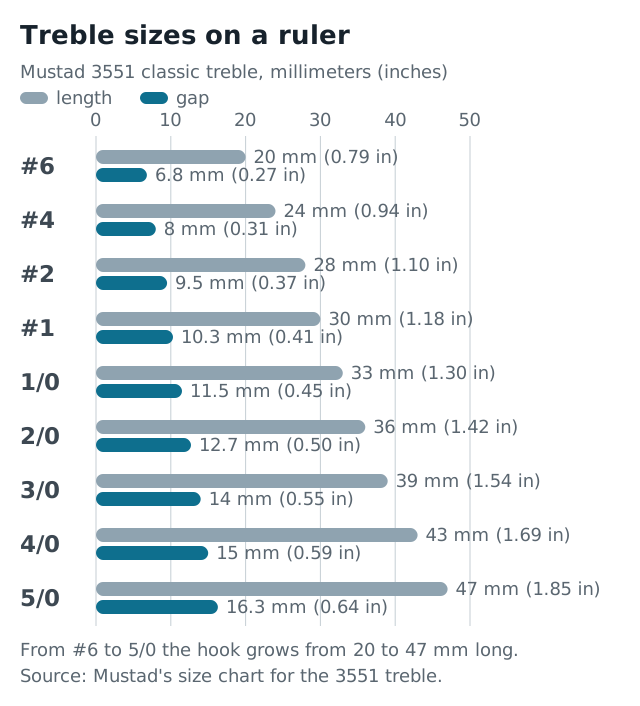
Read the number on the packet before you trust a ruler: the same size differs by maker. Mustad’s KVD Triple Grip #4 has an 8.8 mm gap on an 18.5 mm shank, against 8 mm on 24 mm for its classic #4. The tackle-shop guides run larger still. The Tackle Room puts 1/0 at 9/16 in (14 mm), where Mustad’s classic 1/0 measures 11.5 mm. Where a regulation names a gap, measure the hook itself; the hook size chart shows how, and covers the single-hook scale.
What size treble for each fish?
Tackle Village’s ranges by fish, the smallest sizes for panfish and the biggest for largemouth:
| Fish | Treble size |
|---|---|
| Bluegill | #14 |
| Crappie | #14–#12 |
| Yellow perch | #12–#10 |
| Trout | #12–#8 |
| Smallmouth bass, walleye | #10–#6 |
| Salmon, steelhead | #8–#4 |
| Northern pike | #8–#1 |
| Musky | #6–#2 |
| Catfish | #6–#1 |
| Largemouth bass | #4–1/0 |
For trout that means #12 to #8, though The Tackle Room puts #6 on trout lures. The makers rig bigger for big predators: Rapala’s 5.5 in Super Shad Rap carries 3/0 trebles for pike and musky, three sizes above the top of Tackle Village’s pike range.
What size treble does your lure take?
Usually the size its maker hung on it: #8 on a 2 in Shad Rap, #4 on a 5 in Super Spook, 5/0 on a 7 in X-Rap Magnum. The table reads Rapala’s and Heddon’s own spec sheets.
| Size | Ships on | Lure length and weight |
|---|---|---|
| #10 | Husky Jerk HJ06 | 2.5 in (6.4 cm), 1/8 oz |
| #8 | Shad Rap SR04 and SR05 | 1.5–2 in (4–5 cm), 1/8–3/16 oz |
| #6 | Shad Rap SR07, Husky Jerk HJ08 and HJ10, Skitter Pop SP05 | 2–4 in (5–10 cm), 3/16–3/8 oz |
| #4 (#3 at Rapala) | Shad Rap SR08 and SR09 (#3), Husky Jerk HJ14, Heddon Super Spook, Rippin’ Rap RPR07 (one of its two) | 2.75–5.5 in (7–14 cm), 3/8–7/8 oz |
| #2 | X-Rap Magnum XRMAG10 | 4.4 in (11 cm), 3/4 oz |
| 1/0 | X-Rap Magnum XRMAG15 | 4.75 in (12 cm), 1 1/8 oz |
| 2/0 | X-Rap Magnum XRMAG20 | 5.5 in (14 cm), 1 5/8 oz |
| 3/0 | Super Shad Rap SSR14 (pike, musky) | 5.5 in (14 cm), 1 5/8 oz |
| 4/0, 5/0 | X-Rap Magnum XRMAG30 and XRMAG40 | 6.25–7 in (16–18 cm), 2.5–3 3/8 oz |
The makers run a size smaller than the tackle-shop guides. The Tackle Room calls #4 the bass-crankbait size and #2 the topwater size, yet Rapala’s 4 in jerkbait wears #6 and Heddon’s 5 in Super Spook wears #4. Pokey’s chart, #8–#4 for medium crankbaits and topwater plugs, sits closer to the spec sheets. The guides describe what anglers upgrade to; the spec sheets describe the box.
A lipless bait often carries two sizes so the hooks cannot reach each other: the 2.75 in Rippin’ Rap ships #4 and #6. Rapala also uses a #3, between the usual #4 and #2, on the Shad Rap SR08 and SR09, so check the old hook before you buy replacements.
Wire follows water. The Tackle Room’s rule is 1X standard wire for bass, trout and walleye, 2X for inshore stripers, redfish and snook, 3X and up offshore. Rapala builds the X-Rap Magnum with 4X hooks on 3X split rings for that reason.
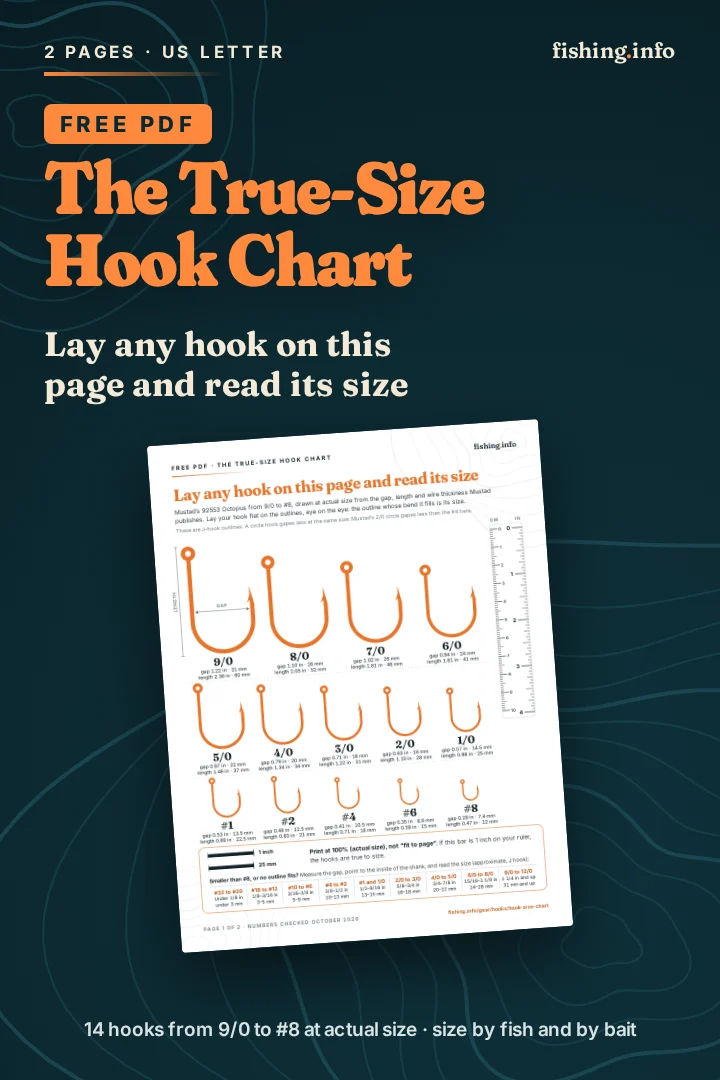
Free PDF · Hook size chart What size is that hook? Lay it on the chart.
Print the free chart, lay any hook on it and read its size: 14 hooks from 9/0 to #8 at actual size, and the size for 17 fish and 16 baits on the back.
Enter your email, confirm it with one click, and the PDF is in your inbox. Plus one email a week on what's biting. Unsubscribe anytime. Privacy.
Round bend, short shank, 2X: what do the names mean?
Every replacement treble is described by its bend, its shank and its wire.
| Hook | Bend and shank | Wire | Sizes | Built for |
|---|---|---|---|---|
| Owner ST-36 | round bend, wide gap, standard shank | standard | #20 to 3/0 | crankbaits, jerkbaits, topwaters; stinger on bait rigs |
| Gamakatsu 2X Round Bend | round bend, standard shank | 2X | #4 to 1/0 | heavier bass and pike lures |
| Mustad KVD Triple Grip TG76 | elbow bend, points angled in, 2X short shank | 1X | #8 to 3/0 | upsizing a crankbait without tangles |
| Owner ST-66 | short shank | 4X, vacuum tinned | #4 to 4/0 | saltwater plugs, musky, stripers, tuna |
| VMC 8651DT Dressed | round bend, short shank, feather and mylar tail | 1X | #6, #4, #2 | rear hook of topwaters and jerkbaits |
Round bend or EWG. Bassmaster Elite pro John Crews says “round bend trebles have more penetration, so they are better when the bass’ mouth is a little harder, as is the case in colder water.” In warm water, he says, an extra wide gap hook has “so much holding power but don’t penetrate like round bends.” Brent Ehrler puts round bends on topwaters and jerkbaits: “when fish nip at it, they hang themselves.” Mustad’s Triple Grip is the holding bend taken further.
Short shank. Western pro Ken Mah: “I like short shank treble hooks because they allow me to upsize my crankbait hooks without them catching one another by swinging together.” Mustad’s numbers show why: its 2X short #4 is 5.5 mm shorter than the classic #4, with a slightly wider gap.
Inline. On a standard treble the eye is bent at a right angle to one point; on an inline treble the eye lines up with one point. The Tackle Room’s case for them: the point facing the fish lines up with the pull, fewer fish throw the hook, and the hook hangs more naturally from the split ring. They cost a little more.
1X to 4X. The X rating says how far the wire departs from the maker’s standard: 2X strong is wire two sizes heavier for the same hook size. It bends less and weighs more, which matters on suspending baits. The singles that replace a treble are on the types of hooks page, and the hooks hub covers every other hook type.
When should you change a treble?
As soon as a point stops catching on your thumbnail, and in five other cases.
- The points are dull. Run a point across a thumbnail; if it slides rather than catches, sharpen it with a file or replace the hook. Ehrler on stock hooks: “price-point related, semi-sharp fish losers.”
- A point is opened or bent. The Tackle Room’s rule: a point bent even slightly will not penetrate cleanly. Replace the hook rather than bend it back.
- Rust. Replace at the first rust, not the first failure: surface rust weakens the metal and dulls the point, and saltwater eats hooks fast. Rinse saltwater lures after every trip and buy a saltwater finish: Owner’s ST-66 is vacuum tinned, and the X-Rap Magnum ships with VMC’s Perma Steel.
- Upsizing for short-strikers. Texas pro Phil Marks goes “at least one, if not two sizes larger” on his crankbaits for a bigger bite, the distance from point to bend. He uses 2X wire so the hook does not flex. The Tackle Room’s limit: one size rarely hurts the action, two can throw the balance. Go up with a short-shank hook, or on the front hook only.
- Suspending jerkbaits. Hook weight sets the sink rate: a heavier treble makes a suspending bait sink slowly, a lighter one makes it rise. Anglers tune jerkbaits this way on purpose. Crews tests any altered bait “in a pool, or in clear lake water.” The Tackle Room’s sign: a bait that rolls or tracks to one side has hooks that are too heavy.
- Regulations. Where a single hook is required, replace the trebles with inline singles of about the same weight, or clip two points. Where barbless is required, pinch all three barbs.
Keep the same size and wire unless you mean to change the action, and check that the hooks cannot touch when the bait hangs still.
Is the split ring strong enough?
Not always: the ring is the weak link few anglers think about. SPRO publishes the numbers for its stainless Power split rings:
- Size 2 holds 32 lb (14.5 kg), on a 0.15 in (3.8 mm) inside diameter.
- Size 4 holds 60 lb (27 kg).
- Size 6 holds 150 lb (68 kg).
- Size 8 holds 255 lb (116 kg).
Rapala’s 3X rings on the X-Rap Magnum exist because a 4X hook on a 1X ring is a 1X connection. Marks runs rings smaller than stock to keep the hooks close to the body and out of each other’s way.
Change hooks with split-ring pliers, the ones with a small tooth on one jaw. A ring opened wide once does not close flat again, so replace it with the hook. The pliers are on the accessories page.
What does a feathered treble add?
A “breathing” action on the pause and a little drag on the strike: feathers and a few strands of mylar on the shank, at the back of a topwater or a jerkbait. Topwater pro Zell Rowland says the feather gives a popper a “breathing” action, flaring on the pause and closing on the pull. Scott Suggs likes the drag: a bass that pushes a topwater aside on the strike sometimes gets it anyway when the feather slows the bait. VMC’s 8651DT comes in #6, #4 and #2, and Rapala ships one on the Skitter Pop. The topwater page says where popper and walker each win.
Can you fish bait on a treble?
Yes, though some waters forbid it. Channel catfish anglers hang cut bait or punch bait on a treble, #6 to #1 by Tackle Village’s chart, because three points hold a paste that slides off a single. Trout anglers in some states fish a salmon egg on a tiny treble.
Some saltwater rules forbid exactly this. Florida forbids “the use of a multiple hook in conjunction with live or dead natural bait” for tarpon, with the same line in its snook and tripletail rules. A treble is a multiple hook under FWC rule, so a live pinfish goes on a single or a circle hook, never a treble.
The catfish lures page is where a treble ends up with cut bait on it. Never put a live baitfish on one for a fish you mean to release: the fish swallows it, and three points go where you cannot reach.
Does a treble hook count as one hook?
Under a hook limit, usually yes; under a single-hook rule, no. A rule that caps how many hooks you fish counts the treble by its one shank. A rule that asks for a single hook counts its points.
| State | What the rule says | A treble counts as |
|---|---|---|
| Minnesota | “hook” means “a single hook or multiple hook, such as a treble hook”; up to three on a line | one hook |
| Michigan | “a hook, single, double, or treble pointed, attached to a manufactured artificial bait is counted as 1 hook” | one hook |
| New York | “15 hook points in any combination of single, double or treble hooks” | three points |
| Alaska | a single hook has “only one point”; a multiple hook has “two or more points” | never a single hook |
| Virginia | “a treble hook with two hook points removed is considered a ‘singlepoint hook’” | a single, once clipped |
Alaska’s multiple-hook definition names the lures that carry them: “plugs, spoons, spinners.” Where an Alaskan water’s rule reads “only one unbaited, single-hook, artificial fly or lure,” the trebles come off before the first cast. On a Virginia artificial-lure trout stream, cutting two points off is enough. So a treble is one hook when the regulation counts hooks and three when it counts points, and never a single hook until two points are gone.
Are treble hooks illegal anywhere?
No state bans treble hooks outright. What exists are single-hook and artificial-only waters: mostly trout streams, salmon and steelhead rivers and catch-and-release sections, where the regulation reads “single hook” or “single barbless hook.” Read the special regulations for the water. A siwash or an inline single of the same weight keeps the bait running true, and in Virginia a clipped treble counts too.
What some states do outlaw is snagging, hooking a fish anywhere but the mouth, and the weighted treble made for it. Pennsylvania makes it unlawful even “to possess a snagging hook while in the act of fishing.” Its code names “a hook with other than a single barb which is weighted on the shank at any point below the eye of the hook and above the barbs thereof.” A treble with lead on its shank is exactly that.
Many release-minded anglers swap anyway. Hühn and Arlinghaus’s 2011 meta-analysis of 107 freshwater hooking studies put mean hooking mortality at 15.9 percent (median 7.8). It found mortality significantly higher on barbed hooks and on natural bait. On lures the gap is smaller, because a lure-caught fish is mouth-hooked either way. One point in the jaw still beats three in the face, and the barbless hooks and catch and release pages carry the rest of the numbers.
How do you get a treble out of a fish, or out of you?
The fish. Long-nosed pliers, the fish in the water or on a wet surface, the lure held so the free points cannot swing into you. Back each point out the way it went in. A point through the gill arch or the eye is cut with side cutters, not torn out. A replacement treble costs a dollar or two.
You. Physicians Matthew Gammons and Edward Jackson laid out the field method in American Family Physician. First cut or tape the two points that are not in you, and take the lure off the hook. If the barb has not gone under, back the hook out. If it has, the string-yank method works without a doctor for small and medium hooks in a fixed part of the body, not an earlobe. Loop line around the bend, press the eye and shank flat against the skin, and jerk the line hard and fast, parallel to the shank. The hook comes out fast, so keep every face out of its line of flight. For a point just under the skin, a doctor numbs the spot with a local anesthetic, pushes the point through, cuts it off and backs the rest out. Anything near an eye goes to a doctor, and check when your tetanus shot was.
What mistakes should you avoid?
- Two sizes up on both hooks of a lipped crankbait. The bait rolls and the hooks lock together. One size, one hook, short shank.
- A 4X hook on the stock ring. The ring opens before the hook bends.
- Trusting the box. Thumbnail test every new bait.
- Live bait on a treble for release. Single or circle hook, every time.
- Pinching one barb for barbless water. Barbless means all three points; a warden counts points, not hooks.
Free PDF · 2 pages
Lay any hook on this page and read its size
The True-Size Hook Chart. Print it at actual size and lay a hook on the outlines: the one its bend fills is its size. One sheet, front and back, for the tackle box.
- 14 hooks from 9/0 to #8 at true size, each with its gap and length in inches and millimeters
- The size for 17 fish and 16 baits, from bluegill (#8 to #12) to tuna (7/0 to 10/0)
- The aught rule in two sentences: why a #6 is smaller than a #4, but a 2/0 is bigger than a 1/0
- Why a 2/0 is not always a 2/0: a circle hook runs one or two sizes bigger than the J hook it replaces
Every hook drawn from Mustad's published gap, length and wire diameter; every size from the 25 sources on the page, Maryland DNR and Idaho Fish and Game among them.
Enter your email, confirm it with one click, and the PDF is in your inbox. Plus one email a week on what's biting. Unsubscribe anytime. Privacy.
Related
Section guide
Fishing Hooks: How to Choose the Right Hook, Set It and Sharpen ItHow to choose fishing hooks: fit the gap to the bait and the mouth, the hooks to buy first, wire and finish, when to set or reel, sharpening and hook laws.
 J Hook for Fishing: What It Is, the Main Patterns, and Sizes by Fish
A J hook is the classic J-shaped fishing hook: point parallel to the shank, set the moment a fish bites. Its patterns, sizes by fish, and where it is banned.
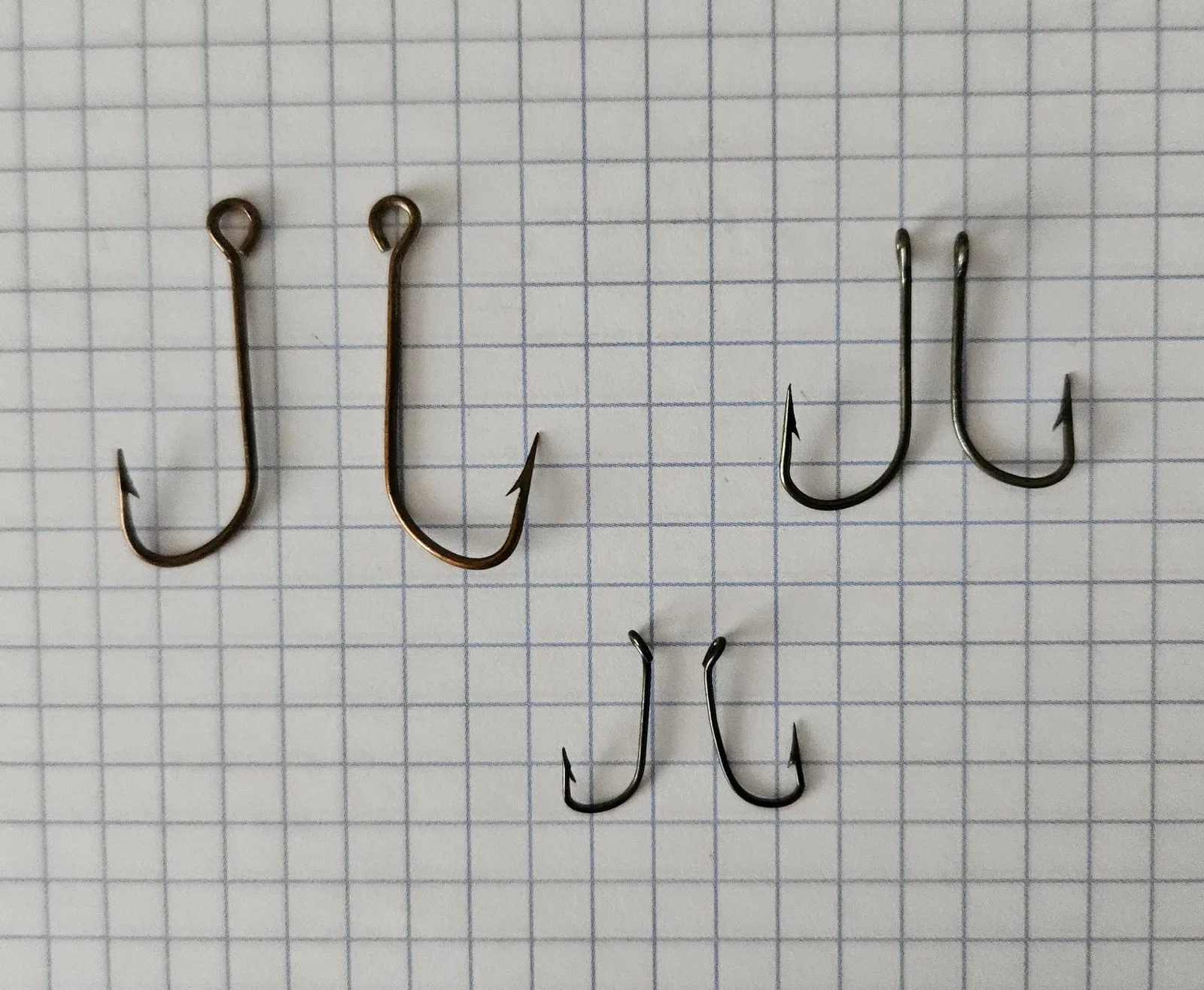 Types of Hooks: The Ten Fishing Hook Styles and What Each One Is For
Ten types of fishing hooks, drawn and explained: J, circle, octopus, Aberdeen, Kahle, siwash, worm, jig, drop-shot and treble, and what each is for.
 Circle Hooks: How They Work, Circle vs J Hook, Sizes, and the Law
A circle hook turns its point back toward the shank and sets itself in the jaw of a fish as you reel. How it works, circle vs J hook, a size chart, the law.
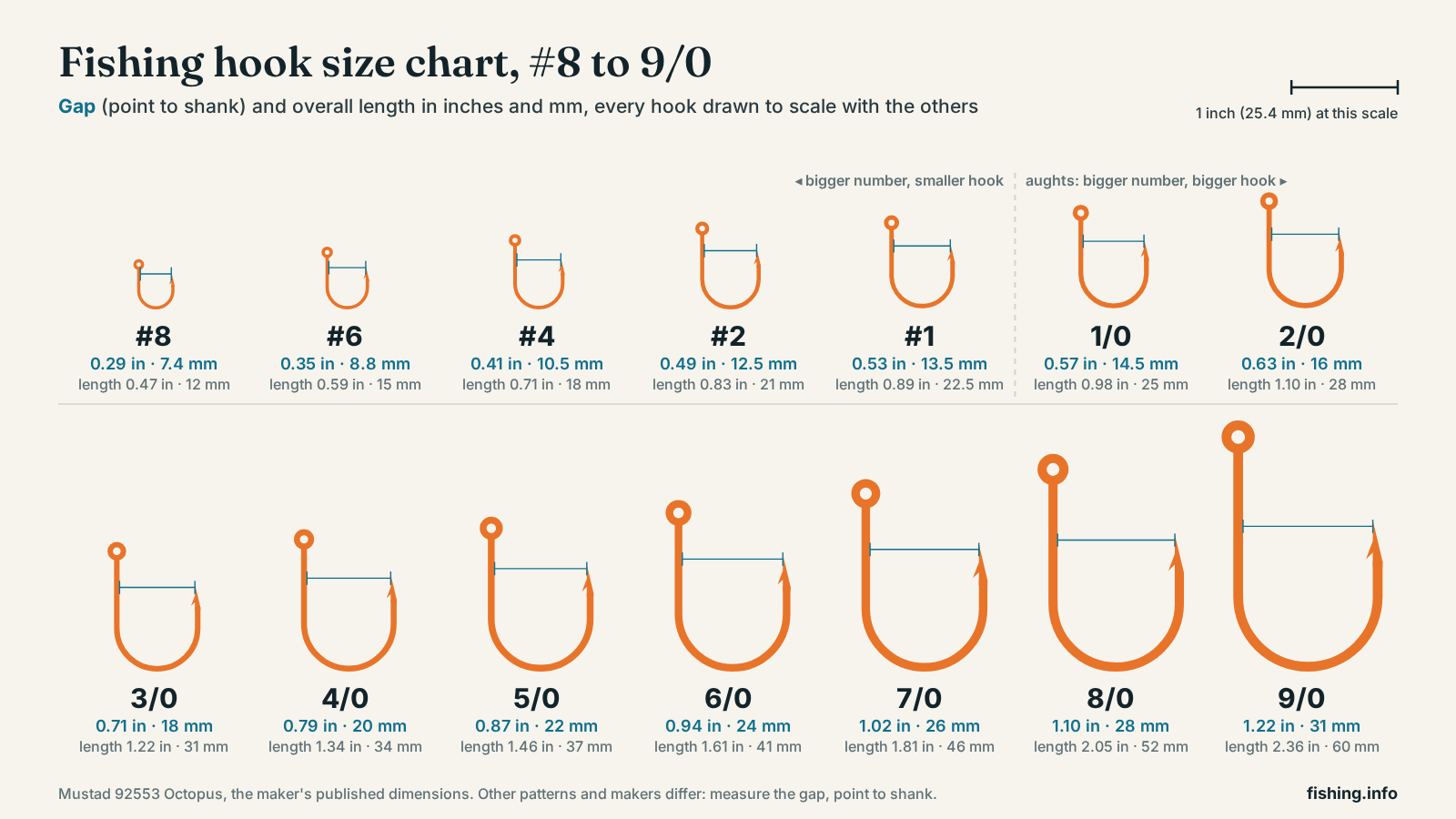 Fishing Hook Size Chart and Guide: Actual Sizes, by Species
Fishing hook size chart and guide: #8 to 9/0 measured in inches and mm, why a #4 is bigger than a #6, an Aberdeen chart, and sizes by species and bait.
Sources
- Rapala, Shad Rap specifications (hook size by model)
- Rapala, Husky Jerk specifications (hook size by model)
- Rapala, Rippin' Rap specifications
- Rapala, Skitter Pop specifications
- Rapala, Super Shad Rap specifications
- Rapala, X-Rap Magnum specifications (4X hooks, 3X split rings)
- Lurenet (PRADCO), Heddon Super Spook specifications
- Mustad, Treble Hook - Bronze (3551-BR): size chart with gap, length and wire diameter
- Mustad, KVD Elite Triple Grip Treble Hook - 2X Short (TG76NP): size chart
- Tackle Village (Rick Wallace), Treble Hook Size Chart: Dimensions and Types Explained
- The Tackle Room, Treble Hook Sizes & Guide: How to Choose the Right Treble
- Pokey's, treble hook size chart
- Wired2Fish, David A. Brown, 4 reasons to change your treble hooks (Ehrler, Marks, Crews, Mah, Rowland, Suggs)
- FishUSA, Owner ST-36 treble hooks (sizes and description)
- FishUSA, Owner ST-66 treble hooks (4X, vacuum tinned)
- Tackle Warehouse, Gamakatsu 2X Strong Round Bend treble hooks
- Discount Tackle, Mustad TG76 KVD Elite Triple Grip treble, 2X short, 1X strong
- Rapala, VMC 8651DT Dressed X-Rap treble
- Discount Tackle, SPRO Power split rings (size chart)
- Alaska Department of Fish and Game, 2026 Southwest sport fishing regulations, tackle definitions
- New York DEC, general freshwater fishing regulations
- Virginia Department of Wildlife Resources, artificial lure trout waters (treble with two points removed)
- Michigan Compiled Laws 324.48703, hooks per line
- Minnesota Rules 6262.0100, subpart 6, angling tackle (hook definition)
- 58 Pa. Code § 63.9, Snatch fishing, foul hooking and snag fishing (Cornell LII)
- Florida FWC, tarpon FAQs (multiple hooks with natural bait)
- Fishingfather, are treble hooks illegal, all 50 states
- Gammons, M. and Jackson, E. (2001), Fishhook Removal, American Family Physician 63(11):2231-2237
- Hühn & Arlinghaus 2011, determinants of hooking mortality in freshwater recreational fisheries