 By
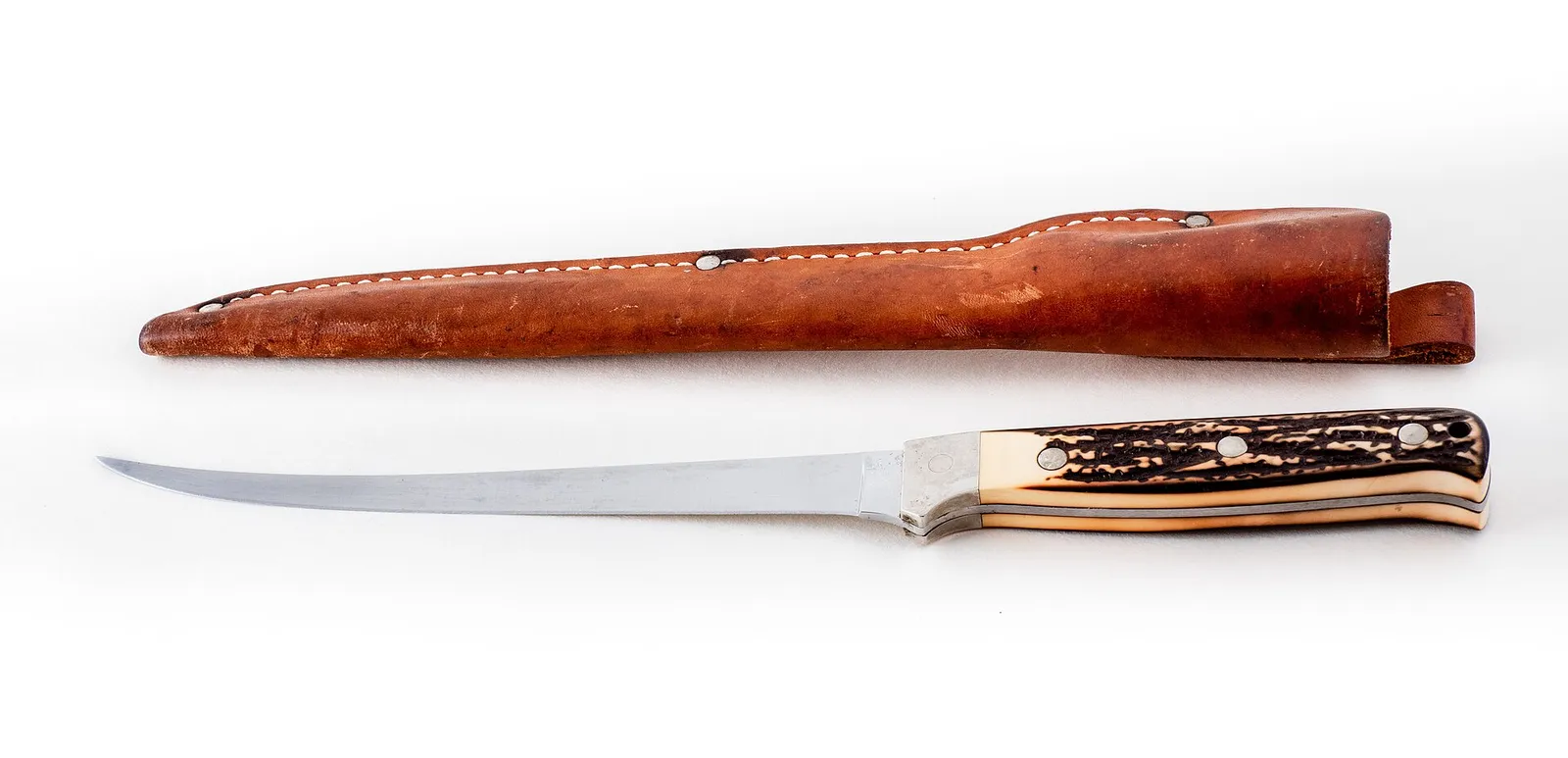
A fillet knife is a thin, flexible knife that lifts the meat off a fish’s bones and then off its skin. The right one is mostly a question of blade length: 4 to 6 in (10 to 15 cm) for panfish and trout, 7 in (18 cm) for most inshore fish, 9 in (23 cm) for big saltwater fish. For most anglers who keep a few fish, a 7 in flexible blade with a grippy handle and a drained sheath is enough, at $14 to $50.
Danco Sports’ sizing rule fits on a thumbnail: 4 to 6 in for panfish, trout and small bass, 7 in for redfish, seatrout and snapper, 9 in for mahi, kingfish and grouper.
Which fillet knife for which fish?
Length and flex decide it, and the fish tells you both. Danco Sports, a pliers and knife maker, sorts its range by the fish on the cleaning table, and its guide is the simplest version of the rule.
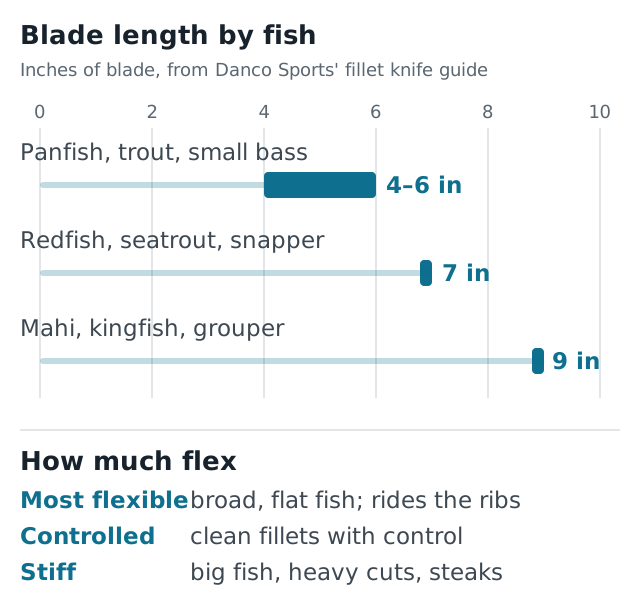
Chart: fishing.info, from Danco Sports’ fillet knife guide.
Panfish and trout: 4 to 6 in. Field & Stream’s tester cleaned bluegill with a 4.35 in pocketknife and found it right for fish of 8 to 10 in, and for perch and crappie too. Perch, bluegill, crappie and stream trout all sit in that range.
Bass and inshore fish: 7 in. Field & Stream calls the 7 in blade of the Bubba Tapered Flex “the perfect do-it-all length and flex for breaking down most fish.” If you buy one knife for bass, walleye and the odd redfish, buy this length.
Big saltwater fish: 9 in. Danco puts mahi, kingfish and grouper here, and its stiffest 9 in blades are the ones it sells for heavy cuts and steaks.
Pike: the bones decide. The Y-bones of a pike are cut around, not through. The five-fillet method, step by step, is on the page are northern pike good to eat.
7 or 9 in? A 7 in, unless your fish are the size of a mahi, a kingfish or a grouper, the fish Danco puts on its 9 in blades.
Do you need a fillet knife at all? Not for small fish: Field & Stream’s tester cleans bluegill with a 4.35 in Case pocketknife. For bigger fish, a fillet blade is built to follow the backbone and ride over the ribs, as Danco’s flex grades below show.
What do the professionals use? Field & Stream says it has “encountered plenty of professional guides” who use Bubba fillet knives every day. Outdoor Life’s saltwater test used Captain Doug Chason, a guide in Apalachicola, Florida, and Wade Patterson, a professional fish cleaner there. Both liked the grip of the Gerber Controller 8, and Chason said it left a smoother cut on big snapper than its rivals.
Flexible or stiff?
Danco sorts its knives three ways. A very flexible blade bends to follow the backbone and ride over the rib bones on broad, flat fish. A controlled-flex blade gives enough to fillet cleanly while you keep control. A stiff blade is for big fish, heavy cuts and steaks.
The testers split along the same line. Outdoor Life picked the Kershaw 7.5 in Narrow Fillet for a livewell of crappie or a stringer of trout, and listed “a bit too much flex for really large fish” as its weakness. Scott Einsmann, the magazine’s gear editor, writes that he does not like a fillet knife that is too flexible. For a mixed bag, the middle setting is the safe choice.
A boning knife is the stiffer cousin. Field & Stream found the Shun Classic Boning & Fillet “shorter and stiffer than most standard fillet knives”, with more control on fine cuts and on large-boned fish.
A folding fillet knife saves space in a tackle bag. KastKing’s folding fillet has a 6.5 in G4116 blade, is 13.5 in long open, folds to 7.5 in and costs $25.99. Outdoor Life’s one complaint about the Gerber Controller 6 folder is worth knowing before you buy any folder: its handle can get packed with scales and slime during a cleaning session.
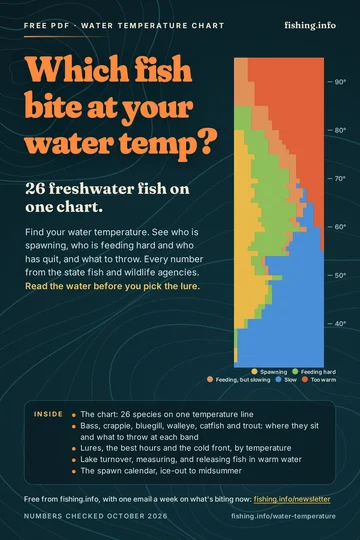
Free PDF · Water temperature chart Which fish are biting at today's water temperature?
One water temperature reading, and the 16-page chart tells you who's spawning, who's feeding hard, where they sit and what to throw. 26 fish, every number sourced.
Enter your email, confirm it with one click, and the PDF is in your inbox. Plus one email a week on what's biting. Unsubscribe anytime. Privacy.
Which steel, and does it matter?
Less than the price tag suggests, if you follow Einsmann’s rule: he prefers a knife that is easy to sharpen over one with long edge retention. Outdoor Life notes that a manual blade needs a touch-up every few fish anyway, so a steel that takes an edge fast earns its keep.
These are the steels on the knives below and on the testers’ lists:
| Steel | Where you see it | What the maker or tester says |
|---|---|---|
| German 4116 (G4116) | KastKing, Danco | Danco’s Tournament, Pro and ECO-1 lines |
| Sandvik 12C27 | Morakniv | 56.5 HRC; “lasting sharpness” and easy upkeep in damp conditions (Morakniv) |
| Sandvik 14C28N | Danco Lunar-1 | Danco’s Lunar-1 line |
| DEXSTEEL | Dexter-Russell | high-carbon, “very easy to sharpen and hone” (Field & Stream) |
| 8Cr13MoV | Bubba Tapered Flex | Field & Stream calls the knife “pricey considering the steel” |
| CPM MagnaCut | Montana Knife Co. Flathead | “insanely corrosion-resistant” and holds an edge (Field & Stream) |
HRC is a hardness reading on the Rockwell C scale. Of the eight picks below, only Morakniv prints it.
The price ladder follows the steel. Field & Stream puts a knife for someone who cleans a few catches a year at $20 to $30. A mid-tier knife with a little better steel runs $50 to $75, and a MagnaCut or S30V knife about $200.
Water is the other enemy. KastKing and Morakniv both cut drain slots into their sheaths so the blade does not sit wet, and Dexter recommends washing its knives by hand.
Electric fillet knife or manual?
An electric fillet knife is faster on a pile of fish; a manual one is lighter, cheaper and gives more feel. Outdoor Life sums up the case for electric: it cleans fish quickly, needs resharpening less often, and saves time on a big haul of panfish such as bluegill, perch or crappie. The same review says a manual knife gives more feel on delicate fillets, weighs less and costs less.
| Electric knife | Power | Blades | Price |
|---|---|---|---|
| Rapala R12 Heavy-Duty Lithium | Battery, 80 min per 2 Ah charge | 6 in, 7.5 in | $204.49 |
| Bubba Lithium Ion Cordless | Battery, two included | 7 in and 9 in flex, 9 in and 12 in stiff | $189.95 (list $213.99) |
| Rapala Heavy Duty Electric | 110V, 8 ft cord | 7.5 in | $91.49 |
| KastKing Speed Demon 110V | 110V, 8 ft cord | 7 in, 9 in | $49.99 |
Cordless or corded is a question of where you clean. A corded knife needs an outlet at the cleaning table; a battery knife goes to the dock, the boat or the ice. Field & Stream expects to pay at least $100 for a quality electric knife, and says the running cost is in replacement blades, because their serrations are not easy to sharpen. Rapala sells a 9 in replacement blade for $14.99.
If you keep only a fish or two, skip the electric knife. It is a tool for the angler who keeps a bag limit of panfish and cleans them all at once.
How do you sharpen a fillet knife?
Put a narrow, even angle on it and keep it there. SORD Fishing Products, a fillet knife maker, counts the angle as both sides added together, so 10 degrees a side makes a 20-degree knife. Its recommendations:
- 10 to 18 degrees for separating meat from skin and for kitchen work, and for light jobs such as trout.
- 18 to 22 degrees for regular fish cleaning, boning and skinning. SORD’s own knives leave the shop at 18 to 20.
- 22 degrees and up for a knife that will hack at a fish or at bait.
A sharper angle wears down faster on fish with tough skin such as red snapper or redfish, SORD warns; it puts shaving razors at 7 to 12 degrees. A fillet knife is not a razor. Touch it up on a rod every few fish, as Outdoor Life advises; Rapala packs a pocket sharpener with the Fish ’n Fillet, and Gerber’s Controller 8 carries one in its sheath.
The picks in detail
Dexter-Russell SANI-SAFE Narrow Fillet is the one knife for the angler who fillets bass, walleye and the odd redfish. It is made in Southbridge, Massachusetts, sold in 7, 8 and 9 in, and Field & Stream found Dexter’s steel quick to hone. Outdoor Life’s one complaint about a Dexter 7 in was a handle that can get slick.
Dexter-Russell BASICS 7 in is the cheapest knife here, at $13.99. It is imported and the page lists no sheath. For a once-a-season knife or a spare in the boat, it does the job.
Rapala Fish ’n Fillet comes with a birch handle, a leather sheath and a sharpener in the box. Outdoor Life’s Michael Pendley bets it has cleaned more fish in the past 50 years than just about every other brand combined. The review says the birch grip fills the hand well but can get a little slick when covered in fish slime.
KastKing Speed Demon Pro suits the angler who wants a rubber grip and a drained sheath for about $25 to $33. Owners rate it 4.81 of 5 over 31 reviews, with a single 2-star. Pick the 7 in flex for panfish and the 9 in “strong” for big fish.
Morakniv Companion Fishing Fillet 155 is the only knife on the list whose maker prints the steel’s hardness. At 6.1 in it sits at the top of Danco’s panfish-and-trout range; Morakniv pitches it as the longer of its two fishing fillets, for larger fish.
Rapala R12 was the electric pick of both Outdoor Life and Field & Stream: two blades, two batteries and an LED light. The Bubba cordless kit has the widest blade range of the electric knives here, from a 7 in flex to a 12 in stiff blade. Buy the R12 for mostly freshwater fish and the Bubba if your fish run from panfish to big saltwater species.
KastKing Speed Demon 110V is the cheap way into electric, if you clean where there is an outlet.
The knife is the last tool in the chain. A fishing stringer or a cooler of ice keeps the catch fresh until you clean it. The fishing accessories page covers the rest of the bag, and a fillet knife sits on the short list of gifts for fishermen that fit anyone who keeps fish.
How we chose
We read the blade, steel, price and origin of each knife from the maker’s own page, or from a retailer where the maker’s page did not load or does not sell direct, on November 1, 2026. Owner ratings are quoted from those pages with the review count; where a page shows no reviews, we say so. Where a knife’s handling is described, the observation is credited to the Outdoor Life or Field & Stream tester who made it.
We did not test these knives by hand. The length and flex advice is Danco Sports’ sizing guide, and the sharpening angles are SORD’s. For the cleaning itself, how to get a fillet without bones covers pin bones and Y-bones, and how to clean and cook a bass walks through one fish start to finish.
Free PDF · 16 pages
Know what's biting before your first cast
The Water Temperature Fishing Chart. Take one water temperature reading, find it on the chart, and you know which of 26 freshwater fish are feeding today, where they are and what to throw. For your phone and the tackle box.
- Where they sit and what to throw at every band: bass, crappie, bluegill and walleye; catfish by species; trout: when to stop and where they hide
- The best hours at your reading, the cold front day by day, and the spawn calendar from ice-out to midsummer
- The three thermometer mistakes that make a reading lie (the first one is the surface)
- The 26-fish chart: who's spawning, feeding hard or shut down at your reading
Every number from state fish and wildlife agencies and fisheries research: 61 sources, all on the site.
Enter your email, confirm it with one click, and the PDF is in your inbox. Plus one email a week on what's biting. Unsubscribe anytime. Privacy.
Related
Section guide
Fishing Accessories: The Small Gear That Decides the DayThe fishing accessories worth carrying: net, pliers, scale, thermometer, tackle box and the rest, with the one spec that matters on each and what it is for.
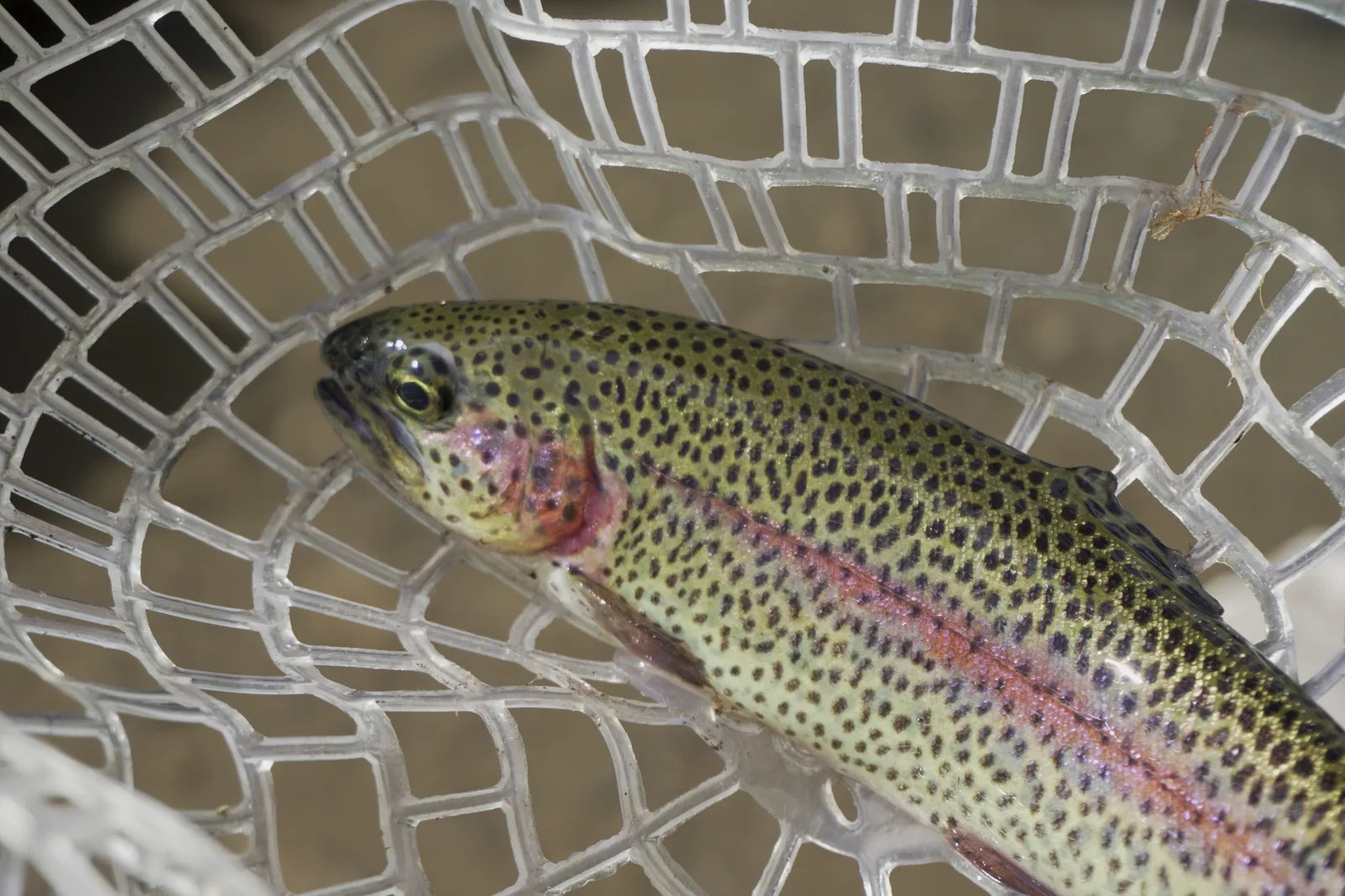 Fishing Net: Which Landing Net to Buy, Rubber or Nylon, and What Size
The fishing net most anglers need is a rubber-mesh landing net sized to their fish. What two mesh studies found, hoop sizes by species, and 7 picks.
 Fishing Stringer: The Right One for Bank, Boat and Wading, and How to Use It
A $3 chain fishing stringer through the lower jaw suits most anglers. Pike lived two hours on one, but a quarter died later. Picks and how to use it.
 Best Fishing Thermometers: From a $14 Stream Tube to the Fish Hawk TD
A $14 encased stream thermometer serves most anglers; only a depth probe reads where summer bass and walleye sit. Five types compared, with picks.
Sources
- Danco Sports, Fishing Fillet Knives (how much flex, which length)
- SORD Fishing Products, What Angle To Sharpen A Fillet Knife
- Michael Pendley and Scott Einsmann, The Best Fillet Knives of 2026, Tested and Reviewed, Outdoor Life
- Cosmo Genova, The Best Fillet Knives of 2025, Tested, Field & Stream
- Dexter-Russell, SANI-SAFE Narrow Fillet Knife (7, 8 and 9 in; DEXSTEEL; American made)
- Dexter-Russell, P94812 BASICS 7" Narrow Fillet Knife
- Knife Country USA, Rapala 03039 Fish 'n Fillet Fixed Blade Knife 7 Inch Blade
- Morakniv, Companion Fishing Fillet 155 (S) (12C27 steel, 56.5 HRC)
- KastKing, Speed Demon Pro Fillet Knife (sizes, prices and owner reviews)
- KastKing, Folding Fillet Knife
- KastKing, Speed Demon 110V Electric Fillet Knife (specifications and owner reviews)
- Rapala, R12 Heavy-Duty Lithium Fillet Knife Combo
- Rapala, Heavy Duty Electric Fillet Knife
- Discount Tackle, Bubba Lithium Ion Cordless Electric Fillet Knife