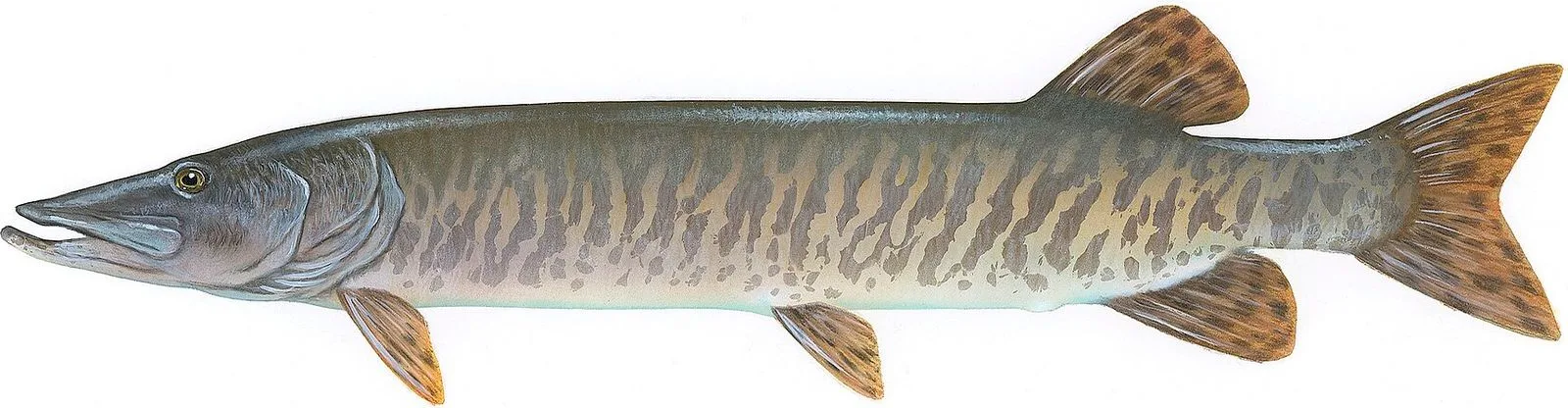
The muskie, or muskellunge, is the largest member of the pike family. Most fish an angler meets are 30 to 42 in (76–107 cm), and 50 in (127 cm) is the line where a muskie becomes a trophy. It is Wisconsin’s state fish, a lone ambush hunter of weed edges and drop-offs, and the hardest freshwater fish in North America to put in a net. Telling one from a northern pike takes ten seconds; the world record is still argued over.
Wisconsin’s creel clerks counted it: one muskie for every 27 hours of fishing. And when biologists opened the stomachs of 1,092 Wisconsin muskies, they found six walleye.
How big do muskie get, and how old is a 40-incher?
Muskellunge kept by Wisconsin anglers between 1990 and 2011 averaged 38.5 in (98 cm). On a good lake a female can pass 50 in (127 cm) and 40 lb (18 kg). The heaviest muskie verified by a state agency in the United States this century weighed 58 lb (26.3 kg).
How fast a muskie gets there depends on the water. The Wisconsin figures below are the statewide average of 5,043 aged fish; Michigan’s come from its own statewide table.
| Length | Wisconsin average | Michigan average |
|---|---|---|
| 11 in (28 cm) | End of year 1 | Year 1 is 15.7 in (40 cm) |
| 32 in (81 cm) | Not published | Age 4 |
| 34–35 in (86–89 cm) | Year 7 | Age 5 |
| 40 in (102 cm) | Year 9 | Age 8 |
| 50 in (127 cm) | Age 17 | Beyond the reliable ages |
So a 40 in muskie is about eight or nine years old, and a 50-incher is in its late teens. Jerry Younk, a Minnesota DNR research biologist, says that depending on the lake a Minnesota muskie needs 13 to 21 years to reach 50 in. The oldest fish he aged was 22; Wisconsin has documented muskies of 30.
Many never get there at all. In northeastern Wisconsin, lake size explains about two thirds of the difference between lakes. Waters of 2,000 acres (800 ha) and more are the ones most likely to grow 50 in fish; lakes down to 100 acres can still grow a 40 in fish.
And nearly every giant is a female. In a Minnesota sample of fish that anglers kept, 26% of the females were longer than 47 in (119 cm) against 1% of the males. Females there grow toward an average final length of 54.2 in (138 cm), males toward 46.1 in (117 cm).
How much does a 50 inch muskie weigh?
Between 30 and 40 lb (14–18 kg) for an average fish, and 39.5 lb (18 kg) for a well-fed one. They come from two curves.
The Wisconsin Department of Natural Resources (DNR) publishes the average curve, the left column below. The chart copied across the internet is the standard-weight equation of Neumann and Willis (1994), built from 4,343 fish in 16 states. Rob Neumann himself notes that it describes the 75th percentile, a fish in above-average condition.
| Length | Average fish (Wisconsin DNR) | Well-fed fish (standard weight) |
|---|---|---|
| 33 in (84 cm) | 10 lb (4.5 kg) | 9.9 lb (4.5 kg) |
| 40–41 in (102–104 cm) | 20 lb (9.1 kg) at 41 in | 18.8 lb (8.5 kg) at 40 in |
| 47 in (119 cm) | 30 lb (13.6 kg) | 32.2 lb (14.6 kg) |
| 50 in (127 cm) | 30–40 lb (14–18 kg) | 39.5 lb (17.9 kg) |
| 52 in (132 cm) | 40 lb (18.1 kg) | 45.1 lb (20.5 kg) |
| 54 in (137 cm) | Beyond the published curve | 51.1 lb (23.2 kg) |
| 58 in (147 cm) | Beyond the published curve | 64.8 lb (29.4 kg) |
Trust the chart less as the fish gets longer. It says 64.8 lb for a 58 in muskie. Joe Seeberger’s 58 in Michigan fish, verified by Michigan DNR in 2012, went 58 lb (26.3 kg). Nolan Sprengeler’s Minnesota record of 2021 measured 57¾ in and weighed 55 lb 14 oz (25.3 kg). For any muskie over about 50 in, measure the girth as well; length alone flatters it. The fish weight calculator works it out from both.
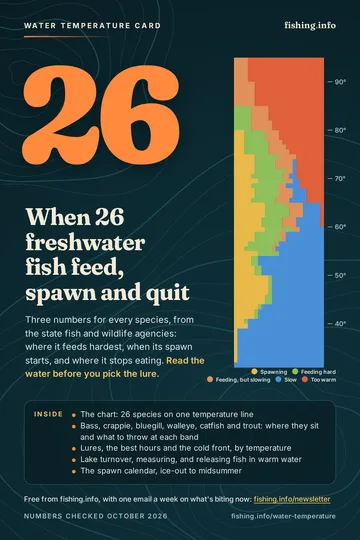
Free card: what 26 species do at your water temperature
Plus one email a week on what's biting now. No sales pitches. Privacy.
Muskie or northern pike: the ten-second check
Three marks settle it.
- Count the pores under the jaw. Five or fewer on each side is a pike; six or more on either side is a muskie. This one works on faded and unmarked fish too.
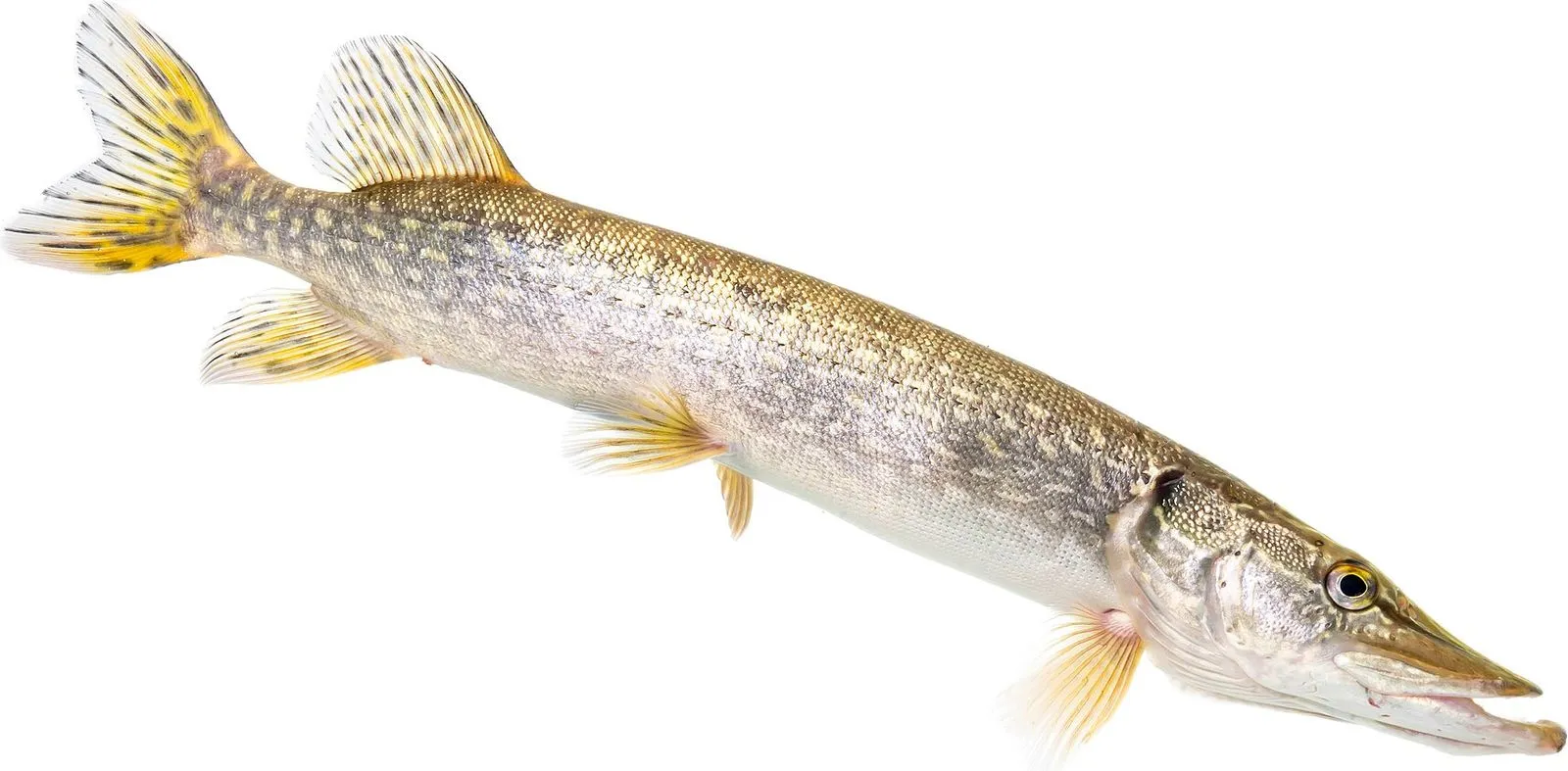
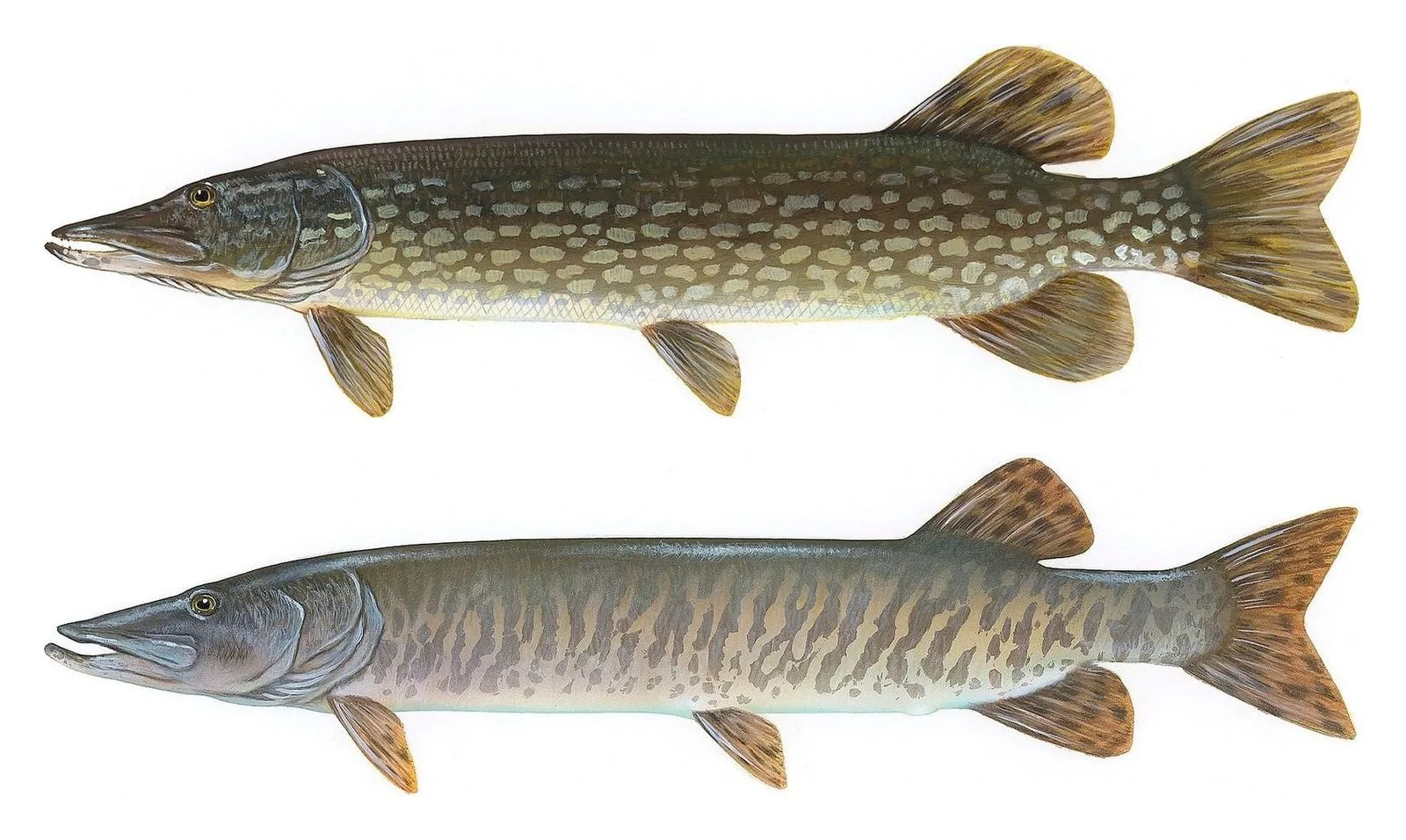
- Look at the pattern. A muskie has dark bars or spots on a light body, or no marks at all. A northern pike is the reverse: rows of pale, bean-shaped spots on a dark green body.
- Look at the tail. Muskie tail tips are pointed. Pike tail tips are rounded.
Two more for a fish in the hand: a muskie’s cheek carries scales on its upper half only, where a pike’s cheek is scaled all over, and muskie fins are pointed and usually rust-colored. Muskies come in three patterns: clear, barred and spotted. In Michigan the spotted fish are mostly Great Lakes muskies and the barred ones live in the southern inland lakes.
The tiger muskie is the cross of the two. It has the pike’s rounded tail tips and bold dark bars on a light body. The muskie vs pike page sets every mark side by side.
Where muskie live
The native range runs through the Great Lakes and St. Lawrence basin and the upper Mississippi, from Quebec to southeastern Manitoba, and south through the Ohio River country. Wisconsin alone has 667 muskie lakes and 100 river stretches, almost nine in ten of them in the north of the state. Minnesota manages 101 waters, Michigan 116. Stocking has spread muskies far wider, and in Maine’s St. John River it is an unwanted invader with no size or bag limit.
A muskie is a solitary fish with a small home range. It holds near drop-offs, rock and sand bars, weed edges and weedy bays, and in the deep, slow pools of medium and large rivers. It is comfortable in water up to about 78 °F (26 °C); big fish avoid water warmer than 77 °F (25 °C) and slide deeper in a hot summer. The temperature chart for 26 species shows where that sits next to pike and walleye.
There are never many. A good Wisconsin lake holds about one adult for every two or three acres. Michigan DNR reckons a 1,000-acre lake probably holds fewer than 500.
What muskie eat, and the walleye question
Fish, almost entirely, and not the ones anglers accuse them of. In 34 northern Wisconsin lakes, biologists examined 1,092 muskies. Yellow perch made up 30% of the diet and white suckers 8%. Six walleye turned up.
Minnesota repeated the work on 12 lakes between 2019 and 2022. Of 350 stomachs with food that could be identified, four held a walleye. Yellow perch again came first, then suckers. A separate Minnesota study found that muskies ate 6 to 16% of the food taken by the top predators in three lakes, while northern pike ate 38 to 50%.
A muskie can swallow a fish two thirds of its own length: a 50 in muskie can handle a 33 in meal. Muskrats, ducklings and frogs are on the record too, rarely. The fish hunts by sight, which is why clear water and daylight suit it.
When muskie spawn
When the shallows warm from 50 to 60 °F (10–16 °C), which is mid-April to late May in Wisconsin, slightly later than the northern pike. There is no nest. A pair swims side by side over several hundred yards of shoreline, scattering 20,000 to 200,000 eggs, and then leaves them. The fish return to the same bays each year.
How to catch a muskie: what the surveys say
“The fish of 10,000 casts” has a measured version. Across Wisconsin’s better muskie waters, creel surveys from 1990 to 2011 recorded one muskie per 27 hours of fishing. On 18 Minnesota waters the figure runs from 11 hours to 200, with an average of 40. On Green Bay in 2021 it was just under 20.
What the agencies say improves those odds:
- Season. Catch rates are best in the warm months, and the biggest fish come late. Minnesota DNR notes that many of the largest muskellunge are caught in October and November.
- Weather and light. Windy, rainy or muggy overcast days, the hours before a front, and dawn and dusk.
- Water. Small, shallow, weedy lakes give more action and smaller fish. Big, deep, clear lakes give long waits and the chance of a giant.
- Tackle for casting. A 7 to 9 ft (2.1–2.7 m) heavy casting rod, 50 to 80 lb braided line and a foot-long steel or fluorocarbon leader. Lures run 5 to 10 in and more: bucktails, spinnerbaits, jerkbaits, big crankbaits. The best muskie lures page picks one per class, with the water temperature each is for.
- The figure eight. Muskies follow a lure to the boat without striking. The agencies’ answer: keep the lure moving and sweep it in a wide figure eight beside the boat at the end of every cast.
Muskie by water temperature: rising and falling
The same reading means two different things. Telemetry summarized by In-Fisherman puts the hinge at 59 °F (15 °C). In spring the fish settle into summer ranges once the water passes it. In fall those ranges break up below it, and the fish wander until about 41 °F (5 °C), when they move to winter areas. The lure columns are what guides and the agencies advise, not test results.
Rising water, spring into summer
| Water | Where the muskies are | What to throw |
|---|---|---|
| Under 50 °F (10 °C) | Cruising shallow flats before the spawn; the pattern fades in the mid-40s °F (7 °C); most seasons still closed | 4–6 in (10–15 cm) neutrally buoyant minnowbait fan-cast over the flats, slow (angler guidance) |
| 50–60 °F (10–16 °C) | Spawning in warm shallow bays, slightly later than the pike; no nest, pairs scatter eggs along the shore | Leave the bays alone; Minnesota opens its season in early June, after the spawn |
| 60–65 °F (16–18 °C) | Post-spawn in fast-warming sandy or soft-bottom bays; from 59 °F (15 °C) fish settle into summer ranges | Jig and soft swimbait at a fish you can see; minnowbait or glider; most are males under 45 in (114 cm) |
| 65–72 °F (18–22 °C) | Summer ranges: weed beds, rock bars, drop-offs, points with wood; 78% of August fixes were in weeds | Bucktail and topwater over the weeds, big rubber on the edges; windy or muggy days, dawn and dusk |
| 72–78 °F (22–26 °C) | Big fish avoid water over 77 °F (25 °C): deeper weed edges, humps, the cool side of the thermocline | The cool hours only; short fights, hooks out in the net, one level photo; the 80 °F line is close |
| Above 78 °F (26 °C) | Past 78 °F (26 °C): 10 of 21 Potomac muskies released above 80 °F (27 °C) died | Maryland DNR asks anglers to stop targeting muskie at 80 °F; fish something else until it cools |
Falling water, late summer into early ice
| Water | Where the muskies are | What to throw |
|---|---|---|
| Under 41 °F (5 °C) | At about 41 °F (5 °C) muskies move to winter areas: deep basins, main-lake breaks, dam faces, rock walls | A live sucker on a quick-strike rig, hung or drifted on the breaks and humps, slow, until the season closes |
| 41–50 °F (5–10 °C) | The big-fish weeks: many of the largest muskies come in October and November on breaks, rocky points, humps | A live white sucker of 10–14 in (25–36 cm) on a quick-strike rig, 50 °F and below; big rubber ripped slowly |
| 50–59 °F (10–15 °C) | Turnover: summer ranges break up below 59 °F (15 °C), fish wander; weed edges, rock bars, mid-depth breaks | Cover water: big rubber, gliders and jerkbaits; the warmest hours of the day as the water keeps cooling |
| 59–65 °F (15–18 °C) | The early-fall bite ramps up from 65 to 58 °F (18–14 °C); the shallow weed bite lasts to about 60–62 °F (16–17 °C) | Bucktail and topwater over green weeds, a jerkbait when they will not chase; dark lures in a bloom |
| 65–70 °F (18–21 °C) | The fall feed starts as the water cools below 70 °F (21 °C): weed beds, rock bars, drop-offs and points | Bucktail and topwater at dawn and dusk; windy, rainy or muggy overcast days and the hours before a front |
| 70–78 °F (21–26 °C) | Late summer: big fish avoid water over 77 °F (25 °C); deep weed edges, humps, the cool side of the thermocline | The cool hours only; short fights, hooks out in the net, one level photo |
| Above 78 °F (26 °C) | Past 78 °F (26 °C): 10 of 21 Potomac muskies released above 80 °F (27 °C) died | Maryland DNR asks anglers to stop targeting muskie at 80 °F; fish something else until it cools |
One caution: the live sucker is a cold-water method, and only on a quick-strike rig. A swallowed sucker kills the fish. The best muskie lures page sizes the lures in these rows.
Releasing a muskie alive
Almost every muskie caught today goes back: members of Muskies Inc. release more than 99.9% of the fish they report. In cool water that works. An Ottawa River study radio-tagged 30 released muskies and lost none. Wisconsin DNR calls catch and release almost universal and puts delayed mortality under 5%.
Warm water is the exception. Maryland DNR tagged Potomac River muskies released above 80 °F (27 °C), and 10 of 21 died. The agency asks anglers to stop targeting muskie at that temperature.
Unhook the fish in the water, in a large net, with long-nosed pliers; cut hooks that will not come free. Lift it level with a hand under the belly for the photo, never by the jaw alone.
Is muskie good to eat?
It is edible, but almost nobody keeps one. Wisconsin DNR notes muskies are rarely targeted for the table, and a legal fish must clear size limits of 40 to 54 in.
A long-lived top predator also builds up mercury and PCBs. Wisconsin’s 2026–2028 safe-eating guide says children under 15, and women who are pregnant, nursing or may become pregnant within three to five years, should not eat muskie. Everyone else: one meal a month. For the table, keep a small pike; are northern pike good to eat? has the boneless cut.
Do muskies attack people?
Rarely, and never fatally in the cases on record. In 2017 a girl of 11 sitting on a paddleboard on Minnesota’s Island Lake needed tendon surgery; the fish was never identified. In 2020 a woman standing waist-deep in Ontario’s Winnipeg River was bitten on the calf. In 2021 a triathlete in Lake St. Clair took 13 stitches in his hand.
A muskie hunts by ambush, says Adam Weir of the Ontario Federation of Anglers and Hunters, and can mistake a moving hand or foot for prey; most would rather swim away. The bite to plan for comes at the boat, during unhooking; northern pike teeth covers it.
Records and size limits
Three fish are called the record, and each has a body behind it. The IGFA lists Cal Johnson’s 67 lb 8 oz (30.6 kg) muskie from Lac Courte Oreilles, Wisconsin, caught July 24, 1949. The National Fresh Water Fishing Hall of Fame and Wisconsin DNR list Louis Spray’s 69 lb 11 oz (31.6 kg) fish, caught three months later near the same town, Hayward. Art Lawton’s 69 lb 15 oz St. Lawrence muskie of 1957 held the title for 35 years. The IGFA and the Hall of Fame threw it out in 1992, after an investigator matched it to a photo of a fish captioned at 49 lb 8 oz.
Size limits show how each state values a big fish: 40 in (102 cm) on most Wisconsin waters, 42 in (107 cm) in Michigan, and 54 in (137 cm) statewide in Minnesota. Check the current state regulations for the water you fish; several lakes carry their own limit. The world record muskie page tells the record stories in full, and the species guides cover every other fish.
Gear for pike and muskie
Gear guide
Best Northern Pike Lures: Six Classics the Agencies and Guides Agree On, and When to Throw EachNorthern pike lures by the evidence: a 1 oz spoon first, then spinners, spinnerbaits, plugs and topwaters, with the water and season each one is for.
Gear guide
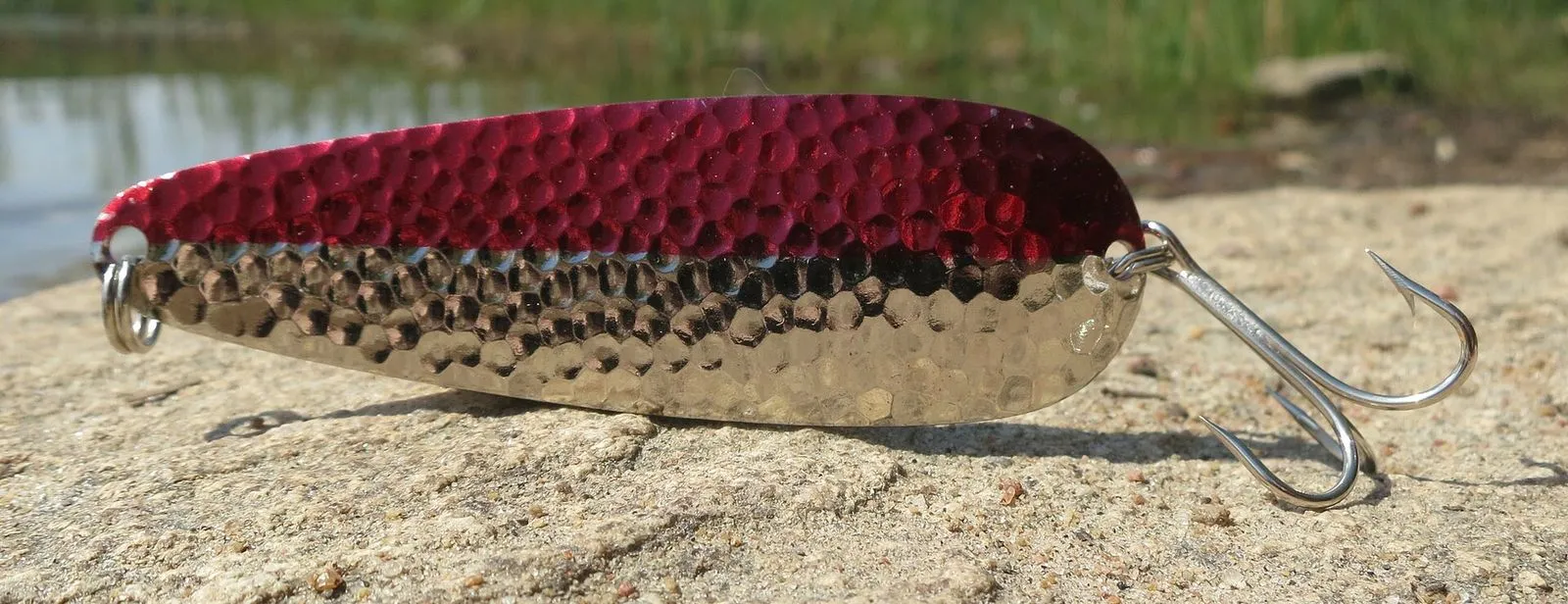
Best Muskie Lures: The Classic in Each Class, and the Water Temperature to Throw ItThe muskie lures guides and magazines keep naming, one per class, with maker-checked sizes and the water temperature each is for, from 40 °F to 75 °F.
Free download
The water temperature card
Read your water temperature and the card tells you who is spawning, who is feeding and what to throw. 26 species, 16 pages, for your phone and the tackle box.
Plus one email a week on what's biting now. No sales pitches. Privacy.
Related
Section guide
Pike Fish: Northern Pike, Muskie, Tiger Muskie and Pickerel Told ApartPike fish in North America: northern pike, muskie, tiger muskie and chain pickerel, told apart by spots, cheek scales and jaw pores, with each record.
- Are Northern Pike Good to Eat? Yes: the Y-Bones, the Five-Fillet Cut and Which Fish to Keep
Northern pike are firm, white and flaky. How to cut five boneless fillets around the Y-bones, which size to keep, and how much is safe to eat.
 Pike Fishing: How to Catch Northern Pike in Every Season
Pike fishing season by season: where northern pike are from ice-out to first ice, what to throw, where big pike go in summer, and the quick-strike rig.
 World Record Pike: The 55 lb German Fish, the 46 lb American One and the State Records
The world record pike is 55 lb 1 oz, caught in Germany in 1986. North America's best is 46 lb 2 oz from New York in 1940, a fish its captor never mounted.
 World Record Muskie: Three Claims, Two Record Books and the Biggest Fish Nobody Disputes
The world record muskie is 67 lb 8 oz to the IGFA and 69 lb 11 oz to the Hall of Fame. Both date from 1949, both are disputed, and a 65 lb fish is not.
 Northern Pike Teeth: How Many, How Sharp, the Summer Myth, and How to Unhook One
Northern pike teeth: about 16 knife-edged canines on each side of the lower jaw, hundreds more on the roof and tongue, and how to unhook one safely.
 Muskie vs Pike: How to Tell Them Apart, and How the Two Fish Really Differ
Muskie vs pike: markings, tail tips, jaw pores and cheek scales side by side, plus size, age, numbers per acre, and pike against pickerel and walleye.
Sources
- Wisconsin DNR, Muskellunge (Esox masquinongy) fact sheet, PUBL FM-705 (2012): names, identification, habitat, spawning, prey size, age
- Wisconsin DNR, Muskellunge Management Update, FH-508 (2012): length at age, weight at length, hours per fish, diet study
- Wisconsin DNR, Musky: Wisconsin's state fish (catch and release almost universal, under 5% delayed mortality)
- Wisconsin DNR, Fishing for musky: conditions, lake types
- Wisconsin DNR, Freshwater angling records (Spray, 69 lb 11 oz)
- Smith, Thomas and Hanchin (2016), Management Plan for Muskellunge in Michigan, Michigan DNR Fisheries Report 12: length at age, color phases, limits
- Michigan DNR (2013), State-record Great Lakes muskellunge now also a world record (Seeberger, 58 lb)
- Minnesota DNR, Long Range Plan for Muskellunge Through 2040: diet studies, 40 hours per fish, temperature, size limit
- Younk and Pereira, An Examination of Minnesota's Muskellunge Waters, Minnesota DNR Investigational Report 498: males and females
- Minnesota DNR, How to catch a muskellunge: seasons, tackle, figure eight, release
- Jerry Younk, Minnesota DNR, Ask the DNR: how old do muskies get (Grand Forks Herald, 2014)
- Iowa DNR, Know Your Catch: how to ID northern pike and muskies
- Wisconsin DNR, Status of Great Lakes Muskellunge in Wisconsin Waters of Green Bay (2021): hours per fish
- Wood (2020), Age and Growth of Muskellunge in Glazier Lake, Maine, Maine IFW: invasive status in the St. John River
- USGS Nonindigenous Aquatic Species, Esox masquinongy: native range, introductions
- Landsman, Wachelka, Suski and Cooke (2011), Fisheries Research 110:377–386: survival of released muskellunge, Ottawa River
- 2016 Hugh C. Becker Muskie Symposium, abstracts: Muskies Inc. release rates
- Maryland DNR, Muskie biology: mortality above 80 °F
- National Park Service, Muskellunge (Esox masquinongy): average size, name origin
- Rob Neumann, Muskie length to weight conversion chart, In-Fisherman (2016): the standard-weight chart and its 75th-percentile caveat
- Neumann and Willis (1994), Relative weight as a condition index for muskellunge, Journal of Freshwater Ecology 9(1):13–18: standard-weight equation from 4,343 fish in 45 populations, 16 states
- Fox 9 (2021), Minnesota DNR certifies 55-pound muskie caught on Mille Lacs Lake as new record
- John Dettloff, The world-record muskie that turned out to be a hoax, Outdoor Life (1992, republished 2025)
- In-Fisherman, Homing in on muskie behavior: telemetry summarized, the 59 °F and 41 °F movements, 80 °F shallows
- Dan Johnson, Early season muskies, In-Fisherman (2015): 32–46 °F minnowbaits, post-spawn bays, bucks under 45 in
- Josh Lantz, The right time, place, and gear for early fall's primetime muskies, In-Fisherman (2024): Heiting's 65–58 °F window, Manthei's weed bite and turnover
- Steven Paul, How to fish live bait for muskies, responsibly, Field & Stream (2026): 50 °F and below, quick-strike rigs, breaks and humps
- Wisconsin DNR and DHS, Choose Wisely: a health guide for eating fish in Wisconsin, PUB-FH-824 (2026–2028): statewide safe-eating guidelines
- Andrew Cruickshank, Rare muskie attack leaves triathlete with 13 stitches, Cottage Life (2021)
- Fox News (2017), Fish attack at Minnesota lake leaves girl, 11, with deep lacerations
- Cottage Tips (2020), Muskie attack sends woman to ER