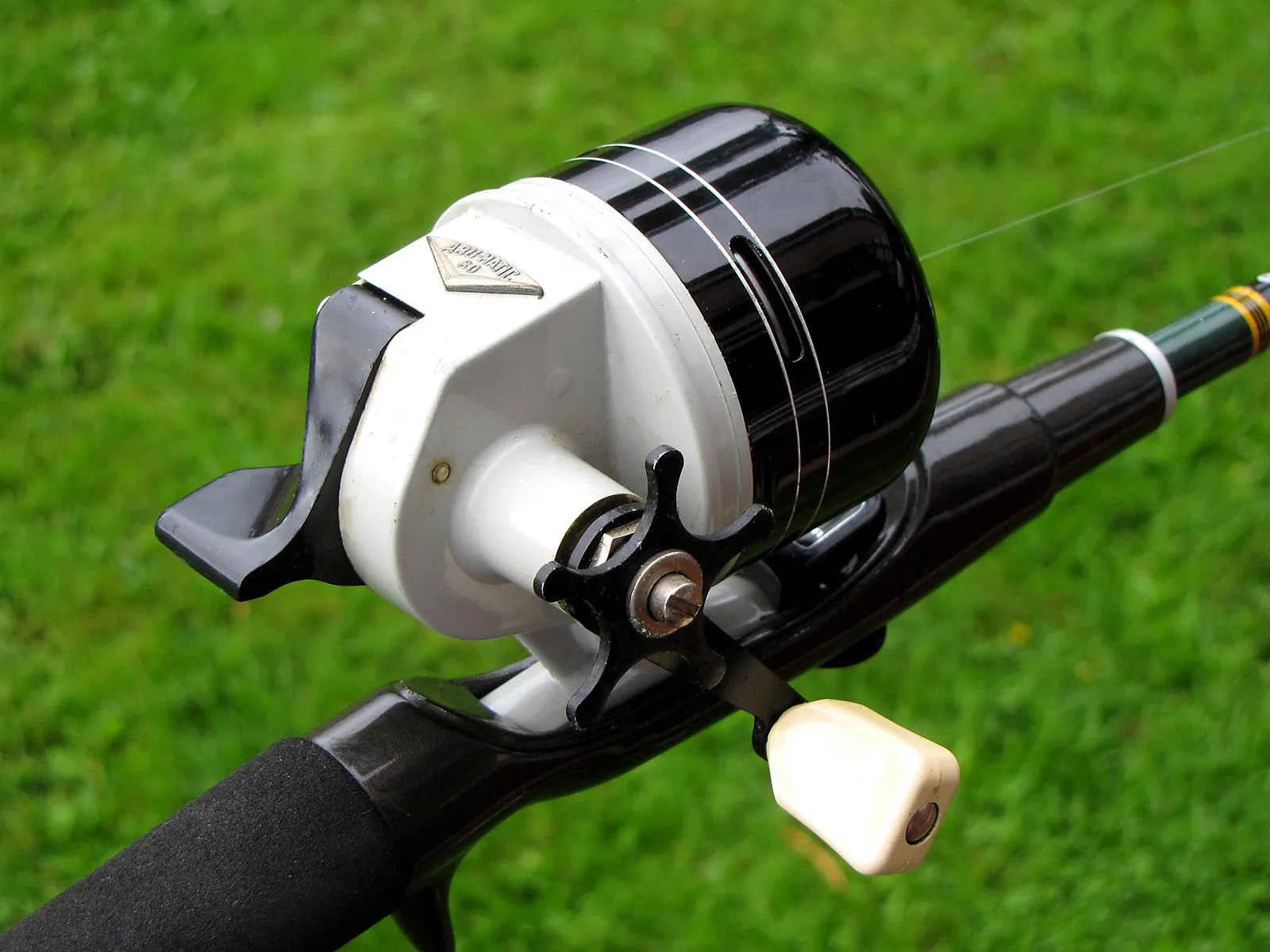
A spincast reel is the one with the button: a fixed spool hidden under a metal nose cone, released by your thumb. Because the spool never turns, a spincast reel cannot backlash. That is why every child in the country has learned on one since the Zebco 33 appeared in 1954. It is also why almost no adult who fishes seriously uses one: the reel gives up distance, line capacity and drag for a cast that cannot go wrong.
The Zebco 33 was built by a company that made time bombs for oil wells, and by 1975 Zebco had sold 70 million reels.
What happens inside the cone?
Take the front cover off (it unscrews counterclockwise) and you find a small spool that does not move, with a spinnerhead in front of it. On the spinnerhead sit one or two pick-up pins: ceramic or titanium on the better reels, stainless steel on the cheap ones. At rest the pins stand out and pinch the line against the head so it cannot leave the spool.
Press the button and a lever pulls the pins in. The weight of the lure draws line off the end of the spool, over the lip and out through the hole in the cone. Release the button and a spring snaps the pins out, and the line stops dead. Turn the handle and the spinnerhead rotates; a pin catches the line and lays it back on the spool.
Three things follow from that machine. It cannot backlash, because the only moving part on the cast is the lure: the spool never spins faster than the line leaves it. It casts short, because the line rubs the spool lip, the inside of the cone and the edge of the hole on the way out, and because the narrow spool holds its coils tightly. Daiwa and Zebco both sell their better models on a larger hole in the cone. And the drag is the weak point. On cheap reels it is a few washers behind the spool with no rated number, and only the models above $50 publish a figure.
Spincast vs spinning vs baitcaster
| Spincast | Spinning | Baitcaster | |
|---|---|---|---|
| Spool | Fixed, enclosed in a cone | Fixed, open, with a bail | Revolving |
| Release | Thumb button | Open the bail, hold the line with a finger | Thumb bar, thumb on the spool |
| Backlash | Impossible | Impossible | Yes, until tension and brakes are set |
| Line twist | Some, as on any fixed spool; it shows as a tangle under the cone | Some, from lures and from reeling against the drag | Little |
| Casting distance | Short | Long | Long, and accurate |
| Line capacity | Small; about 100 yd (91 m) of 10 lb mono | Large; 2–40 lb by size | Large; 10–65 lb |
| Drag | Unrated on cheap models, 10–20 lb (4.5–9 kg) on the best | Good on any decent reel | Strong |
| Lure weights | 1/16–3/8 oz (2–10 g) | 1/32–1 oz and up by size | 1/4–2 oz and up |
| Learning time | Minutes | An hour | Days |
| Price | $14–170 | $30–300 | $60–400 |
| Best for | Children, panfish, a first reel, bobber fishing | Almost everything in fresh water and inshore salt | Heavy lures, heavy cover, big fish |
The trade is plain: the spincast gives up distance, capacity and drag for foolproof casting. Bass Pro’s reel guides steer anyone fishing for more than panfish to a spinning reel. The reels hub compares all three, the spinning reel sizes page shows the step up, and the baitcaster page explains the reel at the far end. Spool, drag, gear ratio and line capacity are defined in the fishing terms under rods, reels and line.
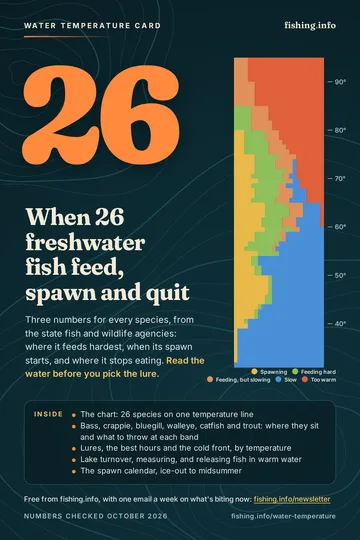
Free card: what 26 species do at your water temperature
Plus one email a week on what's biting now. No sales pitches. Privacy.
Two cousins: the underspin and the big-cone bait reel
The classic spincast sits on top of a casting rod with the button under your thumb. The underspin (or trigger-spin) is the same mechanism hung under a spinning rod, with a lever under the index finger instead of a button: pull to free the line, let go to stop it. It casts light baits farther, helped by the spinning rod’s big first guide and a larger opening in the cone. Daiwa’s Underspin XD comes in three sizes, pre-wound with 4, 8 and 12 lb line, at $49.99. Lew’s sells its Speed Cast as both a push-button and a trigger underspin combo. The underspin is the honest bridge to a spinning reel: the hand position and the rod are already right.
The other cousin is the big-cone bait reel, the Zebco 404 and 33 Max Gold class: a 40- or 60-size body, 15–20 lb mono, a 2.6–2.8:1 ratio and a bite alarm, built for a catfish rod on a forked stick. It winches; it does not fish lures.
Nine spincast reels: what does more money buy?
Not line capacity. The figures are the makers’ own, with one gap: Daiwa’s page leaves the Goldcast’s capacity, weight and line per turn blank, so those come from Bass Pro’s listing of the same reel. Prices are the list prices in October 2026.
| Reel | Gear ratio, line per turn | Mono capacity | Weight; max drag | Price |
|---|---|---|---|---|
| Zebco 202 | 2.8:1, 15 in (38 cm) | 110 yd / 10 lb (100 m) | 6.2 oz (176 g); not rated | $13.99 |
| Zebco 404 | 2.8:1, 17 in (43 cm) | 90 yd / 15 lb (82 m) | 9.0 oz (255 g); not rated | $18.99 |
| Pflueger President 10 | 3.8:1, not listed | 87 yd / 0.25 mm, about 8 lb (80 m) | not listed; 10 lb (4.5 kg) | $46.99 |
| Zebco 33 Gold | 4.1:1, 23 in (58 cm) | 120 yd / 10 lb (110 m) | 9.6 oz (272 g); 12 lb (5.4 kg) | $49.99 |
| Zebco 33 Platinum | 4.7:1, 26 in (66 cm) | 120 yd / 10 lb (110 m) | 10.6 oz (300 g); 12 lb (5.4 kg) | $59.99 |
| Daiwa Goldcast GC100 | 4.1:1, 21 in (53 cm) | 80 yd / 10 lb (73 m) | 9.9 oz (281 g); multi-disc, not rated | $89.99 |
| Zebco Omega Pro 30 | 3.2:1, 17 in (43 cm) | 100 yd / 10 lb (91 m) | 13.6 oz (386 g); 20 lb (9 kg) | $109.99 |
| Zebco Bullet 30 | 5.1:1, 30 in (76 cm) | 90 yd / 10 lb (82 m) | 13.9 oz (394 g); 12 lb (5.4 kg) | $129.99 |
| Zebco Bullet MG | 5.1:1, 30 in (76 cm) | 90 yd / 10 lb (82 m) | 10.9 oz (309 g); 12 lb (5.4 kg) | $169.99 |
Every reel holds about the same line, 80–120 yd of 10 lb mono. What money buys is speed: 15 in per turn on the 202 against 30 in on the Bullet, which is spinning-reel pace. It also buys a rated drag, metal gears, a metal body and bearings: none on the 202 and 404, two plus a clutch on the 33 Gold, eight plus a clutch on the Bullet.
The 33 Gold at $49.99 is the sensible middle. It has a 4.1:1 ratio that keeps up with a small spinnerbait, a 12 lb drag, ceramic pins and a reversible handle, so it passes from a right-handed parent to a left-handed child. The Omega Pro’s 20 lb drag is the strongest published on any spincast, but at 3.2:1 it is a bait reel for catfish and carp. The Bullet is the only spincast built to fish lures all day, and at $130–170 it costs more than a very good spinning reel. Lew’s Speed Cast belongs here too, about $40 as a combo, but Lew’s publishes no ratio, capacity or weight, so it stays out of the numbers.
Who should buy one?
- A child. Press, cast, release; a six-year-old catches bluegill on the first afternoon, and the enclosed spool survives being dropped in the sand. The kids’ fishing pole page sizes the rod to the child.
- Panfish and bobber fishing. Crappie, bluegill and stocked trout on 6–8 lb line, a bobber and a worm; the reel’s limits never come up. For trout, go small: Pflueger’s President 6 holds 115 yd (105 m) of 0.20 mm mono, about 6 lb; the 33 and Bullet are built around 10 lb.
- A backup or a car rod. A $25 spincast combo in the trunk catches the fish by the picnic site.
- Anyone who hates bird’s nests and fishes light; the underspin is the adult version.
- A catfish bait rod on a budget. A 404 on a stiff rod with 15 lb mono and the bite alarm on is a $19 channel-cat outfit.
Who should not: anyone fishing for bass in cover, catfish over a few pounds on lures, or anything in salt water. The drag and the line capacity run out at exactly the fish worth catching. The step up is a 2500-size spinning reel on a 6 ft 6 in (2 m) medium-light spinning rod. The rod and reel combo page names the ones worth buying at $50–100.
Which line, and can you use braid?
Six to ten pound monofilament is the line a spincast reel is designed around. Zebco ships the 33, Omega and Bullet pre-spooled with 10 lb, the small sizes with 6 lb, and the bait reels with 15 or 20 lb. Mono is limp enough to leave the narrow spool without springing and thick enough for the pick-up pins to grip. Go down to 4 lb for an underspin and crappie; go heavier only on the bait reels.
Braid is the question every parent asks. Zebco’s own troubleshooting page answers it: “braided line may not work with spincast reels.” The reason is the pins. A pick-up pin stops the line by pinching it against the spinnerhead. Thin, slick braid slips under the pin instead of stopping, and the cast ends with a loop of braid behind the head. There is no gain to chase anyway: the short cast is set by the cone, not the line. Mono, 6–10 lb, every season.
How to spool a spincast reel
You cannot see the spool, so you check it by taking the cover off. These are the steps from Zebco’s manual, the same for every brand.
- Mount the reel on the rod and run the new line down through the guides from the tip.
- Unscrew the front cover (counterclockwise; hold the handle still). Thread the line through the hole in the cover, tie it to the spool with an arbor knot and trim the tag short so it cannot catch the pins.
- Screw the cover back on. Pinch the line between thumb and finger above the reel and wind under tension, with the filler spool flat on the floor, label up.
- Stop every twenty turns, slacken the line and look for twist. If coils spring up, flip the filler spool over and carry on.
- Take the cover off and look: the right fill is 1/8 in (3 mm) below the lip. Overfilled, the line springs off and jams behind the spinnerhead; underfilled, every cast is short.
- Before the first trip, let 40–50 ft (12–15 m) out and wind it back under finger tension to stretch the coils.
The how to put line on a reel page covers the same job for spinning and casting reels.
How do you teach a child to cast one?
These are Zebco’s own steps, in the order a child can hold in their head.
- Set the drag first. Pull line off by hand and tighten the dial until it comes out with moderate resistance: about 3–4 lb (1.5–2 kg) on 10 lb line, a third of the line’s test. Lighter is safer than heavier; you can tighten it on a fish.
- Let about 6 in (15 cm) of line hang from the tip. Hold the rod with the reel on top, point the tip just above the target, rest the thumb on the button.
- Raise the arm, bending at the elbow, until the rod tip passes the ear and points behind. Press the button and keep it held.
- Whip the rod forward and let the button go at the same time. Too early and the bobber goes straight up; too late and it slaps the water at the feet. Ten casts at a bucket on the grass fix the timing.
- Wind with the rod tip up so the line goes on under tension, and watch the bobber: when it sinks or moves sharply, that, as Zebco’s manual puts it, is fish business.
What goes wrong, and how do you fix it?
A spincast reel needs almost nothing, which is why it gets nothing and dies in year three. Zebco’s maintenance page puts grease on the crank gear, the pinion, the center shaft and the underside of the pick-up arm. A drop of oil goes on the pick-up pin, the handle knobs and the lever pivot. Use little: excess lube slows the reel. Clean it after a drop in sand and service it yearly if it fishes hard. After salt water, soak the spool in fresh water, rinse the body lightly and re-lube: Zebco says dried salt binds parts like sand. Three failures account for most dead spincasts:
| Symptom | Cause | Fix |
|---|---|---|
| Reel will not cast, or the lure stops mid-air | Line tangled behind the spinnerhead, usually from overfilling or a loop of twist | Take off the cover and the spinnerhead (counterclockwise, handle held), untangle, cut away kinked line, refill to 1/8 in (3 mm) below the lip |
| Handle grinds or will not pick up line | Dry or dirty gears; the pick-up arm has no grease, or the spinnerhead spring is broken | Clean and grease the gears and the underside of the pick-up arm; a broken spring means a new spinnerhead, a $5 part |
| Line breaks on a decent fish, or the fish pulls line and the hook never sets | Drag set at the wrong end: locked down, or so loose the hookset slips | Set it at a third of the line test before every trip and back it off after; a corroded drag stack comes apart for cleaning behind the spool |
Mistakes to avoid
- Buying the $14 reel for a child who will fish more than twice. The 202 has no bearings and a 2.8:1 ratio; the 33 Gold at $50 still works in five years and can be handed down.
- Fishing it in salt. Zebco says most of its spincasts are not built for it, and the cone keeps the salt in; an inshore trip wants a sealed spinning reel.
Who invented the spincast reel?
R. D. Hull, a Texas watchmaker, had the idea in 1947 after watching a grocery clerk pull string off a fixed spool. He took it to the Zero Hour Bomb Company of Tulsa, Oklahoma, a firm that made time bombs for fracturing oil wells and needed a product for peacetime. The company built his “Standard” reel, first shown on May 13, 1949. Models 11 and 22 followed in 1953, and the Model 33 in 1954, at $19.50.
In 1956 the company dropped bombs for reels and shortened its name to Zebco. The company’s own history tells why: a friend of President Eisenhower had a reel sent to the White House, and the package triggered a bomb scare. The 33 has been in production ever since, and a new one still costs about what a tank of fuel does.
Free download
The water temperature card
Read your water temperature and the card tells you who is spawning, who is feeding and what to throw. 26 species, 16 pages, for your phone and the tackle box.
Plus one email a week on what's biting now. No sales pitches. Privacy.
Related
Section guide
Fishing Reels: Spinning, Baitcasting and Spincast ExplainedThe three kinds of fishing reels and who each is for, what a 2500 or 4000 size means, what a 6.4:1 gear ratio does, and the Shimano and Daiwa ladders.
 Shimano Reels: Every Spinning and Casting Reel, Sienna to Stella
Every Shimano spinning reel and baitcaster on one price ladder, $35 to $895: what each step buys, which size fits your fishing, and the reel to buy.
 Best Fishing Reels: The Reviewers' Picks by Type and Budget
The best fishing reels by type and budget: spinning, baitcasting and spincast picks with weight, drag and price from the makers' spec sheets.
 Saltwater Spinning Reels: What Sealed Means, Which Size, and the Picks
Saltwater spinning reels compared: IPX5 vs IPX8 sealing, eight reels by drag, weight and price, the size for inshore, surf and offshore, and how to rinse one.
 Baitcaster Explained: How It Works, Who Needs One and How to Set It Up
What a baitcaster is, why it backlashes, how to set tension and brakes so it does not, what gear ratio means, and when a spinning reel is the better choice.
 Spinning Reel Sizes Explained: 1000 to 6000 and Which One You Need
What the size number on a spinning reel means, a 1000-to-6000 table with line, lure and species, the gear ratio and drag to look for, and 2500 versus 3000.
Sources
- Oklahoma Historical Society, Zebco
- American Oil & Gas Historical Society, the Zebco reel's oilfield history
- History of the Zebco 33 fishing reel
- Zebco, company history
- Zebco, spincast reel owner's manual (casting, spooling, drag, troubleshooting)
- Zebco, spincast reel troubleshooting
- Zebco, tips and maintenance (lubrication points, fill level, drag, saltwater)
- Zebco 33 Gold spincast reel, specifications
- Zebco 33 Platinum spincast reel, specifications
- Zebco Omega Pro spincast reel, specifications
- Zebco Bullet spincast reel, specifications
- Zebco Bullet MG spincast reel, specifications
- Zebco 404 spincast reel, specifications
- Zebco 202 spincast reel, specifications
- Pure Fishing, Pflueger President spincast reel, specifications
- Daiwa, Goldcast spincast reel (archived copy)
- Bass Pro Shops, Daiwa Goldcast III series listing (capacity, weight, line recovery)
- Daiwa, Underspin XD reel
- Lew's, Speed Cast spincast and underspin combos (2019 release)
- Bass Pro Shops, guide to choosing baitcast reels