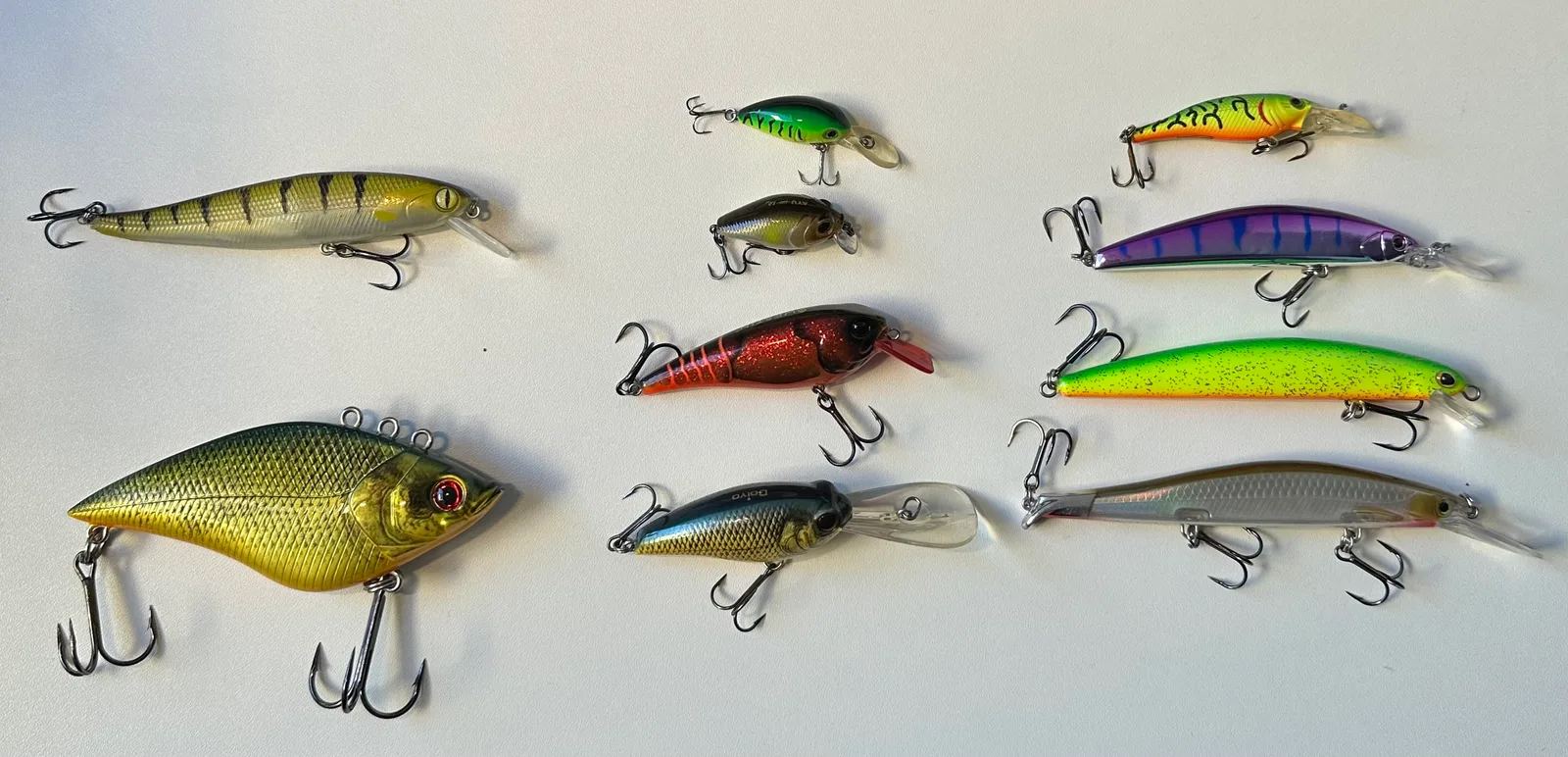
The best fishing lures for a first box are a jig, a Texas-rigged worm, a wacky Senko, a spinnerbait, a chatterbait, a squarebill, a lipless crankbait, a jerkbait, a popper and a hollow frog. With those ten an angler can fish for bass from January to December, and three of them cover trout, walleye, pike and panfish. They are not a matter of taste: five of the ten won a 2025 Bassmaster Elite Series event, by the anglers’ own tackle lists, and most have caught fish for fifty years or more. The picks come from that tournament record, the makers’ spec sheets and the 2026 tackle round-ups; this site has not tested any of them.
The nine 2025 Elite Series events were won on seven different lure families, and no winner fished one lure all week.
What does each of the ten cover?
Each lure earns its place by fishing a season, a depth or a kind of cover the others cannot.
| Lure | Family | Water temperature | Depth | What it covers that nothing else does |
|---|---|---|---|---|
| Jig with craw trailer | Jigs and rigs | 40–90 °F (4–32 °C) | 2–40 ft | Cold water and big fish; rock and wood |
| Texas-rigged worm or creature bait | Soft plastics on a rig | 50–90 °F (10–32 °C) | 1–25 ft | Any cover, any month; on six of the final ten rods at Tenkiller in 2025 |
| Wacky-rigged Senko | Soft plastics | 55–85 °F (13–29 °C) | 1–8 ft | Beds, docks, pressured fish; the beginner’s lure |
| Spinnerbait | Spinnerbaits | 50–75 °F (10–24 °C) | 1–10 ft | Wind, stained water, laydowns; flash and thump |
| Chatterbait (bladed jig) | Jigs, in effect | 50–75 °F | 1–8 ft | Grass; rips free and triggers the bite |
| Squarebill crankbait | Crankbaits | 48–80 °F (9–27 °C) | 2–5 ft | Shallow wood and rock; deflection bites |
| Lipless crankbait | Crankbaits | 45–75 °F (7–24 °C) | Any; it sinks | Grass flats in spring, yo-yoing in winter |
| Suspending jerkbait | Crankbaits | 38–55 °F (3–13 °C) | 3–8 ft | The coldest water; suspended fish |
| Popper | Topwater | 65–90 °F (18–32 °C) | Surface | Calm mornings, targets, the visual strike |
| Hollow-body frog | Topwater | 65–90 °F | Surface over any depth | Matted grass and pads where nothing else can be fished |
What did the pros win on in 2025?
Bassmaster’s tackle reports from the nine regular-season Elite events read like a calendar of the ten. In January Bill Lowen won the St. Johns River on 3/8 oz and 5/16 oz jigs in blue craw. In February Brandon Palaniuk won Okeechobee on a deep-diving Megabass crankbait and a Kanata jerkbait.
Kyle Welcher won the Pasquotank in April on a CrushCity Bronco Bug, Texas-rigged on a 4/0 hook under a 1/4 oz tungsten weight. His margin, 45 lb 7 oz, is the largest in Elite history by Bassmaster’s count. Paul Marks took Hartwell on Zoom flukes rigged three ways. In May Tucker Smith took Lake Fork on a 3/4 oz tungsten football jig with a Yama Craw.
Wes Logan won Tenkiller in June by one ounce, on a 1/2 oz ChatterBait JackHammer with a Zoom Shimmer Shad. That same week, six of the final ten were fishing a Texas-rigged plastic. In August Trey McKinney won St. Clair on a swimbait on a 3/16 oz jig head. Pat Schlapper won the Mississippi the same month on a jerk minnow and a SPRO Bronzeye frog, after winning the Sabine in May on a 3/8 oz finesse jig and a buzzbait.
Nine events, seven lure families, and no winner who fished one lure all week. The best bass lures page has the full event table.
Which lure for which season?
The bands below are Kevin VanDam’s six water-temperature seasons, published by Bassmaster and quoted here as his. The lures are the ones from the ten that fit each band. The bands are for bass; the water temperature chart has the same numbers for 25 species, and the bass water temperature page explains each band.
| Season | Water temperature | From the ten | Where to fish them |
|---|---|---|---|
| Winter | 48 °F (9 °C) and under | Jerkbait with long pauses; jig; lipless bait yo-yoed | Bluffs, channel drops, standing timber |
| Pre-spawn | 48–55 °F (9–13 °C) | Lipless bait ripped through grass; spinnerbait slow-rolled; chatterbait; squarebill in a craw color | Vertical structure next to the spawning flats |
| Spawn | 55–70 °F (13–21 °C) | Wacky Senko; Texas-rigged plastic | Flat, protected shallows and beds |
| Post-spawn | 70–75 °F (21–24 °C) | Popper; spinnerbait fished high | Vertical cover near the beds |
| Summer | 75–90 °F (24–32 °C) | Frog over mats; popper at dawn; Texas rig and jig on ledges | Humps, points, ledges, grass |
| Fall | 75 down to 55 °F (24 to 13 °C) | Spinnerbait; squarebill in a shad color; lipless bait | The creeks the shad move into |
BassResource’s seasonal guide adds the colors. Black and blue or green pumpkin go on winter jigs and worms; white, chartreuse and red in spring; shad and white on fall crankbaits. That is the same answer the clarity table further down gives, for a different reason.
The picks: what each one is and who it suits
Specs are from the makers’ and retailers’ pages. Three of the ten have no product box: the Texas-rigged plastic, the jerkbait and the frog. For those, any of a dozen models does the job.
Yamamoto Senko, 5 in
Gary Yamamoto’s salt-loaded stick bait dates from the mid-1990s. You hook it through the middle and let it fall, and the bite comes on the fall. The maker sells it ten to a pack for $7.99, in dozens of colors. It lists the rigs the bait was built for: wacky, O-ring wacky, weightless and weighted Texas, drop shot, Neko and bed fishing. It is the lure to hand to anyone with a spinning rod and no idea; the Senko page has the rigs and the soft plastics hub the family.
Strike King Tour Grade Football Jig, 1/2 oz
A wide football head sits on a Gamakatsu 60-degree round-bend hook, with a color-matched weedguard and a silicone skirt. It comes in 3/8, 1/2, 3/4 and 1 oz at $5.99 retail. The eight owner reviews on the retailer’s page are all top-rated: a small sample, and it says the same as Wired2Fish’s jig round-up. With a craw trailer it is the crayfish, a big-fish lure for cold water. It is also one of the harder lures to learn, because the bite is a tick or a weight. The bass jigs page has the six types and the jigs hub the rigs.
Strike King KVD 1.5 squarebill
A 2.25 in squarebill that dives 3–6 ft (0.9–1.8 m), per Field & Stream’s test. The test credits the squared-off bill for the way it deflects off stumps, rocks and laydowns, and the collision is the trigger. It costs about $9.99, with 24 owner reviews on the retailer’s page. Throw craw colors in spring and shad in fall; the crankbaits hub sorts the depth classes.
Bill Lewis Rat-L-Trap, 1/2 oz
The original lipless crankbait: 3 in and 1/2 oz on Mustad hooks, in about 200 colors, at $5–9 on the maker’s page. It has been built by hand in Louisiana since about 1970, and the maker’s page quotes Outdoor Life calling it the most influential fishing lure of all time. Rip it through grass flats in pre-spawn or yo-yo it on winter ledges. It is the crankbait with no depth limit; the lipless crankbait page has the retrieves.
Z-Man ChatterBait JackHammer, 1/2 oz
This is Ron Davis’s 2004 invention in its tournament form, built with Evergreen. A stainless hex blade sits over a 5/0 heavy-wire Gamakatsu hook, with a hand-tied silicone skirt and a double-wire trailer keeper. It comes in 3/8, 1/2, 3/4 and 1 1/4 oz at $19.99–21.99. It vibrates, swims and rips free of grass, and it won Tenkiller in 2025. The chatterbaits hub covers trailers, retrieves and the cheaper models that do most of the same job.
Rebel Pop-R P60
A 2 1/2 in, 1/4 oz popper on #6 trebles for $7.99. The maker calls it the standard for more than three decades and notes it was once discontinued and brought back by demand. Fish it pop, pause, pop on a calm summer morning, to a dock, a laydown or a bluegill bed. The topwater hub puts it beside the walking baits.
Mepps Aglia
The French inline spinner of 1938, which On The Water names among the essentials. It is the one lure on this page sized by species. The #0, at 1/12 oz, is for bluegill and small-stream trout. The #1 at 1/8 oz and #2 at 1/6 oz suit bigger stream trout and crappie, and the #3 at 1/4 oz smallmouth and walleye. The #4 and #5, at 1/3 and 1/2 oz, are for big rainbows and steelhead. Prices start at about $4. A small swivel 18 in up the line stops the twist; the spinnerbaits hub covers its bass-sized cousins.
The three without a box
Texas-rigged plastic. A bullet weight, a worm hook and a plastic with the point buried. It goes anywhere, and six of the final ten at Tenkiller were fishing one. Nick Creme’s plastic worm, the bait on the hook, dates from 1949. The Texas rig page has the weight table.
Jerkbait. A suspending minnow, twitched and paused: the bait for the coldest water, 38 to 55 °F. The Megabass Vision 110 and the Rapala Husky Jerk are two examples. Use long pauses in cold water; the jerkbaits page has the cadence by temperature.
Frog. Two upturned hooks ride against a hollow body, walked over hydrilla mats, lily pads and duckweed in summer. The strike is a hole opening in the grass, and the rule is to wait until you feel the fish. Pat Schlapper had a SPRO Bronzeye on his winning list on the Mississippi in August 2025. The frog lures page has the hookset.
What about trout, walleye, pike and catfish?
The ten are a bass list. For five other fish, here is one lure to start with, one backup and the page that explains the fishing.
| Species | Start with | Backup | Where it is explained |
|---|---|---|---|
| Bass | Wacky Senko, 5 in | Texas-rigged creature bait, 3/8 oz weight | Best bass lures |
| Trout | Inline spinner, 1/16–1/8 oz (Rooster Tail or Mepps #0–#1) | 1/64 oz micro jig under a float | Best trout lures |
| Walleye | 1/4 oz jig with a minnow, lifted and dropped | Jerkbait or small plug after dark | Walleye water temperature |
| Crappie | 1/16 oz jig with a 2 in plastic | Minnow on a #2 hook under a slip float | Crappie water temperature |
| Pike | Casting spoon, 3/4–1 oz, on a wire leader | Spinnerbait, 3/4–1 oz, over the weeds | Best pike lures |
| Catfish | Bait, not a lure | Spinner rig with a nightcrawler, or a deep crankbait on river rock in summer | Catfish lures |
Walleye are minnow feeders first, Wisconsin’s fisheries biologists write, which is why the jig-and-minnow leads the row. Wired2Fish’s crappie guide puts more than 90% of crappie anglers on a jig or a minnow, and the 1/16 oz head is the norm. The panfish hub sorts the rest of that family.
Which color?
Tyler Brinks’s rule on BassResource keeps it short: a handful of colors covers everything, chosen by how far you can see into the water. Whether the water is clear, stained or muddy decides the row.
| Water | Soft plastics and jigs | Crankbaits, jerkbaits and topwaters |
|---|---|---|
| Clear (several feet) | Green pumpkin, watermelon, translucent | Natural shad patterns; chrome in bright sun |
| Stained (a foot or two) | Black and blue, white | White or bone; red in spring runoff |
| Muddy (inches) | Solid black, black and blue | Chartreuse with a black back, fire tiger |
The same page gives two exceptions. Red crankbaits and lipless baits work in spring, because runoff stains the water and the bass are eating crawfish. And smallmouth hit chartreuse even in very clear water. If one color has to do everything, it is green pumpkin.
Which five do you buy first?
- A bag of 5 in Senkos in green pumpkin, a pack of 2/0 wacky hooks and a pack of 3/0 EWG hooks with a few 1/4 oz bullet weights: two of the ten for about $20, and they catch bass anywhere in the country from April to October.
- A 3/8 oz spinnerbait in white with a willow and a Colorado blade, for wind and stained water.
- A 3/8 oz jig in green pumpkin or black and blue with a craw trailer, for cold water and big fish.
- A squarebill in a craw color for spring banks and a shad color for fall; one of each if the budget allows.
- A popper in bone, for the first calm morning of summer.
That is $60, and it fishes nine months of the year. With the next $40, add the lipless crankbait, the chatterbait, the jerkbait and the frog, in that order of season. The types of fishing lures page explains the six families the ten come from, and best lures for largemouth bass makes the same argument for one fish.
How we chose
Two tests, applied to a long list. The first is results: which lure types won and placed across the nine 2025 Elite Series events. That is a public, dated record of what caught bass on a given water in a given week. The second is coverage. The list has to fish a 40 °F ledge in January and a matted grass bed in August, and any lure that only repeated what another does was cut. Ten survived.
The product boxes name specific models the tackle lists and round-ups cite, with the sizes, hooks and prices from the makers’ and retailers’ pages. Any well-made lure of the same type does the same job; the lures hub has every type. A beginner’s version of this list costs about $60.
Related
Section guide
Fishing Lures: The Six Types, How Each Works and When to Throw ItJigs, chatterbaits, crankbaits, topwater, spinnerbaits and soft plastics: what each fishing lure does in the water, the depth it covers, and when it wins.
 Fishing Advent Calendars 2026: What Is Behind the Doors, Priced Per Door
Fishing advent calendars for 2026 compared door by door: what is inside, price per door, 12 or 24 doors, and when to order before they sell out.
 Types of Fishing Lures: The Six Families, What Each Does and When
The types of fishing lures by family: crankbaits, topwater, spinnerbaits, jigs, soft plastics, spoons, swimbaits and flies, with depth, retrieve and season.
Sources
- Bassmaster, Best of 2025 Elite Series top lures
- Bassmaster, KVD's 6-season bass guide
- BassResource (Bonita Staples), seasonal lure selection
- BassResource (Tyler Brinks), lure colors for different water clarities
- Wired2Fish (Sam Hudson), the best bass fishing lures for 2026
- Wired2Fish, best bass jigs (Shaye Baker)
- Field & Stream (Shaye Baker), best crankbaits of 2026
- Bassmaster, Gary Yamamoto on the Senko
- Yamamoto Baits, 5 in Senko (count, price, rigs)
- Discount Tackle, Strike King Tour Grade Football Jig (weights, hook, owner reviews)
- Discount Tackle, Strike King KVD 1.5 squarebill (price, owner reviews)
- Bill Lewis Lures, Original Rat-L-Trap (size, hooks, price)
- Bass Pro Shops 1Source, classic lures: the Bill Lewis Rat-L-Trap
- Omnia Fishing, Z-Man ChatterBait JackHammer (weights, hook, price)
- Lurenet, Rebel Pop-R P60 (length, weight, hooks, price)
- Scheels, Mepps Aglia size chart (weight and species by size)
- On The Water, five essential spinners for trout
- Outdoor Life, the best trout lures
- Wisconsin DNR, walleye (minnow feeders, small plugs, day and night)
- Wired2Fish (Jason Sealock), best crappie baits and how to fish them
- Wired2Fish, the best pike lures of all time
- In-Fisherman, catfish lures for trolling, cranking and more