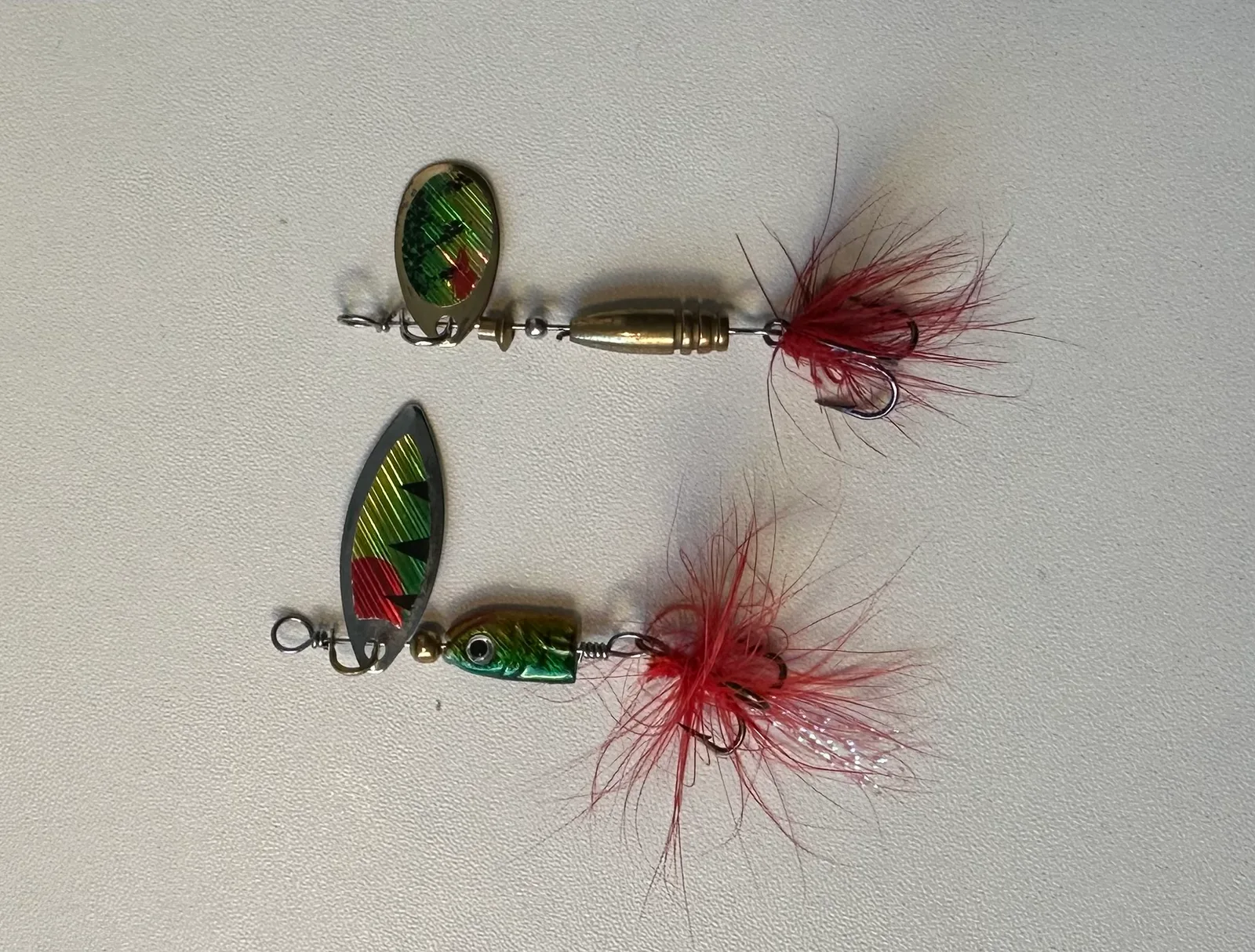
The Rooster Tail is Yakima Bait’s inline spinner, sold in nine weights from 1/24 oz to 1 oz. A willow-shaped blade spins around a weighted, painted body on a straight wire, and the treble hook wears a hackle-feather tail that flares like a rooster’s. You cast it out and reel it back, and it catches trout, bass, panfish, walleye and pike. In 2015 the company’s president called it probably the top-selling inline spinner in the United States, ahead of Panther Martin and Blue Fox.
Howard Worden first called his spinner the Retreat Special. He renamed it the Rooster Tail after watching the Seattle hydroplane races, where the boats throw a plume of spray by that name.
Which size do you need?
Match the size to the fish and the water. The 1/16 oz is the trout standard; 1/4 to 3/8 oz is the size for bass, walleye and pike. Length is measured with the hook. Most sizes also come with a single hook (a #4 at 1/6 oz, a #2 at 1/4 oz) for waters where single hooks are the rule.
| Size | Length | Treble | Line | Fish |
|---|---|---|---|---|
| 1/24 oz (1.2 g) | 1 3/4 in (4.4 cm) | #14 | 2–4 lb | Small-stream trout, bluegill, crappie |
| 1/16 oz (1.8 g) | 2 in (5.1 cm) | #12 | 4 lb | Stream trout, panfish; the trout standard |
| 1/8 oz (3.5 g) | 2 1/4 in (5.7 cm) | #10 | 4–6 lb | Trout in rivers and lakes, smallmouth, white bass |
| 1/6 oz (4.7 g) | 2 1/2 in (6.4 cm) | #8 | 6 lb | Trout in bigger rivers, smallmouth, crappie in wind |
| 1/4 oz (7 g) | 2 3/4 in (7 cm) | #6 | 6–10 lb | Bass, walleye, big trout, pickerel |
| 3/8 oz (10.6 g) | 3 in (7.6 cm) | #6 | 8–12 lb | Bass, pike, stripers, lake trout |
| 1/2 oz (14 g) | 3 1/2 in (8.9 cm) | #4 | 10–14 lb | Pike, stripers, salmon |
| 3/4 oz (21 g) | 4 in (10.2 cm) | #1 | 12–17 lb | Salmon, steelhead, big pike |
| 1 oz (28 g) | 4 1/2 in (11.4 cm) | #1/0 | 15–20 lb | Salmon, lake trout trolled, stripers |
The usual advice puts stream trout on 1/16–1/8 oz and trout in lakes on 1/8–1/4 oz. Bass and pike get 1/4–1/2 oz. There is one exception worth knowing: when the bass bite on a big lake goes tough, Wired2Fish’s reviewer drops to an 1/8 oz on a medium crankbait rod.
In the end, the right size is the one that turns the blade at the speed you want to fish. To see what a #14 or a #1/0 treble actually looks like, the hook size chart has them side by side.
What rod and line?
The trout and panfish sizes want a 5 ft 6 in to 6 ft 6 in (1.7–2 m) ultralight or light spinning rod with a fast tip. Add a 1000 or 2000 reel and 4–6 lb monofilament. The same Wired2Fish reviewer fishes his on anything from a 4 ft 8 in (1.4 m) ultralight to a 6 ft (1.8 m) rod with 6 lb mono. In his view, the longer rod only buys distance.
The bass and walleye sizes want a 6 ft 6 in to 7 ft (2–2.1 m) medium spinning rod, a 2500 reel and 8–10 lb line. For river smallmouth, the 1/8 and 1/4 oz both fish well on the light setup.
Monofilament suits the lure. It floats a little, which keeps a light spinner up in a shallow stream. It is also cheap enough to change when the twist gets into it anyway. For northern pike, add a wire or heavy fluorocarbon leader: pike cut off spinners more than any other lure.
Why does the line twist, and how do you stop it?
An inline spinner’s blade turns one way, and every turn puts a twist in the line. After fifty casts, a spool of 4 lb mono is a bird’s nest of coils.
The fix is a small barrel swivel, size 12 or 14, tied into the line about 12 in (30 cm) above the lure, with a leader below it. The swivel absorbs the twist. A snap swivel at the lure works too, but it can foul the blade on the small sizes. Put the swivel on before the first cast, not after the first tangle.
Some spinners are built to fight the twist. The Vibric Rooster Tail’s offset body and the Blue Fox Vibrax’s gear system both reduce it. Neither removes it.
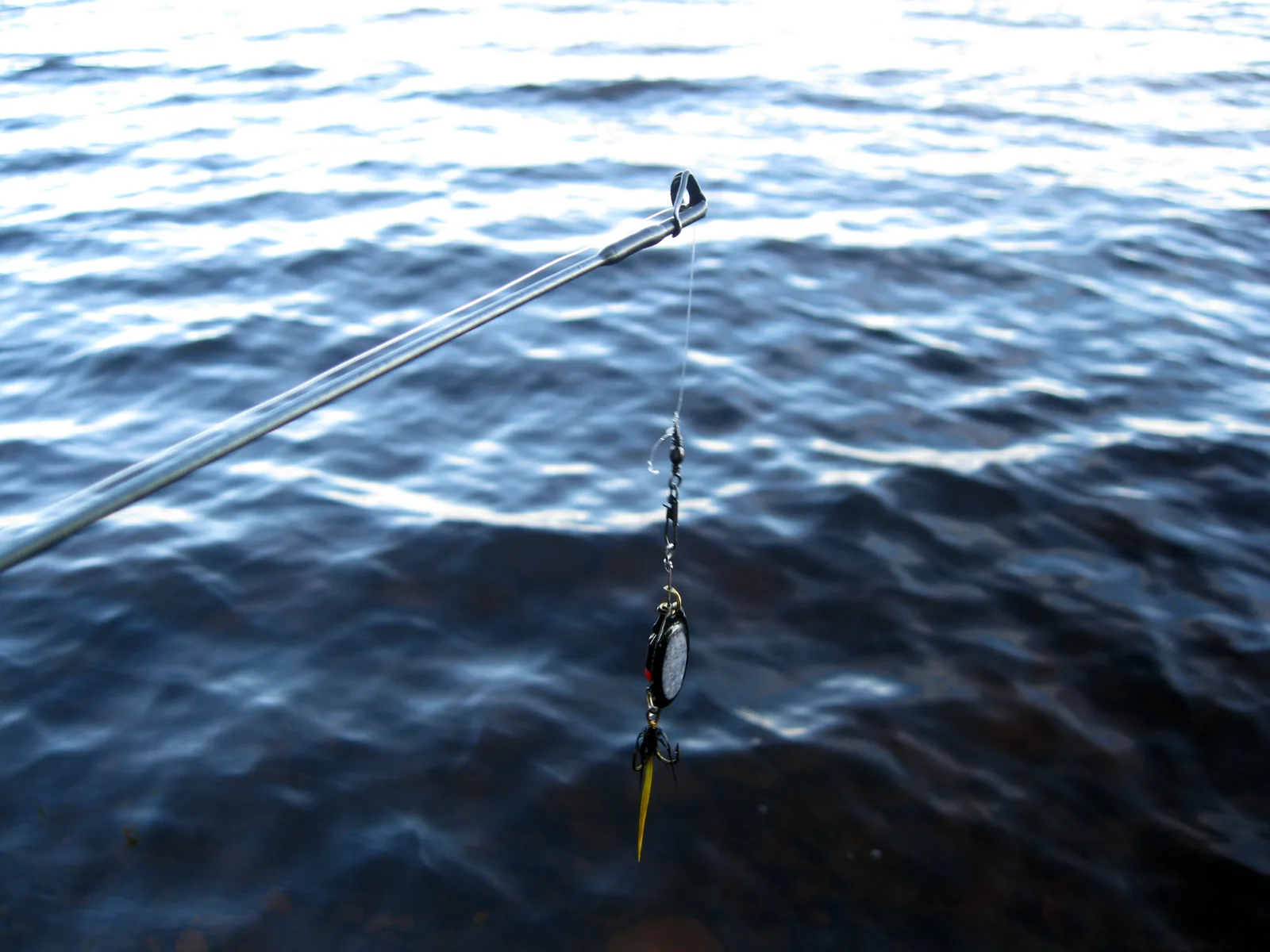
Photo: Santeri Viinamäki, Wikimedia Commons (CC BY-SA 4.0)
How do you fish it?
Reel just fast enough to feel the blade thump through the rod. That is the one rule every spinner guide gives. Reel faster and the lure rides up and the blade blurs; reel slower and the blade stalls. In current, the water turns the blade and the reel only takes up slack.
| Water | Cast | Retrieve |
|---|---|---|
| Small stream | Upstream and across, above the pool or the seam | Reel just fast enough to turn the blade against the current; let it swing through the seam and the tail-out |
| River, bigger water | Across and slightly downstream | Slow reel, rod tip low; the current turns the blade; pause at the end of the swing |
| Lake, shoreline | Along the bank, parallel to weed lines and drop-offs | Count it down a foot a second to the depth, then a steady retrieve, with an occasional pause so it flutters |
| Lake, deep | Over points and humps | Count down, slow retrieve, rod tip up to keep it off the bottom |
| Pond | Anywhere | Steady; vary the speed until fish follow |
A twitch of the rod every few turns makes the blade stutter and the tail pulse. A stalled blade that starts spinning again is a strike trigger.
For river trout, the reviewer describes the version he grew up with on Georgia’s Chattahoochee. Reel it right under the surface through the current eddies, and watch the fish come up for it.
When do you set the hook?
The treble swings free behind the body, and that is why a Rooster Tail hooks and holds so well: a fish cannot use the body as a lever against the hook. How you set the hook depends on the mouth.
- Bluegill and other small-mouthed panfish: let the rod load before you pull. A bluegill often misses the treble on the first grab and keeps hitting until it is hooked.
- Bass and crappie: a short sweep the moment the rod loads. Wait too long and the fish swallows the treble, and a treble hook deep in a crappie is hard to get out alive.
The trebles stay sharp for a long run of fish, but they dull on rock. Check the points after every snag.
Which color?
The 1/16 oz alone comes in 128 colors, the 1/24 oz in 60 and each of the three largest sizes in 24. The choice is simpler than that wall suggests, because a trout sees the flash first and the tail last. The blade finish matters most, the tail color less and the body color least.
- Trout: black with a yellow body, brown trout, rainbow trout; a white or chartreuse body in stained water. A gold or copper blade in low light and tannic water, silver in bright sun and clear water.
- Bass and pike: white, chartreuse, firetiger; a gold blade on the bigger sizes.
- White bass: white or white-and-gold when the run is on.
Hank Parker’s blade rule for bass spinnerbaits holds for spinner blades too: thump for dirty water, flash for clear. A Rooster Tail’s willow-shaped blade is on the flash side. That is one reason it shines in clear trout water, and the reason the Vibric exists for stained water. The spinnerbaits hub sets the inline spinner beside the bass spinnerbait and the buzzbait.
Which Rooster Tail model?
The Original is one of a dozen models that share the blade and the hackle. These are the ones that change how the lure fishes:
| Model | Sizes | What differs | Use it for |
|---|---|---|---|
| Original | 1/24–1 oz | Silver, brass, copper or painted blade; hackle tail | Everything on this page |
| Vibric | 1/16–1/2 oz | Noise-making blade and body; offset body that reduces line twist | Stained water, white bass runs |
| Sonic | 1/16–1/4 oz | Weighted brass body with a sound-producing design; #12, #8, #6 trebles | Deeper, faster water for its size |
| Minnow | 1/16–1/4 oz | Minnow-shaped body, same blade | Shad and shiner lakes |
| Super | 1/8–1/4 oz | Double hook instead of a treble, which snags less | Weedy bass ponds, brushy trout creeks |
| Prop Blade | 1/32 oz | Propeller blade, #14 treble | The smallest streams and the smallest trout |
Hammered-blade, copper-blade, UV and red-hook versions of the Original add a finish, not a different lure.
Where did the Rooster Tail come from?
R.B. Worden founded Worden’s Floating Spinner Company in Granger, Washington, in 1934 by the company’s own account; his son’s obituary says 1929. In 1941 it became the Yakima Bait Company, selling hand-tied flies and wooden bass plugs.
His son Howard joined in the late 1940s, just as spinning reels reached the United States. On a summer trip to California he built a weighted spinner with a willow leaf blade and a hackle tail.
The lure stayed a Northwest secret until the 1960s. Then Florida anglers tried samples and, in the company’s words, immediately caught bass with them; the East Coast followed. Howard Worden died in 2015 at 93, and the lure he named still carries the Worden’s name on the card.
Mistakes to avoid
- No swivel. Twisted line by lunch.
- Reeling too fast. The blade blurs and the lure rides up; slow down until you feel each turn.
- Too big a size in a small stream. A 1/8 oz in a creek spooks trout a 1/16 oz catches.
- Casting downstream only. Up and across lets the lure swing at the current’s speed.
- Setting the hook like a jig. A sweep is enough; the free-swinging treble does the rest.
- Dull trebles. Small trebles dull on rock; check and replace.
Rooster Tail, Mepps or Panther Martin?
All three are inline spinners, and all three twist line. What separates them is the blade and the profile.
| Rooster Tail | Mepps Aglia | Panther Martin | |
|---|---|---|---|
| Maker, origin | Yakima Bait, Washington, late 1940s | André Meulnart, France, 1938 | Panther Martin, 1950s |
| Blade | On a clevis, willow shape; a hackle tail | On a clevis, the wide “butterfly” blade | Spins directly on the shaft; no clevis |
| Starts spinning | Easily | Easily | Instantly, even in slow water; the choice for small, slow streams |
| Profile | Biggest, for the tail | Medium | Smallest, densest; casts farthest for its weight |
| Twist | Yes; swivel | Yes; swivel | Yes; swivel |
| Best for | Lakes, bass, bigger trout | The all-rounder | Small streams, wary trout |
The case for the Panther Martin is its shaft-mounted blade, which spins the moment the lure moves. Even so, the trout spinner lists keep all three. The inline spinners page adds the Blue Fox Vibrax to this comparison, and the lures hub maps every other family.
Most Rooster Tails are bought for one fish; the rainbow trout page says where to find it.
Related
Section guide
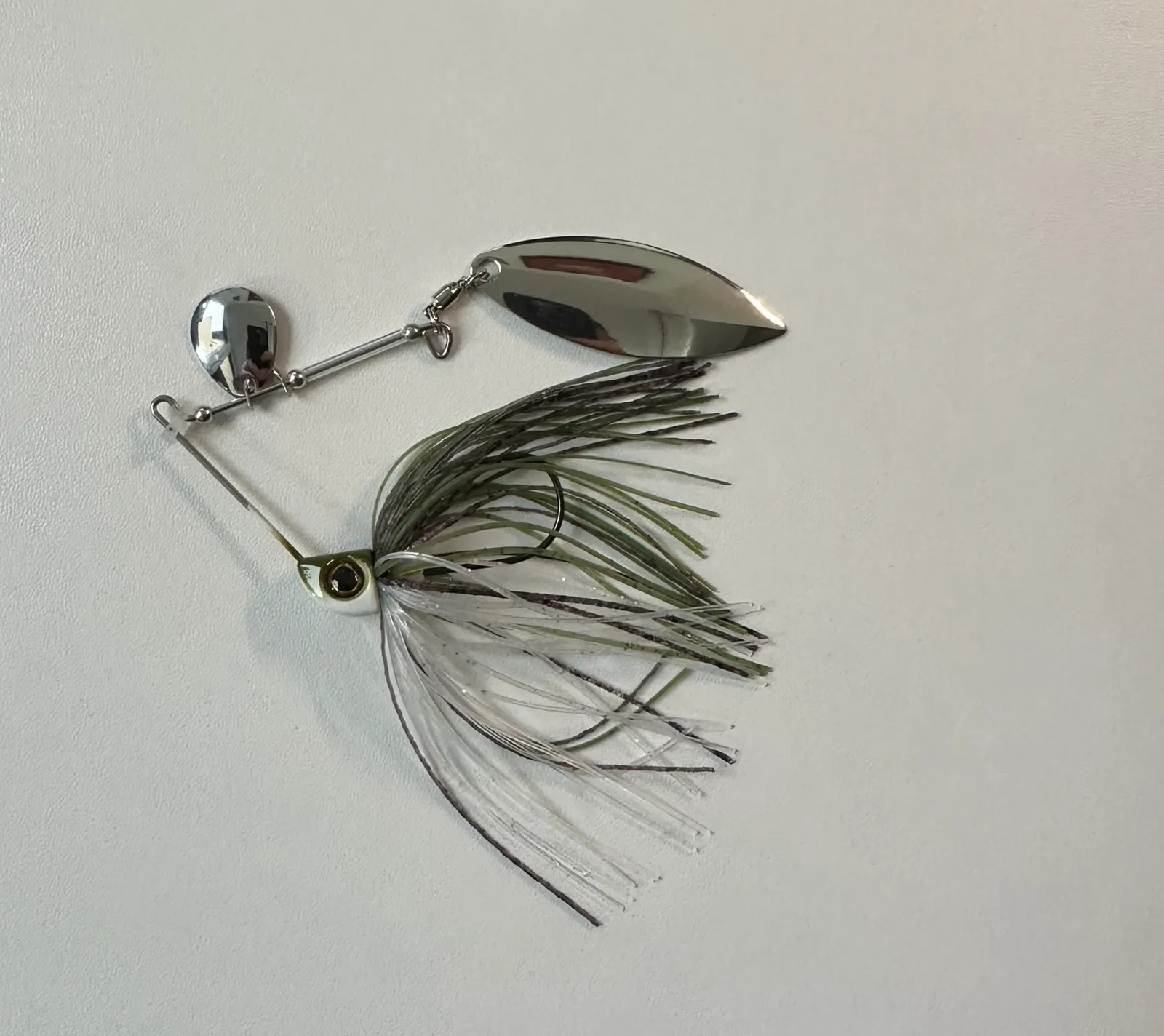
Spinnerbaits, Buzzbaits and Inline Spinners: Blades ExplainedSpinnerbait blades decoded, Colorado, Indiana and willow, the retrieve and water each suits, plus buzzbaits and inline spinners from Mepps to Rooster Tail.
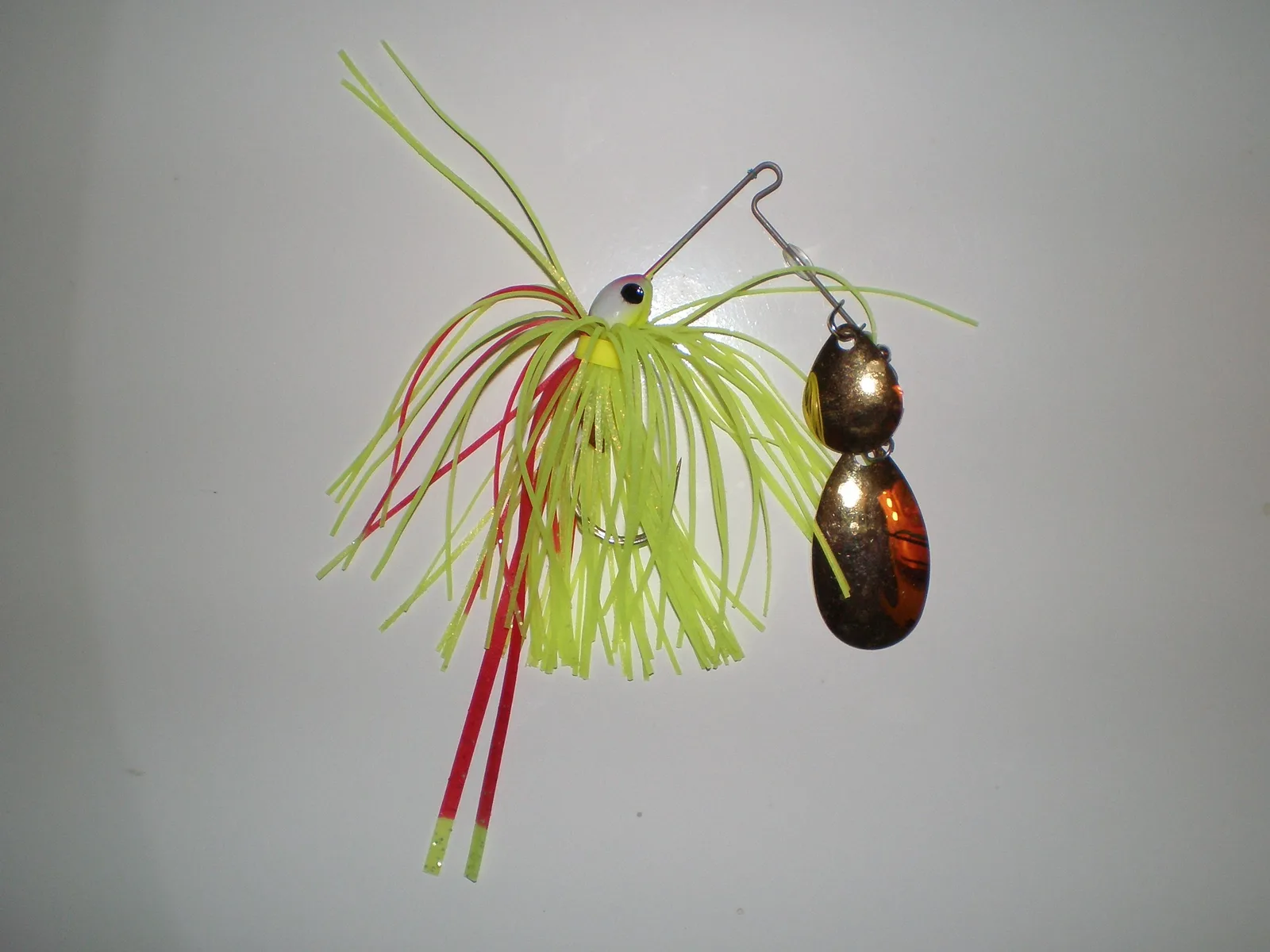 Buzz Bait: How to Fish It, the Trailer Hook, and When It Beats a Frog
A buzz bait is a wire-frame topwater with a propeller blade that squeals and churns; it sinks at rest, so it must keep moving. Retrieve, trailer hook, when.
Sources
- Yakima Bait, about the company and the Rooster Tail's history
- Yakima Bait, Rooster Tail product range (sizes, hooks, lengths)
- Yakima Bait, Original Rooster Tail 1/24 oz treble (length, hook, colors)
- Yakima Bait, Original Rooster Tail 1/16–1/4 oz treble (length, hook, colors)
- Yakima Bait, Original Rooster Tail 3/8 oz treble (length, hook, colors)
- Yakima Bait, Original Rooster Tail 1/2–1 oz treble (length, hook, colors)
- Yakima Bait, Sonic Rooster Tail 1/16–1/4 oz (hook sizes)
- The Spokesman-Review, Howard Worden, creator of the Rooster Tail, dies at 93 (2015)
- Wired2Fish, Worden's Original Rooster Tail review
- On The Water, five essential spinners for trout
- MeatEater, a Panther Martin man's guide to inline trout spinners
- Tackle App, how to use inline spinners
- BassResource, Hank Parker on spinnerbait blade types