 By
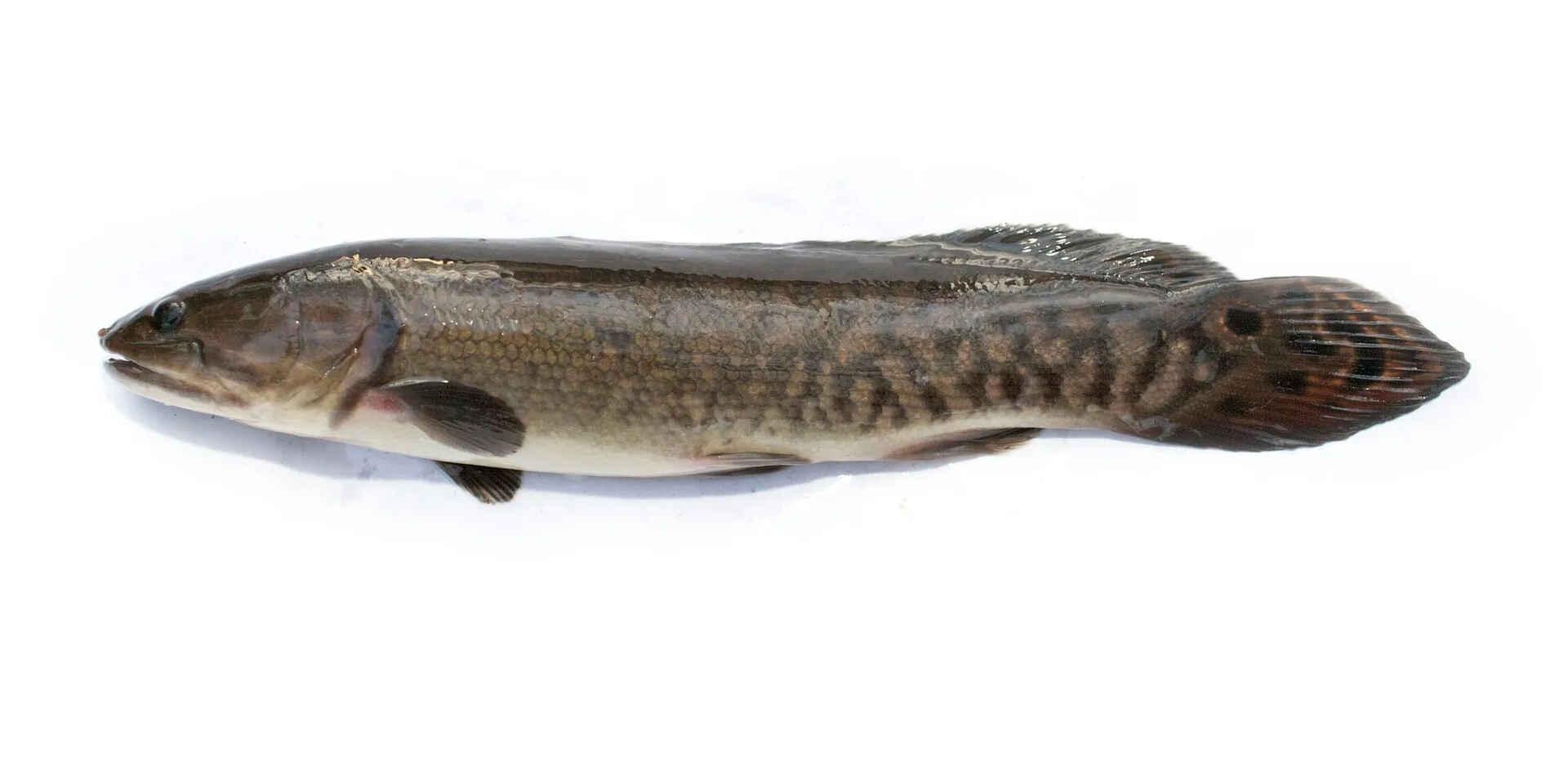
The bowfin is a native, air-breathing predator of the warm, weedy backwaters of eastern North America, usually 15 to 27 in (38 to 69 cm) long, with a world record of 21 lb 8 oz (9.75 kg). Few anglers set out for one; most meet it by accident while fishing for bass, crappie or catfish, and remember the fight. It is also the fish most often mistaken for the invasive northern snakehead, and one fin on the belly tells the two apart.
A farmer once plowed up a live bowfin in a field that had been flooded a few weeks before. The fish gulps air into a swim bladder that works like a lung.
How do you identify a bowfin?
Look along the back first. A bowfin is a stout, nearly cylindrical fish with one long, soft dorsal fin that runs more than half the length of the back, with more than 45 rays and no spines. The tail, or caudal fin, is rounded, and the backbone curves up into it.
Then look at the head. It carries no scales on top, the mouth is big, with long, sharp, curved teeth lining nearly every bone in it, and each nostril has a small barbel-like flap. Underneath, between the lower jaws, sits a bony gular plate: Alabama’s fish survey calls the bowfin the only freshwater fish in that state with one.
The color is mottled olive green, shading to a light green or cream belly. Young fish and adult males carry a black spot at the upper base of the tail, ringed with yellow or orange; in adult females it fades or disappears. In spring, breeding males turn their lower fins a green that Iowa’s DNR calls “vivid as fresh paint”.
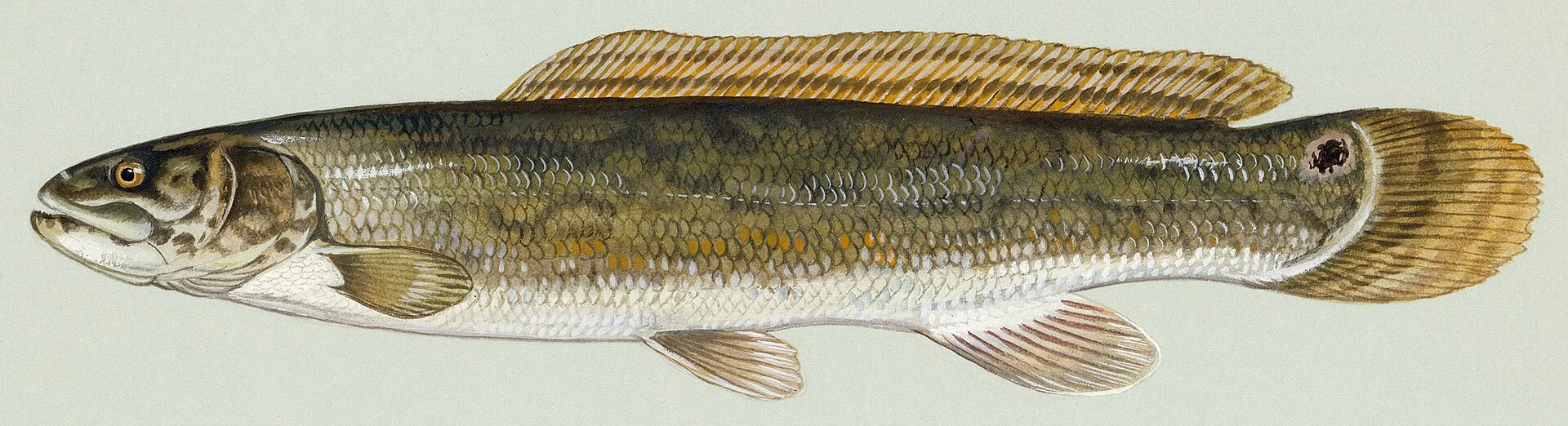
Illustration: Duane Raver, U.S. Fish and Wildlife Service (public domain)
Few fish carry more nicknames. Minnesota and Wisconsin both give dogfish as its other name; Texas lists grindle, grinnel, cypress trout and mudfish, and in Louisiana it is choupique, from the Choctaw name for the fish. None of them make it a shark or a trout: the two bowfins are the last living members of their own family, the Amiidae.
One bowfin or two?
Two, since 2022. A DNA study by Brownstein and colleagues split the bowfin into two species that diverged during the ice ages:
- Emerald (or eyetail) bowfin, Amia ocellicauda: the upper and lower Mississippi and Ohio basins, the Great Lakes, the St. Lawrence and Lake Champlain, the Connecticut River, and west into East Texas rivers. Greenish overall, with a well-marked tail spot.
- Ruddy bowfin, Amia calva: Atlantic rivers from Virginia to Florida, peninsular Florida, and the northern Gulf from the Pearl River east through much of Mississippi, Alabama and Georgia. Reddish brown, with a weaker tail spot and a few more teeth.
For the angler nothing changes: both fish the same way, and most state rules still list a single “bowfin”.
Bowfin vs. snakehead: how do you tell them apart?
Check the anal fin, the fin on the belly behind the vent. On a bowfin it is short, less than a quarter the length of the dorsal fin in Wisconsin’s description. On a northern snakehead it is long: about two-thirds the length of the dorsal fin by Wisconsin’s count, almost as long as the dorsal on Texas’s drawing.
The pelvic fins are the second check: a snakehead’s sit almost under the pectoral fins behind the gills, a bowfin’s are set well back toward mid-body. The scales on top of the head settle it: bare on a bowfin, a snake-like mosaic of scales on a snakehead.
| Check | Bowfin (native) | Northern snakehead (invasive) |
|---|---|---|
| Anal fin | Short, under a quarter of the dorsal fin | Long, two-thirds of the dorsal fin or more |
| Pelvic fins | Set back, near mid-body | Close behind the pectoral fins |
| Top of the head | No scales | Scaled, in a snake-like pattern |
| Sides | Mottled olive to brown, no bold pattern | Dark blotches in a bold, snake-like pattern |
| Under the jaw | A bony gular plate | No plate |
| If you catch one | Release it, or keep it within your state’s rules | Do not release it alive; photograph it and report it |
The look-alike problem cuts both ways. A native bowfin killed as a “snakehead” is a loss, and Missouri’s field guide warns of people persecuting bowfins “out of fear and ignorance”. A snakehead put back as a “bowfin” can spread: it is listed as injurious wildlife under federal law, and Pennsylvania, Missouri and Texas all forbid keeping one alive.
What the agencies ask is plain. Texas says not to release a suspected snakehead alive, and Pennsylvania asks anglers not to release it and to report it. South Carolina wants it in a cooler and reported at once. Michigan’s DNR advises anglers not to put one back in the water. By USGS records the northern snakehead is established in Delaware, Virginia, Maryland, Pennsylvania, New York, New Jersey and Arkansas. A third look-alike, the burbot, has two dorsal fins and a single chin barbel, so it is quick to rule out.

Free PDF · Water temperature chart Which fish are biting at today's water temperature?
One water temperature reading, and the 16-page chart tells you who's spawning, who's feeding hard, where they sit and what to throw. 26 fish, every number sourced.
Enter your email, confirm it with one click, and the PDF is in your inbox. Plus one email a week on what's biting. Unsubscribe anytime. Privacy.
Where do bowfin live?
The native range runs from the St. Lawrence and the Great Lakes west to northern Minnesota and down the Mississippi basin to the Gulf. It also takes in the Atlantic and Gulf coastal plain, from the Susquehanna in Pennsylvania to the Colorado River in Texas. In Missouri it occurs along the entire length of the Mississippi River. Stocked fish also live outside the native range, in states such as Connecticut, Massachusetts and New Jersey.
Within that range, think quiet water with cover. Bowfin live in swamps, sloughs, oxbows, bayous, backwaters, ditches, borrow pits and weedy lakes. Along big rivers they sit in vegetated backwaters rather than the main channel, and they avoid strong current and very muddy water. Virginia’s biologists find them around downed trees, stumps, cypress knees, undercut banks and submerged weeds.
In Texas they live in the Red, San Jacinto and Sabine river systems and the lower Trinity, Brazos and Colorado. In North Carolina the coastal rivers, swamp tributaries and mill ponds hold them. In Vermont they are a Lake Champlain fish.
They also move by the hour. Bowfin hold in deeper water by day and come into the shallows at night to feed.
When do bowfin bite? The bowfin year
Water temperature sets the bowfin’s calendar. The table follows one fish through the year, from cold water to the spawn and the warm months when it breathes the most air.
| When | Water | What the bowfin is doing |
|---|---|---|
| Cold water | 40–50 °F (4–10 °C) | Air breathing stops entirely |
| Late winter, Deep South | 58 °F (14 °C) | An Alabama male in spawning color, running milt, was collected on February 28 |
| Spawn: March–June by state | About 60–66 °F (16–19 °C) | Males clear round nests in shallow weeds and guard eggs and fry |
| After the spawn | Warming | Fry swarm with the guarding male until about 4 in (10 cm) long |
| Summer | 65–85 °F (18–29 °C) | Air breathing peaks; most active at night and in warm water |
The spawn runs from March to early June in South Carolina, April to June in Virginia, April into early June in Missouri, and May into early June in Vermont. Males build round nests 15 to 36 in (39 to 91 cm) across, near logs and stumps in heavy weeds. The eggs hatch in 8 to 10 days, and the male stays with the young for weeks. A Vermont female of about five pounds can lay up to 24,000 sticky eggs, and South Carolina gives up to 55,000. Fish mature at three to five years old and often live about 12 years.
How do you catch a bowfin?
Bowfin fishing is mostly bass and catfish fishing in the right water. Fish slow, weedy, wood-filled backwaters, cast tight to the cover, and expect the hit to be anything but subtle. The Missouri Conservationist calls the strike on a lure “vicious,” and North Carolina’s agency says almost any standard bass bait catches them, “from shiners to topwater plugs to plastic worms.”
Where to cast. Missouri’s advice is to fish woody cover and vegetation, “even during bright sunny days”. A MeatEater guide to the fishery puts the depth at under 10 ft (3 m) most of the time, and often a foot (30 cm) or less.
Lures. Spinnerbaits, crankbaits and plastic worms from the soft plastics box all work, and Florida’s agency adds that bowfin strike topwater and deep-running lures. The catch is aim. The MeatEater guide reports that a lure often has to pass almost against a bowfin’s nose before it bites, and Missouri notes their habit of “following a lure nearly to the boat before striking.” Expect damage: Texas anglers warned Texas Parks & Wildlife magazine that “the spinner bait will be damaged.”
Bait. This is where the bowfin’s nose pays off. Vermont’s biologists write that its sense of smell is much better than its eyesight, “which is why fishing for them with cut bait is so effective”. Missouri lists nightcrawlers, minnows and bluegill heads, fished on the bottom or under a bobber, for fish that ignore lures. Florida says most bowfin are caught on live bait. Fresh cut bait from the same water works best in the MeatEater guide, with bluegill chunks or shad; check whether your state lets you use a game fish as bait first. The same catfish baits cover most of it.
The rig. One published setup, from the MeatEater guide:
- A 7 ft (2.1 m) extra-fast spinning rod built for catfish, with 40 lb braid.
- A slip bobber with a rubber stopper, so the depth changes in seconds and a running fish feels little drag.
- A 50 lb barrel swivel below the float.
- 16 to 18 in (41 to 46 cm) of 40 lb fluorocarbon leader.
- A 3/0 baitholder or circle hook, snelled.
Under a float the bait stays out of the weeds and soft bottom. The author prefers fluorocarbon to steel for more bites, and changes the leader after a fish if the teeth have scraped it. Texas Parks & Wildlife magazine suggests a stout rod, braided line and “possibly a metal leader” instead.
The bite and the hookset. A bowfin often picks up a bait and runs, working it back into its throat the way a gar does. The mouth is bony and hard, and Missouri warns it is difficult to get a good hookset. Charles Meyer, founder of the Bowfin Anglers site, described big females that “may just park, pick it up and chew, with barely perceptible line twitches your only clue.” His advice is to take up the slack, give a couple of fast cranks “and then hang on”. Circle hooks, which catch in the corner of the mouth, need only steady pressure. A 3/0 is bigger than many anglers would pick, and the MeatEater author finds it pins the fish inside the jaw rather than deep in the throat.
The fight and the landing. A hooked bowfin heads for the nearest thick cover, jumps and shakes its head. Because it can breathe air, the MeatEater guide says, it is never really tired out. Meyer’s advice for unhooking: use a wet leather glove and grip behind the gill plates, because “a ’fin will play possum and thrash around when you least expect it.”
How big do bowfin get, and what is the record?
An adult bowfin is typically 15 to 27 in (38 to 69 cm) and 1 to 5 lb (0.5 to 2.3 kg) in Missouri. Females run bigger than males. The Florida Museum gives females up to 30 in (76 cm) and 8½ lb (3.8 kg), and males 18 to 24 in (46 to 61 cm). Virginia says its fish can top 30 in and 10 lb (4.5 kg), and Texas Parks and Wildlife puts the average Texas fish at six to eight pounds.
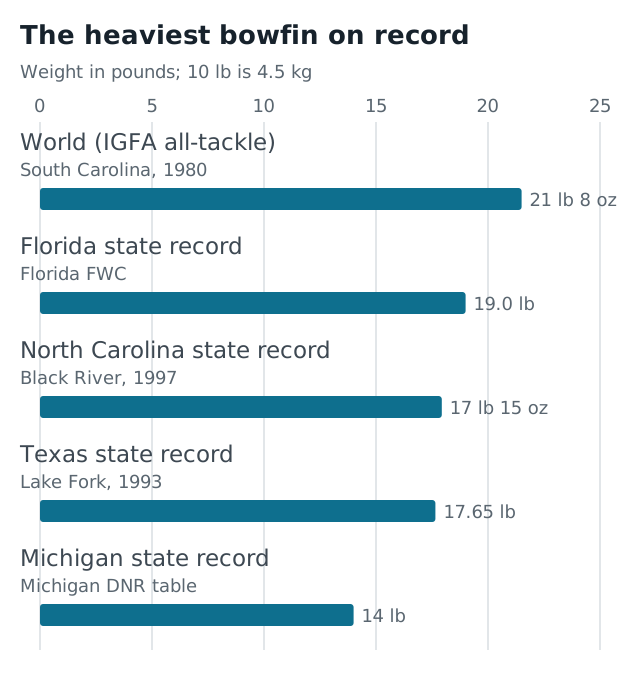
The IGFA all-tackle record is 21 lb 8 oz (9.75 kg), caught by Robert Harmon at Forest Lake, Florence, South Carolina, on January 29, 1980. It is also the South Carolina state record, and it has stood for more than 45 years. The IGFA also keeps length records: 78 cm (30.7 in) from Georgia’s Okefenokee Swamp in May 2025, and 82 cm (32.3 in) on fly from North Hero, Vermont, in 2018.
The state records cluster below it: 19.0 lb in Florida, 17 lb 15 oz in North Carolina (Black River, 1997), 17.65 lb in Texas (Lake Fork, 1993, by Brenda Walsh) and 14 lb in Michigan. Florida also has a Big Catch award for a bowfin of 28 in (71 cm) or 8 lb (3.6 kg).
Can you keep bowfin, and are they protected?
In most states a bowfin is a nongame fish: Texas sets no limit on it, and North Carolina and Missouri class it as nongame. That is changing in places. Vermont sets a daily limit of five, and Missouri’s field guide notes that biologists have been urging states to consider rules on harvest during the spawn.
The reason is caviar. As sturgeon caviar fisheries shrank under tighter rules, bowfin roe gained value, sold in Louisiana as “Cajun caviar”. The best roe comes from females taken a few weeks before they spawn, which removes them before they breed. Louisiana farms now raise bowfin for roe and meat. Rules change, so read your state’s current booklet before you keep one.
Are bowfin good to eat?
They can be, if they are handled right. The Missouri Conservationist is direct: a bowfin “must be kept alive until cleaned or the meat will turn to the consistency of mashed potatoes.” Its method is to fillet the fish like a bass, cut the meat into finger-sized strips, wash them in cold water and fry them. It also notes that bowfin have no mudline, so all the flesh can be eaten. Florida’s agency calls the flesh “jelly-like” but good smoked, fried as patties or stewed.
The other side: the nickname cottonfish comes from flesh that balls up “like cotton” when it is cooked badly or eaten cold. The Florida Museum warns that, as long-lived predators, bowfin build up mercury and other toxins, and they “are often not recommended for consumption.” Check your state’s consumption advisory for the water before keeping one to eat. The eggs, unlike the toxic roe of a gar, are the caviar above.
Are bowfin invasive or aggressive, and do they hurt bass?
Not invasive, and not a threat to bass where they belong. Aggressive, yes, toward prey and lures, as the strikes above show. The bowfin is native across the eastern half of the continent. Outside that range, USGS lists stocked populations, and there it notes that the impacts are unknown and that a predator that eats “virtually any animal small enough to eat” is a potential threat to native fish.
Inside its range, the old belief that bowfin wreck sport-fish populations does not hold up. Missouri’s field guide says “research has disproven that idea” and calls bowfin part of a balanced ecosystem. Adults eat fish, crayfish, insects and frogs; in Missouri, gizzard shad come first, then golden shiners, bullheads and sunfish. Bass anglers catch them on the same lures: Florida says a bass angler is “often surprised” to find a bowfin on the line, and the bowfin lives in the same weedy water as the largemouth bass. For an angler the risk is the teeth at unhooking, which is why Meyer reaches for a glove.
How does a bowfin breathe air?
The bowfin’s swim bladder is lined with blood vessels and works like a lung, filled by gulps of air at the surface. That is why bowfin thrive in swamps and sloughs where oxygen runs out, and why they breathe the most air in the warm water of the bowfin-year table above. Iowa notes that young bowfin have survived 21 days in a pond with no standing water.
The fish is old in a way few are. Its family’s closest relatives appear as fossils about 180 million years old, and the two living bowfins are all that remain of it. The long dorsal fin also lets a bowfin ripple its way backward as easily as forward, which helps in thick weeds, Vermont’s biologists note.
For the bowfin’s neighbors in the same old lineage, the alligator gar page has the biggest of the gars, and the other freshwater fish hub has the rest.
Free PDF · 16 pages
Know what's biting before your first cast
The Water Temperature Fishing Chart. Take one water temperature reading, find it on the chart, and you know which of 26 freshwater fish are feeding today, where they are and what to throw. For your phone and the tackle box.
- Where they sit and what to throw at every band: bass, crappie, bluegill and walleye; catfish by species; trout: when to stop and where they hide
- The best hours at your reading, the cold front day by day, and the spawn calendar from ice-out to midsummer
- The three thermometer mistakes that make a reading lie (the first one is the surface)
- The 26-fish chart: who's spawning, feeding hard or shut down at your reading
Every number from state fish and wildlife agencies and fisheries research: 61 sources, all on the site.
Enter your email, confirm it with one click, and the PDF is in your inbox. Plus one email a week on what's biting. Unsubscribe anytime. Privacy.
Related
Section guide
Freshwater Fish Species Outside the Big Families: Sturgeon, Gar, Bowfin, BurbotThe freshwater fish species outside the bass, trout, catfish and pike families: sturgeon, gar, bowfin, burbot, drum, eel and paddlefish, with records.
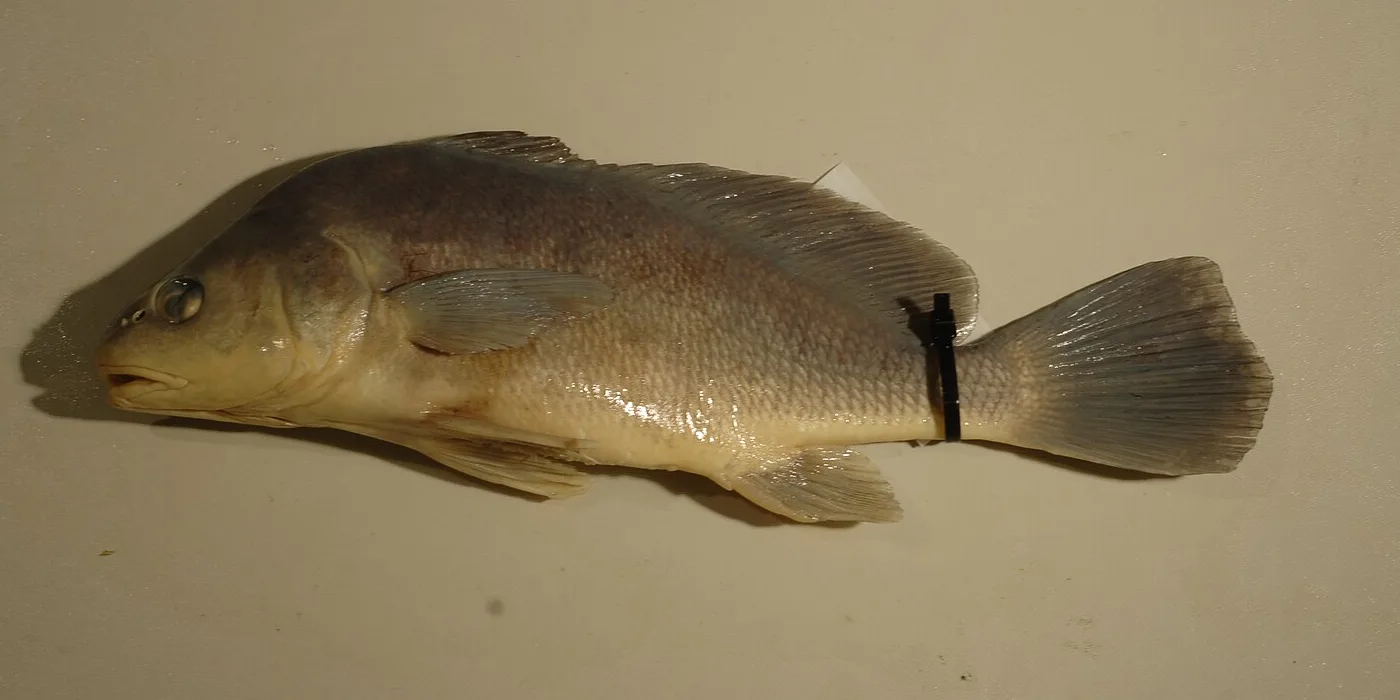 Freshwater Drum: Sheepshead, Gaspergou and How to Catch Them
Freshwater drum, or sheepshead, mostly run 1 to 5 lb; the record is 54 lb 8 oz. How to tell one apart, the rig that catches it and how to cook it.
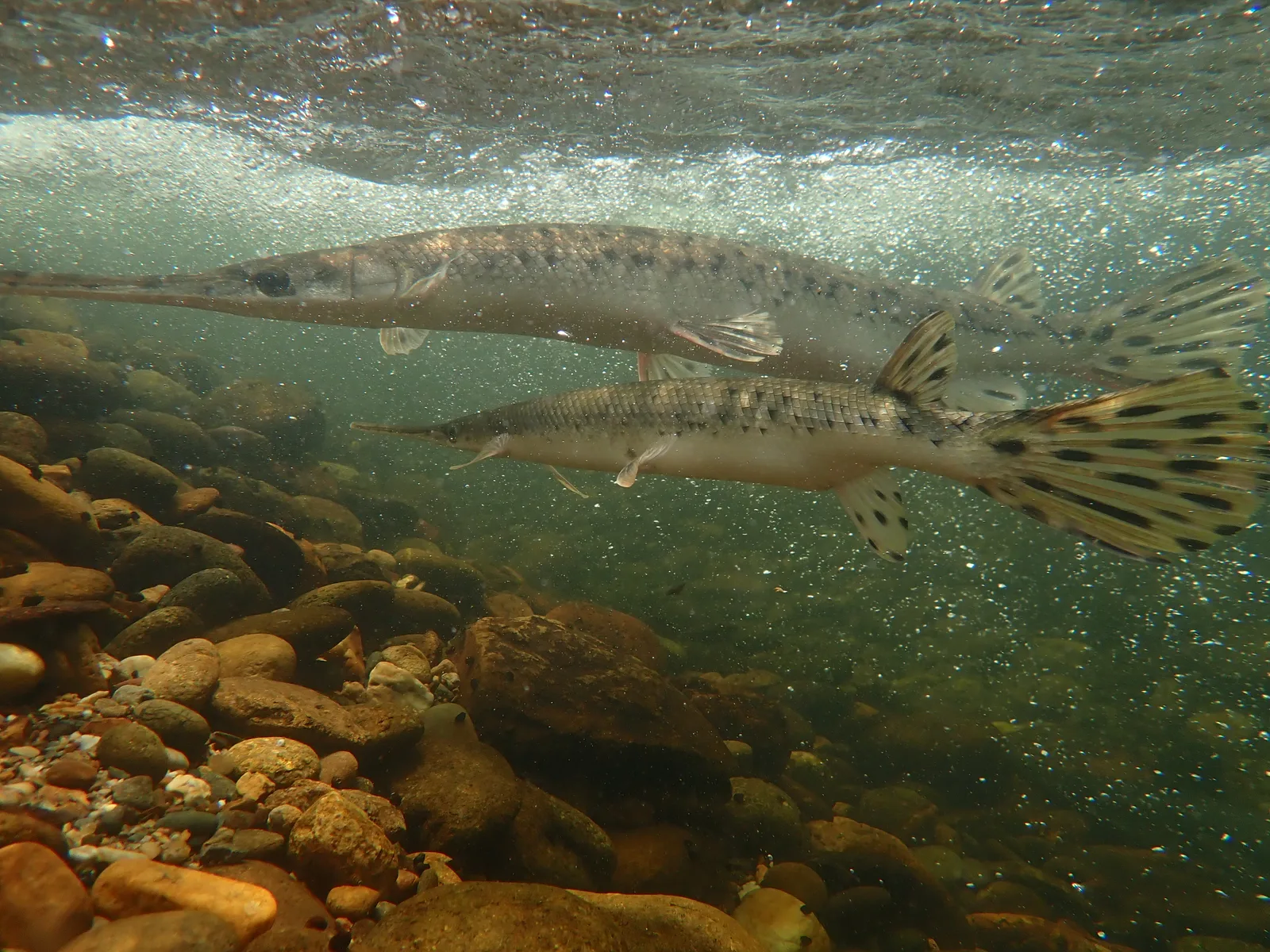 Longnose Gar: Identification, Size, Records, and How to Catch One
Longnose gar commonly reach 3 ft and 5 to 6 lb; the IGFA record is 43 lb, yet four states certify bigger fish. How to ID, find and catch one.
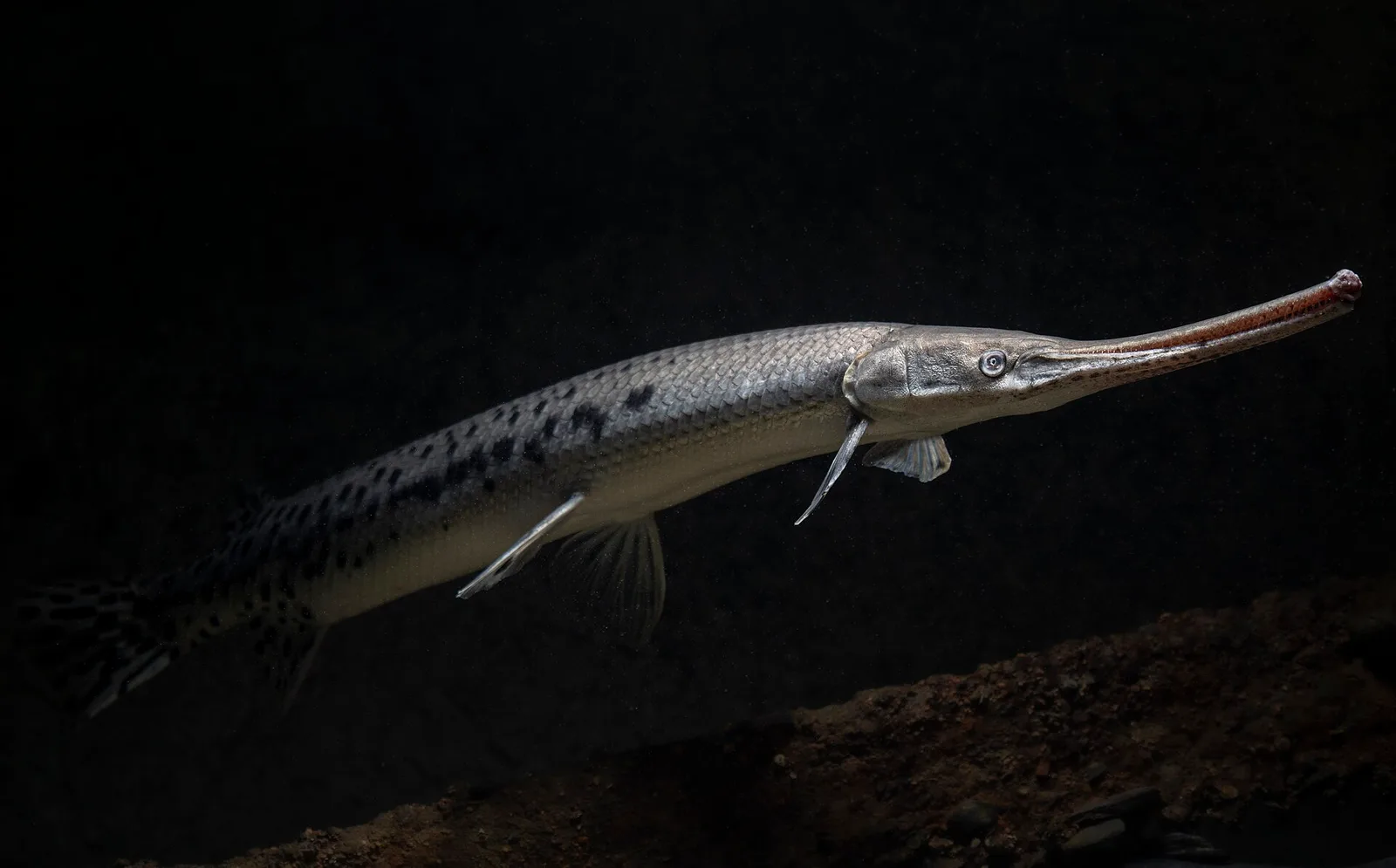 Gar Fishing: Rope Lures, Live Bait and Bowfishing for Every Gar
Gar fishing for all five US gars: hookless rope lures, live bait, fly and bow, the alligator gar rig, and how to handle a mouth full of teeth.
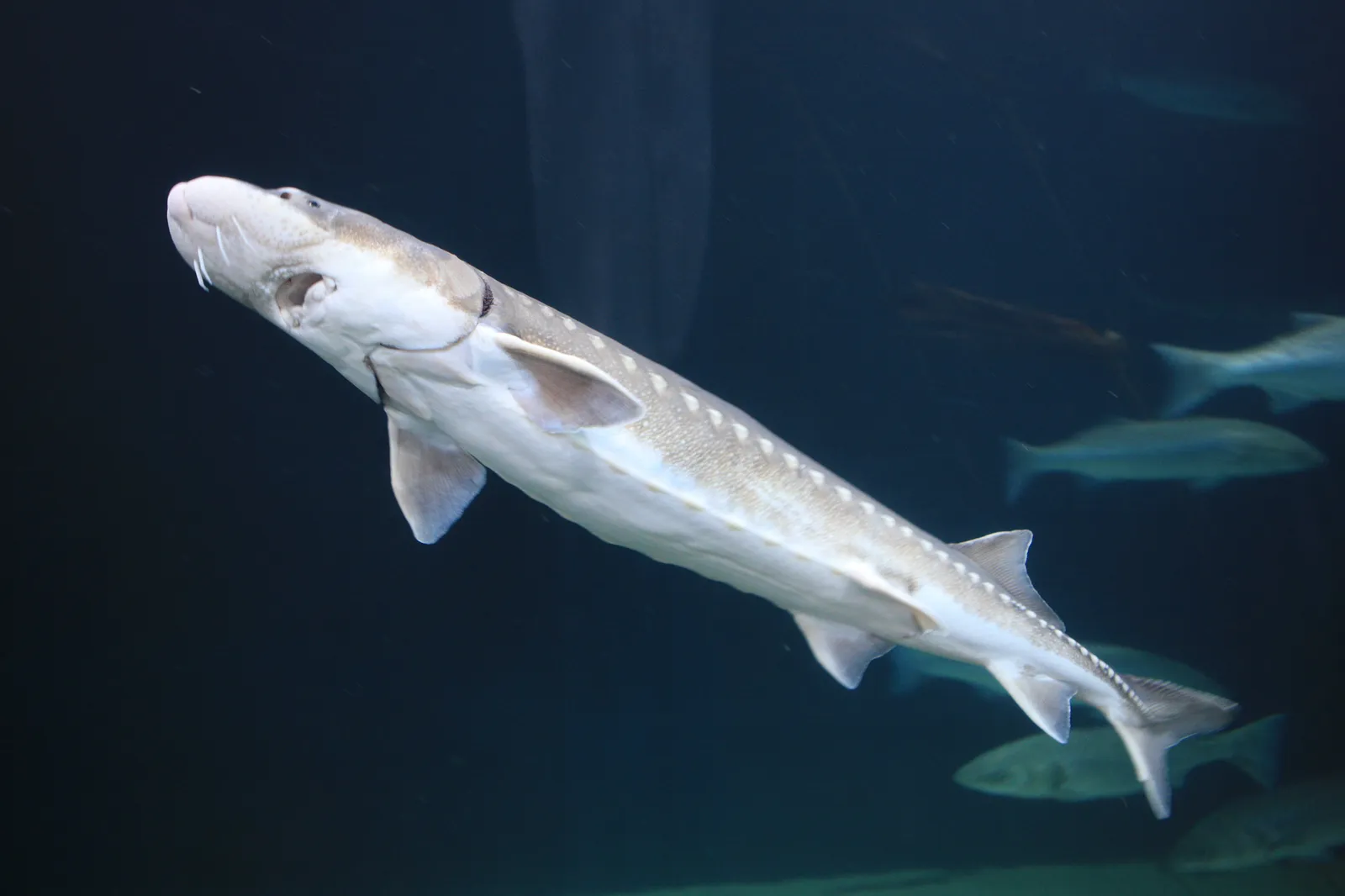 Sturgeon: The Nine US Sturgeons, How Big and Old They Get, and the Rules
Nine sturgeons live in US waters and six may never be kept. How to tell them apart, how big and old they get, the records and where you can fish.
- Alligator Gar: Size, Teeth, Records, and How to Catch One
Alligator gar reach 8 ft and 300 lb and can live past 90 years. How to tell them from other gars, how to catch one, the records and the rules by state.
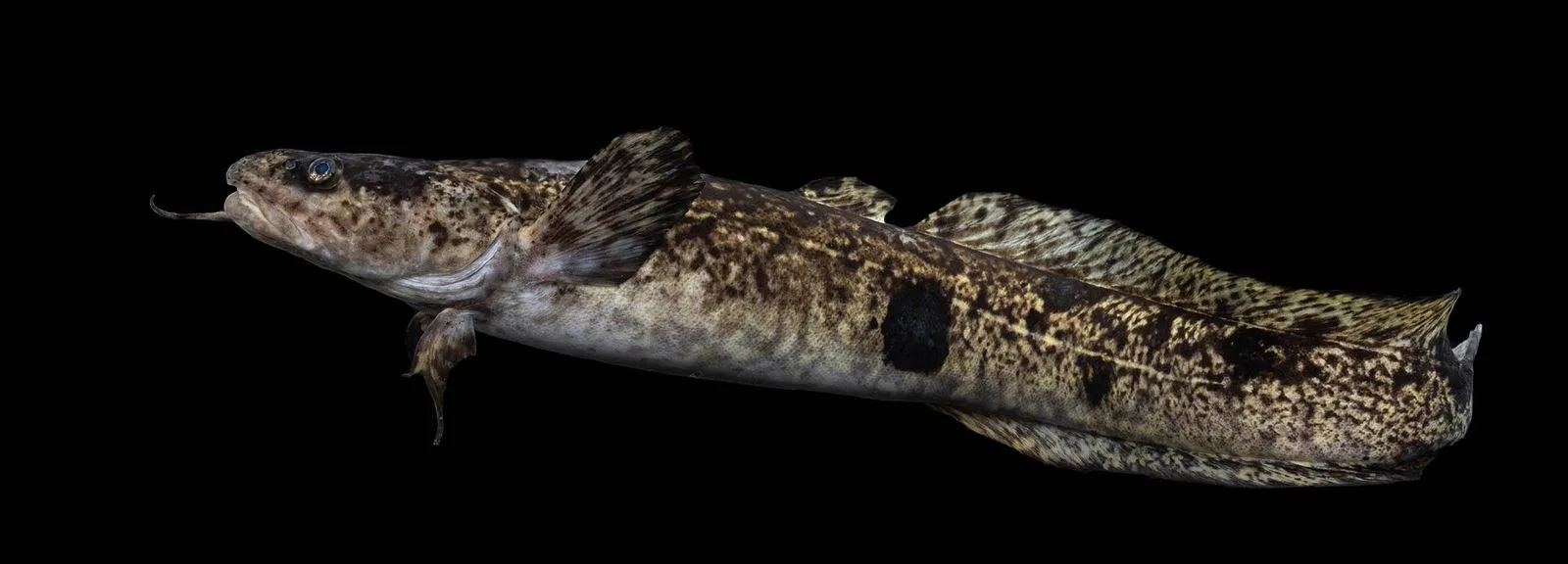 Burbot: The Freshwater Cod That Spawns Under the Ice
Burbot, the only freshwater cod: one chin barbel, 15–28 in, 1.5–5 lb. When and where they bite through the ice, the glow jig that works, and the rules.
Sources
- IGFA World Record Search: Bowfin (all-tackle, Robert Harmon, 21 lb 8 oz; length records)
- Texas Parks and Wildlife Department, Bowfin (Amia calva)
- Texas Parks and Wildlife Department, Bowfin vs. Snakeheads: Distinguishing Features
- Larry D. Hodge, Bowfin Fish: Monsters From the Dinosaur Age Lurk in Texas Waters, Texas Parks & Wildlife Magazine
- Missouri Department of Conservation, Emerald Bowfin (field guide)
- Greg Stoner (2009), Angling for Oddball Fish, Missouri Conservationist
- Minnesota DNR, Bowfin (Dogfish)
- Wisconsin DNR, Did I catch a snakehead?
- Florida Museum of Natural History, Bowfin (Amia calva), Discover Fishes
- Florida Fish and Wildlife Conservation Commission, Bowfin
- North Carolina Wildlife Resources Commission, Bowfin
- South Carolina DNR, Freshwater Fish Records (Mudfish (Bowfin), Forest Lake, 1980)
- South Carolina DNR, Bowfin (Amia calva)
- Vermont Fish & Wildlife Department, Bowfin
- Virginia Department of Wildlife Resources, Bowfin
- Iowa DNR, Fish Iowa: Bowfin
- Alabama Department of Conservation and Natural Resources, Bowfin (from Fishes of Alabama and the Mobile Basin)
- USGS Nonindigenous Aquatic Species, Bowfin (Amia calva) species profile
- USGS Nonindigenous Aquatic Species, Northern Snakehead (Channa argus) species profile
- Pennsylvania Fish and Boat Commission, All About Snakehead
- Michigan DNR (2014), Learn to identify native bowfin versus invasive snakehead fish
- Michigan Invasive Species Program, Northern snakehead
- Brownstein, C. D. et al. (2022), Hidden species diversity in an iconic living fossil vertebrate, Biology Letters 18
- MeatEater, The Beginner's Guide To Bowfin Fishing
- MeatEater, Trash Fish Tuesday: Bowfin
- Joe Cermele, Bowfin vs Snakehead: How to ID, Hook, and Land Both Overlooked Species, Field & Stream
- Michigan DNR, State record fish table (2024 copy)