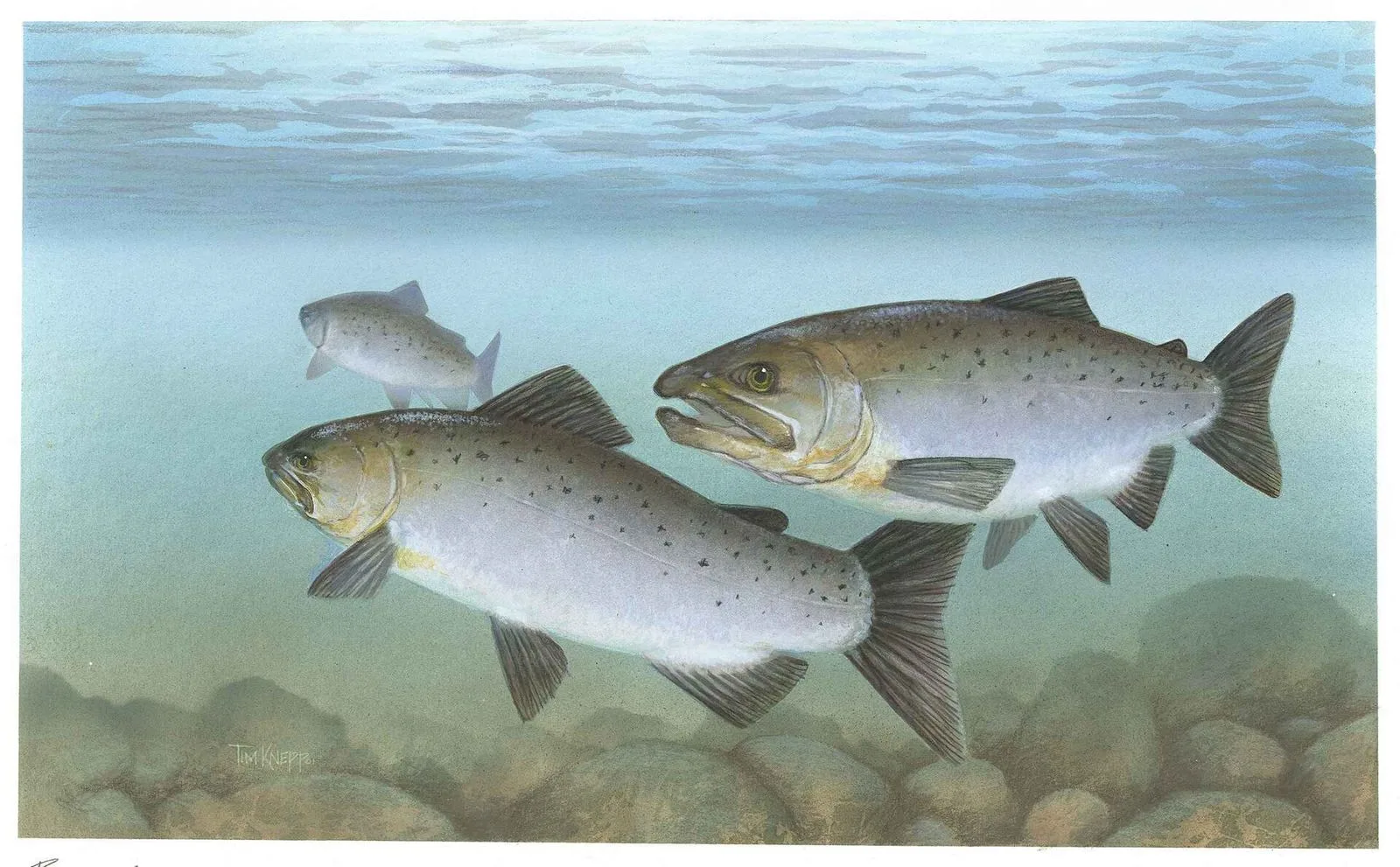
There are six types of salmon a North American angler can meet: five Pacific salmon (chinook, coho, sockeye, pink and chum) and the Atlantic salmon. There are seven Pacific species in all; the other two, masu and amago, live only in Asia. Fresh from the sea or the lake, all of them look silver, and the gum line and the tail are what tell them apart.
Alaska teaches the five Pacific salmon on one hand. Thumb rhymes with chum. The pointer can poke an eye: sockeye. The middle finger is the biggest: king. The ring finger wears silver: coho. The pinky is pink.
Start here
- Coho salmon: the white gum line, the fall runs from Alaska to Lake Ontario, and why the world record came from New York.
- King salmon: the black gum line, California’s four runs, the 2026 Kenai closure and the 97 lb 4 oz record.
- Steelhead: the sea-run rainbow trout that shares the salmon rivers and is often counted with them.
- Water temperature for fishing: where salmon and trout feed, in one chart with 23 other species.
How do you tell the six apart?
Check the mouth first, then the tail. The marks below are the ones on the Alaska and Washington identification cards.
| Salmon | Also called | Typical size | Gum line and tail | Spawning colors |
|---|---|---|---|---|
| Chinook | King, tyee, blackmouth | About 36 in, 30 lb (91 cm, 14 kg) | Black gums; spots on both halves of the tail | Olive brown to maroon |
| Coho | Silver | 24–30 in, 8–12 lb (61–76 cm, 3.6–5.4 kg) | White gums; spots on the upper half only | Dark maroon, dark back |
| Sockeye | Red; kokanee when landlocked | 18–31 in, 4–15 lb (46–79 cm, 1.8–6.8 kg) | White gums, almost no teeth; no tail spots | Bright red body, green head |
| Pink | Humpy, humpback | 20–25 in, 3.5–5 lb (51–64 cm, 1.6–2.3 kg) | Black gums; large oval spots on both halves | Dark back, white belly; male grows a hump |
| Chum | Dog, keta, calico | 24–34 in, 8–15 lb (61–86 cm, 3.6–6.8 kg) | White gums, big teeth; no spots, silver streaks | Calico bars down the sides |
| Atlantic | Landlocked salmon | 28–30 in, 8–12 lb (71–76 cm, 3.6–5.4 kg) | No tail spots; deeply forked tail, slender wrist | Bronze to dark brown |
Two salmon have black gums, chinook and pink, and they are the easiest pair to separate: a pink is small and its tail spots are large ovals. Two have no spots on the tail at all, sockeye and chum; the chum has real teeth and the sockeye almost none.
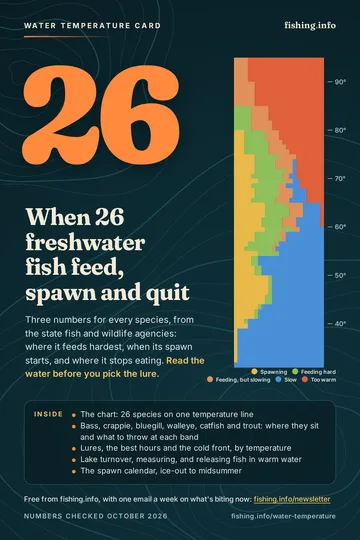
Free card: what 26 species do at your water temperature
Plus one email a week on what's biting now. No sales pitches. Privacy.
Chinook: the king
The king salmon is the largest salmon: a typical adult is about 3 ft long and 30 lb, and Alaska’s profile lists fish to 58 in (147 cm) and 126 lb (57 kg). Chinook mature anywhere from two to seven years old. They range from Monterey Bay to the Chukchi Sea and through the Great Lakes, where they took hold only after Michigan planted them in 1967.
Coho: the silver
The coho is the three-year salmon of small coastal streams, and the fish that opened the Great Lakes salmon fishery in 1966. It swims in all five Great Lakes today.
Sockeye: the red
Sockeye salmon have almost no teeth, the mark that separates a silver sockeye from a silver chum. A sockeye that never goes to sea is a kokanee, and it rarely passes 14 in (36 cm). Sea-run fish live about five years and run from northwest Alaska to Oregon.
Pink: the humpy
Pink salmon are the smallest and the most punctual. On the Pacific coast every one lives exactly two years, so the fish of odd years and even years in the same stream never meet. In the Great Lakes, where they mature at one to four years, pinks are a Lake Superior and St. Marys River fish.
Chum: the dog
Chum spawn at three to six years old and wear the loudest spawning pattern of the family, the calico bars. Spawning males grow canine-like teeth.
Atlantic: the salmon that can spawn again
The only salmon native to the Atlantic, and the only one of the six that can survive spawning and return to do it again. Fishing for sea-run Atlantic salmon is prohibited in the United States. The last wild runs are in Maine, and that population has been listed as endangered since 2000.
What anglers catch is the landlocked form. Maine has it in more than 300 lakes, and Michigan stocks Atlantic salmon in Lake Huron, the St. Marys River and Torch Lake.
And the steelhead?
A steelhead is a rainbow trout that goes to sea. It belongs to the same genus as the Pacific salmon, runs the same rivers and is counted with them as a Pacific salmonid by NOAA, but unlike them it does not have to die after spawning. The salmon’s other close relatives, rainbow, brown, brook and lake trout, are on the trout hub.
Which salmon are protected?
On the Pacific coast, protection goes by population, not by species. NOAA lists nine chinook populations, four coho, two sockeye and two chum as endangered or threatened, and no pink salmon at all. On many West Coast waters that means a wild fish, with its small adipose fin intact, goes back. Check the rules for the river and the season before you keep any salmon.
How big is the record for each?
| Salmon | World record (IGFA) | Angler, year, water |
|---|---|---|
| Chinook | 97 lb 4 oz (44.11 kg) | Les Anderson, 1985, Kenai River, Alaska |
| Atlantic | 79 lb 2 oz (35.89 kg) | Henrik Henriksen, 1928, Tana River, Norway |
| Chum | 35 lb (15.87 kg) | Todd Johansson, 1995, Edye Pass, British Columbia |
| Coho | 33 lb 4 oz (15.08 kg) | Jerry Lifton, 1989, Salmon River, New York |
| Sockeye | 15 lb 3 oz (6.88 kg) | Stan Roach, 1987, Kenai River, Alaska |
| Pink | 14 lb 13 oz (6.74 kg) | Alexander Minerich, 2001, Monroe, Washington |
Two of the six came from one Alaskan river, the Kenai, two years apart. Every other species guide is on the fish species page.
All articles
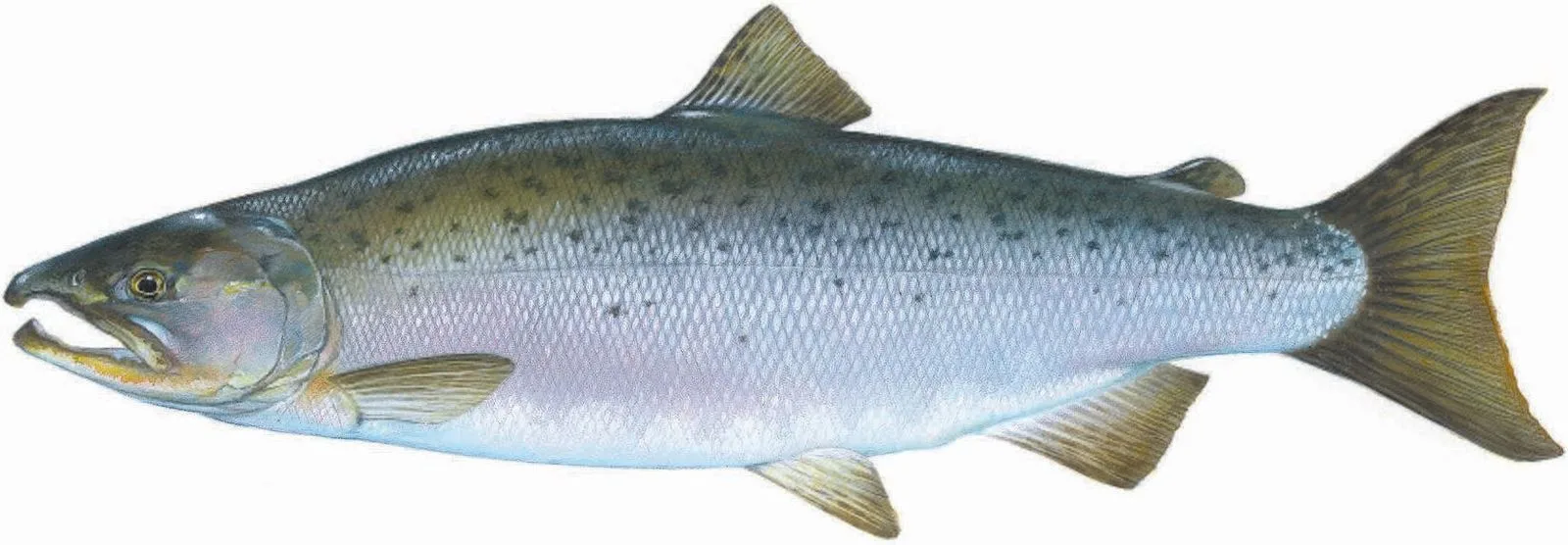 Coho Salmon: How to Tell a Silver From a King, Size, Runs and Records
Coho salmon: the white gum line that separates a silver from a king, how big they get, when they run from Alaska to the Great Lakes, and the record.
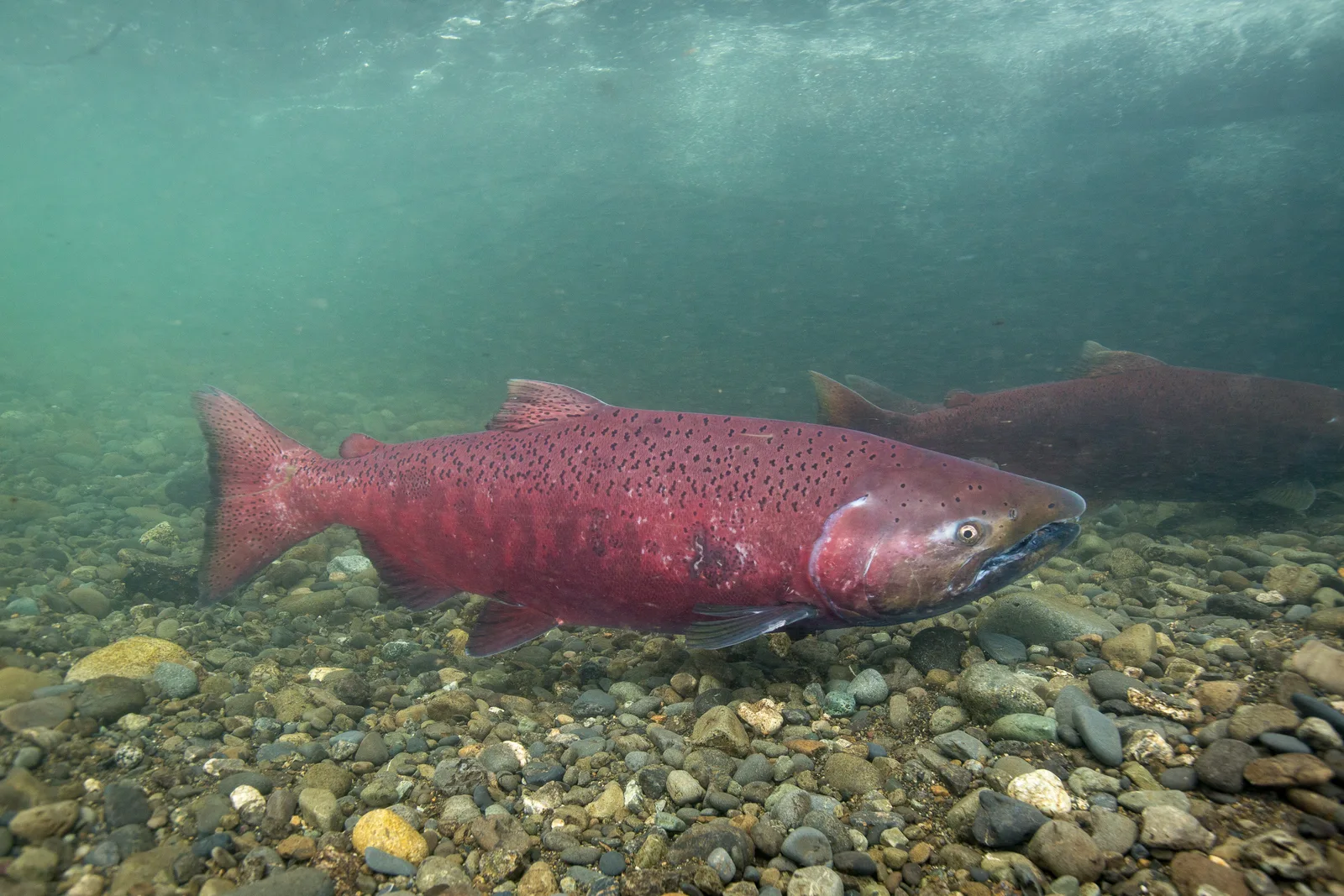 King Salmon (Chinook): Black Gums, Size, Runs and the 97-Pound Record
King salmon, or chinook: the black gums that mark a king, how big they get from Alaska to the Great Lakes, when each run starts, and the 97 lb 4 oz record.
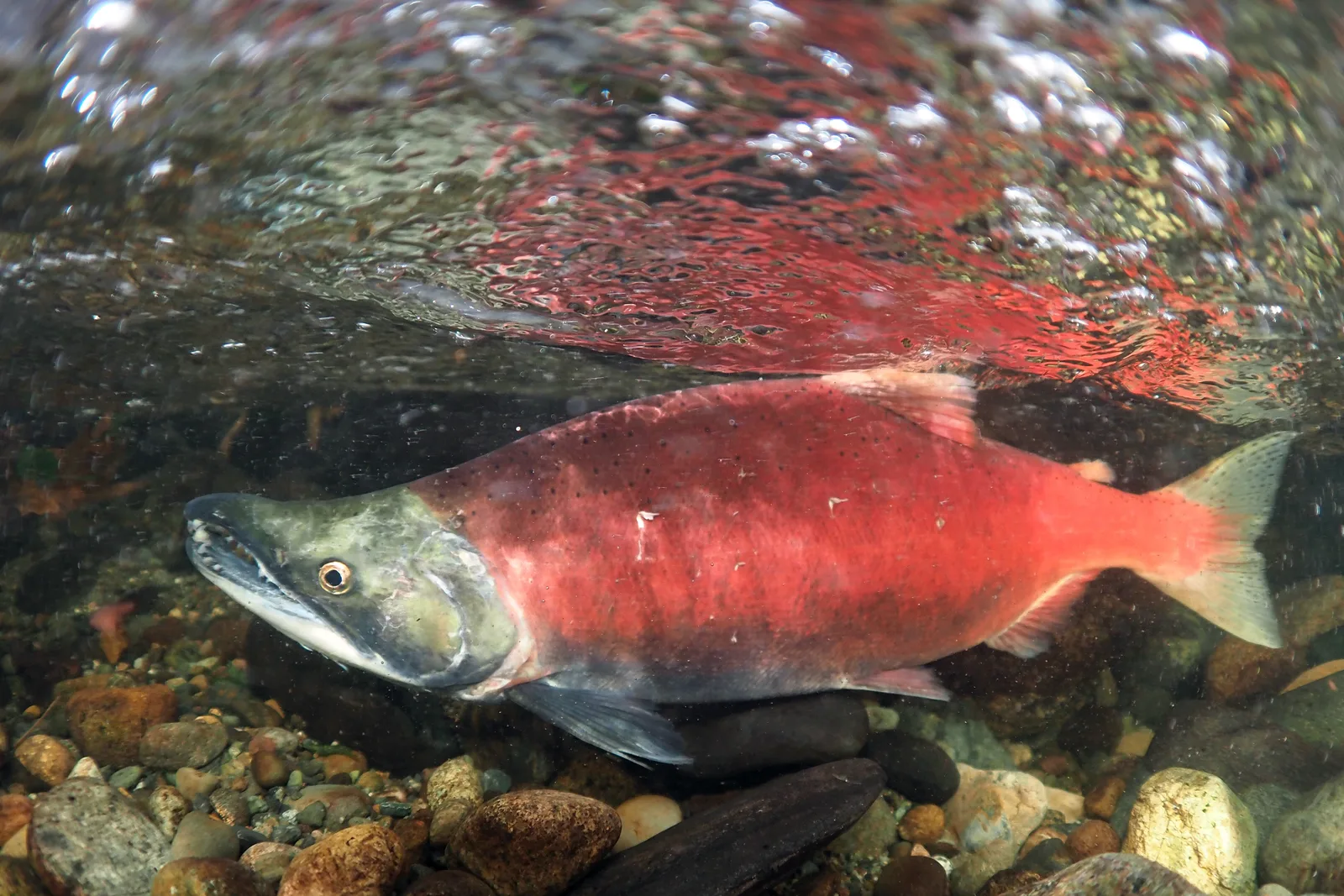 Kokanee Salmon: The Landlocked Sockeye, Season by Season
Kokanee salmon are sockeye that never reach the sea. How to tell one, the 50 °F depth they hold at each season, how to troll for them, and the record.
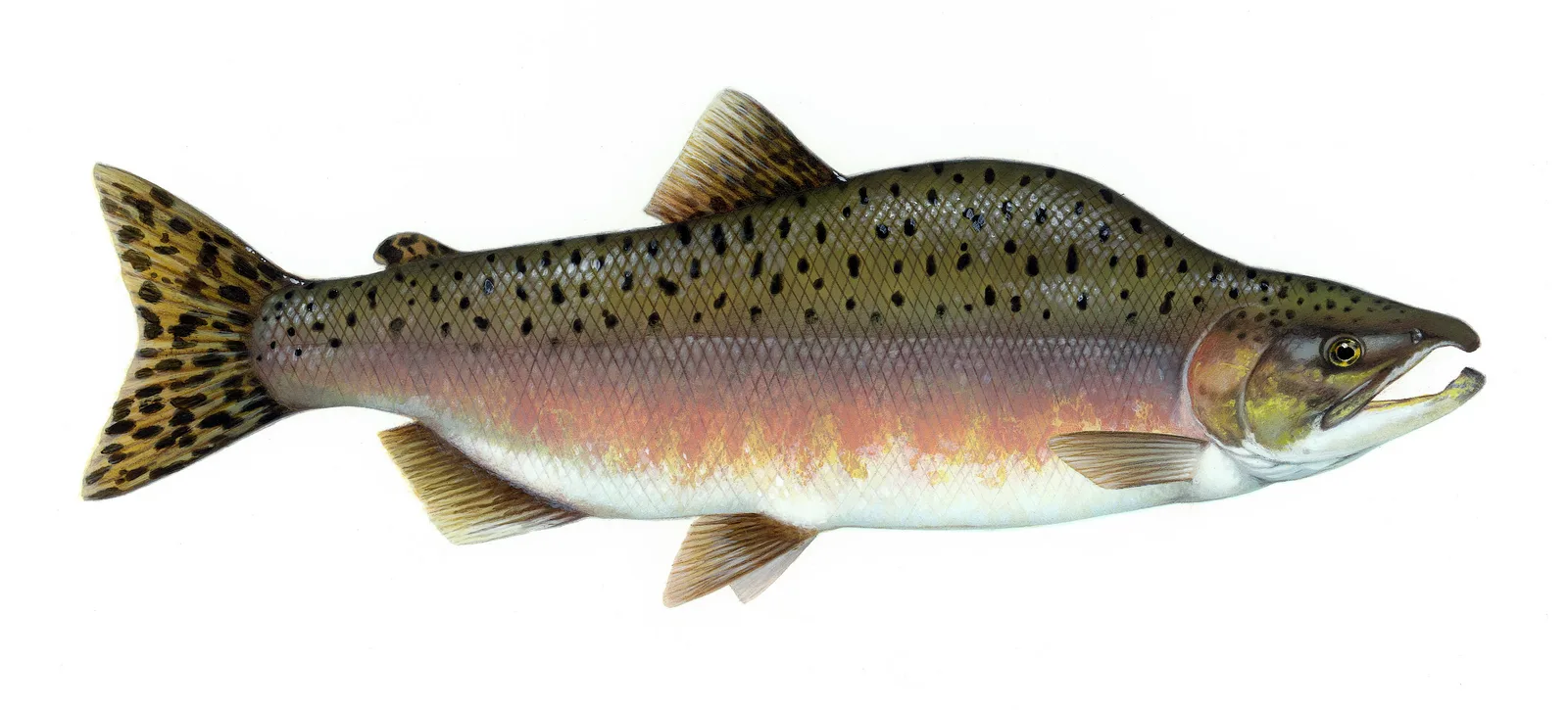 Pink Salmon: Odd-Year Runs, How to Tell a Humpy, Size and Records
Pink salmon live two years, so Puget Sound gets humpies only in odd years. When they run, how to tell one from a king, how to catch it and the record.
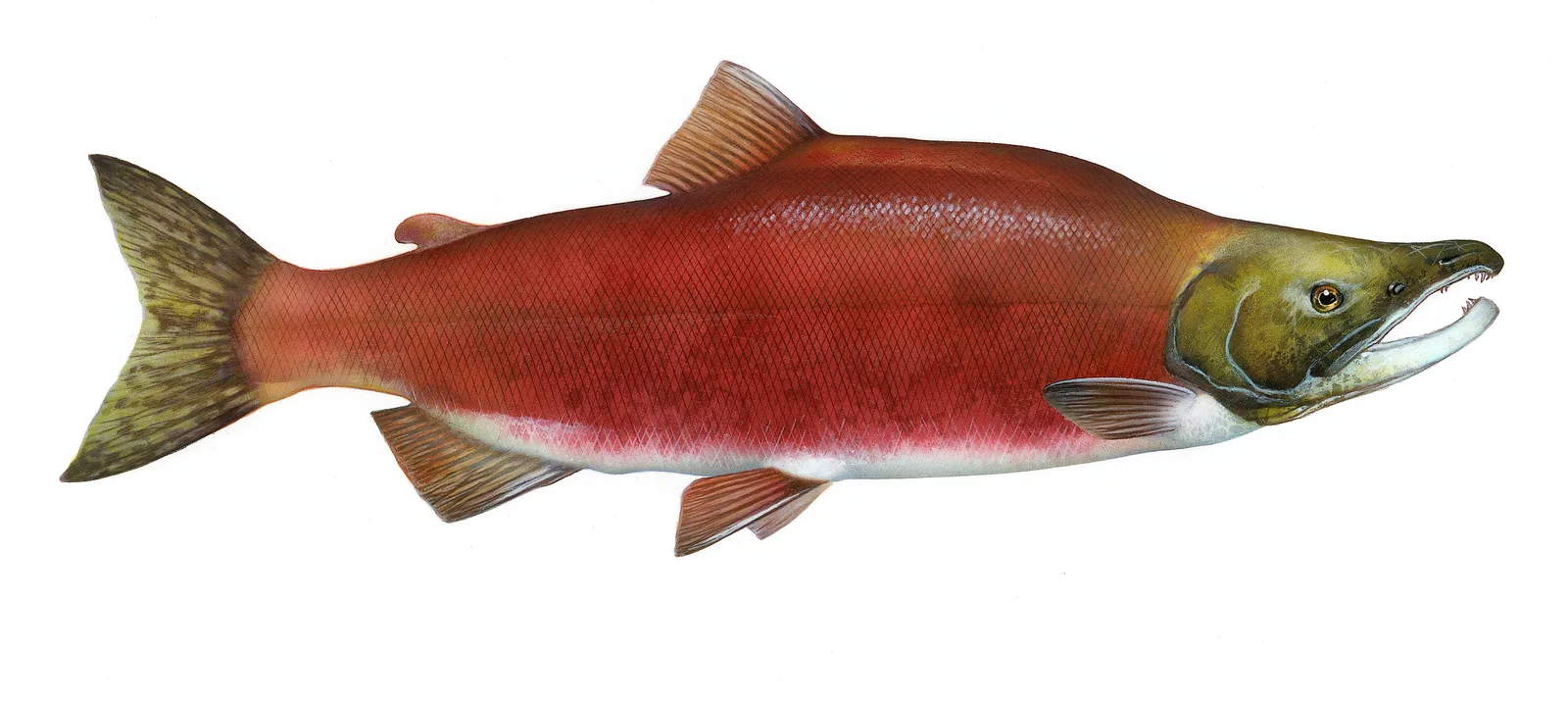 Sockeye Salmon: How to Tell a Red, Where They Run, and the Record
Sockeye salmon: a 4–15 lb red salmon that needs a lake. Tell it from a chum, find the runs from Bristol Bay to Lake Washington, hook one, and the record.
Free download
The water temperature card
Read your water temperature and the card tells you who is spawning, who is feeding and what to throw. 26 species, 16 pages, for your phone and the tackle box.
Plus one email a week on what's biting now. No sales pitches. Privacy.
Sources
- Alaska Department of Fish and Game, Alaska's five species of Pacific salmon (Alaska Fish & Wildlife News, 2015): the hand mnemonic
- Alaska Department of Fish and Game, Alaska salmon fishing guide
- Alaska Department of Fish and Game, Chinook salmon species profile
- Alaska Department of Fish and Game, Sockeye salmon species profile
- Alaska Department of Fish and Game, Pink salmon species profile
- Washington Department of Fish and Wildlife, Pacific salmon ID card (2024): gum line and tail marks
- Great Lakes Sea Grant Network, Salmon and Trout of the Great Lakes: a visual identification guide
- NOAA Fisheries, Chinook salmon
- NOAA Fisheries, Coho salmon
- NOAA Fisheries, Sockeye salmon
- NOAA Fisheries, Pink salmon
- Langan et al. (2026), The Forgotten Pink Salmon in the Laurentian Great Lakes: An Unexpected Invasion With Insights for Three Oceans, Fish and Fisheries 27
- NOAA Fisheries, Chum salmon
- NOAA Fisheries, Chinook salmon (protected): two endangered and seven threatened
- NOAA Fisheries, Coho salmon (protected): one endangered and three threatened ESUs
- NOAA Fisheries, Sockeye salmon (protected): Snake River and Ozette Lake ESUs
- NOAA Fisheries, Chum salmon (protected): Columbia River and Hood Canal summer-run ESUs
- NOAA Fisheries, Atlantic salmon: fishing prohibition, repeat spawning, Gulf of Maine population
- NOAA Fisheries, Listing Gulf of Maine DPS of Atlantic Salmon Under the ESA: populations listed in November 2000
- NOAA Fisheries, Steelhead trout
- U.S. Geological Survey, salmon FAQ: seven Pacific species, five in North America
- Michigan DNR, Chinook salmon: stocked since the 1870s, established after the 1967 plantings
- Michigan DNR, Coho salmon: introduced in 1966 in the Platte River and Bear Creek
- Michigan DNR, Atlantic salmon: Great Lakes history and stocking
- Maine Department of Inland Fisheries and Wildlife, Landlocked salmon
- Tackle Village, World record salmon (IGFA all-tackle records by species)
- Salty101, Salmon world records (IGFA all-tackle records by species)