 By
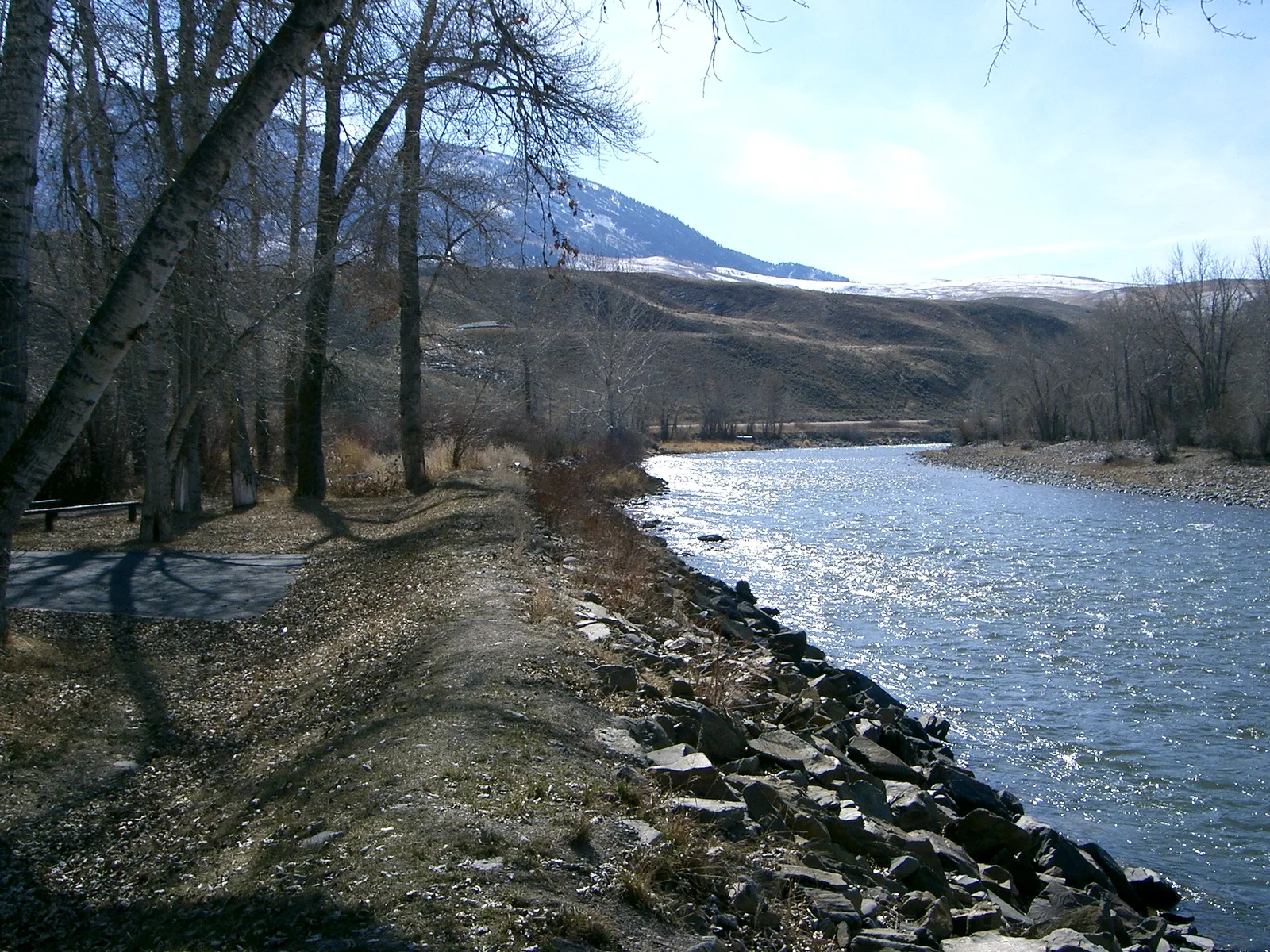
A barbless hook costs you about one trout in eight: in a 2013 California study, anglers landed 76 percent of the trout they hooked on barbed flies and 63 percent on barbless. What it buys is a hook that backs out in seconds, out of a fish, a net or a thumb. A hook without the barb, the small backward spur behind the point, is made that way or made so with one squeeze of pliers. A tight line wins back most of the lost fish, and on a growing list of waters the choice is already made for you.
A largemouth hooked in the mouth survived 98 times in 100 in a 2008 experiment; hooked in the esophagus, 66. Where the hook goes matters more than what is on it.
What do the studies say?
Barbless hooks have been tested on trout, steelhead, bass and saltwater bait fishing. The results agree on more than the arguments at the boat ramp suggest.
| Finding | Number | Study | Fishing |
|---|---|---|---|
| Hooking mortality, all species | Mean 15.9%, median 7.8%; higher on barbed hooks and natural bait | Hühn & Arlinghaus 2011, 252 estimates from 107 studies | Fresh water |
| Mortality by family | Perch and walleye 19.9%, trout and salmon 15.9%, pike 14.9%, carp 5.7% | Same | Fresh water |
| Steelhead release deaths | 7.3% barbed, 2.9% barbless | Hooton 1987, cited by Oregon (ODFW) 2025 | Keogh River, B.C., bait and lures |
| Share of hooked fish landed | 76% barbed, 63% barbless | Bloom 2013, 1,617 trout landed | California, flies |
| Fish landed | 22% more on barbed; unhooking faster on barbless | Schaeffer & Hoffman 2002 | Gulf of Mexico, bait |
| Hook injuries | 62% of fish got a new one; barbed J hooks worst and slowest out | Meka 2004 | Alaska rainbows, flies and spin |
| Survival by hook location | 98% hooked in the mouth, 66% in the esophagus | Wilde & Pope 2008 | Largemouth, lab |
| Trout release deaths | 4.5% barbed, 4.2% barbless; 1 of 11 comparisons significant | Schill & Scarpella 1997, review of past studies | Resident trout, flies and lures |
The findings pull against each other. Hühn and Arlinghaus found mortality significantly higher on barbed hooks across their whole data set. Schill and Scarpella, pooling the trout studies on flies and lures in 1997, found a gap of 0.3 points and called barbed-hook rules “a social issue.” Schaeffer and Hoffman, fishing bait off St. Petersburg, Florida, concluded that barbless hooks “probably did not reduce hooking mortality” there, because most fish were jaw-hooked either way. Washington’s Columbia River manager Ryan Lothrop said much the same in 2019: the evidence for measurable savings was inconclusive, and “the biggest effect is where the fish is hooked.”
The Hühn and Arlinghaus meta-analysis has two more findings worth knowing. About 60 percent of all the mortality estimates were under 10 percent, so most released fish live whatever the hook. And mortality rose with water temperature, which a fishing thermometer settles in seconds; the type of hook, scored separately from the barb, showed no link.
Salmon and steelhead have been studied less than trout. Oregon’s 2025 review cites Hooton’s Keogh River steelhead numbers above. As Oregon’s briefing summarizes it, a 2023 study by Courter and colleagues on Washington’s Cowlitz River also linked barbless hooks to better survival in released Chinook and coho, but the gap was small for Chinook and negligible for coho.
So the barb is the second question. A jaw-hooked fish lives either way. A deep-hooked fish lives more often when the hook comes out fast, or slides free after the line is cut, and a barb works against both. That is why barbless pays most on bait, which gets swallowed, and on trout, salmon and steelhead, which are released by the thousands.
Is it harder to catch fish on barbless hooks?
A little: you land a few fewer. Bloom’s 13-point gap on flies and Schaeffer’s 22 percent on bait are the honest size of it. In Meka’s Alaska data, barbed J hooks landed the most fish and circle hooks the fewest.
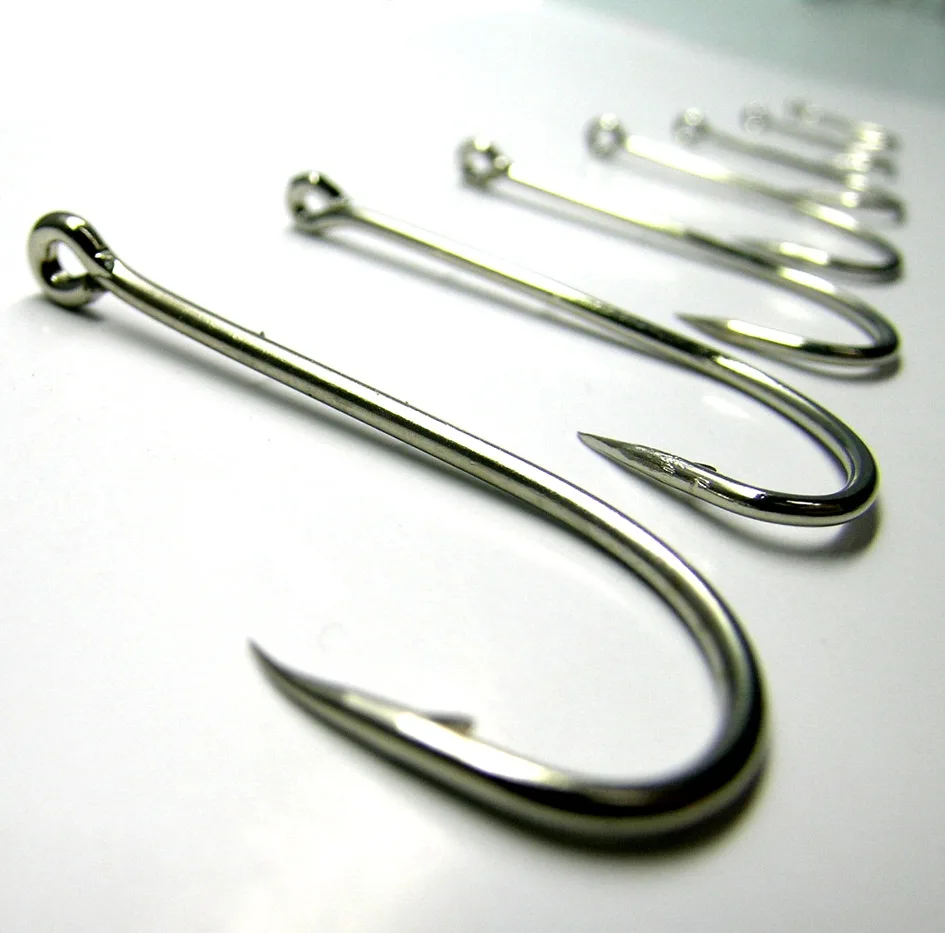
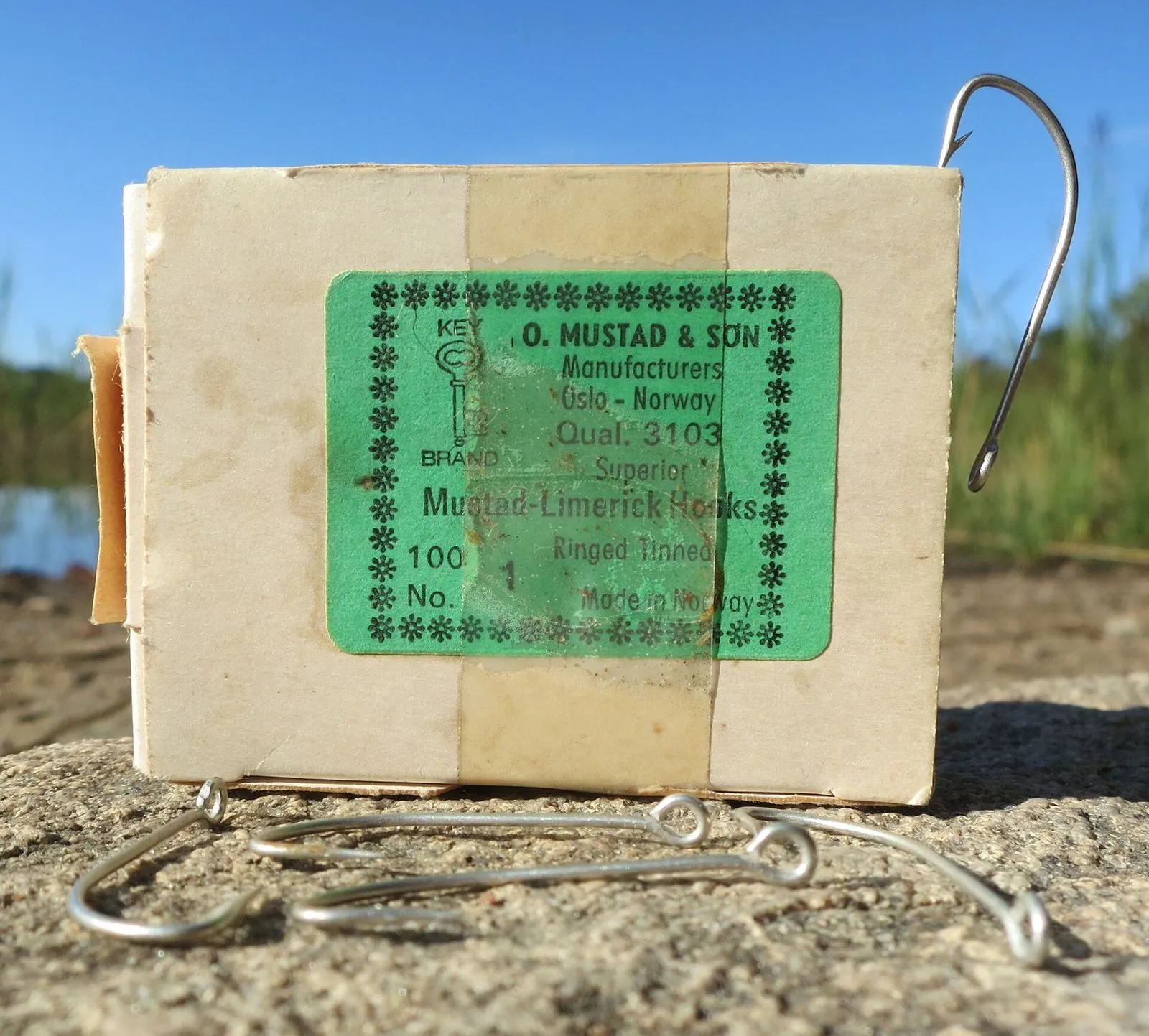
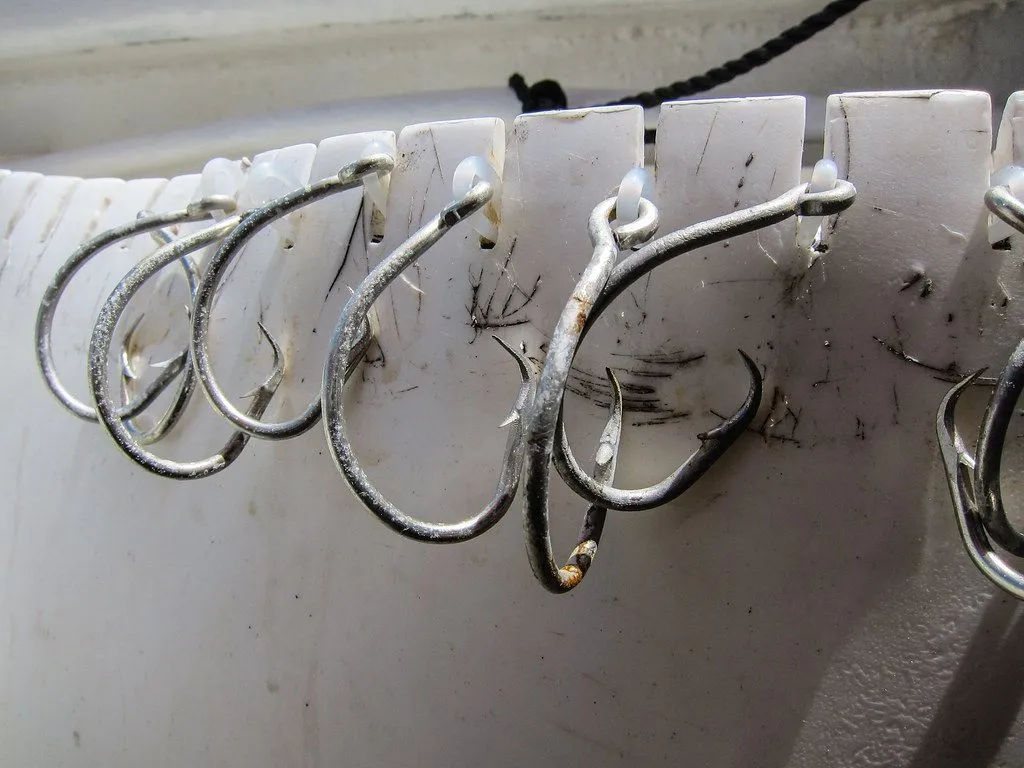
Photo: Daniel Jaeger, Wikimedia Commons (CC BY-SA 2.5). Ordinary barbed hooks: the barb is the small backward spur just behind each point, and it is what holds a hook in once the line goes slack.
Where the lost fish go is the useful part. Domenick Swentosky of Troutbitten, who fishes barbless almost always, finds a barbless hook comes out only when slack gets into the line; anglers who keep tension see “no difference in landing rate.” His rule for trout is “Set quick. Fight quick. Release quick.” Mac Brown, who has guided only with barbless hooks in Bryson City, North Carolina, since 1987, goes against the studies. He argues barbless hooks increase your catch, because the point goes in “with less effort,” like “a spear versus a wedge.”
The other cost lands on the angler’s hands. In Meka’s Alaska study, novice anglers injured a larger share of their trout than experienced ones, mostly while taking the hook out. A barbless hook shortens exactly that moment. Take Me Fishing goes further: “In most situations, you won’t need to use pliers or a de-hooking device.” The same hook comes out of a finger far more easily, too.
Nothing stops you fishing barbed hooks where the rules allow them, and in most water they do. The case for barbless is the fish you release and the hook in your own hand, not the law.
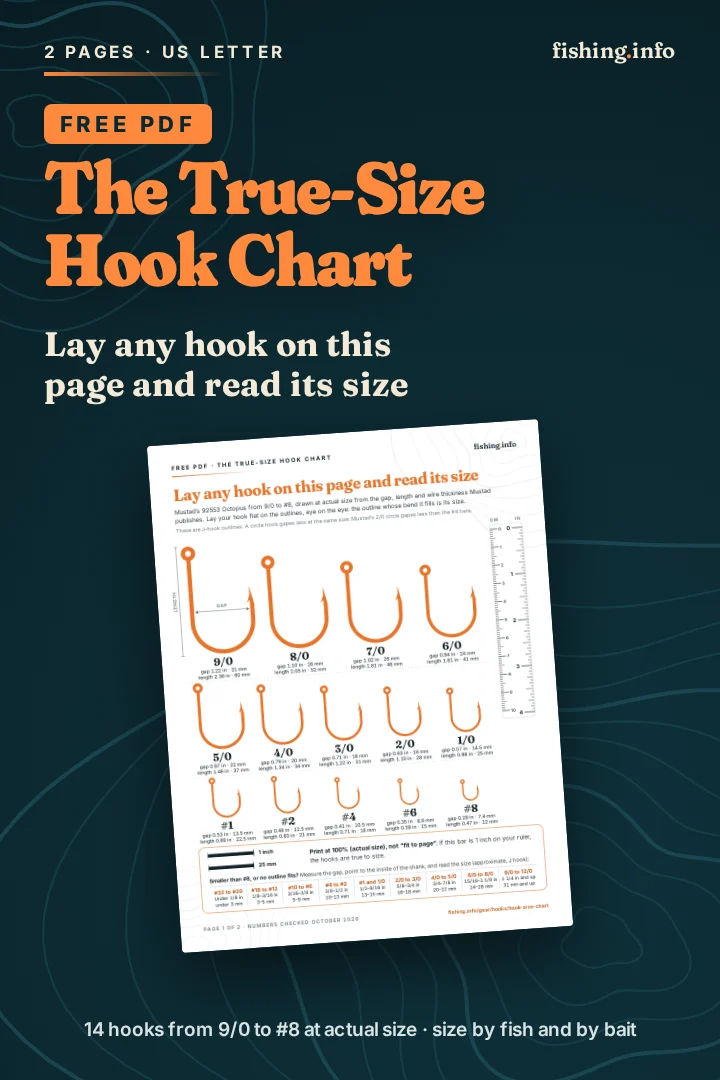
Free PDF · Hook size chart What size is that hook? Lay it on the chart.
Print the free chart, lay any hook on it and read its size: 14 hooks from 9/0 to #8 at actual size, a gap ladder from #32 to 12/0, and the size for 17 fish and 16 baits on the back.
Enter your email, confirm it with one click, and the PDF is in your inbox. Plus one email a week on what's biting. Unsubscribe anytime. Privacy.
Where does barbless pay, and where does it cost?
| Fishing | Barbless helps the fish | Barbless costs the angler | Verdict |
|---|---|---|---|
| Trout on bait or nymphs | A lot: bait gets swallowed, and trout are released in numbers | Some fish lost on slack line | Barbless; required on some waters |
| Salmon and steelhead | Release survival, where wild fish must go back | A few fish lost | Barbless; the law on many rivers |
| Bass on soft plastics | Some, when a slow-fished bait gets swallowed | Few, on a tight line | Pinch it for release fishing |
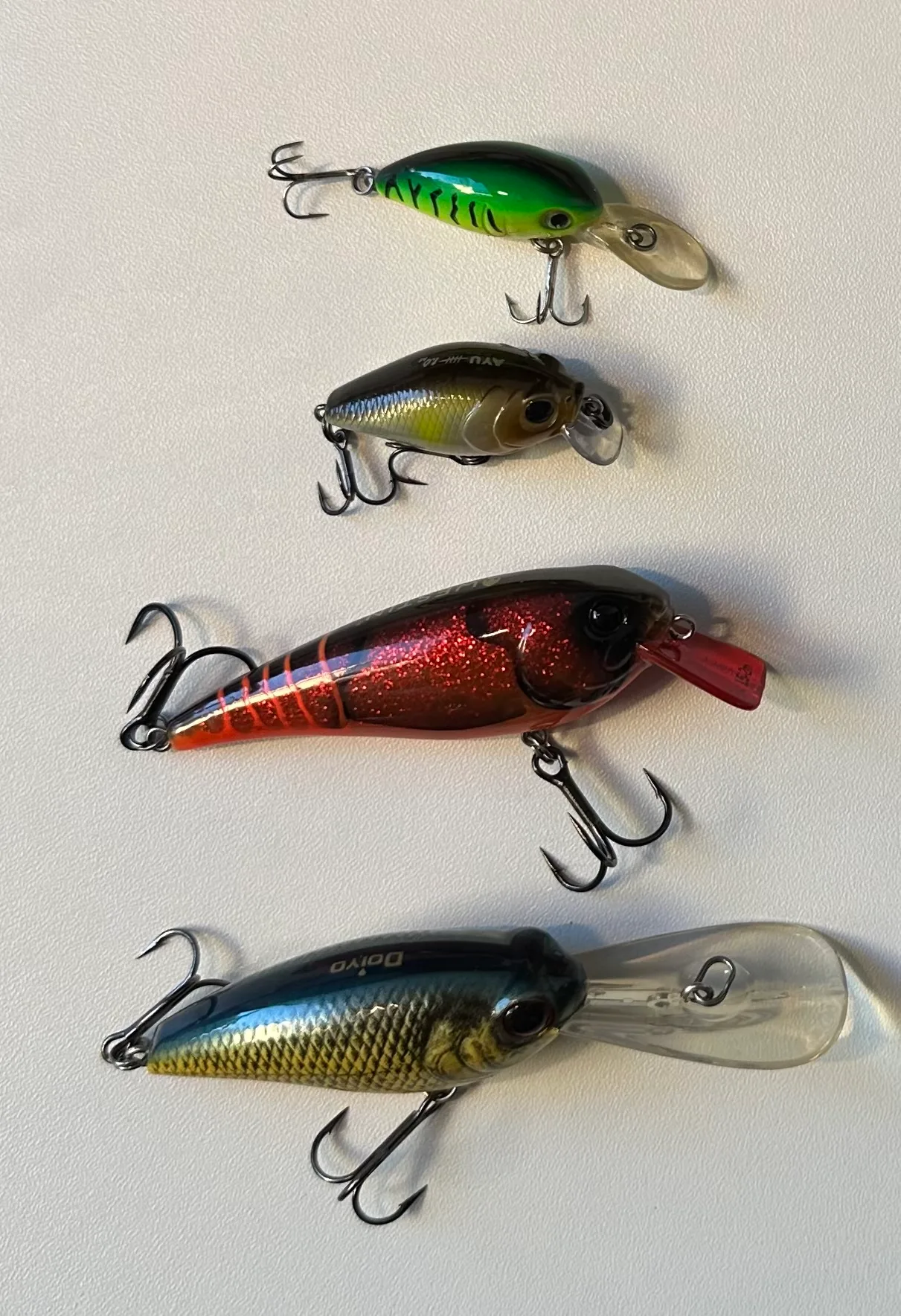
| Crankbaits and topwater | Little: fish are mostly mouth-hooked | A jumping fish throws a barbless treble more easily | Barbed to keep, pinched to release |
| Catfish and carp on bait | Some, but a circle hook does more | Few | Circle hook, barbed or not |
| Pike and musky | Faster unhooking, for fish and hands | Some | Pinched barbs on lures |
How to make a hook barbless
Oregon and Washington define a barbless hook three ways: made without a barb, with the barb filed off, or with the barb bent down to the shank. Idaho’s wording is the same: bend the barbs “all the way down to the shank of the hook.”
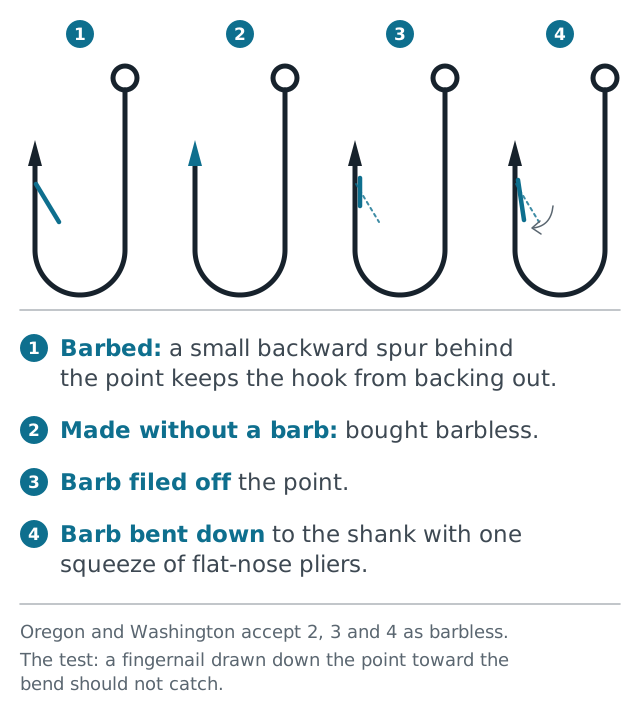
- Use flat-nose pliers. A round or pointed tip can slip off the barb. Mac Brown warns that crimping can break hook points, “especially for saltwater hooks”; for those, a hook made barbless saves the risk.
- Pinch the barb flat against the point until no edge is left.
- Test it. Draw a fingernail down the point toward the bend; if it catches, squeeze again.
- Do every point. On a treble that means all three barbs; Yellowstone’s rule speaks of hook points, not hooks.
- Or replace the trebles. Barbless trebles, or inline single hooks, go on with split-ring pliers; the treble hook page covers the swap.
The hooks hub and types of hooks cover the styles a barb can be pinched on.
Which barbless fishing hooks can you buy?
Bought barbless hooks save the pliers job, and the makers sell them for bait, lures and flies. The barb does not change the size you need: buy the size you would fish barbed, and the hook size chart has it by species. Sizes and prices below are from the makers’ own pages in November 2026.
| Hook | Sizes | Maker’s price | Fits |
|---|---|---|---|
| Gamakatsu Octopus Barbless | 4 to 10/0 | From $5.19 a pack | Bait for salmon, steelhead and trout |
| Owner Barbless No Escape | 4 to 6/0 | $5.00–$5.50 for 4 to 9 hooks | Bait threaded on; a “V” bend and long point to keep the fish on |
| Gamakatsu Treble Round Bend Barbless | 8 to 2/0 | From $12.59 a pack | Swapping the trebles on crankbaits, spoons and spinners |
| Gamakatsu S10-B Standard Down Eye Barbless | 16 to 6 | From $9.79 a pack | Tying dry flies and wet flies |
Owner builds the No Escape to comply with barbless rules, and Gamakatsu sells its barbless octopus hook for the same reason. A barbless treble also saves pinching three barbs on every lure where trebles are allowed but barbs are not.
How do you keep a fish on a barbless hook?
- Keep the line tight from the strike to the net. A barbless hook stays in while there is pressure on it.
- Keep the rod bent. Fight with the rod, and do not drop the tip to gain line; the bend keeps the pressure steady through jumps and head shakes.
- Set the drag a little lighter, so a surge stretches the line rather than tearing the hook through soft tissue.
- Fight fast. A short fight is what both the hook and the fish need.
- Net the fish. The moment the pressure comes off at the boat or the bank is when barbless hooks fall out.
- Keep the point sharp. Take Me Fishing argues a barb adds resistance that makes the point harder to drive in. Whatever that is worth, a dull barbless hook has nothing to hold it.
Will bait stay on a barbless hook?
Bait is the one place a barb seems to earn its keep twice, holding the worm as well as the fish. The one study that measured it found otherwise: in Schaeffer and Hoffman’s Florida bait fishery, bait loss did not differ between barbed and barbless hooks. If worms still slip, a bait-holder hook carries small barbs on the shank to grip them; read the water’s wording before you use one where barbless is the rule. The other fix, from Danny Coyne in SunCruiser’s sport-fishing guide, is a small piece of soft plastic slid on after the bait. The plastic grips the metal and stops the worm sliding off, and it adds a little scent. He rates it highest for jigging or trolling a nightcrawler.
On a circle hook the question matters less. In Meka’s study, circle hooks usually caught trout in the jaw only, where a barbless point does the least harm and comes out fastest. A circle hook, which sets in the corner of the jaw, does more for a bait-caught fish than a barbless J hook does.
Where is barbless the law?
None of the state rules we read requires barbless hooks on all of a state’s water. The rules sit in the special regulations for particular rivers and fisheries, mostly trout, salmon and steelhead.
| Where | Applies to | Rule |
|---|---|---|
| Yellowstone National Park | All fishing, all park waters | Barbless points, or barbs pinched down with pliers (2026 park rules) |
| Idaho | Salmon; salmon and steelhead on the South Fork Clearwater | Barbs removed or bent to the shank (2014 rule); single-point barbless on the South Fork Clearwater (fall 2026) |
| Columbia River mainstem (OR and WA) | Salmon and steelhead | Barbless, both states, since 2013, with a break that began in June 2019 |
| California ocean | Salmon, north of Point Conception | No more than two single-point, single-shank barbless hooks; with bait south of 40°10’ (Cape Mendocino), other than trolling, they must be circle hooks |
| Wyoming, North Platte River | Miracle Mile, Alcova Afterbay, Gray Reef, Fremont Canyon | Single-point barbless hooks, from January 1, 2026 |
Single-hook water is not always barbless water. Great Smoky Mountains National Park allows only artificial flies or lures with a single hook, but it only encourages barbless hooks.
Yellowstone adopted its rule to cut handling time and injury, and allows only lead-free tackle as well. Wyoming gave the same reason for the North Platte: fewer hook injuries in catch-and-release fish. On the Columbia, Washington made barbless voluntary in June 2019, and the two states later realigned on the requirement. Oregon’s commission heard a staff briefing in December 2025 on the pros and cons of dropping it again. Its staff estimated that modeled release deaths of fall Chinook and coho would rise by 10.5 percent, and some seasons might have to shorten. Rules change every season; the listing for the water you fish is the one that counts.
Is barbless always the gentle choice?
A barbless hook is not automatically the gentle choice. Swentosky tells of a friend who watched a wide-gap streamer hook kill a trout by piercing its brain, and argues a big barbless streamer can do more damage than a small barbed dry fly. He keeps hook gaps reasonable and still pinches down even the micro barb on a size 20 Griffith’s Gnat. His conclusion is the one the studies reach: handling decides more than the barb does.
A barbless hook is one of the things that decide whether a released fish lives. Catch and release covers the rest: where the hook went in, how long the fish was in the air, and the water temperature. Whether the fish feels any of it is its own question, taken up in do fish feel pain.
Free PDF · 2 pages
Lay any hook on this page and read its size
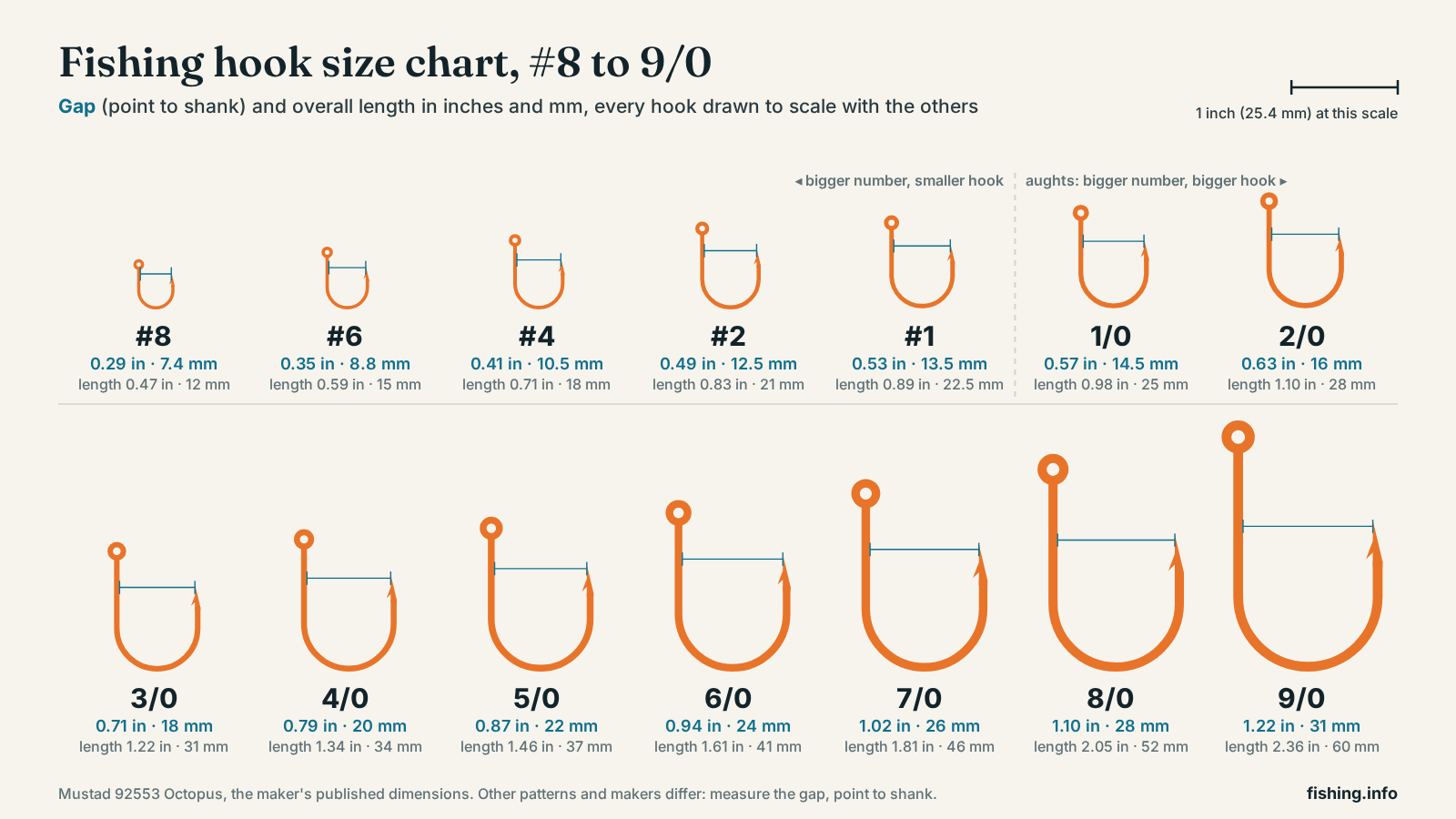
The True-Size Hook Chart. Print it at actual size and lay a hook on the outlines: the one its bend fills is its size. One sheet, front and back, for the tackle box.
- 14 hooks from 9/0 to #8 at true size, each with its gap and length in inches and millimeters
- Smaller than #8 or bigger than 9/0? Measure the gap and read the size off the ladder, #32 to 12/0
- The size for 17 fish and 16 baits, from bluegill (#8 to #12) to tuna (7/0 to 10/0)
- A 2/0 circle that gapes less than a #4: why a 2/0 is not always a 2/0, and the aught rule in two sentences
Every outline drawn from Mustad's published dimensions; every size from the 25 sources on the page, Maryland DNR and Idaho Fish and Game among them.
Enter your email, confirm it with one click, and the PDF is in your inbox. Plus one email a week on what's biting. Unsubscribe anytime. Privacy.
Related
Section guide
Fishing Hooks: How to Choose the Right Hook, Set It and Sharpen ItHow to choose fishing hooks: fit the gap to the bait and the mouth, the hooks to buy first, wire and finish, when to set or reel, sharpening and hook laws.
 J Hook for Fishing: What It Is, the Main Patterns, and Sizes by Fish
A J hook is the classic J-shaped fishing hook: point parallel to the shank, set the moment a fish bites. Its patterns, sizes by fish, and where it is banned.
 Types of Hooks: The Ten Fishing Hook Styles and What Each One Is For
Ten types of fishing hooks, drawn and explained: J, circle, octopus, Aberdeen, Kahle, siwash, worm, jig, drop-shot and treble, and what each is for.
 Treble Hook Size Chart, When to Change Trebles, and Single-Hook Rules
A treble hook size chart from #14 to 5/0 with gap and length, the size for each lure and fish, when to change trebles, and if one counts as one hook.
 Circle Hooks: How They Work, Circle vs J Hook, Sizes, and the Law
A circle hook turns its point back toward the shank and sets itself in the jaw of a fish as you reel. How it works, circle vs J hook, a size chart, the law.
 Fishing Hook Size Chart and Guide: Actual Sizes, by Species
Fishing hook size chart and guide: #8 to 9/0 measured in inches and mm, why a #4 is bigger than a #6, an Aberdeen chart, and sizes by species and bait.
Sources
- Hühn, D. and Arlinghaus, R. (2011), Determinants of hooking mortality in freshwater recreational fisheries: a quantitative meta-analysis, AFS Symposium 75:141–170 (abstract)
- Schaeffer, J. S. and Hoffman, E. M. (2002), Performance of barbed and barbless hooks in a marine recreational fishery, NAJFM 22:229–235 (USGS)
- Wilde, G. R. and Pope, K. L. (2008), A simple model for predicting survival of angler-caught and released largemouth bass, Transactions of the AFS 137:834–840 (USGS)
- Bloom, R. K. (2013), Capture efficiency of barbed versus barbless artificial flies for trout, NAJFM 33:493–498
- Meka, J. M. (2004), Hooking injuries of rainbow trout in the Alagnak River, Alaska, by hook type and angler experience, NAJFM 24:1309–1321 (USGS)
- Oregon Department of Fish and Wildlife, Hook regulations for Columbia River salmon and steelhead fisheries, Commission briefing, December 12, 2025
- Courter, I. I., Buehrens, T., Roes, M., Blackman, T. E., Briscoe, B. and Gibbs, S. (2023), Influence of angling methods and terminal tackle on survival of salmon and steelhead caught and released in the Cowlitz River, Washington, Fisheries Research 268:106848
- Schill, D. J. and Scarpella, R. L. (1997), Barbed hook restrictions in catch-and-release trout fisheries: a social issue, NAJFM 17:873–881 (abstract, OpenAlex)
- Washington Department of Fish and Wildlife (2019), Barbless hooks to become voluntary on much of Columbia River and tributaries
- Chinook Observer (2019), Barbless hooks didn't help fish survival (WDFW's Ryan Lothrop)
- National Park Service, Fishing in Yellowstone
- Idaho Fish and Game (2014), Salmon anglers must use barbless hooks
- Idaho Fish and Game, South Fork Clearwater River steelhead rules, fall 2026
- California Department of Fish and Wildlife, Ocean salmon regulations (14 CCR §27.80)
- Wyoming Game and Fish, Fishing regulation changes taking effect in 2026
- Take Me Fishing (RBFF), Barbless hooks for fishing
- Domenick Swentosky, Q&A: barbless hooks or barbed, does it matter?, Troutbitten (2024)
- Danny Coyne, Keeping live bait on, SunCruiser (2015)
- Gamakatsu, Octopus Barbless hook
- Gamakatsu, Treble Round Bend Barbless
- Gamakatsu, S10-B Standard Down Eye Barbless fly hook
- Owner Hooks, Barbless No Escape
- Mac Brown, Barbless Hooks Increase Your Catch, Mac Brown Fly Fish (2016)
- National Park Service, Great Smoky Mountains: Fishing