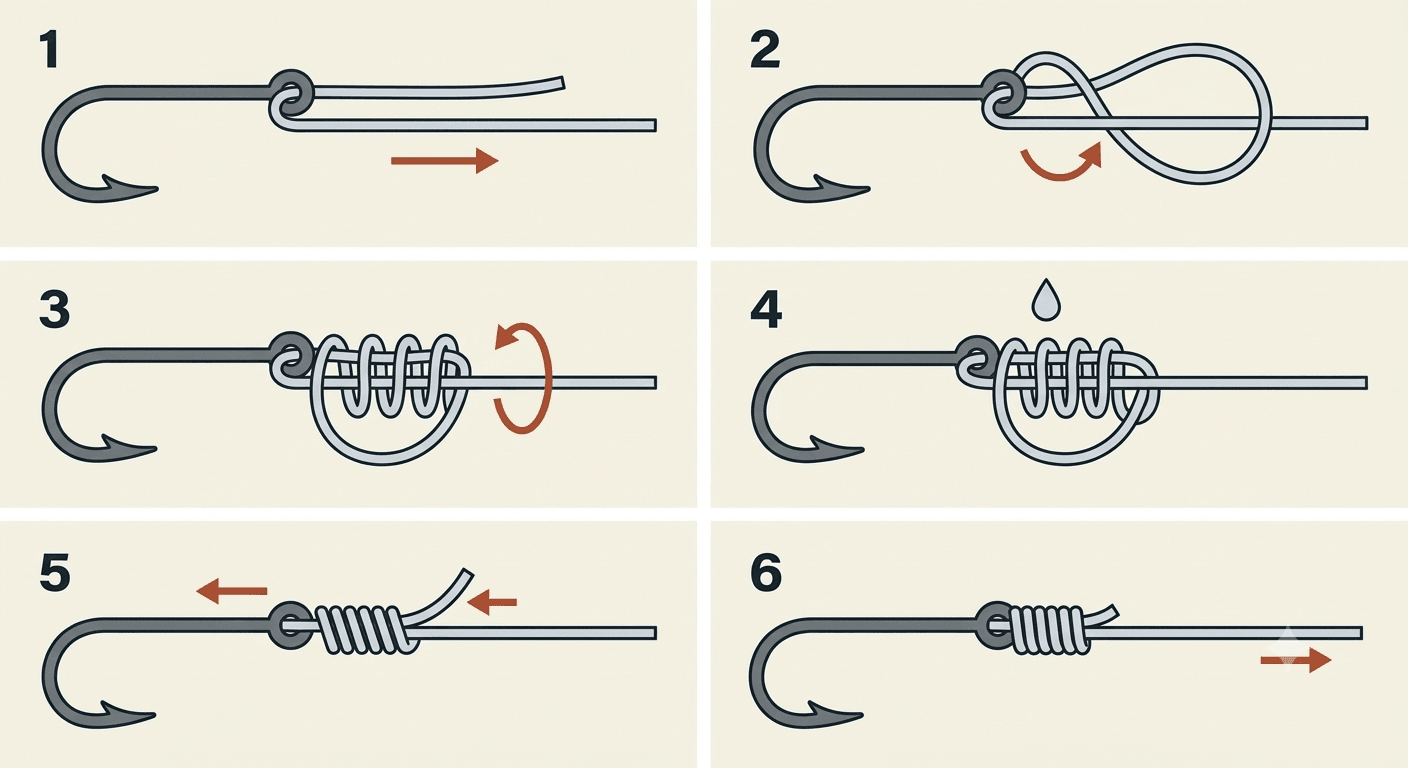
The uni knot is one knot that does six jobs, from tying on a hook to stopping a slip bobber. It is also the best general knot for braided line. On braid the improved clinch slips, and even the Palomar lost to the uni by a pound and a half in the one machine test that compared them. Learn it once, and every connection on a bass, catfish or inshore rig is covered.
Five turns on mono, ten on braid. On 10 lb braid the uni broke at 20.2 lb and the Palomar at 18.4 lb; it is the one everyday knot that beats the Palomar, and it does so only on braid.
What you need
- Any line: monofilament, fluorocarbon or braid. The turn count changes, the knot does not.
- 8 in (20 cm) of tag. The uni uses more line than a clinch, because the tag makes both the loop and the wraps.
- For the double uni, the two lines to be joined. For the snell, a hook with an up- or down-turned eye. For the loop, a lure that fishes better swinging.
- Water to wet it and clippers. A pair of pliers helps lock the loop version.
How do you tie the uni knot?
-
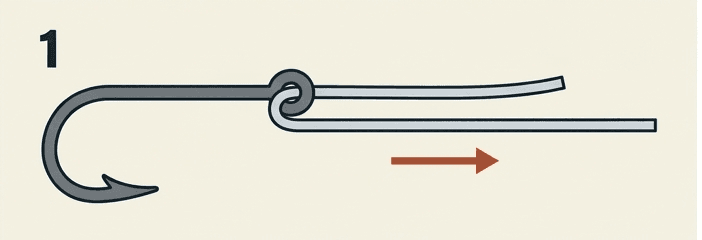
Thread the eye of the hook, lure or swivel and pull 8 in (20 cm) of tag through. Lay the tag back alongside the standing line.
-
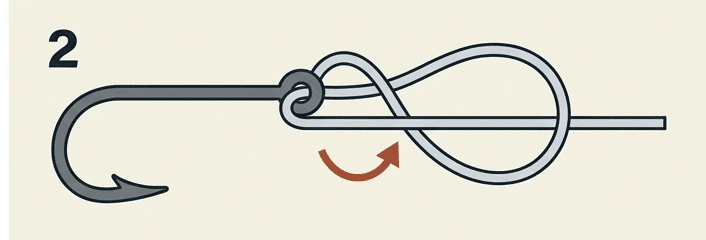
Make the loop. Fold the tag back toward the eye so it forms a loop lying on top of the two parallel strands. Pinch the loop and both strands between thumb and finger just ahead of the eye.
-
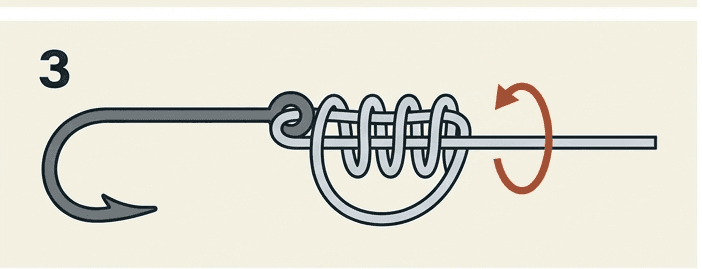
Wrap. Pass the tag through the loop and around both strands, working away from the eye: five or six turns on mono or fluorocarbon, eight to ten on braid. Keep the turns snug and side by side.
-
Wet the knot. Saliva or lake water; a dry nylon knot heats as it tightens, and heat is what weakens it.
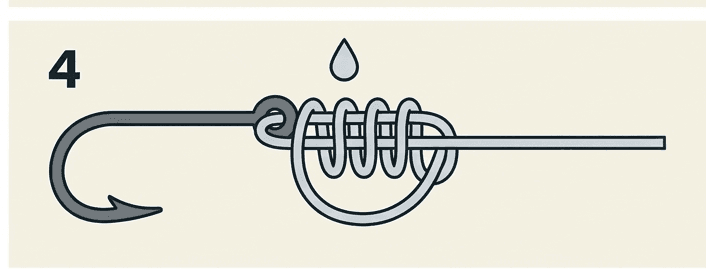
-
Snug the barrel. Pull the tag until the wraps close into a neat barrel around the standing line. It should still slide freely at this point. Dunaway called a tight snug “essential for maximum knot strength”; a loose barrel is a knot that will slip later.
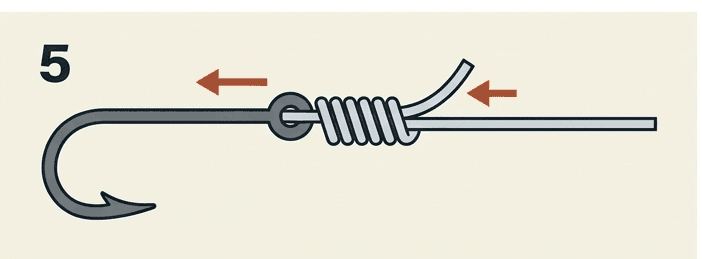
-
Slide it home and trim. Pull the standing line so the barrel slides down against the eye, give it one firm pull to seat, and trim the tag to 1/8 in (3 mm). For a sliding loop, stop before the barrel reaches the eye and leave the loop you want.
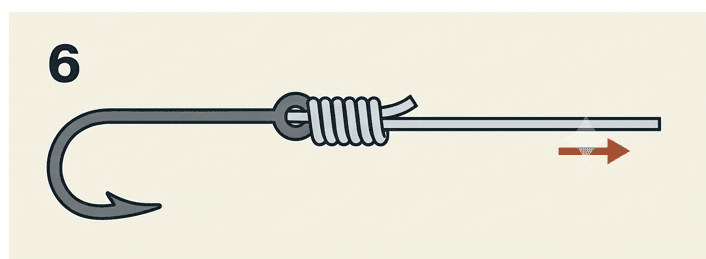
Drawings: fishing.info, generated with Gemini and checked step by step against the text.
How many turns?
The principle matters more than the exact count: nylon grips itself, braid does not, so braid gets about twice the turns. The sources disagree by a turn, and the table shows where.
| Line or job | Turns | Who says so |
|---|---|---|
| Mono or fluorocarbon to a hook, 6–20 lb (2.7–9 kg) | 5–6 | Animated Knots 5; Dunaway 6; Salt Strong tested 5 |
| Braid to a hook or swivel | 8–10 | Salt Strong tested 10 on 10 lb PowerPro |
| Braid uni (tag passed through the eye twice first) | 10–12 | Salt Strong, the braid uni knot |
| Uni snell along the shank | 4–5 | Dunaway; the snell knot page uses 5–7 |
| Line to a reel spool | 2–3 | Dunaway; it only has to grip the arbor |
| Double uni, each side | 5 on nylon, 8–10 on the braid side | Salt Strong tests; the double uni knot page |
The braid uni in the third row is Salt Strong’s version for braid to a swivel or hook. The tag goes through the eye twice before the loop is made, so the knot grips a doubled strand at the eye. The extra turns give the slick line the friction nylon has on its own.
What are the six jobs?
Tied once, the uni holds a hook, lure or swivel. Tied twice, back to back, it joins two lines. Tied along the shank it is a snell; left loose it is a sliding loop. Around a spool it is the arbor knot most anglers already use, and tied with a short piece of line around the main line it is an adjustable bobber stop.
| Job | What changes | Where it fits |
|---|---|---|
| To a hook, lure or swivel | Nothing; the knot as drawn above, seated on the eye | Anything a Palomar loop will not pass over: big crankbaits, bait rigs, pre-tied leaders |
| Sliding loop (Duncan loop) | Stop the barrel short of the eye; lock it with pliers on the tag | Jerkbaits, topwater, jigs that should swing; see the loop knot page |
| Double uni (uni to uni) | One uni with each line around the other, barrels pulled together | Braid to leader when speed beats strength; mono to mono; braid to mono backing |
| Uni snell | The loop is made against the shank, the turns go around shank and line | Circle and octopus hooks with bait; flipping hooks for bass |
| Reel spool | Line around the arbor, two or three turns, pulled down tight | The usual arbor knot; braid needs a mono backing or tape first |
| Bobber stop | Five turns of a short piece of the same line around the main line, tags left long enough to grip | Slip-float rigs; it slides under thumb pressure and holds against the float, as the catfish rigs page shows |
The sliding loop lets a lure swing freely and cinches down under a fish. That is why it suits jerkbaits and topwater.
How do you join two lines with it?
The join is two uni knots, tied in opposite directions.
- Overlap the lines by 8 in (20 cm).
- Tie a uni with the tag of line A around line B.
- Tie a uni with the tag of line B around line A.
- Wet both, then pull the two standing lines away from each other so the barrels travel together and jam.
- Trim both tags to 1/8 in (3 mm), never flush on braid.
For braid to a fluorocarbon leader, the braid side wants eight to ten turns and the leader side five. A braid barrel with only five turns is the join that pulls apart on the hookset.
Dunaway’s fix for a weak join was to double both strands before tying the pair. He said that raised it to “100 percent” of line strength. Inshore anglers use the same trick on thin braid, and it doubles the bulk of the knot.
On a spinning reel that bulk matters. The double uni is the join most anglers can tie in a boat in the wind, but it is also the one that ticks through the guides on every cast. The braid to mono knot page sets it against the FG and the Alberto with the numbers.
Uni or Palomar?
The two knots cover the same hooks and lures, so this is the choice you will make most often.
- On braid, the uni. The one machine test that compared them gave the uni 20.2 lb against 18.4 lb. And the uni never has to be re-threaded because a lure would not pass through the loop.
- On mono and fluorocarbon, the Palomar knot when the lure fits through the loop. It tops Salt Strong’s mono-to-hook ranking and is faster.
- On a pre-tied rig or a big crankbait, the uni. The Palomar needs the whole lure passed through its loop; the uni needs only the tag.
- On a leader you want to swing a bait from, the uni, left as a loop. The Palomar cannot be left loose.
How strong is it?
Not always the strongest, never the weakest, and the one to reach for on braid. That is the whole story of the uni in the tests.
Salt Strong tied a uni and a Palomar to swivels with 10 lb braid and pulled them on a machine. The uni averaged 20.21 lb (9.2 kg) over a few pulls; the Palomar broke at 18.36 lb (8.3 kg) in one. That is “a little over 1.5 pounds, or 8 percent stronger”.
They also set the uni against the clinch on 20 lb Ande mono, 20 lb Seaguar fluorocarbon and 10 lb PowerPro. The uni had five turns on the nylon lines and ten on the braid. The clinch won on mono and on fluorocarbon. On braid it “completely tanked”, and the uni held.
The older percentages come from nylon-era pulls and understate the uni on braid. They put it at 80–82 percent of line strength to an eye and 70–75 percent as a join.
As a line-to-line join, the uni is the easiest to tie and the least consistent. In a mono-to-mono contest, 10 lb Trilene XL to 30 lb Big Game, the double uni ranged from 7 to 12 lb. The surgeon’s knot held 13–15 lb. Dunaway’s claim of “over 90 percent” for the join was a steady pull on mono.
One of Dunaway’s observations is worth more than any percentage. Some knots, he wrote, test above 90 percent on a steady pull and fall to 50 or 60 percent under a sudden jolt. The uni’s barrel, with the wraps bedded against the standing line, was not weakened by jerks. The machine tests above are steady pulls. A hookset on a slack line is not.
Where did the uni knot come from?
The knot was in print 26 years before it had a fishing name. The Ashley Book of Knots (1944) shows it as the gallows knot, number 1121, an alternate arrangement of the multiple overhand noose. Norman Duncan worked it out on his own as a fishing knot in the early 1960s, which is why fly anglers still call the sliding version the Duncan loop.
Vic Dunaway named it the uni knot in a 1970 book, for “universal”. He was outdoors editor of the Miami Herald and later editor of Florida Sportsman. Around the knot he built what he called “the first and only unified approach to knot tying”. British anglers call it the grinner.
Is the uni a fisherman’s knot? Yes. One uni is a multiple overhand noose around the standing line, and two tied against each other are the double fisherman’s bend that climbers join ropes with.
Mistakes that cost strength
- Too few turns on braid. Five is a mono count. Braid needs eight to ten or the barrel slips under load.
- Turns that cross. Lay them side by side; a turn that climbs over its neighbor cuts it.
- Seating with the tag. The tag snugs the barrel; the standing line seats the knot. Pull them in that order, and pull nothing before the knot is wet.
- Trimming braid flush. Braid creeps a little as the barrel beds in. Leave 1/8 in (3 mm) on mono and twice that on braid.
- A double uni with matched turns. The braid side wants twice the turns of the leader side, not the same number.
When does another knot win?
- The Palomar on mono and fluorocarbon, when the lure will pass through the loop.
- The FG knot for braid to leader, when you have a minute and want the strongest, slimmest join.
- The surgeon’s knot for mono to mono when the diameters differ.
- The improved clinch knot on nylon, when you were taught it and it has never failed you. Never on braid.
For every line and job in one table, the knots hub has it; the best fishing knots page sets every test on this page side by side.
Related
Section guide
Fishing Knots: Which Knot for Which Line and JobThe fishing knots that matter, sorted by job and line: hook knots, braid-to-leader knots, line-to-line joins, loops and the spool, with strength-test numbers.
 Palomar Knot: How to Tie It, How Strong It Is, When Not to Use It
The Palomar knot step by step, the pull tests behind its reputation on mono, fluorocarbon and braid, the double Palomar, and the rigs it does not suit.
Sources
- Wikipedia, Uni knot (history, uses, strength)
- In-Fisherman, Vic Dunaway, The uni-knot system
- Animated Knots, Uni knot (steps, strength, pros and cons)
- Salt Strong, Palomar knot vs uni knot with braided line
- Salt Strong, Uni knot vs clinch knot strength test
- Salt Strong, The strongest line-to-line fishing knot
- Salt Strong, The braid uni knot
- Saltwater Experience, Why the uni knot is the best all-around fishing knot