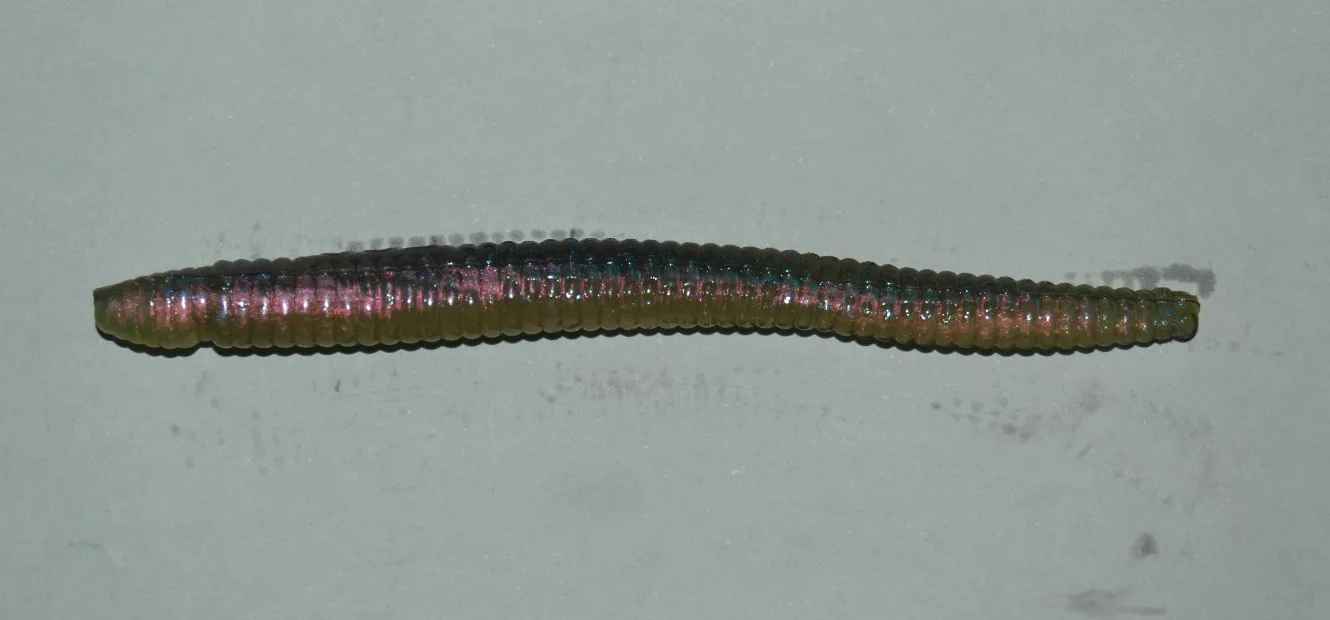
The Yamamoto Senko is a soft plastic stick bait: a plain, tapered cylinder of salt-impregnated plastic, five inches long, with no tail, no claws and no action of its own. Gary Yamamoto designed it in the mid-1990s to fall flat, with a slow side-to-side shimmy he describes as “a continual vibration”, and bass eat it on the fall. By most accounts it is the best-selling and most-copied bass bait of the last thirty years. Fishing it is mostly waiting.
A five-inch Senko takes about ten seconds to fall five feet, shimmying all the way down. Most bites come on that first fall, and the angler’s job is to watch the line.
Why does a Senko catch bass?
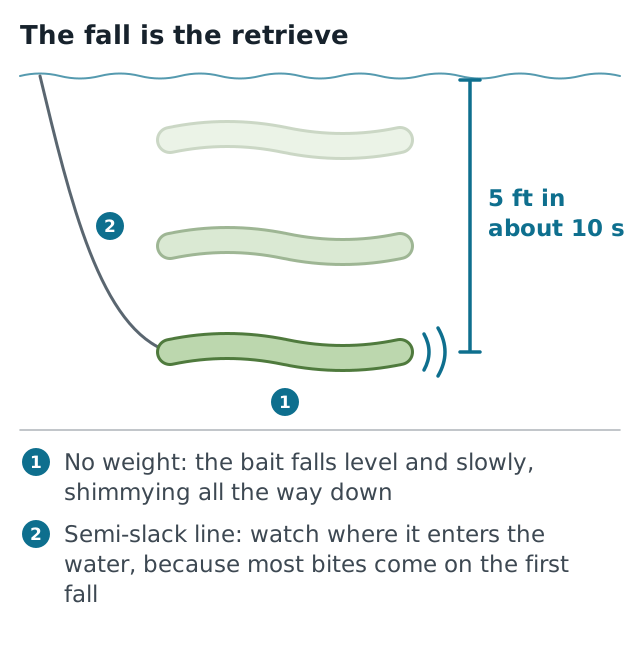
The fall: level, slow and on a slack line. Drawing: fishing.info.
The salt is the design. Soft plastics are plastisol, a PVC resin cooked in plasticizer, and most makers mix in a few percent of salt. Yamamoto went much further, with what Bassmaster’s Bernie Schultz calls “high-density salt impregnation, distributed evenly throughout the body of the lure” and no added weight.
The result is a bait denser than water. It sinks without a weight, but slowly, and falls level rather than nose-first the way a weighted worm does. As it sinks, the two ends flex and the bait shimmies. Rigged weightless on a Texas rig, Yamamoto says, “it has a continual vibration” all the way down. The bait stays in the strike zone longer than anything with a weight on it.
The salt also puts weight in a bait that has none. In TackleTour’s drop test, a 5 in stick bait weighing just over 0.3 oz (9 g) fell in “a photo finish” with the 5 in Senko. So a Senko carries about the mass of a 5/16 oz sinker inside a soft, weedless body. That is why Walker Smith at Wired2Fish calls it “a heavy finesse bait” that “casts like a rocket” and skips under a dock “like a river rock”.
The price of the salt is that a Senko tears easily and lasts a few fish. The O-ring on a wacky rig, and the copies molded from tougher plastics, exist for that reason.
What you need
- Senkos: 5 in (13 cm) for most water and 4 in (10 cm) for very clear water. Green pumpkin and watermelon are the colors Yamamoto names, with salt-and-pepper as his “forgotten color”. Any soft stick bait fishes the same way; Zoom’s Fluke Stick, Strike King’s Ocho and YUM’s Dinger are the alternatives compared further down.
- Hooks: a 3/0–4/0 extra-wide-gap worm hook for Texas rigging, a #1–#2 wacky or Neko hook, a #1–1/0 drop-shot hook. The hooks hub covers the shapes.
- O-rings and the tool that stretches them over the bait, for wacky and Neko rigs; they save a bait per fish.
- Weights as the rig requires: 1/8–1/4 oz (4–7 g) bullet weights, 1/16–1/8 oz (2–4 g) nail weights, 1/4 oz (7 g) drop-shot weights.
- Yamamoto’s tackle: a 7 ft light spinning rod and a 2500 reel, with 10–15 lb braid to a 6–14 lb fluorocarbon leader depending on water clarity. For the weighted Texas rig, a 7 ft medium casting rod and 12–15 lb fluorocarbon. The rods and line hubs explain why.
Which size, from 3 to 7 inches?
Yamamoto makes the original Senko in five lengths. The maker’s pack counts and prices tell you which ones it expects you to go through fastest.
| Size | From the maker | The fall | Rig it on | When |
|---|---|---|---|---|
| 3 in (7.6 cm) Ned Senko | 10 per pack, $5.99 | Too light to cast bare | Ned rig head, 1/16–1/8 oz (2–4 g) | Cold water, smallmouth, pressured fish |
| 4 in (10 cm) | 10 per pack, $7.99 | Slowest; short casts | Wacky, weightless Texas, drop shot | Gin-clear water; Yamamoto’s size for beginners |
| 5 in (13 cm) | 10 per pack, $7.99 | The standard: about 5 ft (1.5 m) in 10 s | All six rigs | Most water, most of the year |
| 6 in (15 cm) | 5 per pack, $6.99 | Faster, bigger profile | Texas with a weight, Carolina | Stained water, grass, bigger bass |
| 7 in (18 cm) | 5 per pack, $6.99 | Fastest of the five | Texas, Carolina, flipping | Summer grass and deep cover |
Yamamoto hands beginners the 4 in because it is “lighter, easier to work with and easier to cast”. The maker publishes no sink rate, because the rate changes with the hook, the line and the water. A hook adds weight, fluorocarbon sinks with the bait, and braid and wind slow it.
Past about 10 ft (3 m) the weightless fall takes longer than most anglers will wait. The answer in one BassResource forum thread is a 3/32 oz (2.7 g) nail weight, a drop shot or a wacky jig head. The Slim and Pro Senkos are the drop-shot versions and the Fat Senko the flipping one. The 7 in Speed Senko (7 per pack, $7.99) is the swimming one.
Which of the six rigs?
| Rig | Hook | Weight | When | How |
|---|---|---|---|---|
| Weightless Texas | 3/0–4/0 EWG, point buried or “tex-posed” | None | Shallow cover, spawning flats, docks, grass edges, 1–8 ft (0.3–2.4 m) | Cast, let it fall on slack line, lift and drop; the original presentation |
| Wacky | #1–#2 wacky or Neko hook through an O-ring at the middle | None, or a 1/16–1/8 oz (2–4 g) weighted wacky head | Spring and pressured fish in clear water; skipping under docks | Both ends flutter on the fall; twitch, let it fall, repeat |
| Texas with a bullet weight | 3/0–4/0 EWG | 1/8–1/4 oz (4–7 g) | Deeper water, wind, cover | Fished as a Texas rig, hopped and dragged |
| Neko | #1–#2 Neko hook through an O-ring | 1/16–1/8 oz (2–4 g) nail weight in the head | Deeper clear water, smallmouth, when wacky is too slow | The bait stands on its head and quivers when shaken |
| Drop shot | #1–1/0 drop-shot hook, nose-hooked | 1/4 oz (7 g) below | Suspended fish, deep and clear | Shake in place; the Senko hovers |
| Jig head or shaky head | 1/8–3/16 oz (4–5 g) head with a 3/0–4/0 hook | In the head | Docks, laydowns, summer | Drag and shake; the tail stands up |
Yamamoto’s own way, from his Bassmaster interview, is a weightless Texas rig on a 3/0 Gamakatsu extra-wide-gap hook. He ties it with a snell knot so the line pulls from the shank rather than the eye, because “smaller light-wire hooks preserve the bait’s tail action”.
The wacky rig is the most popular version among everyone else. The wacky rig page covers the O-ring, the balance point and the weighted variations step by step. The Texas rig and drop shot pages do the same for theirs. On the weighted Texas rig, Smith’s rule is 1/4 oz (7 g) at most: a heavier weight “will cause it to sink too fast, taking away from its trademark horizontal fall”.
The table leaves out two rigs. The Carolina rig is the one Smith says “accounts for countless double-digit catches each year”. On a monofilament leader the bait floats just off the bottom behind the weight and waves through the whole retrieve. It reaches rocky points, shell beds and bluff walls where a weightless bait never gets down.
And half a Senko is a Ned rig. Cut a 5 or 6 in bait in two and thread a half onto a 1/32–1/8 oz (1–4 g) mushroom head; the 3 in Ned Senko saves the cutting.
How do you fish a Senko?
The Senko is fished slower than a worm. Cast to the target and let the bait fall on a semi-slack line. Watch the line where it enters the water, because most bites come on the initial fall. They show as a twitch or a sideways move rather than a pull.
If nothing happens, lift the rod tip to bring the bait up a foot or two. Then lower it and let the bait fall again on slack line. Yamamoto describes a lift-and-drop like a plastic worm’s “but slower due to the lure’s gradual fall rate”. Two or three lifts and a fresh cast cover more water than working one cast back to the boat. On a bite, reel until you feel weight and sweep.
Jason Sealock at Wired2Fish fishes the wacky version on a 6 ft 10 in to 7 ft (2.1 m) medium casting rod and 12 lb fluorocarbon. When the bait reaches bottom untouched, he gives it “3 short pops on semi-slack line” before the next fall. A Japanese angler told him the wacky rig imitates a crawfish: claws folding on the pop, settling on the drop.
Set against the six season bands on the bass hub, the Senko’s own seasons are the spawn and post-spawn, when bass are shallow and will not chase. It catches fish in every other season on the rigs above. Paul Marks won the 2025 Elite Series event at Lake Hartwell on stick baits rigged three ways.
Which color for which water?
Smith counted “more than 75 color patterns” in 2019, and the maker’s chart now passes 150. Six do nearly all the work.
| Water | Color | Why it works |
|---|---|---|
| Clear, any sky | Green pumpkin, or Yamamoto’s green pumpkin and watermelon laminate | Reads as bluegill or crawfish; the one color to own |
| Clear, bright sun | Watermelon with red flake | Translucent body, the flake flashes on the fall |
| Clear, post-spawn | Baby bass | Big largemouth guarding fry eat small bass |
| Stained or muddy | Black with blue flake | Dark silhouette the fish can find at a foot of visibility |
| Tannic water, night | Junebug, plain black | Strongest silhouette of all |
| Anywhere, as a change | Salt-and-pepper | Yamamoto’s “forgotten color”: “fish will bite it” any place in the world |
The rule behind the table is the one for every soft plastic. Go natural and translucent in clear water, dark and solid as it dirties, and subtler, not brighter, on a heavily fished lake.
Which rig at which water temperature?
The bands come from the bass water temperature page. It puts largemouth on the beds at about 60 °F (16 °C) and feeding hardest at 65–80 °F (18–27 °C).
| Water temperature | Where the bass are | Senko rig |
|---|---|---|
| Below 50 °F (10 °C) | Deep and vertical, feeding once in several days | 3 in Ned Senko on a 1/16 oz head, or a 4 in on a drop shot; count the pauses in seconds |
| 50–60 °F (10–16 °C), pre-spawn | Staging on the first drop or point next to the flats | Neko rig or a 1/8–1/4 oz Texas rig on the points; the biggest females of the year |
| 60–65 °F (16–18 °C), spawn | On the flats in 2–8 ft (0.6–2.4 m) | Weightless Texas or wacky, pitched to the bed and left still |
| 65–80 °F (18–27 °C), prime | Grass edges, docks, shade lines | Wacky skipped under docks, weightless Texas on grass edges, Carolina rig across points |
| Above 80 °F (27 °C) | Deep breaks, ledges, the thickest mats | Drop shot in 15–25 ft (5–8 m), Carolina rig on ledges, 1/4 oz Texas rig into cover |
| Cooling 65 to 55 °F (18 to 13 °C), fall | Following shad into creek arms | Weightless 5 in with quicker lifts; wacky when they stop chasing |
The spawn row is where the bait made its name. Bass “tend to get caught up on love more than eating”, Smith writes, and the slow weightless fall “is great at fooling them into biting”. The largemouth bass page explains the bed fish. Smallmouth run the same table a few degrees cooler and prefer the 4 in and the Neko rig.
Senko or a copy: Dinger, Ocho and the rest?
Every soft-plastic maker sells a stick bait; Yamamoto’s line is that “nothing beats the original”.
| Bait, 5 in | Pack and price | Plastic and salt | Durability | Fall |
|---|---|---|---|---|
| Yamamoto Senko | 10 for $7.99 | Softest; heaviest salt load, evenly distributed | Lowest; a few fish per bait without an O-ring | Fastest of the three, and straight down |
| YUM Dinger | 8 per pack, about half the price | Heavily salted but a stiffer plastic | Highest; “much more durable” | Slower, with more side-to-side sway |
| Strike King Ocho | 8 per pack, $5.94–7.49 | Eight-sided body; a plastic that “allows plenty of salt”, coffee scent | Middle | Smooth wave-like motion on the fall |
Ben Hudson’s side-by-side put the Senko at about $8 a pack against $3 for the Dinger in 2019. He found the Dinger “much more durable” and the Senko softer with slightly more action.
So buy by rig. Where the softness shows, on a wacky rig or a weightless Texas rig in open water, the Senko on an O-ring is worth its price. Where any stick bait tears, on a weighted Texas rig in grass or flipped into wood, a Dinger or an Ocho does the same job for less. The Zoom baits page has the version that won at Hartwell.
Mistakes to avoid
- Working it too much. The bait does its work on the fall. Lift, drop, wait.
- Reeling the retrieve. A steadily reeled Senko is a stick. Use the rod.
- A heavy hook. A 5/0 heavy-wire hook kills the shimmy; Yamamoto uses a 3/0.
- No O-ring on a wacky rig. The bait tears on the first fish.
- Heavy line on the weightless rig. It slows the fall and the fish see it. Use 10–12 lb fluorocarbon on casting gear, a 6–10 lb leader on spinning.
- Too much bullet weight. Over 1/4 oz (7 g) the horizontal fall becomes a nose dive.
- Fishing it weightless past 10 ft (3 m). The fall takes longer than the fish will wait; add a nail weight or move to the drop shot.
When does something else work better?
A fluke gives the same soft-plastic profile with a darting action, for fish that want movement. A Ned rig or drop shot gets deeper and finer. A Texas-rigged creature bait goes into cover the weightless Senko cannot. The soft plastics hub covers the families and the rigs hub the rigs.
Where did the Senko and its name come from?
Yamamoto started with a soft jerkbait in mind. He found the Slug-Go “too rigid and oversized” and made something softer and heavier. Schultz writes that the profile came from a Bic Custom Click pen and that the bait reached dealers’ shelves in 1996.
“Senko” is Japanese, chosen by Yamamoto, and is variously translated as a flash of light. It is not a person, and the optics company that shares the word has nothing to do with fishing.
Related
Section guide
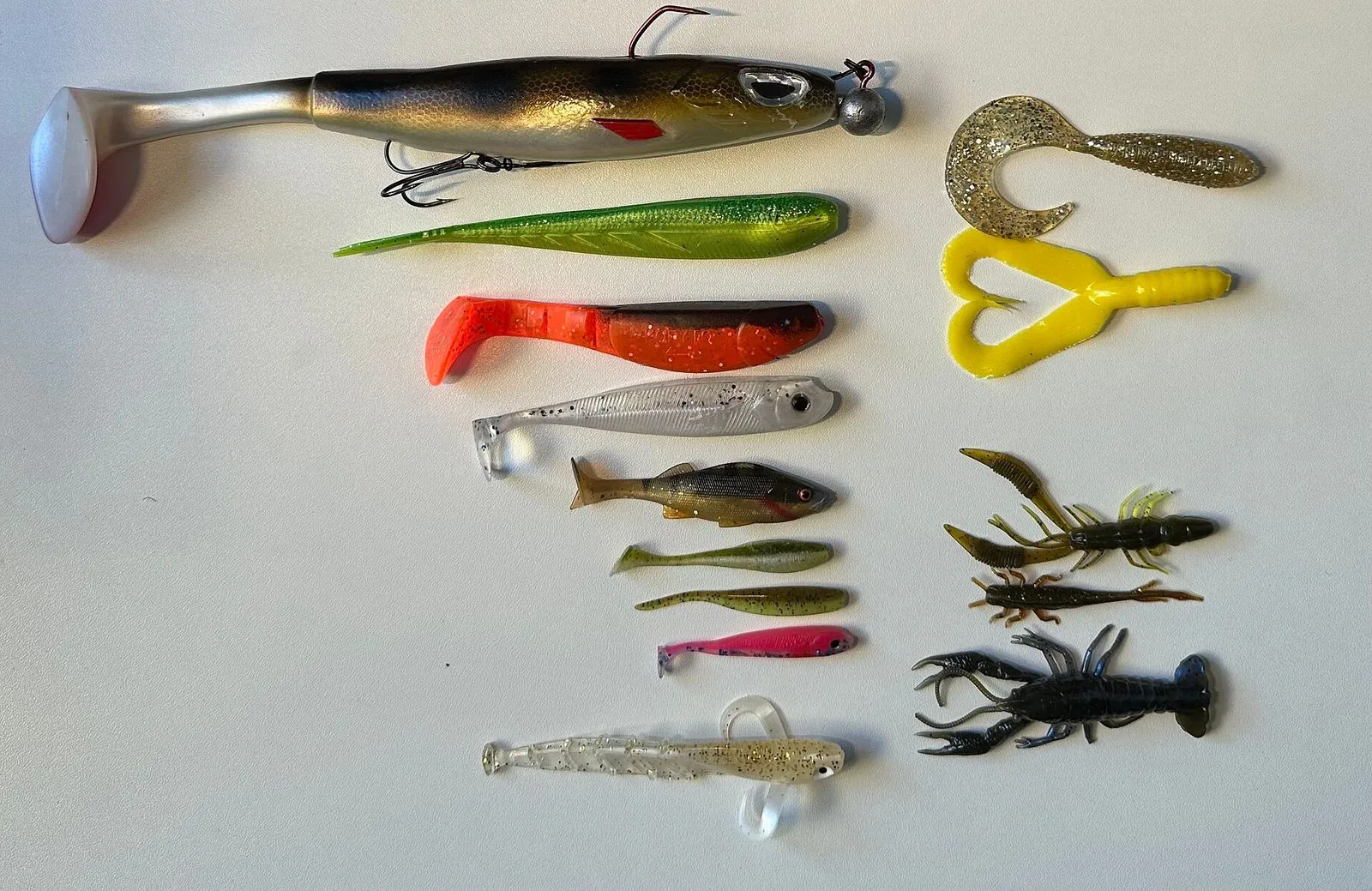
Soft Plastic Lures: Types, Materials and How to Rig ThemSoft plastic lures from the 1949 Creme worm to today's swimbaits and glide baits: the types, what plastisol and salt do, how each is rigged, and the tackle.
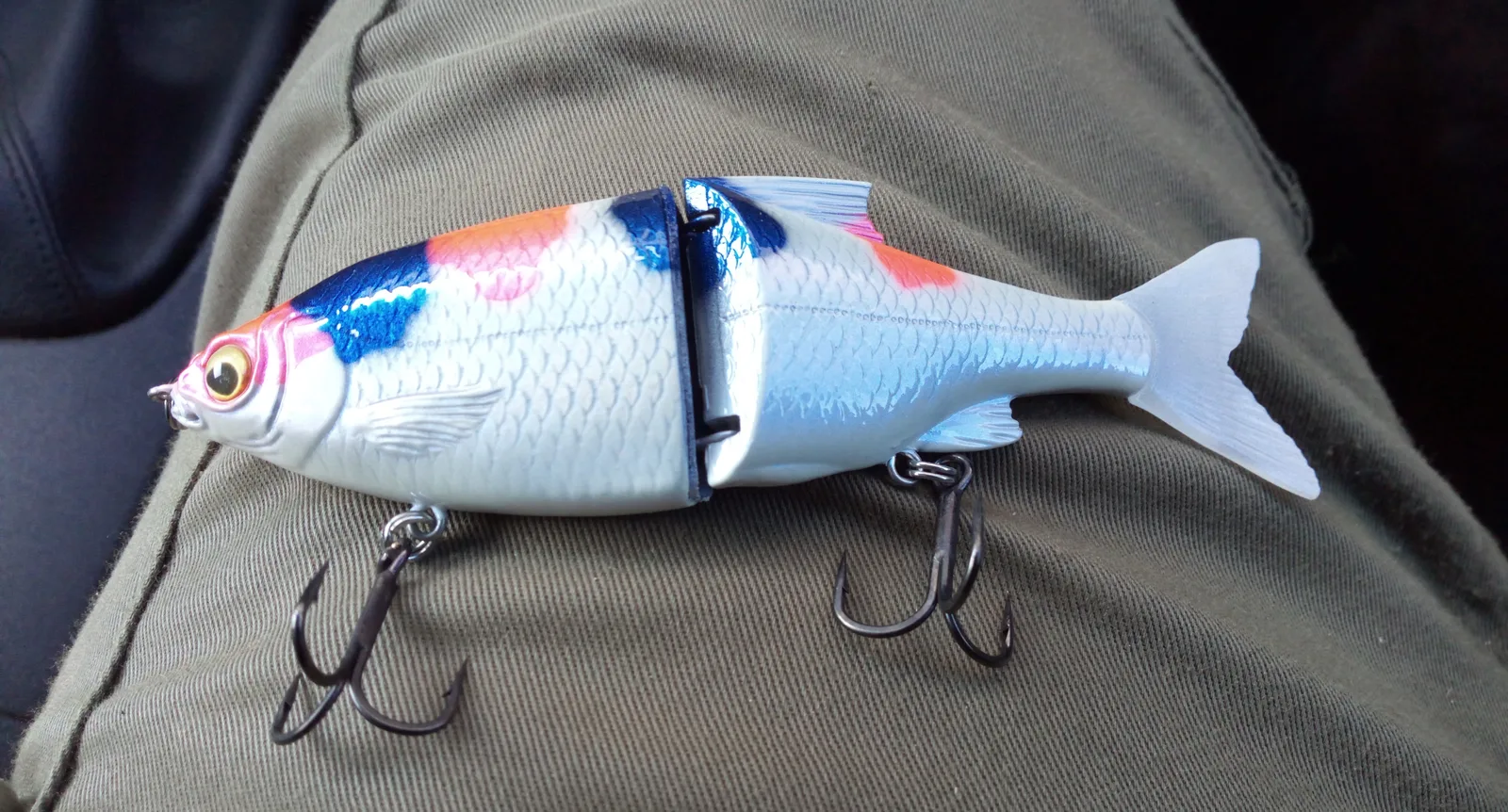 Glide Baits: How They Work, How to Fish Them, and Which to Buy
Glide baits are single-joint hard swimbaits that swing in a wide S. Five retrieves, the 180 turn for followers, rod and line numbers, sink rates, $10 to $250.
 Swimbaits: Soft Paddle Tails, Glides and Segmented Baits Explained
Swimbaits by family: soft paddle tails on a jighead, hollow bellies, pre-rigged Huddlestons, hard segmented baits and glides. Sizes, rigs, rods, retrieves.
Sources
- Bassmaster, Gary Yamamoto on the Senko
- Bassmaster (Bernie Schultz), The Senko: 30 years and counting
- Yamamoto Baits, 5 in Senko 10pk (sizes, pack counts and prices)
- Yamamoto Baits, Senko: the stick bait that changed it all
- Wired2Fish (Walker Smith), Yamamoto Senko review
- Wired2Fish (Jason Sealock), The wacky rig: how to rig and fish
- Discount Tackle, Senko: origin, uses and rigging styles
- FishUSA, Best Senko colors for bass
- TackleTour, Wave Worms Tiki Stick SSP review (drop test against the Senko)
- BassResource forum, How far will a Senko sink?
- On The Line (Ben Hudson), Sink-o or swim: Senko versus Dinger
- Discount Tackle, Strike King Ocho (sizes and pack counts)
- Fish and Save, YUM Dinger 5 in, 8 per pack
- Family Fishin, The science of plastisol (salt in soft plastics)
- Bassmaster, Best of 2025 Elite Series top lures