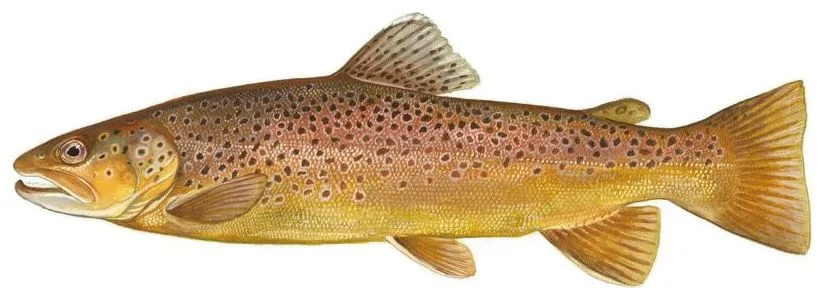
The brown trout is the trout that grows biggest in American rivers and is hardest to fool. A European fish, it came to America as eggs from Germany in 1883 and now lives in almost every trout state. It outlasts brook trout in water that is too warm for them. As it grows it turns into a fish-eater, and it does its serious feeding in the dark.
America’s brown trout descend from eggs shipped across the Atlantic from 1883 on. The first 4,900 fry went into Michigan’s Baldwin River in April 1884.
How do you know it is a brown trout?
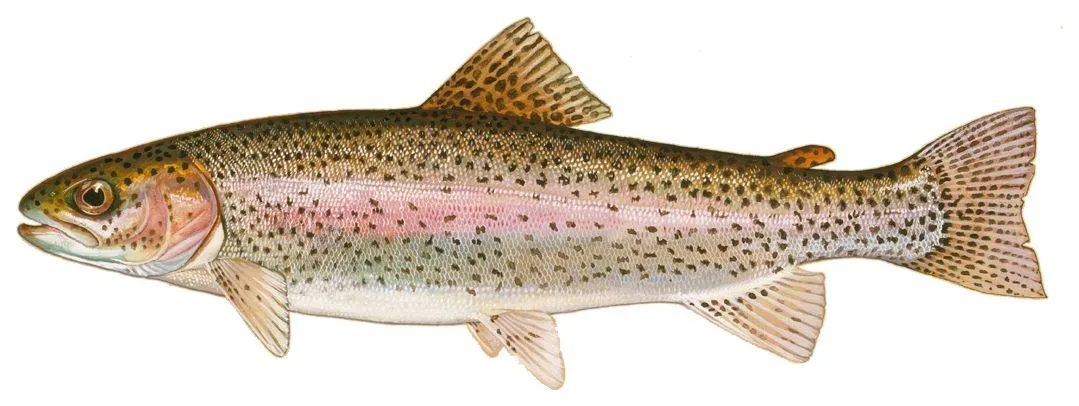
Look for two colors of spots. A brown trout carries black spots and red spots on its flanks, and the red ones sit in pale halos. The body runs from dark brown to golden yellow, with a white to yellow belly. The tail is square and carries few or no spots, which is the quickest way to rule out a rainbow trout. The adipose fin, the small fleshy fin in front of the tail, has a red edge.
The species is unusually variable. The Wild Trout Trust puts the variation in body weight among same-age brown trout in one population at about 60 percent, against about 15 percent for most vertebrates. Fish from peaty water often have golden bellies, and sea-run fish come back silver. Color alone can fool you; the spot pattern and the tail rarely do.
| Mark | Brown trout | Rainbow trout | Brook trout |
|---|---|---|---|
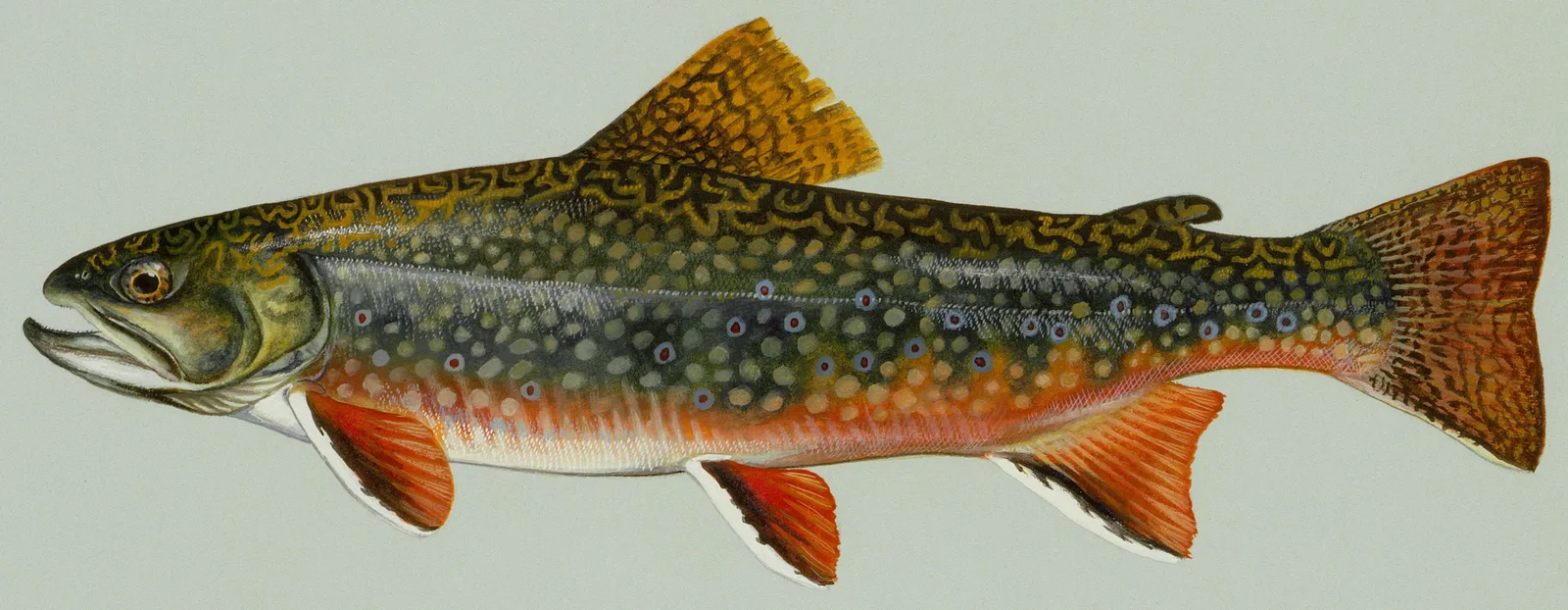
| Spots | Black and red, red ones with pale halos | Small black spots, dense on back and tail | Pale worm-like marks on back; red spots with blue halos |
| Tail | Square, few or no spots | Square, heavily spotted | Square (“squaretail”) |
| Side | Golden brown to olive | Pink to red band | Dark olive with pale marbling |
| Lower fins | Plain | Plain | White leading edge and black line |
| Family branch | Trout (Salmo) | Pacific trout (Oncorhynchus) | Char (Salvelinus) |
The last row is the one that surprises people. A brown trout shares its genus, Salmo, with the Atlantic salmon, and a brook trout is not a trout but a char. Salmon and trout are one family, and the trout vs salmon line is thinner than it looks. A brown crossed with a brook trout gives the sterile, tiger-striped tiger trout.
What do brown trout eat, and when?
Young brown trout eat what every trout eats: insects, mostly drifting nymphs and larvae. As they grow they turn to fish and crustaceans. In West Virginia’s phrase, larger browns “prey and key on fish species.”
The big fish also change their hours. Stream browns feed mainly at night and lake browns by day. West Virginia calls mature fish “more nocturnal, making them more difficult and finicky for anglers to catch.”
Temperature sets the rest. Vermont gives a preferred range of 53–66 °F (12–19 °C). Browns tolerate warmer water than the other common trout: up to about 72 °F (22 °C) in West Virginia’s figure, and brief spells near 80 °F (27 °C) in Vermont’s. That tolerance is why browns hold in lower, warmer river sections that brook trout abandoned. It is not a license to fight them hard in August; the trout water temperature page has the stress thresholds.
| Season | Water | What browns do | For the angler |
|---|---|---|---|
| Spring | Warming toward 50–60 °F (10–16 °C) | Feed hard on insects after winter | Nymphs, small spinners, worms after rain |
| Summer | 53–66 °F (12–19 °C) ideal; above 70 °F (21 °C) stressful | Big fish hide by day, hunt at night | Dawn, dusk and dark; cold tailwaters and springs |
| Early fall | Cooling | Pre-spawn: males aggressive and territorial | Streamers and big spinners; the best big-fish window |
| Fall spawn | 42–48 °F (6–9 °C), September to December | Pairs on shallow gravel redds | Leave spawning fish alone; do not wade the redds |
| Winter | Cold | Slow, deep, close to food | Slow nymphs in deep, soft water |
Free card: what 26 species do at your water temperature
Plus one email a week on what's biting now. No sales pitches. Privacy.
How do you catch a big brown trout?
Fish for the brown’s habits, not for trout in general. Small stream browns take the same nymphs, dry flies, worms and inline spinners as any trout. The big ones are fish-eaters, so the trophy tactics use bigger baits: streamers on a fly rod, jerkbaits and spoons on spinning tackle.
Time matters more than for any other trout. Low light at dawn and dusk, overcast days, stained water after rain, and night fishing where it is legal all favor the big fish. The best time of day to fish page has the hours. The pre-spawn weeks of early fall are the classic window, before the fish pair up on the gravel. The rods, rigs and step-by-step tactics are on the trout fishing page.
You can keep brown trout where the rules allow, but many wild brown trout rivers carry slot limits or catch-and-release rules, so check the regulations for the water. A released brown needs the usual care: a wet hand, little air time and a quick release (catch and release).
How big do brown trout get?
A brown trout’s size depends almost entirely on food. Vermont’s stream browns reach 5–9 in (13–23 cm) in two years and 9–14 in (23–36 cm) by four. Lake fish grow much faster: 11–18 in (28–46 cm) at three and 13–21 in (33–53 cm) on average at four. Most live five or six years, though eight or nine is not unusual in lightly fished water.
So a 21 in (53 cm) brown from a small stream is a fish of many years and a rare one. In a rich lake, where three-year-olds reach 18 in, it is a good fish rather than a miracle.
The all-tackle world record is 44 lb 5 oz (20.1 kg). An angler in his 70s, using the alias Seumas Petrie, caught it on October 27, 2020, in the Ohau Canal near Twizel, New Zealand, on a jig and 6 lb line. The fish was 38.6 in (98 cm) long with a 34 in (86 cm) girth. The canal runs past a salmon farm, and its trout have eaten spilled feed pellets since they were fingerlings. The previous record, 42 lb 1 oz, came from the same canal in 2013.
The American best is a near tie. Tom Healy’s 41 lb 7¼ oz fish from Michigan’s Big Manistee River in 2009 and Roger Hellen’s 41 lb 8 oz fish from Lake Michigan off Racine County, Wisconsin, in 2010 shared the world record as an IGFA tie. Both followed Rip Collins’ 40 lb 4 oz fish from Arkansas’ Little Red River, caught in 1992 on 4 lb line and a 1/32 oz jig.
Is brown trout good to eat?
Yes. Arizona Game and Fish sums up its table quality in one line: “The meat has a pink or yellow color and tastes good.” Like the rainbow, it counts as freshwater trout, which the FDA lists among its Best Choices for low mercury. Wisconsin puts inland trout in its least restricted group: unrestricted for most adults, four meals a month for children under 15 and anyone pregnant, nursing or planning a pregnancy. Some Great Lakes waters have their own exceptions, so check the advisory for that water. Ice a kept fish soon; the FDA’s limit for any seafood out of the cold is 2 hours.
When do brown trout spawn?
Brown trout spawn in fall, from September through December, when the water falls to about 42–48 °F (6–9 °C). Vermont puts it at late October through December at 44–48 °F. A female picks shallow gravel, fans it clean and digs a nest called a redd, then lays her eggs: on average 200–1,000 by the USGS count, and more the bigger she is.
A redd shows as a lighter, freshly cleaned patch of gravel in a shallow riffle or pool tail, and where there is one there are usually more. The eggs sit in the gravel through winter. One boot in the wrong place crushes or dislodges them, so fall wading means walking around the pale patches, not across them. Lake browns have to reach a tributary to spawn; they cannot do it in the lake.
Is a sea trout a brown trout?
Yes. A sea trout is a brown trout that migrated to salt water, not a separate species. The Wild Trout Trust is plain about it: any resident brown trout is physically capable of the change, and whether a fish goes is set by “a mixture of genetic and environmental cues.” Resident and sea-run fish can hatch in the same river.
Britain and Ireland have their own names for the sea-run fish: sewin in Wales and white trout in Ireland, while a small one is a finnock or a peal. On the Gulf of Mexico, “speckled trout” means something else entirely: the spotted seatrout, a member of the croaker family and a cousin of the red and black drum.
Where did America’s brown trout come from?
The native range runs from northern Norway to the Atlas Mountains of North Africa. The American story starts with Fred Mather, a New York fish culturist working under U.S. Fish Commissioner Spencer Baird. In 1883 Mather obtained eggs from Baron Lucius von Behr, president of the German Fishing Society, taken from the streams and lakes of the Black Forest.
The eggs were split between three hatcheries: Mather’s at Cold Spring Harbor on Long Island, Seth Green’s in Caledonia, New York, and the federal hatchery at Northville, Michigan.
In 1885 a second strain arrived, eggs from Loch Leven in Scotland. The two looked different. The German fish had a lighter golden cast with some red spots and fewer black ones. The Loch Leven fish had bigger fins, slimmer bodies, and heavy black spotting with no red. That is where the old names “German brown” and “Loch Leven” come from. The hatcheries interbred the strains. What swims in most rivers today is, in one biologist’s phrase, the “American generic brown trout.”
The USGS now records the species from coast to coast, including Hawaii and Puerto Rico. Native fish pay the price of that success. West Virginia names displacement of native brook trout as the main concern with browns. In the USGS account, adult browns push brook trout out of the best habitat, and brookies are more exposed to predation. The brown trout’s scientific name is Salmo trutta, and the trout hub has the identification table for every species.
Free download
The water temperature card
Read your water temperature and the card tells you who is spawning, who is feeding and what to throw. 26 species, 16 pages, for your phone and the tackle box.
Plus one email a week on what's biting now. No sales pitches. Privacy.
Related
Section guide
Trout: The Types of Trout and How to Tell Them ApartThe types of trout anglers catch, from rainbow and brown to brook and lake trout (two are chars): the marks that identify each, spawn seasons, records.
 Brook Trout: The Char That Marks America's Coldest Water
The brook trout is a char, not a trout: how to tell it apart, where it still lives, why it lost 28% of its range, and the 1915 record.
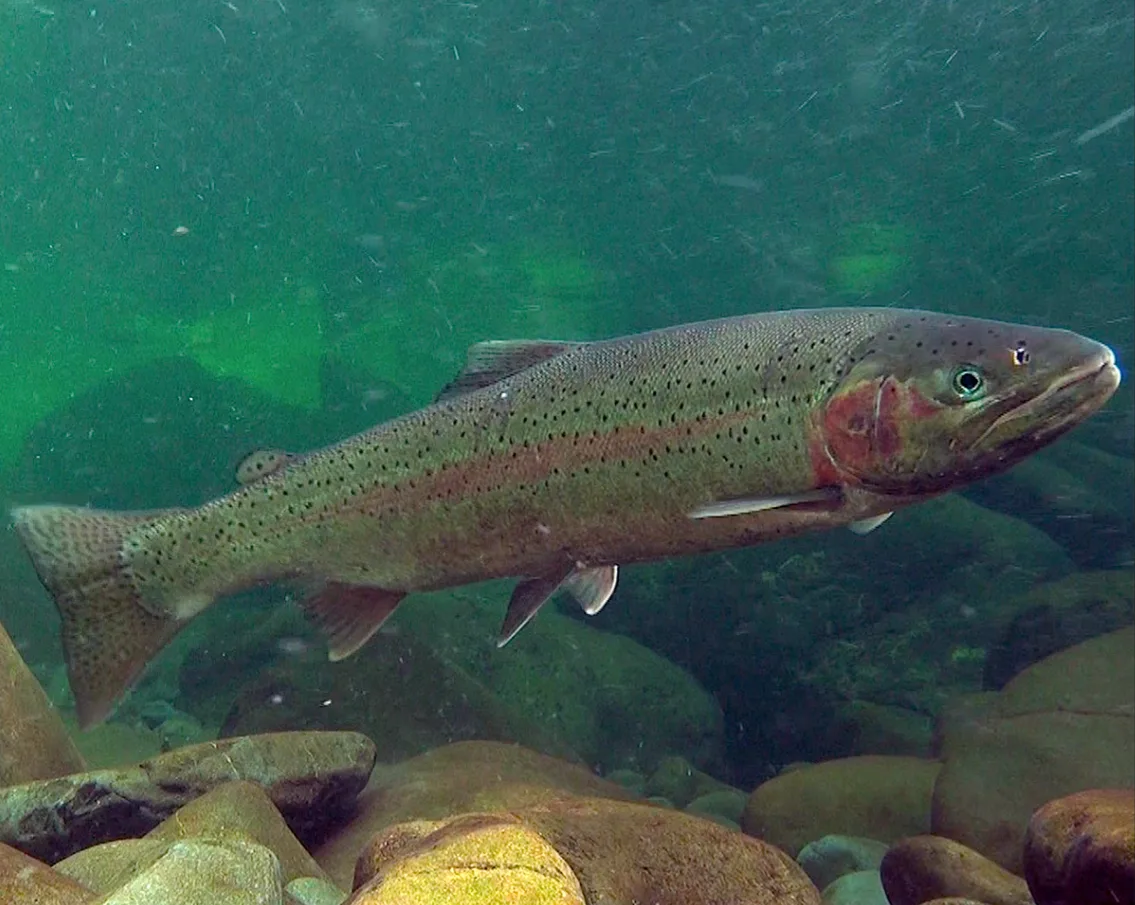 Steelhead Trout: The Rainbow That Goes to Sea
Steelhead trout are rainbows that run to sea or a Great Lake and come back to spawn, often more than once. Runs, the ESA listings, Great Lakes fish, records.
- Rainbow Trout: Identification, Range, Spawning and Record
Rainbow trout from the agency data: how to tell one from a steelhead, cutthroat or brown, the temperatures that matter, spawning, and the 48 lb record.
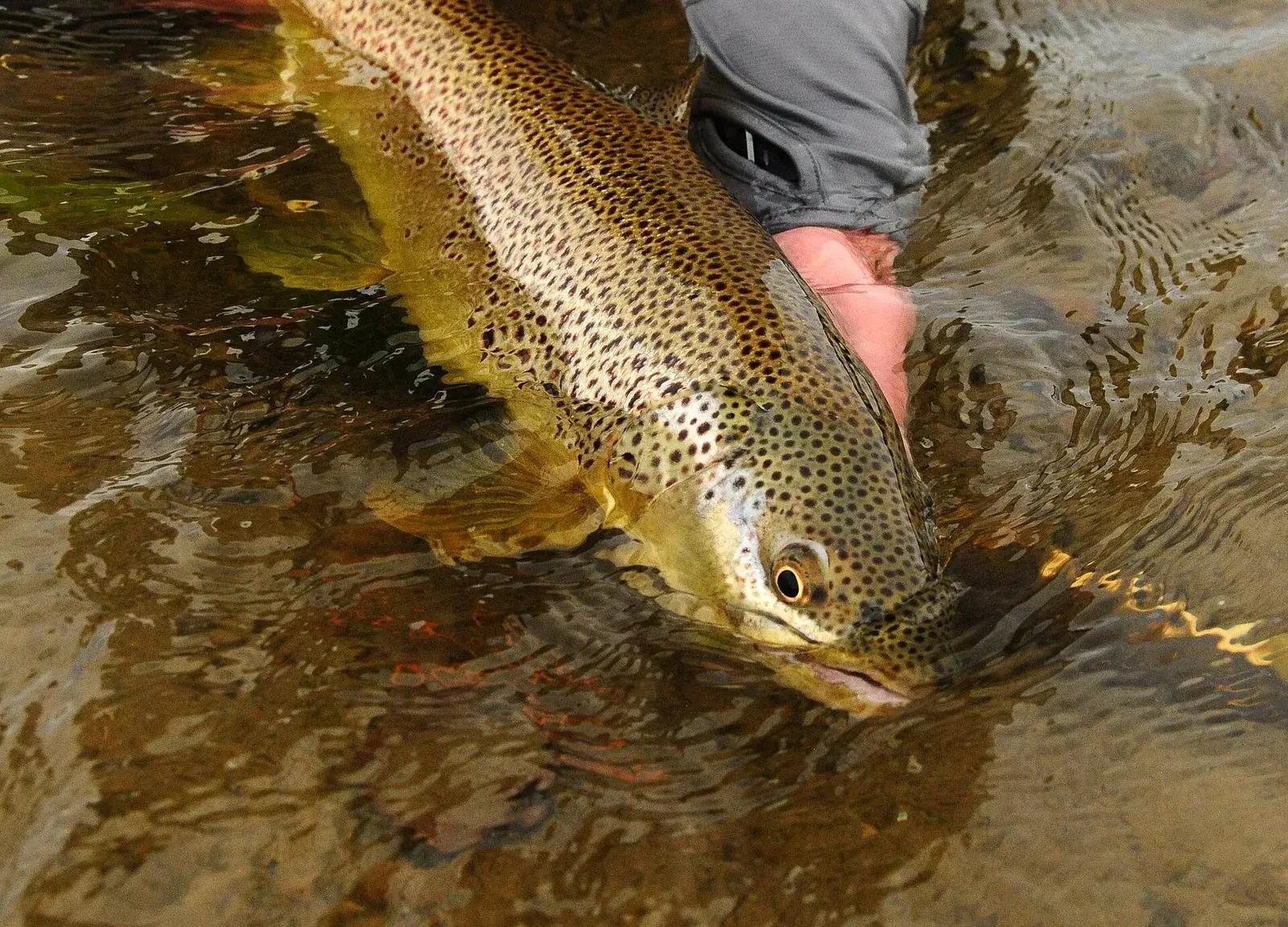 How to Hold a Trout Without Hurting It: Grip, Photo, Release
How to hold a trout so it swims off healthy: the belly cradle and tail grip, no lipping, the 10-second photo, and what the release studies found.
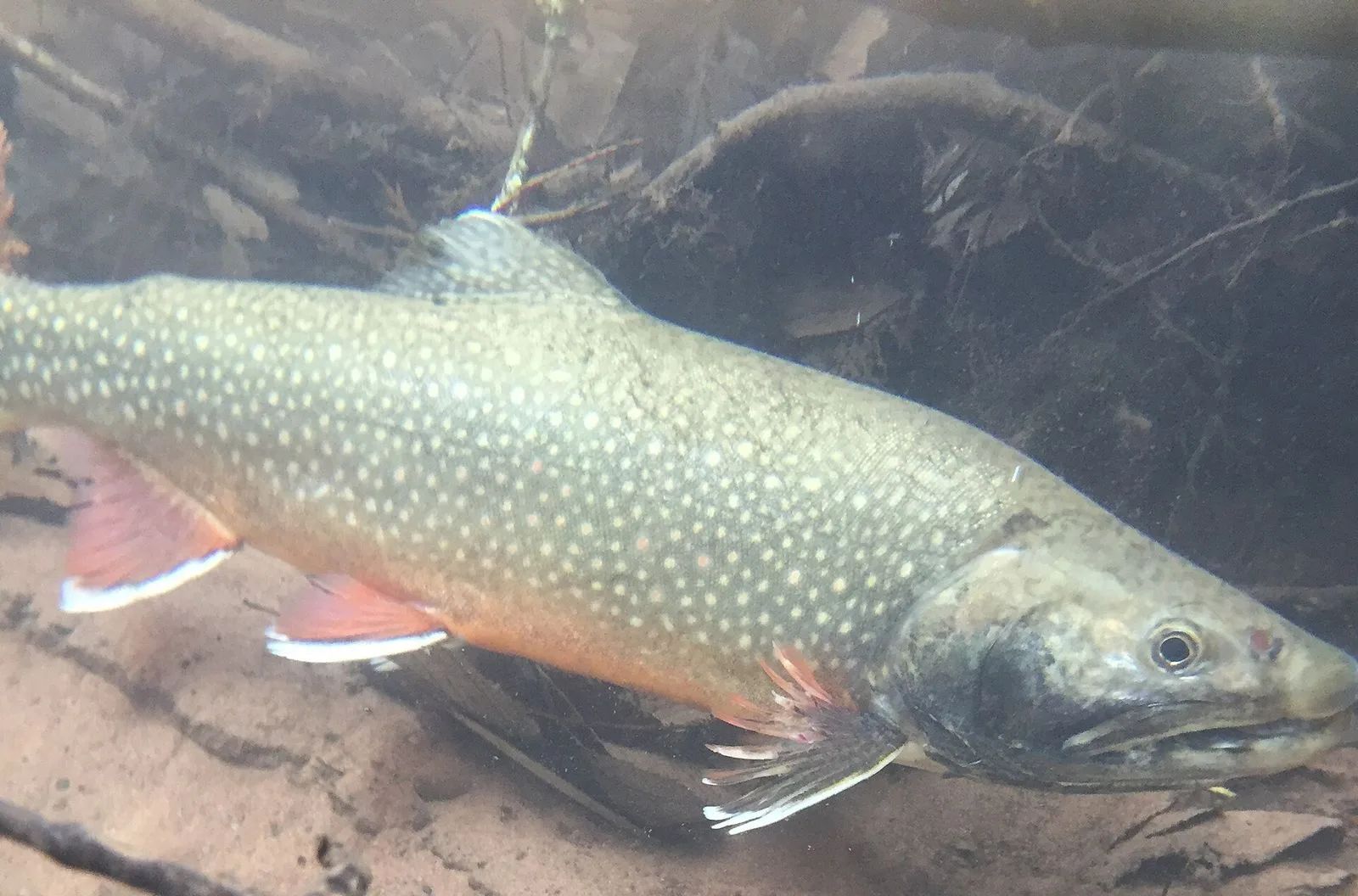 Splake: The Brook Trout and Lake Trout Hybrid
Splake are a hatchery cross of lake trout and brook trout. How to tell them apart, whether they can reproduce, the 20 lb record and how to catch them.
Sources
- West Virginia DNR, brown trout
- Vermont Fish & Wildlife, brown trout
- USGS Nonindigenous Aquatic Species, brown trout fact sheet
- Trout Unlimited Hiwassee 640, the brown trout's arrival in America
- Orvis News, classic fish facts: brown trout
- Wild Trout Trust, brown trout and sea trout
- Flylords, fall fishing ethics and the brown trout spawn
- Outdoor Life, the biggest trout ever caught (IGFA records)
- Anchor Fly, world record brown trout and runners-up
- CBS Chicago, Wisconsin man sets record for brown trout (IGFA tie, 2010)
- ITIS, genus Salmo (Atlantic salmon and brown trout)
- Wild Trout Trust, sea trout
- Texas Parks and Wildlife, spotted seatrout
- Arizona Game and Fish Department, brown trout: table quality
- U.S. Food and Drug Administration, advice about eating fish
- Wisconsin DNR, Eating your catch: statewide safe-eating guidelines for most inland waters
- U.S. Food and Drug Administration, Selecting and serving fresh and frozen seafood safely