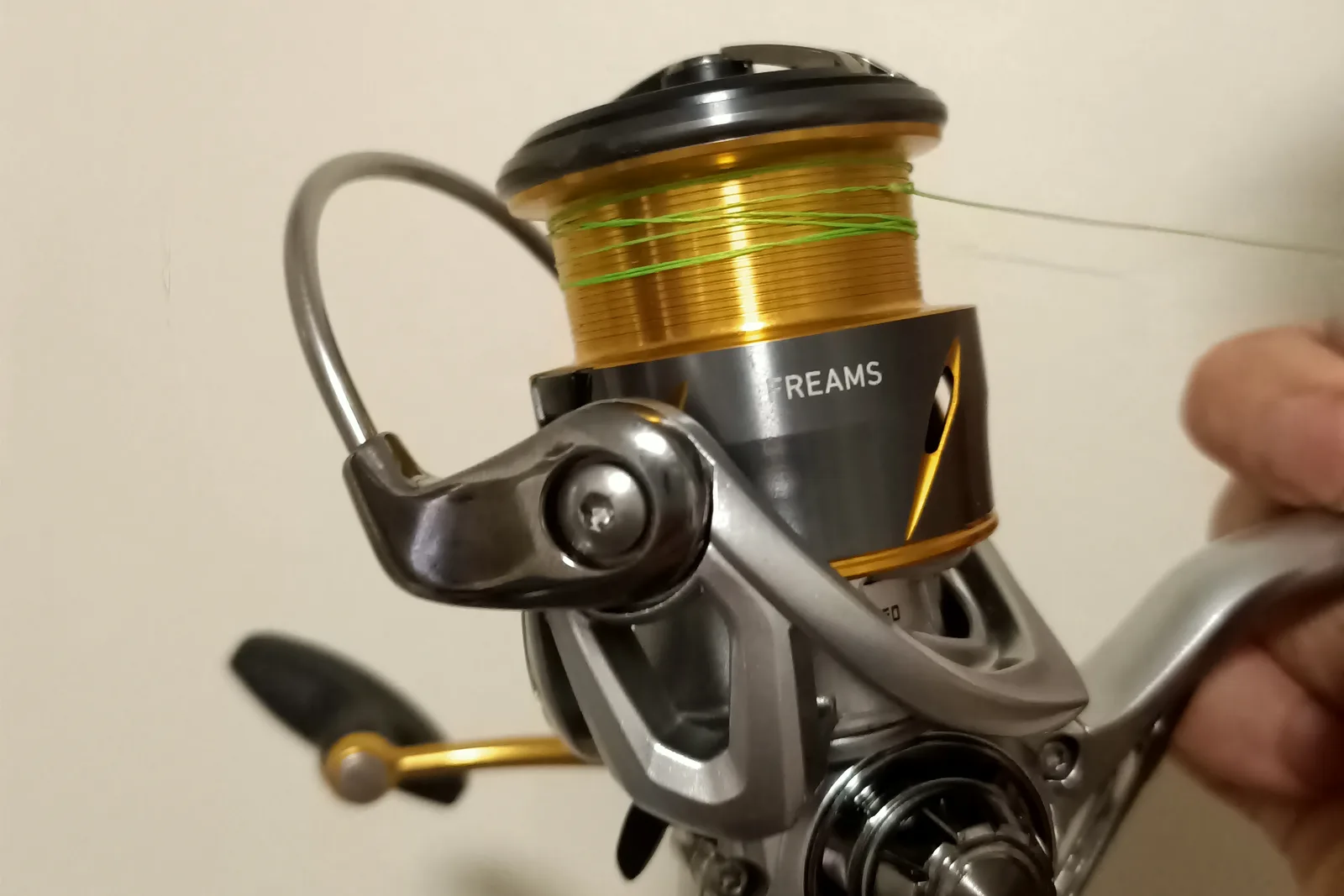
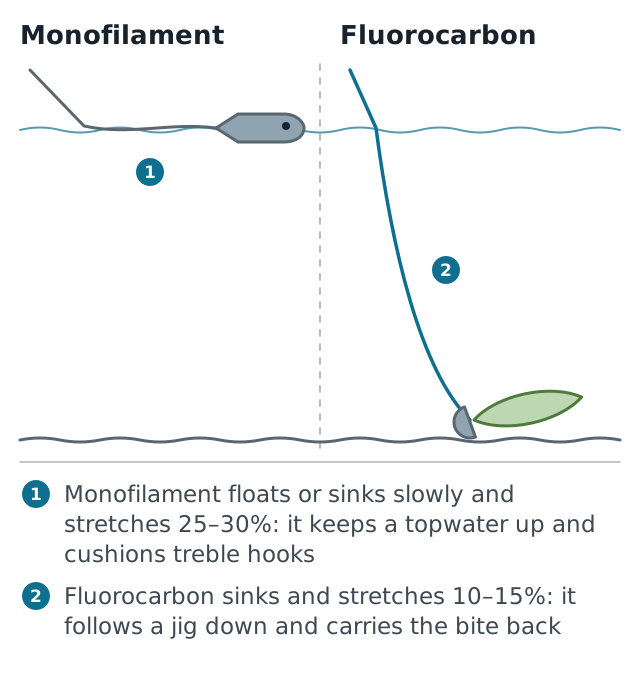
Monofilament fishing line is a single extruded strand of nylon, and it has been the default fishing line since DuPont sold the first spools in 1939 and the limper Stren of 1959 put it on nearly every reel, because it does four things well and cheaply: it stretches, it floats, it ties every knot in the book, and it costs one to three cents a yard. The stretch is the property that matters most. At 25–30 percent it cushions a treble hook against a thrashing fish, lets a catfish take a circle-hook bait without feeling the rod, and absorbs a trolled striper’s surge; it is also why mono feels dull on a jig and why braid and fluorocarbon took its place for bottom fishing.
Every property that makes mono worse for a jig makes it better for a crankbait, a topwater or a catfish bait. It is not the old line. It is the line for stretch.
The properties, measured
| Property | Monofilament | Fluorocarbon | Braid |
|---|---|---|---|
| Material | Nylon, one strand | PVDF, one strand | Woven polyethylene fibers (Spectra, Dyneema) |
| Stretch | 25–30% | 10–15% | About none |
| Buoyancy | Floats or sinks slowly | Sinks | Floats |
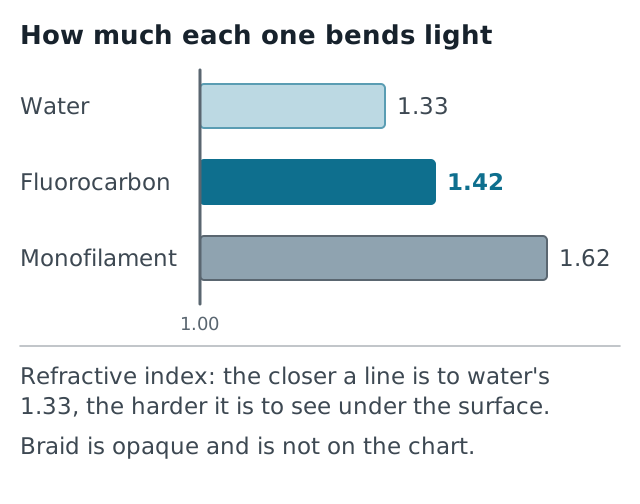
| Visibility | Refractive index 1.62; visible | 1.42; near invisible | Opaque |
| Diameter at 20 lb | 0.016–0.018 in (0.41–0.46 mm) | 0.015–0.016 in | 0.009–0.010 in |
| Abrasion resistance | Moderate | High | Low; frays |
| Water absorption | Absorbs, and loses some strength wet | Very little | None |
| Memory | High; coils off the spool | Moderate to high | None |
| Life on the spool | 3–6 months; UV and water degrade it | 1–2 years | 2–5 years |
| Price per yard | $0.01–0.03 | $0.05–0.15 | $0.04–0.10 |
| Knots | Everything ties easily | Wet and pull slowly | Braid knots and a leader |
The diameters are Tackle Village’s measurements: at 10 lb, mono and fluorocarbon are both 0.011 in and braid 0.008; at 30 lb, 0.020 against braid’s 0.012. Mono is not fatter than fluorocarbon at the same strength; it is fatter than braid by half.
What 25 percent of stretch does at the rod
Nylon stretches 25 to 30 percent of its length before it breaks, fluorocarbon 10 to 15, braid almost nothing. With 60 ft (18 m) of mono out, that is up to 15 ft (4.6 m) of give at the limit, and inches of give at the loads of a hookset, where braid gives none. That give is a spring: it keeps a crankbait’s thin trebles from tearing a hole in a jumping bass, takes the shock out of a striper hitting a trolled plug, and protects the knot, which is where line fails. On TackleTour’s bench, 10 lb Berkley Big Game broke at 11.8 lb on a straight pull but at 94 percent of its rating through a knot: a mono rated 10 lb is usually a little more than 10 lb, and the knot is the part that is not.
The spring costs hooksets, and the fix is the rod. Jason Sealock’s rule at Wired2Fish is to pair stretchy line with a faster action and more backbone, so the rod makes up what the line softens, and to put braid on a moderate rod that bends deep; the rods hub explains action and power. A mono crankbait rod can be moderate, because the trebles want give; a mono topwater or spinnerbait rod should be fast.
Mono against fluorocarbon, and against braid
Against fluorocarbon, mono wins when the line has to float, when the knot has to be tied fast with cold hands, when cold water turns fluorocarbon into wire on a spinning reel, and when the spool costs more than the fish is worth: a 300 yd filler of mono is a third the price. Fluorocarbon wins where the fish can see the line, where it rubs rock and shell, where the lure has to sink, and where the bite has to be felt; the fluorocarbon vs monofilament page settles the two technique by technique.
Against braid, mono wins on stretch, price, knots and on gripping the spool, which is why 20 yd of mono goes under every braid fill. Braid wins on diameter, which means distance, depth and more line on the reel; on sensitivity; on strength in cover; and on life, because polyethylene neither absorbs water nor weakens in the sun. Most anglers settle on braid on the reel and a mono or fluorocarbon leader at the lure, which the braided fishing line and fishing leader pages set out.
Where mono is the right line
| Technique | Mono | Why |
|---|---|---|
| Topwater: poppers, walking baits, buzzbaits | Yes, 12–17 lb | It floats, so the lure’s nose stays up; fluorocarbon drags it under |
| Crankbaits, squarebills, lipless baits | Yes, 10–14 lb, or fluorocarbon | Stretch keeps treble hooks from tearing out on a jumping fish |
| Trolling for stripers, walleye, salmon | Yes, 12–20 lb | Stretch absorbs the strike and the surge on a tight line |
| Catfish and carp bait rigs with circle hooks | Yes, 15–30 lb | The fish takes the bait against a soft line and hooks itself |
| Live bait under a float, panfish, trout in stocked ponds | Yes, 4–8 lb | Cheap, easy to tie, forgiving |
| Spinnerbaits and chatterbaits in stained water | Yes, 14–17 lb | The fish cannot see the line; mono casts well and costs little |
| Leader in stained water on braid | Yes, 6–10 lb finesse, 12–17 lb Texas rig; Matt Allen’s stained-water choice | Cheaper than fluorocarbon, and invisibility does not matter in dirty water |
| Backing under braid on any spool | Yes, 20 yd | Braid slips on a bare spool; mono grips it |
| Beginners’ first spool | Yes, 8–10 lb | Forgives the hookset, the knot and the reel |
Diameter by pound test
The diameter in the small print on the spool decides how far the line casts, how deep a crankbait runs and how much fits on the reel. Berkley’s published figures for Trilene XL (the limp casting line) and Big Game (the tough one) sit beside what Tackle Village measured with a micrometer on Trilene and on SpiderWire Stealth braid.
| Test | Berkley, published | Mono, measured | Braid, measured |
|---|---|---|---|
| 4 lb | 0.008 in (0.20 mm), XL | 0.008 in | – |
| 6 lb | 0.009 in (0.23 mm), XL | 0.009 in | 0.005 in (0.13 mm) |
| 8 lb | 0.010 in (0.25 mm), XL | 0.010 in | 0.007 in (0.18 mm) |
| 10 lb | 0.011 in (0.28 mm), XL | 0.011 in | 0.008 in (0.20 mm) |
| 14–15 lb | 0.015 in (0.38 mm), Big Game 15 lb | 0.014 in at 14 lb | 0.009 in (0.23 mm) |
| 20 lb | 0.018 in (0.46 mm), Big Game | 0.016 in (0.41 mm) | 0.010 in (0.25 mm) |
| 30 lb | 0.022 in (0.56 mm), Big Game | 0.020 in (0.51 mm) | 0.012 in (0.30 mm) |
| 40 lb | 0.024 in (0.61 mm), Big Game | 0.024 in | 0.013 in (0.33 mm) |
| 50 lb | 0.028 in (0.71 mm), Big Game | 0.028 in | 0.014 in (0.36 mm) |
The labels are honest: TackleTour’s micrometer put 10 lb Trilene XL at 0.293 mm against a published 0.280, and 10 lb Big Game at 0.298 against 0.300. And the same pound test is not the same line: Big Game 10 lb is 0.300 mm where XL 10 lb is 0.280, because the tough monos buy their abrasion resistance with a fatter strand. The millimeter column is the one to read on a spool from Europe or Japan, sold by diameter rather than by test.
Copolymer, and the colors
Two variations on mono deserve their own line. Copolymer lines blend two nylons, or nylon with another polymer, for less stretch, a thinner strand for the strength and better abrasion resistance, at a small premium; several of the “premium monofilaments” on the shelf are copolymers, and Sufix says its Advance stretches half as much as a regular mono. They are the sensible upgrade for crankbaits and jerkbaits, where the angler wants some stretch but not all of it. High-visibility mono in yellow or orange is the other: fish care less about line color than anglers fear, and a bright main line lets a float angler, a catfish angler watching a slack line or a bass angler on a light leader see the line move before the rod does. Yellow 4 and 6 lb line is the crappie standard because most crappie bites are seen rather than felt, and night anglers run fluorescent blue, which glows under a black light. Pair any bright line with a clear or fluorocarbon leader in clear water and the fish sees nothing while the angler sees everything.
Memory, and how to beat it
Memory is nylon’s habit of keeping the coils of the spool: a fresh spool of mono jumps off a spinning reel in loops, and a stiff old one casts half as far. Heat makes it worse, which is why a rod left in a truck cab through July comes out with line like a Slinky. Five things beat it:
- Spool under tension, wet, to 1/8 in (3 mm) below the lip; the how to put fishing line on a reel page has the steps.
- Soak it before the first cast. Nylon goes limper wet; a few minutes with the spool in the lake relaxes the coils.
- Stretch the first 30 ft (9 m) by hand. Hook the lure to a fence post, walk back and pull.
- Pick a limp line for spinning reels. Trilene XL, Maxima Ultragreen and Sunline Super Natural are the limp casting monos; Big Game and the other tough lines coil more and belong on a baitcaster or a catfish reel.
- Keep it out of the heat, and replace a spool that still coils after a soak and a stretch.
Where it loses
- Jigs, Texas rigs, drop shots and anything fished on the bottom. The stretch hides the bite and the bottom; fluorocarbon or braid.
- Heavy cover. A 20 lb mono is 0.018 in thick; a 50 lb braid is 0.014. Frogs, punching and flipping want braid’s strength in a thin line.
- Casting distance with light lures. Braid’s thinness and lack of memory cast farther; mono’s coils cost yards.
- Clear water and pressured fish. Mono’s refractive index of 1.62 is farther from water’s 1.33 than fluorocarbon’s 1.42, and fish see it.
- Longevity. Mono weakens in sun and water; a spool that has sat a season is a spool that breaks on the hookset. Change it every three to six months of use, and after any big fish.
- Deep water. Stretch over 100 ft of line means a hookset that never reaches the hook; braid.
The knots that hold in mono
Nylon is the easy line to knot: it is slightly rough and stiff enough that five wraps grip, so a knot that slips in braid holds in mono, and a rushed knot costs less than in fluorocarbon, which glazes when pulled tight dry. The rule is still wet, tighten slowly, trim short, retie after a fish. The Palomar knot is the strongest simple hook knot in mono because it doubles the line through the eye; on nylon the improved clinch beat the uni knot head to head in the pull tests on that page. Mono to mono of similar diameter, 10 lb to 15 lb, is the blood knot; braid to a mono leader is the FG or the double uni, compared on the braid to mono knot page; and the line goes onto the spool with an arbor knot.
When to respool, and how to store it
Nylon degrades whether it is fished or not: sunlight breaks down the polymers that give it strength and flexibility, water soaks in and loosens knots, salt dries into crystals that work like sandpaper, and every rock, dock post and hookset leaves a nick. MeatEater’s Alice Jones Webb puts a hard-fished spool of mono at once per season, sooner if it lives in the sun; Angling Sports’ schedule is three or four times a year for a heavy user, two or three for a weekend-a-month angler, once a year for the occasional one, and a bulk spool unused for two or three years goes in the bin. Braid on the same reel lasts years, which is the second argument for braid with a mono leader: the main line stays and the cheap part gets replaced.
- Read the line, not the calendar. Run it through your fingers from the lure back: rough spots, fraying, a chalky or faded color, stiffness, coils that will not stretch out. On the first 20 ft (6 m), cut 10 ft and retie; along the whole spool, respool.
- Test it. Tie the end to something solid, walk out 25 ft (7.6 m) and pull; old 12 lb mono snaps like thread, and better at the dock than at the fish.
- Store it cool, dark and dry. A sealed bulk spool in a closet keeps; a filler spool on the dash or in a boat locker does not. Never put a reel away wet, and buy 300 yd at a time unless several reels run the same test; a 3,000 yd bulk spool is old before it is used.
Buying it
- A premium spool, not the bulk bin. The difference between a $5 and a $12 spool of mono is consistency of diameter and knot strength; the cheap spool is where line breaks at the knot.
- Color. Clear or low-vis green for most fishing; high-vis yellow for watching the line on a float rig or for a leader-fishing bass angler who wants to see the bite.
The line for each fishing
| Fishing | Mono test | Which mono | Notes |
|---|---|---|---|
| Bass, casting lures | 10–17 lb | Tough mono or copolymer on a baitcaster | 10–14 lb crankbaits, 12–17 lb topwater and spinnerbaits; 17–20 lb for pitching jigs around wood |
| Trout, streams and stocked lakes | 4–6 lb | Limp, clear or green, on a spinning reel | Light enough to cast a 1/16 oz spinner; a 4 lb leader in clear water |
| Catfish | 20–30 lb main, 30–50 lb leader | Tough, abrasion-resistant mono | Circle hooks and a soft line hook the fish; the catfish rigs page builds the rig |
| Panfish and crappie | 4–6 lb | Hi-vis yellow on a light spinning reel | The bite is seen, not felt; a clear leader in clear water |
| Steelhead and salmon under a float | 8–12 lb main | Limp mono that floats and mends | A 4–8 lb fluorocarbon leader below the float; the steelhead page gives the setups |
| Surf | Matched to the sinker | Tough mono main line and a heavier mono shock leader | The shock leader, several rod lengths long, takes the strain of the cast so the main line can stay light enough to throw |
Related
The fluorocarbon fishing line page makes the other case, the line hub holds the three-way comparison, and the best fishing line for bass page turns all three into a setup per technique.
Related
Section guide
Fishing Line: Monofilament, Fluorocarbon and Braid ComparedThe three kinds of fishing line compared on stretch, visibility, diameter, sink rate and life, which line each technique wants, and why braid needs a leader.
 Fluorocarbon Fishing Line: What It Does, and When Not to Use It
Fluorocarbon fishing line sinks, stretches less than mono and is nearly invisible under water. Where it wins, where it loses, and how to tie it so it holds.
 Best Braided Fishing Line: The Reviewers' Picks Compared
The best braided fishing line: eight braids compared on carriers, diameter and price per yard, with picks for flipping, finesse, inshore, surf, catfish and ice.
 Fluorocarbon vs Monofilament: Which Line Wins for Each Technique
Fluorocarbon versus monofilament on the numbers: stretch, visibility, sink rate, abrasion and price, then a technique-by-technique verdict with pound tests.
 Braided Fishing Line: Strength, Diameter, Pros and Cons Explained
Braided fishing line explained: what it is made of, the pound-test and diameter table against mono, why it needs a leader and backing, and when not to use it.
Sources
- The Tackle Room, mono vs fluorocarbon vs braid
- Tackle Village, fishing line diameter chart
- Seaguar, understanding fluorocarbon (FAQ; the refractive indices)
- Tactical Bassin (Matt Allen), best fishing line: braid, mono or fluorocarbon
- Wikipedia, monofilament fishing line (DuPont 1939, Stren 1959, extrusion, degradation)
- Wired2Fish (Jason Sealock), best monofilament fishing lines for 2026
- TackleTour, Berkley Trilene XL review (published vs measured diameter)
- TackleTour, Berkley Trilene Big Game review (diameter, break and knot strength, abrasion cycles)
- FishUSA, Berkley Trilene XL (Berkley's published diameters, 2–10 lb)
- Tomo's Tackle, Berkley Trilene Big Game quarter spool (published diameters, 15–50 lb)
- MeatEater (Alice Jones Webb), you should change your fishing line more often
- Angling Sports, when should I change my fishing line