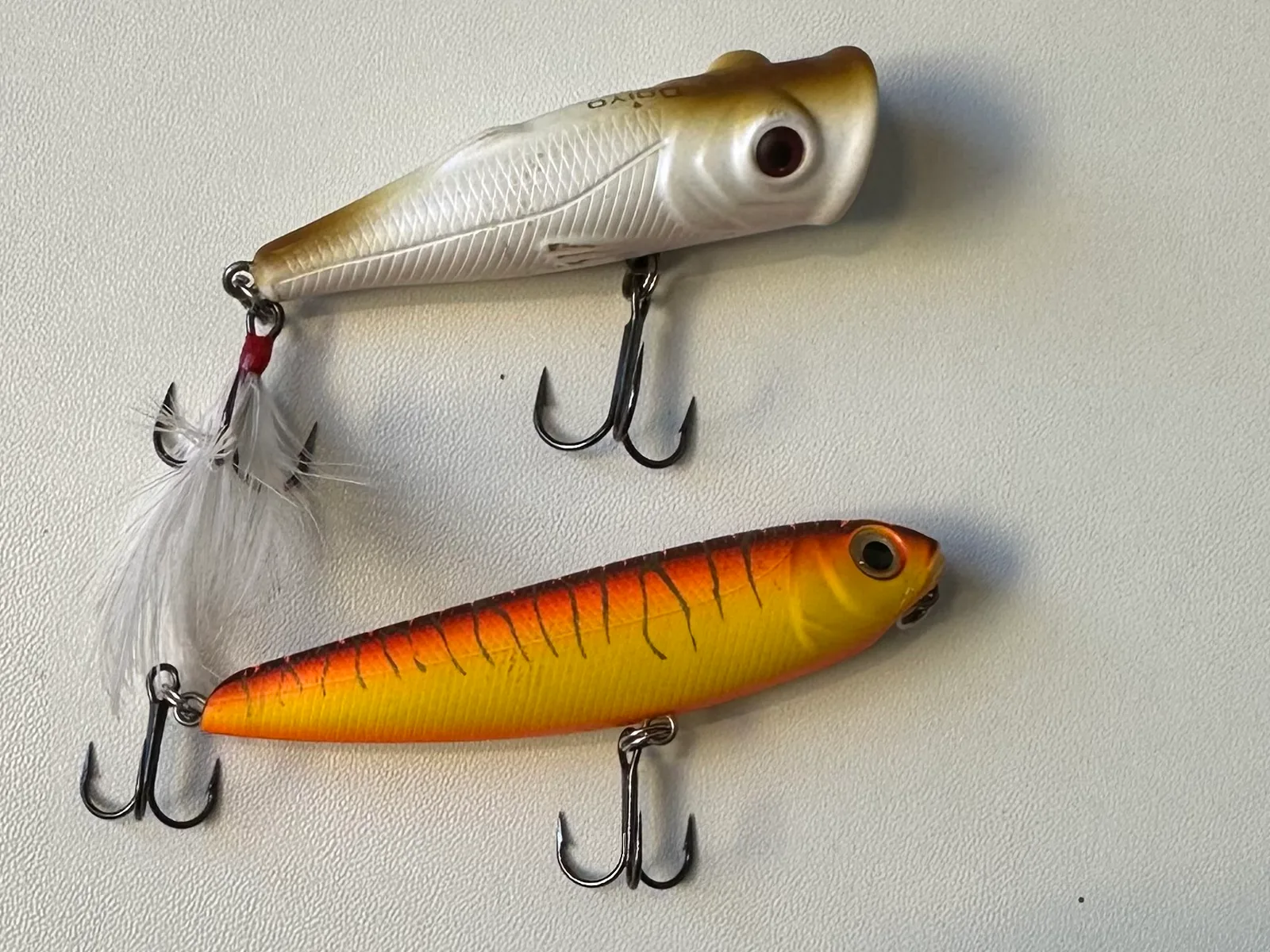
The Whopper Plopper lure is a hard-bodied topwater with a soft rubber tail that spins on a straight retrieve and plops, “like a small water bird running across the surface before flight” in the words of its own origin story. Larry Dahlberg of the television series Hunt for Big Fish and Simon Chan of River2Sea developed it around 2008 as a musky lure; the prototype was a carved broomstick with a cupped rubber tail, and the production lure kept the idea. Bass anglers borrowed it, and the 90 and 110 became the most-thrown prop bait of the last decade, because it does what a buzzbait does, a steady and noisy surface retrieve, and floats when it stops. Below: the six sizes with the maker’s weights and hooks, the rod and line for each, the retrieves, the waters and conditions, the colors, the hookset, and how it compares with the buzzbait, the walking bait and the popper.
Chris Lane had never thrown a Whopper Plopper before the 2016 Elite Series event on Toledo Bend. A neighbor handed him one while he packed, he finished second behind Kevin VanDam, and once the broadcast aired the stores were empty for months.
The six sizes
| Model | Length | Weight | Hooks | For |
|---|---|---|---|---|
| Whopper Plopper 60 | 2 3/8 in (60 mm) | 1/4 oz (7 g) | Two #6 trebles | Spinning gear, rivers, panfish-sized forage, trout |
| 75 | 3 in (75 mm) | 9/16 oz (16 g) | Two X-Strong #4 | Pressured bass, smallmouth, small forage |
| 90 | 3 1/2 in (90 mm) | 1/2 oz (14 g) | Two X-Strong #4 | The bass standard; tough days |
| 110 | 4 3/8 in (110 mm) | 1 oz (28 g) | Two 4X-Strong #2 | The size to start with; flats, wind, long casts |
| 130 | 5 in (130 mm) | 1 3/8 oz (39 g) | Two 4X-Strong #2 | Big largemouth, pike, stripers; the only one with a rattle |
| 190 | 7 1/2 in (190 mm) | 2 3/4 oz (78 g) | One long-shank 4X-Strong 5/0 | Musky; the original |
The figures are River2Sea’s own specification tables, and two details matter more than they look. Only the standard 130 is listed with a rattle; the rest run silent, and the 130S is the silent 130, with a 130SSW for salt water. So the glass-bead “sizzle” some guides describe is the 130’s sound; a 90 or 110 plops and nothing else. And the hooks climb with the size, from plain trebles on the 60 to a long-shank 4X 5/0 on the 190, which is why the big ones hold a pike.
Which one to tie on: FishUSA’s guide says start with the 110, which casts well, makes enough noise to pull bass from a distance and is small enough that an average fish commits; the 90 when the bite is tough, the 130 when you want fewer bites and bigger ones. River2Sea built the 75 for pressured water and small forage and says it sounds closer to a buzz saw than a plop; the 60 and 75 are spinning-rod lures. The copies, the Berkley Choppo among them, follow the same ladder, and “Whopper Plopper” has become the name of the whole type.
Why bass eat it
Pete Robbins, who wrote both the Wired2Fish guide and the Outdoor Life review, gives three reasons. Constant movement: a steadily retrieved plopper can be tracked from a distance, through cover and dirty water, and a bass in clear water gets no time to inspect it and turn away. Action: the slapping tail is faster than a walking bait sashays or a popper spits, and whether it imitates a baitfish, a frog or a swimming mammal does not seem to matter. Profile: the long, slim body is the most natural shape there is, and bass find even the 60; go larger as cover, turbidity and wind increase.
The sound and the bubble trail do the work, not the pause. Unlike a popper or a jerkbait, where the long pause is the trigger, the plopper does poorly when bass want the lure to sit, and strikes often come within the first one or two cranks, so be ready from the moment it lands.
Rod, reel and line by size
| Size | Rod | Reel | Line | Where it earns its place |
|---|---|---|---|---|
| 60 and 75 | 7 ft (2.1 m) medium spinning, fast action | Spinning | 10–15 lb braid, tied direct, no leader | Rivers, wading, pressured water |
| 90 | 6 ft 6 in to 7 ft (2.0–2.1 m) medium-heavy casting | 7:1 baitcaster | 10–14 lb mono or 20–30 lb braid | The all-round bass outfit |
| 110 | 7 ft to 7 ft 6 in (2.1–2.3 m) medium-heavy to heavy | 6:1 to 7:1 baitcaster | 14–17 lb mono or 30–50 lb braid | Flats, wind, long casts |
| 130 | 7 ft 6 in (2.3 m) heavy, or a medium swimbait rod | Swimbait setup | 50 lb braid or 20 lb mono | Big largemouth and pike |
| 190 | Heavy swimbait or umbrella-rig rod | Swimbait setup | 50–65 lb braid | Musky |
The rows come from Mystery Tackle Box’s size-by-size rigging and Wired2Fish’s three scenarios, and they disagree on one thing worth understanding. Around cover Wired2Fish wants a heavy, fast-action casting rod of 6 ft 6 in (2.0 m), short enough for the underhand and roll casts that put the lure under a dock, and 20 lb monofilament, because thick mono does not slip behind bark on a laydown the way thin braid does; on open flats, the same rod a few inches longer and 15–17 lb mono for distance. Outdoor Life’s review adds the counterweight: a rod of at least 7 ft with some give in the tip, so the lure is not pulled away from a striking fish, and a slightly stiffer rod with mono than with braid. Fluorocarbon sinks and is the one line to leave off. Tie the lure on direct; it does not need a walking bait’s snap or loop knot. Check hooks and split rings through the day, and go to 2X or 4X trebles when heavy braid or toothy fish bend the stock ones.
The retrieves
- Steady, rod tip up. Keep the tip high through the first turns of the handle; on a long cast the plopper likes to dig in before it spins, and the high tip lifts the nose and gets the tail turning. Lower the tip as the lure nears the boat. The buzzbait retrieve, and the one for most days.
- Find the speed. Too slow and the tail stalls; too fast and the lure planes up and loses its action. Reel at the pace that gives an even plop, and go faster as the cover gets thinner.
- Pause at cover. Stop the lure as it passes the tip of a dock, a clump of grass or a point in the tules. A bass that has followed without committing usually hits on the pause or on a sudden burst of speed.
- Stutter and rip. Stutter steps, slight pauses and the occasional rip change the sound without stopping it. Long pauses belong to the popper, not the plopper.
- Twitch or walk it. Twitch it like a popper, work it jerk-jerk-pause like an old prop bait, or walk it on a slack line with a wrist twitch: a change of pace for followers, and a way to fish a spot twice.
The one rule under all five: as long as the tail is spinning and you can hear the plop, the lure is working.
Three waters
Cover edges. Two dangling trebles are no reason to keep the plopper away from wood. All it needs is a runway along an edge: the sides and front of a dock, both sides of a laydown, the outside of a bed of emergent grass. Bass sit on a limb, a dock post or a small pocket rather than spreading along the edge, so each retrieve should pass several of those, and a dock is three casts, not one. Work the lure parallel to the edge, since a bass in cover faces out; low water pulls fish to the ends of laydowns and bright sun pushes them deeper in.
Flats of 2 to 8 ft (0.6–2.4 m). Bass feed on shallow flats for three seasons: largemouth cross them after the spawn on the way to summer water and return in fall to ambush shad, and northern smallmouth hunt them in packs through summer and fall, running down schools of yellow perch. They hold on ditches, stumps and clumps of grass, and the bait shows you which. Lean on the 90, 110 or 130 so the splash is found from a distance, and do not let wind stop you: big smallmouth crash through waves to eat it.
Moving water. Largemouth in a laydown on an outside bend, spotted bass in the eddy of a boulder and river smallmouth at the head of a pool all eat a plopper. Cast across and slightly upstream, never straight into the current, which washes the lure back on slack line, and steer it with the rod tip across seams, ledges, rocks and logs. The 60 and 75 on a spinning rod are the river sizes; the lure’s nose-up attitude keeps the line off the water, so no leader is needed.
When it works: temperature, light and wind
Water temperature first. Outdoor Life’s review has the plopper drawing strikes down into the lower 50s °F (10–12 °C) and at its best in the 60s and 70s (16–26 °C); FishUSA draws the line at about 60 °F (16 °C), below which the topwater bite slows. Those are the bands where bass water temperature puts the fish shallow and fast: post-spawn, summer mornings and the fall cooling toward 55 °F (13 °C); it is a pre-spawn and fall lure as much as a summer one, and not a winter lure anywhere colder than Florida. Light second: dawn, dusk and cloud, and an overcast day carries the bite into midday. Surface third: a light chop hides the lure, and a headwind or crosswind is where the noise earns its keep, because the plopper is still found and still casts a long way when a walking bait goes unheard. BassResource’s guidance for the whole topwater family agrees: 65 to 85 °F (18–29 °C), a steady or rising temperature better than a falling one.
Color by light and water
| Light and water | Color | Why |
|---|---|---|
| Dawn, dusk, overcast; clear to lightly stained | Bone (off-white) | The brightest silhouette from below; the all-round choice, and the smallmouth color |
| Stained, muddy or tannic water | Loon (black) | The highest-contrast shadow when bass find prey by silhouette and vibration |
| Night | Bone or Loon | A bright shape against the sky, or a solid shadow; sound matters more than color |
| Clear water, bright sun, bass on shad | Munky Butt, I Know It, Chrome | Natural shad flash for fish that get a long look |
| Shallow grass, docks and wood in late spring and summer | Bluegill | The forage bass hunt along that cover |
| Northern lakes and rivers with perch | Perch | The forage of smallmouth water |
Bass only see the belly of a topwater, which is why silhouette colors win in low light and natural patterns matter mainly in clear water under sun; movement, profile and sound outrank color every day. One trick from Mystery Tackle Box for murky water: paint the tip of the tail blade with a dot of nail polish in a bright or contrasting color, so a bass that follows the plopper has an aiming point.
The hookset
The most common topwater mistake is setting on sight. When a bass blows up on the lure, wait until you feel its weight, then sweep; setting on the splash pulls the plopper out of a mouth that has not closed on it yet. A fish that inhales the lure usually hooks itself; a fish that swipes at it is luck, which is why sharp trebles and checked split rings matter. Braid helps the long-cast hookset, and so does keeping the slack out while the lure moves. Once the fish is on, do not play it out: a 130 or 190 has real inertia, and a bass that gets a good head shake on the jump throws it. Keep the rod loaded and bring the fish to the boat.
Plopper, buzzbait, walking bait or popper
| Whopper Plopper | Buzzbait | Walking bait | Popper | |
|---|---|---|---|---|
| Sound | Loud hollow plop, adjusted by speed | Squeal of blade on wire | Quiet zigzag | Pop or spit, then silence |
| At rest | Floats; can be paused | Sinks; must keep moving | Floats | Floats; the pause is the trigger |
| Cover | Edges of wood and grass; two trebles snag in mats | Through grass and wood on a guarded single hook | Open water and edges | Tight spots, one target |
| Speed | Any, as long as the tail turns | Fast enough to stay up | Slow to medium | Slow, with pauses |
| Best for | Covering water with noise; wind | Thick cover and wood | Calm, clear water; pressured fish | Calm water; fish holding on one spot |
The buzzbait is the lure for the grass the plopper cannot cross, and the frog for the mats neither can; the topwater hub sets all five families side by side, the lures hub maps the six lure families, and the best lures for largemouth bass page puts the topwaters in their season.
Pike and muskie
The Whopper Plopper is a musky lure that bass anglers borrowed. River2Sea calls it Dahlberg’s “secret weapon for musky fishing”: musky anglers had known for decades that a deep-throated, hollow plop drove fish wild, and the trouble with the old metal-tailed baits was that a good tail bent out of tune the first time a fish, a rock or a hard cast hit it. The soft tail rotates on a wire harness and is built to take rocks, stumps and teeth; the maker’s sound tests suggested its pitch varies by as much as an octave even at a constant speed, where a metal tail drones. The 190, 7 1/2 in and 2 3/4 oz on a long-shank 4X-Strong 5/0, is “roll resistant” and works at any speed; the 130, with its 4X-Strong #2 trebles, is the pike size. Both go on the 50–65 lb braid from the table, with a leader against the teeth; the best muskie lures and best pike lures pages place them in their seasons.
Mistakes to avoid
- One speed all day. Vary it; the bite is on the change, and the pause at the dock tip is a cast you never make at one speed.
- Fluorocarbon. It sinks and drags the nose down; mono or braid, both of which float.
- Fishing it through matted grass. Two trebles and a propeller collect weed; that is frog water. Along the edge, a light rubber band over each treble, looped to the body, keeps the hooks out of sparse grass and breaks when a fish bites.
- Setting on the splash, then playing the fish out. Wait for the weight, sweep, and keep the fish coming; the big sizes throw on the jump.
- Casting straight upstream in current. The lure washes back on slack line; cast across and a little up, and steer with the rod tip.
Related
Section guide
Topwater Lures: Types, When to Throw Them and How Each WorksTopwater lures explained: walking baits, poppers, prop baits, frogs and buzzbaits, the water temperature and light that make them work, and the lure histories.
 Frog Lure: How to Fish a Hollow-Body Frog Over Grass, and the Hookset
A frog lure is a hollow, weedless topwater walked over matted grass and pads where nothing else can be fished. The gear, the walk, and the two-second hookset.
Sources
- River2Sea, Whopper Plopper 60 (specifications)
- River2Sea, Whopper Plopper 110 and 75 (specifications)
- River2Sea, Whopper Plopper 130 and 90 (specifications)
- River2Sea, Whopper Plopper 190 (specifications)
- Discount Tackle, Whopper Plopper origins
- Wired2Fish, Pete Robbins: the Whopper Plopper, how to use it and when to fish it
- Outdoor Life, Pete Robbins: River2Sea Whopper Plopper review and fishing tips
- Mystery Tackle Box, Whopper Plopper 101
- Bassmaster, Bernie Schultz: A day late and a lure short (Chris Lane, Toledo Bend 2016)
- FishUSA, best Whopper Plopper colors
- BassResource, topwater baits explained