 By
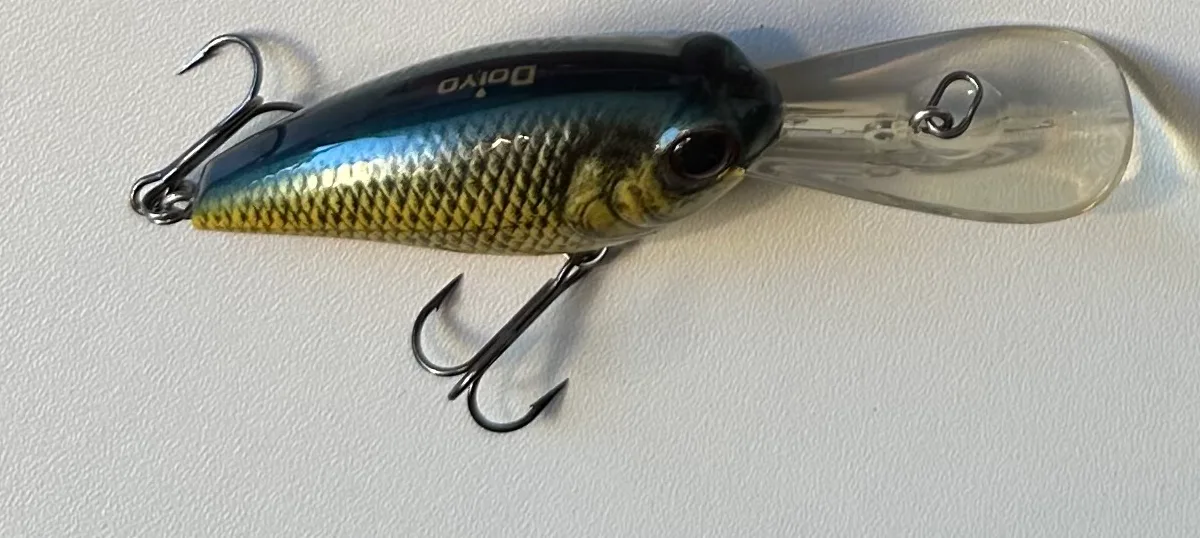
Deep diving crankbaits are crankbaits with a long, angled lip that pulls them about 12–25 ft (3.7–7.6 m) down on the retrieve. They are summer baits, for bass that have left the bank for ledges, humps, shell bars and channel edges. The depth on the box is a ceiling. You reach it only on the line the bait was rated with, and on a cast long enough to give the lip room to work.
In 1982 the deepest crankbaits ran about 12 ft, and the bass on the Alabama River were 14 ft down. Paul Elias knelt on the deck, pushed all but the rod handle under water, and won the Bassmaster Classic.
How deep does each one run?
| Model | Size | Rated depth | Notes |
|---|---|---|---|
| Norman Deep Little N | 2 1/2 in (6.4 cm), 3/8 oz (11 g) | 9–12 ft (2.7–3.7 m) | Norman calls it a medium diver; the natural-lake pick for bass on small baitfish |
| Norman DD22 | 3 in (7.6 cm), 5/8 oz (18 g) | 11–17 ft (3.4–5.2 m) | One of the first crankbaits to reach those depths reliably |
| Bomber Fat Free Shad BD7F | 3 in (7.6 cm) | 12–16 ft (3.7–4.9 m) | The shallower of the two 3 in Fat Free Shads |
| Rapala DT14 | 2 3/4 in (7 cm), 3/4 oz (21 g) | 14 ft (4.3 m) | Balsa; two No. 3 hooks |
| Rapala DT16 | 2 3/4 in (7 cm), 3/4 oz (21 g) | 16 ft (4.9 m) | The DT14’s body with a longer dive |
| Bomber Fat Free Shad BD8F | 3 in (7.6 cm) | 17–19 ft (5.2–5.8 m) | The deeper 3 in model |
| Strike King 6XD | 3 in (7.6 cm), 1 oz (28 g) | 18 ft and more (5.5 m) | Bassmaster: “18 feet and then some”; Tackle Warehouse lists 17 ft+ |
| Rapala DT Metal 20 | 2 3/4 in (7 cm), 7/8 oz (25 g) | 20 ft (6.1 m) | Balsa; a metal disc set into a thin polycarbonate lip |
| Strike King 8XD | Larger than the 6XD | 20 ft and more (6.1 m) | Bassmaster: “can dive to 20 plus” |
| Strike King 10XD | 3 3/4 in body (9.5 cm), 1.92 oz (54 g) | 25 ft (7.6 m) on 14 lb fluorocarbon | Two 1/0 trebles; pairs with an 8 ft cranking rod |
Only one of these ratings names its line: the 10XD’s 25 ft is on 14 lb fluorocarbon. The rest assume the maker’s own test line and a full cast. Rapala builds the idea into the name: DT stands for Dives-To, and the number is the depth in feet. The series runs from the DT04 at 4 ft to the DT16, carved from what Rapala calls the top seven percent of balsa, and the DT Metal 20 carries the idea to 20 ft. Strike King sells each XD size in a dozen or more colors. The crankbaits hub sets the deep divers beside the shallow and mid-depth classes.
Why does yours run shallower than the box?
A crankbait’s lip pulls it down only as far as the line lets it. Four things decide how much of the rated depth you get.
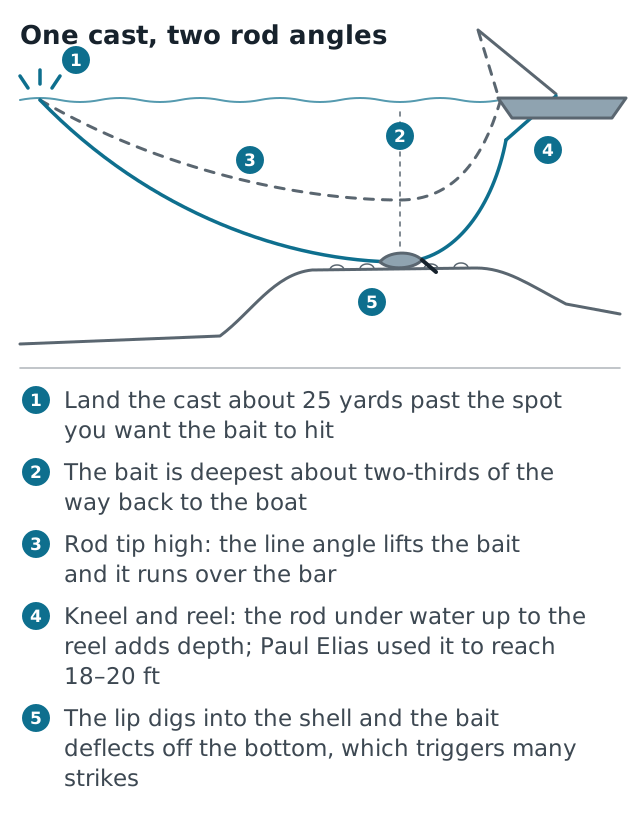
One cast, two rod angles. Drawing: fishing.info.
- Line diameter. Thin line slices through the water and lets the lip dig; thick line drags the bait up. Braid is the thinnest line for its strength, and fluorocarbon sinks. Bassmaster puts the gain from his fluorocarbon at an additional foot or so of depth. No maker publishes a feet-per-pound rule, so treat any line chart you see as a guess.
- Cast length. A deep diver is still diving for most of the retrieve. It is usually deepest about two-thirds of the way back to the boat, so Elias casts about 25 yards past the shell bed he wants it to hit. A short cast ends before the lip has done its work.
- Rod angle. A high rod tip lifts the line, and the bait with it. Elias’s answer is the kneel and reel: on his knees on the deck, he puts as much as 7 ft of rod under water, all the way to the reel. “When you’re trying to get a bait down 18 to 20 feet, you just about have to kneel and reel,” he says.
- Speed. Crank at a medium pace until the bait reaches its maximum depth, and only then speed up.

Free PDF · Water temperature chart Which fish are biting at today's water temperature?
One water temperature reading, and the 16-page chart tells you who's spawning, who's feeding hard, where they sit and what to throw. 26 fish, every number sourced.
Enter your email, confirm it with one click, and the PDF is in your inbox. Plus one email a week on what's biting. Unsubscribe anytime. Privacy.
What rod, reel and line?
The long cast needs a long rod, and the line is a trade between depth and toughness. The deep-cranking pros split into two schools on the reel and the line.
- Rod. Bassmaster showed Elias with a 7 ft 8 in (2.3 m) Pinnacle crankbait rod and a 7 ft 11 in (2.4 m) Quantum prototype, both in 2011; by 2015 Game & Fish had him on a rod of nearly 8 ft. TackleTour found the 8 ft (2.4 m) cranking sticks of recent years made for the 10XD. The length throws the long cast the depth needs.
- Reel. Elias fishes a slow, strong 5.1:1 gear ratio baitcaster, which holds the bait at the medium pace he wants. Bassmaster’s gear review of the XDs recommends the opposite: a fast, deep-spooled reel.
- Line. In 2011 Elias cranked 18–20 ft on 12 lb fluorocarbon; by 2015 Game & Fish had his reel spooled with 20 lb line. He prefers fluorocarbon to monofilament because it sinks and is more sensitive. The XD review puts 20 lb fluorocarbon on them, and the 10XD’s own rating is on 14 lb. Lighter line means more depth; heavier line survives the shell and rock.
- Hooks. Elias makes one change to the bait: the stock No. 2 trebles come off and No. 1 Gamakatsu trebles go on, one size up. One 10XD owner’s review says to upgrade its hooks too. The treble hook page covers sizes and swaps.
Where and when do you throw one?
Elias’s water is shell beds 8–20 ft (2.4–6.1 m) deep. The best of them sit on bars next to a creek or river channel. Kneeling and reeling, he says, is perfect any time bass hold on structure 16–21 ft deep.
Summer is the season. Elias cranks deep all summer, when the bass school on the structure, and the pattern holds until about the September full moon. That is when the baitfish start for the backs of the pockets and creeks, and the bass follow. The bass water temperature and best time to fish for bass pages have the seasons around that window.
Natural lakes are shallower. Mike Pehanich, writing for Lurenet, the web store of the DD22’s maker, puts the breakline on many of them at about 9 ft, leveling at 11–12 ft on some and tapering to 17 ft or more on others. A 10XD has nothing to dig into there; a Deep Little N or a DD22 does.
Boat position decides the depth. Elias sets the boat where his cast lands about 25 yards past the shell bed, so the bait is at its deepest and grinding the bottom when it reaches the fish. Use the sonar to find the school and the top of the structure, then pick the bait whose depth matches. How to read a fish finder shows what a school on a ledge looks like.
How do you retrieve it?
Do you just reel it in? To start, yes: a steady medium pace until the bait reaches bottom. Then Elias burns it, reeling fast to bang the bait into the bottom, and stops it often. “I want my bait digging into the bottom almost all of the time,” he says. The deflection off the bottom is what triggers many of the strikes. When the fish hold off the bottom instead, try an erratic stop-and-start or a pause-and-sweep retrieve.
When the crankbait bite dies on a spot that still shows fish, drag a football jig or a Carolina rig through it for the bass that will not chase.
Which color?
Kelly Jordon brings deep divers down to two basic colors: a white or shad pattern, and a chartreuse pattern. Chartreuse works best early and late in the day and in off-color water. “Once the sun gets up, a white one will outcatch a chartreuse 10 to 1,” he says. On Lake Fork he can barely catch one on chartreuse in daylight. Chrome, at times, draws more strikes than either.
Kevin VanDam sorts by water clarity instead. In clear water he picks natural, translucent baitfish shades such as Clear Sexy Shad and Ghost Minnow. At 18 in to 2 ft (45–60 cm) of visibility, he throws Chartreuse Sexy Shad. In stained water he goes bold, Chartreuse Shad or a chartreuse crawfish pattern, so the bass get a target they can see.
Which deep diver for which depth?
- Top of the structure at 8–12 ft (2.4–3.7 m), the natural-lake breakline: a Norman Deep Little N (9–12 ft, a medium diver by Norman’s own label) or a DD22.
- 12–16 ft (3.7–4.9 m): a Bomber BD7F, a Rapala DT14 or DT16, or the DD22 near the bottom of its range.
- 17–19 ft (5.2–5.8 m): a Strike King 6XD or a Bomber BD8F, on a long cast.
- About 20 ft (6.1 m): a Rapala DT Metal 20 or a Strike King 8XD, with thin fluorocarbon or the kneel and reel.
- 20–25 ft (6.1–7.6 m): a Strike King 10XD on 14 lb fluorocarbon and an 8 ft rod. Rated to 25 ft, it is among the deepest crankbaits sold.
- Deeper than 25 ft, or fish that will not chase: put the crankbait away and fish the football jig or Carolina rig.
Two Classics won on deep cranks
1982, Lake Montgomery, Alabama. Paul Elias won with 32 lb 8 oz over three days. He fished deep-running crankbaits on a submerged, log-studded sandbar, with Bo Dowden on the other end of it. Elias had never tried the kneel and reel before that Classic. Twenty-six years later he won the 2008 Elite event on Falcon Lake with 132 lb 8 oz, a four-day record at the time.
1993, Logan Martin, Alabama. David Fritts won with 48 lb 6 oz over three days on five crankbaits. Four were Poe’s deep divers: the 300 and 400 Series, a weighted 400 Plus and a modified 400 Plus that ran deeper still. The fifth was a shallow flat-sided bait, and all the Poe’s were chartreuse and blue. Most of his bass came from water under 8 ft (2.4 m) next to deep water, off single rocks, logs and small channel beds he found with a depth finder. His deep divers did their work in shallow water beside the drop, not at their rated depth.
When does another crankbait win?
When the bass are up shallow, the squarebill crankbait is the other end of the same family. A lipless crankbait has no rated depth at all: it sinks, and you count it down to the same ledges. The lures hub maps every family.
Free PDF · 16 pages
Know what's biting before your first cast
The Water Temperature Fishing Chart. Take one water temperature reading, find it on the chart, and you know which of 26 freshwater fish are feeding today, where they are and what to throw. For your phone and the tackle box.
- The 26-fish chart: who's spawning, feeding hard or shut down at your reading
- Where they sit and what to throw at every band: bass, crappie, bluegill, walleye, catfish and trout
- The best hours at your reading, the cold front day by day, and the spawn calendar from ice-out to midsummer
- The three thermometer mistakes that make a reading lie (the first one is the surface)
Every number from state fish and wildlife agencies and fisheries research: 61 sources, all on the site.
Enter your email, confirm it with one click, and the PDF is in your inbox. Plus one email a week on what's biting. Unsubscribe anytime. Privacy.
Related
Section guide
Crankbaits and Jerkbaits: Every Type, How Deep It Runs, and How to Fish ItA crankbait's lip sets its depth: squarebills to 6 ft, deep divers to 25. Which type for which season and water temperature, how to fish it, rod and line.
- Squarebill Crankbait: How Deep It Runs, How to Fish It, and When
A squarebill crankbait runs 0–6 ft and deflects off wood and rock instead of snagging. Depth by model, the retrieve, rod and line, seasons, colors, sound.
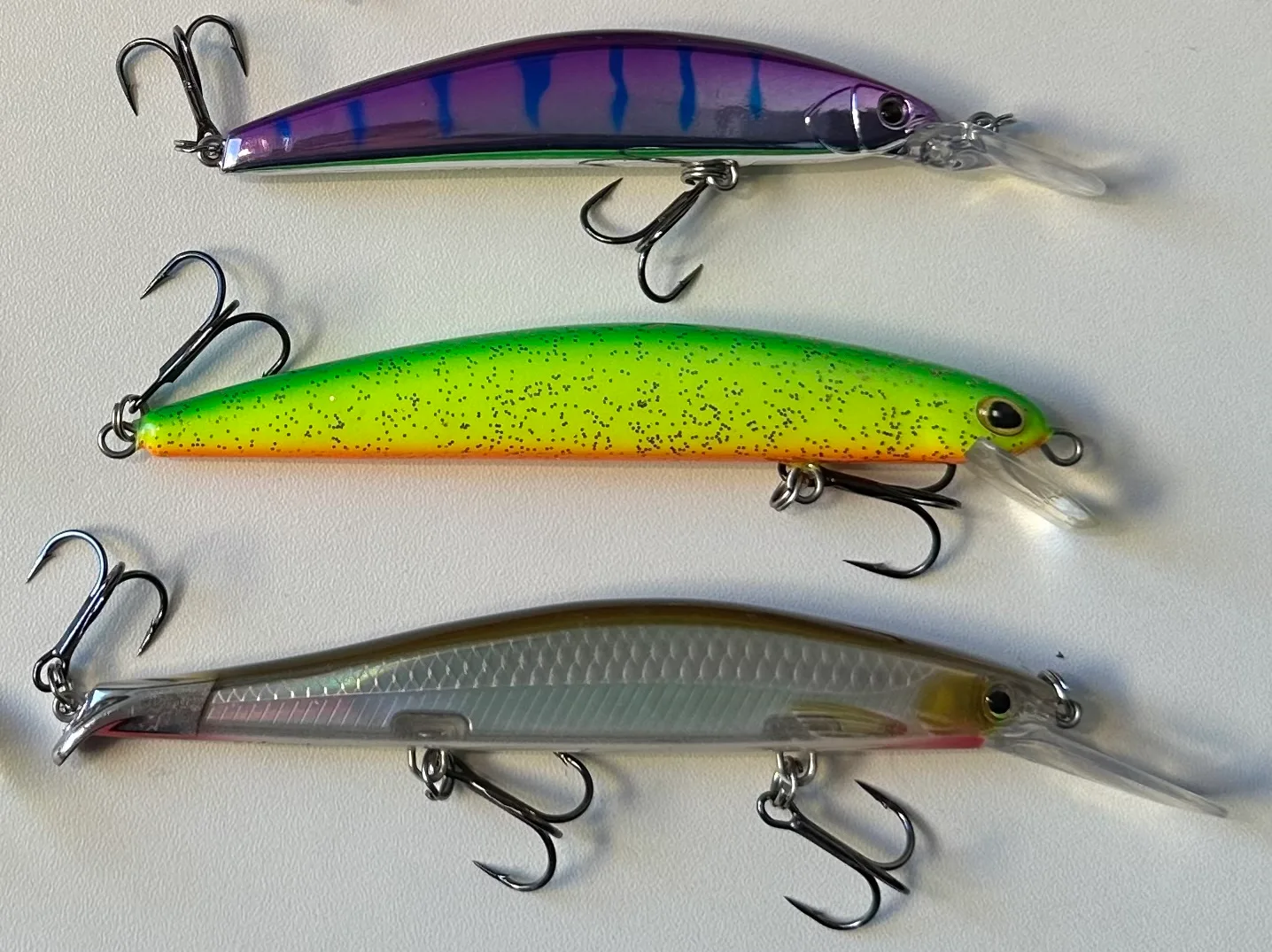 Jerkbait: How to Fish It in Cold Water, the Cadence, and Which to Buy
A jerkbait is a slim minnow plug you twitch and pause; in cold water a suspender hangs still and bass bite on the pause. Cadence, depths and six models.
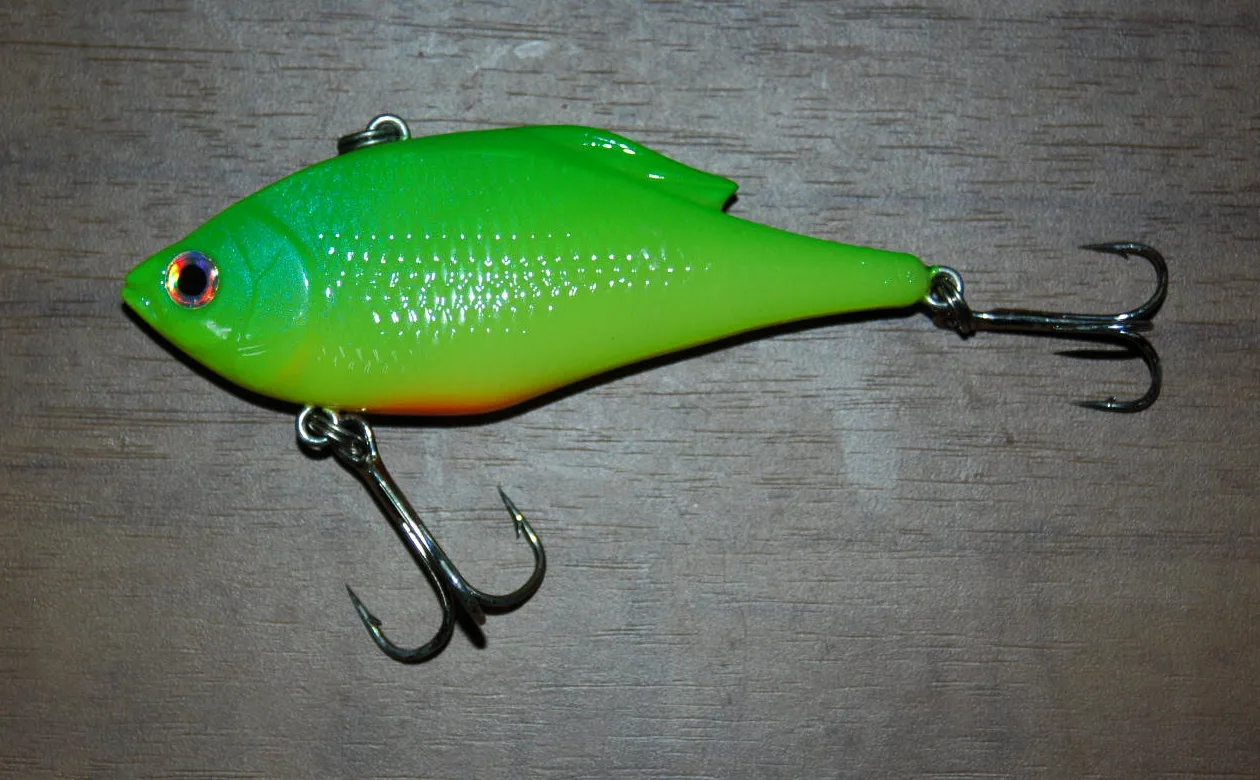 Lipless Crankbait: How to Fish It, Sizes, and the Rat-L-Trap Story
A lipless crankbait sinks, rattles and fishes any depth: eight models, six retrieves, the pre-spawn grass rip, and the soft rod that keeps trebles pinned.
Sources
- Rapala, DT (Dives-To) series specifications
- Rapala, DT Metal 20
- Bassmaster (Thomas Allen), Gear review: Strike King XD family (2015)
- Tackle Warehouse, Strike King 6XD crankbait
- Tackle Warehouse, Strike King 10XD crankbait
- Tackle Tour, Strike King 10XD review (2015)
- Lurenet (Mike Pehanich), Offshore bass fishing with deep diving crankbaits (2022)
- Lurenet, Norman Deep Little N
- Lurenet, Norman DD22
- Bassmaster (John Neporadny Jr.), Cranking deep with Paul Elias (2011)
- Bassmaster, Elias on kneeling and reeling (2011)
- Game & Fish (Lynn Burkhead), Elias, king of kneeling 'n' reeling (2015)
- Bassmaster, 1982 Bassmaster Classic
- Bassmaster, 1993 Bassmaster Classic
- Bassmaster (Pete Robbins), Kelly Jordon: color choices down deep (2010)
- Bassmaster, KVD: crankin' colors