 By
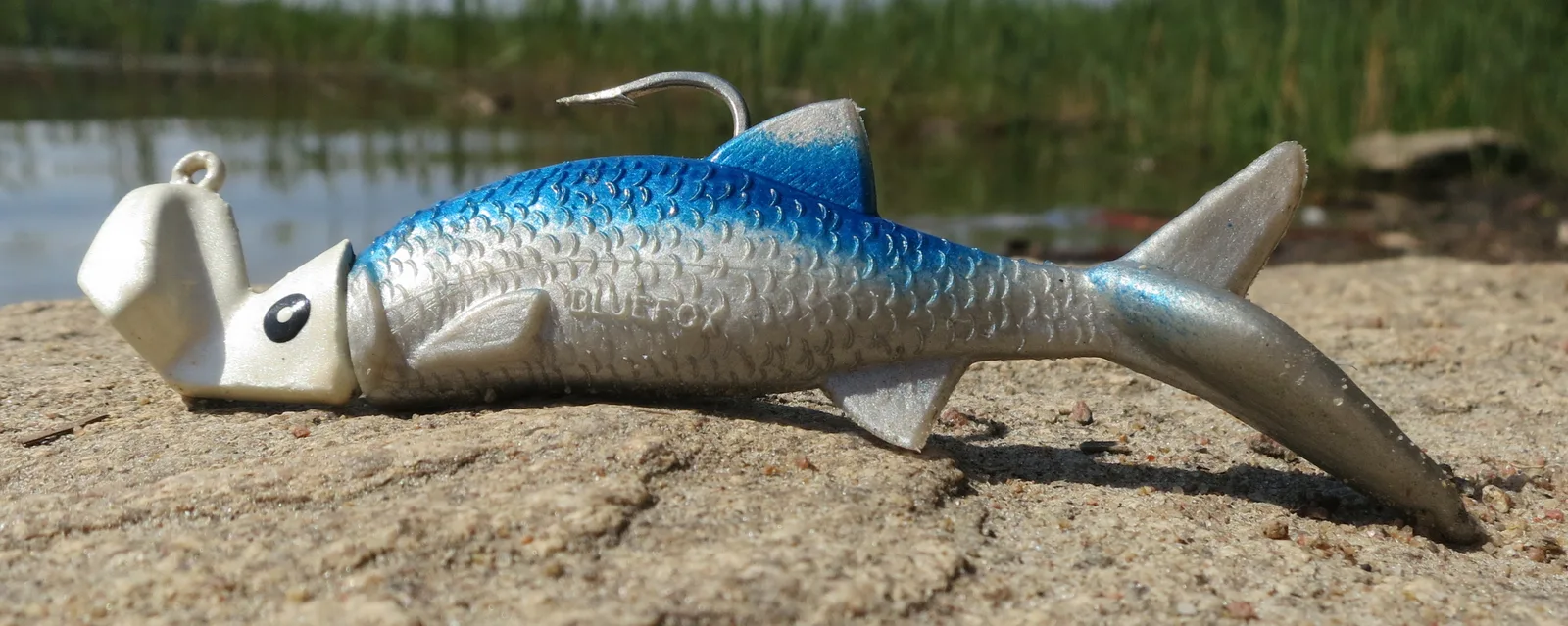
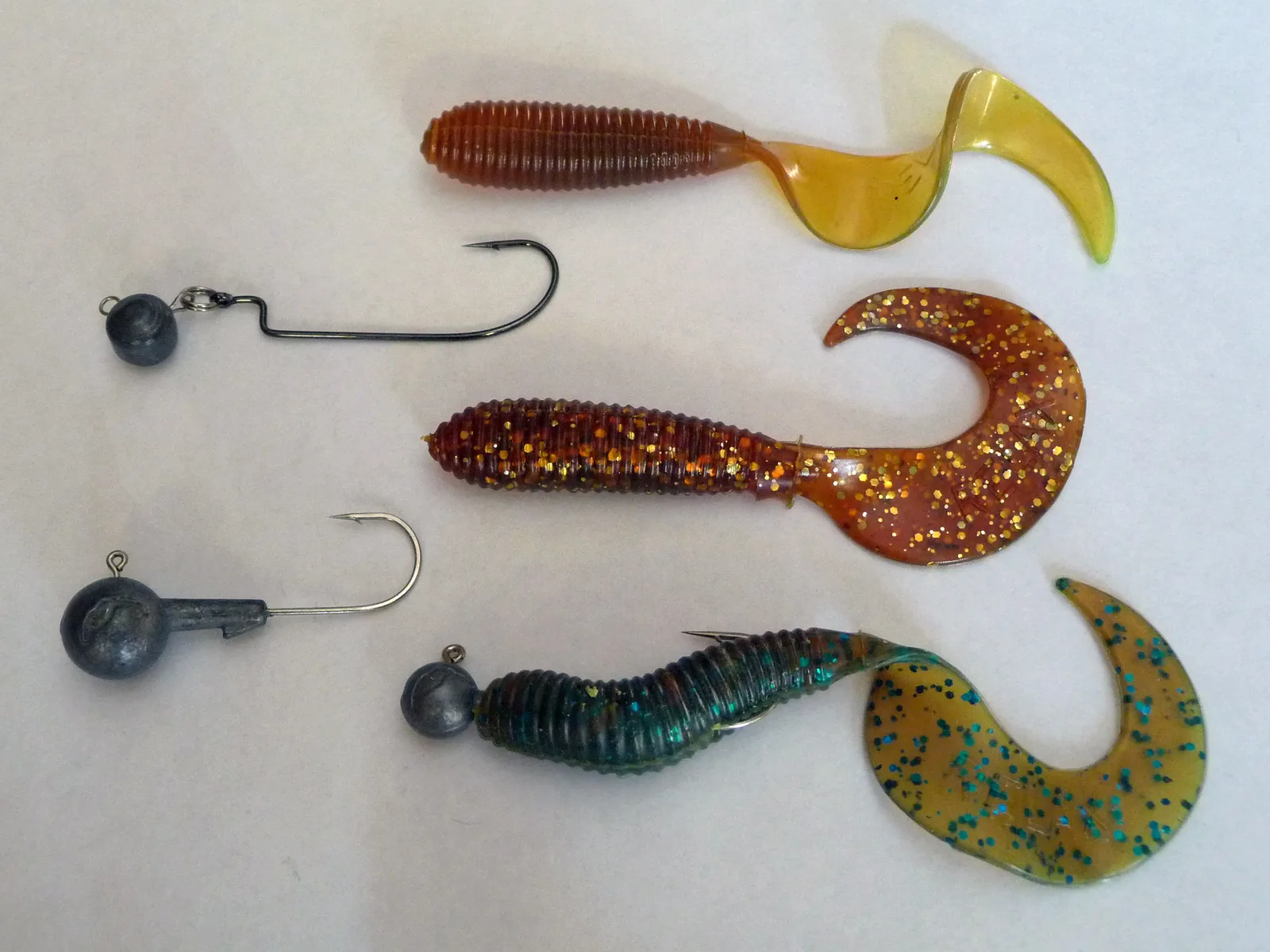
A jig head is a hook with a weight molded on just behind the eye, sold from 1/32 oz (0.9 g) for crappie to 3 oz (85 g) for big swimbaits. Push a soft plastic onto the hook and it catches crappie, bass, walleye, perch and smallmouth with one rig. Three choices decide which head you tie on: the weight, the hook and the shape. A fourth, the angle of the eye, is the one most anglers never look at.
Weigh your jigs. Rod Wall, a former guide, has found jigs marked 1/16 oz weighing anywhere from 1.5 to 2.1 grams; a true 1/16 oz is 1.8 grams.
How heavy should the head be?
Jeff Knapp, who writes on walleye for Bass Pro, has a rule that works for every fish: use the lightest head that still lets you feel the bottom. A light head falls slower, and you go heavier only for depth, wind or current. The numbers below come from the makers’ own ranges and from anglers who fish them.
| Weight | Fish | When | From |
|---|---|---|---|
| 1/32 oz (0.9 g) | Crappie | The lightest head and the slowest fall, on a long-shank #6 | Crappie Magnet |
| 1/16 oz (1.8 g) | Crappie, panfish | The middle crappie weight, on a long-shank #4 | Crappie Magnet |
| 1/8 oz (3.5 g) | Crappie, walleye | The heaviest common crappie head; walleye cast onto shallow flats (or 3/16 oz) | Carolina Sportsman, Bass Pro |
| 1/20–1/5 oz (1.4–5.7 g) | Bass | The Ned rig, on a #1 or #2 light-wire hook | Z-Man |
| 1/16–1/4 oz (1.8–7.1 g) | Bass and more | Round heads for grubs and small swimbaits, 1/0 to 3/0 | Gamakatsu |
| 1/4 oz (7.1 g) | Walleye | Vertical jigging in 10–25 ft (3–7.6 m) of river | Bass Pro |
| 3/8 oz (10.6 g) | Walleye | Deeper than 25 ft, or when it is windy | Bass Pro |
| 3/8–3 oz (10.6–85 g) | Big predators | Big swimbait heads, 6/0 or 8/0 hooks | Z-Man |
The crappie rows are where small differences matter most. The popular crappie weights are 1/32, 1/16 and 1/8 oz. Rod Wall finds that a slight change in weight gives him about a foot (30 cm) of control over the depth his jig swims. That is why he carries a gram scale, about $15 at a hardware store, and weighs each jig before it goes into his rotation. For when crappie and walleye move up and down through the year, see crappie water temperature and walleye water temperature.
Which hook fits the bait?
The hook has to leave its point and some gap clear of the plastic. If the hook is too small, the point sits buried in the bait and misses fish. If it is too big, the bait hangs crooked. The makers pair them like this:
| Bait | Hook | Example head |
|---|---|---|
| 1–2 in (2.5–5 cm) crappie plastics | Long-shank #6 (1/32 oz) or #4 (1/16 oz) | Crappie Magnet |
| 2.75 in (7 cm) Ned bait | #1 or #2, light wire | Z-Man Finesse ShroomZ |
| Grubs and small swimbaits | 1/0 at 1/16–1/8 oz; 2/0 or 3/0 at 3/16–1/4 oz | Gamakatsu Round 26 |
| Small swimbait, jigged vertically | 1/0 or 3/0, 90° line tie | Dirty Jigs Guppy Head |
| Minnow, live or plastic, for walleye | Short shank | Northland Fire-Ball |
| Twister grub for walleye | Standard long shank, barbed collar | Most leadheads |
| 5 and 7 in (13 and 18 cm) swimbaits | 6/0 or 8/0 | Z-Man DieZel Eye |
Shank length is the walleye angler’s choice. Knapp puts a minnow on a short-shank head like Northland’s Fire-Ball, and a twister body on the standard long shank, where the barbed collar holds it. The hook size chart explains why a #6 is smaller than a #4 and a 1/0 bigger than both. Light wire bends out of a snag and goes in with a light hookset on spinning tackle; heavy wire needs a baitcaster and a hard hookset. The types of hooks page covers wire and finish.
Free PDF · What-to-throw pack Which lure at today's water temperature, and in what color?
One reading and one look at the water, and the 16-page pack gives you the lure, how to work it and the color: bass first, with a row each for trout, walleye, crappie, pike and catfish. Plus every family explained, the $60 first box, and the rod and line for each.
It costs you one email address. No card, nothing to buy, and the PDF is yours to keep. Confirm with one click and it's on its way. Then a few short emails and one a week on what's biting. Unsubscribe anytime. Privacy.
Which shape, and which eye angle?
Wired2Fish’s Shaye Baker remembers when a jig head was a crude round lump of lead, hand-poured in someone’s garage and sold at half a dozen for a buck or two. Now, he writes, there is a head for every bait, and a line-tie angle for about every 5 degrees. The round head is still the most versatile.
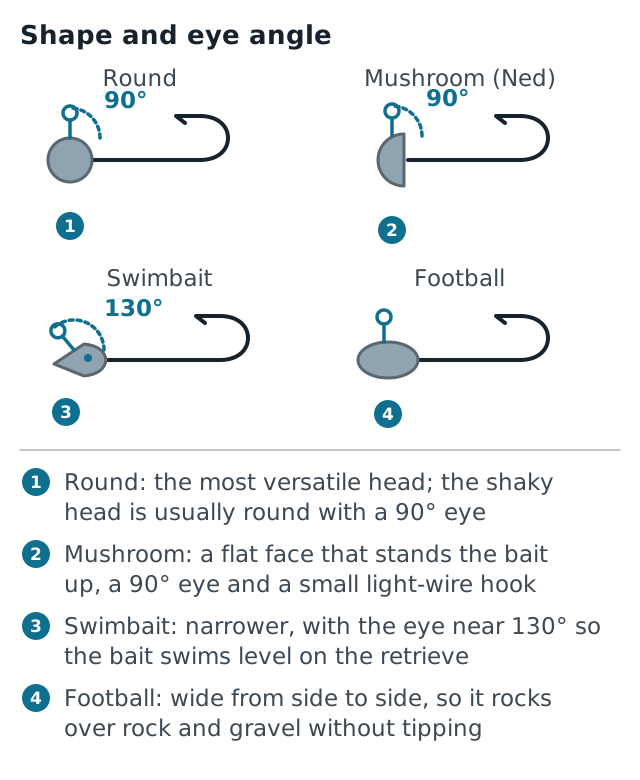
The eye angle is measured from the hook shank. Drawing: fishing.info.
The line tie is the eye where you tie on, and its angle sets how the bait rides. A 90° eye pulls straight up from the head. That helps a Ned bait stand up on the bottom, and it holds a small swimbait level when the line hangs straight down under the boat. A swimbait head’s eye sits closer to 130°, tilted toward the nose. The pull then comes from in front, and the bait swims level as you reel it through the water column. That 130° is measured from the shank, as in the drawing; makers quote the angle in their own ways, so when you buy, compare the picture, not the number. Dirty Jigs built its Guppy Head for small swimbaits; the maker says its 90° design “allows for that perfect horizontal lure position”, which it calls “ideal for vertical jigging”.
| Shape | Eye | What it does | Fish it for |
|---|---|---|---|
| Round | Often 90° | The all-rounder; shaky heads are usually round | Worms, grubs, minnows; vertical walleye jigging |
| Mushroom (Ned) | 90° | Flat face stands the bait up; small hook for light line | The Ned rig on spinning tackle |
| Swimbait | Near 130° | Narrow, cuts the water and stays down; best keepers | Swimbaits reeled through the water column |
| Damiki or guppy | 90° | Small and pill-shaped; holds the bait level | Straight-tail minnows under the boat in cold water |
| Football | Wide, rocks over rock without tipping | Bass on rock; the football jig | |
| Stand-up | Flat bottom holds the bait off the bottom | Casting jigs for walleye | |
| Wobble head | Hinged | Head sits still while current swings the bait | Rivers and current |
| Tube head | Pokes out | Hides inside a tube and makes a goby shape | Smallmouth bass |
| Flick Shake | Ball on a wacky hook | A weighted wacky rig, faster and deeper | The wacky rig |
The shaky head is likely the oldest and most popular of the modern heads, Baker writes, and it runs from under 1/8 oz to more than an ounce. The shaky head page shows how to fish one. For vertical walleye jigging, Knapp likes round and aspirin heads, which offer little water resistance; for casting he picks a stand-up head. The Scrounger is a head with a soft plastic bill that rocks the bait from side to side.
What keeps the plastic on the hook?
The keeper is the barb, wire or screw on the shank that stops the plastic from sliding down the hook. A simple barb works on a grub. A swimbait gets pulled by the tail, so swimbait heads carry stronger keepers: a bigger barb, two barbs facing opposite ways, or a screw-lock, which Baker calls likely the most effective. Gamakatsu’s Round 26 uses a double cone of lead. Z-Man welds a wire keeper onto the Finesse ShroomZ shank, and it holds the stretchy ElaZtech baits of Ned Kehde’s finesse rig without glue.
Do paint and eyes matter?
Paint is the last choice and the least important one, but it is not decoration on every head. Swimbait heads are the most detailed, Baker writes, with reflective eyes and scale-pattern paint, because the head is the front of the fish. Z-Man sells the DieZel Eye with red, glow or chartreuse eyes, and its molded collar takes a skirt. Dirty Jigs paints its tungsten Guppy Head and gives it 3-D eyes.
Which color is best depends on the water, not on one color. FishUSA’s walleye guide says to match the head to the body in clear water, where a contrasting head looks unnatural. In stained water a red, orange or chartreuse head gives fish a focal point to track to the hook, and a red head on a white body is its classic pairing. When in doubt, it says, a red or red-orange head works in most conditions.
Lead or tungsten?
Tungsten is 19.3 g/cm³ and lead 11.35 g/cm³, so tungsten is 1.7 times as dense. A tungsten head of the same weight takes about 41% less volume. But each dimension shrinks only about 16%, which is why a tungsten head looks smaller rather than half the size. Here is the same math at four common weights, with the head pictured as a ball:
| Weight | Lead volume | Tungsten volume | As a ball, lead → tungsten |
|---|---|---|---|
| 1/8 oz (3.5 g) | 0.31 cm³ | 0.18 cm³ | 8.4 → 7.1 mm across |
| 1/4 oz (7.1 g) | 0.62 cm³ | 0.37 cm³ | 10.6 → 8.9 mm across |
| 3/8 oz (10.6 g) | 0.94 cm³ | 0.55 cm³ | 12.1 → 10.2 mm across |
| 1 oz (28.3 g) | 2.50 cm³ | 1.47 cm³ | 16.8 → 14.1 mm across |
Volumes are the weight divided by NIST’s densities; a real head is not a ball, but it shrinks by the same 16% in every direction. Dirty Jigs says its Pure Tungsten Guppy Head is 30% smaller than a lead jig, and that the density adds sensitivity. The price is the catch. In October 2026 the lead Guppy Head sold at $7.49 for three, about $2.50 a head. The Pure Tungsten version cost $9.99 for two, $5.00 a head, about twice as much. You can also pour your own lead heads; the tackle guide covers how, and the EPA’s warning against doing it at home.
In some states the law makes the choice. New Hampshire has banned the use of lead jigs and sinkers of 1 oz or less in fresh water since June 1, 2016, painted or not, with fines up to $250. In Maine it is illegal to sell lead sinkers and lead jigs of 1 oz or less or 2.5 in or shorter. Using them is illegal on inland waters, and since September 1, 2026 that covers painted jigs too. Maine’s wildlife agency says swallowed lead tackle is the third leading cause of death for its 4,000-plus adult common loons. It suggests tungsten, tin, bismuth and steel instead.
Can you fish just a jig head?
Yes, and river walleye anglers do it all winter. Knapp’s version is a short-shank head tipped with a minnow. His other trick, used for years: pinch the tail off a twister grub and tip the jig with a fathead minnow. Baker points out that a shaky head will also carry a swimbait or a tube when the tackle box runs short.
How to choose one, step by step
- Name the fish and the depth. Read the weight off the first table, and start on the light side.
- Measure the plastic. Read the hook off the second table; the point needs a clear gap above the bait.
- Decide how the bait should ride. Standing on the bottom or held under the boat: a 90° eye. Swimming on the retrieve: a swimbait head near 130°.
- Name the bottom. Rock: football. Mud and sand: round or stand-up. Current: a wobble head.
- Match the wire to the tackle. Light wire on spinning gear and light line; heavy wire on a baitcaster.
- Check the law where you fish. In New Hampshire’s fresh water and Maine’s inland waters, a lead head of 1 oz or less is out.
- Weigh a few. A gram scale sorts a box of 1/16 oz crappie jigs into the real 1.5 g and 2.1 g heads.
Mistakes to avoid
- Too heavy. The lightest head that keeps feel of the bottom is the rule; go up only for depth, wind or current.
- A hook that does not fit the plastic. Hold the head against the bait before you rig it.
- Trusting the label. Marked weights vary from jig to jig; weigh them.
- The wrong eye for the job. Ned and shaky heads use 90° to stand the bait up; a swimbait you reel wants the 130° head built to swim level.
- A dull point. Jig heads drag the bottom all day, so touch up the point or replace the head.
Every jig on the jigs hub starts with one of these heads; the fishing terms glossary defines the screw-lock keeper, the stand-up head and tungsten.
Free PDF · 16 pages
Stop guessing. Know which lure to tie on, and what color, before the first cast
A full box, the wrong lure on all day, and a Saturday with nothing to show for it. That is what guessing costs you.
The What-To-Throw Pack. A 16-page PDF. Take the water temperature, look at the water, and the two-page chart in front gives you the lure, how to work it and the color. Behind it, every family explained for bass: crankbaits, topwater, blades, jigs, soft plastics and the rigs; how deep and what cover; color on one page; the $60 first box. And a row each for trout, walleye, crappie, pike and catfish.
- The lure at every water temperature, rising and falling: jig, Senko rig, chatterbait, spinnerbait, crankbait and topwater side by side, from a jerkbait paused 5 to 15 seconds below 45 °F to a frog over the mats at 80–85 °F
- Clear, stained or muddy, and the color for each: green pumpkin in clear water, black and blue in mud, chartreuse with a black back on hard baits, and the two exceptions (red in spring runoff, chartreuse for smallmouth even in clear water)
- How deep, and what cover: the depth ladder from the top 2 ft to the bottom, and the first and second lure for grass, mats, wood, rock, docks and open water, with the rod and line each family needs
- The first box for $60, then $40 more, five lures that fish nine months of the year; and a starting lure for trout, walleye, crappie, pike and catfish, with the Rapala and Rooster Tail sizes
What it costs you: one email address. No card, nothing to buy. You get a version for your phone and one to print, and they're yours to keep. Then a few short emails to help you use it and one a week on what's biting, with an unsubscribe link in every one.
Every line from the lure pages on fishing.info and the 515 sources behind them, Florida FWC, In-Fisherman and Bassmaster among them.
Enter your email, confirm it with one click, and the PDF is on its way. Privacy.
Related
Section guide
Fishing Jigs: The Types, Which Weight, and How to Fish ThemWhat a jig is, every type from football to bucktail and slow-pitch, the weight for your depth, the trailer and color, and how to fish each one.
 Shaky Head Jig: The Finesse Worm on the Bottom, Rigged and Fished
A shaky head jig is a stand-up jig head with a finesse worm rigged weedless, shaken on the bottom so the tail waves. Heads, worms, rigging and the retrieve.
Sources
- Wired2Fish (Shaye Baker), a look at jigheads and how they differ
- Bass Pro Shops 1Source (Jeff Knapp), leadhead jigs for winter river walleye
- Carolina Sportsman (Phillip Gentry), what does your jig weigh?
- Z-Man, Finesse ShroomZ jigheads (weights, hooks, keeper)
- Z-Man, Finesse TRD, the original 2.75 in Ned rig stickworm
- Z-Man, DieZel Eye jigheads (weights, hooks, baits)
- Thorne Bros, Gamakatsu Round 26 jig head (weights and hook sizes)
- Leland's Lures, Crappie Magnet jig heads (weights and hook sizes)
- Thorne Bros, Dirty Jigs Guppy Head and Pure Tungsten Guppy Head
- Discount Tackle, Dirty Jigs Guppy Head 3-pack
- Dirty Jigs, Guppy Swimbait Jig Head (maker's page)
- Gamakatsu, Round 26 jig head (hook and weight pairs)
- FishUSA, spring walleye color rules (jig head color by water clarity)
- NIST ESTAR, composition of tungsten (density 19.3 g/cm³)
- NIST ESTAR, composition of lead (density 11.35 g/cm³)
- Maine Department of Inland Fisheries and Wildlife, lead fishing tackle
- On The Water, New Hampshire's lead jig law (2016)
- New Hampshire RSA 211:13-b, lead fishing sinkers and jigs; use prohibited
- In-Fisherman (Ned Kehde), a history of Midwest finesse fishing and the Ned rig