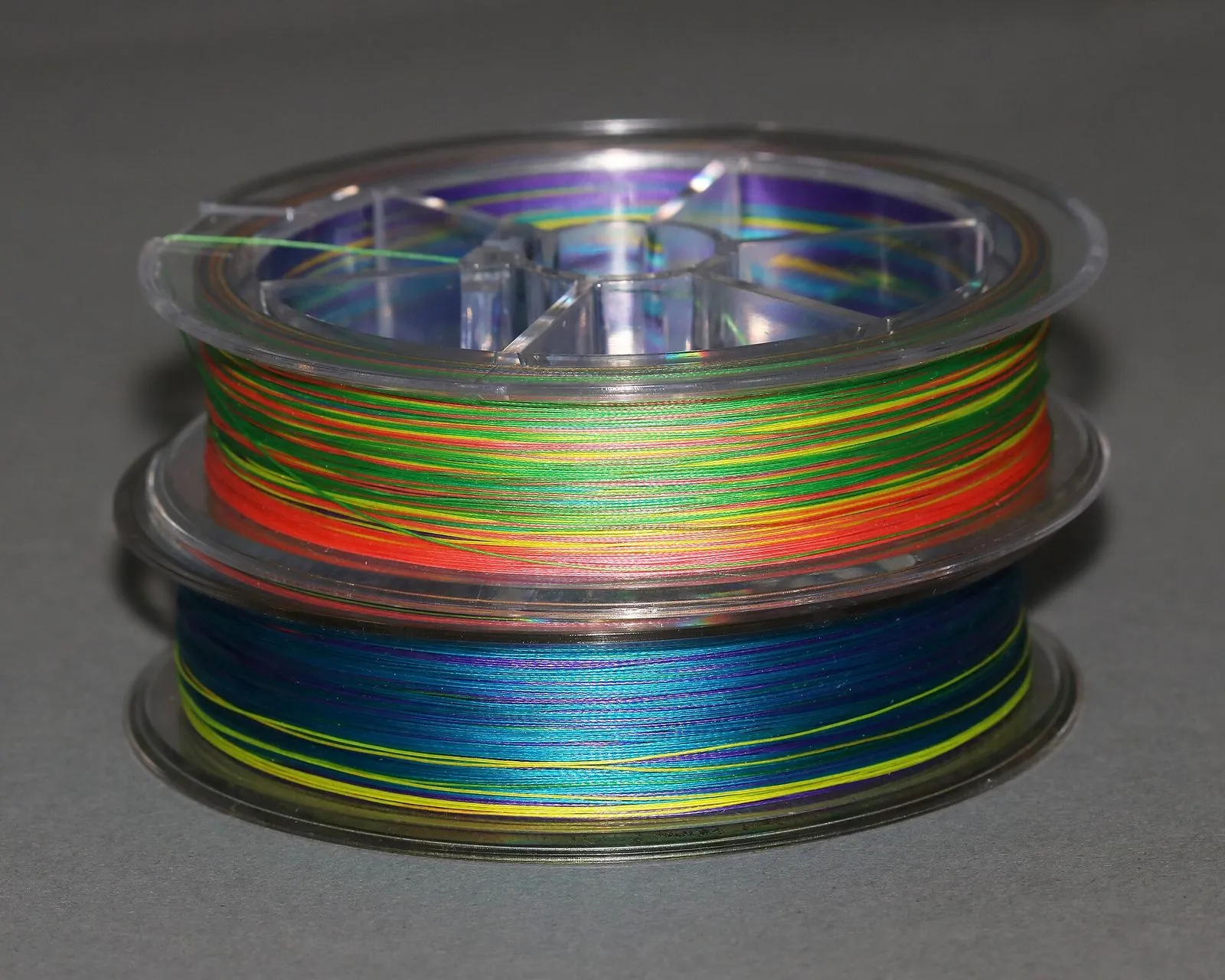
Braided fishing line is made by weaving four, eight or more strands of gel-spun polyethylene, the fiber sold as Spectra and Dyneema, into a single line. The fiber is stronger for its thickness than anything else on a spool, so braid is about a third of the diameter of nylon monofilament at the same breaking strain and it stretches almost not at all. Those two facts give braid everything it is praised for, distance, capacity, sensitivity and hooksets, and everything it is blamed for, visibility, fraying on rock and wind knots. Rigged right, with a leader and a few turns of backing, braid gives you the first four without the last three; the tables below say which test to buy, how to put it on the reel and when mono or fluorocarbon is the better line.
Thirty-pound braid is about the diameter of eight-pound monofilament. That is the whole reason the category exists.
What you need
- A reel with a spool that suits braid: any spinning reel, and a baitcaster if the line is 30 lb or heavier. The reels hub covers both.
- Monofilament for backing, a few yards of 8–10 lb to grip the arbor.
- Fluorocarbon or mono for leaders, in the test the technique wants; the line hub has the three-way comparison.
- Braid-rated scissors. Braid does not cut cleanly with a knife or nail clippers.
Pound test and diameter
The makers rate braid by breaking strain and by the monofilament diameter it matches, which is the number that matters for casting and spool capacity. Tackle Village put a micrometer on Berkley Trilene and Big Game (mono), Berkley Vanish (fluorocarbon) and SpiderWire Stealth (braid).
| Test | Mono | Fluorocarbon | Braid |
|---|---|---|---|
| 6 lb (2.7 kg) | 0.009 in (0.23 mm) | 0.009 in (0.23 mm) | 0.005 in (0.13 mm) |
| 10 lb (4.5 kg) | 0.011 in (0.28 mm) | 0.011 in (0.28 mm) | 0.008 in (0.20 mm) |
| 14 lb (6.4 kg) | 0.014 in (0.36 mm) | 0.013 in (0.33 mm) | 0.009 in (0.23 mm) |
| 20 lb (9.1 kg) | 0.016 in (0.41 mm) | 0.016 in (0.41 mm) | 0.010 in (0.25 mm) |
| 30 lb (13.6 kg) | 0.020 in (0.51 mm) | 0.020 in (0.51 mm) | 0.012 in (0.30 mm) |
| 40 lb (18.1 kg) | 0.024 in (0.61 mm) | 0.022 in (0.56 mm) | 0.013 in (0.33 mm) |
| 50 lb (22.7 kg) | 0.028 in (0.71 mm) | 0.029 in (0.74 mm) | 0.014 in (0.36 mm) |
| 60 lb (27.2 kg) | 0.030 in (0.76 mm) | 0.032 in (0.81 mm) | 0.015 in (0.38 mm) |
The spool label tells the same story in the maker’s own words. Sufix prints a mono-equivalent diameter beside every test of its 832 braid, and PowerPro’s figures, where they are published, land within a pound or two of it.
| Test | Sufix 832 diameter | Equals mono of | PowerPro says |
|---|---|---|---|
| 10 lb (4.5 kg) | 0.008 in (0.20 mm) | 4 lb | – |
| 20 lb (9.1 kg) | 0.009 in (0.23 mm) | 6 lb | 6 lb |
| 30 lb (13.6 kg) | 0.011 in (0.29 mm) | 8 lb | – |
| 50 lb (22.7 kg) | 0.014 in (0.34 mm) | 12 lb | 12 lb |
| 65 lb (29.5 kg) | 0.016 in (0.40 mm) | 17 lb | 16 lb (0.41 mm) |
| 80 lb (36.3 kg) | 0.018 in (0.45 mm) | 20 lb | – |
Two consequences follow. A spool that holds 150 yards of 12 lb mono holds several hundred yards of 50 lb braid, and 20 lb braid casts a light lure as far as 6 lb mono would. Twenty-pound braid is not stronger than 20 lb mono; it is the same strength at a third of the thickness, and most braids test over their label, which is why Salt Strong’s pull tests record 10 lb braid breaking at 17 lb. Japanese braids are sized the other way round, by a PE number that is a diameter scale, which is why they carry odd tests such as 16.5 lb.
Four strands, eight, nine or sixteen
A braid’s strands, which the makers call carriers, decide how it feels more than the fiber does. Fewer strands make a rougher, flatter line that grips cover and wears well; more strands make a rounder, smoother, quieter line that casts farther and costs more. Sufix 832 is eight fibers, seven Dyneema and one Gore, at 32 weaves per inch; Berkley X9 weaves eight strands around a ninth core so the line stays round under tension.
| Construction | Feel and roundness | Abrasion and cover | Casting and noise | Price and use |
|---|---|---|---|---|
| 4-strand | Rough, slightly flat | Best; cuts grass, wears well on wood | Shortest casts; hums in the guides | Cheapest; frogs, punching, catfish |
| 8-strand | Smooth, round | Lower; frays sooner on rock | Longer casts, quiet; digs into the spool less | The all-round choice, spinning and casting reels |
| 9-strand (core) | Smooth, stays round under load | Between the two | Quietest; resists flattening | Casting distance, frogs and jigs in grass |
| 12–16 strand, hollow core | Very smooth, hollow | Low | Long casts | Offshore; the leader is spliced inside with a needle |
| Fused (FireLine) | Stiff, slick, fibers heat-fused | Moderate | Casts well; fewer wind knots | Slightly thicker per test; ice and ultralight |
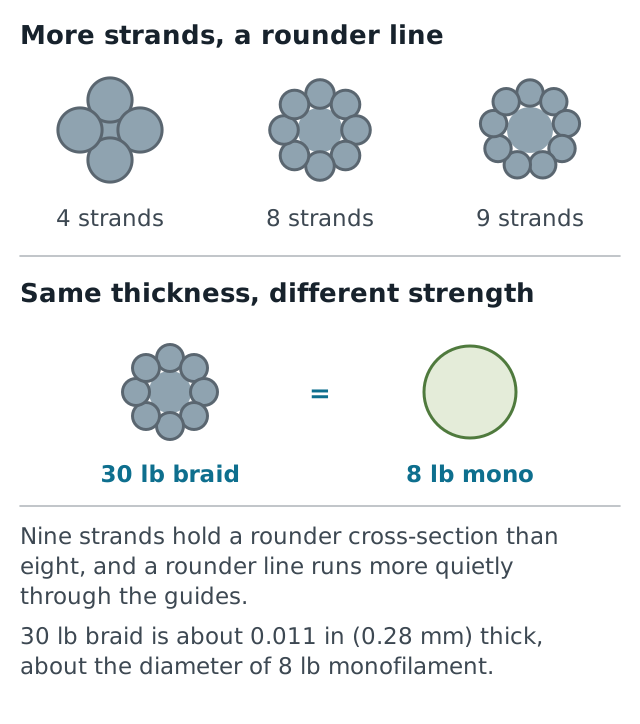
Strand count and roundness, and what braid buys in diameter. Drawing: fishing.info.
Coatings sit on top of the weave. They add stiffness and color and make a new spool feel slick, and they wear off: a stiff coated braid such as SpiderWire DuraBraid softens after two or three trips, and every coated line loses some of its character over a season. The best braided fishing line page compares the current spools by strands, diameter and price.
Rigging braid so it works, step by step
- Back the spool with mono. Braid slips on a bare metal arbor and turns under load like a belt on a pulley. Tie 8–10 lb mono to the spool with an arbor knot, wind on 20 yards, then join the braid with a double uni knot. A strip of electrical tape over the arbor does the same job on a baitcaster.
- Spool under tension, through a damp cloth or your fingers, with the filler spool’s label facing up so the line does not twist. Fill to about 1/8 in (3 mm) below the lip; overfilled braid throws wind knots, underfilled braid casts short. The how to put fishing line on a reel page has the fill and backing by reel size.
- Add a leader in clear water or around rock and shell. Braid is opaque, frays on shell and has no give for a treble hook; a leader fixes all three for the cost of one knot. Fluorocarbon is the default, because it sinks, is nearly invisible (refractive index 1.42 against water’s 1.33 and nylon’s 1.62) and takes abrasion: Matt Allen at Tactical Bassin runs 10 lb braid to 3–8 ft (1–2.4 m) of 5–8 lb fluorocarbon on every finesse rig in clear water, and 12–17 lb on a Texas rig. In stained water he switches to mono, which is cheaper where invisibility no longer matters; on a topwater mono is the only leader, because fluorocarbon sinks the nose of a popper. The fishing leader page has material and length by fishing.
- Join the leader with the FG knot, or the double uni if it has to be tied in thirty seconds in a rocking boat. In Salt Strong’s pull tests the FG held about 98 percent of the braid’s strength; the Alberto knot and the double uni both land around 90 percent, and the braid to mono knot page sets the three side by side. The FG knot is also the slimmest, so it passes the guides without a tick.
- Tie a Palomar to the lure, wetted and pulled tight, with the loop doubled on light braid. A clinch knot slips: in Field & Stream’s machine test an eight-turn clinch on 14 lb FireLine slid and let go at about 10 lb. The Palomar knot page has the doubled-loop version.
- Set the drag lighter than the label suggests. Braid digs into itself on the spool under load, which is PowerPro’s own reason for a lighter drag than the same test in mono; a quarter of the breaking strain is plenty.
- Close the bail by hand on a spinning reel and tug the line before the first turn of the handle, so a loose loop does not become a wind knot on the next cast.
Which test for which fishing
Braid is bought by diameter, not by the number you would buy in mono; the column that matters below is the mono diameter you are really fishing.
| Fishing | Braid test | About the diameter of | Leader |
|---|---|---|---|
| Ultralight panfish, ice jigging at depth | 2–8 lb | 1–3 lb mono | 2–4 lb fluoro, or none through the ice |
| Spinning finesse: drop shot, Ned rig, shaky head, wacky | 8–15 lb | 3–5 lb mono | 4–8 ft of 5–8 lb fluoro; 6–10 lb mono in stained water |
| Baitcaster, topwater tied direct, swim jigs, jerkbaits | 30–40 lb | 8–10 lb mono | None on walking baits and ploppers; 10 lb mono on a jerkbait |
| Flipping, frogs, buzzbaits, jigs in grass | 50–65 lb | 12–17 lb mono | None; 50 lb gives a frog a wider walk, 65 lb punches mats |
| Catfish on bait | 50–80 lb | 12–20 lb mono | 20–50 lb mono leader on the rig, or 80 lb braid for trophy blues |
| Inshore redfish, trout, snook | 10–30 lb | 4–8 lb mono | 18–36 in of 20–30 lb fluoro |
| Surf: jerkbaits, swimbaits, cut bait | 20–30 lb; 50 lb for sharks and rays | 6–12 lb mono | 15–30 lb fluoro; a mono shock top for bait |
The reel decides the floor. On a baitcaster, braid under 30 lb digs into the spool on a backlash and cannot be picked out, so 30 lb is the lightest test that makes sense and 40–65 lb the working range; 8-strand lines dig less than 4-strands. On a spinning reel the opposite holds: 8–20 lb braid casts a light lure farther than any mono of equal strength. For blue catfish, Vic Attardo’s point in Fur-Fish-Game is that 50 lb braid holds in current where thicker mono bows, and that an 80 lb leader needs a swivel rated for 80 lb too; the catfish rigs page builds the rig, and the best fishing line for bass page turns the bass rows into a setup per technique.
When braid is the wrong line
- Treble-hook lures on a short line. Crankbaits, lipless baits and jerkbaits hold fish on thin trebles, and a line with no stretch tears them out on a head shake; 10–14 lb mono or 12 lb fluorocarbon, or 20 lb braid to a 10 lb mono leader as Allen rigs a jerkbait. Topwater is the exception: braid floats, so 30–40 lb tied direct works on walking baits, trading mono’s forgiveness on the hookset for braid’s casting distance.
- Hard cold. Braid carries water in the weave, and that water freezes in the guides when the air drops below freezing; Sufix sells a separate ice braid with a hydrophobic coating because the regular line ices up. In freezing air, mono or fluorocarbon.
- Trolling. A trolled plug hits at speed against a tight line in a rod holder, and mono’s 25–30 percent stretch is the shock absorber; braid trolls only behind a long mono top shot.
- The opposite case: frogs and punching. 50–65 lb braid with no leader at all; in a grass mat a knot is a weak point and the fish cannot see the line anyway.
Color, and the fade
Braid comes in moss green, low-vis gray, white, yellow, pink and multicolor, and because the leader settles what the fish sees, the color is chosen for your own eyes. Hi-vis yellow lets a finesse angler see the line jump on a bite and a catfish angler watch a slack line move; moss green suits the angler who fishes braid straight to a frog. All of it fades: early braids bled dye in the box, and current lines go pale over a season as the coating wears, which costs nothing in strength. A faded first 30 ft (9 m) is a sign to cut back and retie, not to respool.
Care and lifespan
Polyethylene does not absorb water and shrugs off sunlight, which is why braid lasts two to five seasons on a spool where mono lasts three to six months. What kills it is wear, not time, so the checks are by feel.
- Run the first 20 ft (6 m) through your fingers after every trip. Fuzz, a flat spot or a pale patch means cut fibers; trim to clean line and retie the leader.
- Reverse the spool once a season. Wind the braid off onto two empty spools in turn and back on, so the unused inner line is on the outside; a 300 yard fill gives two fresh working ends.
- Rinse salt off and let the spool dry; salt crystals cut like sandpaper when the line runs under load.
- Retire the spool when the line is flat and fuzzy along its whole working length, or a fresh Palomar breaks at the knot on a straight pull: years for a weekend angler, a season for a guide.
Mistakes to avoid
- Winding on a slack spool. Loose coils bury under load and pull off in clumps; spool under tension.
- Trusting a clinch knot. It slips on braid; use a Palomar, an FG or a double uni.
- Cutting it with your teeth or a knife. Both leave a frayed end that will not seat in a knot; braid scissors cost less than a lure.
- Buying the mono number. 20 lb braid on a finesse reel is a 6 lb line in casting terms and a 20 lb line in strength. Read the diameter, not the test.
When to use something else
Monofilament is cheaper, floats, stretches 25–30 percent and forgives a hard hookset on trebles; fluorocarbon sinks, stretches 10–15 percent, is nearly invisible and resists abrasion. The fluorocarbon vs monofilament page settles the two technique by technique, the line hub holds the three-way comparison, and the rods hub explains why a rod’s action changes the answer: a fast rod on stretchy line and a softer rod on braid land the same fish.
Sources
- The Tackle Room, Mono vs fluorocarbon vs braid
- Tackle Village, Fishing line diameter chart (micrometer measurements)
- Tackle Warehouse, Sufix 832 Advanced Superline (the maker's diameter and mono-equivalent chart, construction)
- Bass Pro Shops, PowerPro Braided Spectra Fiber 150 yd (diameter and mono-equivalent per test)
- Wikipedia, PowerPro (Spectra braided line, diameter, drag setting)
- Wired2Fish (Sam Hudson), Best braided fishing lines for 2026 (strand types, size recommendations)
- Take Me Fishing, How to spool a spinning reel with braided line
- Tactical Bassin (Matt Allen), Best fishing line: braid, mono or fluorocarbon
- Salt Strong, Albright vs Alberto vs FG knot (braid-to-leader pull tests)
- Field & Stream (John Merwin), The strongest fishing knots, tested (clinch knot slipping on braid)
- Fur-Fish-Game (Vic Attardo), Blue catfish obsession (braid for blue cats)
- Surf Fishing SoCal, What line for surf fishing: type and strength
- Rapala, Sufix 832 Advanced Ice Braid (hydrophobic coating against freezing)