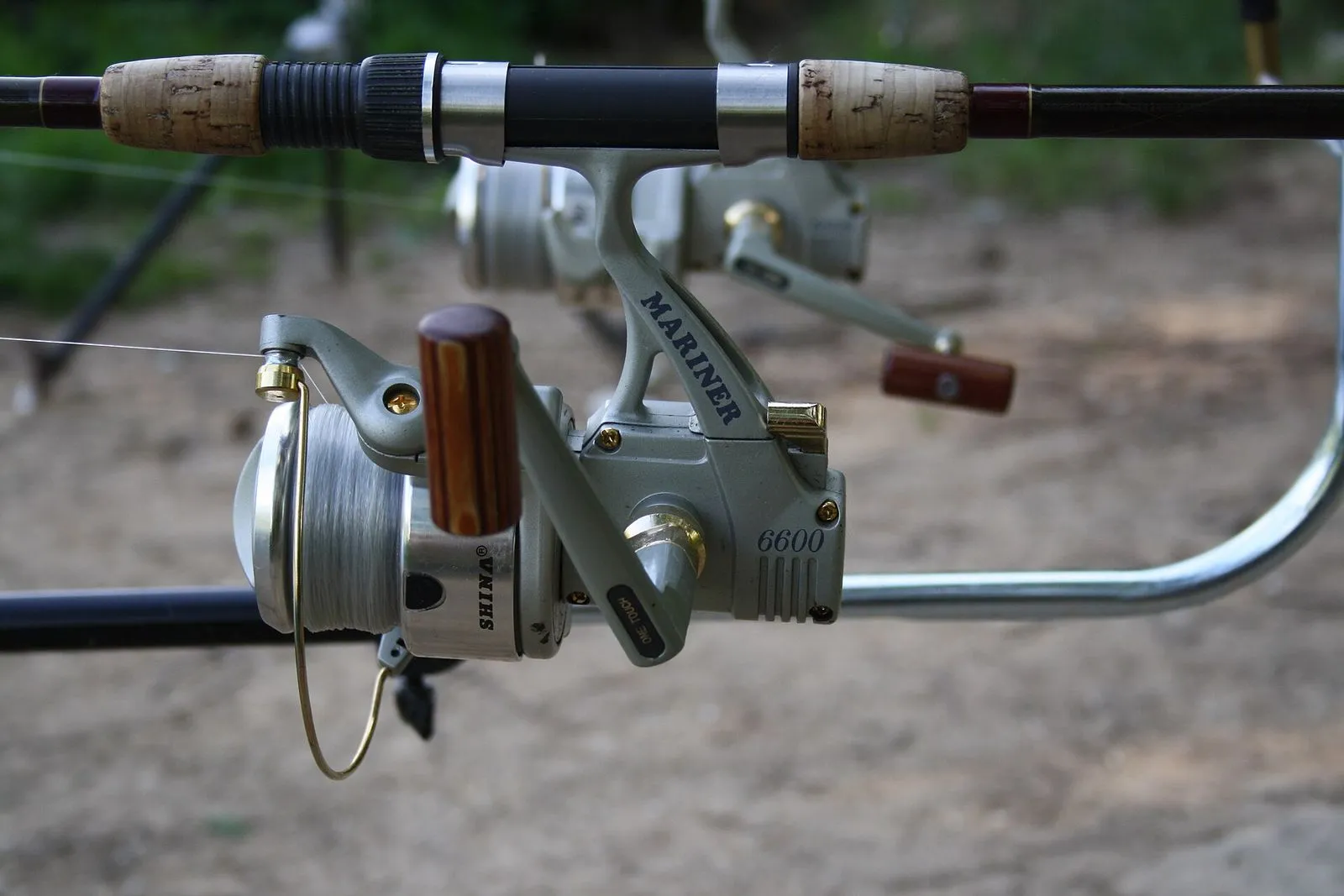
A spinning fishing rod carries the reel underneath, with the guides on the underside of the blank and a big first guide near the handle. That big guide funnels the loose coils that peel off a spinning reel’s open spool, coils a casting rod’s small guides would choke. The payoff: a spinning reel casts a 1/16 oz (2 g) jig as easily as a 1/2 oz (14 g) one, without the backlash a baitcaster makes with light lures. Casting rods, with the reel on top and a trigger grip, take over where power matters more than finesse: heavy lures, heavy line, thick cover.
A spinning rod is the rod almost everyone learns on, and the one many never stop using, because it throws the light baits that catch the most fish.
Spinning or casting rod?
| Spinning rod | Casting rod | |
|---|---|---|
| Reel | Hangs below the blank, fixed spool, bail | Sits on top, revolving spool, trigger grip under the seat |
| Guides | Below the blank; large near the handle, shrinking to the tip; fewer of them | On top of the blank; small and numerous, to keep the line off the blank when it bends |
| Lure weight | 1/16 to about 1 oz (2–28 g) | 3/8 to 2 oz and more (10–57 g+) |
| Line | 4–12 lb mono or fluoro; 10–20 lb braid | 10–25 lb mono or fluoro; 30–65 lb braid |
| Casting | Light lures far; no backlash; less accurate at distance; line twist with some lures | Heavy lures accurately; backlash until the reel is set up; more control of the fall |
| Best at | Finesse bass, trout, panfish, walleye, inshore, surf, beginners | Jigs, Texas rigs, frogs, big swimbaits, flipping and pitching, pike and musky |
| Hook-set and power | Enough for single hooks on light line; drop-shot, Ned rig | Leverage and winch power for heavy line in cover |
Lamiglas’s summary is the rule most anglers use: spinning for finesse and light lures, casting for power. The ranges overlap in the middle. A 3/8 oz spinnerbait or a 1/2 oz jig can go on either, and the choice there is habit and what the reel does better. The baitcaster page explains what a casting outfit does that a spinning outfit cannot.
Which spinning rod for which fishing?
| Fishing | Length | Power / action | Line and lures | A maker’s spec |
|---|---|---|---|---|
| Panfish, crappie, small stream trout | 5–6 ft 6 in (1.5–2 m) | Ultralight / fast | 2–6 lb; 1/32–3/16 oz jigs, small spinners, bait under a float | St. Croix Premier PS60ULF: 6 ft, 2–6 lb, 1/32–3/16 oz |
| Trout in rivers, bigger streams | 6–7 ft (1.8–2.1 m) | Light / fast | 4–8 lb; 1/16–5/16 oz spinners, spoons, small plugs | St. Croix Premier PS66LF: 6 ft 6 in, 4–8 lb, 1/16–5/16 oz |
| Finesse bass (drop shot, Ned rig, shaky head, wacky), walleye, smallmouth | 6 ft 10 in to 7 ft 2 in (2.1–2.2 m) | Medium-light / fast or extra-fast | 6–10 lb fluoro, or 10–15 lb braid to a leader; 1/8–3/8 oz | Shimano SLX 7 ft ML extra-fast: 4–10 lb, 1/16–5/16 oz; Dobyns Fury FR 702SF: 6–12 lb, 1/8–1/2 oz |
| All-round bass and walleye, light spinnerbaits, jerkbaits | 7 ft (2.1 m) | Medium / fast | 8–12 lb; 1/4–5/8 oz | Shimano SLX 7 ft M: 6–12 lb, 3/16–5/8 oz; Dobyns Fury FR 703SF: 8–17 lb, 3/16–5/8 oz |
| Inshore saltwater (redfish, trout, snook) | 7–7 ft 6 in (2.1–2.3 m) | Medium to medium-heavy / fast | 10–20 lb braid; 1/4–1 oz | St. Croix Premier PS70MHF: 7 ft, 8–14 lb, 3/8–3/4 oz |
| Surf | 9–12 ft (2.7–3.7 m) | Medium-heavy to heavy / moderate-fast | 20–40 lb braid; 2–6 oz | A surf series, not a long bass rod: St. Croix Triumph Surf, from $200 |
| Catfish from the bank, carp | 7–10 ft (2.1–3 m) | Medium-heavy / moderate | 15–30 lb; bait rigs with 1–4 oz weights | Ugly Stik Catfish Special spinning, 7–10 ft, $75–85 |
If the fishing is bass, walleye and the odd trout, and you can have one spinning rod, the 7 ft medium-light fast rod is it. Bassmaster’s guide calls medium-light, medium and medium-heavy “the most popular rod powers”; for a spinning rod the first two do the work. The drop shot and Ned rig pages show what that rod spends most of its life doing. The catfish rods page covers the bottom row properly.
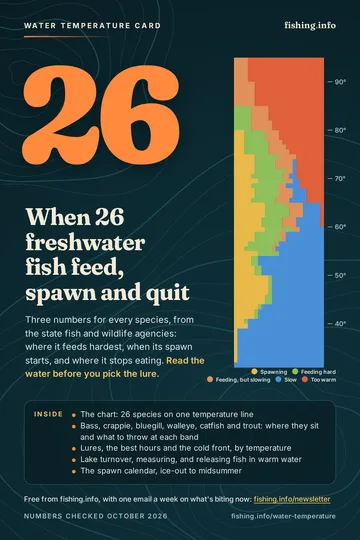
Free card: what 26 species do at your water temperature
Plus one email a week on what's biting now. No sales pitches. Privacy.
How do you read the label?
Every spinning rod carries the same five facts above the handle, and once you can read one label you can read them all. St. Croix’s Premier PS70MLF is a good one to practice on.
| On the label | Example (St. Croix Premier PS70MLF) | What it tells you |
|---|---|---|
| Model code | PS70MLF: Premier Spinning, 7 ft 0 in, Medium-Light, Fast | Most makers pack length, power and action into the code; Dobyns writes it as FR 702SF, where the 2 is the power |
| Length | 7 ft (2.1 m) | Shorter casts more accurately; longer casts farther and picks up more line on the hook-set |
| Power | Medium-light | The stiffness of the blank, ultralight to extra-heavy; it sets the two ranges below |
| Action | Fast | Where it bends: fast in the top third, moderate into the middle; fast for single hooks and jigs, moderate for treble-hooked plugs |
| Line and lure | 4–10 lb, 1/8–1/2 oz | The ranges the blank casts and fights with properly; the line figure is a mono rating |
The label does not say two things out loud. First, the line rating is a monofilament rating. Lamiglas puts it plainly: a rod marked 10–20 lb “may work effectively with braid from 15–30 lb,” because braid of that strength is as thin as the mono the rod was designed around.
Second, the ranges differ by maker. Shimano rates its 7 ft medium-light SLX at 4–10 lb and 1/16–5/16 oz. Dobyns rates the 7 ft medium-light Fury at 6–12 lb and 1/8–1/2 oz. Same words on the label, a quarter of an ounce apart at the top. Read the numbers, not just the power word.
What are the parts, and what does each do?
From the tip down, a spinning rod is a blank, a set of guides, a reel seat and a handle, and each part has one job.
| Part | What it does | What to look for |
|---|---|---|
| Blank | The tapered graphite or glass tube; its stiffness is the power, its bend is the action | Straight, no scuffs at the ferrule; the power and action you need, not the prettiest finish |
| Guides and tip-top | Carry the line along the blank; the first guide is the biggest because it catches the coils off the spool | A ceramic ring in every guide, or a coated steel ring; no cracks or grooves |
| Reel seat | The threaded fitting that clamps the reel foot | Locks tight with no wobble; an exposed-blank seat puts your finger on the rod for feel |
| Handle | Cork or EVA foam; a full grip runs unbroken from the seat to the butt, a split grip leaves bare blank in between | Long enough that the butt tucks under your forearm on a two-handed cast |
The guides are what make the rod a spinning rod. A Fuji guide kit for spinning rods up to 7 ft 6 in (2.3 m) starts with a size 25 ring at the first guide. It steps down through a 12 and a 6, and runs the rest of the way to the tip in 5.5s. The big first ring gathers the loose coils from the spool into a straight line. The small running guides keep that line close to the blank so it does not slap. A casting rod needs none of that, because line comes off a revolving spool already straight; that is why casting rods carry more guides and smaller ones.
A split grip saves a little weight and shows off the blank; a full cork grip gives a second hand somewhere to go on a long cast and on a big fish. St. Croix sells every Premier spinning model with a full grip; Dobyns builds the Fury spinning series on a cork split grip. Neither catches more fish. Pick by feel in the hand, with a reel on.
Graphite, glass or composite? One piece or two?
Graphite is the material of nearly every spinning rod over $100: light, stiff and sensitive, so a 1/8 oz jig ticking gravel 40 ft (12 m) away registers in your fingers. Makers talk about modulus and tonnage. Wired2Fish’s Jason Sealock explains that higher-modulus graphite is stiffer for its weight. Dobyns builds the Fury on “high modulus graphite blanks,” Fenwick’s World Class on a blend of 40- and 36-ton graphite.
Fiberglass bends deeper and slower, weighs more and is far harder to break. Its cushion is what crankbait anglers want. It is also why Ugly Stik’s GX2 uses “a combination of graphite and fiberglass” the maker calls Ugly Tech. For a first spinning rod, the composite’s toughness is worth more than the graphite’s feel; for a drop-shot rod, the reverse.
One-piece blanks transmit more and have no ferrule to loosen; a two-piece 7 ft rod fits in a trunk, and most anglers never feel the difference. St. Croix charges $20 more for the two-piece Premier (PS70MLF2 at $185 against $165), which tells you the joint costs something to build well. Buy one piece if the rod will live on a boat, two if it rides in a car.
Which guides are worth paying for?
The guides matter more on a spinning rod than on a casting rod, because the loose coils off the spool slap the first few on every cast. Rod builder Chris Adams at Mud Hole lays out the ring ladder. Aluminum oxide is the common ceramic and fine for mono and fluorocarbon. Fuji’s Alconite “handles braid well and dissipates heat effectively” at a mid-range price. Silicon carbide (SiC) is the premium ring that “can handle anything from heavy braided line to long saltwater runs without wear.” Torzite and zirconia are thinner and lighter still, and priced like it.
Ugly Stik goes the other way with Ugly Tuff guides: one-piece coated stainless steel with no ceramic insert to pop out. That is the right answer for a rod that will be stepped on. A cracked or grooved ring frays braided line cast after cast; a decent ring is the cheapest casting-distance upgrade there is.
Which reel and line go on it?
Spinning reels are sized by a number, 1000 to 8000 and up, and the spinning reel page has the full table. Ardent’s guide and the common bands run like this.
| Rod | Reel size | Main line | Leader |
|---|---|---|---|
| Ultralight 5–6 ft, panfish and stream trout | 1000 | 4–6 lb mono, or 6–10 lb braid | None, or 4 lb fluoro |
| Light 6–7 ft, river trout | 2000 | 6–8 lb mono, or 10 lb braid | 4–6 lb fluoro |
| Medium-light 7 ft, finesse bass and walleye | 2500 | 10–15 lb braid | 6–10 lb fluoro |
| Medium 7 ft, all-round bass | 3000 | 15–20 lb braid, or 8–12 lb mono | 10–12 lb fluoro |
| Medium-heavy 7–7 ft 6 in, inshore | 3500–4000 | 20–30 lb braid | 15–25 lb fluoro |
| Surf 9–12 ft | 5000–8000 | 30–50 lb braid | 30–50 lb mono shock leader |
A reel too big for the rod unbalances it and tires the wrist. Too small, and the line capacity and drag run out on the fish you bought the rod for. Braid to a fluorocarbon leader is what most spinning anglers now fish: thin braid on the spool for casting distance and no memory, a few feet of fluorocarbon at the lure for invisibility and abrasion. Spool it right the first time; the how to put line on a reel page shows the way that avoids twist.
What does a spinning rod cost?
| Price band | A rod in it | What you get |
|---|---|---|
| Under $60 | Ugly Stik GX2 spinning, $59.95 | Graphite-glass composite, coated steel guides, 20 models from 4 ft 6 in ultralight to 9 ft medium; close to unbreakable |
| About $100 | Shimano SLX spinning, $99.99; Dobyns Fury spinning, from about $100 | Graphite blanks, Fuji reel seat on the Fury, split grips; the first rods with real sensitivity |
| $150–220 | St. Croix Premier spinning, $145–215 | US-built graphite, full cork grip, 37 spinning models from 4 ft 6 in to 7 ft 6 in |
| Over $250 | St. Croix Avid and Legend, G. Loomis, Fenwick World Class | Higher-modulus graphite, titanium frames, lighter rings; the last 10% of feel |
The jump worth making is the first one: a $100 graphite rod feels bites a $40 rod never shows you. Above $200 you pay for weight saved in grams and for guide frames that will not corrode. The best fishing rods page ranks the current picks across every type with prices. A rod and reel combo is the cheaper way to get a matched spinning outfit, and the beginner fishing rod page picks the first one.
How do you choose one, step by step?
- Name the fishing. Panfish, trout, finesse bass, inshore, surf: the table above gives the length and power.
- Pick the power for the lure weights, not the fish size. A 4 lb smallmouth on a medium-light rod is fine; a 1/8 oz jig on a medium-heavy rod is unfishable.
- Fast action for single hooks and jigs, moderate for treble-hooked plugs and bait rigs.
- Read the line and lure ranges, not just the power word; two makers’ medium-lights are a quarter ounce apart.
- Buy the guides, then the blank. A $100 rod with Alconite rings outlasts a $100 rod with a fancier blank and bare ceramic that chips.
- Hold it with the reel on. Balance at the front of the reel seat means a rod you can fish all day.
- Spend the money on the reel first if the budget is tight; a $100 reel on a $50 rod fishes better than the reverse.
How do you cast it?
Take Me Fishing’s sequence, with Outdoor Life’s refinements, in five steps for a first day.
- Hold the rod at waist height with the reel below it and the reel stem between your fingers, index finger ahead of the reel foot. Let the lure hang 10–18 in (25–45 cm) below the tip.
- Hook the line with your index finger just ahead of the line roller, then open the bail with the other hand, still holding the line.
- Sweep the rod back over your dominant shoulder to about the 10 o’clock position, check that nothing is behind you, and look at the target.
- Snap forward and let the line go as the rod passes 12 o’clock. Too early and the lure climbs into the sky; too late and it slaps down short.
- Close the bail by hand, not with the handle, so no loose loop goes onto the spool, and start the retrieve.
The fishing for beginners page takes it from the first cast to the first fish.
How do you look after it?
Rinse the rod in fresh water after salt and let it dry before it goes in the tube. Run a cotton ball through every guide once a season; a snag means a cracked ring that is cutting your line. Never lift a fish with the rod pointed straight up. That high-stick snaps tips that would hold a fish at 45 degrees.
Mistakes to avoid
- Buying power for the fish instead of the lure. The rod casts the lure; the drag fights the fish.
- Ignoring the line rating with braid. The number is for mono; braid can be heavier, but a leader far over the rating puts the strain on the blank.
- A reel that is too big. A 4000 on a 7 ft medium-light rod is nose-heavy by lunchtime.
- Closing the bail with the handle. The loop it lays on the spool becomes next cast’s tangle.
- A spinning rod for 3/4 oz jigs in timber. That is casting-rod work; the rods hub has the chart that shows where each type takes over.
Free download
The water temperature card
Read your water temperature and the card tells you who is spawning, who is feeding and what to throw. 26 species, 16 pages, for your phone and the tackle box.
Plus one email a week on what's biting now. No sales pitches. Privacy.
Related
Section guide
Fishing Rods: Power, Action and Length, and Which Rod for Which LureHow a fishing rod is rated: power, action and length explained, the line and lure ranges for each power, and the rod each bass and catfish technique wants.
 Fishing Pole: Pole or Rod, the Six Kinds, and What a First One Costs
A fishing pole and a fishing rod are the same thing. The six kinds, from a bamboo cane pole to a fly outfit, who each one suits, and what a first one costs.
 Catfish Rods: Length, Power, the Soft Tip, and the Reviewers' Picks
Catfish rods explained: 7–10 ft, medium-heavy, a soft glass tip on a strong butt, sinker ratings by species, and the reviewers' picks with maker specs.
 Rod and Reel Combo: The Best Picks by Fishing, and When Not To
The best rod and reel combos by fishing, from maker specs and owner ratings: first spinning, bass baitcast, inshore, surf, catfish, kids; where separates win.
 Fishing Rod for Beginners: The One Setup, and Eight Combos That Deliver It
A fishing rod for beginners is a 6 ft 6 in to 7 ft medium spinning combo. Eight combos from the 2026 guides compared on rod, reel, price and verdict.
 Best Fishing Rods: The Reviewers' Picks by Technique and Budget
The best fishing rods by what you fish: bass casting and spinning, trout, panfish, walleye, catfish, inshore and surf, with the makers' specs and prices.
 Kids Fishing Pole: The Reviewers' Picks by Age, 3 to 14
The kids fishing pole the 2026 guides pick for each age, 3 to 14: push-button first, spinning from about 8, with prices, owner complaints and the first rig.
Sources
- Lamiglas, the difference between casting and spinning rods
- Lamiglas, fishing rod line rating, power and lure rating explained
- Cast and Spear, spinning rod vs casting rod
- Bassmaster, fishing rods: lengths, powers and actions
- Wired2Fish (Jason Sealock), fishing rods explained: action, power and more
- St. Croix, Premier spinning rods: model specifications and prices
- Shimano SLX spinning rod, specifications per model (FishUSA)
- Dobyns Rods, Fury spinning rods: model chart
- Ugly Stik, GX2 spinning rod: models, construction and price
- Mud Hole (Chris Adams), choosing the right guide ring
- Mud Hole, Fuji KL-H high-frame spinning guide kits (guide sizes per rod)
- Ardent, fishing reel sizes explained
- Take Me Fishing, how to cast a spinning reel
- Outdoor Life (Pete Robbins), how to cast a spinning reel
- USAngler (John Baltes), best bass fishing rods