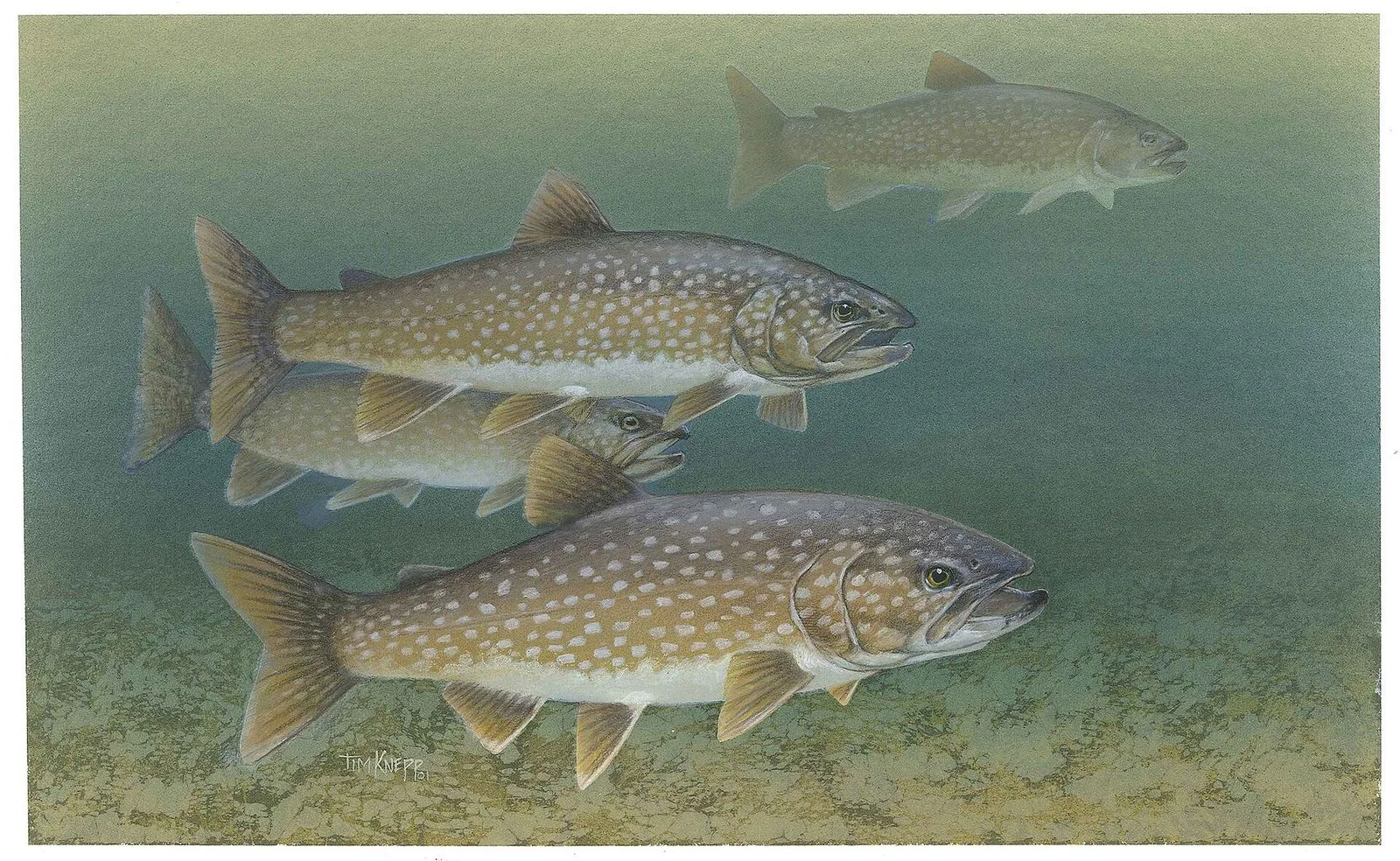
The lake trout is a char of the deepest, coldest lakes of northern North America, and it can outlive the angler who catches it. Most weigh 2–4 lb (0.9–1.8 kg), big lakes grow them past 40 lb (18 kg), and Canadian lakes have produced fish 70 years old. In summer a laker sinks below the thermocline, into water of 42–52 °F (6–11 °C).
In 1995 Lloyd Bull trolled a Dardevle spoon on Great Bear Lake, near the Arctic Circle, and landed a 72 lb lake trout. It is still the all-tackle world record, and guides there reckon a 50 lb laker takes 1,000–1,500 hours of fishing.
How do you identify a lake trout?
Two marks settle it. The tail is deeply forked, more deeply than any other char’s; a brook trout’s tail is square. And the spots are cream to pale yellow and bean-shaped, on a dark green or gray-brown body, with no red spots anywhere.
The color follows the water. Lakers from clear lakes are often so silvery the spots are hard to see, and in stained water they are nearly black.
The lower fins have a narrow white leading edge, sharpest at spawning time. It is never as crisp as a brookie’s, and never orange. A fish with a moderate fork, red spots and some marbling on the back is probably a splake, the hatchery cross of lake trout and brook trout.
Where are lake trout, and how deep?
The native range covers most of Canada, Alaska and the Great Lakes, plus northern New England, New York and a few mountain lakes of Montana. Stocking has pushed it much further, into reservoirs across the West.
What a lake trout needs is cold water with oxygen in it. A typical lake trout lake in Maine is large, deep and rocky. Its water stays at 60 °F (16 °C) or colder at depth all year, with more than 6 parts per million of dissolved oxygen. New York’s biologists give the preferred range as 42–52 °F, with 48 °F (9 °C) the optimum. The trout water temperature chart puts that beside the other trout.
That preference drives the whole year:
- Spring, after ice-out: the surface is cold, and lakers cruise the shorelines and shallow reefs.
- Summer: when the surface warms in late spring they sink below the thermocline, deeper than 45 ft (14 m) in Maine’s lakes and well over 200 ft (61 m) down in the big lakes.
- Fall: the surface is cold again, and lakers cruise the shorelines and shallow reefs.
- Winter: through the ice they can be anywhere from 10 to 100 ft (3–30 m).
Lake trout fishing turns those depths into a method for each season.
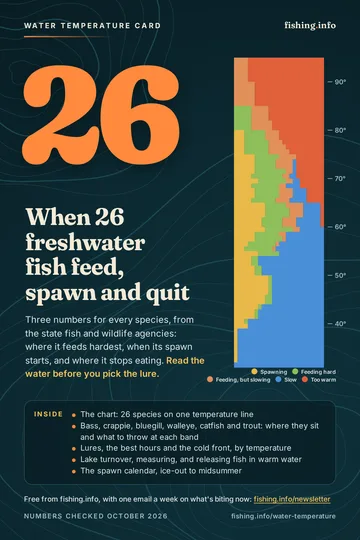
Free card: what 26 species do at your water temperature
Plus one email a week on what's biting now. No sales pitches. Privacy.
How big do lake trout get?
Most adult lake trout weigh under 5 lb (2.3 kg), even in good water; in Maine the common size is 18–24 in (46–61 cm) and 2–4 lb. Big lakes grow them to 3 ft (91 cm) and 40 lb. Commercial gill nets have taken heavier fish, the biggest a 102 lb (46 kg) laker from Lake Athabasca in 1961.
The all-tackle world record is Lloyd Bull’s 72 lb (32.65 kg) fish from Great Bear Lake, Northwest Territories, trolled on a Husky Dardevle on Aug. 19, 1995. Maine’s state record is 39.2 lb (17.8 kg), from Richardson Lake. Alaska’s rod-and-reel record is 47 lb (21.3 kg), from Clarence Lake in 1970.
Are lake trout good to eat?
Maine’s biologists count “excellence as a food fish” among the lake trout’s virtues. They note that many anglers prefer the small, lean fish from plankton-feeding populations to fish fattened on smelt. The flesh runs from white to deep red with the diet.
The big, old fish are the ones to release, because they are the spawners. Read the lake’s fish consumption advisory before keeping any. Lake trout are long-lived, fatty predators, and they store pollutants such as PCBs and mercury; the state advisories set the limits by lake and by size of fish.
How did the Great Lakes lose their lake trout, and get them back?
No trout in North America has a history like the Great Lakes laker, and a laker on your line in Lake Superior is a small conservation miracle. Sea lamprey, a parasite from the Atlantic, climbed past Niagara through the shipping canals and reached every upper lake by 1938. One lamprey can kill up to 40 lb (18 kg) of fish in its 12–18 months of feeding. Together with heavy commercial fishing, it nearly erased the lake trout.
| Year | What happened | The number |
|---|---|---|
| 1835 | First sea lamprey recorded in Lake Ontario | – |
| 1921–1938 | Lamprey spreads to Erie, Huron, Michigan, Superior | – |
| Before the invasion | Upper Great Lakes lake trout harvest | About 15 million lb (6,800 t) a year |
| 1962 | Lake trout season closed after the collapse | – |
| Early 1960s | Upper Great Lakes harvest | About 300,000 lb (136 t), 2% of normal |
| Early 1960s | Lampricide TFM, found after testing nearly 6,000 chemicals | Lampreys cut by 90% |
| 2021 | Lake Superior commercial and sport harvest | Over 463,000 lb (210 t) |
| 2024 | Lake Superior Committee declares lakers recovered | Most of the lake, from natural reproduction |
Stocking and lamprey control rebuilt the fish. Lake Superior’s nets now hold as many lakers as in the 1940s or more, and stocking has stopped in areas such as the Apostle Islands. Parts of western Lake Superior are still stocked because they fall short of the recovery benchmarks. The U.S. Fish & Wildlife Service values the Great Lakes lake trout sport fishery at more than $7 billion a year and 75,000 jobs.
Why are lake trout killed in Yellowstone?
Where it does not belong, the lake trout is the villain. Nobody officially stocked lake trout in Yellowstone Lake. The National Park Service says they arrived by unknown means in the mid-1980s, probably from nearby Lewis Lake, and the first one was caught in 1994; the USGS calls it an illegal introduction. The big ones fed heavily on the lake’s native Yellowstone cutthroat trout and decimated them.
The National Park Service has removed more than 5.1 million lake trout from the lake since, about 289,900 in 2025 alone. It reports the spawning population down 87% since 2012.
Where and when do lake trout spawn?
Lake trout are the odd ones out among spawning trout: they build no redd. As the surface cools below 60 °F in the fall, mature fish gather over exposed shoals and rocky shorelines. In Maine they spawn at night, from mid-October to mid-November. The spot is often within 30 ft (9 m) of shore, usually in less than 6 ft (1.8 m) of water, over broken ledge and rubble 5–25 in (13–64 cm) across.
The eggs are broadcast over the rocks and drop into the crevices, where suckers, eels, bullheads and crayfish pick at them. A female carries 2,000–20,000 eggs depending on her size. They incubate under the ice for five to six months and usually hatch in April. The fry stay in the rocks until the yolk sac is gone, then head for deep water.
Females often spawn only once every two or three years, and in northern Alaska every other year or less. That is why a wind-swept rocky point in November is where the fish are. Check the fall rules before fishing a spawning reef; some waters close or restrict it.
What do lake trout eat, and how old do they get?
Young lakers eat insects and crustaceans, including the opossum shrimp Mysis in many Canadian lakes. They turn to fish at 8–10 in (20–25 cm): whitefish, suckers, minnows, sculpins and perch. Where smelt have been introduced, lakers eat them almost to the exclusion of everything else. Where there is no forage fish, lake trout stay plankton eaters all their lives and never grow large.
Growth is the slowest of any sport trout. In Maine, lake trout add 2–4 in (5–10 cm) a year for their first six years, then an inch or less a year once they mature. Most males mature at six and 16–18 in (41–46 cm), most females at seven or eight and 20 in (51 cm) or more.
The practical rule: you cannot read a laker’s age from its weight. Maine has recorded fish over 25 years old. In Alaska they pass 50, with a maximum of 62, and Canadian lakes have produced lake trout 70 years old. A 20 lb fish from a cold northern lake may be decades old, which is why so many trophy lakes are managed for catch and release.
Togue, mackinaw, laker: the names
It is called togue in Maine, mackinaw in the West, and laker, gray trout or salmon trout elsewhere. The scientific name, Salvelinus namaycush, comes from a Cree name for the fish. What all the names hide is that the lake trout is not a trout. Like the brook trout, it is a char, with light spots on a dark body instead of dark spots on a light one.
Lake Superior holds several forms of lake trout, and two matter to anglers. The common “lean” laker is the one you troll and jig. The siscowet is most abundant 300–600 ft (90–180 m) down and is so fat that its flesh is notably oily: a 1965 study measured up to 89% fat by dry weight, against 7–52% in lean lakers.
And a Baltimore “lake trout” sandwich is not a lake trout at all. It is fried Atlantic whiting, a cheap ocean fish sold under a better name. The trout hub covers every trout and char in North America.
Free download
The water temperature card
Read your water temperature and the card tells you who is spawning, who is feeding and what to throw. 26 species, 16 pages, for your phone and the tackle box.
Plus one email a week on what's biting now. No sales pitches. Privacy.
Related
Section guide
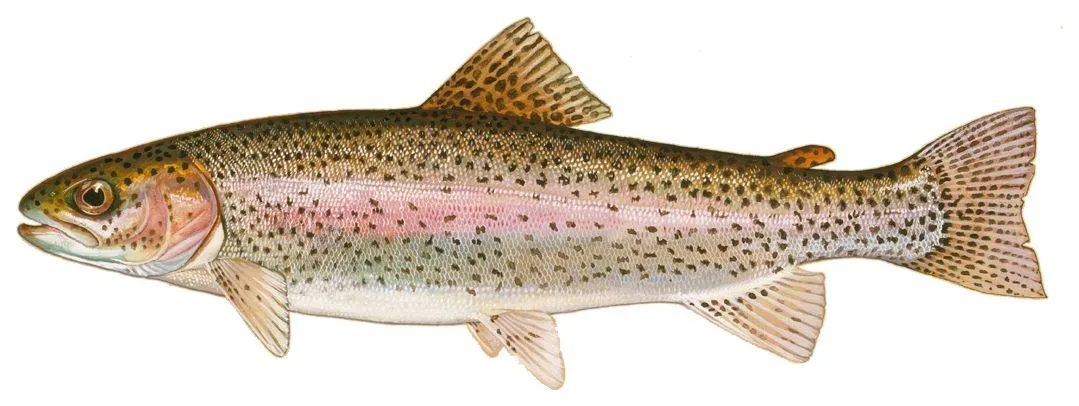
Trout: The Types of Trout and How to Tell Them ApartThe types of trout anglers catch, from rainbow and brown to brook and lake trout (two are chars): the marks that identify each, spawn seasons, records.
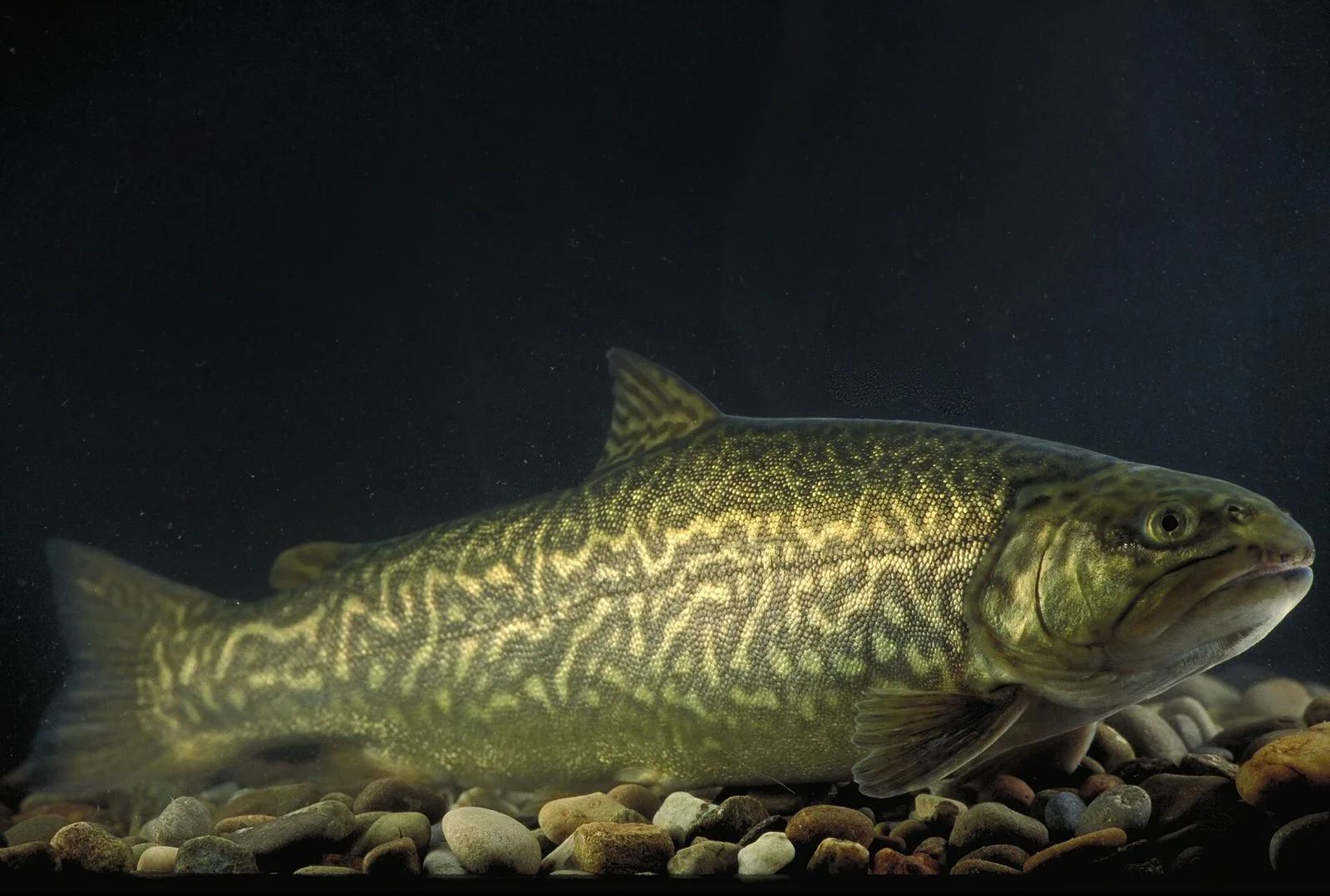 Tiger Trout: The Sterile Brown x Brook Hybrid Explained
Tiger trout are sterile brown x brook hybrids from hatcheries: how they are made, why states from Oregon to Virginia stock them, and the 27 lb 6 oz record.
 Trout Fishing for Beginners: Where, When and What to Use
Trout fishing peaks at 55–65 °F, and most beginners catch stocked fish first. Where trout hold in streams and lakes, the one outfit to buy, and when to go.
 Brown Trout: Identification, History, Habits and Records
Brown trout from the agency data: how to tell one from a rainbow or brook, the 1883 import, night feeding, the fall spawn and the 44 lb record.
 Brook Trout: The Char That Marks America's Coldest Water
The brook trout is a char, not a trout: how to tell it apart, where it still lives, why it lost 28% of its range, and the 1915 record.
 Steelhead Trout: The Rainbow That Goes to Sea
Steelhead trout are rainbows that run to sea or a Great Lake and come back to spawn, often more than once. Runs, the ESA listings, Great Lakes fish, records.
- Rainbow Trout: Identification, Range, Spawning and Record
Rainbow trout from the agency data: how to tell one from a steelhead, cutthroat or brown, the temperatures that matter, spawning, and the 48 lb record.
Sources
- U.S. Fish & Wildlife Service, lake trout (Salvelinus namaycush)
- Maine IFW, lake trout (togue) species information
- Maine IFW, lake trout management plan (Johnson, 2001)
- Alaska Department of Fish and Game, lake trout species profile
- New York DEC, trolling for Lake Ontario trout and salmon (lake trout temperatures)
- IGFA game fish database, lake trout
- Field & Stream, the biggest trout ever caught (Lloyd Bull's 72 lb lake trout)
- Great Lakes Fishery Commission, sea lamprey
- U.S. Fish & Wildlife Service, all about invasive sea lamprey
- Great Lakes Now, after a dramatic decline, lake trout have recovered in most of Lake Superior (2024)
- National Park Service, Yellowstone fish management
- USGS Nonindigenous Aquatic Species, lake trout factsheet (native range, introductions)
- Wisconsin DNR, fish consumption advice (mercury, PCBs and PFAS)
- Michigan State University Extension, siscowet lake trout: everything you need to know
- Eschmeyer & Phillips (1965), fat content of the flesh of siscowets and lake trout from Lake Superior (USGS)
- Wikipedia, lake trout (the name namaycush)
- Culture of Baltimore (the fried 'lake trout' sandwich)