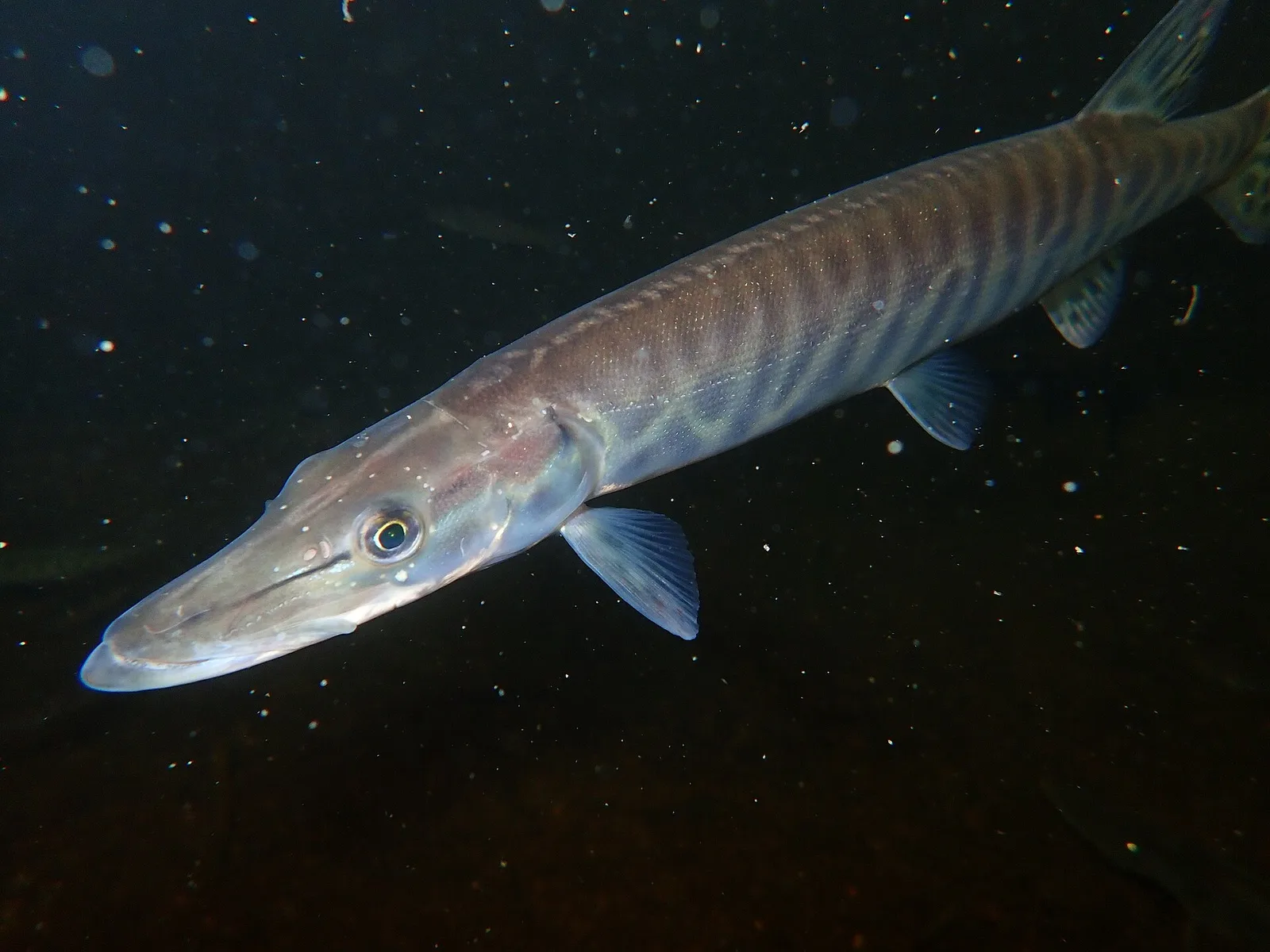
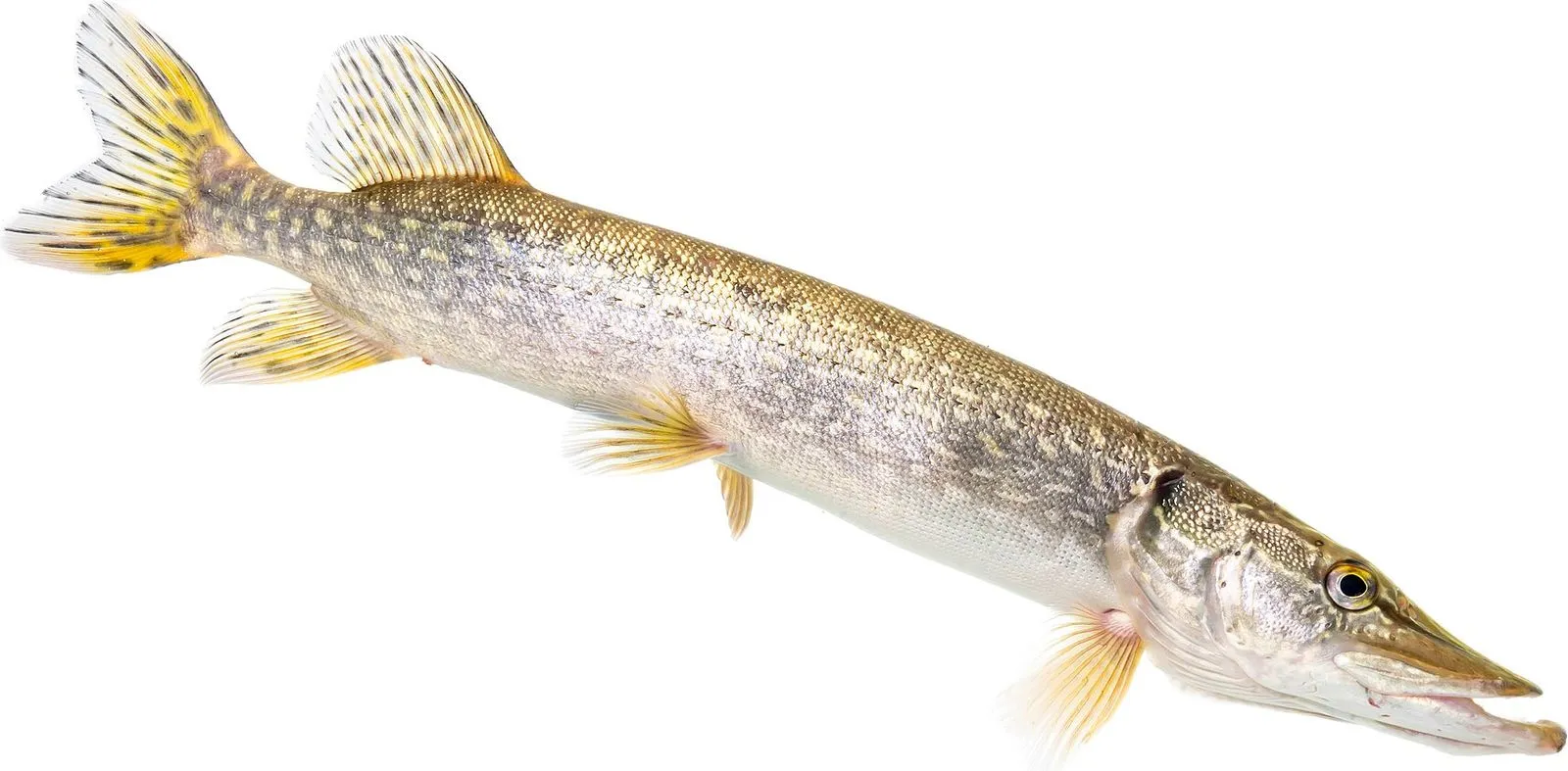
A tiger muskie is the cross of a northern pike and a muskellunge: a striped, fast-growing hybrid that reaches 34 to 48 in (86–122 cm) and more than 30 lb (14 kg). A few are born wild where the two parents share a lake. Nearly all the rest come from a hatchery truck, stocked in about 30 states as a trophy fish and as a hired predator.
The tiger muskie record is the oldest in the pike family: 51 lb 3 oz, caught July 16, 1919, and still standing. Colorado gets its tigers from Nebraska and pays for them in walleye.
What fish make a tiger muskie?
A northern pike and a muskie. Wisconsin DNR, Pennsylvania’s Fish and Boat Commission and Idaho Fish and Game describe the same recipe: milt from a male pike on the eggs of a female muskellunge. The fish also goes by tiger muskellunge, tiger musky, hybrid muskellunge and norlunge.
It happens without help too. Natural hybrids turn up where the parents’ ranges overlap, in the northeastern and western Great Lakes regions. Some Wisconsin lakes keep producing them where northern pike were stocked into native muskie water.
The calendar explains why wild tigers stay scarce. Wisconsin pike spawn as the ice breaks up, in late March or early April. Wisconsin muskies spawn from mid-April to late May, as the water warms from 50 to 60 °F (10–16 °C). A wild tiger needs a late pike and an early muskie on the same flooded shallows.
Hatcheries like the cross for what Pennsylvania’s Fish and Boat Commission calls hybrid vigor: tigers “are hardier and faster-growing than their purebred parents, and they respond better to hatchery-raising.”
How do you tell a tiger from a muskie or a pike?
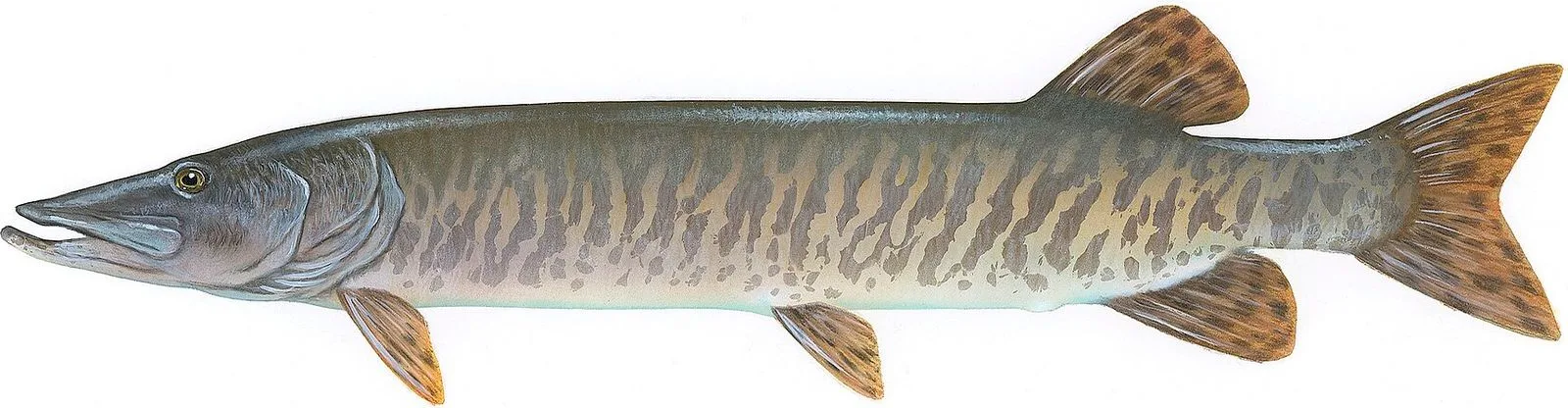
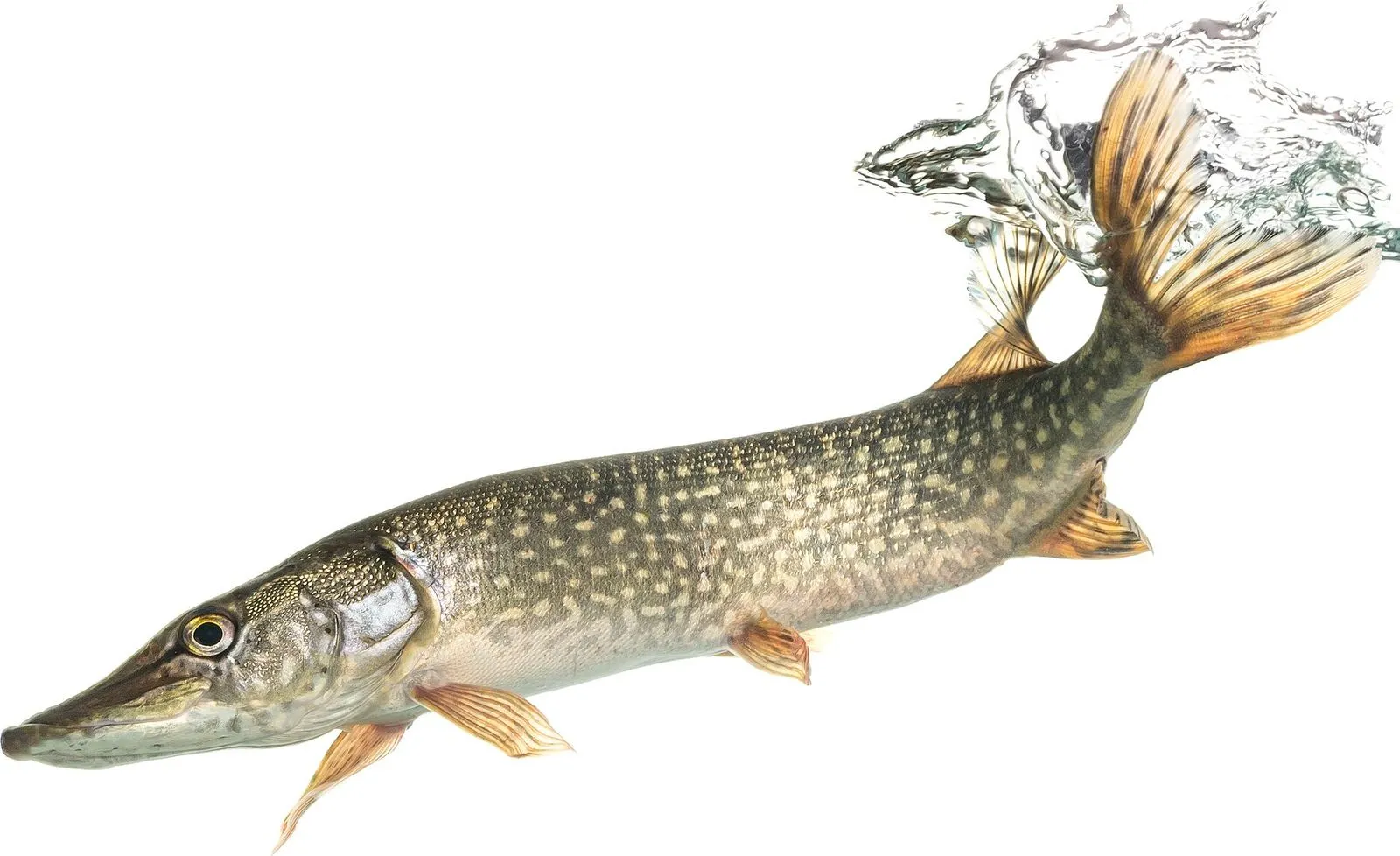
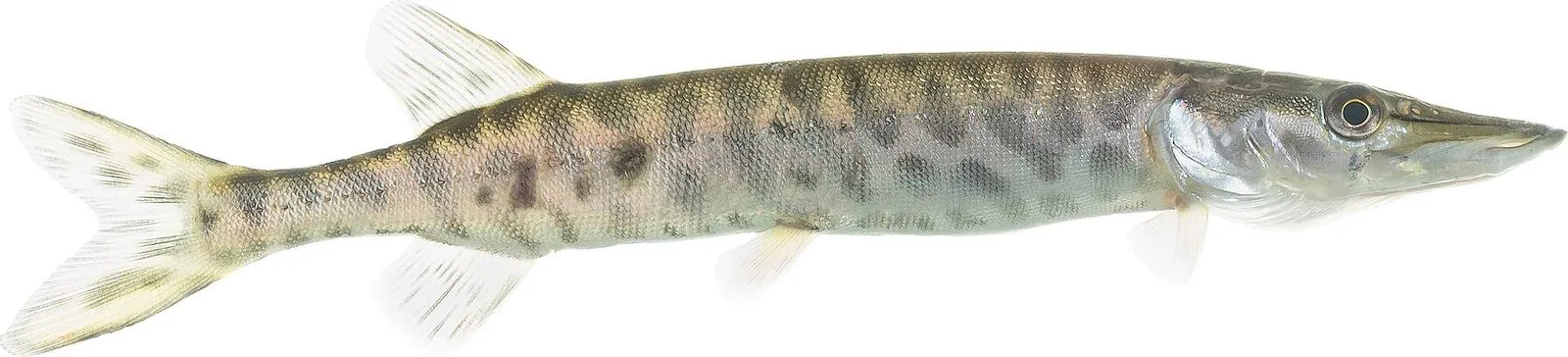
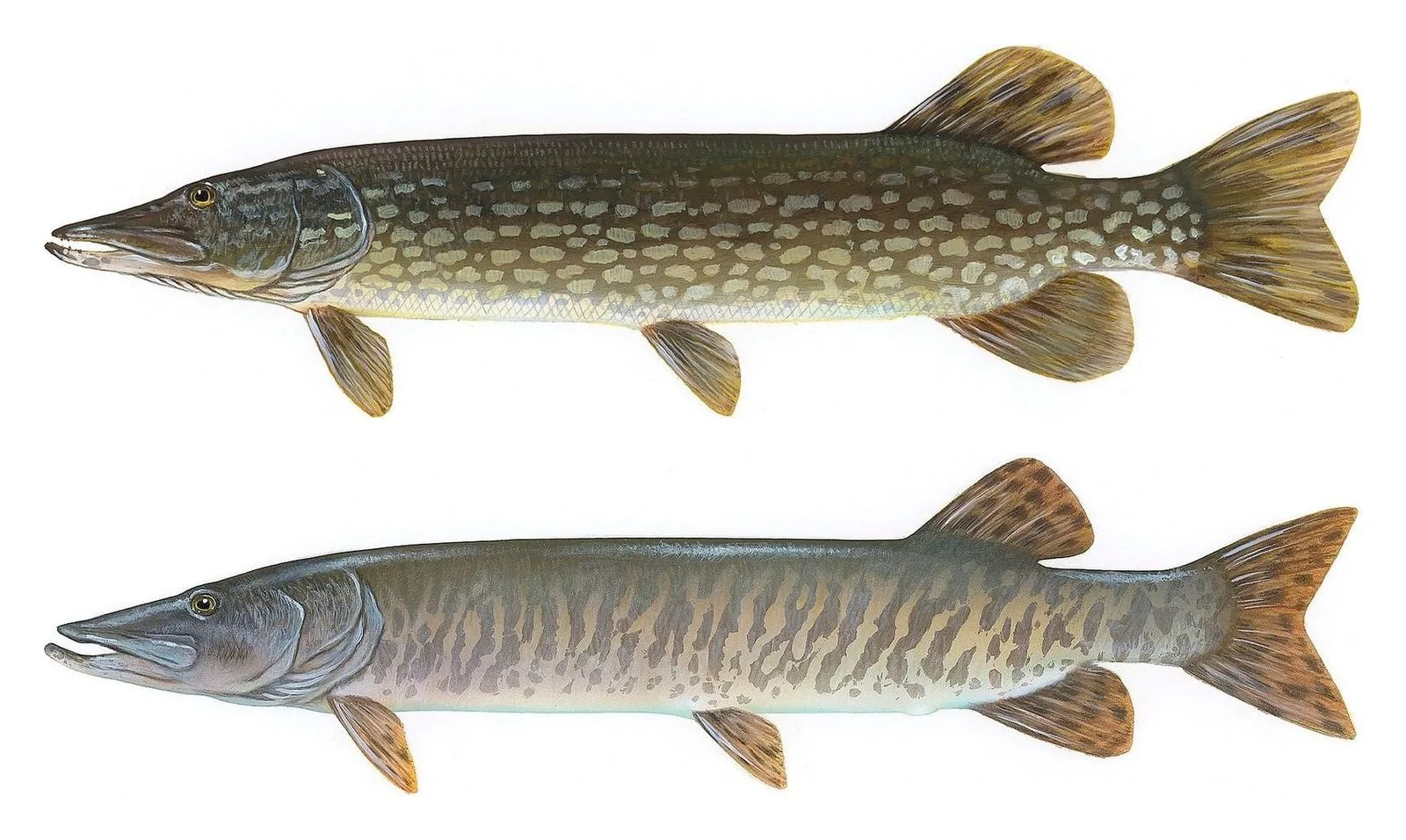
The agencies do not agree on what a tiger looks like, and that is worth knowing before an argument at the ramp. Wisconsin DNR’s identification card says the hybrid has “irregular vertical light markings on a dark background.” Washington, Colorado and Pennsylvania describe dark bars on a light background. Both are honest: the bars and the gaps on a tiger are about equally wide, so the eye can read either one as the background.
Go by the marks that do not depend on the eye.
| Mark | Northern pike | Tiger muskie | Muskie |
|---|---|---|---|
| Pattern | Pale spots in rows | Irregular vertical stripes | Dark bars or spots, or none |
| Tail tips | Rounded | Rounded, spotted | Pointed |
| Cheek scales | Fully scaled | Fully or two-thirds | Top half only |
| Gill cover scales | Top half | Top half to a third | Top half |
| Pores per side of jaw | 5 or fewer | 5 to 7 | 6 to 9 |
Stripes with a rounded tail is the quick answer. A striped fish with pointed tail tips is a barred muskie, not a tiger.
The cheek is the best check on a fish in the net. A muskie’s lower cheek is bare, and a tiger’s is scaled at least two thirds of the way down. Pore counts overlap at five, six and seven, so they settle only the extremes. On a tiger the stripes almost or completely cross the back, and the jaws are usually spotted. Young tigers are spotted; the bars come with age.
Shape helps as well. Pennsylvania describes a tiger as plumper than a purebred, “shorter and more robust.” The longer comparison of the two parents is on the muskie vs pike page. The pike family page sets the whole family side by side, the small chain pickerel of the East included.
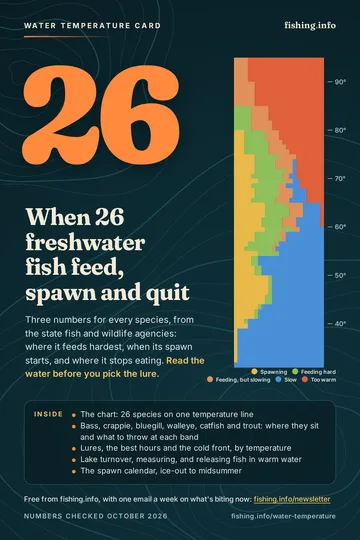
Free card: what 26 species do at your water temperature
Plus one email a week on what's biting now. No sales pitches. Privacy.
How big do tiger muskies get?
Washington’s Department of Fish and Wildlife publishes the growth ladder.
- Stocking size: about 7 in (18 cm) in Colorado, 9 in (23 cm) in New York, 10 in (25 cm) in Idaho.
- Two years: 18 to 20 in (46–51 cm).
- Three years: 25 to 30 in (64–76 cm).
- Mature adult: 34 to 48 in (86–122 cm), and more than 30 lb (14 kg).
Colorado Outdoors, the state’s wildlife magazine, followed one fish that went from 7 in to 18 in (46 cm) in a single year.
They grow fast and they stop sooner. Pennsylvania: “they don’t live as long as regular muskies, so they don’t attain the muskellunge’s great size.” Idaho Fish and Game gives the hybrid 15 to 20 years.
Three record fish show what the length means in pounds. Utah’s record measured 49 in with a 21½ in girth and weighed 33 lb 9 oz (15.2 kg). New York’s was 50 in and 35 lb 8 oz (16.1 kg). The world record was 54 in and 51 lb 3 oz (23.2 kg). For a fish in between, the fish weight calculator works from length and girth.
The 1919 record
John Knobla caught the heaviest tiger muskie on record on July 16, 1919, in Lac Vieux Desert on the Wisconsin–Michigan line. Wisconsin DNR lists it at 51 lb 3 oz (23.2 kg) and 54 in (137 cm). It is the state record and the IGFA all-tackle record for the hybrid, and nothing in the pike family has stood longer.
The best modern fish is well short of it. Edward Kalinowski’s Idaho record from Little Payette Lake, caught August 6, 2013, weighed 44.25 lb (20.1 kg) at 52.5 in. The Modern Day Muskellunge World Record Program lists it as its tiger record. The world record muskie page covers the three purebred fish that claim that title.
Are tiger muskies sterile?
Mostly, and enough for the job. Washington, Colorado and New York call the fish sterile. USGS is more exact: male tiger muskellunge are always sterile, but females are often fertile and can breed back with a parent species.
What matters at the water is that tigers do not found a population. None of these agencies reports a lake where tigers sustain themselves, and USGS says populations are maintained by stocking in most cases. When the trucks stop, the tigers age out.
That is the whole reason the West uses them. A Colorado Parks and Wildlife biologist draws the contrast with northern pike, which eat hard and reproduce on their own, and so can take over a fishery and wreck its trout. A tiger eats just as hard and leaves no descendants.
Which states stock tiger muskie, and why?
USGS records the hybrid outside its natural range in about 30 states, from Arkansas to Wyoming. Two have never stocked it: Oklahoma and Tennessee. The states below say the most about why.
| State | Stocked since | The reason given | State record |
|---|---|---|---|
| Washington | Not given | Trophy fish; eats pikeminnow and suckers | 37.88 lb (17.2 kg), Curlew Lake, 2014 |
| Colorado | 1980s | Controls suckers and carp; a trophy | 40 lb 2 oz (18.2 kg), Quincy Reservoir, 1994 |
| Idaho | Late 1980s | Controls brook trout, pikeminnow, carp, suckers | 44.25 lb (20.1 kg), Little Payette Lake, 2013 |
| Utah | Own hatchery fish since 2021 | Over 85,000 raised in-state | 33 lb 9 oz (15.2 kg), Pineview, 2006 |
| New York | 1968 | A sterile, fast-growing cross; fry now from Pennsylvania | 35 lb 8 oz (16.1 kg), Tioughnioga River, 1990 |
| Wisconsin | Natural hybrids | Pike in native muskie lakes | 51 lb 3 oz (23.2 kg), Lac Vieux Desert, 1919 |
Pennsylvania stocks tigers in large reservoirs and rivers statewide. Michigan once raised them and has stopped.
Does the hired predator work? Colorado has one hard number. In Gross Reservoir, suckers fell from 78% of the fish biomass to about 35% over ten years of tiger stocking. Colorado Parks and Wildlife also notes that the biggest fish ever caught in the state was a tiger muskie.
The supply lines are stranger than the fish. Colorado gets its fry from Nebraska in trade for walleye and raises them at the Wray hatchery; in the year its magazine covered, 15,000 tigers went into 29 waters. Idaho’s eggs are fertilized and hatched in Wyoming. The fish arrive at the Hagerman hatchery at about 3 in (8 cm) and go out a year later at roughly 10 in. New York’s Oneida Hatchery plans about 90,000 nine-inch tigers from this year’s fry, for 35 waters, and calls Otisco Lake perhaps the best of them.
Tiger muskie in Utah
Utah relied on fish donated by other states until 2021. Now eggs from hatchery muskellunge are crossed with milt from pike caught in Recapture Reservoir, and the state has raised and stocked more than 85,000 of its own. The waters named in the 2023 release are Pineview, Cottonwood, Joes Valley, Newton, Scofield and Yuba, plus a handful of high lakes.
Pineview Reservoir is the one with the history. Kelly Parry’s 33 lb 9 oz state record came from it in 2006. So did the catch-and-release record, a 53¼ in (135 cm) fish that Ray Johnson let go on November 28, 1998.
How do you catch a tiger muskie?
Start with the good news from Pennsylvania: tigers are “easier to catch than purebred muskellunge, having more of the eagerness to bite anglers’ baits and lures of their northern pike parent.” Easier is relative. Wisconsin DNR wrote in 2012 that the average angler can still need more than 50 hours to catch a legal muskie. An Idaho Fish and Game coordinator adds that mature tigers are as picky about a lure as they are about their prey.
- What they eat. Washington’s page calls adult tigers “voracious predators that prefer large, soft-rayed fish like northern pikeminnow and suckers.” The same page passes on the tiger’s nickname, the “fish of a thousand casts.”
- Where and when. Washington points anglers to shallow weedy bays from late May through the end of September. Colorado’s advice is big lures over vegetation in summer. The tiger wanders its home water more than either parent.
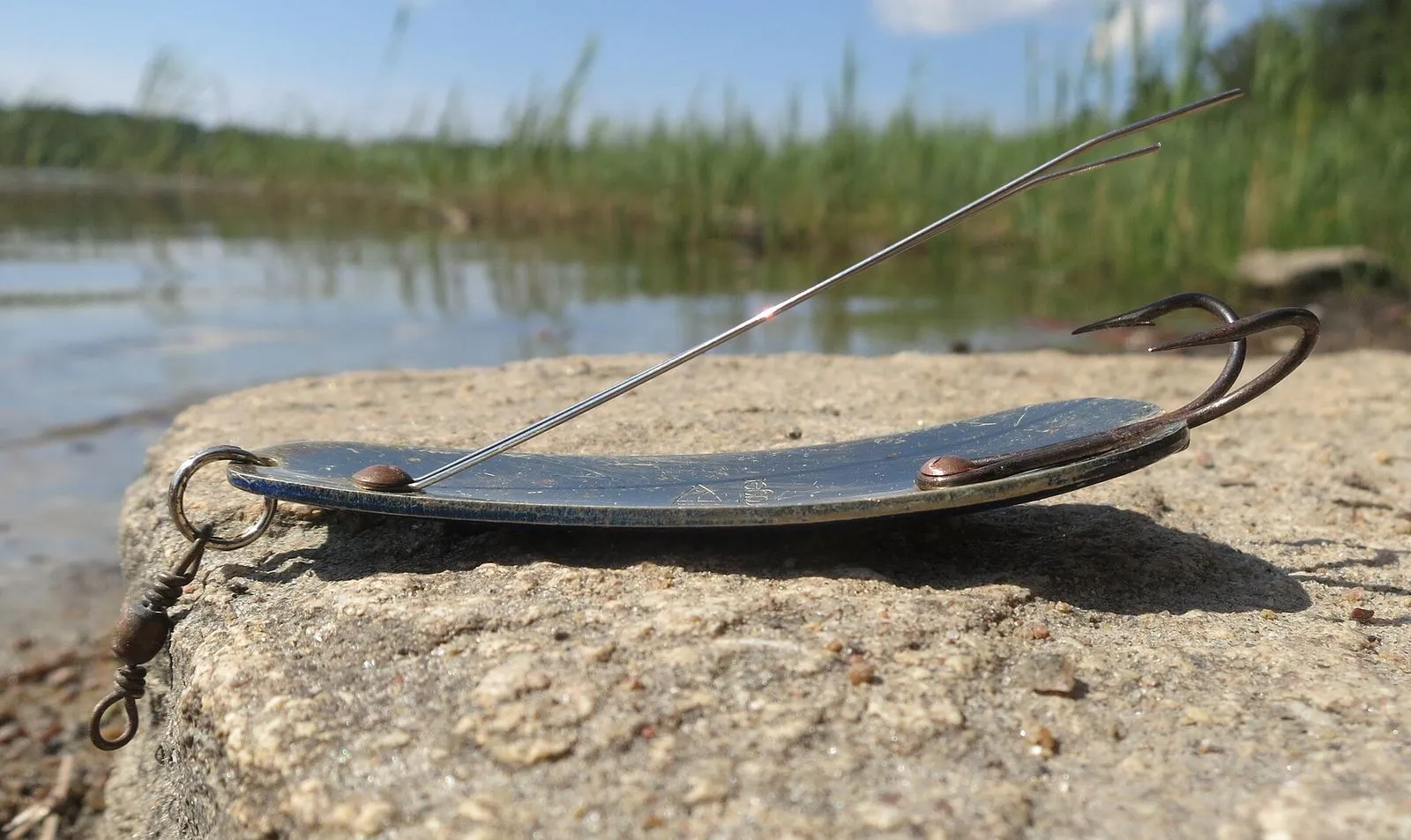
- Lures. Washington’s list: bucktail spinners, spinnerbaits, glide baits, jerkbaits and wooden or plastic plugs. The best muskie lures page sorts them by type.
- Tackle. Muskie tackle transfers. Wisconsin DNR names a medium-heavy casting rod of 7 ft (2.1 m) or more and 50 to 80 lb braid.
- The figure eight. Muskies follow a lure to the boat without striking, so Wisconsin anglers sweep the lure in a figure eight at boatside to finish every cast.
- Handling. Unhook the fish in the water, in a large net, with long-nosed pliers, or cut the hooks with a heavy wire cutter.
Do tiger muskies have a pike’s teeth?
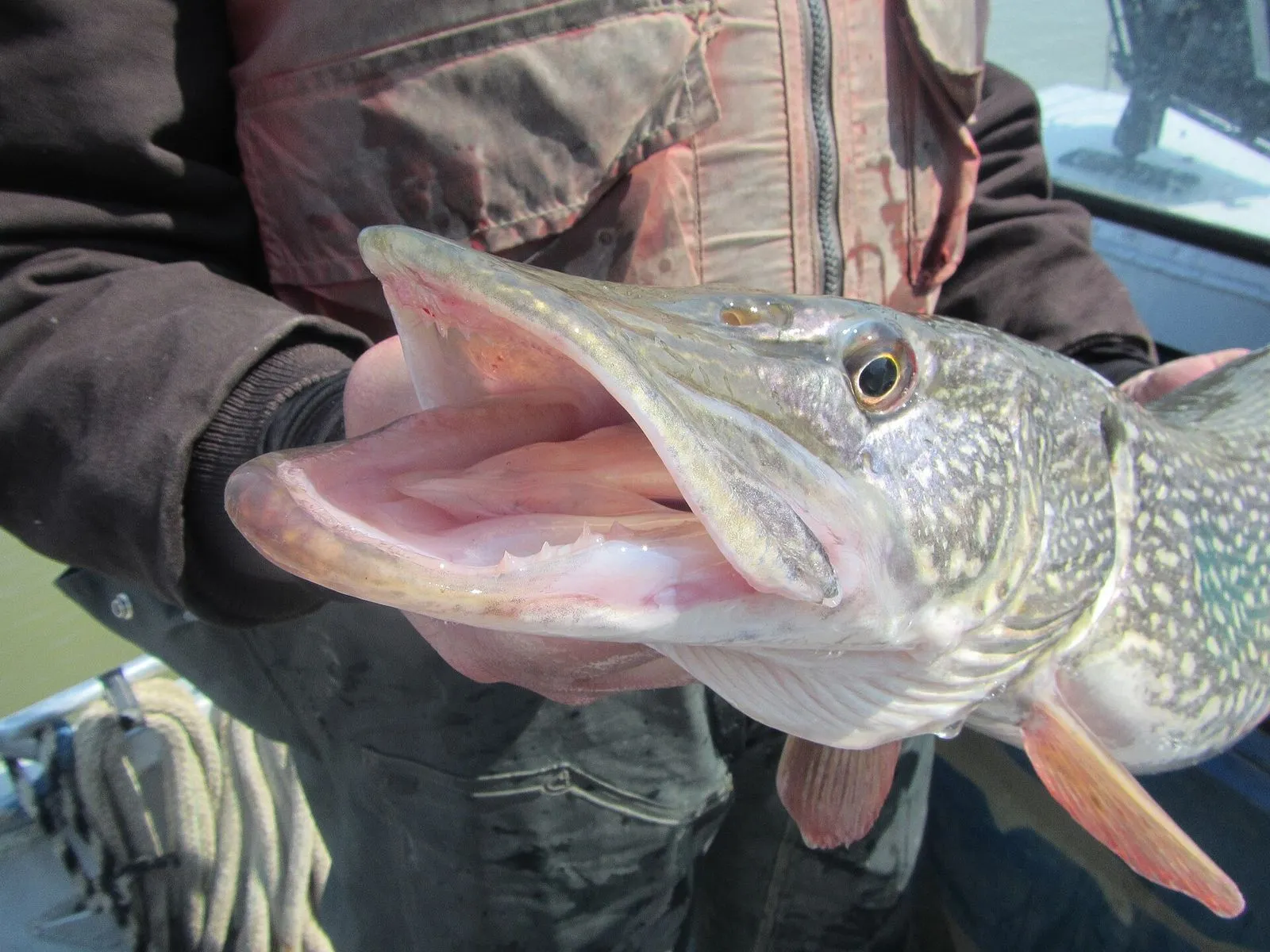
They have the parents’ teeth. No agency describes the hybrid’s mouth separately, and Wisconsin DNR’s description of the pike applies: large canines ring the lower jaw, and short, sharp, brushlike teeth cover the roof of the mouth and the tongue.
The same fact sheet settles an old story. Pike-family fish do not drop their teeth in summer. Teeth “are not shed entirely at any one time; rather, worn-out or broken teeth are replaced as they are lost.” A tiger in August has a full set, so use a wire or fluorocarbon leader and long-nosed pliers every month of the year. The northern pike teeth page has the counts.
Can you eat tiger muskie?
In practice, almost never, because almost none are legal to keep. States protect the hybrid with high minimum lengths. A fish that costs a year of hatchery care only earns its keep if it lives long enough to eat suckers and grow into a trophy.
Colorado’s magazine gave the limit in 2019 as one fish of 36 in (91 cm) or longer. New York’s DEC lists a 30 in (76 cm) statewide minimum and 36 in on Otisco Lake. Iowa counts a tiger as a muskellunge for length, bag and possession limits. Rules move every year, so read the current regulations for the water before keeping anything.
There is a health reason to let a big one go as well. Wisconsin advises women of childbearing age and children under 15 not to eat muskies at all, and everyone else to stop at one meal a month. Long-lived top predators collect mercury and PCBs, and an old tiger sits in the same seat.
Gear for pike and muskie
Gear guide
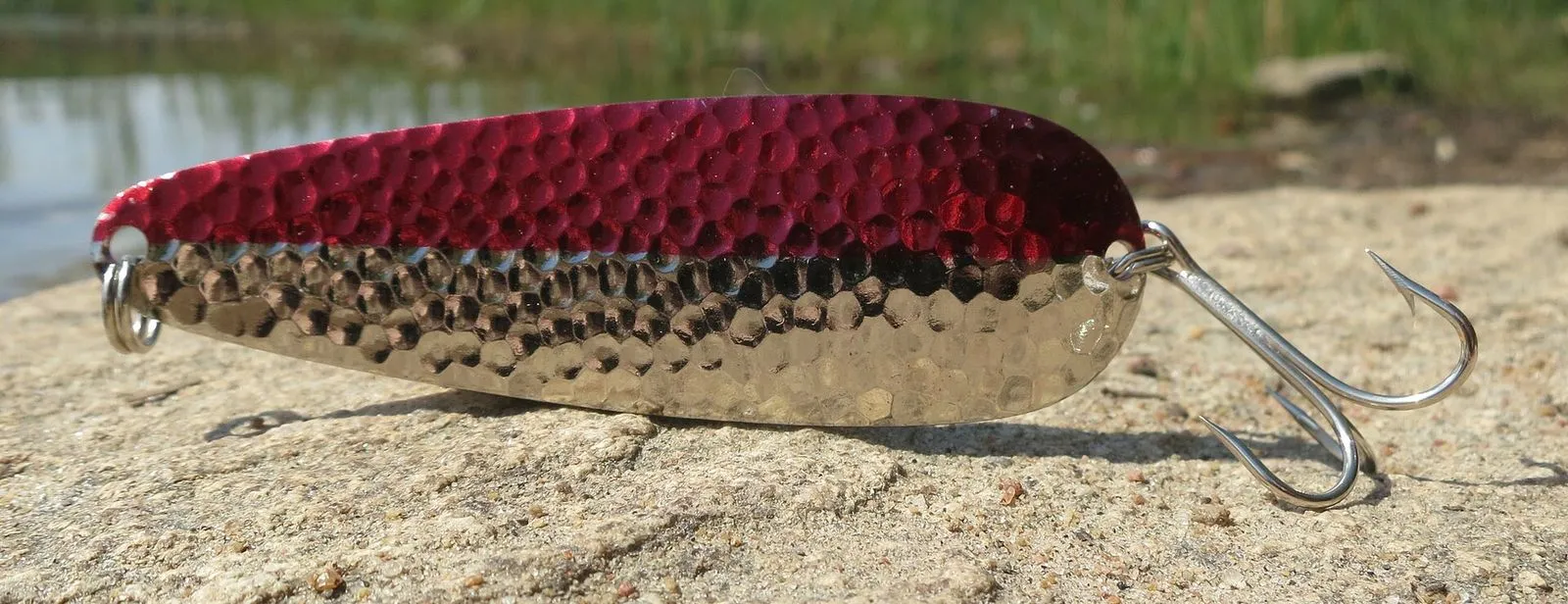
Best Northern Pike Lures: Six Classics the Agencies and Guides Agree On, and When to Throw EachNorthern pike lures by the evidence: a 1 oz spoon first, then spinners, spinnerbaits, plugs and topwaters, with the water and season each one is for.
Gear guide
Best Muskie Lures: The Classic in Each Class, and the Water Temperature to Throw ItThe muskie lures guides and magazines keep naming, one per class, with maker-checked sizes and the water temperature each is for, from 40 °F to 75 °F.
Free download
The water temperature card
Read your water temperature and the card tells you who is spawning, who is feeding and what to throw. 26 species, 16 pages, for your phone and the tackle box.
Plus one email a week on what's biting now. No sales pitches. Privacy.
Related
Section guide
Pike Fish: Northern Pike, Muskie, Tiger Muskie and Pickerel Told ApartPike fish in North America: northern pike, muskie, tiger muskie and chain pickerel, told apart by spots, cheek scales and jaw pores, with each record.
- Are Northern Pike Good to Eat? Yes: the Y-Bones, the Five-Fillet Cut and Which Fish to Keep
Northern pike are firm, white and flaky. How to cut five boneless fillets around the Y-bones, which size to keep, and how much is safe to eat.
 Pike Fishing: How to Catch Northern Pike in Every Season
Pike fishing season by season: where northern pike are from ice-out to first ice, what to throw, where big pike go in summer, and the quick-strike rig.
 World Record Pike: The 55 lb German Fish, the 46 lb American One and the State Records
The world record pike is 55 lb 1 oz, caught in Germany in 1986. North America's best is 46 lb 2 oz from New York in 1940, a fish its captor never mounted.
 World Record Muskie: Three Claims, Two Record Books and the Biggest Fish Nobody Disputes
The world record muskie is 67 lb 8 oz to the IGFA and 69 lb 11 oz to the Hall of Fame. Both date from 1949, both are disputed, and a 65 lb fish is not.
 Northern Pike Teeth: How Many, How Sharp, the Summer Myth, and How to Unhook One
Northern pike teeth: about 16 knife-edged canines on each side of the lower jaw, hundreds more on the roof and tongue, and how to unhook one safely.
 Muskie vs Pike: How to Tell Them Apart, and How the Two Fish Really Differ
Muskie vs pike: markings, tail tips, jaw pores and cheek scales side by side, plus size, age, numbers per acre, and pike against pickerel and walleye.
Sources
- Wisconsin DNR, Muskellunge – Northern Pike Identification, PUBL-FM-503: markings, pores, cheek and gill-cover scales, tail
- Wisconsin DNR, Northern Pike (Esox lucius) fact sheet, PUBL-FM-707 (2008): the hybrid cross, teeth, spawning dates
- Wisconsin DNR, Muskellunge (Esox masquinongy) fact sheet, PUBL FM-705 (2012): tackle, figure eight, hours per fish, handling, consumption advice
- Wisconsin DNR, Wisconsin Record Fish List (2021): Knobla, 51 lb 3 oz, 1919
- Pennsylvania Fish and Boat Commission, The 100-Year Chain: The Pike Family (2003): hybrid vigor, shape, catchability
- USGS Nonindigenous Aquatic Species, tiger muskellunge fact sheet: fertility, natural hybrids, states stocked
- Washington Department of Fish and Wildlife, tiger muskie: size at age, lakes, lures, state record
- Colorado Parks and Wildlife, tiger muskie species page
- Colorado Outdoors (2019), Tiger Muskie: the role of this silent predator in Colorado's waters
- Idaho Fish and Game (2023), Raising tigers: how F&G uses tiger muskies in sport fish management
- New York DEC, Musky, Pike, Tiger Musky and Pickerel Fishing Opportunities
- New York DEC, New York State Freshwater Fishing Records
- Utah Division of Wildlife Resources, Record fish caught in Utah
- TownLift (2023), reprint of a Utah DWR release on hatching and rearing tiger muskie in Utah
- Iowa DNR, Know Your Catch: how to ID northern pike and muskies
- Modern Day Muskellunge World Record Program, current records
- Wikipedia, Tiger muskellunge (pointer to the IGFA record)