 By
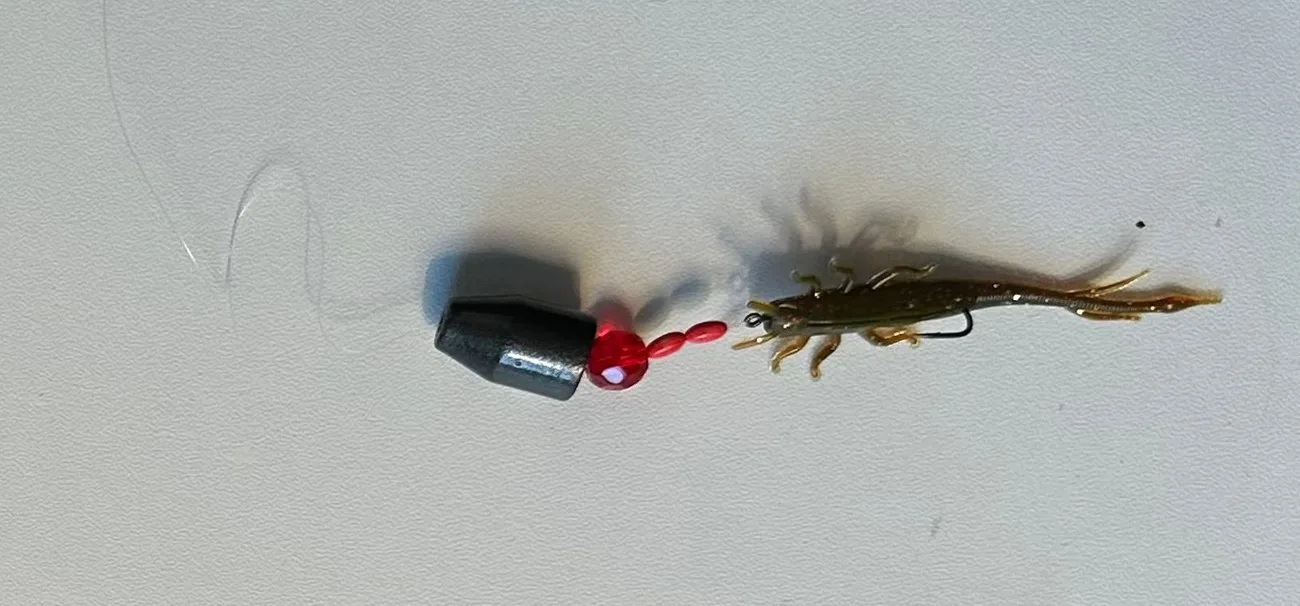
A Texas rig is a soft plastic bait on a worm hook, with a bullet-shaped weight sliding on the line in front of it. The hook point is tucked back into the plastic, so the rig comes through grass, brush and laydowns without snagging, and the point still clears the plastic on the hookset. It is one of the most fished bass rigs there is and still one that wins: at the 2025 Bassmaster Elite on Lake Tenkiller, six of the top ten anglers named a Texas-rigged soft plastic among their key baits. Bass are its main target, but Virginia’s wildlife agency calls it a multi-species setup, “from largemouth and smallmouth bass to pike and pickerel”.
Bury the hook point back into the plastic and the rig slides through grass, brush and laydowns that would snag any exposed hook. That one detail is the whole invention.
What you need
- A bullet weight, 1/32 to 2 oz (1–57 g), in lead or tungsten. Tungsten is smaller for the same weight and costs more; fishing weights compares the metals by size. In Wired2Fish’s words, it transmits bottom contact “a lot better than lead”.
- A worm hook. Use an offset round-bend hook for straight and ribbon-tail worms. Use an extra-wide-gap (EWG) hook for bulkier creature baits, craws and beaver-style baits, where more plastic has to clear the gap on the hookset. Size follows the plastic: Bassmaster’s Gettys Brannon puts a 10 in ribbon-tail worm on a 5/0, and smaller worms and creature baits on a 2/0–4/0, “the smallest hook that you can get away with”. The hooks hub covers the shapes.
- A soft plastic: a 6–10 in worm, a creature bait, a craw or a stick bait. The soft plastics hub lists the families.
- A bobber stop or rubber peg, optional, to fix the weight against the bait in heavy cover.
- A rod with backbone to drive the point through the plastic: Wired2Fish suggests “around a 7-foot medium-heavy rod with a little tip action”. A baitcaster is usual, but the rig “fishes just fine on spinning tackle too”. Spool 15–20 lb fluorocarbon, dropping to 12 lb in clear, deep water. Or use 40 lb braid to a 12–17 lb mono leader, Tactical Bassin’s Texas-rig setup; for punching mats, straight 65 lb braid. The rods and line hubs explain the choices.
How to tie a Texas rig, step by step
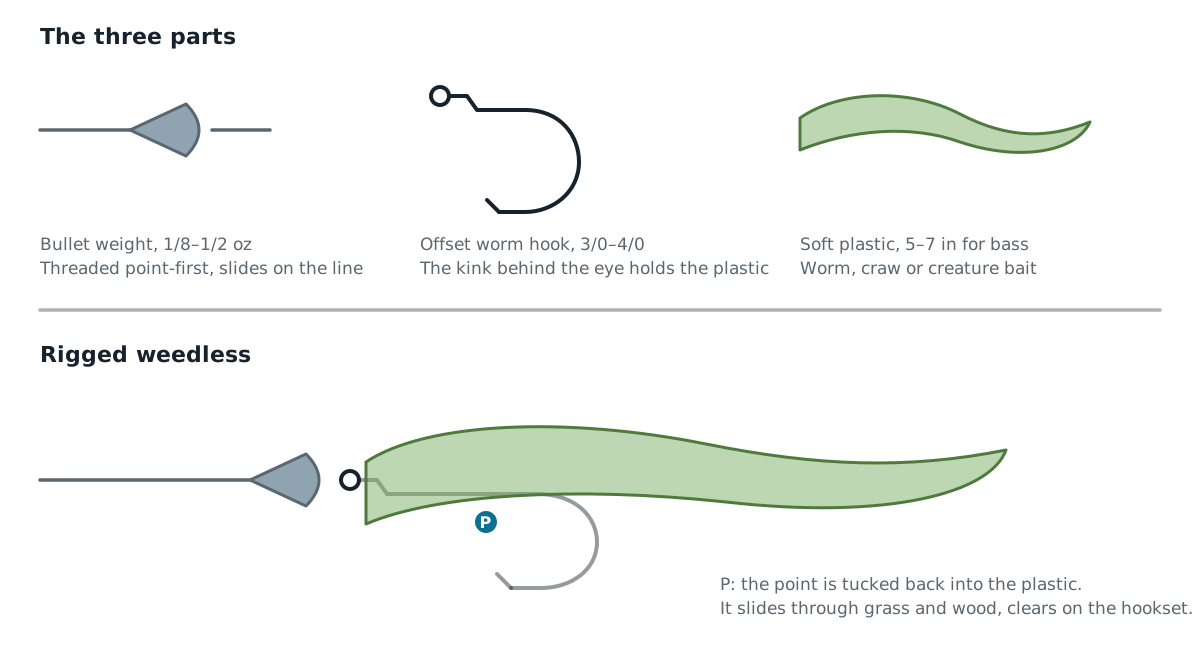
The three parts, and the finished rig with the point buried. Drawing: fishing.info.
- Thread the bullet weight onto the main line, point first, so the narrow end faces the rod tip. Add a bobber stop above it if you want the weight pegged.
- Tie on the hook with a Palomar knot, wetted before it is pulled tight.
- Enter the nose. Push the hook point into the center of the bait’s nose and bring it out through the side about 1/4 in (6 mm) down.
- Slide the bait up over the bend and onto the hook’s elbow or bait keeper. Then turn the hook so the eye sits in the nose of the bait and the bait hangs straight.
- Lay the hook along the bait to find where the point will re-enter, so the plastic sits straight with no bow; a bowed bait spins on the retrieve.
- Push the point back into the body, straight through. Leave it just under the skin (“Tex-posed”) around sparse cover such as docks and bank grass, for easier hooksets, or bury it a fraction below the surface for thick cover.
- Check it hangs straight and swims true on a short cast; re-rig if it twists. Repeat step 3 a little lower if the bait sits crooked.

Free PDF · Water temperature chart Which fish are biting at today's water temperature?
One reading, and the 16-page chart shows which of 26 fish are spawning, feeding hard or slowing down; for bass, crappie, bluegill and walleye, where they sit and what to throw. Every number sourced.
Enter your email, confirm it with one click, and the PDF is in your inbox. Plus one email a week on what's biting. Unsubscribe anytime. Privacy.
Which weight for which water?
Use the lightest weight that keeps contact with the bottom, and go heavier when depth, cover or wind takes that contact away. The weight is what makes the rig so versatile: Wired2Fish fishes it “in inches of water or 70 feet of water just by adjusting your slip sinker”. The table follows Bassmaster’s weight-selection guide.
| Situation | Bullet weight | Why |
|---|---|---|
| Finesse baits, stick baits, slow fall | 1/32–1/8 oz (1–4 g) | The fall is the presentation |
| Shallow water, 5 ft (1.5 m) or less | 1/8 oz (4 g) | Enough to feel the bottom without killing the action |
| Around 20 ft (6 m) | 1/4, 5/16 or 3/8 oz (7–11 g) | Reaches the bottom on a cast |
| Deeper than 20 ft | 1/2 oz (14 g) | Contact with fish holding tight to the bottom |
| Dragging big worms | 3/8–1/2 oz (11–14 g) | Constant contact with the bottom |
| Stroking a worm off the bottom | 1/2–3/4 oz (14–21 g) | Weight gives the lift-and-fall its speed |
| Sparse pads, reeds, shallow bushes | 1/2 oz (14 g) | Enough to get in and out of thin cover |
| Matted grass, moss, hydrilla canopy | 1–2 oz (28–57 g), pegged | Punches through the mat to bass underneath |
| Wind | One size heavier than the depth calls for | Line bowed by wind hides the bite |
Peg the weight with a bobber stop in heavy cover, so weight, hook and plastic stay together and nothing wraps on branches. Elsewhere, leave it free to slide.
How did the pros rig it at Tenkiller?
Bassmaster listed the key baits of the top ten at the 2025 Elite on Lake Tenkiller, an Oklahoma reservoir in high water. Six of them flipped or punched a Texas-rigged soft plastic into heavy cover, most of it on flooded shorelines:
| Angler (finish) | Bait | Hook | Weight |
|---|---|---|---|
| Andrew Loberg (2nd) | Strike King Rage Bug | 4/0 | 1/2 oz (14 g) tungsten |
| Kyle Welcher (3rd) | CrushCity Bronco Bug | 4/0 heavy-cover flip and punch | 1/2 oz (14 g) tungsten |
| Brandon Card (4th) | Zoom Brush Hog | 4/0 straight shank | 3/8 and 1/2 oz (11 and 14 g) |
| Keith Combs (7th) | Strike King Rage Bug | 3/0 Owner Jungle Flipping | 3/8 oz (11 g) |
| Logan Latuso (9th) | Missile Baits D Bomb | 5/0 Hayabusa straight | 1/2 and 5/16 oz (14 and 9 g) |
| Jordan Lee (10th) | Berkley Creature Hawg, punch rig | 4/0 | 3/8 or 1/2 oz (11 or 14 g), by the thickness of the cover |
Four of the six used a 4/0, and none went lighter than 5/16 oz. The winner, Wes Logan, flipped flooded bushes with a jig and a Zoom Super Chunk trailer instead.
How to fish it
Fish it on the bottom, and slowly. Virginia’s wildlife agency puts it in one line: “the Texas rig is best fished using a slow retrieve”.
Cast past the target and let the rig fall on a semi-slack line. Watch the line as it sinks. Then work the bait back with the rod, not the reel: lift the tip to drag or hop the bait a foot, lower the tip and reel up the slack, pause, repeat.
Cover changes the cast, not the method. In grass, pull the rig through the stalks and let it fall into the holes. On a laydown, pitch it to the trunk and let it fall down the branches.
What does a bite feel like?
Bites on the fall show as a tick, or as a line that jumps sideways, which is why you watch the line as it sinks. On the bottom a bite feels like a tap, a mushy weight or line moving off; fish “will often pick up the bait and run”, Wired2Fish notes. Around close cover, keep the rod near 10 o’clock, ready to strike. When the bite comes, reel down until the rod loads and set the hook hard, because the point still has to clear the plastic.
Mistakes to avoid
- The bait rigged crooked. It spins, twists the line and looks wrong. Re-rig until it hangs straight.
- Too much weight. The bait falls like a stone and the bite disappears with it. Go lighter until you lose contact, then one size heavier.
- Reeling the retrieve. The rod moves the bait; the reel only takes up slack.
- Burying the hook too deep where you do not need to. Around sparse cover, Tex-pose the point so it clears the plastic faster; buried deep, it needs a hard hookset to come through.
- A hook the wrong size for the plastic. A 10 in worm takes a 5/0; smaller worms and creature baits a 2/0–4/0. Too big a hook kills the action, and too narrow a gap will not clear a bulky bait.
What are the different types of Texas rig?
- Weightless. No bullet weight at all, for shallow water, as Virginia’s wildlife agency suggests. The Senko page covers the stick bait whose original presentation this is.
- Pegged, or punching. A bobber stop above the weight keeps weight, hook and plastic together for flipping tight to cover. Pegged at 1–2 oz on straight 65 lb braid, it punches through matted grass.
- Tex-posed. The point lies on the back of the bait, pushed in only slightly. Hooksets come easier, but it snags more, so it suits sparse cover such as docks and bank grass.
- With a bead or rattle. Some anglers add beads, rattles or other noise attractors; the rig in the photo above carries a glass bead between the weight and the knot.
When does something else win?
A Carolina rig covers water faster and drags the bottom on flats. A wacky-rigged stick bait beats it on pressured, clear-water fish around beds and docks, and a drop shot hovers a small bait above the bottom in deep, clear and cold water. A shaky head or a Ned rig gets bites in clear, pressured water where the Texas rig is too much. A jig with a craw trailer is the same idea with a skirt and a bigger profile for flipping. All of them are on the rigs page, each with its season.
When bass are chasing moving baits in pre-spawn and fall, the chatterbait and spinnerbait hubs cover the alternatives.
Where did the Texas rig come from?
The plastic worm came first. Nick and Cosma Creme molded the first one in their Akron, Ohio, basement in 1949 and sold the six-inch Wiggle Worm by mail from 1951. Texas anglers, fishing the flooded timber of new reservoirs, learned to rig it weedless with the hook back in the body. As Creme Lure’s Wayne Kent tells it, the first Texas rig had no bullet weight: an unnamed angler cut the brass eyelet out of a bell sinker and threaded it on the line ahead of the hook. Demand in Texas exploded in 1959, and Creme opened a plant in Tyler, Texas, within the year. Nobody’s name is attached to the rig itself; the state’s is.
Free PDF · 16 pages
Know what's biting before your first cast
The Water Temperature Fishing Chart. Take one water temperature reading, find it on the chart, and see which of 26 freshwater fish are spawning, feeding hard or slowing down. Six pages go deeper: bass, crappie, bluegill, walleye, catfish and trout. For your phone and the tackle box.
- Where they sit and what to throw at every temperature: bass, crappie, bluegill and walleye. Catfish, one by one. Trout: the 68 °F line where you stop, and where they hide
- A bass that drops 3 ft feels more pressure change than the biggest cold front: the front day by day, and what to throw on each
- The three thermometer mistakes that make a reading lie (the first one is the surface)
- The 26-fish chart: who's spawning, feeding hard or slowing down at your reading
The chart's numbers come from state fish and wildlife agencies and fisheries research: 61 sources, each listed on the site.
Enter your email, confirm it with one click, and the PDF is in your inbox. Plus one email a week on what's biting. Unsubscribe anytime. Privacy.
Related
Section guide
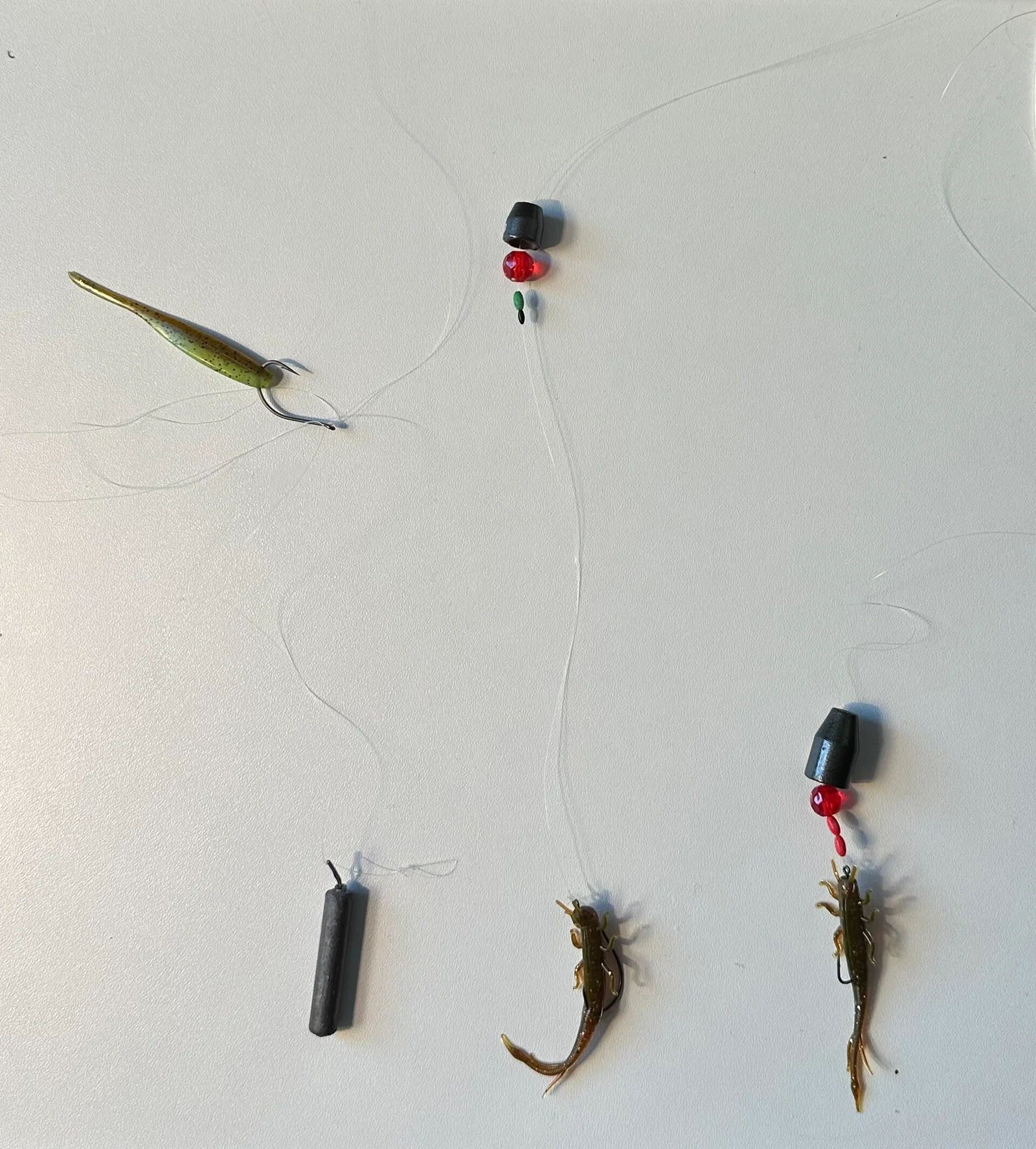
Fishing Rigs: Texas, Carolina, Drop Shot, Ned and WackyFishing rigs explained: the Texas, Carolina, drop shot, Ned and wacky rigs, the weight for each depth, and which rig fits which cover and fish.
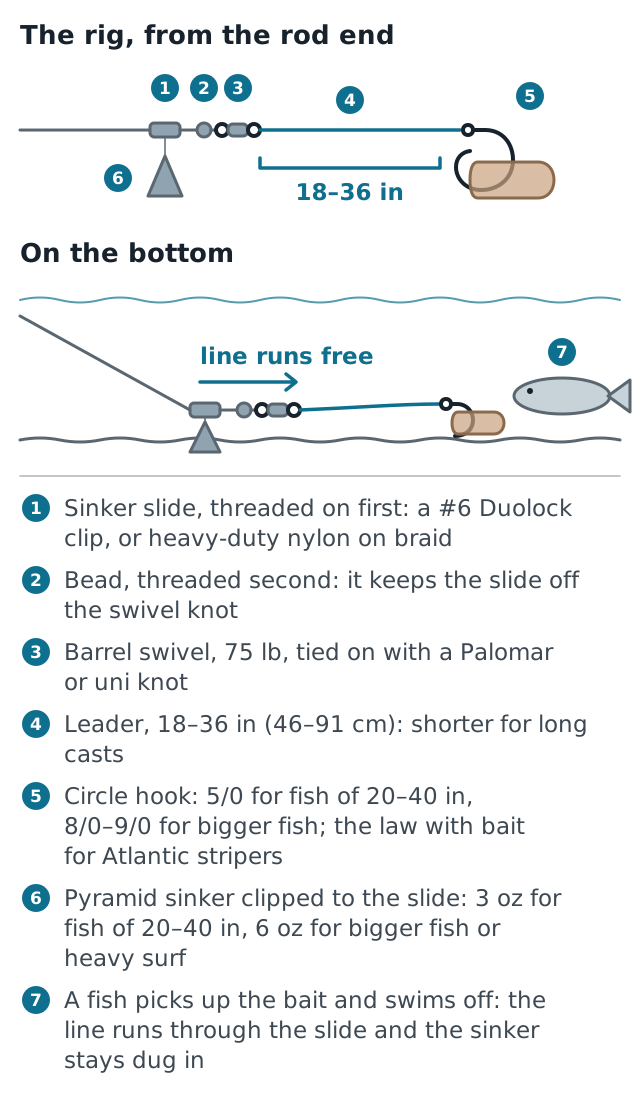 Fish Finder Rig: How to Tie It, Sinker Weights and Leader Length
How to tie a fish finder rig for the surf in seven steps, a size for every part, sinker weight by surf, leader length, and when a circle hook is the law.
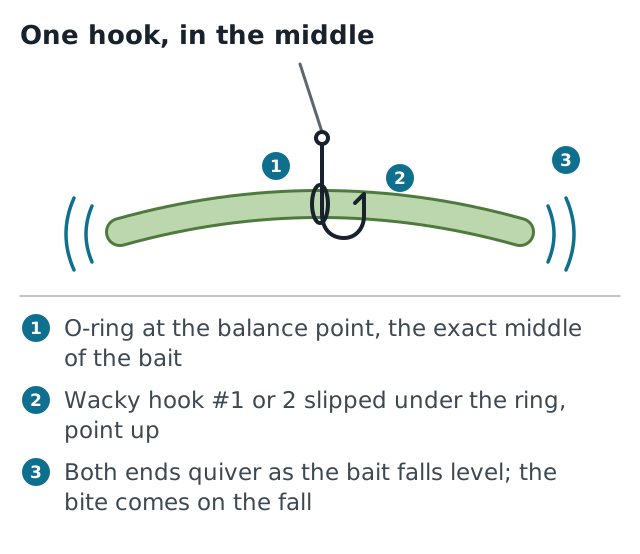 Wacky Rig: How to Rig It, and When It Beats a Texas Rig
The wacky rig hooks a stick bait through its middle so both ends quiver on the fall. The O-ring method, hook and line, weightless or weighted, when to use it.
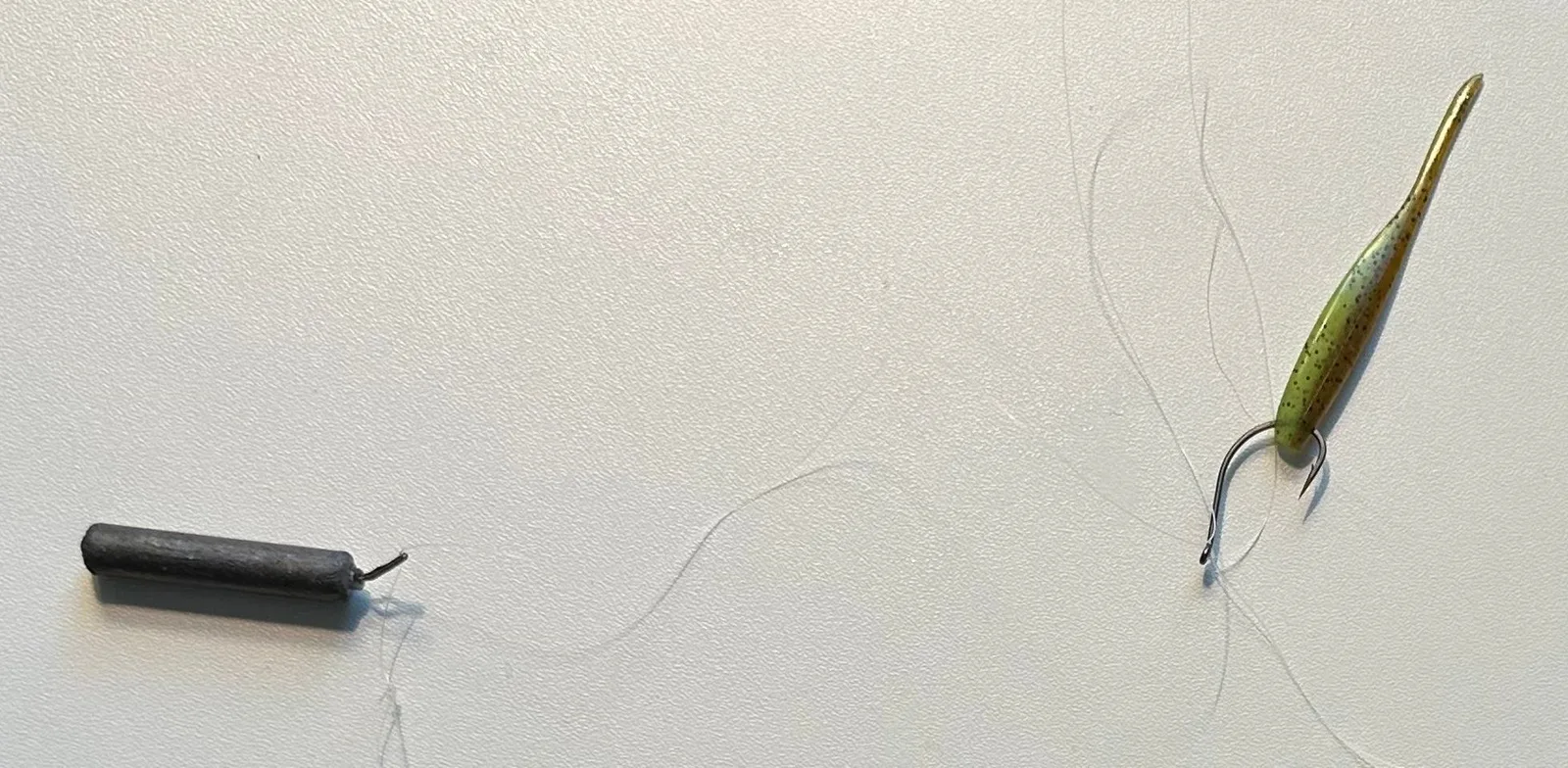 Drop Shot Rig: How to Tie It, Hook and Weight Sizes, How to Fish It
Drop shot rig step by step: a #1–1/0 hook tied 12–18 in above a 1/8–1/4 oz weight, the tag trick that stands it out, the baits, tackle and how to fish it.
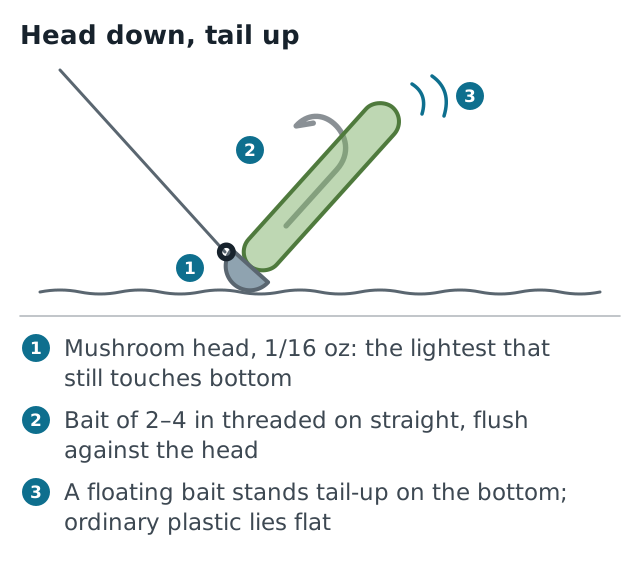 Ned Rig: How to Fish It, the Right Jig Head and Where It Came From
The Ned rig is a 2–4 in floating bait on a 1/16 oz mushroom head, fished slowly; the head and bait for each depth, six retrieves, the tackle, its 2006 origin.
- Carolina Rig: How to Tie It, Leader Length and When to Use It
Carolina rig: a 1/2–3/4 oz sinker, bead and swivel, then an 18–36 in leader to a 3/0–5/0 hook. Sizes, leader by cover, the retrieve and the bite.
Sources
- Wired2Fish (Jason Sealock), The Texas Rig: How to Rig and Fish
- Bassmaster (Gettys Brannon, 2018), The Texas Rig: Part 1, Hook Style
- Bassmaster (Gettys Brannon, 2018), The Texas Rig: Part 3, Weight Selection
- Virginia DWR (Jordan Luckey, 2024), Try Throwing a Texas Rig!
- Texas Parks & Wildlife magazine (Dyanne Fry Cortez, March 2015), Creme of the Crop
- Bassmaster (2025), Top lures at Lake Tenkiller 2025
- Tactical Bassin, Best fishing line: braid, mono or fluorocarbon