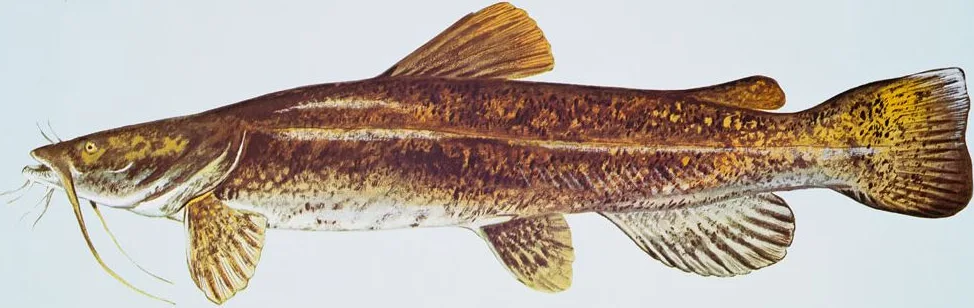
The flathead catfish, Pylodictis olivaris, is the predator of the catfish family: a fish that stops eating anything but other fish once it is ten inches long, hunts at night from a hole under a log, and grows past 100 lb. Its genus name means “mud fish” and its species name “olive-colored”, and anglers call it shovelhead, yellow cat or Opelousas. It is the second-largest freshwater sport fish in Texas after the blue catfish, the fish that noodlers pull out of river-bank holes by hand, and, east of the Appalachians, an invader that has reshaped whole river systems. Below: the identification marks, the habitat, the spawning and growth numbers, the live-bait rule and the record, each with its source.
Ken Paulie’s 123 lb world record flathead took a live minnow under a bobber on a Zebco 33 in a Kansas reservoir in 1998. The fish did not care about the tackle.
Identification
Nothing else in North American fresh water looks like a flathead. The tail is squared off with only a slight notch, where channel and blue catfish have deeply forked tails. The head is broad and flat, and the lower jaw projects beyond the upper, the reverse of the other catfish. The anal fin is short and rounded with 14–17 rays, against 24–29 on a channel and 30 or more on a blue. The color is pale yellow to light brown, heavily mottled with black and brown, and the belly is pale. Missouri’s guide adds one mark for the doubtful: the tooth pad in the upper jaw has a backward extension on each side.
| Mark | Flathead catfish | Channel catfish | Blue catfish |
|---|---|---|---|
| Tail | Squared, slight notch | Deeply forked | Deeply forked |
| Jaw | Lower jaw projects beyond the upper | Upper jaw longer | Upper jaw slightly longer |
| Anal fin rays | 14–17 | 24–29 | 30–35 |
| Color | Yellow-brown, heavily mottled | Olive to slate, spotted | Bluish silver, unspotted |
| Common size | 15–45 in (38–114 cm), 1–45 lb (0.5–20 kg) | 12–32 in (30–81 cm), 1–15 lb (0.5–6.8 kg) | 20–44 in (51–112 cm), 3–40 lb (1.4–18 kg) |
| Maximum | About 100 lb (45 kg) in Missouri’s data; record 123 lb (55.8 kg) | 58 lb (26.3 kg) | 143 lb (64.9 kg) |
Where they live
The native range runs from the lower Great Lakes through the Mississippi River watershed to the Gulf states, west of the Appalachians. Flatheads live in reservoirs and large streams with slow current, never in headwater creeks; Texas describes “deep pools of streams, rivers, canals, lakes and reservoirs, where the water is turbid”, and Missouri puts the adults “near submerged logs, piles of drift, or other cover” in pools, with the young on riffles among the rocks. The pattern is a big fish in a fixed home: a hole under a log jam, an undercut bank, a bridge piling or a deep outside bend, which it leaves at night to hunt the shallows and returns to before daylight.
East of the mountains the flathead is an introduced species and, by any measure, an invasive one. Stockings, some deliberate, put it into Atlantic-slope rivers from Florida to Pennsylvania; it was first found in Pennsylvania’s Schuylkill River in 1999 and the Susquehanna in 2002 and has since moved through both basins. In the Cape Fear River in North Carolina, samples have found flatheads making up a tenth of the fish by number and about two thirds by weight, and models suggest they suppress native fish biomass by 5–50% through predation and competition. Where the state agency asks anglers to keep every flathead, that is why.
Season and behavior
Flatheads are cavity spawners, like the other catfish, but they wait for warmer water and choose bigger holes: hollow logs, caves excavated in clay banks, root masses and man-made structure. Texas puts the spawn at 75–80 °F (24–27 °C) from late May through August; Missouri says late June and July. A female produces about 1,200 eggs per pound of body weight, up to 100,000 in a large fish, so a 50 lb (23 kg) female lays around 60,000; the eggs hatch in four to six days and the male guards the fry for about a week. Fish mature between three and six years old, at around 18 in (46 cm).
The seasonal pattern is simpler than the channel catfish’s because flatheads are less active in cold water. The guides agree that September and October, when the fish feed hard before winter, produce both the most and the biggest flatheads, with the pre-spawn period from March to May second; through summer they feed at night; in winter they go dormant in the deepest holes and few anglers bother with them.
How to catch them
The rule that separates flathead fishing from the rest is the bait. Texas’s profile is blunt: above 10 in (25 cm), the flathead’s “diet consists entirely of fish: shad, carp, suckers, sunfish, largemouth bass and other catfish”, and Missouri adds that they “are not scavengers”. So the bait is alive: bluegill, sunfish, perch, goldfish, bullheads or big shad, “good hearty and lively” in the guides’ phrase, hooked through the back or the lips on a 7/0–10/0 circle hook and held on the bottom or under a float beside the cover the fish lives in. Cut bait takes the odd flathead, mostly in moving water, but it is the exception. The rig is a heavy slip-sinker or a three-way rig with 2–8 oz of lead, on a 7–10 ft rod with a strong butt and a soft tip and 40–65 lb braid or 25–30 lb mono, because the fish has to be turned before it reaches the wood. The catfish hub has the rig table and the tackle. Expect one or two fish in a night to be a good trip; flathead fishing is patience, not numbers. In the states that allow it, noodling, catching spawning flatheads by hand from their holes, is a summer tradition with its own page under the hub.
Size, age and records
| Fish | Weight | Age | Source |
|---|---|---|---|
| Sexual maturity | – | 3–6 years, about 18 in (46 cm) | Texas Parks and Wildlife, Missouri Department of Conservation |
| Average lifespan | – | 12–14 years; one Texas fish 24 years | Texas Parks and Wildlife |
| Common adult | 1–45 lb (0.5–20 kg) | – | Missouri Department of Conservation |
| Big fish | 100 lb (45 kg) | – | Missouri maximum; Texas trotline fish over 110 lb (50 kg) |
| World record | 123 lb (55.8 kg), 61 in (155 cm), girth 43 in (109 cm) | At least 22 years, most likely male | Elk City Reservoir, Kansas, 19 May 1998, examined by state biologists |
The record belongs to Ken Paulie, who was fishing a live minnow under a bobber with a Zebco 33 and 12–14 lb line at Elk City Reservoir in southeast Kansas on 19 May 1998 when the 123 lb flathead took it. Kansas biologists later examined the fish and put its age at 22 years or more. An unverified 139 lb 14 oz fish from the Arkansas River in 1982 is the folk record, and the question everyone asks, whether 200 lb catfish exist, has a clear answer for North America: no certified fish comes close, and the only catfish over 200 lb on record are the European wels and the Mekong giant, both on the world-record page under the hub. Regulations vary by state; Oklahoma’s daily limit is five flatheads with no size limit, Texas has trophy rules on some reservoirs, and the invaded Atlantic states have no limit at all.
Related
The catfish hub covers all the species, the baits and the rigs; the channel catfish and blue catfish pages under it cover the forked-tail fish; the hooks and rods hubs cover the heavy tackle live-bait fishing needs.
Sources
- Texas Parks and Wildlife, flathead catfish
- Missouri Department of Conservation, flathead catfish field guide
- Examination of the world-record flathead catfish captured from Elk City Reservoir, Kansas, May 1998
- Outdoor Life, the biggest North American catfish of all time
- Smith et al. 2021, Range expansion of invasive flathead catfish in the Delaware and Susquehanna rivers, North American Journal of Fisheries Management
- Catfish Edge, best catfish bait