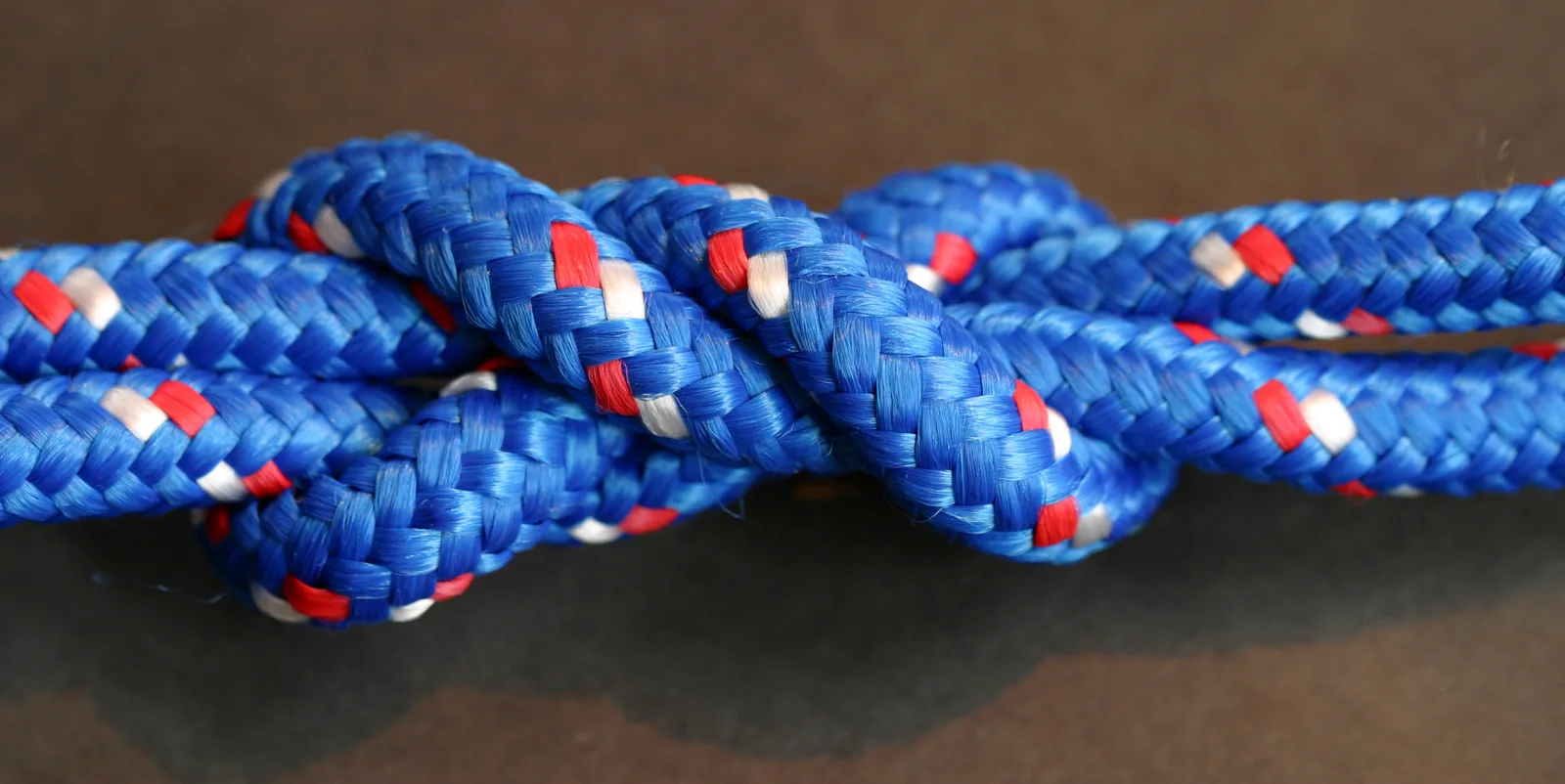
The fishing surgeon’s knot joins two lines by laying them side by side and tying both together in a double overhand knot. In a mono-to-mono pull contest the three-pass version broke at 13–15 lb on 10 lb line, well ahead of the double uni and the Albright. It is fast, it takes lines of different sizes, and it needs nothing but your fingers. That is why fly anglers use it to add tippet, and Florida charter captains use it to put on a leader.
On IGFA’s test machine, a surgeon’s knot passed four times through the loop kept 64.6 percent of 50 lb braid’s real breaking strength. Every Albright, Alberto and double uni in that class tested lower.
What is the surgeon’s knot, and what is it not?
Two different knots share the name. The one surgeons tie on a suture is a modified reef knot with an extra twist in the first throw; The Ashley Book of Knots numbers it 461, 463 and 1209. The angler’s knot borrows only that doubled turn. Animated Knots calls it the Surgeon’s Join: two overlapping lines, treated as one strand, tied in an overhand knot with a second pass through the loop.
It is often called the double surgeon’s knot, although the “double” is redundant: the name already implies two turns. Add a third pass and it becomes the triple surgeon’s knot. Pass four or more times and anglers just count: “four surgeons”, “six-turn surgeon’s”. The surgeon’s loop is a separate knot: the same double overhand tied in the end of one line to make a loop, often for a loop-to-loop connection.
It joins line to line. It is not a knot for a hook, a swivel or a lure; that is the job of the Palomar or the uni knot.
What do you need?
- Two lines to join: mono to mono, a fluorocarbon leader to mono, a tippet to a fly leader, or a leader to light braid. Orvis uses it on tippet sections of similar or very different diameters. Animated Knots is more cautious and says “moderately unequal”.
- Enough overlap: 4 to 6 in (10–15 cm). Give a triple or a braid version the longer end of that.
- Water or saliva to wet it, and clippers.
Free card: what 26 species do at your water temperature
Plus one email a week on what's biting now. No sales pitches. Privacy.
How do you tie a double surgeon’s knot?
-
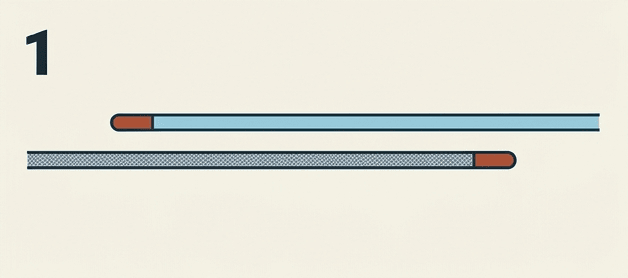
Overlap the lines. Lay the end of the leader and the end of the tippet or main line side by side, running in opposite directions, with 4 to 6 in (10–15 cm) of overlap.
-
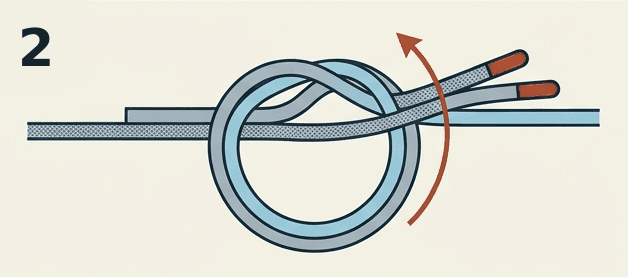
Tie an overhand knot with both lines together. Treat the overlap as one strand. Make a loop, then pass the tag end of one line and the whole length of the other line through it.
-
Pass the same two ends through again. Twice through is the double surgeon’s. A third pass makes the triple, and the knots that did best in the tests below went through three and four times.
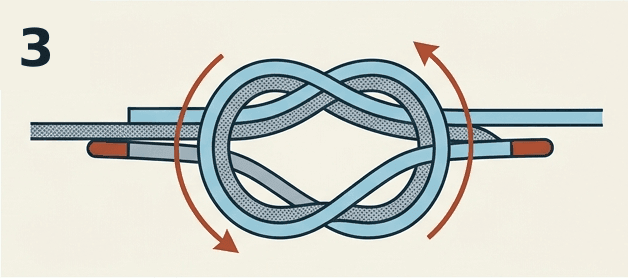
-
Wet it and pull all four ends. Hold the standing line and the tag on each side together, and draw the knot down steadily. Animated Knots and Orvis both set it on all four ends, never two.
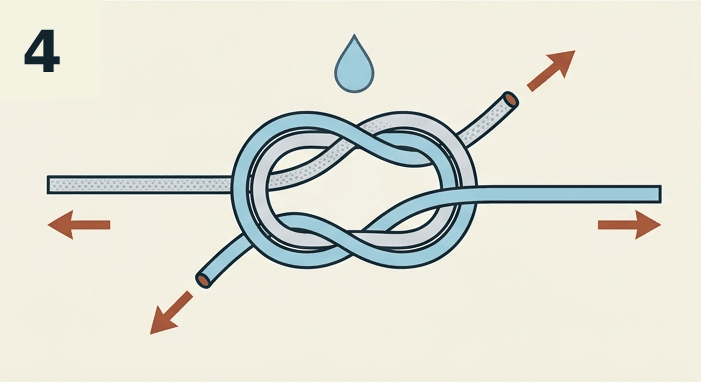
-
Trim both tags. Once every strand is snug, trim them as close to the knot as possible. The finished knot sits at a slight angle in the line, which is one of its costs.
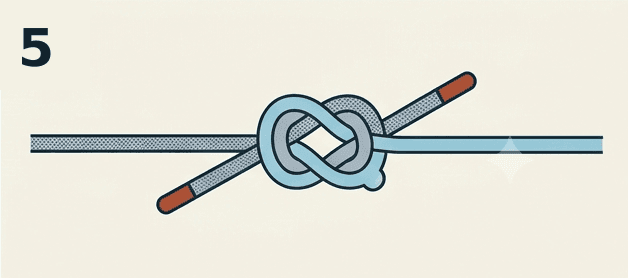
Drawings: fishing.info, generated with Gemini and checked step by step against the text.
When your fingers are too cold to manage the loop, tie it with a hemostat instead of your fingertips, the same clamp fly anglers use to unhook a fish. Orvis has posted a video of the double and the triple tied that way.
What is a triple surgeon’s knot?
It is the same knot with a third pass through the loop. In the published versions, the pass count climbs as the lines get slicker, from mono to braid.
- Two passes is the textbook version taught for tippet to leader.
- Three passes won Salt Strong’s 2015 mono contest. Its 2018 ranking lists it as the “3 Turn Surgeon’s Knot”.
- Four passes is what the surgeon’s entries went through in Sport Fishing’s braid-to-leader challenge, in both the 15 lb and 50 lb classes.
- Six passes is the version Salt Strong ranks for braid to leader.
Two Florida charter captains told Sport Fishing what they tie for light braid. Jason Stock of Holmes Beach uses a double uni or “three surgeons”. William Toney of Homosassa ties “four to five surgeons”: “It’s a quick, strong knot that gets my clients back to fishing. I’ve never had this knot fail.”
More is not always better. In the 50 lb class a second surgeon’s entry went through the loop twelve times, on a doubled braid made with a Bimini twist. It scored 64.4 percent, no better than the four-pass knot on a single strand.
How strong is the surgeon’s knot?
Three published tests give figures with their lines and method. Salt Strong ties two knots on one strand and pulls until one breaks. Sport Fishing pulled three samples of each entry on the International Game Fish Association’s Instron 5543. It reports the mean, as a percentage of what the braid really broke at. John Merwin’s Field & Stream figures are a percentage of the leader’s unknotted strength; the article does not name the machine or the number of pulls.
| Test | Lines | Surgeon’s result | Others in the same test |
|---|---|---|---|
| Salt Strong 2015, best 3 of 4 pulls | 10 lb Trilene XL to 30 lb Trilene Big Game mono | 3 passes: 13–15 lb (5.9–6.8 kg); won 2 of 3 pulls in the final round | Salt Strong knot 13–15 lb; double uni 7–12 lb; Albright 6–8 lb |
| Sport Fishing, IGFA Instron | 15 lb Spiderwire braid (real break 34.4 lb) to 30 lb fluoro | 4 passes: 52.2%, about 18 lb (8.2 kg) | Best FG 73.4%; best double uni 55.8%; best Albright 46.2%; best Alberto 42.2% |
| Sport Fishing, IGFA Instron | 50 lb Spiderwire braid (real break 62.8 lb) to 80 lb fluoro | 4 passes: 64.6%, about 40.6 lb (18.4 kg) | Best FG 76.4%; best Albright 59.4%; double uni 46.6%; best Alberto 43.6% |
| Field & Stream, John Merwin | 30 lb FireLine to 10 lb Seaguar InvizX fluoro | 4 turns: 80% | J knot 83%; 5-turn double uni 75%; 3-turn Seaguar knot 73% |
| Field & Stream, John Merwin | 10 lb Trilene Big Game mono to 10 lb InvizX fluoro | 3 turns: 65% | Blood knot 83%; 3-turn Seaguar knot 66% |
Salt Strong’s later ranking, from 2018, is cooler on it than its own contest. For mono to mono it puts the three-turn surgeon’s third, behind the blood knot and the double uni, and calls it extremely easy and fast with very strong holding strength. For braid to leader it puts the six-turn surgeon’s third of seven, behind the PR bobbin knot and the FG. It ranks ahead of the doubled double uni, the Alberto, the improved Albright and the GT.
Why do the tests disagree? Three reasons. Each knot was tied by one person, and the same knot tied by different entrants “tested far differently,” in Sport Fishing’s words. The lines differ, from stretchy mono to fused braid. And the pass count differs, from three to six.
The pattern that holds across all three: the surgeon’s beats the Albright and usually the double uni. It loses to a well-tied FG on braid, and to the blood knot on two lines of the same strength.
One more figure worth knowing: the “15 lb” braid broke at 34.4 lb. A surgeon’s at 52.2 percent still held about 18 lb, more than the label and less than the line.
Surgeon’s knot, blood knot or double uni?
- Two lines of similar diameter on a tapered fly leader: the blood knot. The surgeon’s is “rather bulkier than the Blood Knot,” as Animated Knots puts it, and it puts a slight angle in the line.
- Lines of clearly different size, or a tippet change with cold hands: a double or triple surgeon’s. It handles tippet sections that differ greatly in diameter, and it ties with a hemostat.
- Braid to leader at home, or before a trip: the FG. It was the stronger join in both Sport Fishing classes and in Salt Strong’s 2018 ranking.
- Braid to leader on the water, in a hurry: a surgeon’s with three to five passes, as the Florida captains tie it, or a double uni with five or more wraps a side.
- Mono to mono, equal strength, and strength matters most: the blood knot, 83 percent to the surgeon’s 65 in Merwin’s test.
- A lure is already tied on the leader: not the surgeon’s. The whole leader has to pass through the loop; Salt Strong’s own SS knot can be tied with the lure in place.
- Wire leader to line: the Albright.
What costs the knot strength?
- Pulling two ends instead of four. The knot seats crooked and one line takes the load.
- Too little overlap. Short tags pull through as the knot seats. Stay inside the 4 to 6 in, and use the long end for extra passes.
- Seating it dry. Wet the knot before you draw it tight.
- Two passes on braid. Braid is slick. Every braid version in the tests went through the loop four times or more.
- Tying on the lure first. Salt Strong’s 2018 ranking lists this as the knot’s one drawback: join the lines, then tie on the hook or lure.
The knots hub matches each knot to its line and job; for braid, start with the FG.
Free download
The water temperature card
Read your water temperature and the card tells you who is spawning, who is feeding and what to throw. 26 species, 16 pages, for your phone and the tackle box.
Plus one email a week on what's biting now. No sales pitches. Privacy.
Related
Section guide
Fishing Knots: Which Knot for Which Line and JobFishing knots by job and line: the five to learn first (Palomar, uni, FG, surgeon's, loop), the knot for braid, and what three pull tests measured.
 FG Knot: How to Tie It, and What the Pull Tests Show
The FG knot step by step: 12–15 pairs of wraps on a tight braid, the hitches, the setting pull, and what four named pull tests measured.
 Uni Knot: One Knot for Hooks, Leaders, Snells and Loops
How to tie the uni knot in six steps, the turns for mono, fluorocarbon and braid, its six uses from hook to reel spool, and the pull tests.
 Palomar Knot: How to Tie It, How Strong It Is, When Not to Use It
How to tie the Palomar knot in six steps, its pull-test scores (89% on 10 lb mono, 82% on fluorocarbon), the double version for braid, and when to skip it.
Sources
- Luke Simonds, The strongest line-to-line fishing knot (mono-to-mono contest, 10 lb Trilene XL to 30 lb Trilene Big Game), Salt Strong (2015)
- Luke Simonds, The best fishing knots of all time, ranked, Salt Strong (2018)
- Doug Olander, Strongest fishing knots connecting braid to leader (53 knots on IGFA's Instron 5543), Sport Fishing
- John Merwin, The strongest fishing knots for each type of line, tested, Field & Stream
- Animated Knots, Surgeon's Join
- Orvis, Surgeon's knot (overlap, passes, tightening)
- Phil Monahan, Video: how to tie a surgeon's knot with cold hands, Orvis News (2024)
- Animated Knots, Surgeon's Loop Knot
- Take Me Fishing, Double surgeon's knot
- Wikipedia, Surgeon's knot (the surgical knot and its Ashley numbers)