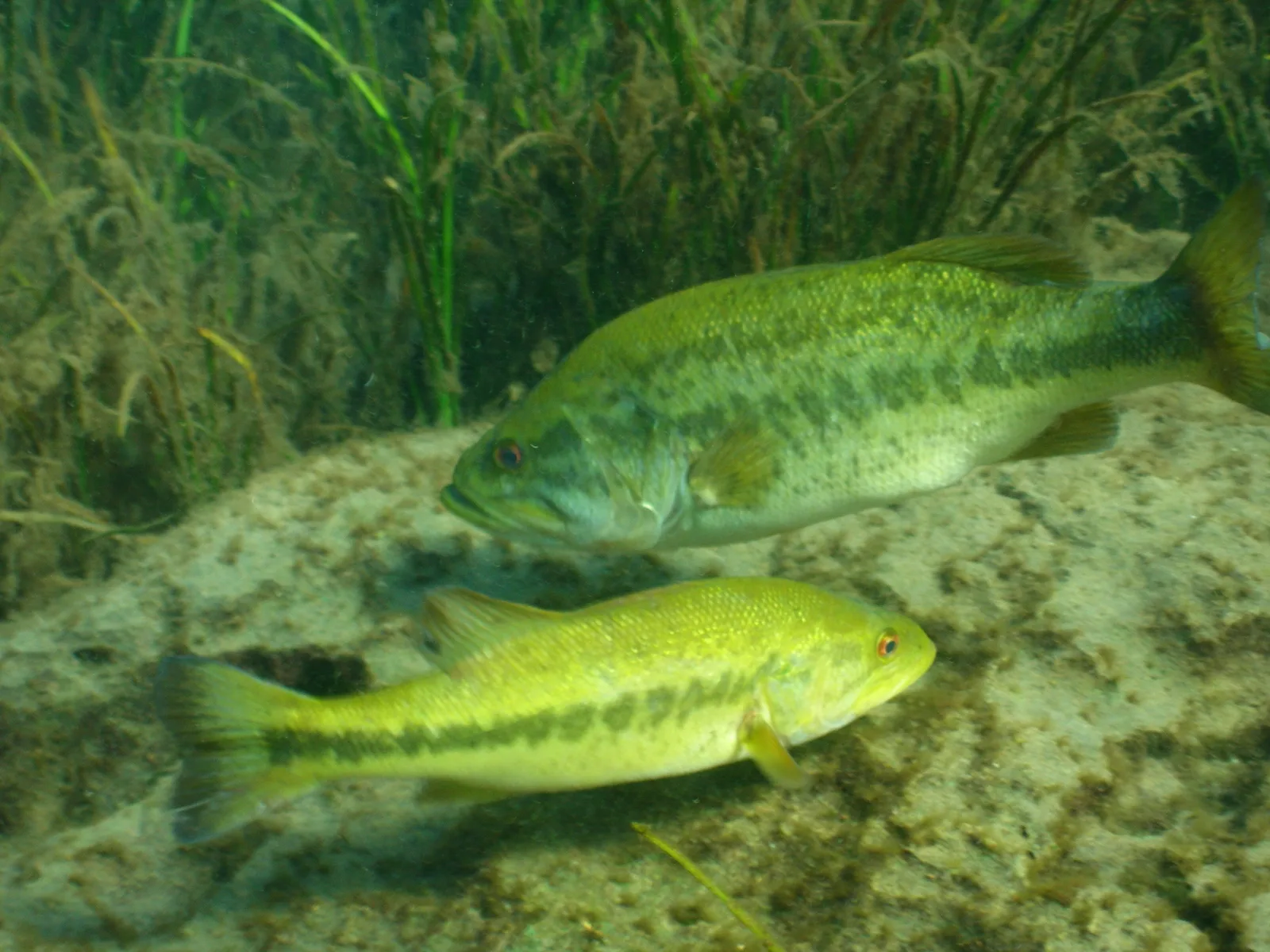
Bass spawn when the water reaches about 60 °F (16 °C) and holds there for a few days. That means February in south Florida and June in northern Minnesota, with every other state somewhere in between. The full range of spawning temperatures runs from 59 to 75 °F (15–24 °C). What decides the date on your water is not the calendar but a thermometer on a warm, protected flat in the afternoon.
The male does all the work. He builds the nest, chases the female off once she has laid, and guards the eggs and fry for a week to a month while eating almost nothing. The fish sitting on a bed in May is nearly always a male; the big one hovering a cast away is the female.
What happens at each water temperature?
The bands are Kevin VanDam’s, from the six-season framework most tournament anglers work from, and they match the agency biology.
| Stage | Water temperature | Where the bass are | What works |
|---|---|---|---|
| Pre-spawn | 48–55 °F (9–13 °C) | Moving from deep wintering areas toward spawning flats; staging on vertical structure next to the flats | Crawfish-pattern crankbaits, slow-rolled spinnerbaits, lipless crankbaits |
| Spawn | 55–70 °F (13–21 °C), nesting from about 60 °F | Flat, protected, shallow structure with a firm bottom | Tubes and floating worms in clear water, soft jerkbaits in stained |
| Post-spawn | 70–75 °F (21–24 °C) | Leaving the beds, suspended near vertical cover; fry guarders still shallow | Topwater, spinnerbaits, anything high in the water column |
The nesting itself fits in a narrower window. The male largemouth builds a nest in 2–8 ft (0.6–2.4 m) of water, on almost any bottom except soft mud, even the top of a submerged log. The female lays 2,000–43,000 eggs, and then the male chases her off.
The fry hatch in five to ten days and hang over the nest in a tight school for several days more. Warmer water speeds this up. Eggs hatch in two to four days at 64–73 °F (18–23 °C), and in one to three days at 81–84 °F (27–29 °C). The male guards the fry for seven to ten days.
All that time he fans silt off the eggs with his tail, which is what makes a bed visible.
When do bass spawn where you live?
The dates apply the 60 °F trigger to typical spring warming, checked against the state agencies’ season statements. Your lake will run early in a warm spring and late in a cold one; the thermometer overrules the table.
| Region | Largemouth spawn | Notes |
|---|---|---|
| South Florida | February to March, some fish from December | Florida bass, the same species for regulations; a long, drawn-out spawn with several waves |
| Texas, Louisiana, Alabama, Georgia, the Carolinas | March to April | Texas’s profile says February to May by latitude; south Texas first |
| Tennessee, Arkansas, Oklahoma, Virginia | April to early May | Reservoirs warm later than ponds and creek arms |
| Mid-Atlantic, Ohio Valley, Missouri, Kansas | May | The full moon in May is the folk marker, and it is often right |
| Great Lakes states, New England, the Dakotas | Late May into June | Smallmouth run into late June; a cold front can stall everything for a week |
| Canada, northern Minnesota | June | Harvest seasons often open after the spawn; check the regulations |
Two things move a lake off this table. Shallow, dark-bottomed ponds and the backs of northern coves warm first and spawn first. Deep, clear, wind-swept main lakes warm last.
Northern populations also adapt. A Minnesota smallmouth will nest a few degrees cooler than a Tennessee one, so the state figures disagree by 5–10 °F. The bass water temperature page sets them out band by band.
Why does the spawn take six weeks, not a weekend?
Not every bass in a lake spawns the same week. Fish move up in waves, each on a warming trend. The first wave on a southern reservoir in March can be followed by a third wave in May. In a big reservoir the spawn can run six weeks, from the first creek arm to the last main-lake pocket. That is why tournament anglers can fish “the spawn” for most of a spring. Three things set the pace.
The thermometer, read where the fish are. Surface water on a protected flat in the afternoon can be 5–8 °F warmer than the main lake at dawn. That afternoon reading is the one the bass respond to.
The weather. A cold front that drops the shallows by three to five degrees pushes bedding fish off the flats to the first deeper edge. They come back when the warming resumes, sometimes to the same nest.
The water level. A rising lake pulls bass to the bank and gives sight fishing its best days. The fall that follows leaves nests dry. Then the fish spawn on the first offshore cover with stable water, a stump or a rock in 5–10 ft (1.5–3 m). On lakes with big spring swings in level, that offshore spawn is a pattern of its own.
Do smallmouth and spotted bass spawn at the same time?
In a lake that holds both, the largemouth usually go first and the smallmouth follow. The reason is the water, not the species. Largemouth stage and nest on shallower flats that warm sooner, while smallmouth will take water a few degrees cooler. Where a gravel smallmouth flat warms first, the order flips and the two overlap.
Smallmouth usually nest at 62–64 °F (17–18 °C), with spawning recorded as low as 53 °F. In southern Wisconsin that is mostly mid-May through June; Minnesota gives May and June at about 60 °F. One detail helps when you are looking for beds: the male may build several practice nests before he settles on one.
The nest site differs too. Smallmouth want a large, circular bed of clean gravel next to a log or boulder in 3–10 ft (1–3 m) of water. In a river they use the slack water just downstream of a boulder. Largemouth nest on sand, mud or gravel among vegetation in 2–8 ft.
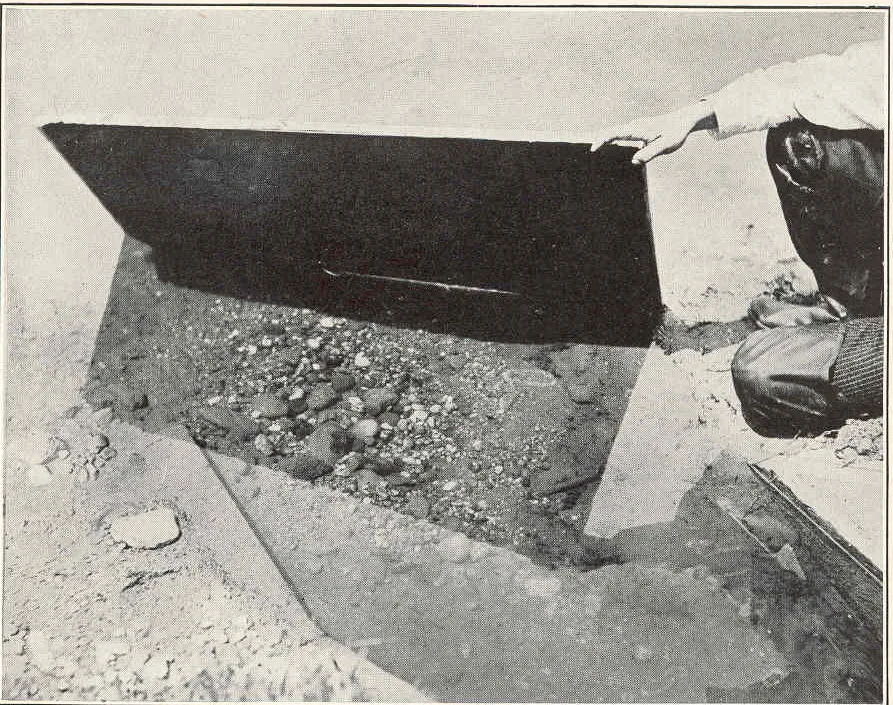
A smallmouth nest photographed through a viewing screen by Jacob Reighard for the U.S. Bureau of Fisheries in 1908: the cleaned gravel stands out from the sand around it exactly as it does today. Photo: Jacob Ellsworth Reighard, Wikimedia Commons (public domain).
The male smallmouth is the more devoted parent. A mature female carries 2,000–15,000 eggs, and the average nest holds about 2,500 of them. A nest can hold up to 10,000, since a male may spawn with several females on one nest. The eggs hatch in about ten days in the mid-50s °F and in two to three days in the mid-70s. The male then guards the fry for up to a month.
Spotted bass spawn across the widest band, 57–74 °F (14–23 °C). Their males also stay on the eggs and fry for up to four weeks.
In clear reservoirs, spotted bass and smallmouth nest deeper than the textbook depths. Bass writer Sam Hanggi describes spotted bass paired up on sandy shoals in 10–12 ft of water on Alabama’s Lake Martin. In the clearest lakes he has found nests as deep as 15 ft (4.6 m). So a clear-water lake with no visible beds is not a lake with no spawn. The smallmouth bass and largemouth bass pages carry the full season tables for each.
What does a bed look like, and who is on it?
A bass bed is a cleared saucer of bottom one to three feet across. The male has fanned off the loose layer, so it looks lighter than its surroundings on a dark or silty bottom and darker on pale sand.
Largemouth beds sit beside something: a dock post, a stump, a clump of reeds, the edge of a laydown. Most are in 2–5 ft of water, on the sheltered side of a point or in the back of a pocket where the wind cannot reach. Polarized glasses do most of the finding, and a high sun between late morning and mid-afternoon does the rest. Where you cannot see the bottom, forward-facing sonar in a perspective view shows beds in 2–8 ft, but as shapes; the size of the fish is a guess.
Two fish use a bed. The smaller male arrives first, builds, and stays until the fry disperse. The larger female comes up for a day or a few days, lays in stages, often on more than one nest, and leaves.
- A single bass circling a bed, nose down, refusing to leave even when you drift over it, is a male “locked on”.
- A bigger fish sliding in and out of view a few yards off the bed is the female. The male’s reaction tells you where she is.
- Fish moving along the bank in a straight line without stopping are cruisers, between beds or not yet committed, and far harder to catch.
- An empty bed is often not empty. The male spooked as you approached and will be back within a minute or two if you stop and wait.
How do you fish each stage?
- Pre-spawn (48–55 °F). Find the spawning flats first, then fish the deeper edge next to them: the channel swing, the point, the first drop. The biggest females of the year are here, feeding hard. Slow-roll a spinnerbait, crawl a crawfish-colored crankbait, or drag a jig. This is the stage that produces the heaviest tournament bags, and the best time to fish for bass page explains why the week before the first wave beats the spawn itself.
- Early spawn (55–62 °F). The males move up first and build nests. Cover the flats with a moving bait, a lipless crankbait or a swim jig, and look for the light circles of cleaned bottom in 2–8 ft.
- Peak spawn (60–68 °F). Sight fishing in clear water: a white tube, a floating worm or a wacky-rigged stick bait. Pitch it past the bed, crawl it onto the edge, pause, then crawl it to the center and leave it still. White shows you the strike. The male hits it to move it, so watch the bait and set when it is inside the mouth, not when he first noses it. The female is harder, and most catchable in the few days right after she has laid. Give a fish you can see no more than about 45 minutes before moving on. In stained water, pitch a Texas-rigged creature bait to every piece of shallow cover; the Texas rig page has the weights.
- Post-spawn (68–75 °F). The fish are tired and scattered. Males guard clouds of fry in the shallows and will hit a topwater popper or a swimbait pulled over them. Females suspend off the first points and docks and take a jerkbait or a spinnerbait. Fishing is slower for two weeks. Then the bluegill beds, and the shad spawning on riprap and seawalls at first light, bring the bass back to the bank in packs.
- Any stage, cold front. A front drops the water three or four degrees and pushes the fish off the flats for a few days. Go back to the pre-spawn edge with a jig and slow down.
Does bed fishing hurt the bass?
Catching bass off their beds is legal in most states and a hard argument in all of them. The best data comes from a Florida pond study. Bass were caught off 44 of 91 nests that were fished. In fished ponds 41 percent of nests produced fry, against 54 percent in unfished ponds, but the difference in young bass per pond was not statistically significant.
The wider research finds that angled males guard less and abandon more. Under typical fishing pressure, the effect on the population is “minimal”. A model in the same Florida study compared the rules:
| Rule | Adult bass, against year-round harvest with a 14 in minimum |
|---|---|
| Catch-and-release all year | 42 percent more |
| No fishing during the spawn | 20 percent more |
| Catch-and-release during the spawn | 8 percent more |
What does the law say?
Several northern states settle the argument in the rulebook. New York’s statewide regulation opens black bass, largemouth and smallmouth both, to harvest only from June 15 to November 30. From December 1 to June 14, bass fishing is catch and release only, with artificial lures only, which covers the whole spawn in most of the state.
Other northern states and Canadian provinces open bass harvest after a spring closure or run an early catch-and-release season. The dates differ by zone, so read the current regulations for your water before the first warm week in May. The bass hub points to the regulation pages.
Where bed fishing is legal, four rules protect the fish.
- Keep it wet. Seconds out of the water, not minutes.
- Release it on its own bed. A male moved across the lake will not find his nest.
- Leave the male while the female is still on the bed. Taking him spooks her off.
- Skip the beds on small ponds, where a few nests are the whole year class.
The catch and release page has the handling steps.
Related
Section guide
Bass Fishing: Where the Bass Are, What to Throw, and the Three Bass You Will MeetBass fishing from the angler's side: where largemouth, smallmouth and spotted bass are at each water temperature, what to throw first, how to tell them apart.
 Smallmouth vs Largemouth Bass: How to Tell Them Apart
Smallmouth vs largemouth bass: the jaw, the stripe and the dorsal fin settle the identification in seconds. Then habitat, size, records and how each one fights.
 How to Fish for Bass: A Beginner's Season-by-Season Guide
How to fish for bass from the first cast: one rod and reel, five lures, where bass are at each water temperature, and a numbered method for a day on the water.
 Best Bass Lures: What Won the 2025 and 2026 Elite Series, Season by Season
Best bass lures from two seasons of Elite Series winning baits: a lure for each water color, depth, cover and season, with smallmouth and spotted bass picks.
 World Record Largemouth Bass: Perry, Kurita and Dottie
The world record largemouth bass is 22 lb 4 oz, caught in Georgia in 1932 and tied in Japan in 2009: the documented story, the IGFA rules, and Dottie.
 Spotted Bass: How to Tell It From Largemouth and Alabama Bass
Spotted bass from the agency data: the tooth patch, jaw and scale counts that separate it from largemouth and Alabama bass, habitat, spawning, and records.
- Smallmouth Bass: Identification, Habitat, Spawning and Records
Smallmouth bass from the agency data: the marks that separate them from largemouth, the cool rocky water they need, spawning at 60–64 °F, and the 1955 record.
Sources
- Texas Parks and Wildlife, largemouth bass species profile
- Texas Parks and Wildlife, smallmouth bass species profile
- U.S. Fish & Wildlife Service, largemouth bass
- Wisconsin DNR, smallmouth bass
- Minnesota DNR, smallmouth bass
- Florida FWC, largemouth bass profile
- Animal Diversity Web (University of Michigan), Micropterus salmoides
- New York DEC, statewide freshwater fishing seasons, sizes and catch limits
- Bassmaster, KVD's 6-season bass guide
- Mississippi Sportsman, the FWC bed-fishing study
- Bartholomew & Bohnsack, a review of catch-and-release angling mortality (Carleton University copy)
- Wired2Fish, Sam Hanggi, When to fish deep during the spawn
- Texas Parks and Wildlife, spotted bass species profile
- Field & Stream, When do bass spawn?