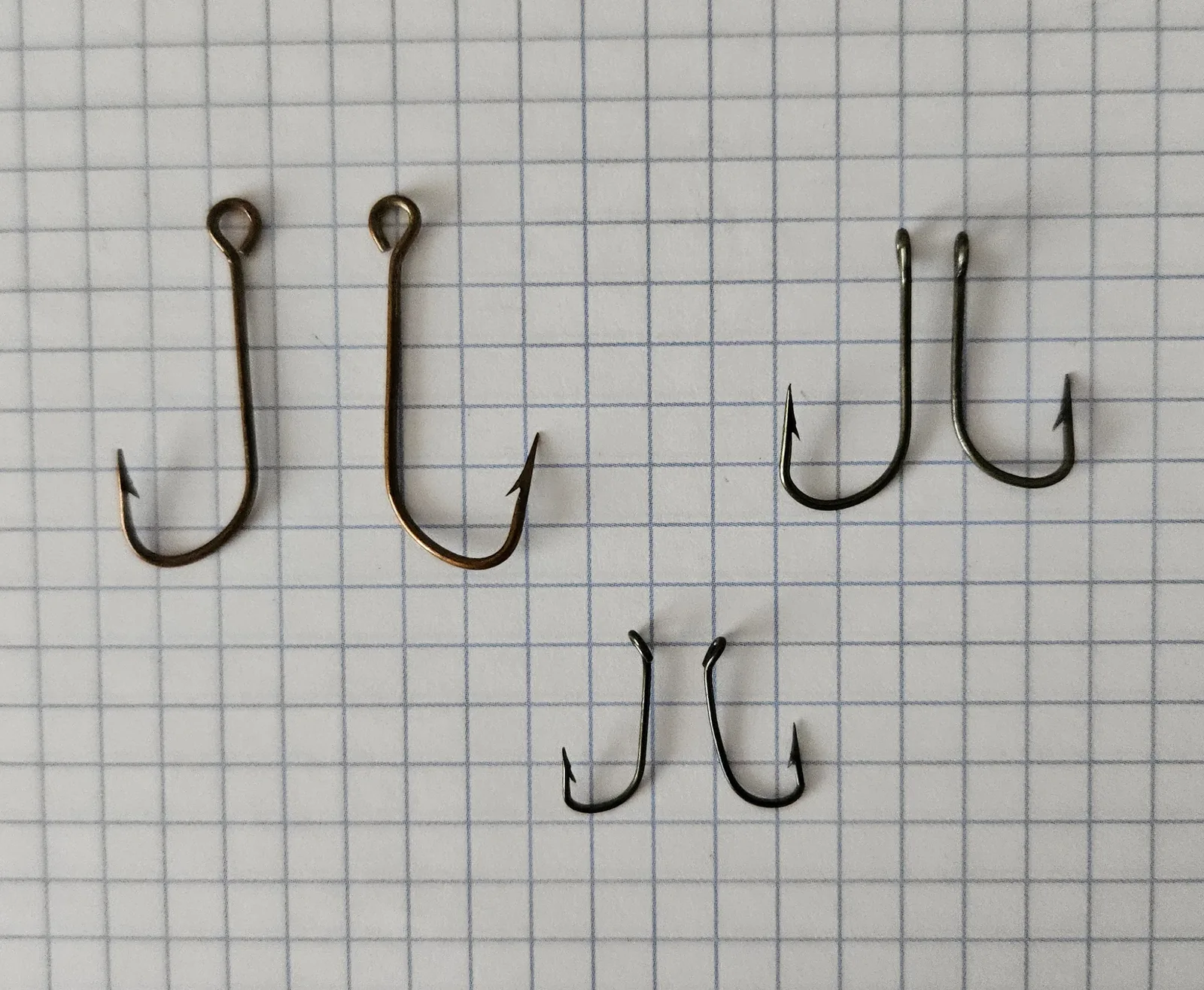
There are ten types of fishing hooks worth knowing, and each is a shape with a job: the J hook for bait, the circle hook for bait you do not strike, the worm hook for Texas-rigged plastics. The seven others are the octopus, Aberdeen, Kahle, siwash, jig, drop-shot and treble. Every hook has the same parts, and the types differ only in how those parts are bent. Learn the shapes, and a wall of hooks in a tackle shop reads like a menu.
A hook is seven parts bent ten ways. Each bend is an answer to one question: how does this fish take this bait?
What are the ten types?
Each type is a shape with a job. The second column is how you tell them apart on the rack.
| Type | What marks it | Bait or lure | Fish | Common sizes |
|---|---|---|---|---|
| Bait hook (J hook, baitholder) | The plain J shape; baitholder versions carry one or two barbs on the shank to stop bait sliding | Worms, minnows, dough, cut bait; general bait fishing | Everything from bluegill to catfish | #10 to 6/0 |
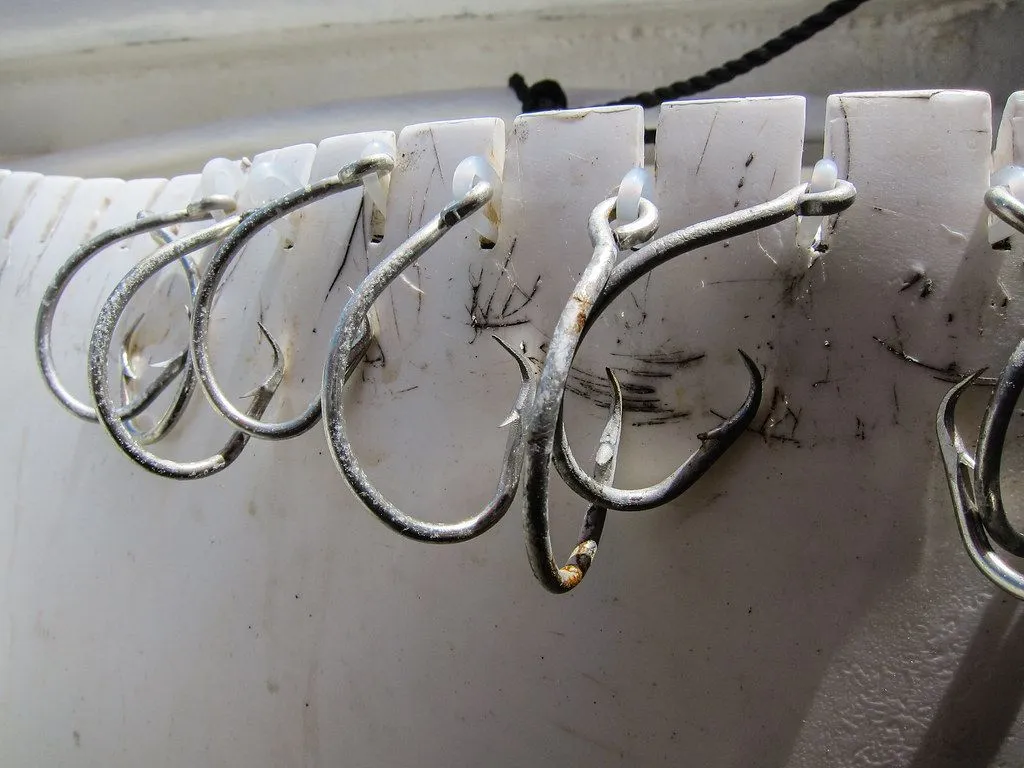
| Circle hook | Point curved back toward the shank, gap almost a circle | Live and cut bait, fished without striking | Catfish, striped bass, redfish, reef fish; required by law in places | 1/0–12/0 |
| Octopus | Short, curved shank, up-turned eye, offset point | Leeches, minnows, small live baits; drop shot | Walleye, trout, steelhead, salmon | #8 to 3/0 (Gamakatsu Octopus UV); #6 to #1 (Eagle Claw 226) |
| Aberdeen | Long shank, thin light wire that bends free of snags | Minnows, worms, crickets for panfish in timber and brush | Crappie, bluegill, perch | #10 to 4/0 (Eagle Claw 214); #10 to #2 is the panfish range |
| Kahle | Very wide gap, point angled toward the eye; between a J and a circle | Big live baits, whole shrimp, cut bait; also Senko-style plastics | Flounder, catfish, redfish, sea trout | #10 to 10/0 (Eagle Claw L141); 1/0–6/0 for most live bait |
| Siwash | Long shank, open eye that is closed with pliers onto a split ring | Replaces trebles on spoons and spinners; trailer hook on spinnerbaits | Salmon, pike, bass; single-hook waters | 1/0–5/0 |
| Worm hook and EWG | Offset bend just below the eye that holds the plastic; the extra-wide-gap version bows the shank out for bulky baits | Texas-rigged soft plastics; the EWG for creature baits and craws | Largemouth and smallmouth bass | 1/0–6/0 |
| Jig hook | Eye bent at 60° or 90° to the shank, molded into a lead or tungsten head | Jigs of every kind: bass jigs, crappie jigs, shaky heads | Everything | #6 to 6/0 |
| Drop-shot hook (also mosquito, wacky, Neko) | Small, fine wire, short shank, straight eye | Drop-shot, wacky and Neko rigs; nose-hooked finesse plastics | Bass, walleye, panfish | #4 to 1/0 (Owner’s mosquito runs #14 to 7/0) |
| Treble | Three points on one shank | Crankbaits, jerkbaits, topwater, spoons; cut bait for catfish | Anything that hits a lure | #8 to 3/0 |
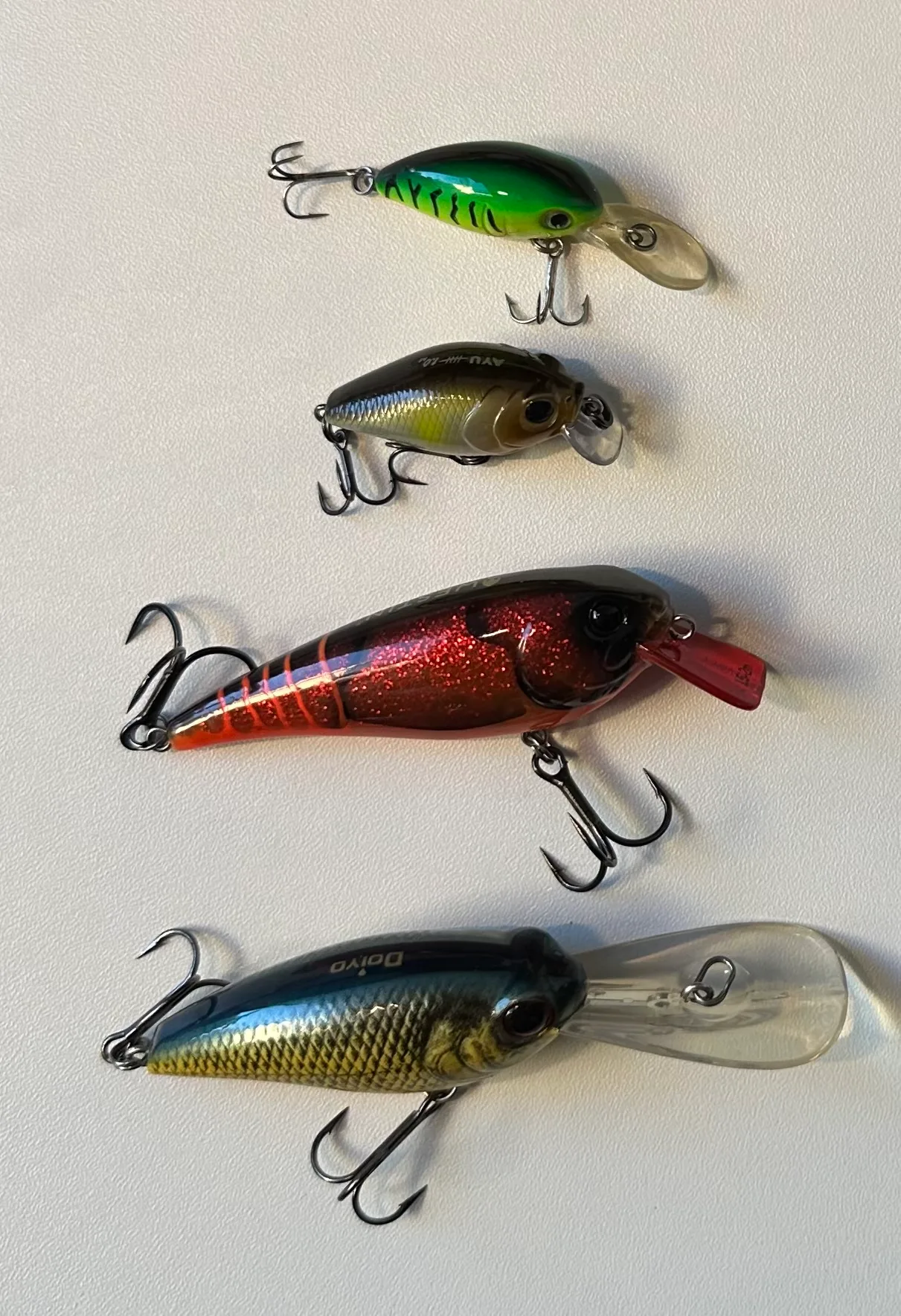
Two of these come built into the lure. The jig hook is molded into a lead or tungsten head, as the jigs pages show, and the treble hook hangs from crankbaits and topwaters.
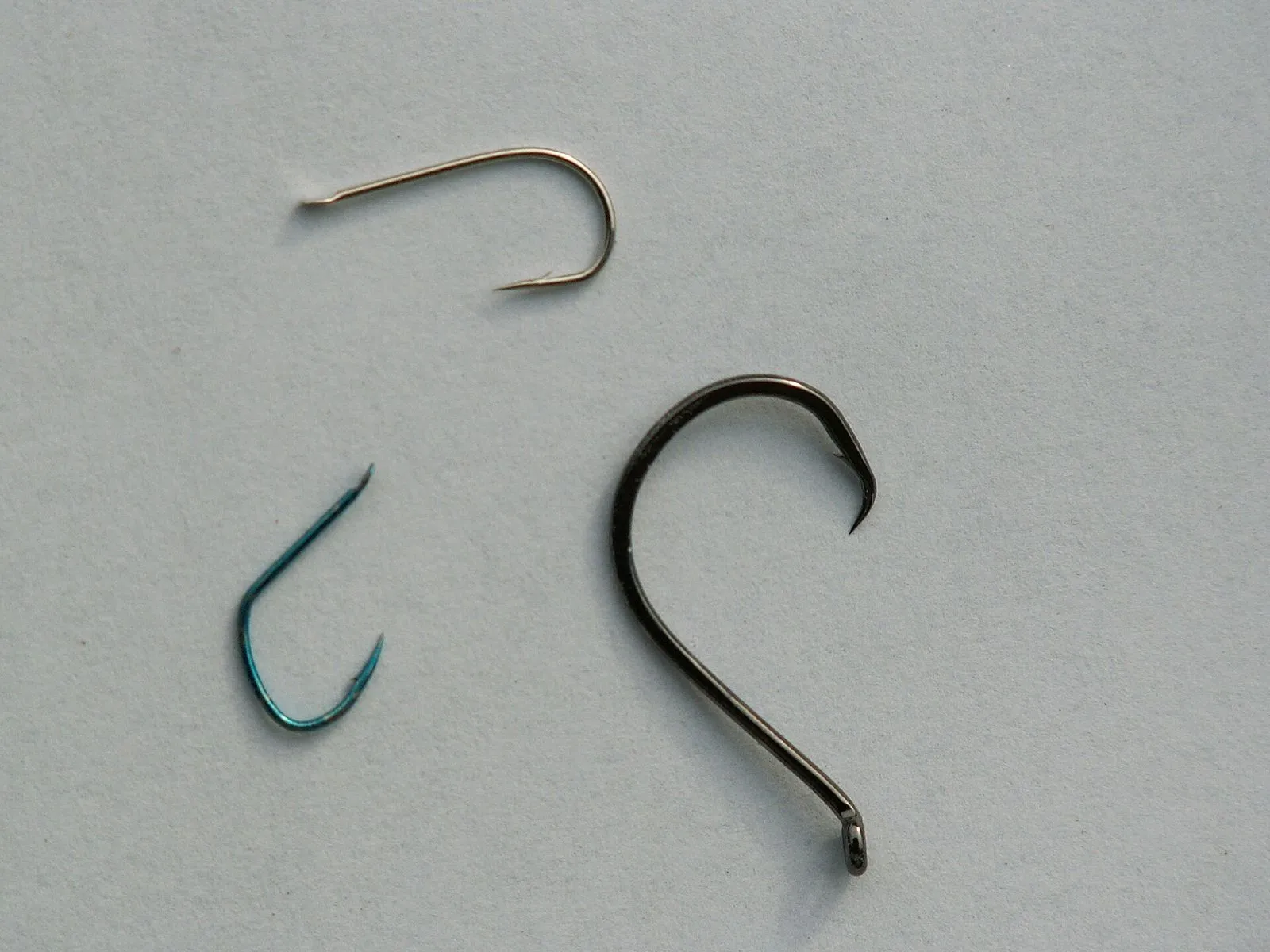
Sizes are a separate decision from type, and they are not standardized between makers. The hook size chart page measures why a 2/0 octopus and a 2/0 circle hook are not the same hook.
Which hook do you need?
- Bait or lure? A lure comes with its hooks; the choice is whether to change them, and the treble hook page covers that. Bait fishing is where the type is chosen.
- Will the fish swallow it? Catfish, stripers and reef fish take a bait down. A circle hook, fished by reeling rather than striking, keeps the hook in the corner of the mouth. Maine’s regulators put it in one sentence: point the rod at the fish and reel, and the hook sets itself.
- Is the bait small and soft? A minnow, a leech or a piece of worm goes on an octopus or a small bait hook, which hides in the bait and does not kill it. A light-wire Aberdeen does the same: less puncture, so the minnow swims longer.
- Is the cover snaggy? An Aberdeen’s light wire straightens on a snag and is bent back with pliers, so the panfish angler in flooded timber loses fewer rigs.
- Is it a soft plastic? A worm hook, EWG for bulk, rigged Texas style with the point buried; pick the wire from the table below.
- Does the regulation say single hook? A siwash in place of a treble on a spoon or plug, or an inline single on a crankbait. The open eye closes onto the split ring with pliers.
Then the size, which changes with the type. A 3/0 EWG hook holds a 6 in (15 cm) worm. A 3/0 Aberdeen holds a large minnow, and a 3/0 circle hook is a channel catfish hook. The what size hook for catfish page has the catfish sizes by bait, and the catfish rigs page shows those hooks tied in.
Free card: what 26 species do at your water temperature
Plus one email a week on what's biting now. No sales pitches. Privacy.
Which worm hook, and which wire?
The worm hook is the one type that splits again, because a bass angler rigs a 4 in (10 cm) finesse worm one week and a fist-sized creature bait the next. Gamakatsu, whose EWG is its best-selling worm hook, names four shapes.
- Straight shank. Small barbs or a keeper below the eye, and an O’Shaughnessy bend. It suits long, narrow worms and is the flipping and punching hook: a straight shank snelled to braid levers the point up into the roof of the mouth.
- Offset shank, round bend. A Z-bend under the eye pins the plastic, and the hook stays streamlined through cover. A 3/0 fits a 7 in (18 cm) worm, a 5/0 a 10 in (25 cm) one.
- Extra wide gap. The shank bows out, so a bulky bait can collapse on the hookset and still leave bite room. It is the hook for craws, creature baits and swimbaits.
- Hybrid. It sits between the two, for a Senko or a fluke.
The Texas rig page shows the rigging and the hook-to-bait sizes.
Within each shape, the wire is chosen for the line, not for the fish. A hook that is thin for its rod straightens on the set, and the fish swims off with a bent paper clip. A hook that is thick for its line never gets driven past the barb.
| Wire | Line it matches | Rod | Hooks built this way |
|---|---|---|---|
| Light (fine) wire | 4–10 lb (1.8–4.5 kg) mono or fluorocarbon | Medium-light spinning | Mosquito and drop-shot hooks, Aberdeen, light-wire straight shank |
| Standard wire | 10–20 lb (4.5–9 kg) | Medium to medium-heavy casting | Offset round bend, EWG, octopus |
| Heavy (superline) wire | 25–80 lb (11–36 kg) braid | 7 ft (2.1 m) and up, medium-heavy to heavy | Superline EWG, heavy-cover straight shank, flipping hooks with a welded eye |
Gamakatsu’s Superline series exists for exactly this. Its stronger wire “prevents the hook from bending when an angler is using stronger lines”, which is what 50 lb braided line and a flipping stick ask of a hook.
Wire gauge, finish and point: what changes?
Within a type, four choices remain.
Wire gauge. Light wire penetrates on light tackle and bends on big fish. Heavy wire holds a flipped bass on 65 lb braid and needs a hard hookset. Makers write it as 1X to 4X, one step heavier per X; the hook size chart page measures what a step adds.
Forging. A forged hook has been hammered flat through the bend, which stiffens the wire without thickening it. Eagle Claw lists forged or unforged on every hook, and the heavy-cover flipping hooks are forged with a welded eye.
Finish. Bronze is cheapest and rusts out of a lost fish. Black nickel, platinum black and black chrome resist corrosion in fresh water; tin and nickel are for salt; red and gold are sold as attractors. Stainless does not rust. That is why the federal reef-fish rules in the Gulf of Mexico require non-stainless circle hooks with natural bait: a hook left in a released fish should rust out.
Point. A needle point is round in section and penetrates easiest. A cutting or knife-edge point is ground with edges and holds in hard mouths. A kirbed or offset point is bent out of line, so it catches on the way out of a bait. Check every point on a thumbnail before the first cast, and touch it up with a file or swap the hook when it skates.
What are the parts of a hook?
Eagle Claw, which has made hooks in Denver since 1925, describes a hook by ten attributes; seven of them are parts.
- The point is the sharp end.
- The barb is the small backward spur behind it that stops the hook backing out. A barbless hook simply leaves it off; the barbless hooks page weighs what that costs and saves.
- The bend is the curve, and the shank the straight length from the bend to the eye, where the line ties.
- The gap is the distance from the point straight across to the shank.
- The throat is the depth from the point down to the bottom of the bend.
The types change the gap (wide for bulky plastics, narrow for small baits) and the shank (long for baitholders and Aberdeens, short for octopus and circle hooks). They also change the eye, and the point: straight, or curved back for circle hooks.
The eye alone comes in more shapes than most anglers notice. Eagle Claw lists nine:
- Ringed: the plain eye.
- Up eye: sits above the shank and takes a snell knot cleanly.
- Down eye: turned the other way, to steer how a dragged bait sits.
- Open eye: left with a gap, so the hook clips straight onto a split ring in place of a treble.
- Cross eye: bent 90 degrees, for jig heads and vertical fishing.
- Side eye: for a horizontal presentation.
- Big eye: for heavy line.
- Welded eye: closed shut, for the fish that would spring an ordinary one open.
- “R” ringed eye: a loose ring through the eye (the R in the model number) that lets a bait swing freely.
Why does the packet say Sproat or Kirby?
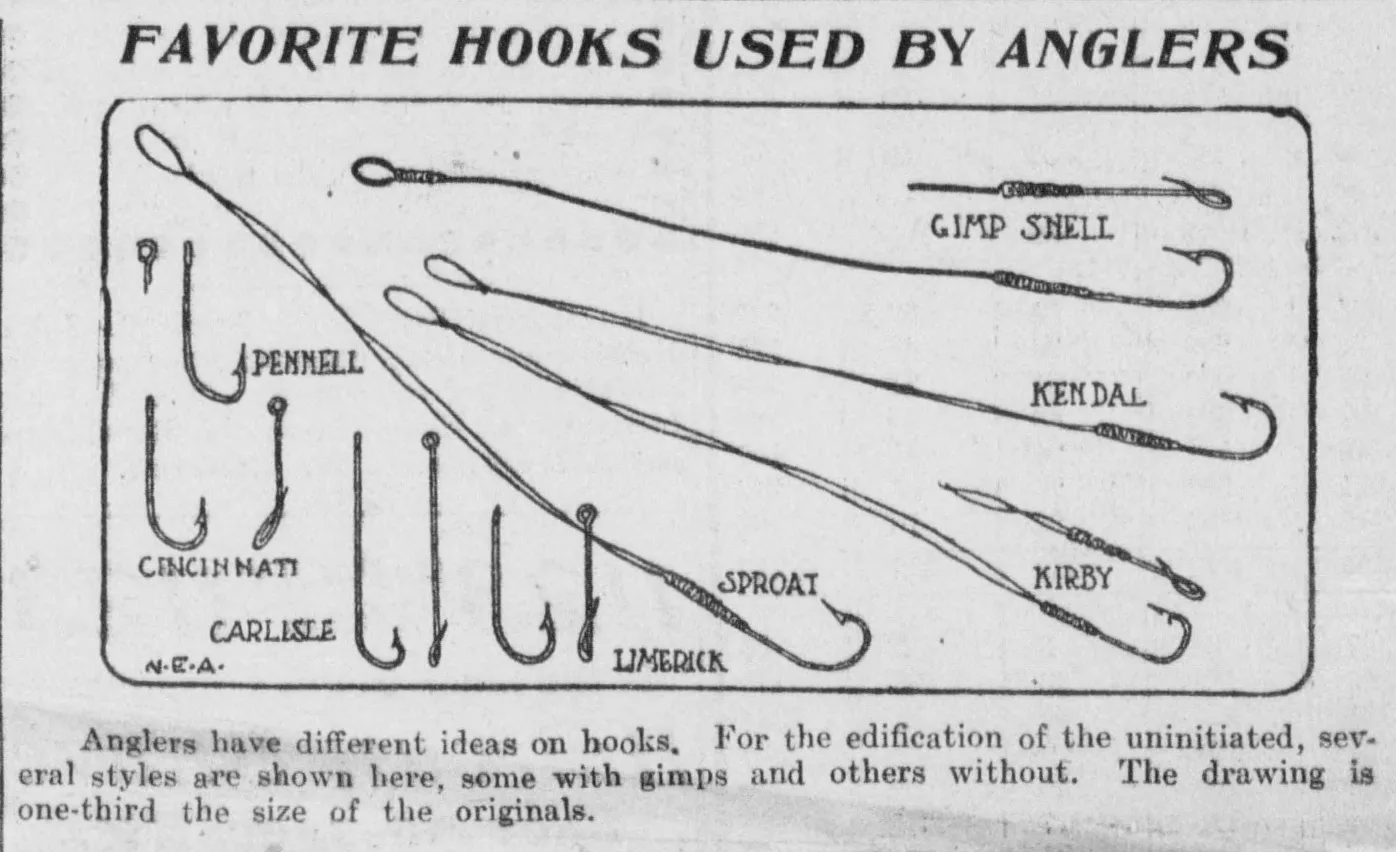
“Favorite hooks used by anglers”, The Tacoma Times, 6 April 1904. Library of Congress, public domain.
Open a hook catalog and some of the names are not types at all but bends, and they are old. This drawing ran in a Tacoma newspaper in April 1904 and shows what a tackle counter stocked then. Carlisle, Limerick, Sproat, Kirby, Kendal, Pennell and Cincinnati are there, several on “gimps”, the snelled leaders of the day. Most of them are still sold.
- Carlisle is the long-shank minnow hook of the day, the Aberdeen’s near relative.
- Limerick and Sproat are bends, and they still name fly-tying hooks.
- Kirby is Charles Kirby, who opened his hook shop in London’s Harp Alley in 1650. He gave his name to the point bent sideways out of line with the shank. A “kirbed” or offset point is the feature makers advertise on their octopus hooks today.
- O’Shaughnessy, a heavy-wire bend from the same era, is the bend on Gamakatsu’s standard straight-shank worm hook.
- The gimp snell survives as the snelled hook on a card, tied with the snell knot that an up-eye hook is made for.
The pattern names describe the bend; the type names on this page describe the job. A packet that says “Sproat bend octopus” is telling you both.
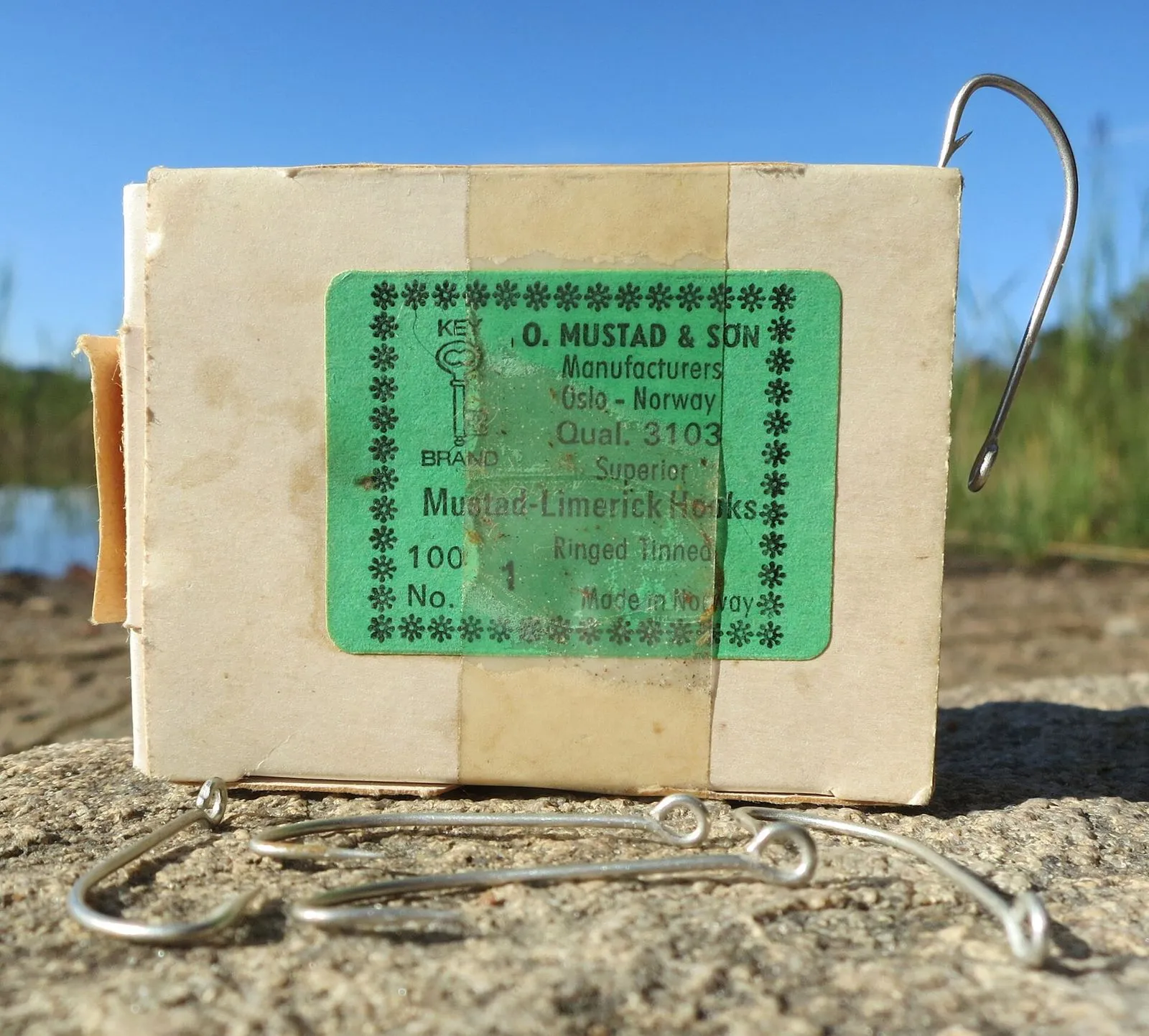
A hook is the cheapest part of the rig and the only one that touches the fish. The hooks hub holds the size-by-species chart and the law on circle hooks, and the best bass lures page shows trebles, EWGs and jig hooks in use.
Free download
The water temperature card
Read your water temperature and the card tells you who is spawning, who is feeding and what to throw. 26 species, 16 pages, for your phone and the tackle box.
Plus one email a week on what's biting now. No sales pitches. Privacy.
Related
Section guide
Fishing Hooks: Sizes, Types and Which Hook for Which FishHow fishing hook sizes work from 32 to 20/0, the parts of a hook, the ten hook types and what each is for, and a size-by-species chart from bluegill to tuna.
 Treble Hook: Sizes, When to Change Them, and the Single-Hook Waters
A treble hook has three points on one shank and comes on almost every crankbait and topwater. Sizes by lure, when to change them, and the single-hook waters.
 Circle Hooks: How They Work, How to Fish Them, and Where They Are Law
Circle hooks turn the point back toward the shank and set themselves in the corner of the mouth when you reel, not strike. How to fish them, and the rules.
 Fishing Hook Size Chart: How Sizes Work, With Hooks by Species
The fishing hook size chart explained: why #4 is bigger than #6 and 2/0 bigger than 1/0, the gap the number describes, and a size-by-species and bait chart.
Sources
- Gulf of Mexico Fishery Management Council, reef fish gear rules (non-stainless circle hooks with natural bait)
- The Fishing Museum Online, a brief history of the hook
- Eagle Claw, anatomy of a fish hook
- Eagle Claw, hook eye variations
- Eagle Claw, light wire Aberdeen hook 214 (sizes 10 to 4/0)
- Eagle Claw, Lazer Sharp straight eye Kahle hook L141 (sizes 10 to 10/0)
- Eagle Claw, octopus hook 226
- Gamakatsu, key worm hook styles you must have
- Gamakatsu, Octopus UV hooks (sizes 8 to 3/0)
- Owner, mosquito hook 5177 (sizes 14 to 7/0)
- Bass Pro Shops, a simple guide to the most popular fish hook styles
- Take Me Fishing, fishing hooks: sizes, types and anatomy
- Maine DMR, tips for using circle hooks
- The Tacoma Times, 6 April 1904, favorite hooks used by anglers (Library of Congress)