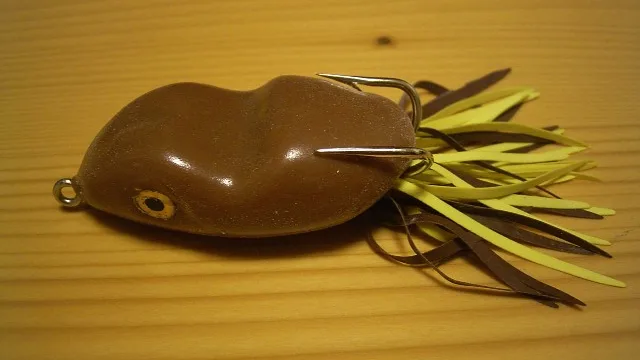
A frog lure is a hollow-body frog: a soft, air-filled plastic body with a double hook whose two points ride upturned against its back. It walks over matted grass, lily pads, duckweed and laydowns that would foul any other lure, and it collapses on the bite so the points come through. The skill is not the cast or the retrieve; it is waiting through the explosion before you set the hook. Pat Schlapper had a SPRO Bronzeye Frog 65 on his winning list at the 2025 Mississippi River Elite event.
The frog disappears in a hole in the grass. Count two full seconds. Then set. Everything about frog fishing is in that count.
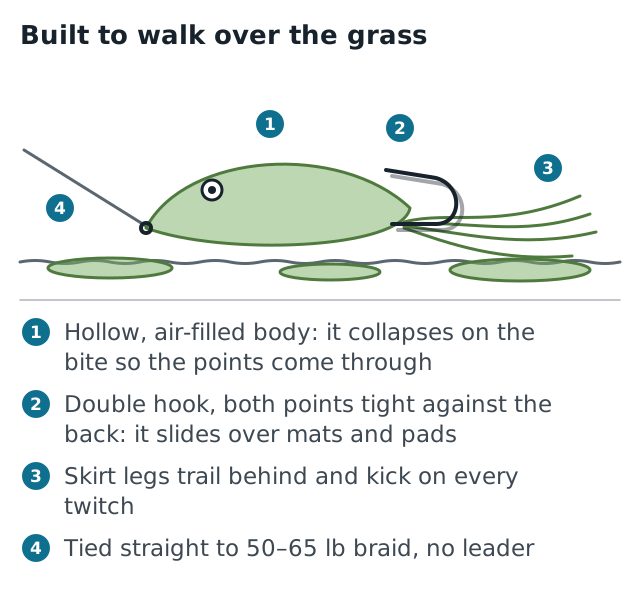
The parts of a hollow-body frog. Drawing: fishing.info.
Where does a frog win, and when?
The frog is a cover bait, and the cover is specific. Throw it on matted hydrilla and milfoil, lily pads, duckweed and the scum anglers call cheese. Throw it on laydowns, docks and overhanging trees: anywhere a treble hook would snag on the first cast.
Ish Monroe’s rule, in a Wired2Fish piece, is to fish where the grass changes: the outside edge, the holes, the points in the mat, the line where two kinds of grass meet. Add the shade line along a bank or a dock in the afternoon, and bluegill beds in late spring. Wired2Fish’s editors argue that a hollow frog imitates a bluegill sharking across the surface more than a frog, which is why bluegill colors work over beds.
The season is set by the water. Largemouth bass feed hardest at 65–80 °F (18–27 °C). The frog over mats fits the 80–85 °F (27–29 °C) band above that, when the thickest shallow cover is the only shade a bass can find. Above 85 °F (29 °C) feeding shrinks to dawn and dusk, and the punch rig under the mat takes over. The bass water temperature page carries the band-by-band table.
The Tackle Warehouse guide reads the same arc without a thermometer: the bite starts in spring and peaks in summer, as the vegetation thickens and the fish move under it. The best bass lures page puts the frog in its summer slot.
Walking, popping or buzzing frog?
Michael Iaconelli’s Bassmaster column argues for three frogs, because three designs do three jobs. The walking frog has a pointed nose and a stout double hook. Twitched on a slack line, it walks side to side and covers a field of lily pads. It pushes over matted hydrilla, duckweed, even the sawdust and trash mats of a tidal river. Weight in the rear makes the nose flop down on each twitch, which Iaconelli says is what draws a bass up under the mat.
The popping frog carries a cupped face like a hard popper. He pops it once and leaves it, “slowing way down,” on hard cover, in the holes of a grass mat and in open water: skipped under a dock and left to sit. Its limit is just as clear. A popping frog “does not come over matted grass worth a darn,” because the cup scoops weed.
The buzzing frog is a hybrid of a solid toad and a hollow frog, with legs or a tail that work whether it is reeled or twitched. On a steady retrieve it spits and gurgles like a buzzbait. But it runs over matted grass where a buzzbait’s blade would tangle, and it floats in place when stopped, which a toad never does. The Teckel Sprinker in the table is one. Its paddle tail on a swivel gives it a Whopper Plopper’s plop without the Plopper’s exposed trebles.
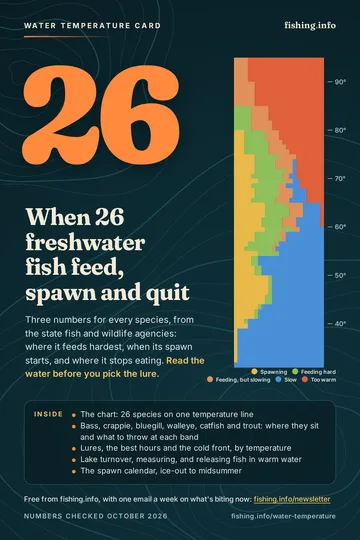
Free card: what 26 species do at your water temperature
Plus one email a week on what's biting now. No sales pitches. Privacy.
Six frogs, side by side
Lengths, weights and hooks are from the maker and retailer pages, body length without the legs. Strike King’s frog is 5.75 in (14.6 cm) with them, which shows how much of a frog is skirt.
| Frog | Body length | Weight | Hook | Type and note |
|---|---|---|---|---|
| SPRO Bronzeye Frog 65 | 65 mm (2.6 in) | 5/8 oz (18 g) | Gamakatsu 4/0 EWG double | Walking; Dean Rojas design, weighted to land on its belly, $13.99 |
| Booyah Pad Crasher | 2.5 in (6.4 cm) | 1/2 oz (14 g) | 3/0 double | Walking; chined belly, very soft body, rear drain hole, $9.99 |
| Jackall Kaera | 2.2 in (5.6 cm) | 1/2 oz (14 g) | wide-gap double, size not listed | Walking, small; flat sides push water, skips well, $13.99 |
| Strike King KVD Sexy Frog | 2.5 in (6.4 cm) | 5/8 oz (18 g) | 4/0 double | Walking; sealed nose, free-floating rattle, $12.99 |
| Z-Man Leap FrogZ | 2.25 or 2.75 in (5.7 or 7 cm) | not listed by Z-Man | heavy double, set slightly open | Walking and popping bodies; deep-V belly, sealed eyelet, $7.99 |
| Teckel Sprinker | 4.5 in (11.4 cm) with tail | 5/8 oz (18 g) | Gamakatsu double | Buzzing; paddle tail on a swivel plops on a straight retrieve, $14.99 |
The weights cluster at 1/2 to 5/8 oz, which is why one rod and one line fish every frog on the list. The small frogs walk and skip best. Wired2Fish names the 2.2 in Kaera its best overall for sneaking around backwaters, but not the frog for bombing a cast a hundred feet into a mat; the heavier Bronzeye and Sexy Frog are.
What rod, reel and line?
- A walking frog from the table first, a popping frog second, a buzzing frog for sparse grass.
- A 7 ft to 7 ft 6 in (2.1–2.3 m) casting rod. The Tackle Warehouse guide calls for heavy or extra-heavy power with an extra-fast taper in matted grass, medium-heavy in open water and light cover. Iaconelli fishes a 7 ft 4 in to 7 ft 6 in medium-heavy, because a little tip action helps the cast and the twitch and slows the set a fraction, so you do not snatch the frog away.
- A high-speed baitcaster: 7:1 or faster for Iaconelli, 8:1 or faster for Tackle Warehouse. It picks up slack before the set and keeps the fish’s head up afterward. Lock the drag down.
- Braided line, no leader: 50 lb to start, 65 lb or heavier in thick mats, 40 lb for the small frogs. Braid does not stretch, so the hooks drive home through a mouthful of grass. It floats, so the frog sits up on the mat.
- Pliers to bend the hooks up a hair, glue for leaks, and a bottle of scent or dip dye for the belly.
How do you walk a frog?
| Cover | Frog | Retrieve | Color |
|---|---|---|---|
| Matted hydrilla, milfoil, “cheese” | Walking frog | Short twitches to walk it across the mat; pause in every hole and at the edge | Black or dark in low light; white or bluegill in sun |
| Lily pads | Walking or popping frog | Walk between the pads, pause on a pad, drag off it | Green pumpkin, bluegill |
| Duckweed and scum | Walking frog | Slow, steady walk; the bait leaves a trail | Black |
| Laydowns and wood | Popping frog | Pop and pause beside the trunk and branches | Bluegill, shad |
| Open water, dock edges, bank grass | Popping or buzzing frog | Pop-pause like a popper; walk it in chop; buzz it along the grass line | White, shad |
| Bluegill beds | Popping frog | Pop in place over the beds | Bluegill |
The walk is the same wrist-twitch as a walking bait. Point the rod tip down, give a short snap on a semi-slack line, reel up the slack and snap again, so the frog’s nose swings left and right. Slow it down on cold mornings and in the thickest mats; speed it up on bright afternoons and over sparse grass.
A buzzing frog is reeled steadily. A Major League Fishing review passes on Jim Tutt’s trick for it: bury the rod butt in your stomach and keep the tip at two o’clock. That takes away your ability to jerk the bait out of a fish’s mouth.
The hookset, step by step
- Watch the frog, not the rod tip. Most strikes come at a pause.
- When it disappears, do nothing. The splash is the fish’s attempt; the frog may still be in the air.
- Count two full seconds. Jenifer Flanagan of Bass Pro Shops puts it this way: “I usually count to two, while taking up the slack, and then set the hook as hard as I can.” The Tackle Warehouse guide’s advice is the same idea, shorter: wait “a split second longer” than feels natural.
- Reel down until you feel the weight of the fish. If there is no weight, the fish missed; keep the frog walking, because the fish often comes back.
- Sweep hard, a long, powerful set with the rod from ten o’clock to twelve, using the whole arm. The hooks have to compress the body and clear the grass.
- Keep the rod high and reel fast, lifting the fish’s head over the grass before it buries. A fish that gets its head down in hydrilla is a fish and a ball of weed.
- Boat-flip or net the fish with the grass; do not try to unwrap it in the water.
Frog bites are missed often: the MLF tester hooked about half of his Sprinker strikes. The count in step 3 fixes the angler’s half; the tune-ups fix the frog’s.
Tune-ups before the first cast
A frog out of the package is set up to not snag; it is not yet set up to hook. Iaconelli’s column and the Tackle Warehouse guide make the same adjustments.
- Bend the hooks out. With needle-nose pliers, turn each point up and slightly away from the body. Iaconelli’s limit is a gap of “no more than 1/16 of an inch” (1.6 mm); more and the frog picks up grass.
- Trim the legs. When bass knock the frog into the air or strike short, they are hitting the legs. Cut them back until the strikes land on the body.
- Add a rattle. Push a tube or glass rattle into the rear hole where the hook exits. Iaconelli uses one in matted grass and in stained water, where the noise and the extra weight help a bass find the frog through the mat.
- Add weight. Small weights in the cavity, or lead wire around the hook shank, make the frog sit lower, cast farther and land softer on a mat.
- Add a stinger when fish strike and do not stick, and replace a dulled hook rather than the frog.
- Seal and squeeze. A frog that takes on water walks badly. Squeeze it out after every fish and glue a puncture. Prefer a sealed nose (the Sexy Frog and Leap FrogZ list one) and a rear drain hole (the Pad Crasher, Kaera and Leap FrogZ).
Which color?
A bass sees the belly, so choose by the belly, not the back. The Tackle Warehouse guide sorts them in three groups. Green and brown bellies look natural in clear water and sun. Black or white bellies give a silhouette in low light and under cloud. A chartreuse belly imitates a bluegill and is the easiest to see from under a mat.
Iaconelli reaches for bluegill when he hears bluegills popping in a grass mat, and white when shad are flicking under the trees. A black and a white frog, he says, cover most days between them.
Mistakes to avoid
- Setting on the splash. The frog comes flying back with no fish on it. Count.
- Light tackle. A medium rod and fluorocarbon lose fish in the grass and the frog in the trees; a loose drag loses them at the boat.
- Giving up after a miss. Keep walking; a bass that missed often comes back.
When does something else win?
Over open water, dock edges and bare banks, a popper lure or a Whopper Plopper hooks more of its strikes, because trebles do what a double hook under a soft body cannot. Along a sparse grass line a buzzbait covers water faster. When the water passes 85 °F (29 °C) and the bass will not come up, the punch rig on the Texas rig page fishes the same mats from below. The topwater hub sets the frog beside the walkers, poppers and prop baits.
Where did the hollow frog come from?
Harry Ehlers, an advertising man for the Totes rain-boot company, watched a boot mold being dipped in plastic in the late 1950s and saw a frog: a hollow body, dipped, with the hooks riding against it. By ODU Magazine’s account, he molded the first in his kitchen and sold it through classified advertisements in Field & Stream. He built Snag Proof Lures outside Cincinnati on it.
The design has not changed in seventy years; the plastics, the hooks and the walk have. Dean Rojas led the 2004 Bassmaster Classic on Lake Wylie into the final day with a frog he had modified himself and finished fourth. The SPRO Bronzeye he designed next won Best of Show at ICAST 2005, and by 2008 Bassmaster counted it among the nation’s best-selling bass lures.
Free download
The water temperature card
Read your water temperature and the card tells you who is spawning, who is feeding and what to throw. 26 species, 16 pages, for your phone and the tackle box.
Plus one email a week on what's biting now. No sales pitches. Privacy.
Related
Section guide
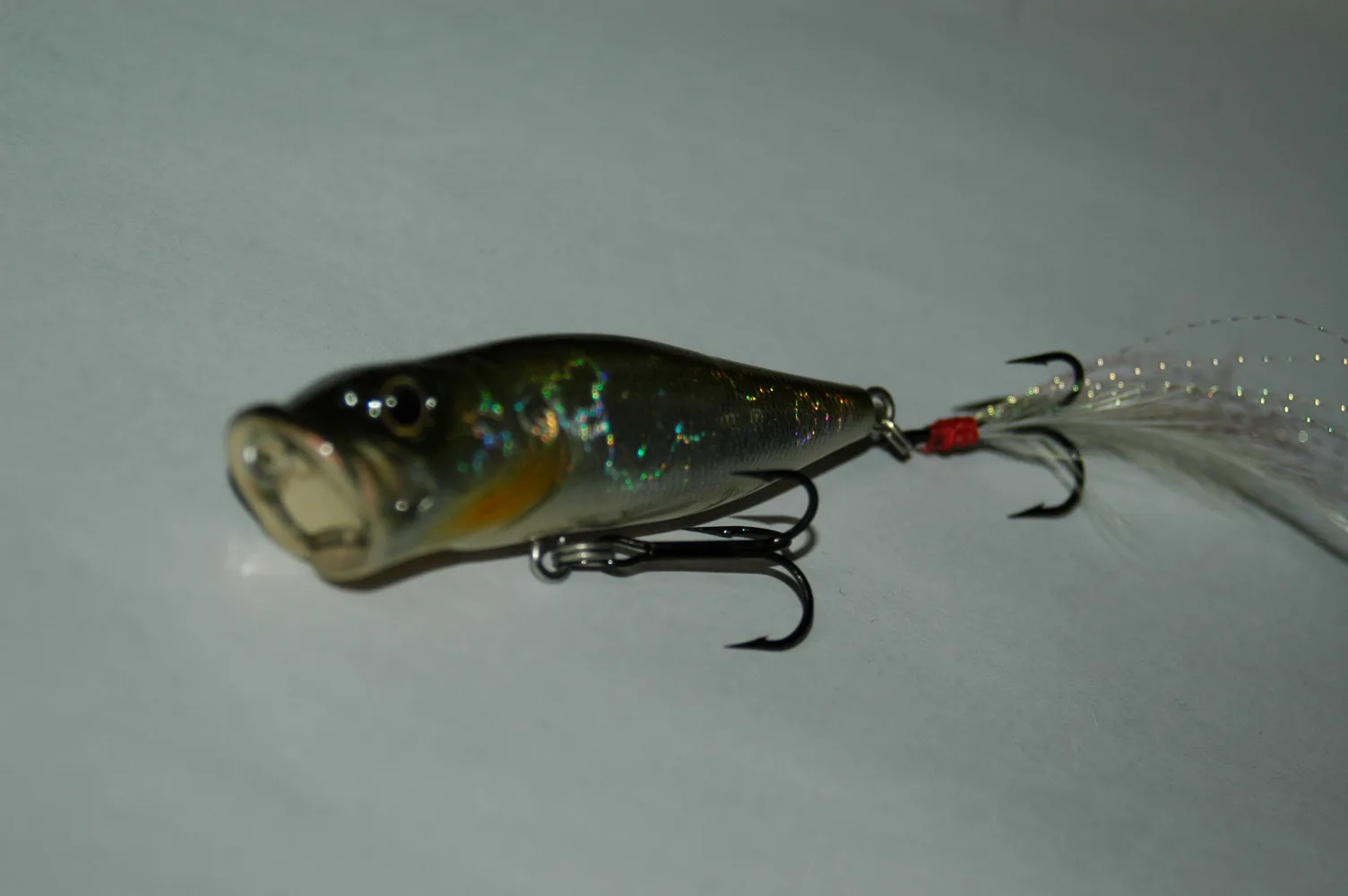
Topwater Lures: Types, When to Throw Them and How Each WorksTopwater lures in five families: walking baits, poppers, prop baits, frogs and buzzbaits, with the 65–85 °F water and low light that make each one work.
 Jitterbug Lure: How to Fish the Arbogast Jitterbug, Day and Night
The Arbogast Jitterbug lure comes in four sizes, 2 to 4 1/2 in. Reel it slow and steady, throw black at night, set only when you feel the fish.
 Whopper Plopper Lure: Sizes, How to Fish It, and Where It Began
Whopper Plopper lure: all six sizes with the maker's weights and hooks, rod and line by size, the retrieves, colors by light and water, and the hookset.
Sources
- Tackle Warehouse, hollow-body frog patterns and techniques
- Wired2Fish, best practices for frog fishing with Ish Monroe
- Wired2Fish, best frog lures
- Bassmaster, Michael Iaconelli: why anglers need three different hollow-body frogs
- SPRO, Bronzeye Frog 65
- Lurenet, Booyah Pad Crasher
- Shimano Fish Shop, Jackall Kaera
- Omnia Fishing, Jackall Kaera Frog
- Strike King, KVD Sexy Frog
- Omnia Fishing, Strike King KVD Sexy Frog
- Bassmaster, Z-Man talks frog (Leap FrogZ)
- Major League Fishing, product review: Teckel Sprinker Frog
- ODU Magazine, Snag Proof Lures and the first hollow-bodied frog
- Bassmaster, A man and his frog (Dean Rojas and the Bronzeye)
- Bassmaster, Best of 2025 Elite Series top lures
- Mississippi Sportsman (Michael O. Giles, 2013), Don't pull the trigger too quickly for frog-fishing strikes