 By
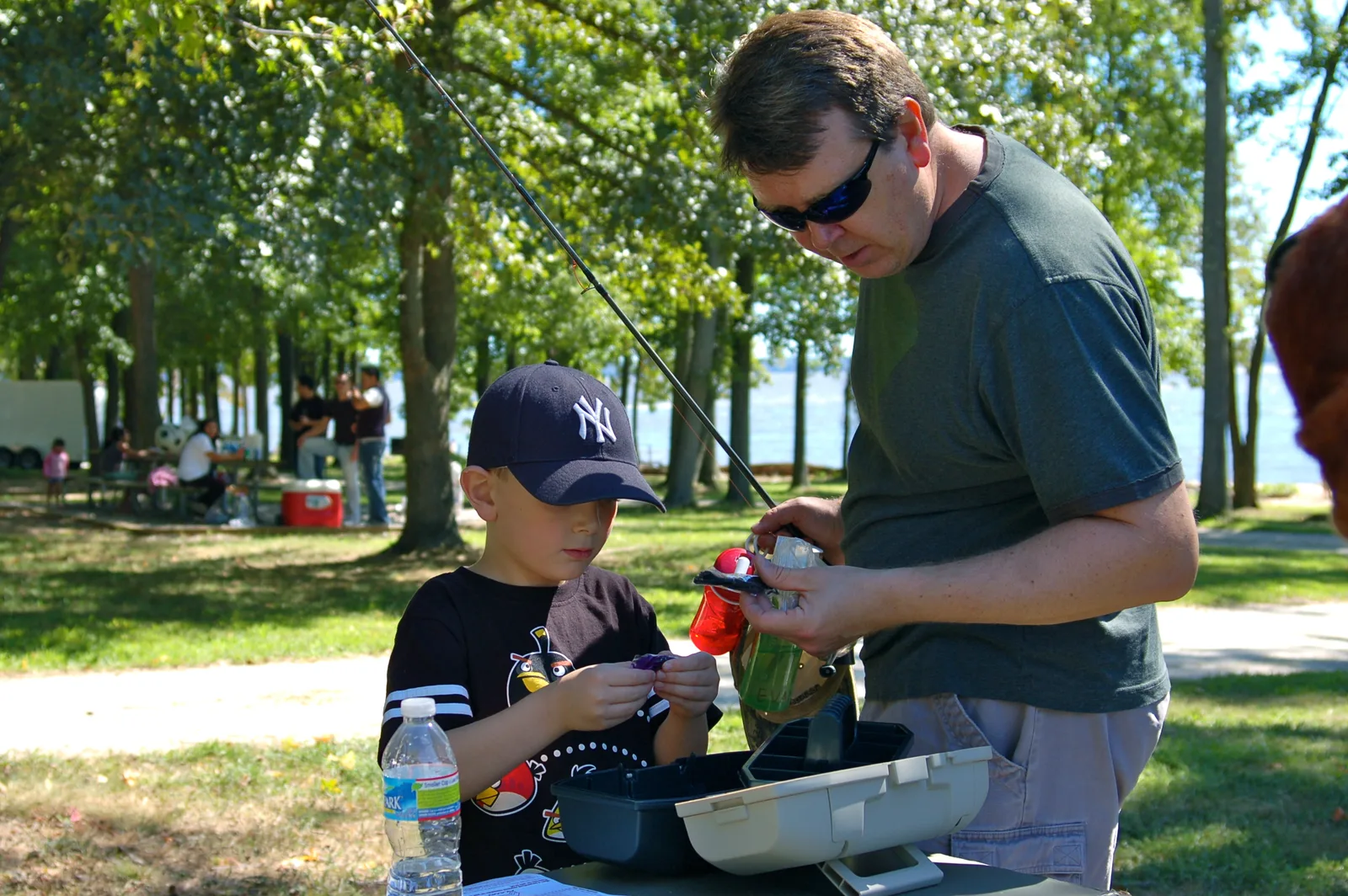
Fishing tackle is everything you fish with: the rod, reel and line, the lures, and the terminal tackle at the end of the line, meaning the hooks, sinkers, swivels, snaps, floats and leaders. A first box for a pond holds very little. Kentucky’s wildlife agency starts beginners on size 6 hooks, removable split shot and 1¼ in bobbers. After that the fish decide, from 4/0 worm hooks for bass to a 3 oz pyramid sinker in the surf.
“You can catch a big fish with a small hook, but you can’t catch a little fish with a big hook.” That is Marc Johnson, Kentucky Fish and Wildlife’s aquatic education coordinator, on what beginners get wrong across the board.
Start here
- Tackle boxes: trays, hard boxes, bags and waterproof boxes for the bank, boat or kayak, and what 3600 and 3700 mean.
- Plano tackle boxes: every Plano series, size and model number, from a $3.99 tray to the 40-bait Big Game.
- Fishing bobbers: a float holds the bait at one depth and shows the bite; below about 4 ft, a slip bobber does the job.
- Hook size chart: how the size numbers run, and which hook fits which fish.
- Fishing for beginners: from the license to the first fish.
What counts as fishing tackle?
Tackle is “the equipment used by anglers when fishing.” Outdoor Life’s Joe Cermele puts the minimum at four things: “A hook, line, rod, and reel.” Everything else improves on those four, and each part has its own guide:
- Rods (fishing rods): power, action and length decide which lures a rod can throw.
- Reels (fishing reels): spinning, baitcasting or spincast, sized to the rod.
- Line (fishing line): monofilament, fluorocarbon or braid, and when to add a leader.
- Hooks (fishing hooks): sizes, styles and the circle-hook rules.
- Lures (fishing lures): the six families, from spoons to swimbaits.
- Terminal tackle: the hooks, sinkers, swivels, snaps, floats and leaders at the end of the line.
- Tools (fishing accessories): pliers, cutters, a scale, a landing net and a stringer.
- Storage (tackle boxes): the trays and boxes that carry the rest.
Is fishing tackle the same as bait? No. Bait is what the fish eats, alive or prepared; Pennsylvania’s Fish and Boat Commission names “red worms, nightcrawlers, maggots, mealworms and grasshoppers.” A lure is an artificial bait, and lures count as tackle. A “bait and tackle” shop sells both. The gear hub says which number matters most on each piece of the outfit.
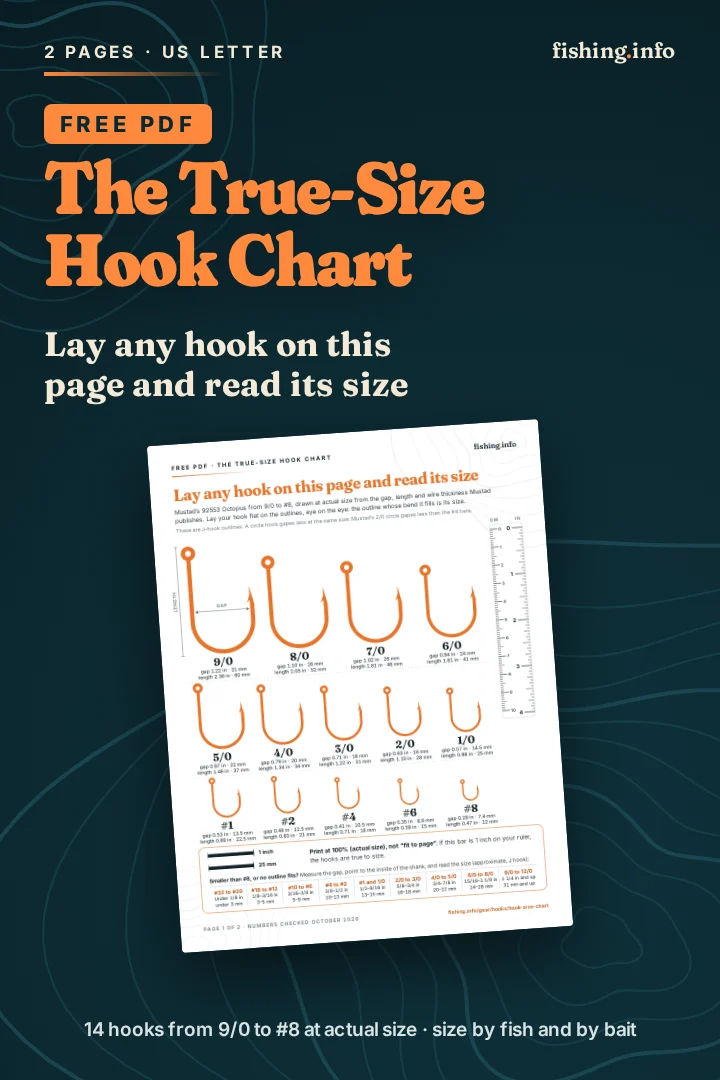
Free PDF · Hook size chart What size is that hook? Lay it on the chart.
Print the free chart, lay any hook on it and read its size: 14 hooks from 9/0 to #8 at actual size, a gap ladder from #32 to 12/0, and the size for 17 fish and 16 baits on the back.
No card, nothing to buy, and the PDF is yours to keep. Confirm with one click and it's on its way. Then a few short emails and one a week on what's biting. Unsubscribe anytime. Privacy.
What is terminal tackle?
Terminal tackle is “the gear at the end of your line that gets cast out with your bait,” in Outdoor Life’s definition. Wired2Fish’s Shaye Baker sorts it three ways: the common pieces (hooks, weights and jigheads), the components that join them (swivels, snaps, split rings, beads and blades), and add-ons such as rattles, pegs and bobber stops. A rig is one arrangement of them, such as a Carolina rig. The glossary defines each piece under hooks and terminal tackle.
| Piece | What it does | Where it earns its place |
|---|---|---|
| Hook | Holds the bait and the fish | Every rig; size it to the fish’s mouth |
| Sinker (weight) | Takes the bait down and holds it there | Bottom rigs, Texas and Carolina rigs, under a float |
| Jighead | A hook with the weight molded on | Soft plastics, crappie jigs |
| Float (bobber) | Holds the bait at one depth and shows the bite | Panfish, crappie, walleye |
| Barrel swivel | Stops line twist; joins line to leader | Bait spinning in current, lures that twist line |
| Three-way swivel | Three eyes: main line, weight and hook | Bait rigs; two make a high-low rig |
| Snap, snap swivel | Lets you change lures without retying | Inline spinners, spoons, sinkers on a slide |
| Bead | Shields the knot from a sliding sinker | Carolina, fish finder and slip-sinker rigs |
| Leader | A length of tougher or less visible line | Clear water, rock, teeth |
| Bobber stop, peg | Sets a slip float’s depth; pins a bullet weight | Slip-bobber rigs, Texas rigs |
Hooks are the piece most beginners buy wrong. Below size 1 the number falls as the hook grows, so a 6 is bigger than a 10; above it, 1/0, 2/0 and up get bigger with the number. Buy for the fish’s mouth, not for the fish you hope to catch, which is Johnson’s point above. The hook size chart runs the whole scale, and types of fishing hooks explains the bait-holder, Aberdeen, circle, octopus and worm hooks you will find on the rack.
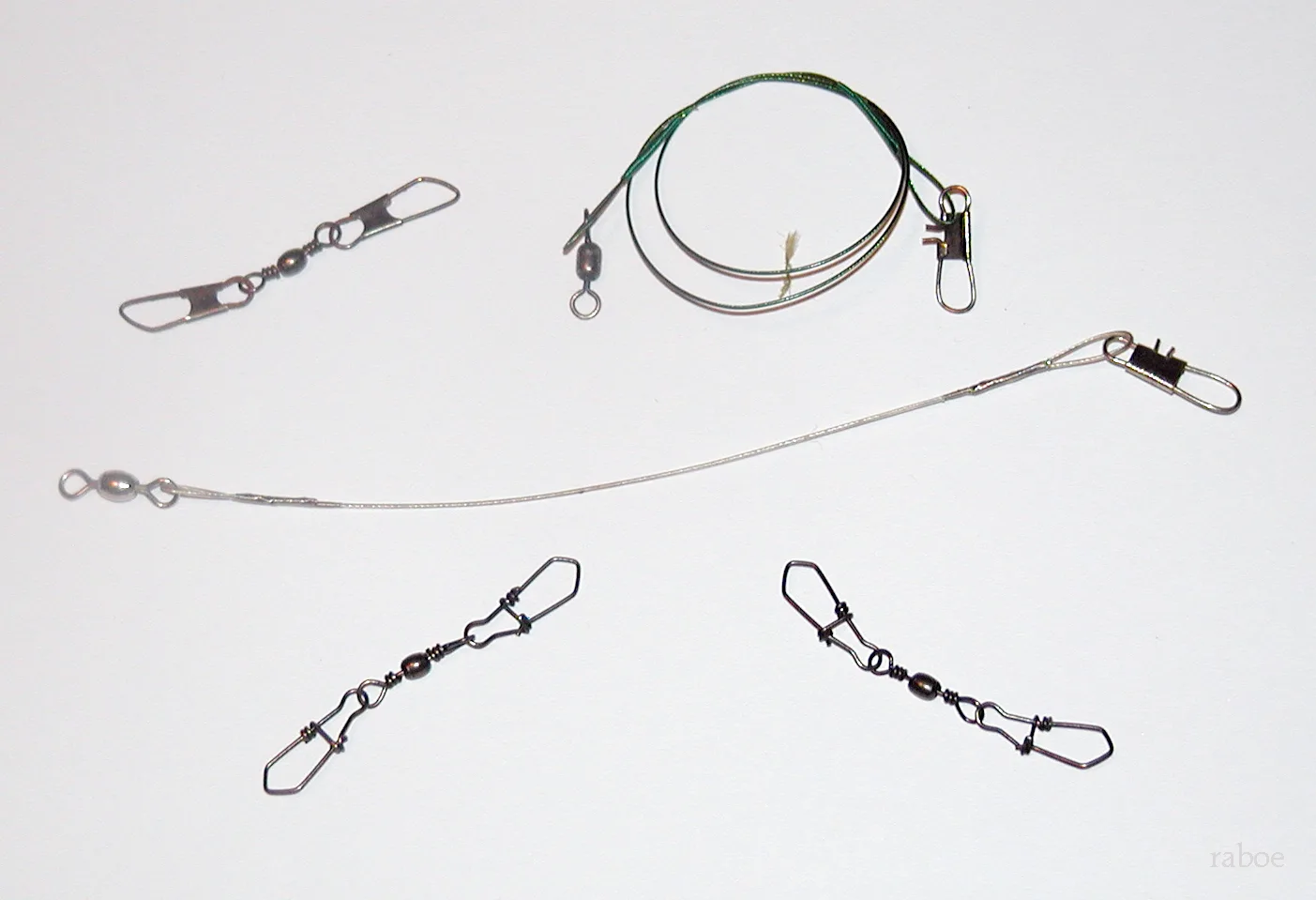
Wire leaders, barrel swivels and snap swivels: the joints between line and lure. Photo: Raboe001, Wikimedia Commons (CC BY-SA 2.5).
Which sinker for which job?
A sinker’s shape decides what it does once it lands. Wired2Fish’s Jason Sealock counts three kinds: slip sinkers the line runs through, weights tied to the end of the line, and add-ons that clip or pinch on, like split shot. Within those, match the shape to the bottom and the rig; the fishing weights guide gives every shape’s sizes and a split shot size chart.
| Sinker | Kind | How it fishes | Use it for |
|---|---|---|---|
| Split shot | Pinch-on | A little weight, easy to add or remove | Worms in ponds and creeks; balancing a float |
| Bullet (worm weight) | Slip | Cone-shaped, slides through cover | Texas rig |
| Egg | Slip | A fish runs without feeling it; round, so it slips past rock | Bait rigs over rock, Carolina rigs |
| Cylinder (barrel) | Slip | More bottom contact | Carolina rig |
| Bank | Tie-on | Teardrop, casts far, moves a little in moderate current | Silt, mud and sand |
| Pyramid | Tie-on | Digs in and holds; wedges in rock | Sand and mud, the surf |
| Flat (no-roll) | Slip or tie-on | Lies flat, stays put in current | Catfish and carp on hard, rocky bottom |
| Bell (drop-shot) | Tie-on | Sits on bottom below the hook | Drop-shot rig |
| Sputnik | Tie-on | Steel arms anchor, then release and swing back on the retrieve | Heavy surf |
Outdoor Life says split shot is usually reserved for “shallow water, small moving waters, and ponds”, and calls the pyramid “a poor choice for rocky bottoms.” The bullet weight belongs on the Texas rig because, in Baker’s words, the whole rig “can be dragged along the bottom without the weight catching on cover.” The egg sinker lets a fish “swim away with it without immediately feeling resistance.”
How heavy? It depends on the water. For catfish, Wired2Fish’s Steve Quinn gives weights “from 1/2 to 10 ounces,” and up to about an ounce in small creeks. Surf sinkers run “from as little as 2 ounces to as much as 8,” Florida Sportsman writes, and four-sided pyramids “hold sandy bottom better than the 3-sided variety.”
Lead, tungsten or tin? Lead is the cheap, soft standard. Tungsten is denser, so a tungsten weight is smaller for the same weight and does not chip or deform, Sealock says, but it costs more. Cermele adds that you “cannot find many of the most-used sinkers cast in tungsten,” while tin is cheaper than tungsten but “much lighter than lead”: expect to need more or bigger tin split shot. Five states restrict small lead sinkers by weight, from ½ oz in New York and Vermont to 1 oz in New Hampshire, Maine and Massachusetts, and Washington bans small ones on 12 lakes.
Do you need swivels, snaps and leaders?
Add each one for a reason. A barrel swivel’s “main function is reducing line twist,” Cermele writes, so put one above cut bait that spins in current or a lure with an erratic action. It also makes two strong tie-in points between main line and leader. A three-way swivel carries the main line, a weight and a hook line; two of them spaced apart make a high-low rig with baits at two depths. Size numbers differ by maker, so buy a fishing swivel by the pound test on the pack.
Snaps let you change lures without retying. A small snap swivel suits lures “like in-line spinners that tend to twist your main line.” Beads go between a sliding sinker and the swivel, where “knot protection is their primary purpose.”
A leader is a length of different line between the main line and the hook, usually tied to the swivel. It hides the line in clear water, stands up to rock and shell, or survives teeth. In the surf, Tackle Village ties 12–18 in (30–46 cm) of 40 lb mono for most fish and calls steel leaders “required” for bluefish and shark. The fishing line guide covers when braid needs one.
Which bobber, and what size?
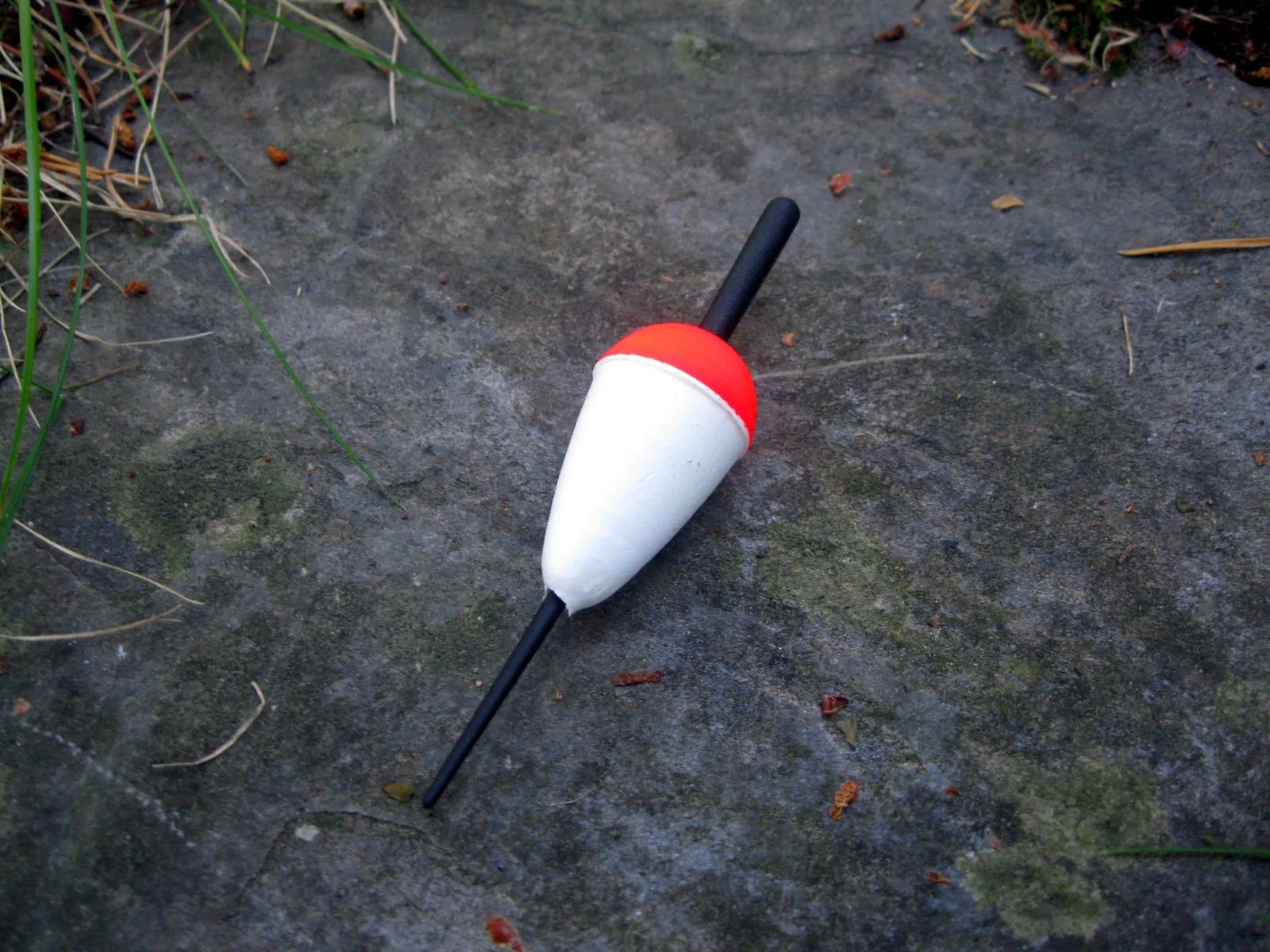
A float holds the bait at a depth and shows the bite. Outdoor Life names four shapes: round, the classic red-and-white clip-on for still water; pencil, for light bites; oval, for current; and slip, for depth. For bluegill, Outdoor Illinois tells beginners to start with a ¾ to 1 in bobber, a size 8 to 10 hook and 4–6 lb line. Kentucky’s urban-lake box takes 1¼ in bobbers and size 6 hooks.
Past about 4 ft (1.2 m) deep, a fixed bobber is hard to cast, and a slip bobber takes over. It slides on the line until it meets a bobber stop, so the stop, not the cast, sets the depth. Use the smallest float that holds up your bait and shot: a bobber “that is too big will mask the strike of a bluegill,” Outdoor Illinois warns.
How do the pieces go together?
Six common rigs show how the same few parts combine. The table lists each from the rod end down.
| Rig | For | Parts, rod end first |
|---|---|---|
| Bobber rig | Panfish from the bank | Bobber, small split shot, size 6 hook, redworm, about 3 ft below the bobber |
| Texas rig | Bass in grass and wood | Bullet weight, an optional peg or bobber stop, worm hook, soft plastic |
| Carolina rig | Bass on open bottom | ½–¾ oz (14–21 g) egg sinker, bead, swivel, 18–36 in (46–91 cm) leader, 3/0–5/0 worm hook |
| Drop-shot rig | Bass in deep, clear water | Hook tied 12–18 in (30–46 cm) above a drop-shot weight on the end of the line |
| Slip-sinker rig | Catfish, anchored | Egg or no-roll sinker, bead, swivel, 12–36 in (30–91 cm) leader, circle hook |
| Fish finder rig | The surf | Sinker slide with a pyramid, bead, barrel swivel, 12–18 in (30–46 cm) of 40 lb mono, 5/0 circle hook |
The sliding rigs share one idea: the line runs through the sinker, so a fish moves off with the bait without feeling the weight. In those, the bead is there to protect the knot. Pick the rig for the fish and the bottom, then buy its parts.
What goes in a first tackle box?
Pliers and clippers go in every box. Kentucky’s list has both, “to remove hooks and clip excess line,” and South Dakota’s trip planner adds a tape measure, a stringer and a fish ID book. The rest depends on the fish.
| Fishing | Hooks | Weights and floats | Lures | Also pack |
|---|---|---|---|---|
| Panfish, pond or urban lake | Size 6; size 8 on a pressured pond full of small fish | Removable split shot; 1¼ in (3.2 cm) bobbers | Size 1 feather jigs; small white inline spinners | Redworms or wax worms |
| Bass | 4/0 EWG worm hooks; small jigheads | Small bullet sinkers, beads, bobber stops | Hard baits by type; soft plastics in their bags | A binder or soft bag |
| Catfish | 1/0–12/0; circle hooks for a rod holder | ½–10 oz (14–283 g) bank or no-roll sinkers; barrel swivels | Seldom: cut and stink bait outdraw them | Gauze or netting for livers |
| Surf, fish of 20–40 in (51–102 cm) | 5/0 circle | 3 oz (85 g) pyramid; 2–8 oz (57–227 g) as the surf demands | Seldom on a bait rig | Sinker slides, beads, barrel swivels, 40 lb leader |
For the panfish row, Kentucky’s simplest rig is a redworm on a size 6 hook under a bobber with a small split shot, set “three feet under the bobber” to start. Pennsylvania’s commission calls 6-lb test “a good all around size” for a first line. Kentucky’s pick for the box itself is a one-tray box “fitted with a latch, rather than the snap-on variety.” Stocked from that row, it makes a child’s first box; for an adult, see gifts for fishermen.
What tackle do you need for bass? The bass row is a start: worm hooks and bullet weights for soft plastics, and a tray each for topwaters, crankbaits and jerkbaits. Bassmaster’s Bernie Schultz splits hard baits from soft ones before anything else. The bass fishing hub and the fishing lures guide take it from there; the catfish rigs page builds the catfish row into rigs.
The surf row is the fish finder rig: Tackle Village’s sizes for “your standard-sized 20-40 inch inshore fish,” stepping up to a 6 oz pyramid and an 8/0 or 9/0 hook for fish over 40 in.
What is the one thing every angler needs? A license. Pennsylvania’s gear checklist puts it first, ahead of the rod: a “Fishing License or a fishing buddy with one,” needed from age 16 there, as in Kentucky. The same checklist calls a spincast outfit “great for beginners” and asks you to check the line on the reel “for twists, nicks or knots” before you go.
Freshwater or saltwater tackle: what changes?
Salt changes four things.
- Corrosion. Salt rusts hooks fast. SKB’s rule is never to put “a wet or salty lure” straight back in your main box; rinse it in fresh water and dry it first. A saltwater spinning reel adds seals, but still gets a rinse.
- Weight. Surf sinkers run 2–8 oz, against split shot for a pond. That takes a rod rated to throw them: Florida Sportsman’s 4–6 oz sinkers go on surf rods of 11 to 13 ft. The fishing rods guide sizes a first surf rod.
- Teeth. Bluefish and sharks bite through mono, so a steel leader goes on.
- Hook rules. With bait, Atlantic striped bass anglers must use circle hooks, the rule in every Atlantic state from Maine to North Carolina since January 1, 2021. In federal Gulf waters, “non-stainless steel circle hooks are required when fishing with natural baits” for reef fish.
The New England lead bans are freshwater rules. New Hampshire’s covers all fresh water, and the use bans in Maine and Massachusetts cover inland waters, though Maine’s sale ban is statewide.
How should you store and organize tackle?
Bassmaster’s Bernie Schultz splits hard baits from soft ones first, then sorts the hard baits by type into utility boxes. Keep soft plastics in their original bags: materials like ElaZtech “can warp and compromise thinly made plastic tackle boxes.” In a boat, Wired2Fish stacks 3600 and 3700 utility trays and loads only the boxes for that season or species.
Terminal tackle wants small compartments that hold. Wired2Fish keeps “small bullet sinkers, hooks, beads, bobber stops, split shot, split rings, small jigheads” in a thin pocket box, and hooks and jigheads in foam-insert boxes. Baker would store metal parts “like hooks, blades and swivels in waterproof boxes”, but a sealed box also holds in the water that comes back on wet hooks. The tackle box guide compares Plano, Flambeau, KastKing and other boxes, with the tray sizes that fit each bag.
How do you keep tackle from rusting?
Waterproof boxes keep water out, but “they also do a great job of keeping water in, resulting in rusty hooks,” GearJunkie found. Rinse used tackle in fresh water and dry it on a towel in a well-ventilated spot before it goes back. Rust-inhibiting boxes such as Flambeau’s Zerust line release a vapor that coats exposed metal. They “do not work perfectly,” GearJunkie says, but they prevent “a full-on rust takeover.”
Who makes fishing tackle?
Two companies own a long list of the brands in a US tackle aisle. Pure Fishing’s brands include PENN, Abu Garcia, Berkley, Ugly Stik, Fenwick, Pflueger, Shakespeare, SpiderWire, Frabill, Van Staal and Plano. PRADCO Outdoor Brands sells Heddon, Rebel, Bomber, Cotton Cordell, Bandit, Lindy, YUM, BOOYAH, War Eagle and Thill floats. So a Berkley soft plastic, an Ugly Stik rod and a Plano box can share one parent company.
Which brand is best for lures? No public sales ranking exists. The best fishing lures ranks ten lures by what each one does, whoever makes it.
What does fishing tackle cost?
Less than the aisle suggests. “In those beginning stages, you don’t need a lot of stuff,” Johnson says. These are list prices on the makers’ sites in October 2026:
| Item | Price |
|---|---|
| Plano One-Tray box, empty | $19.99 |
| Plano Catch All Two-Tray kit (grubs, jig heads, hooks, split shot, bobbers) | $29.99 |
| Plano Three-Tray kit for bass, panfish or catfish | $39.99 |
| Plano StowAway 3700 utility tray | $9.99 |
| Thill Pro Series slip float | $2.99 |
Most tackle boxes cost $30–70 by GearJunkie’s bands; racks and backpacks run more. Sinkers swing with the material. Florida Sportsman’s 2019 price for a Sputnik surf sinker was “5 to 6 bucks,” “significantly pricier” than a pyramid, and tungsten is “very expensive,” Cermele writes. Below about $120, a rod and reel combo is the better buy than a rod and a reel bought apart.
You can also start for nothing. Pennsylvania runs a Fishing Tackle Loaner Program, with locations where you can borrow “a rod, reel or other fishing equipment,” and a borrowed outfit shows what you would use before you buy your own. A stocked kit is worth it when its contents match one row of the first-box table; Plano’s bass kit, for one, holds 86 bait-holder hooks, 36 soft-plastic bodies, jigs and split shot.
Where should you buy fishing tackle?
Online for convenience and sales, a local shop to handle gear first and find local favorites. Wired2Fish’s editors like online sales, but call themselves “a huge advocate of going to your local tackle shop,” partly because “a lot of fishing tackle is only available in certain regional locales.” Their 2023 list of the best stores names Tackle Warehouse as the best online store for bass gear, and Bass Pro Shops, Academy Sports and Scheels among the big-box chains. It adds FishUSA for ice fishing gear, Omnia Fishing for personalized picks and Barlow’s Tackle for do-it-yourself supplies. Kentucky’s release tells beginners to ask the clerk at the local bait shop when they cannot find an item.
Pennsylvania’s commission notes that many sporting goods stores sell tackle boxes already stocked with hooks, sinkers and bobbers. A discount store may carry the basics; call before you drive there.
Where is lead tackle banned?
Lead rules cover small sinkers and jigs, by weight or length. Check your state’s rules before you fish.
| State (rule) | What is banned | Size covered | Where |
|---|---|---|---|
| New Hampshire (RSA 211:13-b use; 339:77 sale) | Using and selling lead sinkers and jigs | 1 oz (28 g) or less | All fresh water |
| Maine (12 MRS §12663-B sale; §12664 use) | Selling lead sinkers and jigs; using them inland | 1 oz (28 g) or less, or 2.5 in (6.4 cm) or less | Sale statewide, use on inland waters |
| Massachusetts (321 CMR 4.01) | Using lead sinkers, weights and jigs | Under 1 oz (28 g) | Inland waters |
| New York (ECL 11-0308) | Retail sale of lead sinkers, not jig heads or lures | ½ oz (14 g) or less | Statewide |
| Vermont (10 V.S.A. §4606, §4615) | Selling and using lead sinkers, not jig heads or lures | ½ oz (14 g) or less | Statewide |
| Washington (WDFW) | Using lead weights and jigs | 1.5 in (3.8 cm) or less on the longest axis | 12 named lakes |
Since Sept. 1, 2026, Maine’s use ban covers painted lead jigs too. Yellowstone National Park requires lead-free terminal tackle and allows sinkers and jig heads of bismuth-tin, molybdenum or tungsten.
Can you make your own tackle?
Making your own sinkers and jig heads means pouring them: melt lead in a pot, pour it into a mold around the hook, then trim the excess. The EPA strongly advises against doing it at home, because melted lead releases particles that spread through a house. If you pour anyway, it says to work in a ventilated shop detached from the house and wear a respirator. Homemade sinkers and jigs fall under the same use bans as bought ones; New Hampshire’s ban covers lead jigs “regardless of whether they are painted, coated, or covered.”
Can you take tackle on a plane?
Yes. TSA allows small fishing lures in carry-on and checked bags, but wants large hooks “sheathed, securely wrapped, and packed in your checked luggage.” The officer at the checkpoint has the final word.
Which lure catches every fish, and which one was banned?
No lure catches everything. Kentucky’s starter list puts two lures in a first box: size 1 feather jigs and small inline spinners such as the Rooster Tail, with white “a good, all-around color.”
The lure banned from the top bass tournaments was the Alabama rig, “a weighted head with five wire leaders trailing behind,” each carrying a swimbait. From Feb. 1, 2012, B.A.S.S. limited its Bassmaster Classic and Elite Series anglers “to the use of a single lure during practice and competition.”
All articles
 Fishing Bobbers: Which Float to Buy, and How to Set a Slip Bobber's Depth
Which fishing bobber to buy: round, spring, pencil or slip, the size for bluegill and crappie, five picks from $2.74, and how to set a slip bobber's depth.
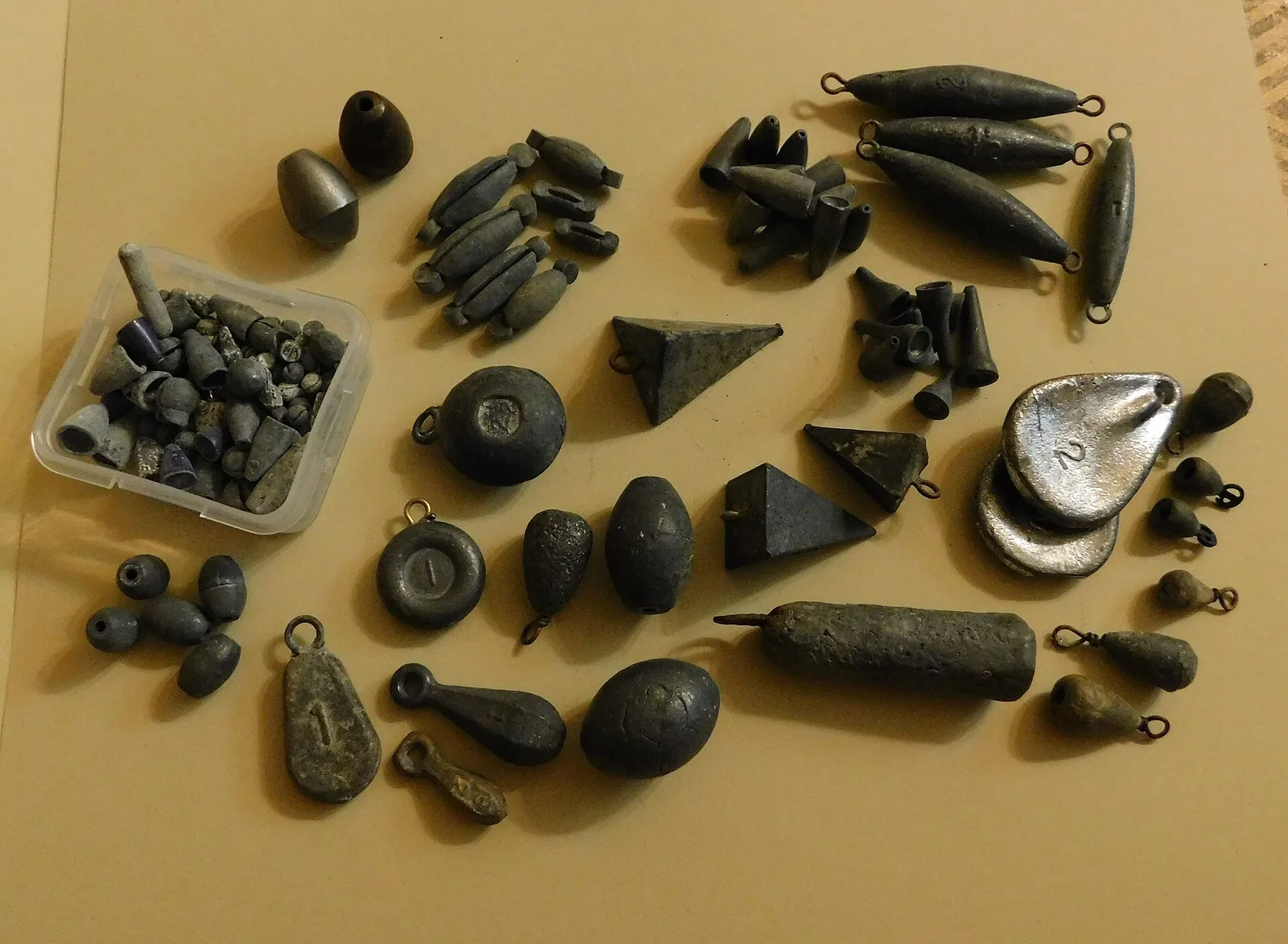 Fishing Weights: Every Sinker Type, the Sizes, and the Lead Laws
Fishing weights: 10 sinker types and their jobs, a split shot size chart in ounces, how heavy to go, tungsten vs lead, and where lead is banned.
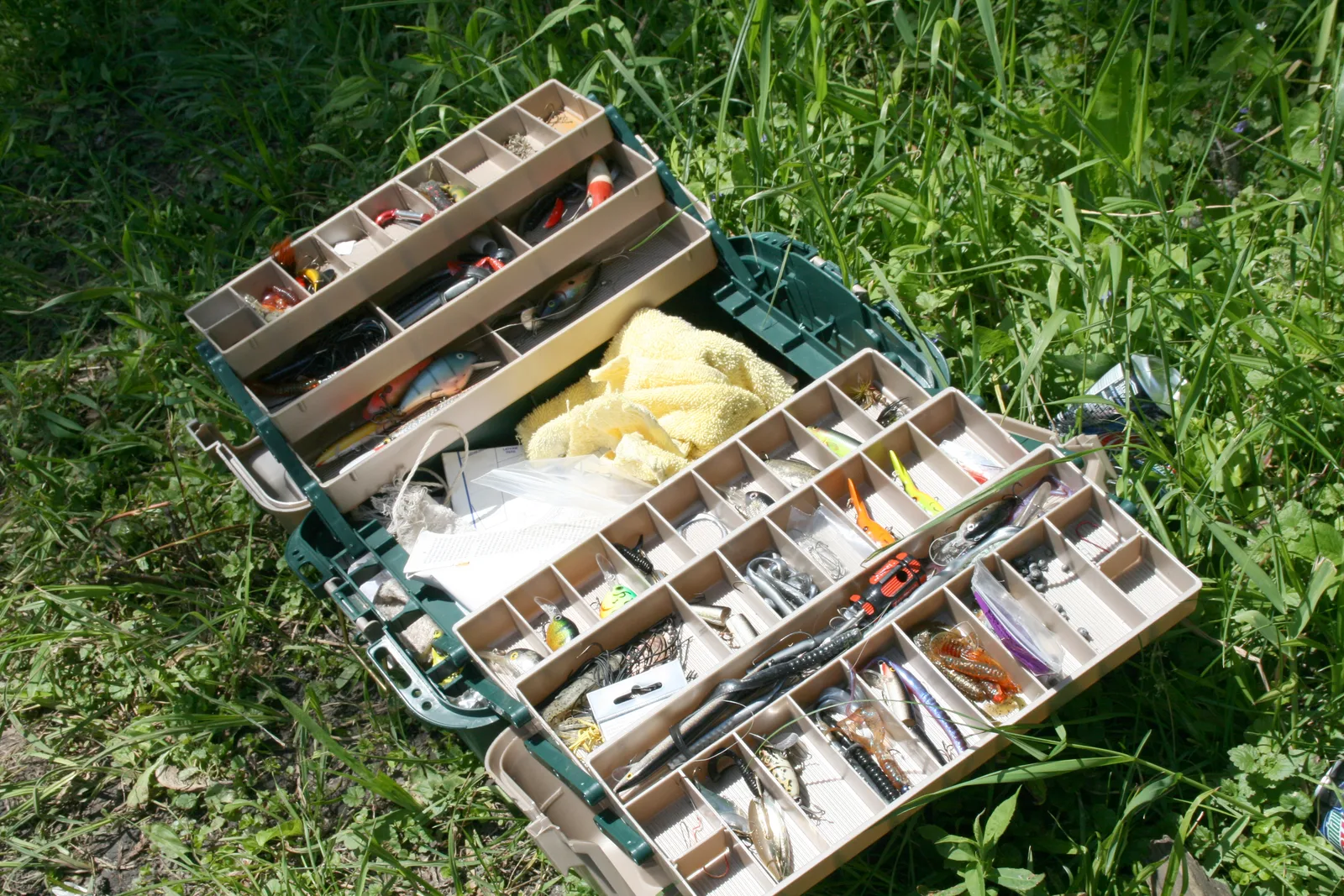 Plano Tackle Box: Every Series, Size and Model Number Decoded
Every Plano tackle box series and size: StowAway, ProLatch and EDGE trays, racks, bags and kits, with Plano's own prices and what each model number means.
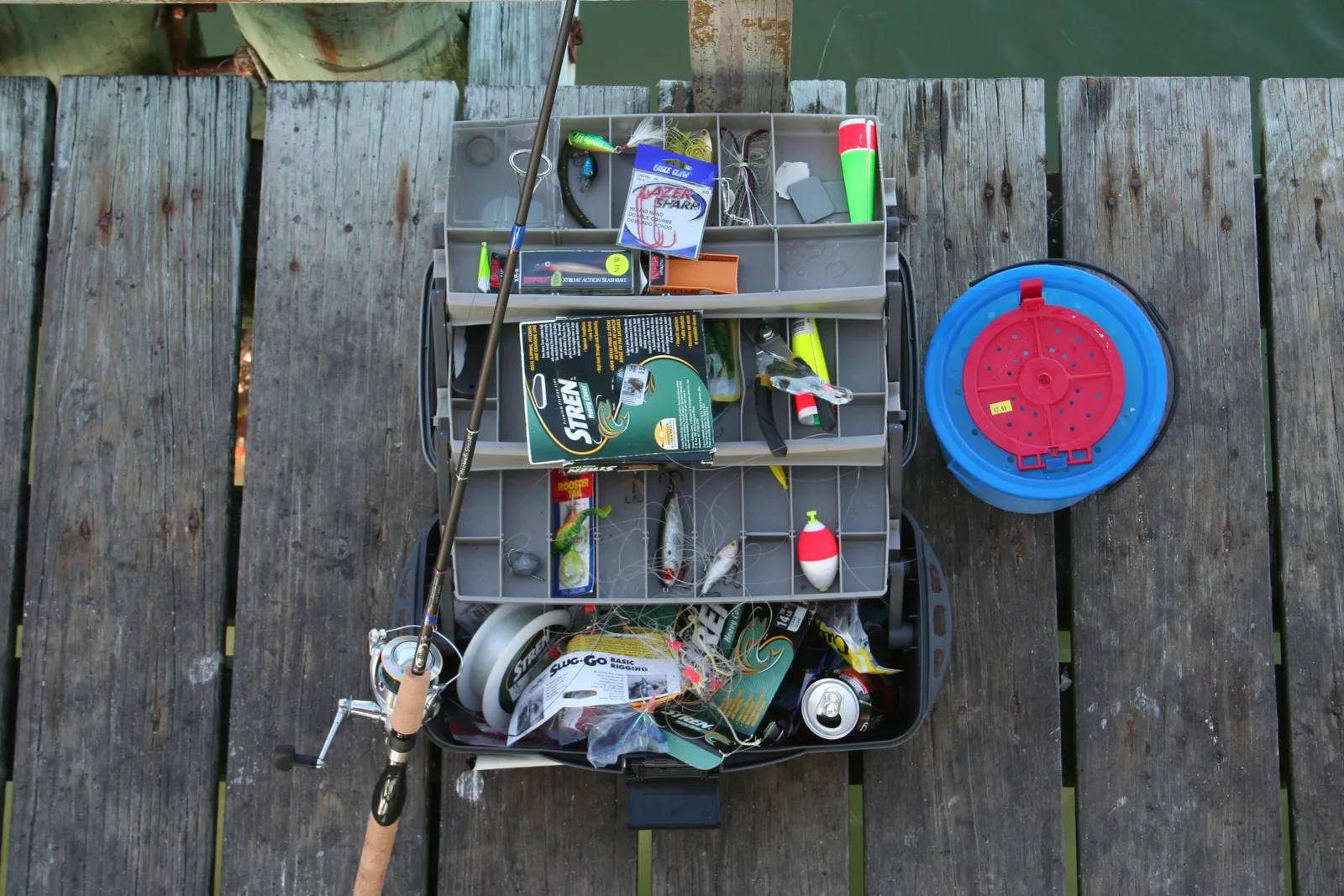 Tackle Box: The Best Boxes, Trays and Bags, and What 3700 Means
The best tackle box for bank, boat, kayak, kid or musky: eight picks with owner-complaint counts, and the 3600 and 3700 tray sizes explained.

Free PDF · 2 pages
Stop guessing hook sizes. Lay any hook on this page and read it
A jar of loose hooks and no packet in sight. Guess wrong and you find out with a fish on.
The True-Size Hook Chart. Print it at actual size, lay a hook on the outlines, and the one its bend fills is its size. One sheet, front and back, for the tackle box.
- 14 hooks from 9/0 to #8 at true size, plus a ladder from #32 to 12/0
- The size for 17 fish and 16 baits, from bluegill to tuna
- A 2/0 circle that gapes less than a #4: why a 2/0 is not always a 2/0
Every outline drawn from Mustad's published dimensions; every size from the 25 sources on the page, Maryland DNR and Idaho Fish and Game among them.
No card, nothing to buy. Confirm with one click and the PDF is on its way, one version for your phone and one to print, yours to keep. Then a few short emails and one a week on what's biting, with an unsubscribe link in every one. Privacy.
Sources (43)
- Game & Fish (Kentucky Department of Fish and Wildlife Resources news), Stocking your first fishing tackle box (the starter list)
- Pennsylvania Fish and Boat Commission, Fishing gear and equipment (stocked boxes, 6-lb test, live bait)
- South Dakota Game, Fish and Parks, Fish SD trip planner (the trip checklist)
- Outdoor Illinois Journal (Steven Beltran), Bluegill fishing in Illinois: the perfect fish to introduce youngsters to angling, May 2025
- Lurenet blog (Jeff Samsel), When and how to fish with a slip bobber (fixed floats past about 4 ft), March 2025
Show all 43 sourcesShow fewer sources
- Wikipedia, Fishing tackle (definitions of tackle, terminal tackle and rig)
- Outdoor Life (Joe Cermele), Terminal tackle: what you need to know for better rigs (swivels, clips, bobbers, sinker shapes and materials, beads)
- Wired2Fish (Shaye Baker), All about terminal tackle, April 2024
- Wired2Fish (Jason Sealock), Best fishing weights and sinker types, July 2023
- Florida Sportsman, Choosing the right sinker (surf sinker weights, pyramids and Sputniks), November 2019
- Tackle Village (Rick Wallace), Fish finder rig (sinker, hook and leader sizes for surf fish)
- Wired2Fish (Steve Quinn), How to catch a catfish (hooks, weights, floats, livers)
- Wired2Fish (Shaye Baker), Why the 4/0 EWG just might be the best bass hook of all time
- ASMFC, Atlantic Striped Bass Board approves Addendum VI (circle hooks with bait by January 1, 2021)
- 50 CFR 622.30, Required fishing gear (Gulf reef fish: non-stainless steel circle hooks with natural baits)
- Bassmaster (Bernie Schultz), Tips for organizing your tackle (hard and soft baits)
- Wired2Fish (Jason Sealock), Best tackle boxes for fishing (utility trays, soft plastics, pocket box)
- GearJunkie (Morgan Nowels), The best tackle boxes for fishing (waterproof boxes, rust systems, price bands)
- SKB Cases, Making fishing lures last a lifetime (rinsing and drying tackle)
- Hunting Life, Flambeau Zerust (how the rust-inhibiting vapor works)
- Pure Fishing, Fishing gear brands (the brands it owns)
- PRADCO Outdoor Brands, Lurenet brands (the brands it sells)
- Plano, One-Tray Tackle Box (price, made in USA)
- Plano, Catch All Two-Tray Tackle Box Kit (contents, price)
- Plano, Three-Tray Tackle Box Bass Kit (contents, price)
- Plano, StowAway 3700 (price)
- Lurenet, Thill Pro Series Slip Floats (sizes, price)
- Wired2Fish (Editors), Best fishing tackle stores, February 2023
- Bassmaster, B.A.S.S. imposes One-Lure Rule (January 19, 2012)
- New Hampshire RSA 211:13-b, Use of lead sinkers and jigs prohibited
- Maine 12 MRS §12663-B (sale of lead sinkers and jigs)
- Maine Inland Fisheries and Wildlife, Maine's lead jig and sinker laws (card, updated 2025-10-01)
- Maine 12 MRS §12664 (lead sinker and jig use ban; painted jigs covered from Sept. 1, 2026)
- Massachusetts 321 CMR 4.01 (lead sinkers and jigs, inland waters)
- New York ECL 11-0308 (retail sale of lead sinkers)
- Vermont 10 V.S.A. 4615 (sale of lead sinkers)
- Vermont 10 V.S.A. 4606 (use of lead sinkers prohibited)
- Connecticut OLR, Lead sinker laws in select states, 2020-R-0162 (sale and use rules compared, incl. NH RSA 339:77)
- Washington Department of Fish and Wildlife, Common loon (lead rules on 12 lakes)
- National Park Service, Yellowstone fishing regulations (lead-free terminal tackle)
- U.S. EPA, Humans and lead fishing sinkers (making sinkers and jigs at home)
- Wired2Fish (Jason Sealock), How to pour your own lead fishing jigs
- TSA, Small fishing lures (What can I bring)